New Semester
Started
Get
50% OFF
Study Help!
--h --m --s
Claim Now
Question Answers
Textbooks
Find textbooks, questions and answers
Oops, something went wrong!
Change your search query and then try again
S
Books
FREE
Study Help
Expert Questions
Accounting
General Management
Mathematics
Finance
Organizational Behaviour
Law
Physics
Operating System
Management Leadership
Sociology
Programming
Marketing
Database
Computer Network
Economics
Textbooks Solutions
Accounting
Managerial Accounting
Management Leadership
Cost Accounting
Statistics
Business Law
Corporate Finance
Finance
Economics
Auditing
Tutors
Online Tutors
Find a Tutor
Hire a Tutor
Become a Tutor
AI Tutor
AI Study Planner
NEW
Sell Books
Search
Search
Sign In
Register
study help
engineering
chemical engineering
Chemical Engineering An Introduction 1st Edition Morton Denn - Solutions
Show that Equations 13.32 and 13.33 apply to an exchanger in which there are N parallel tubes of identical diameter if D is simply replaced by ND.Equations 13.32Equations 13.33 Qs hтл DL = = -Q₁ hTл DL = A e(1-A) L/B L 1 L √ [T;(x) - T,(x)]dx = AT₂0 + (Tio – Tso) B (e(1-A)L/B -
Liquids are contained in concentric cylinders of height L, where the radius of the inner cylinder is R and the radius of the outer cylinder is R. If the temperatures T1 (inner) and T2 (outer) are initially different, how long will it take to reach equilibrium? You may assume that the relevant
A cylindrical preheat tank with a length-to-diameter ratio of 1 and a capacity of 100 m3 is used in a semi batch operation. The tank is completely jacketed, and the temperature of the heating material in the jacket is maintained at 100◦C by steam that condenses. The material to be heated has the
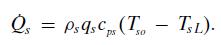
Derive Equations 13.34a and b.Equations 13.34a.Equations 13.34b. Qs = Piqic pt (Tio TiL).
You are required to design a jacketed system to heat a continuous flow of 1m3/min of a liquid with the physical properties of water from 20◦C to 80◦C. You may assume that the heating medium is condensing steam, so that the jacket temperature is always at 100◦C. You decide to use a cylindrical
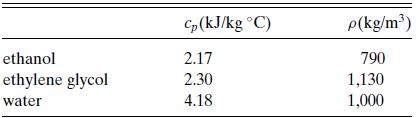
a. 10 L each of ethanol at –1.1◦C (30◦F), ethylene glycol at –6.67◦C (20◦F), and water at 26.7◦C (80◦F) are poured into a tank and mixed. What is the final temperature? Relevant physical property data are b. The final temperature must be 21.1◦C (70◦F). Only the inlet
A crude oil stream available at 209◦C is to be used to cool a heavy gas oil stream from 319◦C to 269◦C in a shell-and-tube heat exchanger. The crude oil is on the shell side and the gas oil on the tube side. The flow rates of the streams are 105,700 kg/hr for the gas oil and 367,600 kg/hr for
An insulated tank contains 10 kg of water at 20◦C. A stream of 100 percent sulfuric acid at 20◦C is added by accident at a rate of 1 kg/min. How long will it take for the temperature to rise to 100◦C?
A continuous mixing operation is carried out by adding 0.3 kg/hr of calcium chloride crystals to a pure water stream flowing at 1 kg/hour.a. If both streams are at 25◦C when they enter the mixer, what is the temperature of the exit stream?b. How much heat would have to be removed if the operation
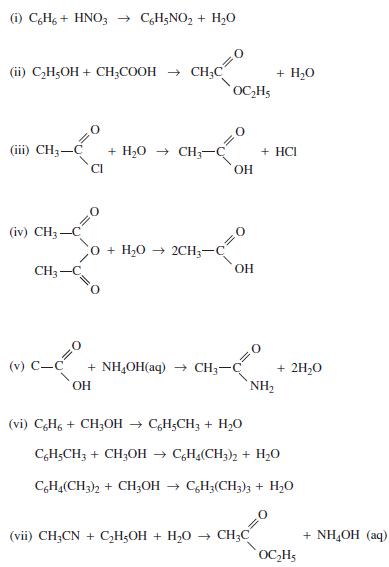
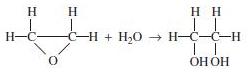
Find the heat of reaction ΔHR for each of the following reactions using both heat of formation and heat of combustion data, as available. (1) C6H6+ HNO3 → C6H5NO₂ + H₂O (ii) C₂H5OH + CH₂COOH → CH₂C (iii) CH3-C + H,O → CH CI (iv) CH3-C CH3- (v) C-C O + H,O → 2CH + NH₂OH(aq) →
a. 5 kg/hr of sodium hydroxide and 10 kg/hr of water are to be mixed in an insulated tank. Both feed streams are to be put into the mixer at the same temperature. What is a safe inlet temperature at which to mix the feeds?b. We would like to carry out the mixing process in part (a) with the
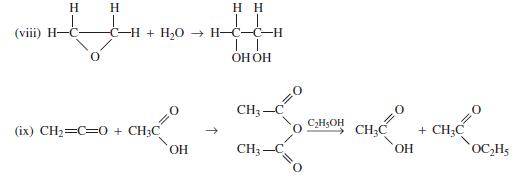
a. Derive an equation for the heat of reaction at any temperature if you are given the heat of reaction ΔHR R(To) at a standard temperature To. You may assume an ideal solution.b. Find the temperature dependence of the heat of reaction for reaction (viii) in Problem 15.1.Reaction (viii) in
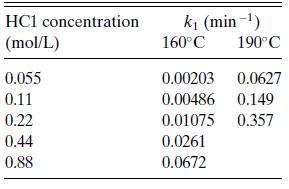
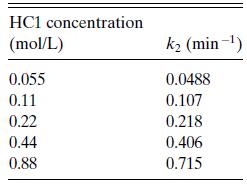
For the formation of glucose from cellulose discussed in Problem 6.12, the rate constant k1 shows the following temperature dependence at an HCl concentration of 0.055 mol/L:Check the validity of the Arrhenius relation and determine the activation energy.Problem 6.12The formation of sugars from
The following specific reaction rate constant data were reported by Smith [J. Phys. & Coll. Chem., 59, 367 (1947)] for the reaction urea + formaldehyde → monomethylolurea:Check the validity of the Arrhenius relation and determine the activation energy. T, °C k, L/mol s 30 5.5 x 10⁻⁵ 40 11.8
A common rule of thumb states that the reaction rate doubles for each 10◦C rise in temperature. Under what conditions is this rule of thumb valid?
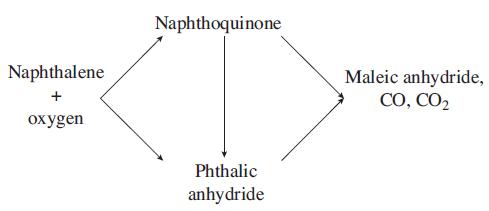
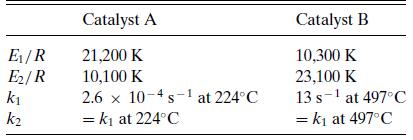
The catalytic gas phase oxidation of naphthalene to form phthalic anhydride is thought to take place as follows:The reaction has been studied by DeMaria, Longfield, and Butler [Ind. Eng. Chem., 53, 259 (1961)] in a fluidized bed reactor with two catalysts, designated A and B. A surprisingly good
The irreversible exothermic reaction A + B → nD is to be carried out isothermally in a batch reactor. The rate is described by mass action kinetics.a. What is the rate at which heat must be removed from the reactor in order to maintain a constant temperature?b. If the reactor is cooled with a
The irreversible first-order reaction A→R is to be carried out in an adiabatic continuous flow stirred-tank reactor. The molecular weight of A is 18, and you may take all physical properties to be those of water and constant. The reaction rate k = ko exp(−E/RT), with ko = 109 min−1 and E/R =
Do a search to find an original research paper in which the heat capacity of some liquid was measured. Carefully read the paper and describe the experimental procedure in your own words. Show clearly by means of a sample calculation how the heat capacity was calculated from the experimental data.
Showing 1800 - 1900
of 1819
First
5
6
7
8
9
10
11
12
13
14
15
16
17
18
19
Step by Step Answers

 Get 50% OFF
Claim Now
Get 50% OFF
Claim Now


![Qs h DL = = -Q hT DL = A e(1-A) L/B L 1 L [T,(x) T,;(x)]dx = AT0 + (Tio Tso) B (e(1-A)L/B - 1) - (1-A) L](https://dsd5zvtm8ll6.cloudfront.net/si.question.images/images/question_images/1697/5/3/0/871652e43f76425d1697530870115.jpg)
![ht DL (TL - TL) - ( ) - 450 = In [(TL - TL)/(To T)] - 10 = In(/) = .m:](https://dsd5zvtm8ll6.cloudfront.net/si.question.images/images/question_images/1697/5/3/0/896652e44109736b1697530895334.jpg)