New Semester
Started
Get
50% OFF
Study Help!
--h --m --s
Claim Now
Question Answers
Textbooks
Find textbooks, questions and answers
Oops, something went wrong!
Change your search query and then try again
S
Books
FREE
Study Help
Expert Questions
Accounting
General Management
Mathematics
Finance
Organizational Behaviour
Law
Physics
Operating System
Management Leadership
Sociology
Programming
Marketing
Database
Computer Network
Economics
Textbooks Solutions
Accounting
Managerial Accounting
Management Leadership
Cost Accounting
Statistics
Business Law
Corporate Finance
Finance
Economics
Auditing
Tutors
Online Tutors
Find a Tutor
Hire a Tutor
Become a Tutor
AI Tutor
AI Study Planner
NEW
Sell Books
Search
Search
Sign In
Register
study help
engineering
engineering mechanics dynamics
Engineering Mechanics Dynamics 8th Edition James L. Meriam, L. G. Kraige, J. N. Bolton - Solutions
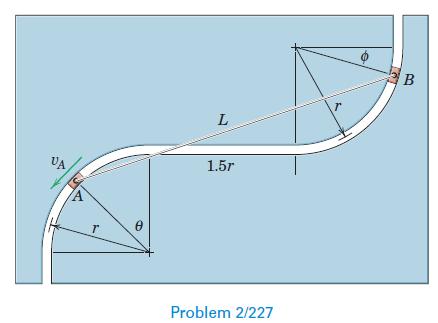
The two sliders are connected by the light rigid bar and move in the smooth vertical-plane guide. At the instant illustrated, the speed of slider A is 25 mm /s, θ = 45°, and Φ = 15°. Determine the speed of slider B for this instant if r = 175 mm. B 1.5r VA Problem 2/227
For the two sliders of Prob. 2 /227, determine the time rate of change of speed for slider B at the location shown if the speed of slider A is constant over a short interval which includes the position shown.Data from Prob. 2/227The two sliders are connected by the light rigid bar and move in the
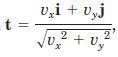
A particle moving in the x-y plane has a velocity v = 7.25i + 3.48j m/s at a certain instant. If the particle then encounters a constant acceleration a = 0.85j m/s2, determine the amount of time which must pass before the direction of the tangent to the trajectory of the particle has been altered
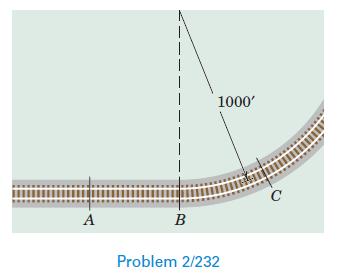
An inexperienced designer of a roadbed for a new high-speed train proposes to join a straight section of track to a circular section of 1000-ft radius as shown. For a train that would travel at a constant speed of 90 mi/hr, plot the magnitude of its acceleration as a function of distance along the
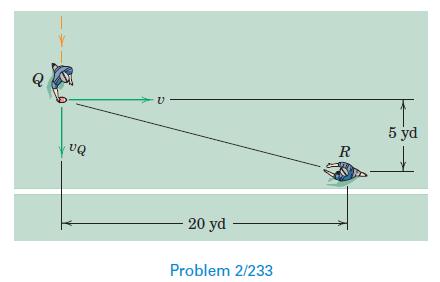
While scrambling directly toward the sideline, the football quarterback Q throws a pass toward the stationary receiver R. At what speed vQ should the quarterback run if the direction of the velocity of the ball relative to the quarterback is to be directly down the field as indicated? The speed of
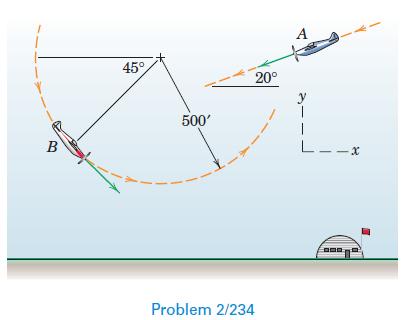
Two airplanes are performing at an air show. Plane A travels along the path shown and, for the instant under consideration, has a speed of 265 mi/hr that is increasing at a rate of 4 mi/hr every second. Meanwhile, plane B executes a vertical loop at a constant speed of 150 mi/hr. Determine the
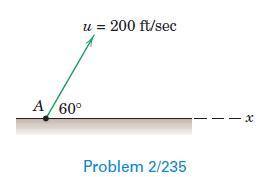
At time t = 0 a small ball is projected from point A with a velocity of 200 ft/sec at the 60° angle. Neglect atmospheric resistance and determine the two times t1 and t2 when the velocity of the ball makes an angle of 45° with the horizontal x-axis. u = 200 ft/sec A/ 60° --x Problem 2/235
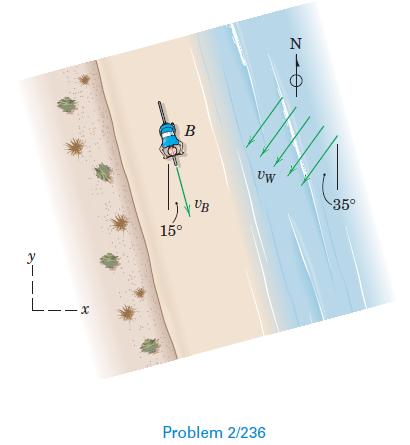
A bicyclist rides along the hard-packed sand beach with a speed vB = 16 mi/hr as indicated. The wind speed is vW = 20 mi/hr. (a) Determine the velocity of the wind relative to the bicyclist. (b) At what speed vB would the bicyclist feel the wind coming directly from her left (perpendicular to her
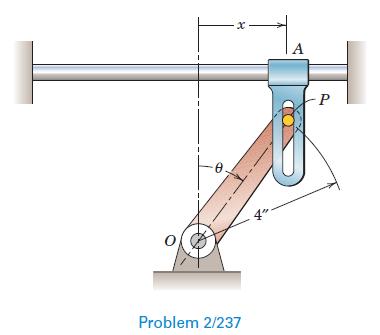
Rotation of the arm OP is controlled by the horizontal motion of the vertical slotted link. If x˙ = 4 ft/sec and x¨ = 30 ft/sec2 when x = 2 in., determine θ˙ and θ¨ for this instant. A -P Problem 2/237
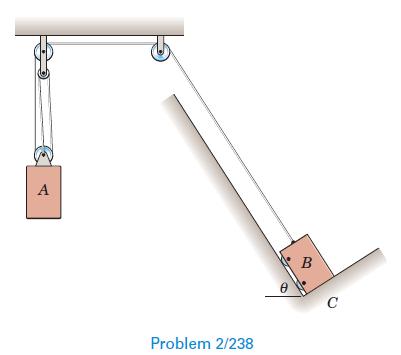
Body A is released from rest in the position shown and moves downward causing body B to lift off the support at C. If motion is controlled such that the magnitude aB/A = 2.4 m/s2 is held constant, determine the amount of time it takes for body B to travel 5 m up the incline and the corresponding
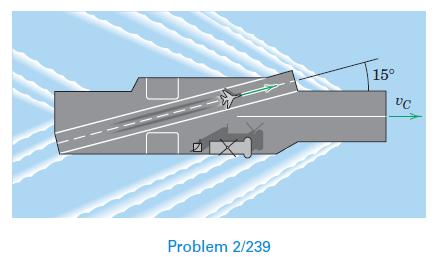
The launching catapult of the aircraft carrier gives the jet fighter a constant acceleration of 50 m/s2 from rest relative to the flight deck and launches the aircraft in a distance of 100 m measured along the angled takeoff ramp. If the carrier is moving at a steady 30 knots (1 knot = 1.852 km/h),
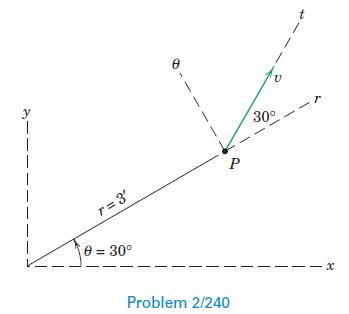
For the instant represented the particle P has a velocity v = 6 ft/sec in the direction shown and has acceleration components ax = 15 ft/sec2 and ax = −15 ft/sec2. Determine ar, ay, at, an, and the radius of curvature ρ of the path for this position. Draw the related acceleration components
The coordinates of a particle which moves with curvilinear motion are given by x = 10.25t + 1.75t2 − 0.45t3 and y = 6.32 + 14.65t − 2.48t2, where x and y are in millimeters and the time t is in seconds. Determine the values of u, v, a, a, er, en, at, at, an, an, ρ, and β˙ (the angular
The coordinates of a particle which moves with curvilinear motion are given by x = 10.25t + 1.75t2 − 0.45t3 and y = 6.32 + 14.65t − 2.48t2, where x and y are in millimeters and the time t is in seconds. Determine the values of u, v, a, a, er, eθ, vr, vr, vθ, vθ, ar, ar, aθ, aθ, r, r˙,
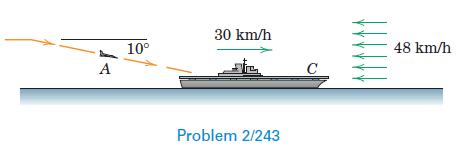
As part of a training exercise, the pilot of aircraft A adjusts her airspeed (speed relative to the wind) to 220 km/h while in the level portion of the approach path and thereafter holds her absolute speed constant as she negotiates the 10° glide path. The absolute speed of the aircraft carrier is
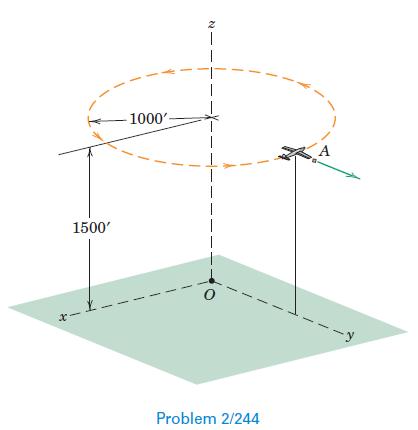
A small aircraft is moving in a horizontal circle with a constant speed of 130 ft/sec. At the instant represented, a small package A is ejected from the right side of the aircraft with a horizontal velocity of 20 ft/sec relative to the aircraft. Neglect aerodynamic effects and calculate the
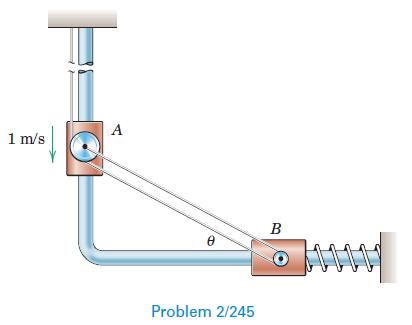
Cylinder A has a constant downward speed of 1 m/s. Compute the velocity of cylinder B for (a) θ = 45°, (b) θ = 30°, and (c) θ = 15°. The spring is in tension throughout the motion range of interest, and the pulleys are connected by the cable of fixed length. A 1 m/s B Problem 2/245
A rocket fi red vertically up from the north pole achieves a velocity of 27 000 km /h at an altitude of 350 km when its fuel is exhausted. Calculate the additional vertical height h reached by the rocket before it starts its descent back to the earth. The coasting phase of its flight occurs above
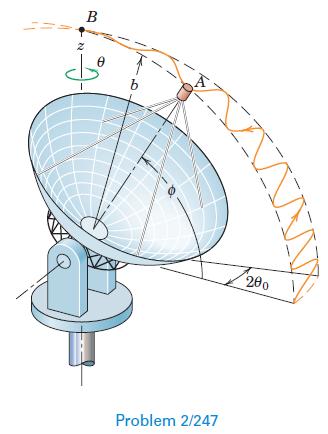
The radar tracking antenna oscillates about its vertical axis according to θ = θ0 cos ωt, where ω is the constant circular frequency and 2θ0 is the double amplitude of oscillation. Simultaneously, the angle of elevation Φ is increasing at the constant rate Φ˙ = K. Determine the expression
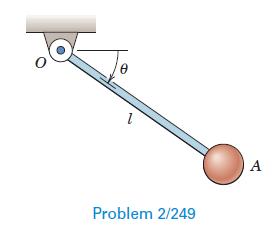
If all frictional effects are neglected, the expression for the angular acceleration of the simple pendulum is θ¨ = g/l cos θ, where g is the acceleration of gravity and l is the length of the rod OA. If the pendulum has a clockwise angular velocity θ˙ = 2 rad/s when θ = 0 at t = 0, determine
A baseball is dropped from an altitude h = 200 ft and is found to be traveling at 85 ft/sec when it strikes the ground. In addition to gravitational acceleration, which may be assumed constant, air resistance causes a deceleration component of magnitude kv2, where v is the speed and k is a
A ship with a total displacement of 16 000 metric tons (1 metric ton = 1000 kg) starts from rest in still water under a constant propeller thrust T = 250 kN. The ship develops a total resistance to motion through the water given by R = 4.50v2, where R is in kilonewtons and v is in meters per
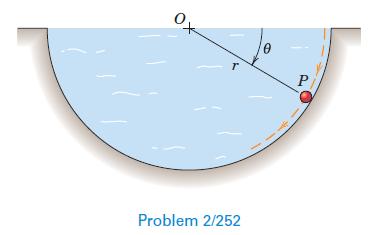
At time t = 0, the 1.8-lb particle P is given an initial velocity v0 = 1 ft/sec at the position θ = 0 and subsequently slides along the circular path of radius r = 1.5 ft. Because of the viscous fluid and the effect of gravitational acceleration, the tangential acceleration is at = g cosθ − k/m
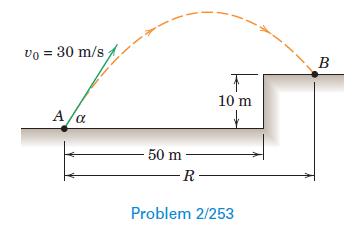
A projectile is launched from point A with speed v0 = 30 m /s. Determine the value of the launch angle θ which maximizes the range R indicated in the figure. Determine the corresponding value of R. vo = 30 m/s B 10 m A/a 50 m R- Problem 2/253
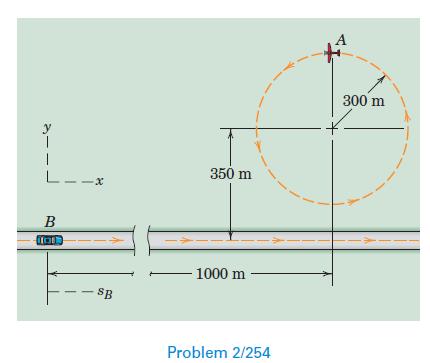
A low-flying crop duster A is moving with a constant speed of 40 m /s in the horizontal circle of radius 300 m. As it passes the twelve-o’clock position shown at time t = 0, car B starts from rest from the position shown and accelerates along the straight road at the constant rate of 3 m/s2 until
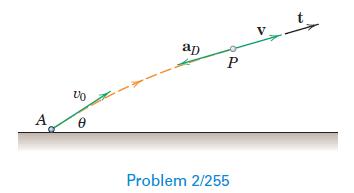
A particle P is launched from point A with the initial conditions shown. If the particle is subjected to aerodynamic drag, compute the range R of the particle and compare this with the case in which aerodynamic drag is neglected. Plot the trajectories of the particle for both cases. Use the values
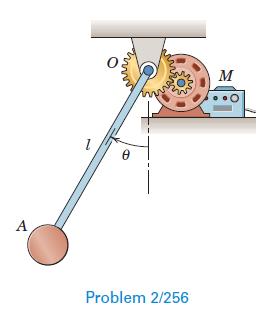
By means of the control unit M, the pendulum OA is given an oscillatory motion about the vertical given by θ = θ0sin √g/l t, where θ0 is the maximum angular displacement in radians, g is the acceleration of gravity, l is the pendulum length, and t is the time in seconds measured from an
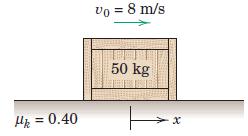
The 50-kg crate is projected along the floor with an initial speed of 8 m /s at x = 0. The coefficient of kinetic friction is 0.40. Calculate the time required for the crate to come to rest and the corresponding distance x traveled. vo = 8 m/s 50 kg H = 0.40 %3!
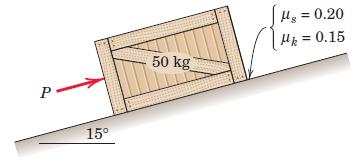
The 50-kg crate is stationary when the force P is applied. Determine the resulting acceleration of the crate if (a) P = 0, (b) P = 150 N, and (c) P = 300 N. 씨s = 0.20 %3D Hk = 0.15 50 kg P 15°
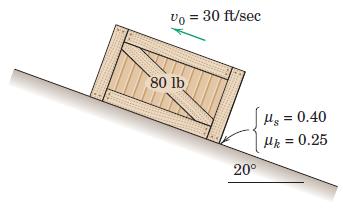
At a certain instant, the 80-lb crate has a velocity of 30 ft /sec up the 20° incline. Calculate the time t required for the crate to come to rest and the corresponding distance d traveled. Also, determine the distance d′ traveled when the crate speed has been reduced to 15 ft /sec. Vo = 30
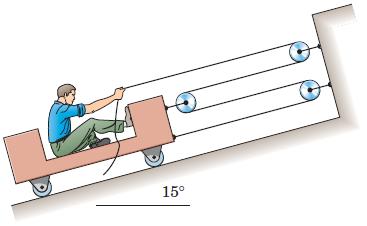
A man pulls himself up the 15° incline by the method shown. If the combined mass of the man and cart is 100 kg, determine the acceleration of the cart if the man exerts a pull of 175 N on the rope. Neglect all friction and the mass of the rope, pulleys, and wheels. 15°
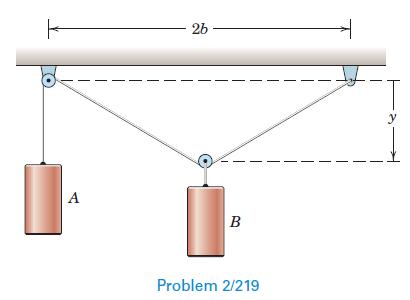
For a given value of y, determine the upward velocity of A in terms of the downward velocity of B. Neglect the diameters of the pulleys. 2b y A B Problem 2/219
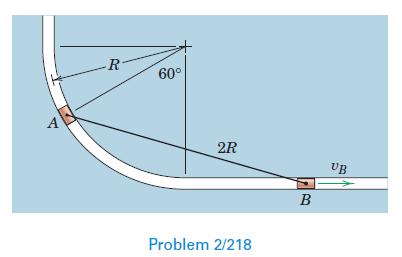
The small sliders A and B are connected by the rigid slender rod. If the velocity of slider B is 2 m/s to the right and is constant over a certain interval of time, determine the speed of slider A when the system is in the position shown. -R- 60° 2R UB B Problem 2/218
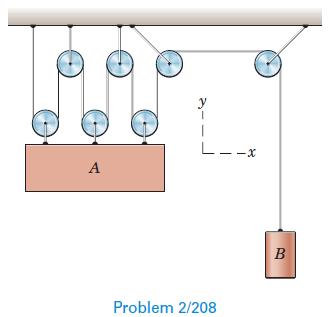
At the instant represented, vB/A = 3.5j m/s. Determine the velocity of each body at this instant. Assume that the upper surface of A remains horizontal. y L--x A B Problem 2/208
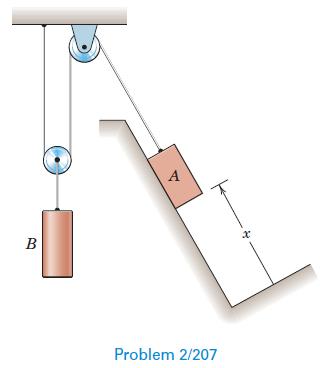
If the velocity x˙ of block A up the incline is increasing at the rate of 0.044 m/s each second, determine the acceleration of B. В Problem 2/207
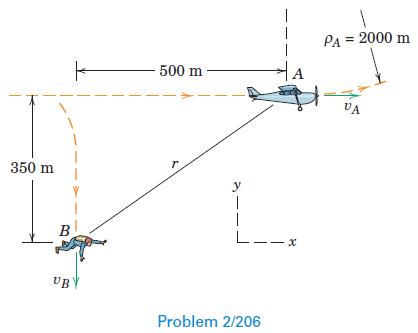
At a certain instant after jumping from the airplane A, a skydiver B is in the position shown and has reached a terminal (constant) speed vB = 50 m/s. The airplane has the same constant speed vA = 50 m/s, and after a period of level flight is just beginning to follow the circular path shown of
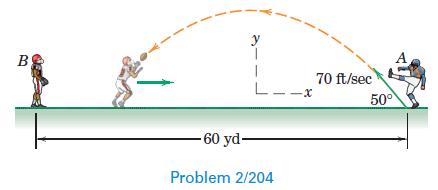
A place kicker A executes a “pooch” kick, which is designed to eliminate a potential return by the receiving team. The “pooch” kick features a high trajectory and short range, thereby preventing the deep kick returner B from reaching his maximum speed before encountering coverage. To offset
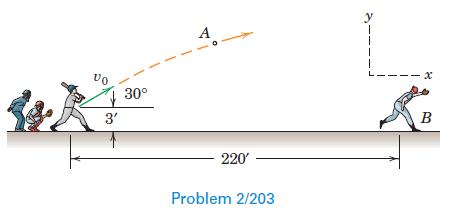
A batter hits the baseball A with an initial velocity of v0 = 100 ft/sec directly toward fi elder B at an angle of 30° to the horizontal; the initial position of the ball is 3 ft above ground level. Fielder B requires 14 sec to judge where the ball should be caught and begins moving to that
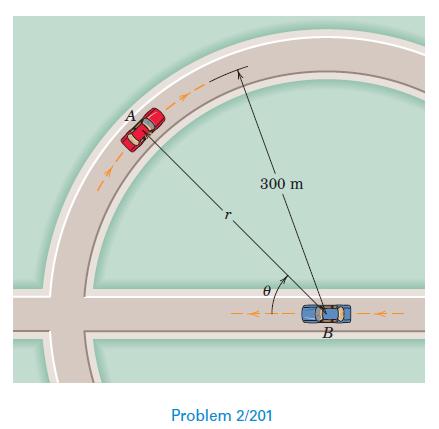
For the conditions of Prob. 2/201, determine the values of r¨ and θ¨ as measured by an observer in car B at the instant represented. Use the results for r˙ and θ˙ cited in the answers for that problem.Data from Prob. 2/201Car A is traveling at the constant speed of 60 km/h as it rounds the
Car A is traveling at the constant speed of 60 km/h as it rounds the circular curve of 300-m radius and at the instant represented is at the position θ = 45°. Car B is traveling at the constant speed of 80 km/h and passes the center of the circle at this same instant. Car A is located with
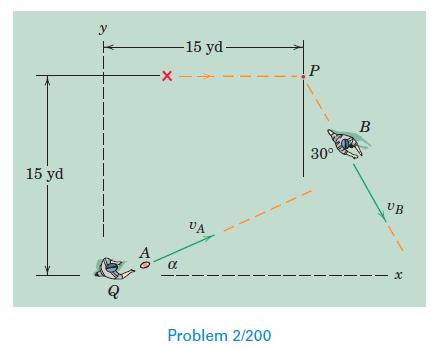
After starting from the position marked with the “x”, a football receiver B runs the slant-in pattern shown, making a cut at P and thereafter running with a constant speed vB = 7 yd/sec in the direction shown. The quarterback releases the ball with a horizontal velocity of 100 ft/sec at the
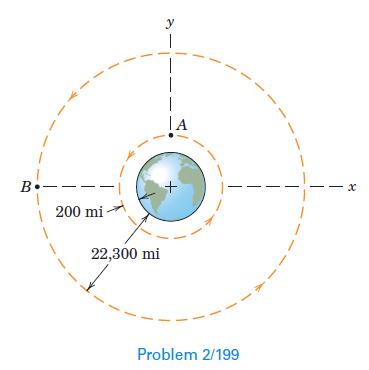
The shuttle orbiter A is in a circular orbit of altitude 200 mi, while spacecraft B is in a geosynchronous circular orbit of altitude 22,300 mi. Determine the acceleration of B relative to a nonrotating observer in shuttle A. Use g0 = 32.23 ft/sec2 for the surface-level gravitational acceleration
As part of an unmanned-autonomous-vehicle (UAV) demonstration, an unmanned vehicle B launches a projectile A from the position shown while traveling at a constant speed of 30 km/h. The projectile is launched with a speed of 70 m/s relative to the vehicle. At what launch angle θ should the
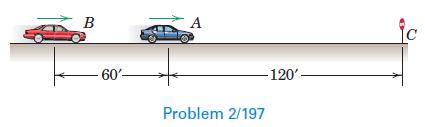
Car A is traveling at 25 mi/hr and applies the brakes at the position shown so as to arrive at the intersection C at a complete stop with a constant deceleration. Car B has a speed of 40 mi/hr at the instant represented and is capable of a maximum deceleration of 18 ft/sec2. If the driver of car B
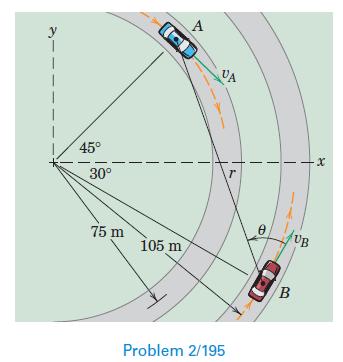
For the cars of Prob. 2 /195, determine the instantaneous values of r¨ and θ¨ if car A is slowing down at a rate of 1.25 m/s2 and car B is speeding up at a rate of 2.5 m/s2. Refer to the printed answers for Prob. 2/195 as needed.Data from Prob. 2/195At the instant illustrated, car B has a speed
At the instant illustrated, car B has a speed of 30 km/h and car A has a speed of 40 km/h. Determine the values of r˙ and θ˙ for this instant where r and θ are measured relative to a longitudinal axis fixed to car B as indicated in the figure. y VA 45° 30° 75 m UB 105 m Problem 2/195
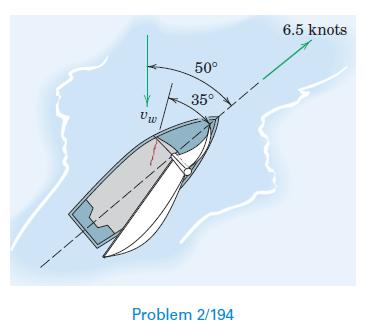
A sailboat moving in the direction shown is tacking to windward against a north wind. The log registers a hull speed of 6.5 knots. A “telltale” (light string tied to the rigging) indicates that the direction of the apparent wind is 35° from the centerline of the boat. What is the true wind
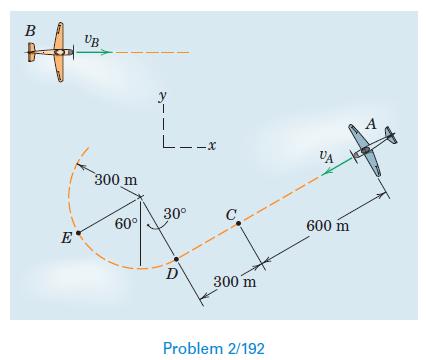
For the planes of Prob. 2/192, beginning at the position shown, plane A increases its speed at a constant rate and acquires a speed of 415 km/h by the time it reaches position E, while plane B experiences a steady deceleration of 1.5 m/s2. Relative to the pilot in plane B, what are the velocities
Plane A travels along the indicated path with a constant speed vA = 285 km/h. Relative to the pilot in plane B, which is flying at a constant speed vB = 350 km/h, what are the velocities which plane A appears to have when it is at positions C and E? Both planes are flying horizontally. B UB y L--x
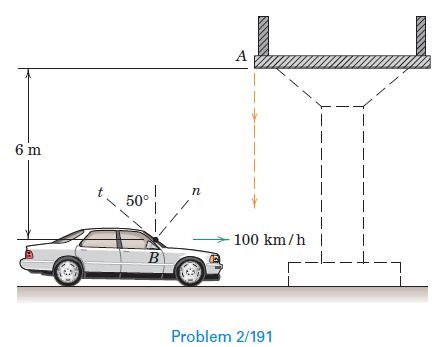
A drop of water falls with no initial speed from point A of a highway overpass. After dropping 6 m, it strikes the windshield at point B of a car which is traveling at a speed of 100 km/h on the horizontal road. If the windshield is inclined 50° from the vertical as shown, determine the angle θ
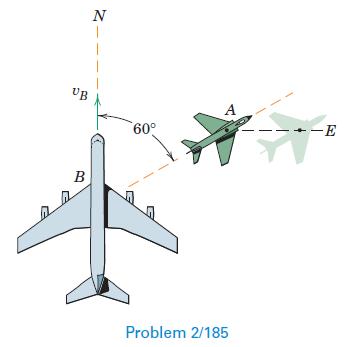
The jet transport B is flying north with a velocity vB = 600 km /h when a smaller aircraft A passes underneath the transport headed in the 60° direction shown. To passengers in B, however, A appears to be flying sideways and moving east. Determine the actual velocity of A and the velocity which A
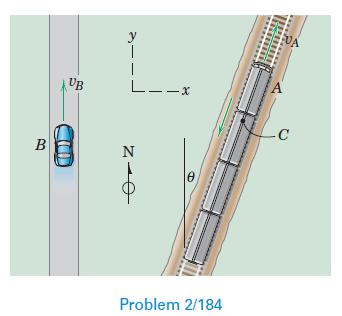
Train A is traveling at a constant speed vA = 35 mi/hr while car B travels in a straight line along the road as shown at a constant speed vB. A conductor C in the train begins to walk to the rear of the train car at a constant speed of 4 ft/sec relative to the train. If the conductor perceives car
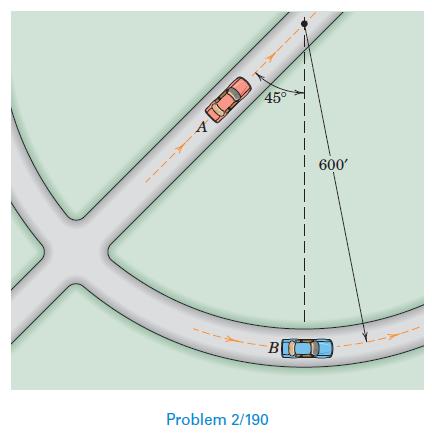
For the instant represented, car A has an acceleration in the direction of its motion, and car B has a speed of 45 mi/hr which is increasing. If the acceleration of B as observed from A is zero for this instant, determine the acceleration of A and the rate at which the speed of B is changing. 45 |
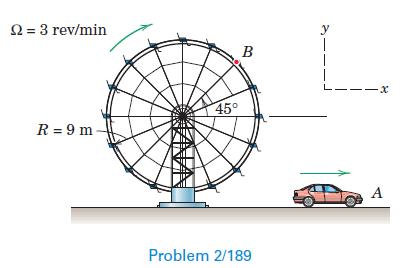
The car A has a forward speed of 18 km/h and is accelerating at 3 m/s2. Determine the velocity and acceleration of the car relative to observer B, who rides in a nonrotating chair on the Ferris wheel. The angular rate Ω = 3 rev/min of the Ferris wheel is constant. 2 = 3 rev/min y B --x 45° R = 9
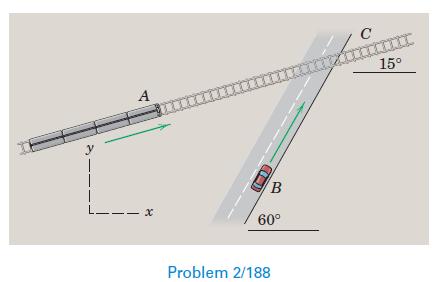
Train A travels with a constant speed vA = 120 km /h along the straight and level track. The driver of car B, anticipating the railway grade crossing C, decreases the car speed of 90 km/h at the rate of 3 m/s2. Determine the velocity and acceleration of the train relative to the car. 15° A B. L---
A ship capable of making a speed of 16 knots through still water is to maintain a true course due west while encountering a 3-knot current running from north to south. What should be the heading of the ship (measured clockwise from the north to the nearest degree)? How long does it take the ship to
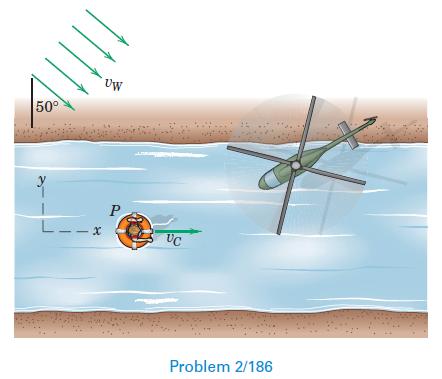
A helicopter approaches a rescue scene. A victim P is drifting along with the river current of speed vC = 2 m/s. The wind is blowing at a speed vW = 3 m/s as indicated. Determine the velocity relative to the wind which the helicopter must acquire so that it maintains a steady overhead position
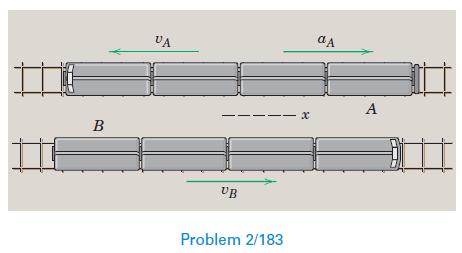
Rapid-transit trains A and B travel on parallel tracks. Train A has a speed of 80 km/h and is slowing at the rate of 2 m/s2, while train B has a constant speed of 40 km/h. Determine the velocity and acceleration of train B relative to train A. VA A --x B UB Problem 2/183
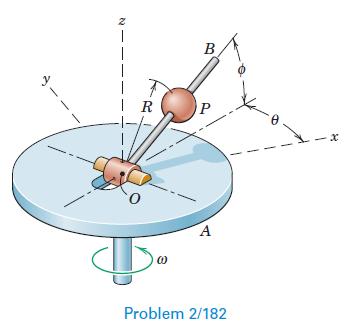
The disk A rotates about the vertical z-axis with a constant speed ω = θ˙ = π/3 rad/s. Simultaneously, the hinged arm OB is elevated at the constant rate Φ˙ = 2π/3 rad /s. At time t = 0, both θ = 0 and Φ = 0. The angle θ is measured from the fixed reference x-axis. The small sphere P
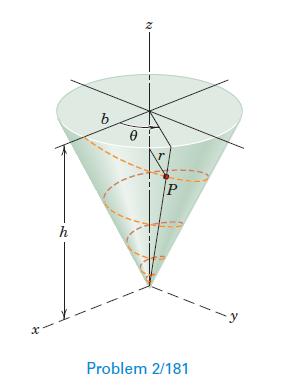
The particle P moves down the spiral path which is wrapped around the surface of a right circular cone of base radius b and altitude h. The angle γ between the tangent to the curve at any point and a horizontal tangent to the cone at this point is constant. Also the motion of the particle is
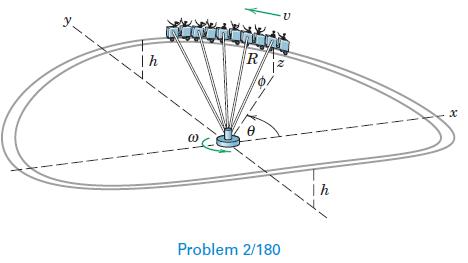
In the design of an amusement-park ride, the cars are attached to arms of length R which are hinged to a central rotating collar which drives the assembly about the vertical axis with a constant angular rate ω = θ˙. The cars rise and fall with the track according to the relation z = (h/2)(1 −
Beginning with Eq. 2 /18, the expression for particle velocity in spherical coordinates, derive the acceleration components in Eq. 2 /19. Start by writing the unit vectors for the R-, θ-, and Φ-coordinates in terms of the fixed unit vectors i, j, and k.
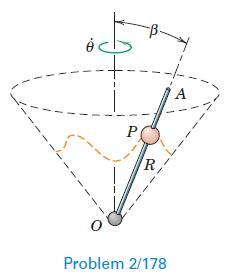
The rod OA is held at the constant angle β = 30° while it rotates about the vertical with a constant angular rate θ˙= 120 rev/min. Simultaneously, the sliding ball P oscillates along the rod with its distance in millimeters from the fixed pivot O given by R = 200 + 50 sin 2πnt, where the
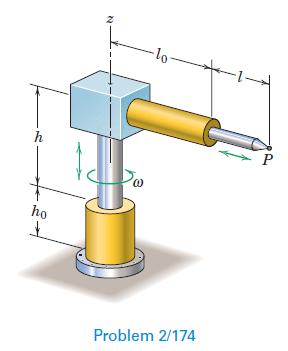
The vertical shaft of the industrial robot rotates at the constant rate ω. The length h of the vertical shaft has a known time history, and this is true of its time derivatives h˙ and h¨ as well. Likewise, the values of l, l˙, and l¨ are known. Determine the magnitudes of the velocity and
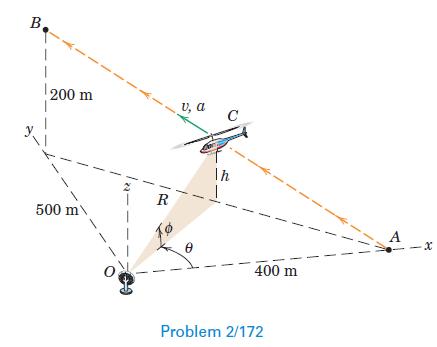
For the helicopter of Prob. 2/172, fi nd the values of R¨ , θ¨, and Φ¨ for the radar tracking device at O at the instant when h = 100 m. Refer to the printed answers for Prob. 2 /172 as needed.Data from Prob. 2/172A helicopter starts from rest at point A and travels along the indicated path
A helicopter starts from rest at point A and travels along the indicated path with a constant acceleration a. If the helicopter has a speed of 60 m/s when it reaches B, determine the values of R˙ , θ˙, and Φ˙ as measured by the radar tracking device at O at the instant when h = 100 m. в. 200
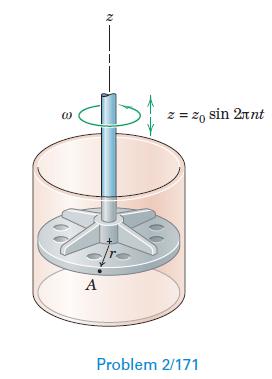
The rotating element in a mixing chamber is given a periodic axial movement z = z0 sin 2πnt while it is rotating at the constant angular velocity θ˙ = ω. Determine the expression for the maximum magnitude of the acceleration of a point A on the rim of radius r. The frequency n of vertical
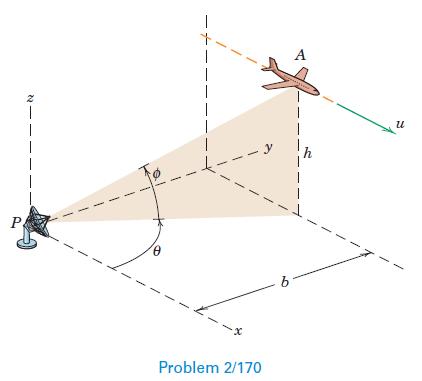
The radar antenna at P tracks the jet aircraft A, which is flying horizontally at a speed u and an altitude h above the level of P. Determine the expressions for the components of the velocity in the spherical coordinates of the antenna motion. A y h Р. Problem 2/17O
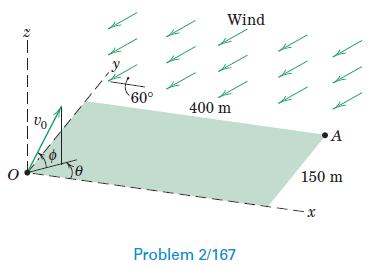
A projectile is launched from point O at a speed v0 = 80 m/s with the goal of hitting the target A. At the launch instant, a strong horizontal wind begins blowing and imparts a constant acceleration of 1.25 m/s2 to the projectile in the same direction as the wind. If the launch conditions are
If the launch speed of the projectile in Prob. 2/167 remains unchanged, what values of θ and Φ (positive and less than 90°) will ensure that the projectile impacts the target at A if the wind conditions are considered. Please list both possible combinations of the angles.Data from Prob. 2/167A
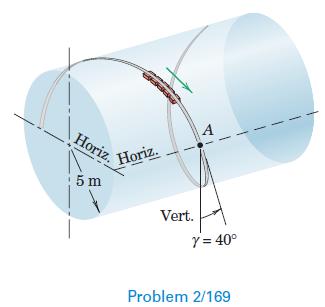
An amusement ride called the “corkscrew” takes the passengers through the upside-down curve of a horizontal cylindrical helix. The velocity of the cars as they pass position A is 15 m/s, and the component of their acceleration measured along the tangent to the path is g cos θ at this point.
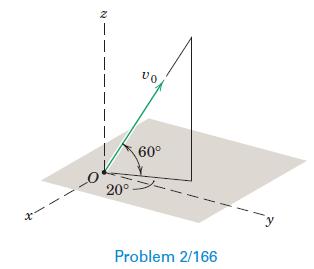
A projectile is launched from point O with an initial velocity of magnitude v0 = 600 ft/sec, directed as shown in the figure. Compute the x-, y-, and z-components of position, velocity, and acceleration 20 seconds after launch. Neglect aerodynamic drag. 60° 20° Problem 2/166
The rectangular coordinates of a particle are given in millimeters as functions of time t in seconds by x = 30 cos 2t, y = 40 sin 2t, and z = 20t + 3t2. Determine the angle θ1 between the position vector r and the velocity v and the angle θ2 between the position vector r and the acceleration a,
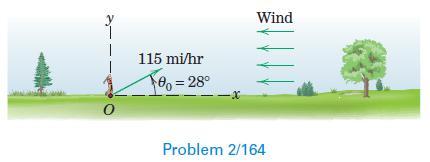
A golf ball is driven with the initial conditions shown in the figure. If the wind imparts a constant horizontal deceleration of 4 ft/sec2, determine the values of r, r˙, r¨, θ, θ˙ , and θ¨ when t = 1.05 sec. Take the r-coordinate to be measured from the origin. y Wind 115 mi/hr 00 = 28°
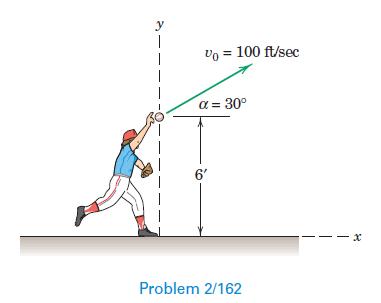
At time t = 0, the baseball player releases a ball with the initial conditions shown in the figure. Determine the quantities r, r˙, r¨, θ, θ˙, and θ¨, all relative to the x-y coordinate system shown, at time t = 0.5 sec. y vo = 100 ft/sec a = 30° 6' Problem 2/162
The low-flying aircraft P is traveling at a constant speed of 360 km/h in the holding circle of radius 3 km. For the instant shown, determine the quantities r, r˙, r¨, θ, θ˙ , and θ¨ relative to the fixed x-y coordinate system, which has its origin on a mountaintop at O. Treat the system as
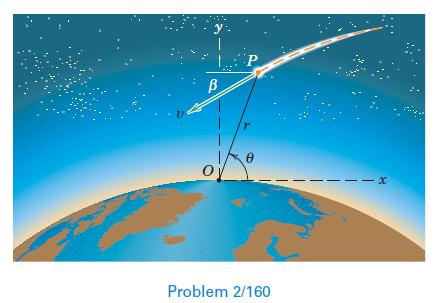
A meteor P is tracked by a radar observatory on the earth at O. When the meteor is directly overhead (θ = 90°), the following observations are recorded: r = 80 km, r˙ = −20 km/s, and θ˙ = 0.4 rad/s. (a) Determine the speed v of the meteor and the angle θ which its velocity vector makes with
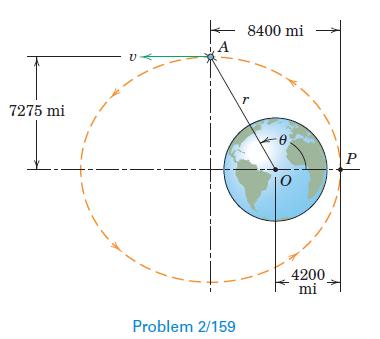
An earth satellite traveling in the elliptical orbit shown has a velocity v = 12,149 mi/hr as it passes the end of the semi minor axis at A. The acceleration of the satellite at A is due to gravitational attraction and is 32.23 [33959/84004]2 = 7.159 ft/sec2 directed from A to O. For position A
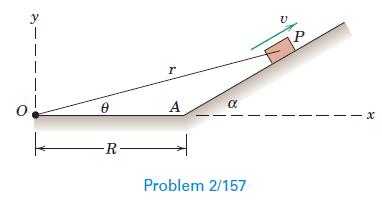
For the conditions of Prob. 2/157, determine θ˙ as a function of time.Data from Prob. 2/157The small block P starts from rest at time t = 0 at point A and moves up the incline with constant acceleration a. Determine r˙ as a function of time. of A А — х -R- Problem 2/157
The small block P starts from rest at time t = 0 at point A and moves up the incline with constant acceleration a. Determine r˙ as a function of time. of A А — х -R- Problem 2/157
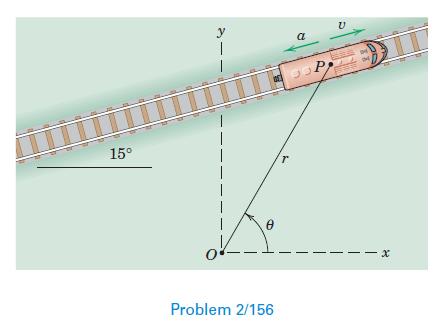
A locomotive is traveling on the straight and level track with a speed v = 90 km/h and a deceleration a = 0.5 m/s2 as shown. Relative to the fixed observer at O, determine the quantities r˙, r¨, θ˙, and θ¨ at the instant when θ = 60° and r = 400 m. P 15° Problem 2/156
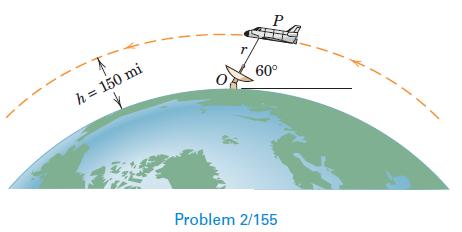
At the instant depicted in the figure, the radar station at O measures the range rate of the space shuttle P to be r˙ = −12,272 ft/sec, with O considered fixed. If it is known that the shuttle is in a circular orbit at an altitude h = 150 mi, determine the orbital speed of the shuttle from this
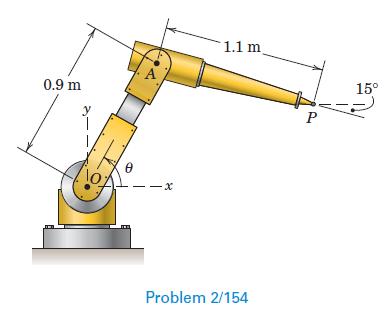
The member OA of the industrial robot telescopes and pivots about the fixed axis at point O. At the instant shown, θ = 60°, θ˙ = 1.2 rad/s, θ¨ = 0.8 rad/s2, O̅A̅ = 0.9 m, O̅A̅˙ = 0.5 m/s, and O̅A̅¨ = −6 m/s2 . Determine the magnitudes of the velocity and acceleration of joint
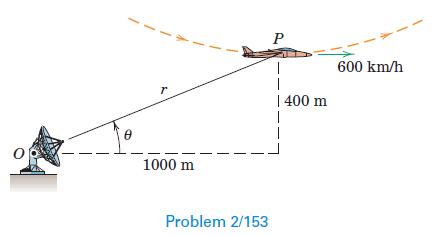
At the bottom of a loop in the vertical (r-θ) plane at an altitude of 400 m, the airplane P has a horizontal velocity of 600 km / h and no horizontal acceleration. The radius of curvature of the loop is 1200 m. For the radar tracking at O, determine the recorded values of r¨ and θ¨ for
In addition to the information supplied in the previous problem, the sensors at O indicate that r¨ = 14 ft/sec2. Determine the corresponding acceleration a of the aircraft and the value of θ¨.
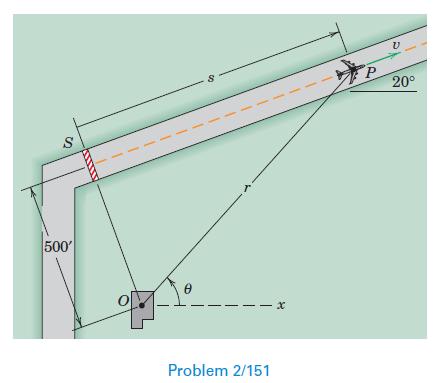
Instruments located at O are part of the ground traffic control system for a major airport. At a certain instant during the takeoff roll of the aircraft P, the sensors indicate the angle θ = 50° and the range rate r˙ = 140 ft/sec. Determine the corresponding speed v of the aircraft and the value
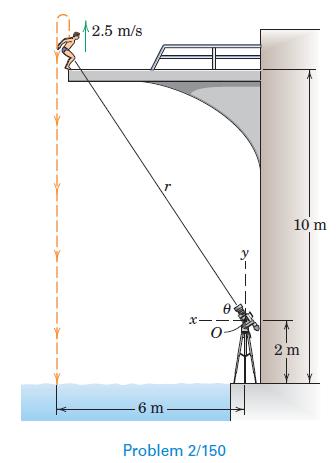
The diver leaves the platform with an initial upward speed of 2.5 m /s. A stationary camera on the ground is programmed to track the diver throughout the dive by rotating the lens to keep the diver centered in the captured image. Plot θ˙ and θ¨ as functions of time for the camera over the
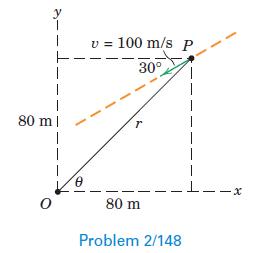
Repeat Prob. 2/148, but now the speed of the particle P is decreasing at the rate of 20 m/s2 as it moves along the indicated straight path.Data from Prob. 2/148As it passes the position shown, the particle P has a constant speed v = 100 m/s along the straight line shown. Determine the corresponding
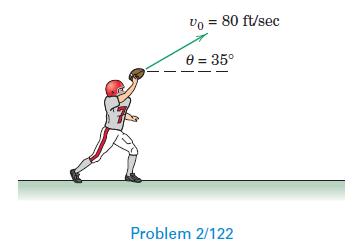
A football player releases a ball with the initial conditions shown in the figure. Determine the radius of curvature ρ of the path and the time rate of change v˙ of the speed at times t = 1 sec and t = 2 sec, where t = 0 is the time of release from the quarterback’s hand. Vo = 80 ft/sec e =
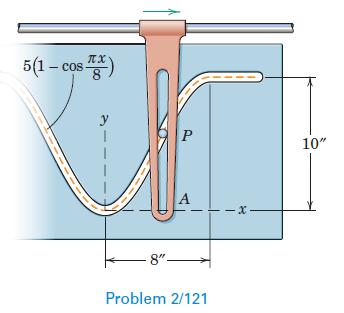
The figure shows a portion of a plate cam used in the design of a control mechanism. The motion of pin P in the fixed slot of the plate cam is controlled by the vertical guide A, which travels horizontally at a constant speed of 6 in./sec over the central sinusoidal portion of the slot. Determine
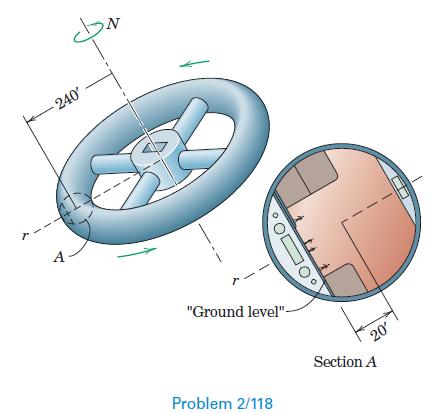
The preliminary design for a “small” space station to orbit the earth in a circular path consists of a ring (torus) with a circular cross section as shown. The living space within the torus is shown in section A, where the “ground level” is 20 ft from the center of the section. Calculate
As it passes the position shown, the particle P has a constant speed v = 100 m/s along the straight line shown. Determine the corresponding values of r˙, θ˙, r¨, and θ¨. y v = 100 m/s P 30° 80 ml 9. 80 m Problem 2/148
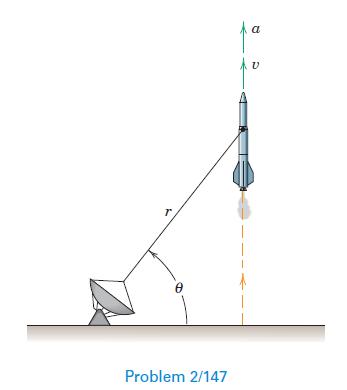
The rocket is fi red vertically and tracked by the radar station shown. When θ reaches 60°, other corresponding measurements give the values r = 9 km, r¨ = 21m/s2, and θ˙ = 0.02 rad/s. Calculate the magnitudes of the velocity and acceleration of the rocket at this position. a Problem 2/147
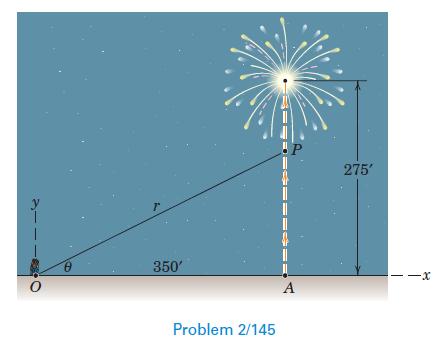
For the fireworks shell of Prob. 2 /145, determine the values of r¨ and θ¨ when the shell reaches an altitude y = 175 ft. Refer to the printed answers for Prob. 2/145 as needed.Data from Prob. 2 /145A fi reworks shell P is launched upward from point A and explodes at its apex at an
A fi reworks shell P is launched upward from point A and explodes at its apex at an altitude of 275 ft. Relative to an observer at O, determine the values of r˙ and θ˙ when the shell reaches an altitude y = 175 ft. Neglect aerodynamic drag. 275 350 A Problem 2/145
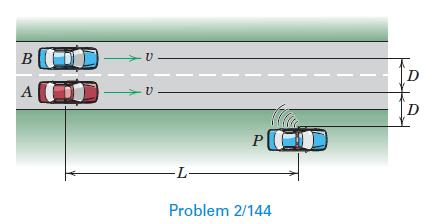
Cars A and B are both moving with constant speed v on the straight and level highway. They are side by- ide in adjacent lanes as shown. If the radar unit attached to the stationary police car P measures “line-of-sight” velocity, what speed v′ will be observed for each car? Use the
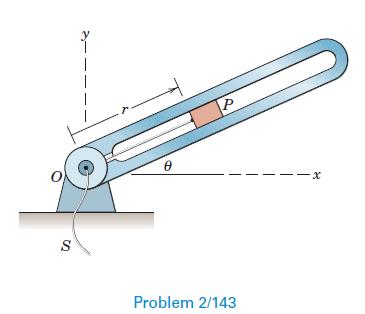
The slider P can be moved inward by means of the string S, while the slotted arm rotates about point O. The angular position of the arm is given by θ = 0.8t − t2/20 , where θ is in radians and t is in seconds. The slider is at r = 1.6 m when t = 0 and thereafter is drawn inward at the constant
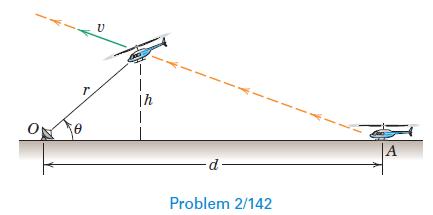
A helicopter starts from rest at point A and travels along the straight-line path with a constant acceleration a. If the speed v = 28 m/s when the altitude of the helicopter is h = 40 m, determine the values of r˙, r¨, θ˙ , and θ¨ as measured by the tracking device at O. At this instant, θ =
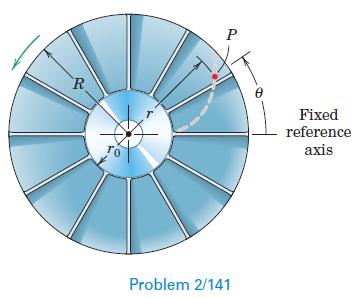
The radial position of a fluid particle P in a certain centrifugal pump with radial vanes is approximated by r = r0 cosh Kt, where t is time and K = θ˙ is the constant angular rate at which the impeller turns. Determine the expression for the magnitude of the total acceleration of the particle
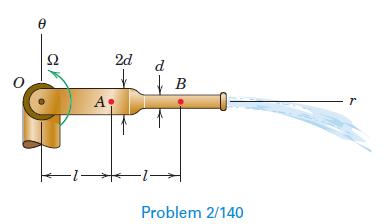
The nozzle shown rotates with constant angular speed Ω about a fixed horizontal axis through point O. Because of the change in diameter by a factor of 2, the water speed relative to the nozzle at A is v, while that at B is 4v. The water speeds at both A and B are constant. Determine the velocity
Showing 2300 - 2400
of 2550
First
12
13
14
15
16
17
18
19
20
21
22
23
24
25
26
Step by Step Answers

 Get 50% OFF
Claim Now
Get 50% OFF
Claim Now