New Semester
Started
Get
50% OFF
Study Help!
--h --m --s
Claim Now
Question Answers
Textbooks
Find textbooks, questions and answers
Oops, something went wrong!
Change your search query and then try again
S
Books
FREE
Study Help
Expert Questions
Accounting
General Management
Mathematics
Finance
Organizational Behaviour
Law
Physics
Operating System
Management Leadership
Sociology
Programming
Marketing
Database
Computer Network
Economics
Textbooks Solutions
Accounting
Managerial Accounting
Management Leadership
Cost Accounting
Statistics
Business Law
Corporate Finance
Finance
Economics
Auditing
Tutors
Online Tutors
Find a Tutor
Hire a Tutor
Become a Tutor
AI Tutor
AI Study Planner
NEW
Sell Books
Search
Search
Sign In
Register
study help
engineering
engineering mechanics dynamics
Engineering Mechanics Dynamics 8th Edition James L. Meriam, L. G. Kraige, J. N. Bolton - Solutions
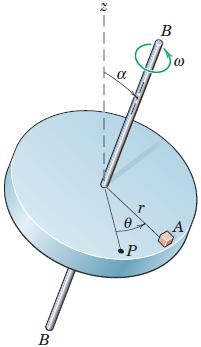
The disk spins about the fixed axis BB, which is inclined at the angle α to the vertical z-axis. A small block A is placed on the disk in its lowest position P at a distance r from the axis when the disk is at rest. The angular velocity ω = θ˙ is then increased very slowly, starting from zero.
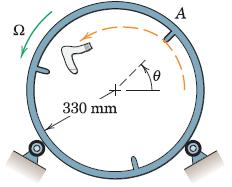
The rotating drum of a clothes dryer is shown in the figure. Determine the angular velocity Ω of the drum which results in loss of contact between the clothes and the drum at θ = 50°. Assume that the small vanes prevent slipping until loss of contact. 330 mm
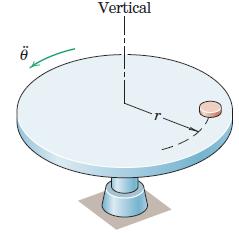
A small coin is placed on the horizontal surface of the rotating disk. If the disk starts from rest and is given a constant angular acceleration θ¨ = α, determine an expression for the number of revolutions N through which the disk turns before the coin slips. The coefficient of static friction
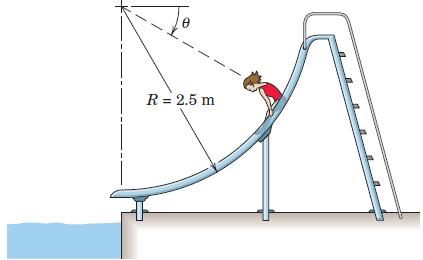
Beginning from rest when θ = 20°, a 35-kg child slides with negligible friction down the sliding board which is in the shape of a 2.5-m circular arc. Determine the tangential acceleration and speed of the child, and the normal force exerted on her (a) when θ = 30° and (b) when θ = 90°. R =
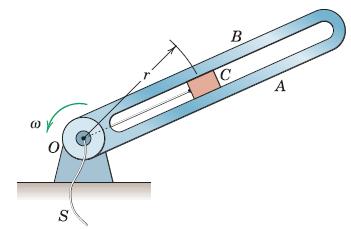
The slotted arm revolves in the horizontal plane about the fixed vertical axis through point O. The 3-lb slider C is drawn toward O at the constant rate of 2 in. /sec by pulling the cord S. At the instant for which r = 9 in., the arm has a counterclockwise angular velocity ω = 6 rad /sec and is
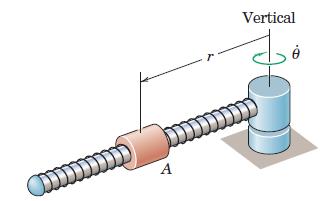
The spring-mounted 0.8-kg collar A oscillates along the horizontal rod, which is rotating at the constant angular rate θ˙ = 6 rad /s. At a certain instant, r is increasing at the rate of 800 mm /s. If the coefficient of kinetic friction between the collar and the rod is 0.40, calculate the
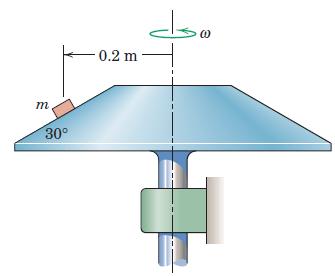
The small object of mass m is placed on the rotating conical surface at the radius shown. If the coefficient of static friction between the object and the rotating surface is 0.80, calculate the maximum angular velocity ω of the cone about the vertical axis for which the object will not slip.
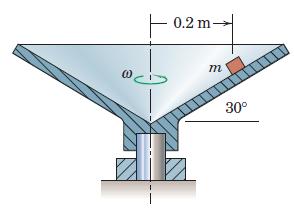
The small object is placed on the inner surface of the conical dish at the radius shown. If the coefficient of static friction between the object and the conical surface is 0.30, for what range of angular velocities ω about the vertical axis will the block remain on the dish without slipping?
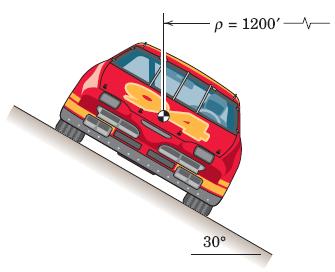
Determine the speed v at which the race car will have no tendency to slip sideways on the banked track, that is, the speed at which there is no reliance on friction. In addition, determine the minimum and maximum speeds, using the coefficient of static friction μs = 0.90. State any assumptions. p
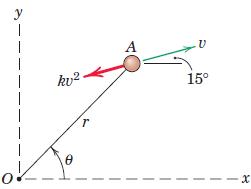
The 0.1-lb projectile A is subjected to a drag force of magnitude kv2, where the constant k = 0.0002 lb-sec2/ ft2. This drag force always opposes the velocity v. At the instant depicted, v = 100 ft/sec, θ = 45°, and r = 400 ft. Determine the corresponding values of r¨ and θ¨. y ku? 15° --x
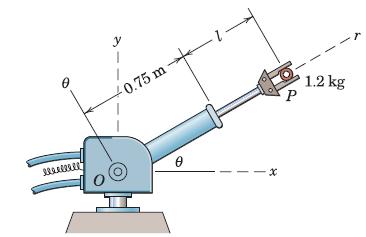
The robot arm is elevating and extending simultaneously. At a given instant, θ = 30°, θ˙ = 40 deg /s, θ¨ = 120 deg /s2, l = 0.5 m, l˙ = 0.4 m /s, and l¨ = −0.3 m /s2. Compute the radial and transverse forces Fr and Fθ that the arm must exert on the gripped part P, which has a mass of 1.2
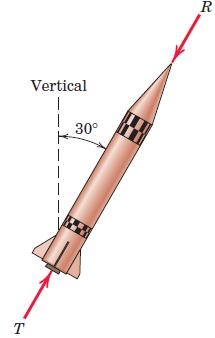
The rocket moves in a vertical plane and is being propelled by a thrust T of 32 kN. It is also subjected to an atmospheric resistance R of 9.6 kN. If the rocket has a velocity of 3 km/s and if the gravitational acceleration is 6 m/s2 at the altitude of the rocket, calculate the radius of curvature
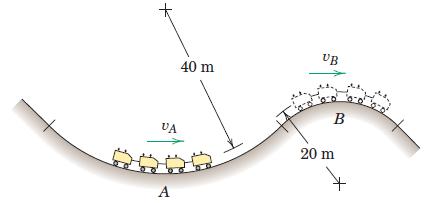
The cars of an amusement park ride have a speed vA = 22 m/s at A and a speed vB = 12 m/s at B. If a 75-kg rider sits on a spring scale (which registers the normal force exerted on it), determine the scale readings as the car passes points A and B. Assume that the person’s arms and legs do not
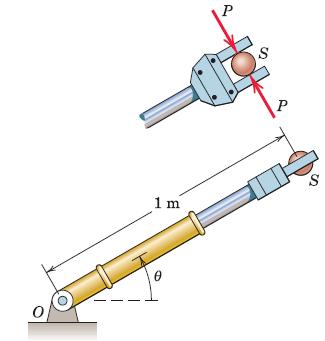
A 2-kg sphere S is being moved in a vertical plane by a robotic arm. When the angle θ is 30°, the angular velocity of the arm about a horizontal axis through O is 50 deg /s clockwise and its angular acceleration is 200 deg/s2 counterclockwise. In addition, the hydraulic element is being shortened
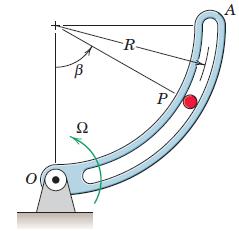
The quarter-circular slotted arm OA is rotating about a horizontal axis through point O with a constant counterclockwise angular velocity Ω = 7 rad /sec. The 0.1-lb particle P is epoxied to the arm at the position R = 60°. Determine the tangential force F parallel to the slot which the epoxy must
Determine the altitude h (in kilometers) above the surface of the earth at which a satellite in a circular orbit has the same period, 23.9344 h, as the earth’s absolute rotation. If such an orbit lies in the equatorial plane of the earth, it is said to be geosynchronous, because the satellite
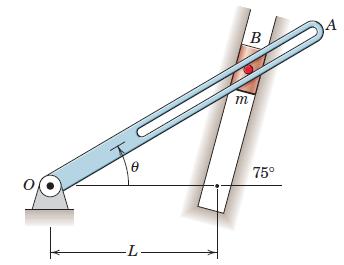
The configuration of Prob. 3/70 is now modified as shown in the figure. Use all the data of Prob. 3/70 and determine the forces applied to the slider B by both arm OA and the sides of the slot. Neglect all friction. A m 75° -L-
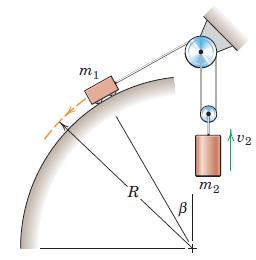
At the instant under consideration, the cable attached to the cart of mass m1 is tangent to the circular path of the cart. If the upward speed of the cylinder of mass m2 is v2 = 1.2 m/s, determine the acceleration of m1 and the tension T in the cable. What would be the maximum speed of m2 for which
Repeat the previous problem, only now the slotted arm is rotating with angular velocity Ω = 3 rad /s, and this rate is increasing at 5 rad /s2.
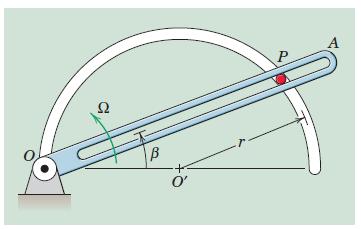
A 0.2-kg particle P is constrained to move along the vertical-plane circular slot of radius r = 0.5 m and is confined to the slot of arm OA, which rotates about a horizontal axis through O with a constant angular rate Ω = 3 rad /s. For the instant when β = 20°, determine the force N exerted on
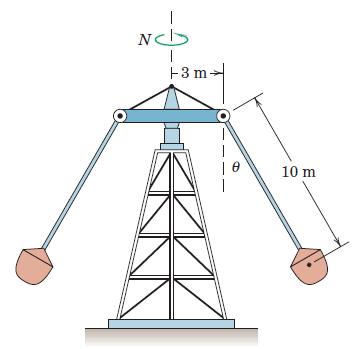
Calculate the necessary rotational speed N for the aerial ride in an amusement park in order that the arms of the gondolas will assume an angle θ = 60° with the vertical. Neglect the mass of the arms to which the gondolas are attached and treat each gondola as a particle. F3 m- 10 m
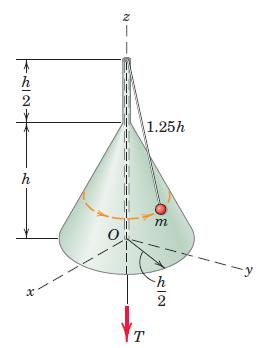
The particle of mass m = 0.2 kg travels with constant speed v in a circular path around the conical body. Determine the tension T in the cord. Neglect all friction, and use the values h = 0.8 m and v = 0.6 m/s. For what value of v does the normal force go to zero? h 1.25h h m -y T
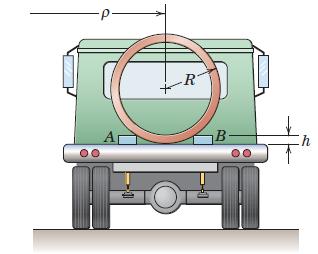
The flatbed truck carries a large section of circular pipe secured only by the two fixed blocks A and B of height h. The truck is in a left turn of radius ρ. Determine the maximum speed for which the pipe will be restrained. Use the values ρ = 60 m, h = 0.1 m, and R = 0.8 m. R'
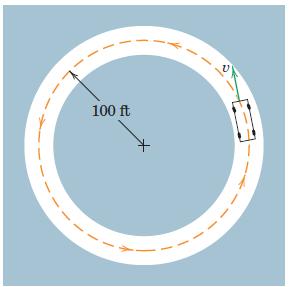
The car of Prob. 3/61 is traveling at 25 mi/hr when the driver applies the brakes, and the car continues to move along the circular path. What is the maximum deceleration possible if the tires are limited to a total horizontal friction force of 2400 lb?Data From problem 3/61The standard test to
The standard test to determine the maximum lateral acceleration of a car is to drive it around a 200-ft-diameter circle painted on a level asphalt surface. The driver slowly increases the vehicle speed until he is no longer able to keep both wheel pairs straddling the line. If this maximum speed is
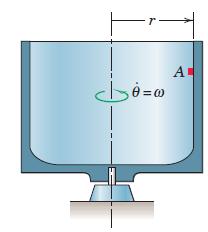
A small object A is held against the vertical side of the rotating cylindrical container of radius r by centrifugal action. If the coefficient of static friction between the object and the container is μs, determine the expression for the minimum rotational rate θ˙ = ω of the container which
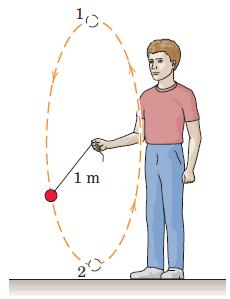
A child twirls a small 50-g ball attached to the end of a 1-m string so that the ball traces a circle in a vertical plane as shown. What is the minimum speed v which the ball must have when in position 1? If this speed is maintained throughout the circle, calculate the tension T in the string when
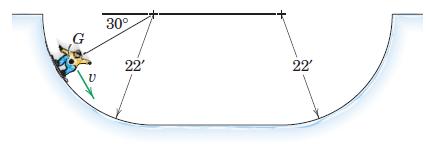
A 180-lb snowboarder has speed v = 15 ft/sec when in the position shown on the halfpipe. Determine the normal force on his snowboard and the magnitude of his total acceleration at the instant depicted. Use a value μk = 0.10 for the coefficient of kinetic friction between the snowboard and the
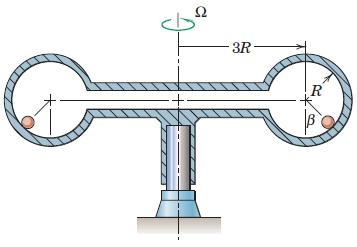
The small spheres are free to move on the inner surface of the rotating spherical chambers shown in section with radius R = 200 mm. If the spheres reach a steady-state angular position β = 45°, determine the angular velocity Ω of the device. Ω 3R R
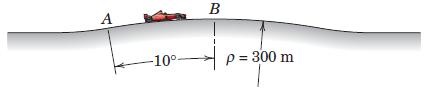
A Formula-1 car encounters a hump which has a circular shape with smooth transitions at both ends. (a) What speed vB will cause the car to lose contact with the road at the topmost point B? (b) For a speed vA = 190 km / h, what is the normal force exerted by the road on the 640-kg car as
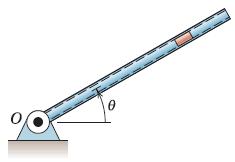
The hollow tube is pivoted about a horizontal axis through point O and is made to rotate in the vertical plane with a constant counterclockwise angular velocity θ˙ = 3 rad /sec. If a 0.2-lb particle is sliding in the tube toward O with a velocity of 6 ft/sec relative to the tube when the position
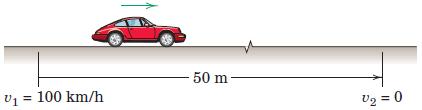
During a brake test, the rear-engine car is stopped from an initial speed of 100 km/h in a distance of 50 m. If it is known that all four wheels contribute equally to the braking force, determine the braking force F at each wheel. Assume a constant deceleration for the 1500-kg car. 50 m v1 = 100
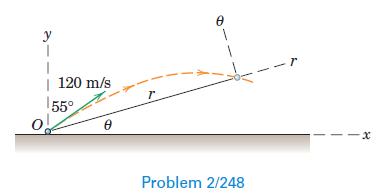
A projectile is fired with the given initial conditions. Plot the r- and θ-components of velocity and acceleration as functions of time for the time period during which the particle is in the air. State the value for each component at time t = 9 s. y 1. | 120 m/s 55° Problem 2/248
The position s of a particle along a straight line is given by s = 8e−0.4t − 6t + t2, where s is in meters and t is the time in seconds. Determine the velocity v when the acceleration is 3 m/s2.
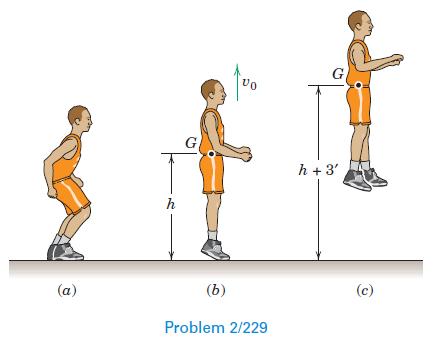
In a test of vertical leaping ability, a basketball player (a) Crouches just before jumping, (b) Has given his mass center G a vertical velocity v0 at the instant his feet leave the surface, (c) Reaches the maximum height. If the player can raise his mass center 3 feet as shown,
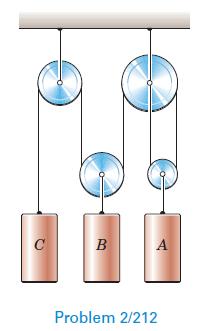
Determine the relation which governs the accelerations of A, B, and C, all measured positive down. Identify the number of degrees of freedom. C B A Problem 2/212
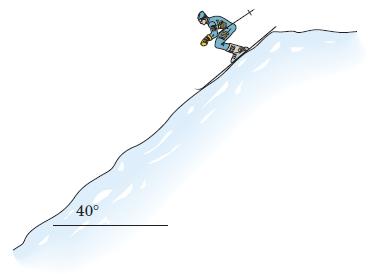
A skier starts from rest on the 40° slope at time t = 0 and is clocked at t = 2.58 s as he passes a speed checkpoint 20 m down the slope. Determine the coefficient of kinetic friction between the snow and the skis. Neglect wind resistance. 40°
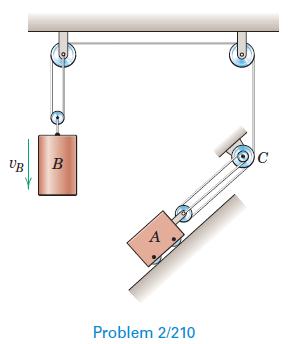
Determine the velocity of cart A if cylinder B has a downward velocity of 2 ft/sec at the instant illustrated. The two pulleys at C are pivoted independently. UB B Problem 2/210
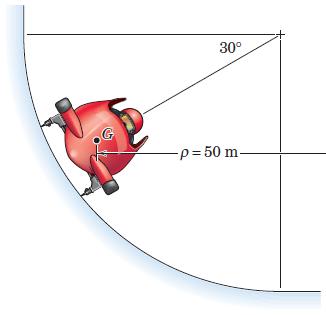
Determine the speed which the 630-kg four-man bobsled must have in order to negotiate the turn without reliance on friction. Also find the net normal force exerted on the bobsled by the track. 30° G -P3D50 m-
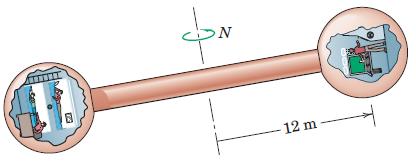
In the design of a space station to operate outside the earth’s gravitational field, it is desired to give the structure a rotational speed N which will simulate the effect of the earth’s gravity for members of the crew. If the centers of the crew’s quarters are to be located 12 m from the
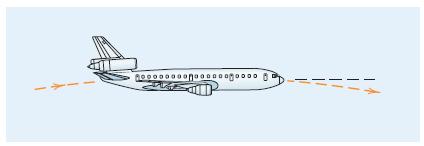
A jet transport plane flies in the trajectory shown in order to allow astronauts to experience the “weightless” condition similar to that aboard orbiting spacecraft. If the speed at the highest point is 600 mi/hr, what is the radius of curvature ρ necessary to exactly simulate the orbital
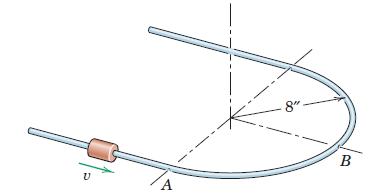
The 4-oz slider has a speed v = 3 ft /sec as it passes point A of the smooth guide, which lies in a horizontal plane. Determine the magnitude R of the force which the guide exerts on the slider (a) just before it passes point A of the guide and (b) as it passes point B. 8" B A
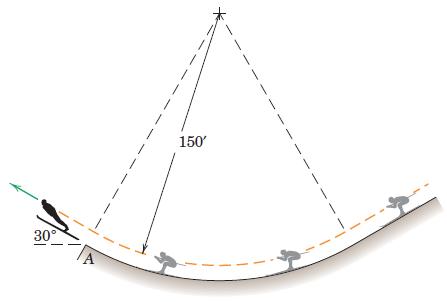
If the 180-lb ski-jumper attains a speed of 80 ft /sec as he approaches the takeoff position, calculate the magnitude N of the normal force exerted by the snow on his skis just before he reaches A. 150' 30°
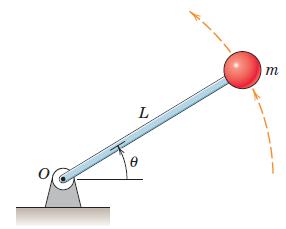
The particle of mass m is attached to the light rigid rod, and the assembly rotates about a horizontal axis through O with a constant angular velocity θ˙ = ω. Determine the tension T in the rod as a function of θ. m L
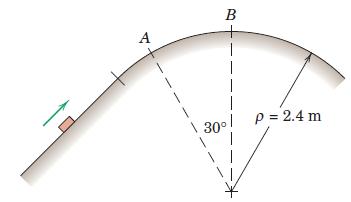
If the 2-kg block passes over the top B of the circular portion of the path with a speed of 3.5 m/s, calculate the magnitude NB of the normal force exerted by the path on the block. Determine the maximum speed v which the block can have at A without losing contact with the path. B 30°l P= 2.4 m
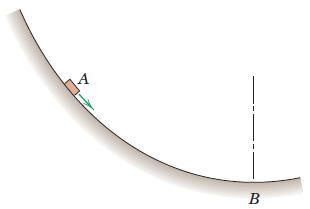
The small 2-kg block A slides down the curved path and passes the lowest point B with a speed of 4 m /s. If the radius of curvature of the path at B is 1.5 m, determine the normal force N exerted on the block by the path at this point. Is knowledge of the friction properties necessary? B
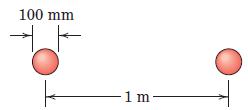
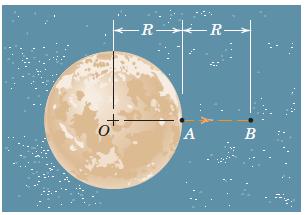
Two iron spheres, each of which is 100 mm in diameter, are released from rest with a center-to-center separation of 1 m. Assume an environment in space with no forces other than the force of mutual gravitational attraction and calculate the time t required for the spheres to contact each other and
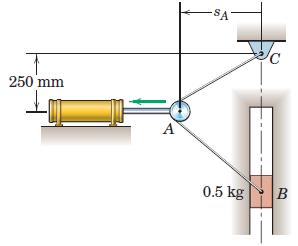
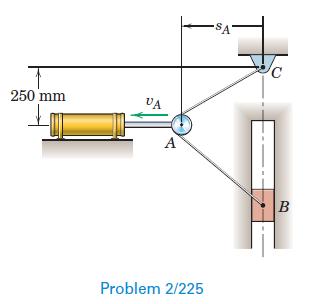
The rod of the fixed hydraulic cylinder is moving to the left with a speed of 100 mm /s, and this speed is momentarily increasing at a rate of 400 mm/s each second at the instant when sA = 425 mm. Determine the tension in the cord at that instant. The mass of slider B is 0.5 kg, the length of the
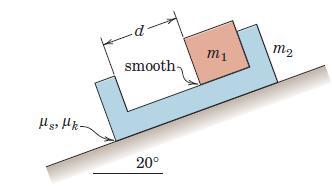
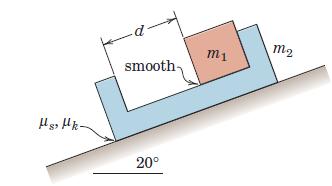
The system of Prob. 3/43 is reconsidered here, only now the interface between the two bodies is not smooth. Use the values μs = 0.10 and μk = 0.08 between the two bodies. Determine the time t when m1 contacts the lower stop on m2 and the corresponding distance s2 traveled by m2.Data from problem
The system is released from rest in the configuration shown at time t = 0. Determine the time t when the block of mass m1 contacts the lower stop of the body of mass m2. Also, determine the corresponding distance s2 traveled by m2. Use the values m1 = 0.5 kg, m2 = 2 kg, μs = 0.25, μk = 0.20, and
The design of a lunar mission calls for a 1200-kg spacecraft to lift off from the surface of the moon and travel in a straight line from point A and pass point B. If the spacecraft motor has a constant thrust of 2500 N, determine the speed of the spacecraft as it passes point B. Use Table D/ 2 and
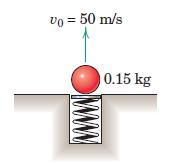
A spring-loaded device imparts an initial vertical velocity of 50 m/s to a 0.15-kg ball. The drag force on the ball is FD = 0.002v2, where FD is in newtons when the speed v is in meters per second. Determine the maximum altitude h attained by the ball (a) With drag considered (b) With drag
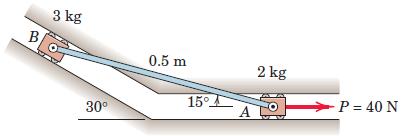
The sliders A and B are connected by a light rigid bar and move with negligible friction in the slots, both of which lie in a horizontal plane. For the position shown, the velocity of A is 0.4 m /s to the right. Determine the acceleration of each slider and the force in the bar at this instant. B 3
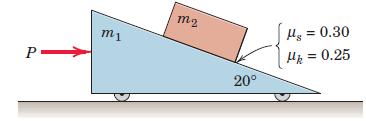
Determine the range of applied force P over which the block of mass m2 will not slip on the wedge-shaped block of mass m1. Neglect friction associated with the wheels of the tapered block. m2 Hs = 0.30 %3D m1 Hk = 0.25 20°
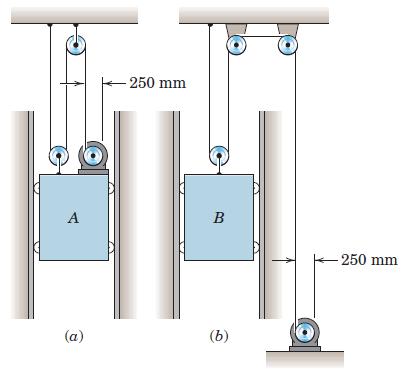
Two configurations for raising an elevator are shown. Elevator A with attached hoisting motor and drum has a total mass of 900 kg. Elevator B without motor and drum also has a mass of 900 kg. If the motor supplies a constant torque of 600 N∙m to its 250-mm-diameter drum for 2 s in each case,
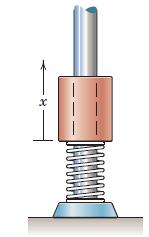
The 4-lb collar is released from rest against the light elastic spring, which has a stiffness of 10 lb /in. and has been compressed a distance of 6 in. Determine the acceleration a of the collar as a function of the vertical displacement x of the collar measured in feet from the point of release.
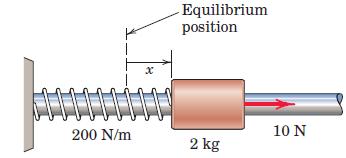
The spring of constant k = 200 N/ m is attached to both the support and the 2-kg cylinder, which slides freely on the horizontal guide. If a constant 10-N force is applied to the cylinder at time t = 0 when the spring is undeformed and the system is at rest, determine the velocity of the cylinder
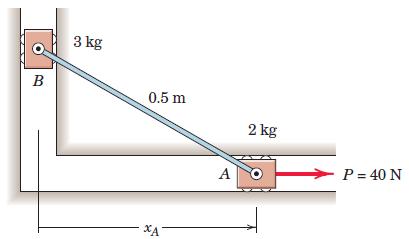
The sliders A and B are connected by a light rigid bar of length l = 0.5 m and move with negligible friction in the slots, both of which lie in a horizontal plane. For the position where xA = 0.4 m, the velocity of A is vA = 0.9 m /s to the right. Determine the acceleration of each slider and the
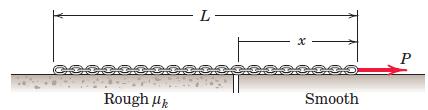
A heavy chain with a mass ρ per unit length is pulled by the constant force P along a horizontal surface consisting of a smooth section and a rough section. The chain is initially at rest on the rough surface with x = 0. If the coefficient of kinetic friction between the chain and the rough
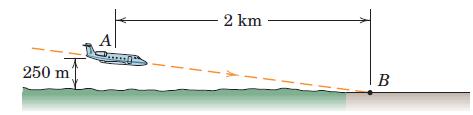
During its final approach to the runway, the aircraft speed is reduced from 300 km / h at A to 200 km / h at B. Determine the net external aerodynamic force R which acts on the 200-Mg aircraft during this interval, and fi nd the components of this force which are parallel to and normal to the fl
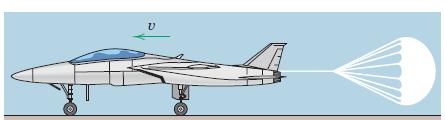
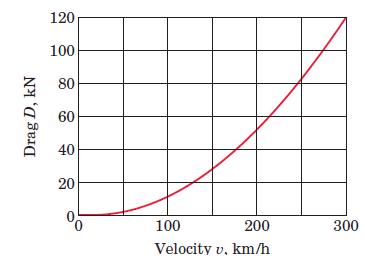
A jet airplane with a mass of 5 Mg has a touchdown speed of 300 km / h, at which instant the braking parachute is deployed and the power shut off. If the total drag on the aircraft varies with velocity as shown in the accompanying graph, calculate the distance x along the runway required to reduce
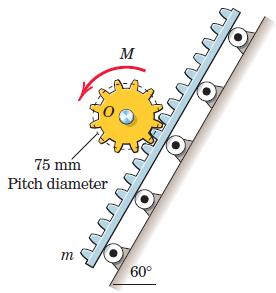
The rack has a mass m = 50 kg. What moment M must be exerted on the gear wheel by the motor in order to accelerate the rack up the 60° incline at a rate a = g/4? The fixed motor which drives the gear wheel via the shaft at O is not shown. Neglect the effects of the mass of the gear wheel. M 75 mm
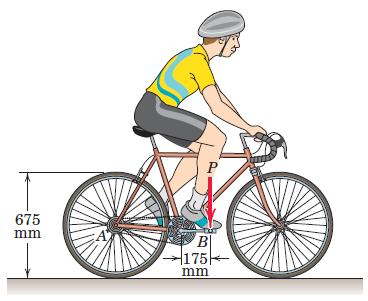
If the rider presses on the pedal with a force P = 160 N as shown, determine the resulting forward acceleration of the bicycle. Neglect the effects of the mass of rotating parts, and assume no slippage at the rear wheel. The radii of sprockets A and B are 45 mm and 90 mm, respectively. The mass of
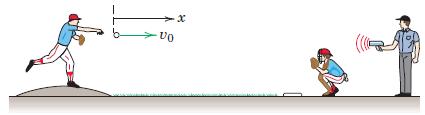
A player pitches a baseball horizontally toward a speed-sensing radar gun. The baseball weighs 5 1/8 oz and has a circumference of 9 1/8 in. If the speed at x = 0 is v0 = 90 mi / hr, estimate the speed as a function of x. Assume that the horizontal aerodynamic drag on the baseball is given by D =
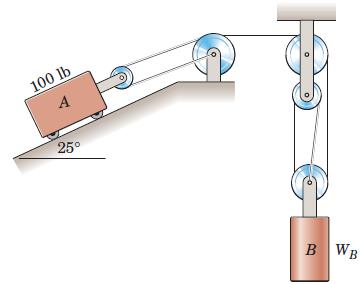
Determine the weight of cylinder B which would cause block A to accelerate (a) 5 ft /sec2 down the incline and (b) 5 ft /sec2 up the incline. Neglect all friction. 100 lb 25° B WB
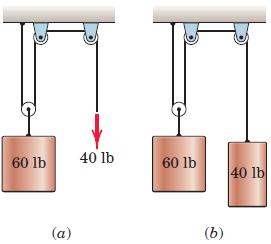
Determine the vertical acceleration of the 60-lb cylinder for each of the two cases. Neglect friction and the mass of the pulleys. 60 lb 40 lb 60 lb 40 lb (a) (b)
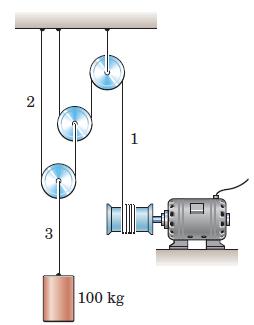
The winch takes in cable at the rate of 200 mm /s, and this rate is momentarily increasing at 500 mm /s each second. Determine the tensions in the three cables. Neglect the weights of the pulleys. 2 1 100 kg 3
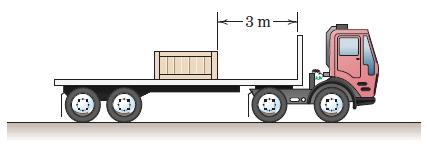
If the truck of Prob. 3/24 comes to a stop from an initial forward speed of 70 km / h in a distance of 50 m with uniform deceleration, determine whether or not the crate strikes the wall at the forward end of the flat bed. If the crate does strike the wall, calculate its speed relative to the truck
The coefficient of static friction between the flat bed of the truck and the crate it carries is 0.30. Determine the minimum stopping distance s which the truck can have from a speed of 70 km / h with constant deceleration if the crate is not to slip forward. -3 m-
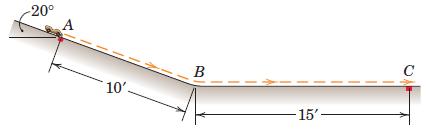
The 5-oz pinewood-derby car is released from rest at the starting line A and crosses the finish line C 2.75 sec later. The transition at B is small and smooth. Assume that the net retarding force is constant throughout the run and fi nd this force. -20° B C 10'. 15'-
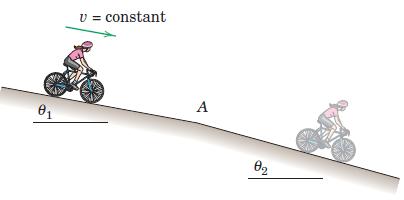
A bicyclist finds that she descends the slope θ1 = 3° at a certain constant speed with no braking or pedaling required. The slope changes fairly abruptly to θ2 at point A. If the bicyclist takes no action but continues to coast, determine the acceleration a of the bike just after it passes point
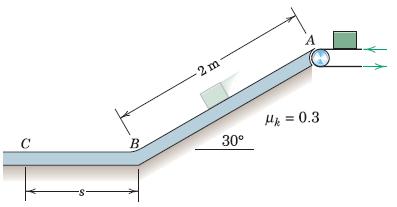
A small package is deposited by the conveyor belt onto the 30° ramp at A with a velocity of 0.8 m /s. Calculate the distance s on the level surface BC at which the package comes to rest. The coefficient of kinetic friction for the package and supporting surface from A to C is 0.30. -2 m- C 사=D
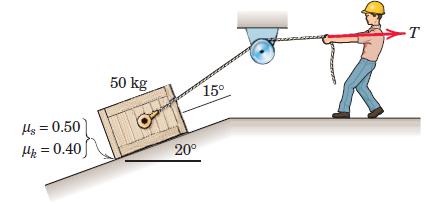
The wheeled cart of Prob. 3 /19 is now replaced with a 50-kg sliding wooden crate. The coefficients of static and kinetic friction are given in the figure. Determine the acceleration of the crate if (a) T = 300 N and (b) T = 400 N. Neglect friction at the pulley. T 50 kg 15° Hs = 0.50 He = 0.40
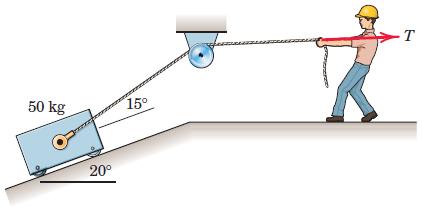
A worker develops a tension T in the cable as he attempts to move the 50-kg cart up the 20° incline. Determine the resulting acceleration of the cart if (a) T = 150 N and (b) T = 200 N. Neglect all friction, except that at the worker’s feet. 50 kg 15° 20°
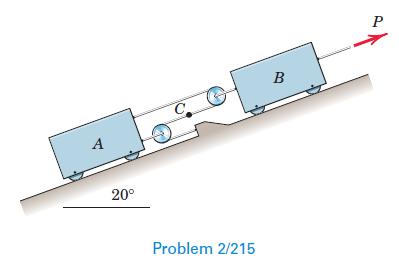
A toy train has magnetic couplers whose maximum attractive force is 0.2 lb between adjacent cars. What is the maximum force P with which a child can pull the locomotive and not break the train apart at a coupler? If P is slightly exceeded, which coupler fails? Neglect the mass and friction
cesium-ion engine for deep-space propulsion is designed to produce a constant thrust of 2.5 N for long periods of time. If the engine is to propel a 70-Mg spacecraft on an interplanetary mission, compute the time t required for a speed increase from 40 000 km / h to 65 000 km / h. Also fi nd the
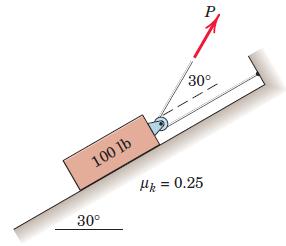
Determine the tension P in the cable which will give the 100-lb block a steady acceleration of 5 ft /sec2 up the incline. 30° 100 lb Hk = 0.25 30°
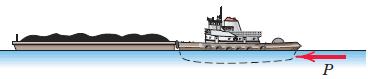
The drive system of the 350-ton tugboat causes an external thrust P = 7000 lb to be applied as indicated in the figure. If the tugboat pushes an 800-ton coal barge starting from rest, what is the acceleration of the combined unit? Also, determine the force R of interaction between tugboat and
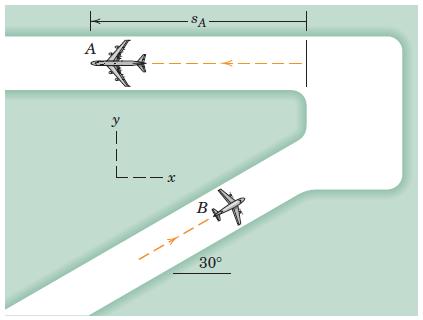
The 750,000-lb jetliner A has four engines, each of which produces a nearly constant thrust of 40,000 lb during the takeoff roll. A small commuter aircraft B taxis toward the end of the runway at a constant speed vB = 15 mi / hr. Determine the velocity and acceleration which A appears to have
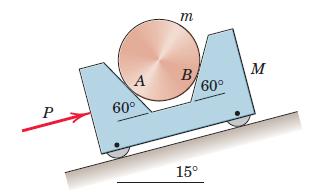
The system of the previous problem is now placed on the 15° incline. What force P will cause the normal reaction force at B to be zero? m M A B 60° P 60° 15°
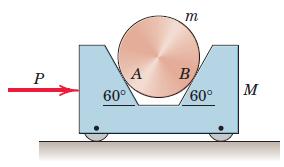
For a given horizontal force P, determine the normal reaction forces at A and B. The mass of the cylinder is m and that of the cart is M. Neglect all friction. m A 60° B 60° P M
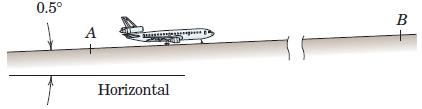
The 300-Mg jet airliner has three engines, each of which produces a nearly constant thrust of 240 kN during the takeoff roll. Determine the length s of runway required if the takeoff speed is 220 km / h. Compute s first for an uphill takeoff direction from A to B and second for a downhill takeoff
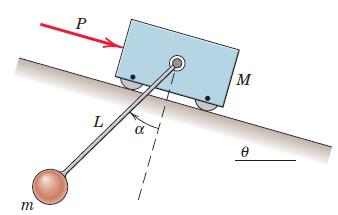
Determine the steady-state angle α if the constant force P is applied to the cart of mass M. The pendulum bob has mass m and the rigid bar of length L has negligible mass. Ignore all friction. Evaluate your expression for P = 0. M L m
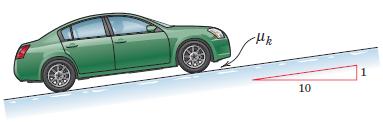
The inexperienced driver of an all-wheel-drive car applies too much throttle as he attempts to accelerate from rest up the slippery 10-percent incline. The result is wheel spin at all four tires, each of which has the same gripping ability. Determine the vehicle acceleration for the conditions of
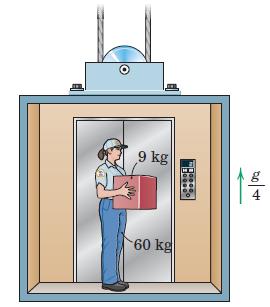
A 60-kg woman holds a 9-kg package as she stands within an elevator which briefly accelerates upward at a rate of g /4. Determine the force R which the elevator floor exerts on her feet and the lifting force L which she exerts on the package during the acceleration interval. If the elevator support
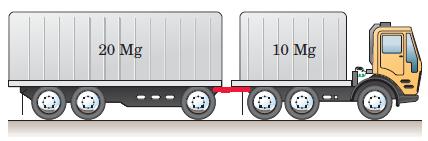
The 10-Mg truck hauls the 20-Mg trailer. If the unit starts from rest on a level road with a tractive force of 20 kN between the driving wheels of the truck and the road, compute the tension T in the horizontal drawbar and the acceleration a of the rig. 20 Mg 10 Mg
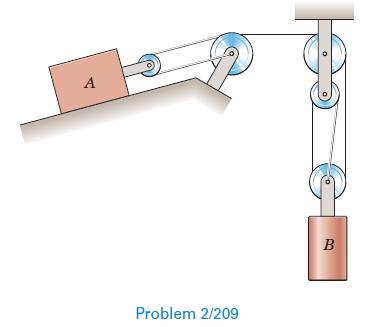
At a certain instant, the velocity of cylinder B is 1.2 m/s down and its acceleration is 2 m/s2 up. Determine the corresponding velocity and acceleration of block A. A B Problem 2/209
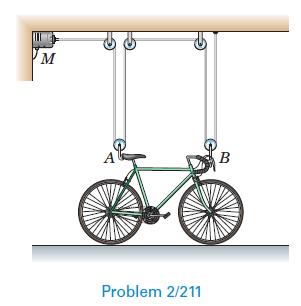
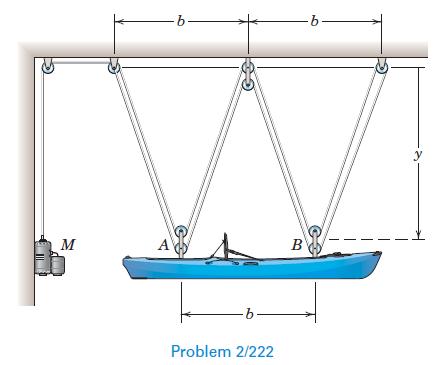
An electric motor M is used to reel in cable and hoist a bicycle into the ceiling space of a garage. Pulleys are fastened to the bicycle frame with hooks at locations A and B, and the motor can reel in cable at a steady rate of 12 in./sec. At this rate, how long will it take to hoist the bicycle 5
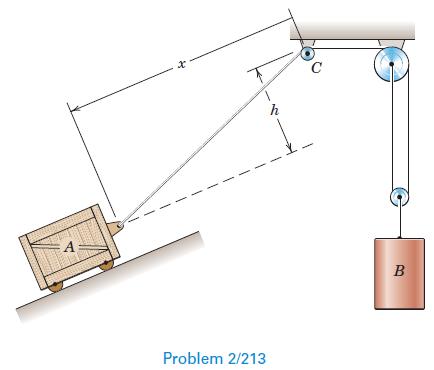
Determine an expression for the velocity vA of the cart A down the incline in terms of the upward velocity vB of cylinder B. C. = A B Problem 2/213
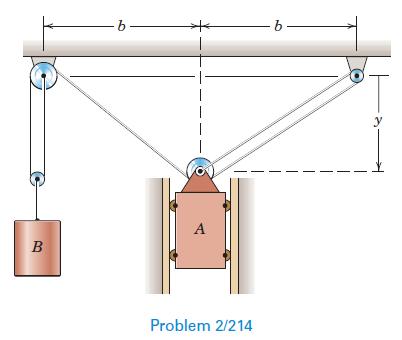
Neglect the diameters of the small pulleys and establish the relationship between the velocity of A and the velocity of B for a given value of y. y A B Problem 2/214
Under the action of force P, the constant acceleration of block B is 6 ft/sec2 up the incline. For the instant when the velocity of B is 3 ft/sec up the incline, determine the velocity of B relative to A, the acceleration of B relative to A, and the absolute velocity of point C of the cable. P B
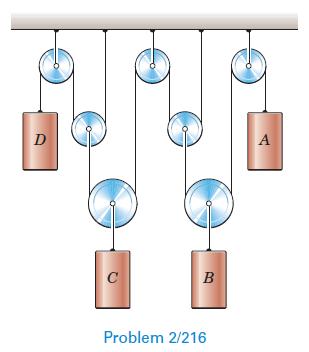
Determine the relationship which governs the velocities of the four cylinders. Express all velocities as positive down. How many degrees of freedom are there? A C Problem 2/216
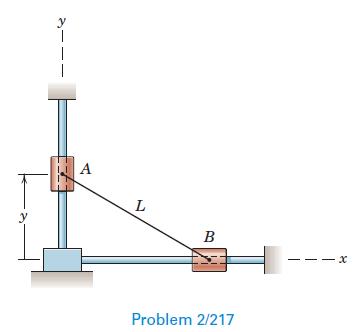
Collars A and B slide along the fixed right-angle rods and are connected by a cord of length L. Determine the acceleration ax of collar B as a function of y if collar A is given a constant upward velocity vA. y A L B Problem 2/217
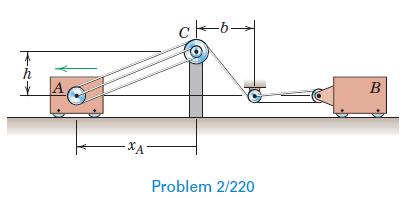
Cart A has a leftward velocity vA and acceleration aA at the instant represented. Determine the expressions for the velocity and acceleration of cart B in terms of the position xA of cart A. Neglect the diameters of the pulleys and assume that there is no mechanical interference. The two pulleys at
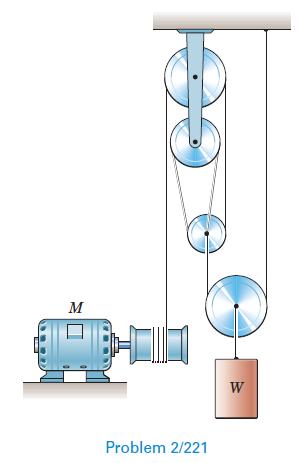
Determine the vertical rise h of the load W during 10 seconds if the hoisting drum draws in cable at the constant rate of 180 mm/s. M W Problem 2/221
The hoisting system shown is used to easily raise kayaks for overhead storage. Determine expressions for the upward velocity and acceleration of the kayak at any height y if the winch M reels in cable at a constant rate l˙. Assume that the kayak remains level. -- y M A B b- Problem 2/222
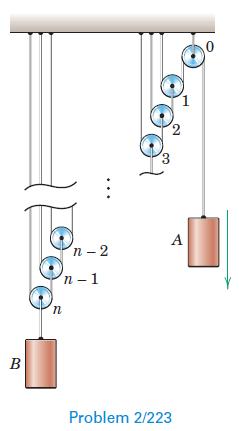
Develop an expression for the upward velocity of cylinder B in terms of the downward velocity of cylinder A. The cylinders are connected by a series of n cables and pulleys in a repeating fashion as shown. 3, A n - 2 n- 1 B Problem 2/223
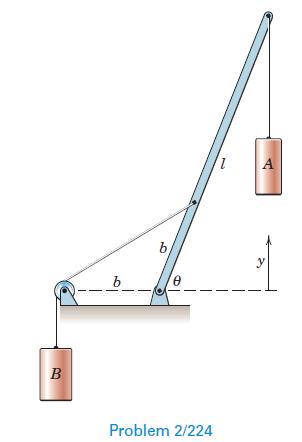
If load B has a downward velocity vB, determine the upward component (vA)y of the velocity of A in terms of b, the boom length l, and the angle θ. Assume that the cable supporting A remains vertical. 1, A b, y B Problem 2/224
The rod of the fixed hydraulic cylinder is moving to the left with a constant speed vA = 25 mm/s. Determine the corresponding velocity of slider B when sA = 425 mm. The length of the cord is 1050 mm, and the effects of the radius of the small pulley A may be neglected. -SA 250 mm VA A Problem 2/225
With all conditions of Prob. 2/225 remaining the same, determine the acceleration of slider B at the instant when sA = 425 mm.Data from Prob. 2/225The rod of the fixed hydraulic cylinder is moving to the left with a constant speed vA = 25 mm/s. Determine the corresponding velocity of slider B when
Showing 2200 - 2300
of 2550
First
12
13
14
15
16
17
18
19
20
21
22
23
24
25
26
Step by Step Answers

 Get 50% OFF
Claim Now
Get 50% OFF
Claim Now