New Semester
Started
Get
50% OFF
Study Help!
--h --m --s
Claim Now
Question Answers
Textbooks
Find textbooks, questions and answers
Oops, something went wrong!
Change your search query and then try again
S
Books
FREE
Study Help
Expert Questions
Accounting
General Management
Mathematics
Finance
Organizational Behaviour
Law
Physics
Operating System
Management Leadership
Sociology
Programming
Marketing
Database
Computer Network
Economics
Textbooks Solutions
Accounting
Managerial Accounting
Management Leadership
Cost Accounting
Statistics
Business Law
Corporate Finance
Finance
Economics
Auditing
Tutors
Online Tutors
Find a Tutor
Hire a Tutor
Become a Tutor
AI Tutor
AI Study Planner
NEW
Sell Books
Search
Search
Sign In
Register
study help
engineering
engineering mechanics dynamics
Engineering Mechanics Dynamics 8th Edition James L. Meriam, L. G. Kraige, J. N. Bolton - Solutions
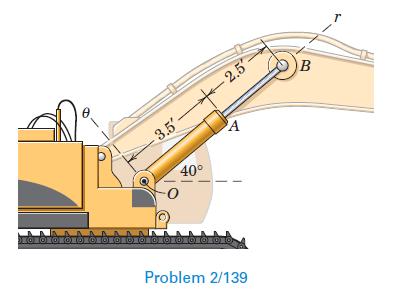
Consider the portion of an excavator shown. At the instant under consideration, the hydraulic cylinder is extending at a rate of 6 in. /sec, which is decreasing at the rate of 2 in. /sec every second. Simultaneously, the cylinder is rotating about a horizontal axis through O at a constant rate of
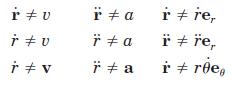
A particle moving along a plane curve has a position vector r, a velocity v, and an acceleration a. Unit vectors in the r- and θ-directions are er and eθ, respectively, and both r and θ are changing with time. Explain why each of the following statements is correctly marked as an inequality. r +
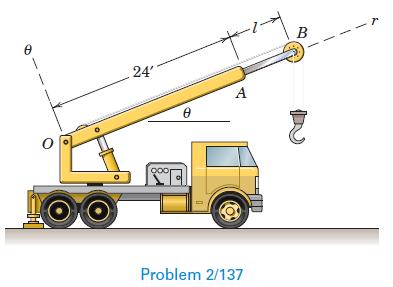
The boom OAB pivots about point O, while section AB simultaneously extends from within section OA. Determine the velocity and acceleration of the center B of the pulley for the following conditions: θ = 20°, θ˙ = 5 deg /sec, θ¨ = 2 deg /sec2, l = 7 ft, l˙ = 1.5 ft /sec, l¨ = −4 ft /sec2.
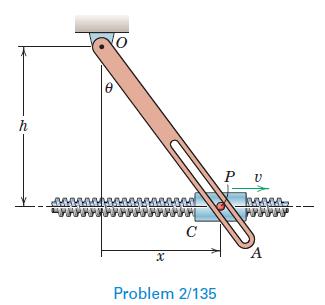
For the bar of Prob. 2/135, determine the values of r¨ and θ¨ if the velocity of collar C is decreasing at a rate of 5 mm/s2 at the instant in question. Refer to the printed answers for Prob. 2/135 as needed.Data from Prob. 2/135Rotation of bar OA is controlled by the lead screw which imparts a
Rotation of bar OA is controlled by the lead screw which imparts a horizontal velocity v to collar C and causes pin P to travel along the smooth slot. Determine the values of r˙ and θ˙, where r = OP, if h = 160 mm, x = 120 mm, and v = 25 mm/s at the instant represented. h C A Problem 2/135
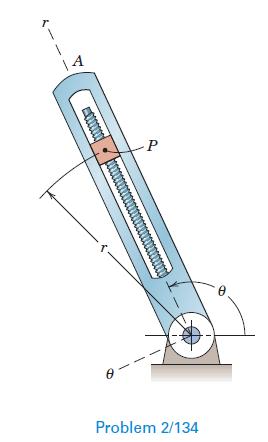
Motion of the sliding block P in the rotating radial slot is controlled by the power screw as shown. For the instant represented, θ˙ = 0.1 rad/s, θ¨ = −0.04 rad /s2, and r = 300 mm. Also, the screw turns at a constant speed giving r˙ = 40 mm/s. For this instant, determine the magnitudes of
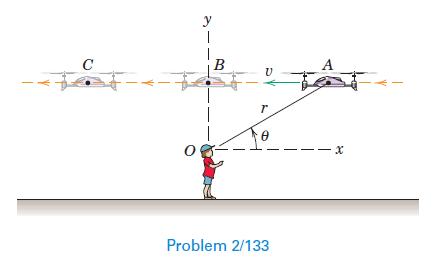
A drone flies over an observer O with constant speed in a straight line as shown. Determine the signs (plus, minus, or zero) for r, r˙, r¨, θ, θ˙ , and θ¨ for each of the positions A, B, and C. y В A Problem 2/133
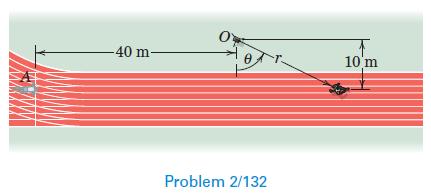
The sprinter begins from rest at position A and accelerates along the track. If the stationary tracking camera at O is rotating counterclockwise at the rate of 12.5 deg/s when the sprinter passes the 60-m mark, determine the speed v of the sprinter and the value of r˙. -40 m- 10 m Problem 2/132
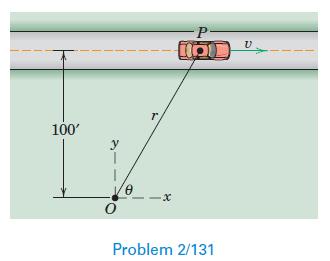
A car P travels along a straight road with a constant speed v = 65 mi/ hr. At the instant when the angle θ = 60°, determine the values of r˙ in ft/sec and θ˙ in deg/sec. P 100' y Problem 2/131
A projectile is launched at time t = 0 with the initial conditions shown in the figure. If the wind imparts a constant leftward acceleration of 5 m/s2, plot the n- and t-components of acceleration and the radius of curvature ρ of the trajectory for the time the projectile is in the air. State the
A particle which moves with curvilinear motion has coordinates in meters which vary with time t in seconds according to x = 2t2 + 3t − 1 and y = 5t − 2. Determine the coordinates of the center of curvature C at time t = 1 s.
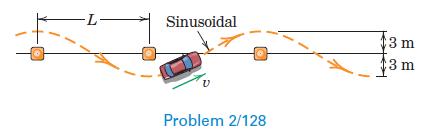
In a handling test, a car is driven through the slalom course shown. It is assumed that the car path is sinusoidal and that the maximum lateral acceleration is 0.7g. If the testers wish to design a slalom through which the maximum speed is 80 km/h, what cone spacing L should be used? -L- Sinusoidal
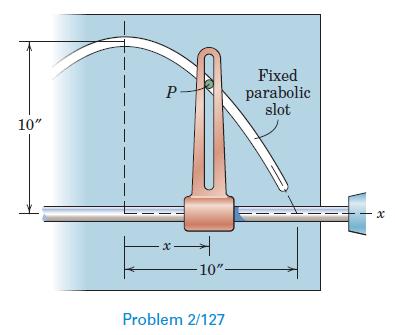
In the design of a control mechanism, the vertical slotted guide is moving with a constant velocity x˙ = 15 in. /sec during the interval of motion from x = −8 in. to x = +8 in. For the instant when x = 6 in., calculate the n- and t-components of acceleration of the pin P, which is confined to
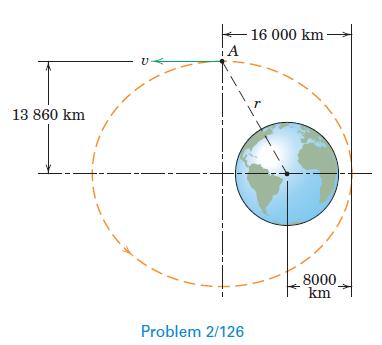
An earth satellite which moves in the elliptical equatorial orbit shown has a velocity v in space of 17 970 km/h when it passes the end of the semi minor axis at A. The earth has an absolute surface value of g of 9.821 m/s2 and has a radius of 6371 km. Determine the radius of curvature ρ of the
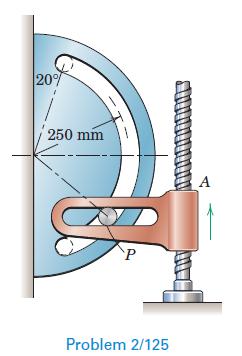
In the design of a timing mechanism, the motion of pin P in the fixed circular slot is controlled by the guide A, which is being elevated by its lead screw. Guide A starts from rest with pin P at the lowest point in the circular slot, and accelerates upward at a constant rate until it reaches a
The particle P starts from rest at point A at time t = 0 and changes its speed thereafter at a constant rate of 2g as it follows the horizontal path shown. Determine the magnitude and direction of its total acceleration (a) just before it passes point B, (b) just after it passes point B, and (c) as
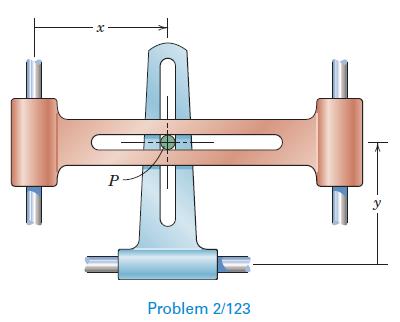
During a short interval the slotted guides are designed to move according to x = 16 − 12t + 4t2 and y = 2 + 15t − 3t2, where x and y are in millimeters and t is in seconds. At the instant when t = 2 s, determine the radius of curvature ρ of the path of the constrained pin P. P- y Problem 2/123
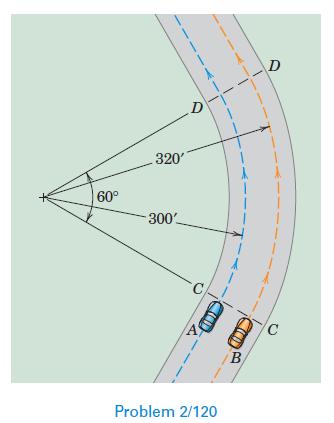
Two cars travel at constant speeds through a curved portion of highway. If the front ends of both cars cross line CC at the same instant, and each driver minimizes his or her time in the curve, determine the distance δ which the second car has yet to go along its own path to reach line DD at the
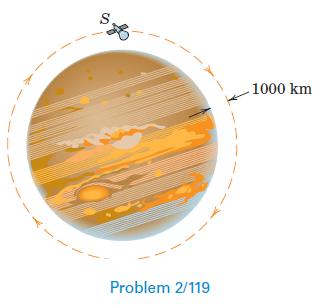
A spacecraft S is orbiting Jupiter in a circular path 1000 km above the surface with a constant speed. Using the gravitational law, calculate the magnitude v of its orbital velocity with respect to Jupiter. Use Table D /2 of Appendix D as needed. 1000 km Problem 2/119
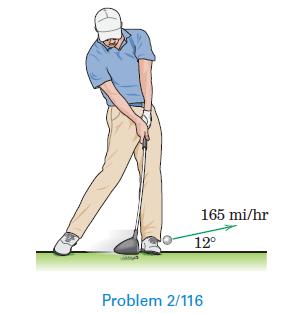
If the golf ball of Prob. 2/116 is launched at time t = 0, determine the two times when the radius of curvature of the trajectory has a value of 1800 ft.Data from Prob. 2/116A golf ball is launched with the initial conditions shown in the figure. Determine the radius of curvature of the trajectory
A golf ball is launched with the initial conditions shown in the figure. Determine the radius of curvature of the trajectory and the time rate of change of the speed of the ball (a) just after launch and (b) at apex. Neglect aerodynamic drag. 165 mi/hr 12° Problem 2/116
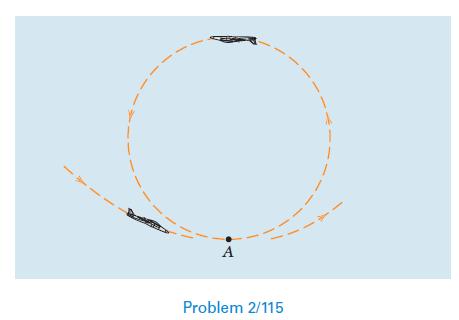
At the bottom A of the vertical inside loop, the magnitude of the total acceleration of the airplane is 3g. If the airspeed is 800 km/h and is increasing at the rate of 20 km/h per second, calculate the radius of curvature ρ of the path at A. A Problem 2/115
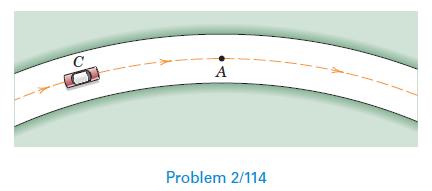
The car C increases its speed at the constant rate of 1.5 m/s2 as it rounds the curve shown. If the magnitude of the total acceleration of the car is 2.5 m/s2 at point A where the radius of curvature is 200 m, compute the speed v of the car at this point. A Problem 2/114
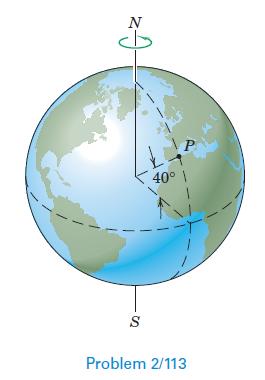
Consider the polar axis of the earth to be fixed in space and compute the magnitudes of the velocity and acceleration of a point P on the earth’s surface at latitude 40° north. The mean diameter of the earth is 12 742 km and its angular velocity is 0.7292(10−4) rad/s. N 40° S Problem 2/113
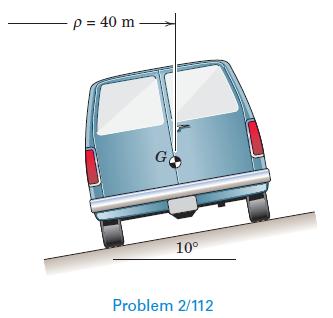
A minivan starts from rest on the road whose constant radius of curvature is 40 m and whose bank angle is 10°. The motion occurs in a horizontal plane. If the constant forward acceleration of the minivan is 1.8 m/s2, determine the magnitude a of its total acceleration 5 seconds after starting. p =
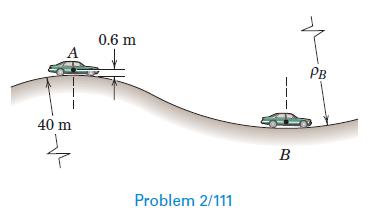
The speed of a car increases uniformly with time from 50 km/h at A to 100 km/h at B during 10 seconds. The radius of curvature of the hump at A is 40 m. If the magnitude of the total acceleration of the mass center of the car is the same at B as at A, compute the radius of curvature ρB of the dip
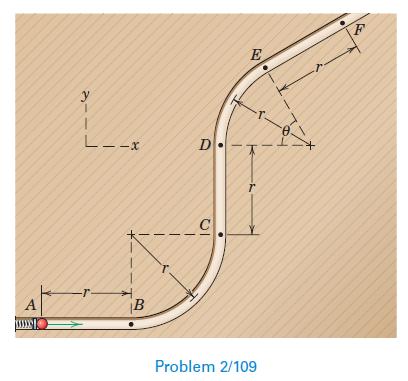
For the pinball game of Prob. 2/109, if the plunger imparts an initial speed of 3 m /s to the ball at time t = 0, determine the acceleration a of the ball (a) at time t = 0.08 s and (b) at time t = 0.20 s. At point F, the speed of the pinball has decreased by 10% from the initial value, and this
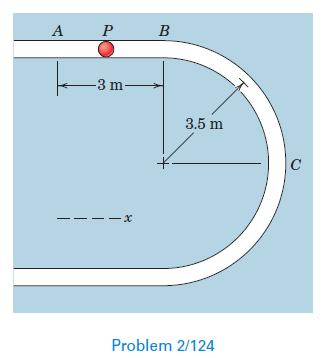
An overhead view of part of a pinball game is shown. If the plunger imparts a speed of 3 m/s to the ball which travels in the smooth horizontal slot, determine the acceleration a of the ball (a) just before it exits the curve at C and (b) when it is halfway between points D and E. Use the values r
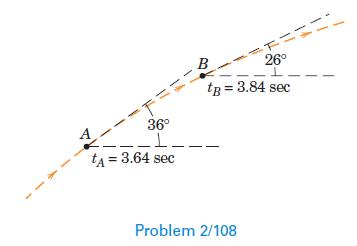
A particle moves along the curved path shown. If the particle has a speed of 40 ft/sec at A at time tA and a speed of 44 ft/sec at B at time tB, determine the average values of the acceleration of the particle between A and B, both normal and tangent to the path. B 26° tg = 3.84 sec 36° ta = 3.64
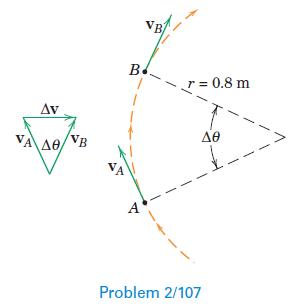
A particle moves on a circular path of radius r = 0.8 m with a constant speed of 2 m/s. The velocity undergoes a vector change Δv from A to B. Express the magnitude of Δv in terms of v and Δθ and divide it by the time interval Δt between A and B to obtain the magnitude of the average
A train enters a curved horizontal section of track at a speed of 100 km/h and slows down with constant deceleration to 50 km/h in 12 seconds. An accelerometer mounted inside the train records a horizontal acceleration of 2 m/s2 when the train is 6 seconds into the curve. Calculate the radius of
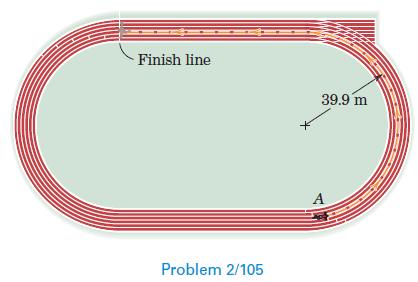
A sprinter practicing for the 200-m dash accelerates uniformly from rest at A and reaches a top speed of 40 km/h at the 60-m mark. He then maintains this speed for the next 70 meters before uniformly slowing to a final speed of 35 km/h at the finish line. Determine the maximum horizontal
A ship which moves at a steady 20-knot speed (1 knot = 1.852 km/h) executes a turn to port by changing its compass heading at a constant counterclockwise rate. If it requires 60 seconds to alter course 90°, calculate the magnitude of the acceleration a of the ship during the turn.
A particle moves along the curved path shown. The particle has a speed vA = 12 ft/sec at time tA and a speed vB = 14 ft/sec at time tB. Determine the average values of the normal and tangential accelerations of the particle between points A and B. UB B 25° tg = 2.62 sec A VA 15° ta = 2.4 sec
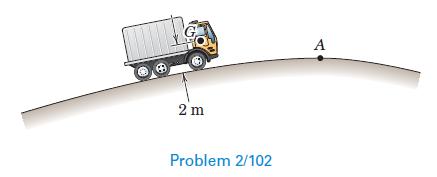
The driver of the truck has an acceleration of 0.4g as the truck passes over the top A of the hump in the road at constant speed. The radius of curvature of the road at the top of the hump is 98 m, and the center of mass G of the driver (considered a particle) is 2 m above the road. Calculate the
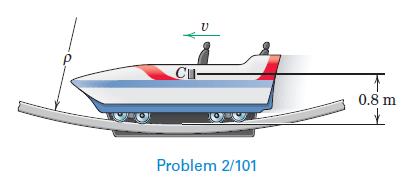
An accelerometer C is mounted to the side of the roller-coaster car and records a total acceleration of 3.5g as the empty car passes the bottommost position of the track as shown. If the speed of the car at this position is 215 km/h and is decreasing at the rate of 18 km/h every second, determine
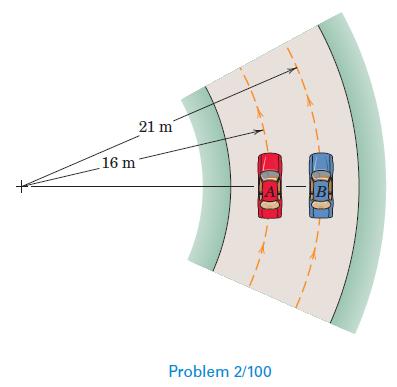
Determine the maximum speed for each car if the normal acceleration is limited to 0.88g. The roadway is unbanked and level. 21 m 16 m Problem 2/100
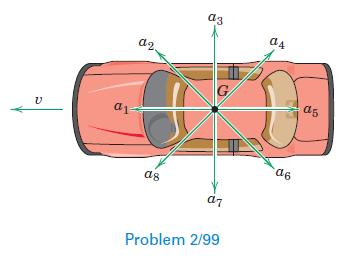
The car moves on a horizontal surface without any slippage of its tires. For each of the eight horizontal acceleration vectors, describe in words the instantaneous motion of the car. The car velocity is directed to the left as shown for all cases. az a2. a5 a6 as Problem 2/99
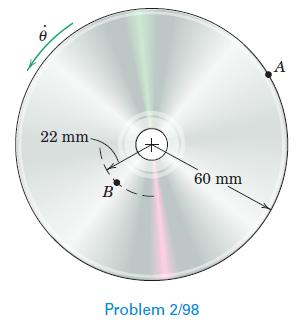
If the compact disc is spinning at a constant angular rate θ˙= 360 rev/min, determine the magnitudes of the accelerations of points A and B at the instant shown. A 22 mm- 60 mm B Problem 2/98
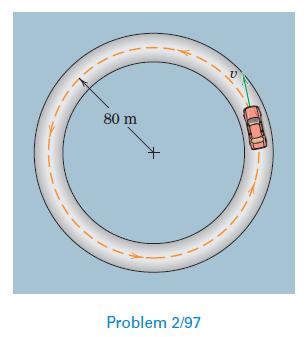
A test car starts from rest on a horizontal circular track of 80-m radius and increases its speed at a uniform rate to reach 100 km/h in 10 seconds. Determine the magnitude a of the total acceleration of the car 8 seconds after the start. 80 m Problem 2/97
A projectile is ejected into an experimental fluid at time t = 0. The initial speed is v0 and the angle to the horizontal is θ. The drag on the projectile results in an acceleration term aD = −kv, where k is a constant and v is the velocity of the projectile. Determine the x- and y-components of
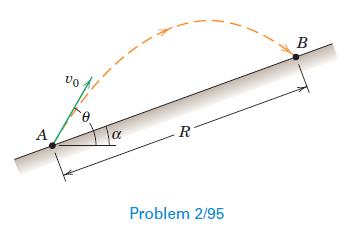
A projectile is launched with speed v0 from point A. Determine the launch angle θ which results in the maximum range R up the incline of angle α (where 0 ≤ α ≤ 90°). Evaluate your results for α = 0, 30°, and 45°. в B Ta A R Problem 2/95
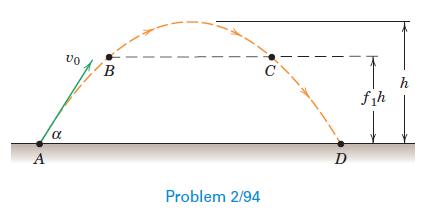
A projectile is launched from point A and lands on the same level at D. Its maximum altitude is h. Determine and plot the fraction ƒ2 of the total flight time that the projectile is above the level ƒ1h, where ƒ1 is a fraction which can vary from zero to 1. State he value of ƒ2 for ƒ1 =
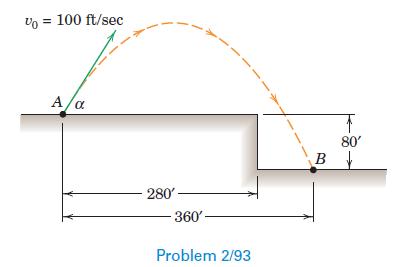
A projectile is launched from point A with an initial speed v0 = 100 ft/sec. Determine the minimum value of the launch angle θ for which the projectile will land at point B. vo = 100 ft/sec A/a 80' в - 280 ' 360'– Problem 2/93 -
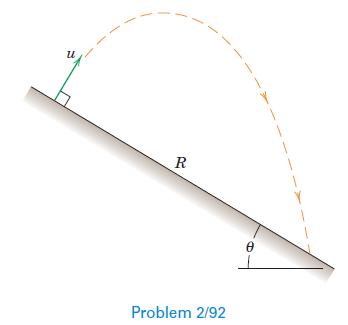
A projectile is fi red with a velocity u at right angles to the slope, which is inclined at an angle θ with the horizontal. Derive an expression for the distance R to the point of impact. R Problem 2/92
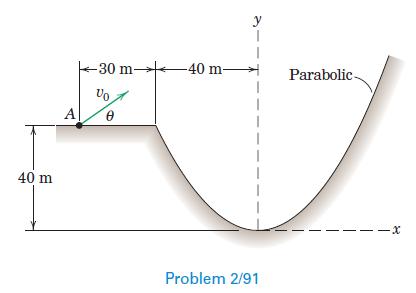
A projectile is launched from point A with v0 = 30 m/s and θ = 35°. Determine the x- and y-coordinates of the point of impact. y -30 m→ -40 m- Parabolic- Vo A 40 m -x Problem 2/91
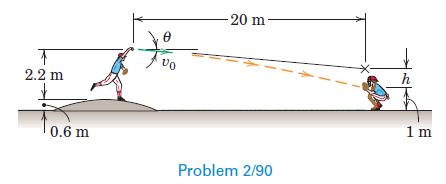
Determine the location h of the spot toward which the pitcher must throw if the ball is to hit the catcher’s mitt. The ball is released with a speed of 40 m/s. -20 m vo 2.2 m 1 m 0.6 m Problem 2/90
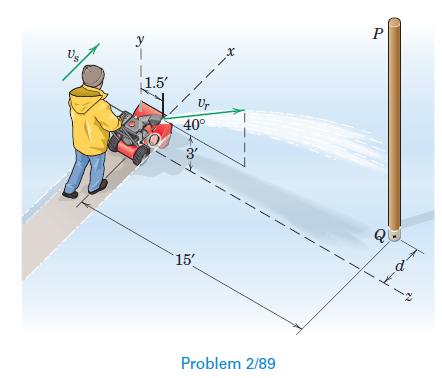
A snow blower travels forward at a constant speed vs = 1.4 ft/sec along the straight and level path shown. The snow is ejected with a speed vr = 30 ft/sec relative to the machine at the 40° angle indicated. Determine the distance d which locates the snow blower position from which an ejected snow
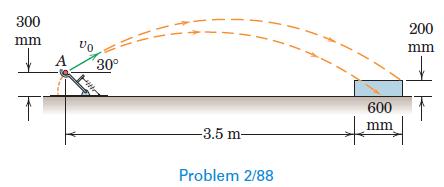
A team of engineering students is designing a catapult to launch a small ball at A so that it lands in the box. If it is known that the initial velocity vector makes a 30° angle with the horizontal, determine the range of launch speeds v0 for which the ball will land inside the box. 300 200 mm mm
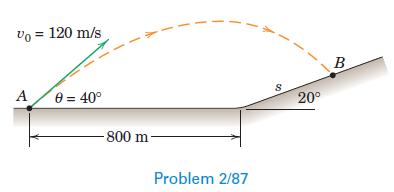
A projectile is launched from point A with the initial conditions shown in the figure. Determine the slant distance s which locates the point B of impact. Calculate the time of flight t. vo = 120 m/s A e = 40° 20° -800 m Problem 2/87
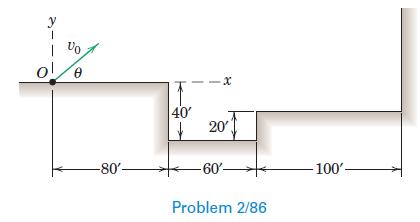
A projectile is launched from point O with the initial conditions shown. Determine the impact coordinates for the projectile if (a) v0 = 60 ft/sec and θ = 40° and (b) v0 = 85 ft /sec and θ = 15°. y | Vo o! -x 40 20 -80' 60'- 100 Problem 2/86
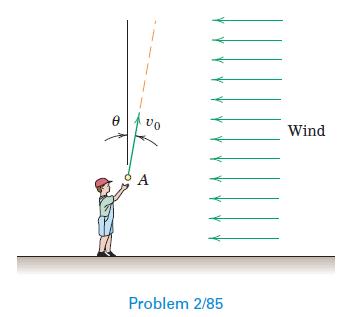
A boy throws a ball upward with a speed v0 = 12 m/s. The wind imparts a horizontal acceleration of 0.4 m/s2 to the left. At what angle θ must the ball be thrown so that it returns to the point of release? Assume that the wind does not affect the vertical motion. vo Wind A Problem 2/85
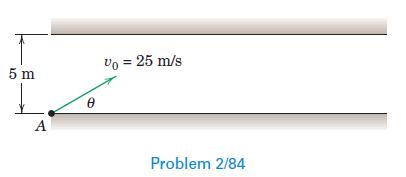
A projectile is launched with a speed v0 = 25 m/s from the floor of a 5-m-high tunnel as shown. Determine the maximum horizontal range R of the projectile and the corresponding launch angle θ. Vo = 25 m/s 5 m A Problem 2/84
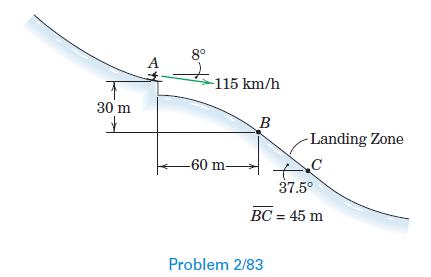
A ski jumper has the takeoff conditions shown. Determine the inclined distance d from the takeoff point A to the location where the skier first touches down in the landing zone, and the total time tƒ during which the skier is in the air. For simplicity, assume that the landing zone BC is straight.
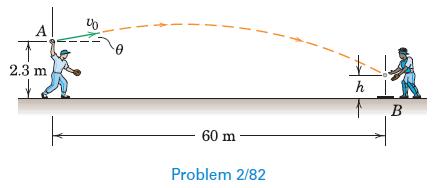
An out fielder experiments with two different trajectories for throwing to home plate from the position shown: (a) v0 = 42 m /s with θ = 8° and (b) v0 = 36 m/s with θ = 12°. For each set of initial conditions, determine the time t required for the baseball to reach home plate and the altitude h
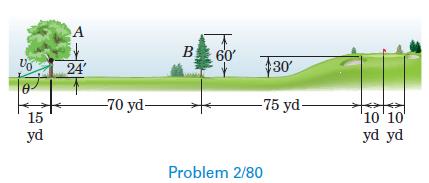
If the launch speed of the golf ball of the previous problem remains v0 = 115 mi/hr, what launch angle θ will put the first impact point of the ball closest to the pin? How far from the pin is this impact point?
A golfer is attempting to reach the elevated green by hitting his ball under a low-hanging branch in one tree A, but over the top of a second tree B. For v0 = 115 mi/hr and θ = 18°, where does the golf ball land first? A B 60 24 30 -70 yd- -75 yd- 10'10' yd yd 15 yd Problem 2/80
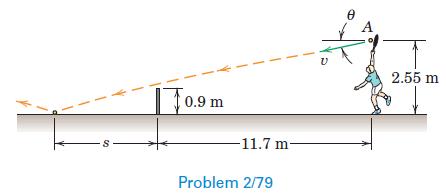
If the tennis player serves the ball horizontally (θ = 0), calculate its velocity v if the center of the ball clears the 0.9-m net by 150 mm. Also fi nd the distance s from the net to the point where the ball hits the court surface. Neglect air resistance and the effect of ball spin. 2.55 m | 10.9
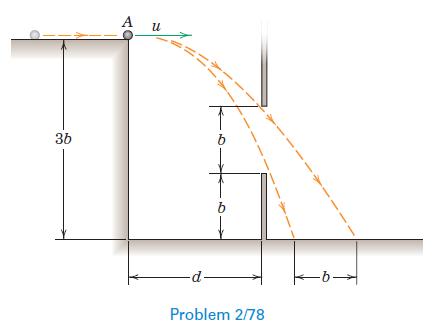
A particle is launched from point A with a horizontal speed u and subsequently passes through a vertical opening of height b as shown. Determine the distance d which will allow the landing zone for the particle to also have a width b. Additionally, determine the range of u which will allow the
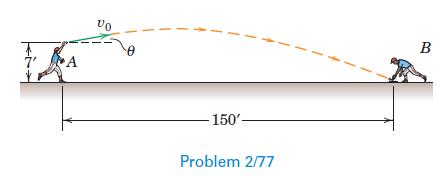
During a baseball practice session, the cutoff man A executes a throw to the third baseman B. If the initial speed of the baseball is v0 = 130 ft/sec, what launch angle θ is best if the ball is to arrive at third base at essentially ground level? B A 150'- Problem 2/77
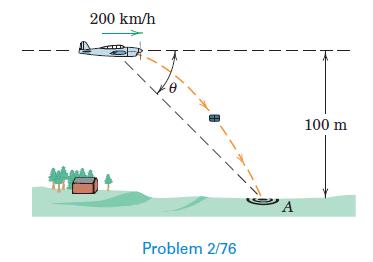
The pilot of an airplane carrying a package of mail to a remote outpost wishes to release the package at the right moment to hit the recovery location A. What angle θ with the horizontal should the pilot’s line of sight to the target make at the instant of release? The airplane is flying
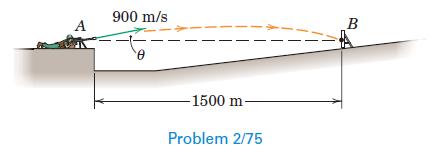
A marksman fi res a practice round from A toward a target B. If the target diameter is 160 mm and the target center is at the same altitude as the end of the rifle barrel, determine the range of “shallow” launch angles θ for which the round will strike the target. Neglect aerodynamic drag and
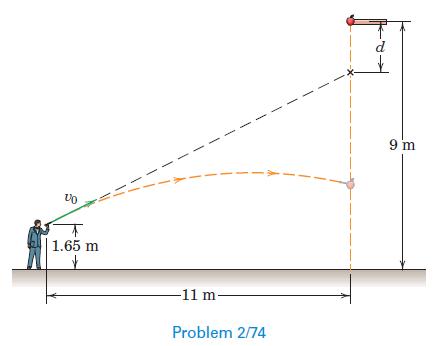
As part of a circus performance, a man is attempting to throw a dart into an apple which is dropped from an overhead platform. Upon release of the apple, the man has a reflex delay of 215 milliseconds before throwing the dart. If the dart is released with a speed v0 = 14 m/s, at what distance d
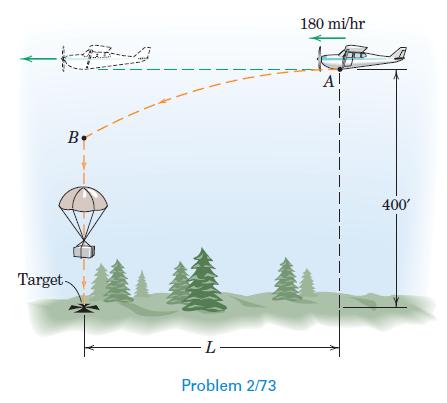
A small airplane flying horizontally with a speed of 180 mi/hr at an altitude of 400 ft above a remote valley drops an emergency medical package at A. The package has a parachute which deploys at B and allows the package to descend vertically at the constant rate of 6 ft /sec. If the drop is
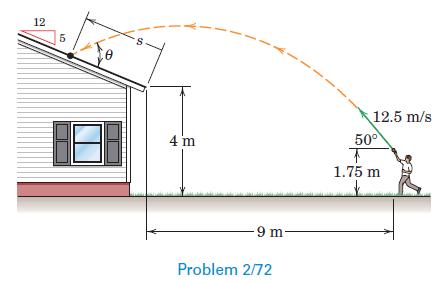
A boy tosses a ball onto the roof of a house. For the launch conditions shown, determine the slant distance s to the point of impact. Also, determine the angle θ which the velocity of the ball makes with the roof at the moment of impact. 12 5 12.5 m/s 50° 4 m 1.75 m 9 m - Problem 2/72
Electrons are emitted at A with a velocity u at the angle θ into the space between two charged plates. The electric field between the plates is in the direction E and repels the electrons approaching the upper plate. The field produces an acceleration of the electrons in the E-direction of eE/m,
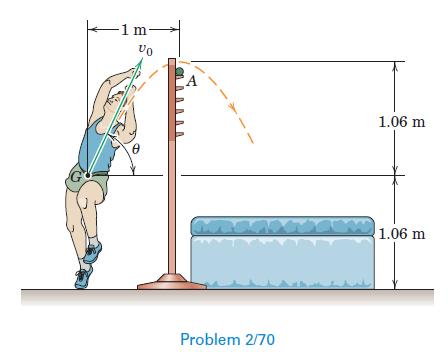
The center of mass G of a high jumper follows the trajectory shown. Determine the component v0, measured in the vertical plane of the figure, of his takeoff velocity and angle θ if the apex of the trajectory just clears the bar at A. (In general, must the mass center G of the jumper clear the bar
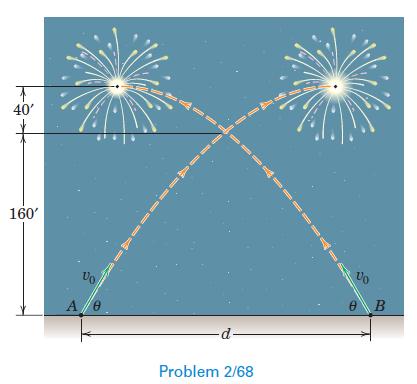
If a strong wind induces a constant rightward acceleration of 16 ft/sec2 for the fi reworks shells of Prob. 2/68, determine the horizontal shift of the crossing point of the shells. Refer to the printed answers for Prob. 2/68 as needed.
A fi reworks show is choreographed to have two shells cross paths at a height of 160 feet and explode at an apex of 200 feet under normal weather conditions. If the shells have a launch angle θ = 60° above the horizontal, determine the common launch speed v0 for the shells, the separation
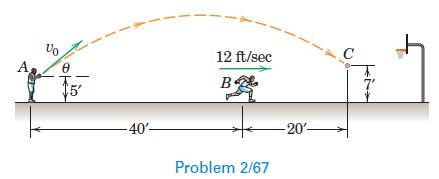
In a basketball game, the point guard A intends to throw a pass to the shooting guard B, who is breaking toward the basket at a constant speed of 12 ft /sec. If the shooting guard is to catch the ball at a height of 7 ft at C while in full stride to execute a layup, determine the speed v0 and
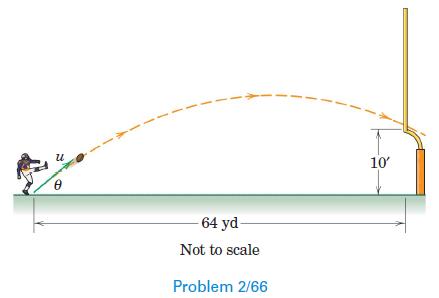
A placekicker is attempting to make a 64-yard field goal. If the launch angle of the football is 40°, what is the minimum initial speed u which will allow the kicker to succeed? 10 64 yd- Not to scale Problem 2/66
Prove the well-known result that, for a given launch speed v0, the launch angle θ = 45° yields the maximum horizontal range R. Determine the maximum range.
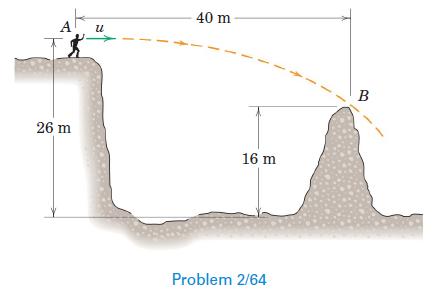
With what minimum horizontal velocity u can a boy throw a rock at A and have it just clear the obstruction at B? 40 m A B 26 m 16 m Problem 2/64
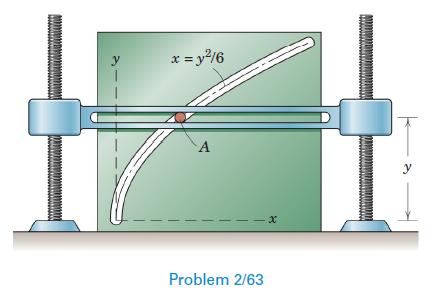
For a certain interval of motion the pin A is forced to move in the fixed parabolic slot by the horizontal slotted arm which is elevated in the y-direction at the constant rate of 3 in. /sec. All measurements are in inches and seconds. Calculate the velocity v and acceleration a of pin A when x = 6
The rectangular coordinates of a particle which moves with curvilinear motion are given by x = 10.25t + 1.75t2 − 0.45t3 and y = 6.32 + 14.65t − 2.48t2, where x and y are in millimeters and the time t is in seconds, beginning from t = 0. Determine the velocity v and acceleration a of the
At time t = 0, a particle is at rest in the x-y plane at the coordinates (x0, y0) = (6, 0) in. If the particle is then subjected to the acceleration components ax = 0.5 − 0.35t in. /sec2 and ay = 0.15t − 0.02t2 in. /sec2, determine the coordinates of the particle position when t = 6 sec. Plot
At time t = 0, the position vector of a particle moving in the x-y plane is r = 5i m. By time t = 0.02 s, its position vector has become 5.1i + 0.4 j m. Determine the magnitude vav of its average velocity during this interval and the angle θ made by the average velocity with the positive x-axis.
At time t = 10 s, the velocity of a particle moving in the x-y plane is v = 0.1i + 2j m/s. By time t = 10.1 s, its velocity has become −0.1i + 1.8j m/s. Determine the magnitude aav of its average acceleration during this interval and the angle θ made by the average acceleration with the positive
Repeat Prob. 2/57 for the case where aerodynamic drag is included. The magnitude of the drag deceleration is kv2, where k = 3.5(10−3) ft−1 and v is the speed in feet per second. The direction of the drag is opposite the motion of the projectile throughout the flight (when the projectile is
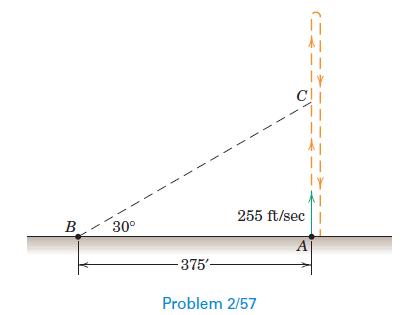
A projectile is fi red vertically from point A with an initial speed of 255 ft/sec. Relative to an observer located at B, at what times will the line of sight to the projectile make an angle of 30° with the horizontal? Compute the magnitude of the speed of the projectile at each time, and ignore
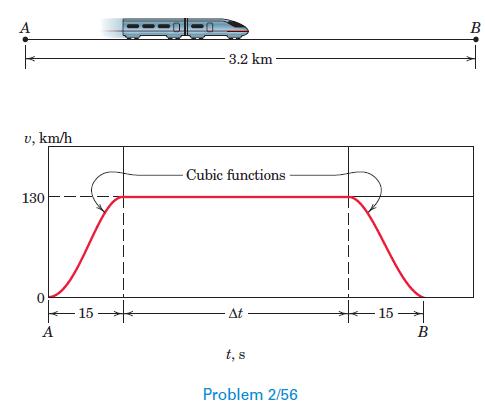
The preliminary design for a rapid-transit system calls for the train velocity to vary with time as shown in the plot as the train runs the 3.2 km between stations A and B. The slopes of the cubic transition curves (which are of form a + bt + ct2 + dt3) are zero at the end points. Determine the
The vertical acceleration of a certain solid-fuel rocket is given by a = ke−bt − cv − g, where k, b, and c are constants, v is the vertical velocity acquired, and g is the gravitational acceleration, essentially constant for atmospheric flight. The exponential term represents the effect of a
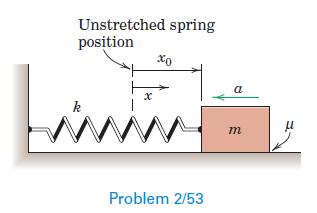
The situation of Prob. 2/53 is repeated here. This time, use the values m = 5 kg, k = 150 N /m, μ = 0.40, and x0 = 500 mm and determine the final spring stretch (or compression) xƒ when the block comes to a complete stop. The sign on the μg term is dictated by the direction of motion for the
A block of mass m rests on a rough horizontal surface and is attached to a spring of stiffness k. The coefficients of both static and kinetic friction are μ. The block is displaced a distance x0 to the right of the un stretched position of the spring and released from rest. If the value of x0 is
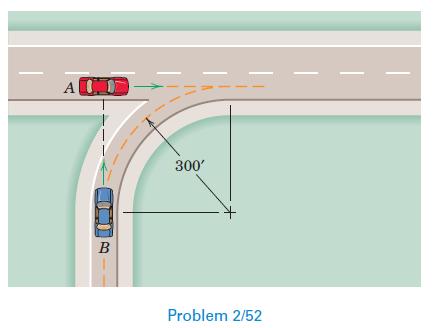
Car A travels at a constant speed of 65 mi / hr. When in the position shown at time t = 0, car B has a speed of 25 mi/hr and accelerates at a constant rate of 0.1g along its path until it reaches a speed of 65 mi/hr, after which it travels at that constant speed. What is the steady-state position
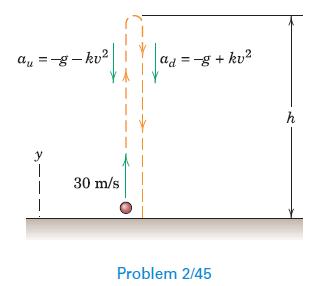
For the baseball of Prob. 2/45 thrown upward with an initial speed of 30 m/s, determine the time tu from ground to apex and the time td from apex to ground.Data from Prob. 2/45When the effect of aerodynamic drag is included, the y-acceleration of a baseball moving vertically upward is au = −g −
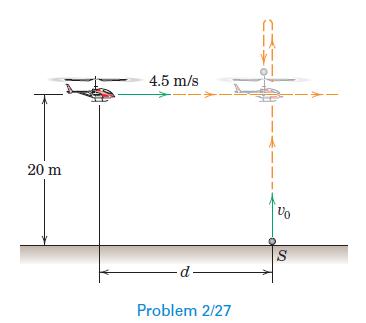
A toy helicopter is flying in a straight line at a constant speed of 4.5 m/s. If a projectile is launched vertically with an initial speed of v0 = 28 m/s, what horizontal distance d should the helicopter be from the launch site S if the projectile is to be traveling downward when it strikes the
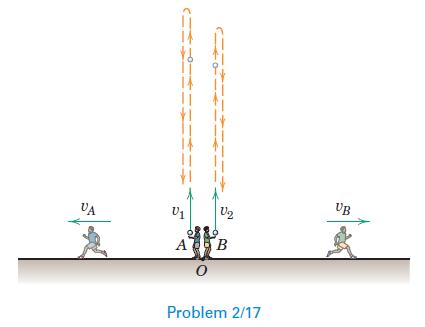
A game requires that two children each throw a ball upward as high as possible from point O and then run horizontally in opposite directions away from O. The child who travels the greater distance before their thrown ball impacts the ground wins. If child A throws a ball upward with a speed of v1 =
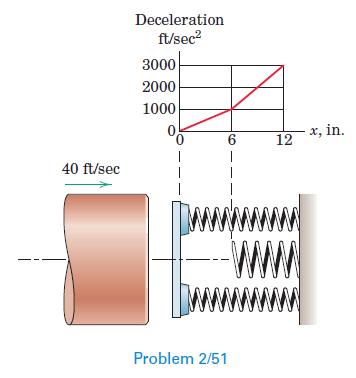
A bumper, consisting of a nest of three springs, is used to arrest the horizontal motion of a large mass which is traveling at 40 ft/sec as it contacts the bumper. The two outer springs cause a deceleration proportional to the spring deformation. The center spring increases the deceleration rate
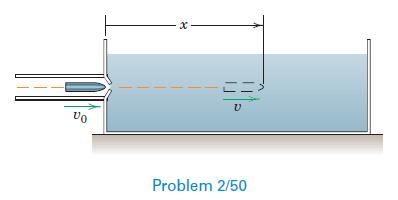
A test projectile is fi red horizontally into a viscous liquid with a velocity v0. The retarding force is proportional to the square of the velocity, so that the acceleration becomes a = −kv2. Derive expressions for the distance D traveled in the liquid and the corresponding time t required to
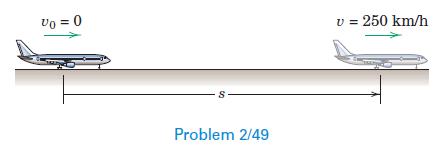
On its takeoff roll, the airplane starts from rest and accelerates according to a = a0 − kv2, where a0 is the constant acceleration resulting from the engine thrust and −kv2 is the acceleration due to aerodynamic drag. If a0 = 2 m/s2, k = 0.00004 m−1, and v is in meters per second, determine
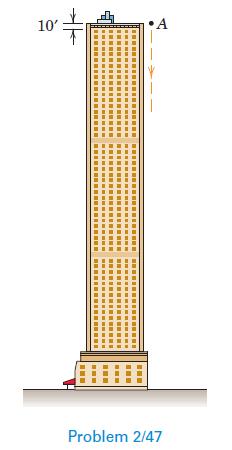
Repeat Prob. 2/47, except now include the effects of aerodynamic drag. The drag force causes an acceleration component in ft/sec2 of 0.005v2 in the direction opposite the velocity vector, where v is in ft/sec.Data from Prob. 2/47The stories of a tall building are uniformly 10 feet in height. A ball
The stories of a tall building are uniformly 10 feet in height. A ball A is dropped from the rooftop position shown. Determine the times required for it to pass the 10 feet of the first, tenth, and one hundredth stories (counted from the top). Neglect aerodynamic drag. 10위 A Problem 2/47
When the effect of aerodynamic drag is included, the y-acceleration of a baseball moving vertically upward is au = −g − kv2, while the acceleration when the ball is moving downward is ad = −g + kv2, where k is a positive constant and v is the speed in meters per second. If the ball is thrown
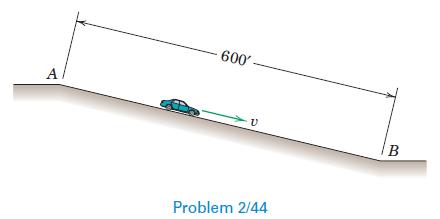
The driver of a car, which is initially at rest at the top A of the grade, releases the brakes and coasts down the grade with an acceleration in feet per second squared given by a = 3.22 − 0.004v2, where v is the velocity in feet per second. Determine the velocity vB at the bottom B of the grade.
The aerodynamic resistance to motion of a car is nearly proportional to the square of its velocity. Additional frictional resistance is constant, so that the acceleration of the car when coasting may be written a = −C1 − C2v2, where C1 and C2 are constants which depend on the mechanical
A projectile is fi red downward with initial speed v0 in an experimental fluid and experiences an acceleration a = σ − ηv2, where σ and η are positive constants and v is the projectile speed. Determine the distance traveled by the projectile when its speed has been reduced to one-half of the
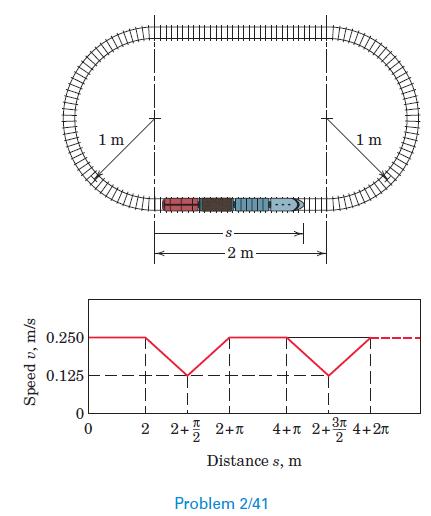
The electronic throttle control of a model train is programmed so that the train speed varies with position as shown in the plot. Determine the time t required for the train to complete one lap. 1m 1 m 2 m 0.250 0.125 2 2+ 2+1 4+1 2+ 4+2n Distance s, m Problem 2/41 Speed v, m/s
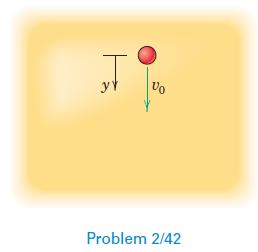
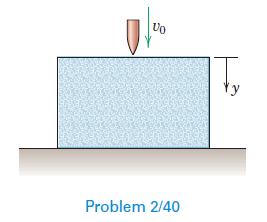
The falling object has a speed v0 when it strikes and subsequently deforms the foam arresting material until it comes to rest. The resistance of the foam material to deformation is a function of penetration depth y and object speed v so that the acceleration of the object is a = g − k1v − k2y,
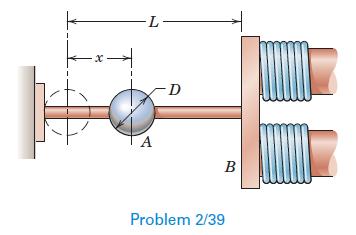
The steel ball A of diameter D slides freely on the horizontal rod which leads to the pole face of the electromagnet. The force of attraction obeys an inverse- square law, and the resulting acceleration of the ball is a = K/(L − x)2, where K is a measure of the strength of the magnetic field. If
Showing 2400 - 2500
of 2550
First
12
13
14
15
16
17
18
19
20
21
22
23
24
25
26
Step by Step Answers

 Get 50% OFF
Claim Now
Get 50% OFF
Claim Now