New Semester
Started
Get
50% OFF
Study Help!
--h --m --s
Claim Now
Question Answers
Textbooks
Find textbooks, questions and answers
Oops, something went wrong!
Change your search query and then try again
S
Books
FREE
Study Help
Expert Questions
Accounting
General Management
Mathematics
Finance
Organizational Behaviour
Law
Physics
Operating System
Management Leadership
Sociology
Programming
Marketing
Database
Computer Network
Economics
Textbooks Solutions
Accounting
Managerial Accounting
Management Leadership
Cost Accounting
Statistics
Business Law
Corporate Finance
Finance
Economics
Auditing
Tutors
Online Tutors
Find a Tutor
Hire a Tutor
Become a Tutor
AI Tutor
AI Study Planner
NEW
Sell Books
Search
Search
Sign In
Register
study help
engineering
introduction to chemical engineering thermodynamics
Introduction To Chemical Engineering Thermodynamics 2nd Edition HALDER - Solutions
For a mixture of \(20 \mathrm{~mol}\) per cent methane, \(30 \mathrm{~mol}\) per cent ethane and \(50 \mathrm{~mol}\) per cent propane at \(10^{\circ} \mathrm{C}\), determine(a) Dew point pressure(b) Bubble point pressure.Get \(K\)-values from the standard nomograph.
The following data are reported for vapour-liquid equilibrium for the ethanol-water system at \(298 \mathrm{~K}\). Test whether the data are thermodynamically consistent or not.
A solution containing \(2.423 \mathrm{~g}\) of sulphur in \(100 \mathrm{~g}\) of naphthalene (melting point \(80.1^{\circ} \mathrm{C}\) ) gave a freezing point depression of \(0.64^{\circ} \mathrm{C}\). The latent heat of fusion of naphthalene is \(35.7 \mathrm{cal} / \mathrm{g}\). What is the
Calculate the molal freezing point depression constant for benzene if its latent heat of fusion at \(5^{\circ} \mathrm{C}\) is \(9.83 \mathrm{~kJ} / \mathrm{mol}\).
The melting point of phenol is \(40^{\circ} \mathrm{C}\). A solution containing \(0.172 \mathrm{~g}\) acetanilide \(\left(\mathrm{C}_{8} \mathrm{H}_{9} \mathrm{ON}\right)\) in \(12.54 \mathrm{~g}\) phenol freezes at \(39.25^{\circ} \mathrm{C}\). Calculate the freezing point depression constant and
The boiling point of acetic acid is \(118.1^{\circ} \mathrm{C}\) and its latent heat of vaporization is \(121 \mathrm{cal} / \mathrm{g}\). A solution containing \(0.4344 \mathrm{~g}\) anthracene in \(44.16 \mathrm{~g}\) acetic acid boils at \(118.24^{\circ} \mathrm{C}\). What is the molecular
The boiling point elevation of a solvent is observed to be \(2.3 \mathrm{~K}\) when \(13.86 \mathrm{~g}\) of a solute is added to \(100 \mathrm{~g}\). Calculate molal elevation constant \(K_{\mathrm{b}}\) and molar latent heat of vaporization \(L_{\mathrm{v}}\) of the solvent. Given that Molar mass
Calculate the osmotic pressure at \(50^{\circ} \mathrm{C}\) of a glucose \(\left(\mathrm{C}_{6} \mathrm{H}_{12} \mathrm{O}_{6}\right)\) solution that has \(60 \mathrm{~g}\) of glucose dissolved in enough water to make \(1500 \mathrm{~g}\) of solution.
A solution contains \(0.6 \mathrm{~g}\) urea and \(1.8 \mathrm{~g}\) glucose in \(100 \mathrm{cc}\) of water at \(27^{\circ} \mathrm{C}\). Calculate the osmotic pressure of the solution.
Discuss the significance of liquid-liquid equilibrium in extraction process.
Explain the effect of temperature on liquid-liquid equilibrium with the help of a neat graphical representation.
Define the term critical solution temperature.
What do you mean by depression of freezing point? Discuss van't Hoff's law of freezing point depression of a solution.
What is ternary liquid-liquid equilibrium? How does a triangular diagram play an important role in explaining the phase equilibrium in a ternary system?
Give an informatory note on miscibility diagram for the ternary system.
Discuss the solid-vapour equilibrium for sublimation process.
What is boiling point elevation? Derive an expression on the relationship between the concentration of the solute and the boiling point elevation.
Show that the elevation of the boiling point is proportional to the molality of the solution.
What is osmotic pressure? How does it play an important role in osmotic equilibrium?
Explain osmotic equilibrium with the help of a neat sketch.
Justify the statement: Osmosis is of paramount importance in biological systems.
The freezing point of pure benzene is \(5.44^{\circ} \mathrm{C}\) and that of the solution containing \(2.092 \mathrm{~g}\) of benzaldehyde in \(100 \mathrm{~g}\) of benzene is \(4.44^{\circ} \mathrm{C}\). Calculate the molecular weight of benzaldehyde when \(K_{\mathrm{f}}\) for benzene is 5.1 .
The molality of dissolved gases in water at \(0^{\circ} \mathrm{C}\) and \(1 \mathrm{~atm}\) is \(1.29 \times 10^{-3}\). The decrease in volume during melting of ice is \(0.0907 \mathrm{cc} / \mathrm{g}\). The latent heat of fusion is \(1436.3 \mathrm{cal} / \mathrm{mol}\). The vapour pressure at
Calculate the mass of methyl alcohol which, when dissolved in \(100 \mathrm{~g}\) of water, would just prevent the formation of ice at \(-10^{\circ} \mathrm{C}\), given that \(K_{\mathrm{f}}\) is \(1.86 \mathrm{~K} / \mathrm{mol}-\mathrm{kg}\).
A hydrocarbon \(\mathrm{H}_{2}\left(\mathrm{CH}_{2}\right)_{n}\) is dissolved in a solvent \(S\) which freezes at \(9.0^{\circ} \mathrm{C}\). A solution which contains \(0.90 \mathrm{~g}\) of hydrocarbon per \(180 \mathrm{~g}\) of the solvent freezes at \(8.48^{\circ} \mathrm{C}\). Calculate the
Estimate the depression in the freezing point if \(58.5 \mathrm{~g}\) of \(\mathrm{NaCl}\) is added to \(1 \mathrm{~L}\) of water at atmospheric pressure.
Calculate the molal boiling point elevation constant of benzene if its heat of vaporization at \(80.1^{\circ} \mathrm{C}\) is \(30.67 \mathrm{~kJ} / \mathrm{mol}\).
Determine the boiling point elevation of water when \(5 \mathrm{~g}\) sucrose is added to \(100 \mathrm{~g}\) of pure water at \(100^{\circ} \mathrm{C}\). Molecular weight of sucrose is 342.30 .
A sample of benzene which is contaminated with non-volatile substances boils at \(3^{\circ} \mathrm{C}\) higher than that of a sample of pure benzene. The normal boiling point of benzene is \(80.1^{\circ} \mathrm{C}\) and the latent heat of vaporization is \(30.76 \mathrm{~kJ} / \mathrm{mol}\).
A solution containing \(0.50 \mathrm{~g}\) of a sample \(X\) in \(50 \mathrm{~g}\) of a solvent yields a boiling point elevation of \(0.40 \mathrm{~K}\), while a solution of \(0.60 \mathrm{~g}\) of sample \(Y\) in the same mass of solvent gives a boiling point elevation of \(0.60 \mathrm{~K}\).
Calculate the osmotic pressure of a sugar solution that contains \(100 \mathrm{~g}\) of sucrose \(\left(\mathrm{C}_{12} \mathrm{H}_{22} \mathrm{O}_{11}\right)\) dissolved in enough water to make \(1 \mathrm{~L}\) of solution at \(25^{\circ} \mathrm{C}\).
Estimate the osmotic pressure of an aqueous solution containing \(5 \mathrm{~g}\) of glucose \(\left(\mathrm{C}_{6} \mathrm{H}_{12} \mathrm{O}_{6}\right)\) and \(5 \mathrm{~g}\) of sucrose \(\left(\mathrm{C}_{12} \mathrm{H}_{22} \mathrm{O}_{11}\right)\) in \(1 \mathrm{~L}\) of water at \(25^{\circ}
The average osmotic pressure of human blood is \(0.78 \mathrm{MPa}\) at the body temperature of \(37^{\circ} \mathrm{C}\). Calculate the concentration of \(\mathrm{NaCl}\) in water which can be used as an extender of blood in case of emergency.
Human blood is isotonic with \(0.9 \% \mathrm{NaCl}\) solution at \(27^{\circ} \mathrm{C}\). What is the osmotic pressure?
An evaporator operating at \(150 \mathrm{kPa}\) is fed with \(5 \mathrm{~mol}\) per cent sodium hydroxide solution. Estimate the temperature at which the solution boils in the evaporator.
The following reaction takes place in a system consisting of \(3 \mathrm{~mol} \mathrm{CH}_{4}\), \(1 \mathrm{~mol} \mathrm{H}_{2} \mathrm{O}, 1 \mathrm{~mol} \mathrm{CO}\) and \(4 \mathrm{~mol}_{2}\) initially:\[ \mathrm{CH}_{4}+\mathrm{H}_{2} \mathrm{O} \rightarrow \mathrm{CO}+3 \mathrm{H}_{2}
A system initially charged with \(3 \mathrm{~mol} \mathrm{CH}_{4}\) and \(4 \mathrm{~mol} \mathrm{H}_{2} \mathrm{O}\) is undergoing the following reaction:\[ \begin{align*} \mathrm{CH}_{4}+\mathrm{H}_{2} \mathrm{O} & \rightarrow \mathrm{CO}+3 \mathrm{H}_{2} \tag{A}\\ \mathrm{CH}_{4}+2
In a chemical laboratory, it is decided to carry out the reaction\[ \mathrm{C}_{2} \mathrm{H}_{5} \mathrm{OH}(\mathrm{g})+\frac{1}{2} \mathrm{O}_{2}(\mathrm{~g}) \rightarrow \mathrm{CH}_{3} \mathrm{CHO}(\mathrm{g})+\mathrm{H}_{2} \mathrm{O}(\mathrm{g}) \]at 1 bar and \(298 \mathrm{~K}\).
At 1 atm and \(27^{\circ} \mathrm{C}\), will the vaporization of liquid water be spontaneous? Given that \(\Delta H=9710 \mathrm{cal}\) and \(\Delta S=26\) e.u.
Calculate the standard Gibbs free energy change and the equilibrium constant at 1 bar and \(298 \mathrm{~K}\) for the ammonia synthesis reaction\[ \mathrm{N}_{2}(\mathrm{~g})+3 \mathrm{H}_{2}(\mathrm{~g}) \rightarrow 2 \mathrm{NH}_{3}(\mathrm{~g}) \]Given that the standard free energies of
Calculate the equilibrium constant \(K_{P}\) at \(25^{\circ} \mathrm{C}\) for the water-gas reaction\[ \mathrm{CO}(\mathrm{g})+\mathrm{H}_{2} \mathrm{O}(\mathrm{g}) \rightarrow \mathrm{CO}_{2}(\mathrm{~g})+\mathrm{H}_{2}(\mathrm{~g}) \]Given that\[ \Delta G_{f, \mathrm{CO}}^{0}=-32.8
Calculate the equilibrium constant at \(1000 \mathrm{~K}\) and 1 bar for the following reaction:\[ \mathrm{CO}(\mathrm{g})+\mathrm{H}_{2} \mathrm{O}(\mathrm{g}) \rightarrow \mathrm{CO}_{2}(\mathrm{~g})+\mathrm{H}_{2}(\mathrm{~g}) \]Assuming that the heat of reaction remains constant in the
Assuming that the standard enthalpy changes of the reaction are constant in the temperature range of \(298 \mathrm{~K}\) to \(700 \mathrm{~K}\), estimate the equilibrium constant at \(700 \mathrm{~K}\) for the ammonia synthesis reaction\[ \mathrm{N}_{2}(\mathrm{~g})+3 \mathrm{H}_{2}(\mathrm{~g})
Estimate the standard Gibbs free energy and the equilibrium constant at \(1000 \mathrm{~K}\) for the reaction\[ \mathrm{CO}(\mathrm{g})+\mathrm{H}_{2} \mathrm{O}(\mathrm{g}) \rightarrow \mathrm{CO}_{2}(\mathrm{~g})+\mathrm{H}_{2}(\mathrm{~g}) \]Given that the standard heat of reaction \(\Delta
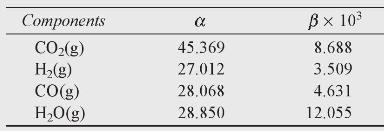
An equimolar mixture of \(\mathrm{CO}(\mathrm{g})\) and \(\mathrm{H}_{2} \mathrm{O}(\mathrm{g})\) enters a reactor which is maintained at \(10 \mathrm{bar}\) and \(1000 \mathrm{~K}\). The reaction involved is\[ \mathrm{CO}(\mathrm{g})+\mathrm{H}_{2} \mathrm{O}(\mathrm{g}) \rightarrow
Ammonia synthesis reaction is represented by\[ \mathrm{N}_{2}(\mathrm{~g})+3 \mathrm{H}_{2}(\mathrm{~g}) \rightarrow 2 \mathrm{NH}_{3}(\mathrm{~g}) \]Initially, \(1 \mathrm{~mol}\) of nitrogen and \(5 \mathrm{~mol}\) of hydrogen gas are fed into the reactor. The process is maintained at \(800
The reaction for oxidation of sulphur is given by\[ \mathrm{SO}_{2}(\mathrm{~g})+\frac{1}{2} \mathrm{O}_{2}(\mathrm{~g}) \rightarrow \mathrm{SO}_{3}(\mathrm{~g}) \]A mixture of sulphur dioxide and oxygen is fed to the reactor in the mole ratio of \(5: 4\). The process is maintained at \(750
The dissociation of phosphorus pentachloride takes place at \(250^{\circ} \mathrm{C}\) as\[ \mathrm{PCl}_{5} \rightleftharpoons \mathrm{PCl}_{3}+\mathrm{Cl}_{2} \quad K_{P}=1.8 \]Calculate the pressure (in atm) that is necessary to obtain \(50 \%\) conversion of \(\mathrm{PCl}_{5}\).
A mixture of \(1 \mathrm{~mol}\) of sulphur dioxide gas, \(0.5 \mathrm{~mol}\) of oxygen gas and \(2 \mathrm{~mol}\) of argon gas are fed into a reactor at \(30 \mathrm{bar}\) and \(900 \mathrm{~K}\) to produce sulphur trioxide gas. The equilibrium constant for the reaction is 6 . Calculate the
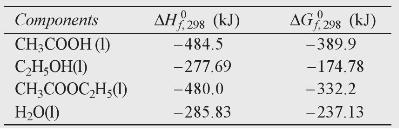
In a laboratory investigation, acetic acid is esterified in the liquid phase with ethanol at \(373.15 \mathrm{~K}\) and \(1 \mathrm{~atm}\) pressure to produce ethyl acetate and water according to the reaction\[ \mathrm{CH}_{3} \mathrm{COOH}(\mathrm{l})+\mathrm{C}_{2} \mathrm{H}_{5}
The thermal decomposition of limestone takes place as\[ \mathrm{CaCO}_{3}(\mathrm{~s}) \rightleftharpoons \mathrm{CaO}(\mathrm{s})+\mathrm{CO}_{2}(\mathrm{~g}) \]Calculate the decomposition pressure at \(1000 \mathrm{~K}\) when standard enthalpy, \(\Delta H_{1000}^{0}\), and entropy, \(\Delta
The following thermal decomposition occurs at \(400 \mathrm{~K}\) :\[ A(\mathrm{~s}) \rightarrow B(\mathrm{~s})+C(\mathrm{~g}) \]The standard Gibbs free energy of the reaction, \(\Delta G^{0}=85,000-213.73 T+6.71 T \ln\) \(T-0.00028 T^{2}\). Determine the decomposition pressure at \(400
In a steel reactor, steam is passed over a bed of red-hot carbon at \(875 \mathrm{~K}\) and 1 bar. At these conditions, the equilibrium constant for the reaction is 0.514 . Calculate the equilibrium composition of the reactor effluent at \(875 \mathrm{~K}\). The reaction mixture is assumed to
The hydrate of sodium carbonate decomposes according to the following equation:\[ \mathrm{Na}_{2} \mathrm{CO}_{3} \cdot \mathrm{H}_{2} \mathrm{O}(\mathrm{s}) \rightarrow \mathrm{Na}_{2} \mathrm{CO}_{3}(\mathrm{~s})+\mathrm{H}_{2} \mathrm{O}(\mathrm{g}) \]The equilibrium pressure of water vapour
In a chemically reacting system at equilibrium, \(\mathrm{CO}, \mathrm{CO}_{2}, \mathrm{H}_{2}, \mathrm{H}_{2} \mathrm{O}\), and \(\mathrm{CH}_{4}\) are considered to be present in a single-gas phase. Determine the number of independent reactions that occur and the number of degrees of freedom.
Determine the number of degrees of freedom of a chemically reacting system prepared by partially decomposing \(\mathrm{CaCO}_{3}\) into an evacuated space.
A feed stock of pure n-butane is cracked at \(750 \mathrm{~K}\) and 1.2 bar to produce olefins. The following two independent reactions occur favouring the equilibrium conversions at these conditions:\[ \begin{align*} & \mathrm{C}_{4} \mathrm{H}_{10} \rightarrow \mathrm{C}_{2}
For a binary system, the influence of composition on property \(M\) can be represented by\[ M=x_{1} M_{1}+x_{2} M_{2}+A x_{1} x_{2} \]where \(M_{1}\) and \(M_{2}\) are the values of \(M\) for pure chemical species 1 and 2 respectively, and \(A\) is a parameter independent of composition. Develop
How can you establish the continuity equation?
A man weighs \(800 \mathrm{~N}\) on the earth's surface where the acceleration of gravity is \(g=9.83 \mathrm{~m} / \mathrm{s}^{2}\). Calculate the weight of the man on the moon where the acceleration due to gravity is \(g=3.2 \mathrm{~m} / \mathrm{s}^{2}\).
Explain the application of the first law of thermodynamics to the flow process.
In a constant-volume calorimeter, methane undergoes a compression process. The released heat at \(25^{\circ} \mathrm{C}\) is \(3720 \mathrm{cal}\). What will be the enthalpy change of the process at \(25^{\circ} \mathrm{C}\) ?
An insulated frictionless piston-cylinder assembly containing \(500 \mathrm{~g}\) of \(\mathrm{H}_{2}\) gas. The gas is compressed at \(27^{\circ} \mathrm{C}\) adiabatically from \(10 \mathrm{~L}\) to \(5 \mathrm{~L}\). Calculate the final temperature and also \(\Delta U, \Delta H, Q\), and \(W\),
Explain the significance of the microscopic and macroscopic approaches to the study of thermodynamics.
A mercury manometer reads \(40 \mathrm{~cm}\) at \(30^{\circ} \mathrm{C}\) and \(1 \mathrm{~atm}\). Determine the absolute pressure, given that \(ho_{\mathrm{Hg}}=14.02 \mathrm{~g} / \mathrm{cm}^{3}\) and \(g=9.792 \mathrm{~m} / \mathrm{s}^{2}\).
Define isothermal, isochoric and isobaric processes with suitable examples.
Why is the thermodynamic process also called cyclic process? Explain with suitable example.
The potential energy of a body of \(20 \mathrm{~kg}\) mass is \(2 \mathrm{~kJ}\). What should be the height of the body from the ground?
A spherical ball of mass \(10 \mathrm{~kg}\) is dropped from a height of \(15 \mathrm{~m}\). What is its potential energy at the time of release? Consider the potential energy of the ball as transformed into kinetic energy when it strikes the ground. Determine the velocity at which the ball strikes
A U-tube mercury manometer is connected to a venturimeter to measure the pressure drop of water flowing through a pipeline. If the difference in the mercury levels in the tube is \(20 \mathrm{~cm}\), then determine the pressure drop, given that the density of mercury \(=1.4 \times 10^{4}
What is thermodynamics?
An astronaut weighs \(800 \mathrm{~N}\) on the earth's surface where the acceleration of gravity is \(g=9.83 \mathrm{~m} / \mathrm{s}^{2}\). The mass and the radius of the moon are \(7.4 \times 10^{22} \mathrm{~kg}\) and \(3500 \mathrm{~km}\) respectively. Find out the value of \(g\) on the moon.
Explain the scope and limitations of thermodynamics.
Estimate the gravitational force and the acceleration due to gravity on a body of \(1.25 \mathrm{~kg}\) mass on the earth's surface. The radius and mass of the earth are \(6370 \mathrm{~km}\) and \(6.02 \times 10^{24} \mathrm{~kg}\) respectively.
Estimate the gravitational force on a body of \(1.5 \mathrm{~kg}\) mass on the earth's surface, given that the radius and mass of the earth are \(6000 \mathrm{~km}\) and \(6 \times 10^{24} \mathrm{~kg}\) respectively, and the universal gravitational constant, \(G=6.672 \times 10^{-11}
A reactor contains a gas mixture of \(25 \mathrm{~kg} \mathrm{NH}_{3}, 15 \mathrm{~kg} \mathrm{CO}\) and \(10 \mathrm{~kg} \mathrm{C}_{2} \mathrm{H}_{2}\). Calculate the total number of moles of the gas mixture present in the reactor and the average molar mass of the mixture.
Assuming that the radius of the moon and the earth are \(0.3 \mathrm{~km}\) and \(1 \mathrm{~km}\) respectively, calculate the weight of \(1 \mathrm{~kg}\) mass on the moon. The mass of the moon is 0.013 relative to the earth's mass.
How do units and dimensions play an important role in characterizing the physical quantities of thermodynamic systems?
An elevator with a mass of \(2000 \mathrm{~kg}\) rests at a level of \(6 \mathrm{~m}\) above the base of the elevator shaft. It is at a height of \(60 \mathrm{~m}\) when the cable holding it breaks. It falls freely to the base, where it is brought to rest by a strong spring. Assume \(g=9.81
Mention the SI and British units of the following:(a) Pressure(b) Force(c) Temperature(d) Work done(e) Energy(f) Heat(g) Power.
At what absolute temperature do the Celsius and Fahrenheit scales show the same numerical value?
The pressure of a gas in a container is measured with a U-tube manometer. The density of the liquid used is \(1200 \mathrm{~kg} / \mathrm{m}^{3}\). The difference in the height of the fluid between the two limbs is \(62 \mathrm{~cm}\) and the local atmospheric pressure is \(112 \mathrm{kPa}\).
Distinguish between absolute pressure and gauge pressure. How is it related to the other in case of vacuum?
How can temperature in the Fahrenheit scale be expressed in the Rankine scale? What will the temperature of \(160^{\circ} \mathrm{C}\) be in the Rankine scale of temperature?
A force of \(150 \mathrm{~N}\) is applied to a block which rests on a rough surface, to push back the block by \(10 \mathrm{~m}\) from the original position. Determine the work done by the system.
Differentiate between open, closed and isolated systems with the help of neat sketches and examples.
A man is driving a two-wheeler of \(150 \mathrm{~kg}\) mass at the speed of \(70 \mathrm{~km} / \mathrm{h}\). What is its kinetic energy? What amount of work should be done to stop the engine of the twowheeler, if the driver so wants?
A gas is enclosed by a movable piston in a cylinder. The gas expands from an initial volume of \(3 \mathrm{~m}^{3}\) to a final volume of \(5 \mathrm{~m}^{3}\) as a result of \(210 \mathrm{~kJ}\) of work done on the system by an external source. The pressure of the system remains constant at \(560
Write short notes on the following:(a) Homogeneous system(b) Heterogeneous system.
\(\mathrm{N}_{2}\) gas is confined in a cylinder of \(0.5 \mathrm{~m}\) diameter having a closely fitted frictionless piston. The weights of the piston and the block resting on it together equal \(185 \mathrm{~kg}\). The atmospheric pressure and the acceleration due to gravity \(g\) are \(1.013
A pump delivers water from a well which is \(100 \mathrm{~m}\) deep. The local gravitational acceleration is \(9.81 \mathrm{~m} / \mathrm{s}^{2}\). Determine the change in potential energy per \(\mathrm{kg}\) of water.
Write an informatory note on extensive and intensive properties with suitable examples.
A manometer shows the reading as \(60 \mathrm{~cm}\) at \(30^{\circ} \mathrm{C}\) and \(1 \mathrm{~atm}\). Determine the absolute pressure, given that \(ho_{\mathrm{Hg}}=14.02 \mathrm{~g} / \mathrm{cm}^{3}\) and \(g=0.792 \mathrm{~m} / \mathrm{s}^{2}\).
A metal block of mass \(15 \mathrm{~kg}\) falls freely from rest. What will be its kinetic energy after falling \(12 \mathrm{~m}\) ? Find the velocity of the metal block just after impact.
Point out the extensive and intensive properties from the following list:(a) Temperature(b) Pressure(c) Volume(d) Specific heat(e) Internal energy(f) Refractive index (g) Potential energy (h) Enthalpy.
The reading on a mercury-filled manometer is \(70.2 \mathrm{~cm}\) at \(25^{\circ} \mathrm{C}\). Determine the pressure that corresponds to the height of the mercury column, given that \(g=9.832 \mathrm{~m} / \mathrm{s}^{2}\).
A gas is enclosed by a frictionless piston in a \(0.3 \mathrm{~m}\) diameter cylinder, and a metal block is placed on the piston. The weight of the piston and the block rested on it together equal \(100 \mathrm{~kg}\). The atmospheric pressure and the acceleration due to gravity \(g\) are \(1.013
Determine the power required to accelerate a car weighing \(1200 \mathrm{~kg}\) from a velocity of \(10 \mathrm{~km} / \mathrm{h}\) to \(100 \mathrm{~km} / \mathrm{h}\) in just \(1 \mathrm{~min}\) on a level road.
Find the temperature which has the same value on both the centigrade and Fahrenheit scales.
What conditions must be satisfied for a process to be in thermodynamic equilibrium?
Showing 600 - 700
of 2105
1
2
3
4
5
6
7
8
9
10
11
12
13
14
15
Last
Step by Step Answers

 Get 50% OFF
Claim Now
Get 50% OFF
Claim Now