New Semester
Started
Get
50% OFF
Study Help!
--h --m --s
Claim Now
Question Answers
Textbooks
Find textbooks, questions and answers
Oops, something went wrong!
Change your search query and then try again
S
Books
FREE
Study Help
Expert Questions
Accounting
General Management
Mathematics
Finance
Organizational Behaviour
Law
Physics
Operating System
Management Leadership
Sociology
Programming
Marketing
Database
Computer Network
Economics
Textbooks Solutions
Accounting
Managerial Accounting
Management Leadership
Cost Accounting
Statistics
Business Law
Corporate Finance
Finance
Economics
Auditing
Tutors
Online Tutors
Find a Tutor
Hire a Tutor
Become a Tutor
AI Tutor
AI Study Planner
NEW
Sell Books
Search
Search
Sign In
Register
study help
engineering
introduction to chemical engineering thermodynamics
Introduction To Chemical Engineering Thermodynamics 2nd Edition HALDER - Solutions
Calculate the equilibrium constant at \(25^{\circ} \mathrm{C}\) for the following reaction:\[ \mathrm{N}_{2} \mathrm{O}_{4}(\mathrm{~g}) \rightarrow 2 \mathrm{NO}_{2}(\mathrm{~g}) \]Given that \(\Delta G_{f, \mathrm{NO}_{2}}^{0}=51.31 \mathrm{~kJ} / \mathrm{mol}\) and \(\Delta G_{f, \mathrm{~N}_{2}
A centrifugal pump is an example of a/an(a) Closed system(b) Open system(c) Isolated system(d) None of these.
Calculate \(\Delta G_{298}^{0}\) at 1 bar and \(298.15 \mathrm{~K}\) for the following reaction:\[ \mathrm{SO}_{2}(\mathrm{~g})+\frac{1}{2} \mathrm{O}_{2}(\mathrm{~g}) \rightarrow \mathrm{SO}_{3}(\mathrm{~g}) \]Given that \(\Delta G_{f, \mathrm{SO}_{3}}^{0}=-370.532 \mathrm{~kJ} / \mathrm{mol}\)
A system in which no mass transfer occurs across the boundary is called a/an(a) Open system(b) Closed system(c) Isolated system(d) Macroscopic system.
At \(2000 \mathrm{~K}\), the free energy change in calories for the reaction\[ \mathrm{N}_{2}+\mathrm{O}_{2} \rightleftharpoons 2 \mathrm{NO} \]is given by \(\Delta G^{0}=22000-2.5 T\). Calculate \(K_{p}\) at this temperature.
A pressure cooker is a good example of(a) Closed system(b) Open system(c) Isolated system(d) None of these.
In a chemical laboratory, it is proposed to carry out the reaction\[ \mathrm{C}_{2} \mathrm{H}_{4}(\mathrm{~g})+\mathrm{H}_{2} \mathrm{O}(\mathrm{g}) \rightarrow \mathrm{C}_{2} \mathrm{H}_{5} \mathrm{OH}(\mathrm{g}) \]at 1 bar and \(298 \mathrm{~K}\). Calculate the standard Gibbs free energy change
For the chemical reaction\[ \mathrm{N}_{2} \mathrm{O} \rightarrow \mathrm{N}_{2}+\frac{1}{2} \mathrm{O}_{2} \]\(\Delta H=-20000\) cal and \(\Delta S=18\) e.u. Will the reaction be spontaneous at \(25^{\circ} \mathrm{C}\) ?
A quasi-static process(a) Proceeds very fast(b) Is a reversible process(c) Occurs when the system remains infinitesimally closed to an equilibrium state(d) None of these.
For the endothermic reaction,\[ \mathrm{C}+\mathrm{H}_{2} \mathrm{O}(\mathrm{g}) \rightarrow \mathrm{CO}(\mathrm{g})+\mathrm{H}_{2}(\mathrm{~g}) \]where \(\Delta H==+31400 \mathrm{cal}\) and \(\Delta S=+32\) e.u. Discuss the feasibility of the reaction at \(100^{\circ} \mathrm{C}\) and
Calculate the second and third virial coefficients of a gas which obeys van der Waal's equation of state.
A process is called isochoric if the(a) Pressure is constant(b) Temperature is constant(c) Volume is constant(d) Mass is constant.
How does the addition of inert gases affect the degree of conversion of a chemical reaction?
Assuming that the standard enthalpy changes of the reaction are constant in the temperature range \(298 \mathrm{~K}\) to \(800 \mathrm{~K}\), estimate the equilibrium constant at \(800 \mathrm{~K}\) for the ammonia synthesis reaction\[ \mathrm{N}_{2}(\mathrm{~g})+3 \mathrm{H}_{2}(\mathrm{~g})
A change in which the temperature of the system remains unchanged is called a/an(a) Irreversible change(b) Adiabatic change(c) Reversible change(d) Isothermal change.
The equilibrium constant for the reaction \(A \rightarrow B\) is doubled when temperature is changed from \(25^{\circ} \mathrm{C}\) to \(35^{\circ} \mathrm{C}\). Calculate the enthalpy of reaction.
When no heat energy is allowed to enter or leave a system, the system is called a/an(a) Isothermal system(b) Reversible system(c) Adiabatic system(d) Irreversible system.
Calculate the equilibrium constant at \(750 \mathrm{~K}\) and 1 bar for the following reaction:\[ \mathrm{C}_{2} \mathrm{H}_{5} \mathrm{OH}(\mathrm{g})+\frac{1}{2} \mathrm{O}_{2}(\mathrm{~g}) \rightarrow \mathrm{CH}_{3} \mathrm{CHO}(\mathrm{g})+\mathrm{H}_{2} \mathrm{O}(\mathrm{g}) \]Assume that
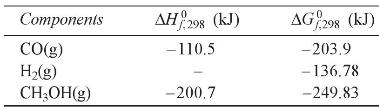
Evaluate the equilibrium constant at \(600 \mathrm{~K}\) for the reaction\[ \mathrm{CO}(\mathrm{g})+2 \mathrm{H}_{2}(\mathrm{~g}) \rightarrow \mathrm{CH}_{3} \mathrm{OH}(\mathrm{g}) \] Data Table: 0 Components AH 298 (kJ) 0 AG 298 (kJ) CO(g) -110.5 -203.9 H2(g) -136.78 CHOH(g) -200.7 -249.83
All the spontaneous processes are(a) Reversible(b) Irreversible(c) Quasi-static(d) None of these.
Calculate the values of \(K_{p}\) at \(25^{\circ} \mathrm{C}\) and \(800^{\circ} \mathrm{C}\) for the water-gas reaction\[ \mathrm{CO}(\mathrm{g})+\mathrm{H}_{2} \mathrm{O}(\mathrm{g}) \rightarrow \mathrm{H}_{2}(\mathrm{~g})+\mathrm{CO}_{2}(\mathrm{~g}) \]Using the following data at \(298
Which of the following is not an intensive property?(a) Temperature(b) Pressure(c) Density(d) Enthalpy.
Which one is not a state property?(a) Internal energy(b) Volume(c) Heat(d) Enthalpy.
Calculate \(\Delta G^{0}\) for the hydrogenation of ethylene at \(298 \mathrm{~K}\) using the following data:\(\Delta G_{f, 298}^{0}\) for \(\mathrm{C}_{2} \mathrm{H}_{4}=68.12 \mathrm{~kJ} / \mathrm{mol}\)\(\Delta G_{f, 298}^{0}\) for \(\mathrm{C}_{2} \mathrm{H}_{6}=-32.89 \mathrm{~kJ} /
Which of the following is not a property of the system?(a) Pressure(b) Volume(c) Work(d) Temperature.
Hydrogen bromide is produced by the following reaction:\[ \frac{1}{2} \mathrm{H}_{2}(\mathrm{~g})+\frac{1}{2} \mathrm{Br}_{2}(\mathrm{~g}) \rightarrow \mathrm{HBr}(\mathrm{g}) \]The equilibrium constant at temperature \(420 \mathrm{~K}\) is given as \(\log K_{p}=2.44\), and \(\Delta H_{0}=\) -11970
A system is said to be in mechanical equilibrium if the(a) Composition of the system remains constant(b) Temperature of the system remains constant(c) Pressure of the system remains constant(d) None of these.
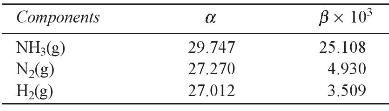
Estimate the standard Gibbs free energy and the equilibrium constant at 1 bar and \(800 \mathrm{~K}\) for the reaction\[ \mathrm{N}_{2}(\mathrm{~g})+3 \mathrm{H}_{2}(\mathrm{~g}) \rightleftharpoons 2 \mathrm{NH}_{3}(\mathrm{~g}) \]Given that the standard heat of reaction, \(\Delta H_{298}^{0}\),
For an adiabatic process, which of the following is correct?(a) \(E=0\)(b) \(Q=0\)(c) \(Q=W\)(d) \(P V=0\).
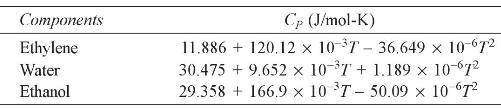
For the vapour-phase hydration of ethylene to ethanol\[ \mathrm{C}_{2} \mathrm{H}_{4}+\mathrm{H}_{2} \mathrm{O} \rightarrow \mathrm{C}_{2} \mathrm{H}_{5} \mathrm{OH} \]The equilibrium constants were measured at temperature \(420 \mathrm{~K}\) and \(600 \mathrm{~K}\). They are \(6.8 \times 10^{-2}\)
One calorie is equivalent to(a) \(418.4 \mathrm{~J}\)(b) \(41.84 \mathrm{~J}\)(c) \(4.184 \mathrm{~J}\)(d) \(0.4184 \mathrm{~J}\).
Methanol is produced by the following reaction:\[ \mathrm{CO}(\mathrm{g})+2 \mathrm{H}_{2}(\mathrm{~g}) \rightarrow \mathrm{CH}_{3} \mathrm{OH}(\mathrm{g}) \]The standard heat of formation of \(\mathrm{CO}(\mathrm{g})\) and \(\mathrm{CH}_{3} \mathrm{OH}(\mathrm{g})\) at \(298 \mathrm{~K}\) are
Sulphur trioxide is produced according to the reaction\[ \mathrm{SO}_{2}(\mathrm{~g})+\frac{1}{2} \mathrm{O}_{2}(\mathrm{~g}) \rightarrow \mathrm{SO}_{3} \]Given that\[ \begin{aligned} & \Delta H_{f, 298}^{0} \text { for } \mathrm{SO}_{2}=-70.96 \mathrm{kcal} / \mathrm{mol} \\ & \Delta
The first law of thermodynamics basically represents the law of conservation of(a) Energy(b) Mass(c) Momentum(d) None of these.
An exothermic reaction is one in which the reacting substances(a) Have more energy than the product(b) Have less energy than the product(c) Have as much energy as the product(d) Are at higher temperature than the product.
In the gaseous reaction\[ 2 A+B \rightleftharpoons A_{2} B \]\(\Delta G^{0}=-1200\) cal at \(227^{\circ} \mathrm{C}\). What total pressure would be necessary to produce \(60 \%\) conversion of \(B\) into \(A_{2} B\) when \(2: 1\) mixture is used?
A minus sign of the free energy change indicates that the(a) Reaction is spontaneous(b) Reaction is non-spontaneous(c) System is in equilibrium(d) Reaction is very much unlikely.
Phosphorus pentachloride dissociates according to the reaction:\[ \mathrm{PCl}_{5}(\mathrm{~g}) \rightarrow \mathrm{PCl}_{3}(\mathrm{~g})+\mathrm{Cl}_{2}(\mathrm{~g}) \]Show that \(K_{P}=\frac{\alpha^{2}\left(\frac{P}{P^{0}}\right)}{1-\alpha^{2}}\), where \(P\) is the total pressure and \(\alpha\)
If a mixture of \(1 \mathrm{~mol}\) of \(\mathrm{CO}(\mathrm{g}), 1 \mathrm{~mol}\) of \(\mathrm{H}_{2} \mathrm{O}(\mathrm{g})\), and \(2 \mathrm{~mol}\) of \(\mathrm{He}(\mathrm{g})\) are fed into a reactor at 10 bar and \(1000 \mathrm{~K}\), the following reaction occurs to produce carbon dioxide
A spontaneous reaction is defined as one which(a) Proceeds by itself(b) Proceeds only when heated(c) Proceeds on heating at high pressure and in presence of catalyst(d) Proceeds by itself or when properly initiated.
Which one of the following is a spontaneous process?(a) Dissolution of \(\mathrm{CuSO}_{4}\) in \(\mathrm{H}_{2} \mathrm{O}\)(b) Reaction between \(\mathrm{H}_{2}\) and \(\mathrm{O}_{2}\) to form \(\mathrm{H}_{2} \mathrm{O}\)(c) Water falling downhill(d) Flow of current from low potential to high
Ammonia synthesis reaction is represented by\[ \mathrm{N}_{2}(\mathrm{~g})+3 \mathrm{H}_{2}(\mathrm{~g}) \rightarrow 2 \mathrm{NH}_{3}(\mathrm{~g}) \]The mixture of nitrogen, hydrogen and helium gas is fed to the reactor in the mole ratio of 1:3:2. The process is maintained at \(800 \mathrm{~K}\)
In a reaction, if \(H\) and \(S\) are positive, the rate of reaction(a) Increases with increase in temperature(b) Decreases with increase in temperature(c) Has no effect on temperature(d) Decreases with increase in pressure.
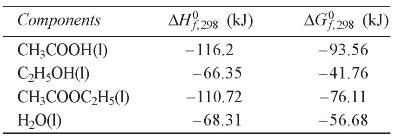
The esterification of ethanol with acetic acid takes place at \(373 \mathrm{~K}\) as\[ \mathrm{CH}_{3} \mathrm{COOH}(\mathrm{l})+\mathrm{C}_{2} \mathrm{H}_{5} \mathrm{OH}(\mathrm{l}) \rightarrow \mathrm{CH}_{3} \mathrm{COOC}_{2} \mathrm{H}_{5}(\mathrm{l})+\mathrm{H}_{2} \mathrm{O}(\mathrm{l}) \]The
All naturally occurring processes proceed spontaneously in a direction which leads to(a) Decrease in entropy(b) Increase in enthalpy(c) Increase in free energy(d) Decrease in free energy.
The thermal decomposition of limestone takes place as\[ \mathrm{CaCO}_{3}(\mathrm{~s}) \rightleftharpoons \mathrm{CaO}(\mathrm{s})+\mathrm{CO}_{2}(\mathrm{~g}) \]Calculate the decomposition pressure at \(600 \mathrm{~K}\) when standard enthalpy \(\left(\Delta H_{600}^{0}\right)\) and entropy
When a solid melts, there is(a) An increase in enthalpy(b) No change in enthalpy(c) A decrease in enthalpy(d) A decrease in internal energy.
Determine the decomposition pressure of calcium carbonate at \(600 \mathrm{~K}\) and \(1000 \mathrm{~K}\). Also determine the decomposition temperature at 1 bar.
For an endothermic reaction, \(H\) is(a) - ve(b) 0(c) + ve(d) Unpredictable.
Consider the following decomposition process:\[ A(\mathrm{~s}) \rightleftharpoons B(\mathrm{~s})+C(\mathrm{~g}) \] The pressure at equilibrium is \(\ln P=12-\frac{3790}{T}\). Deduce the expression for \(\Delta G^{0}\) as a function of temperature for the given reaction.
Which of the following has/have the least entropy?(a) Ice(b) Liquid water(c) Steam(d) Water at triple point.
Calculate \(\Delta G^{0}\) at \(600^{\circ} \mathrm{C}\) and \(850^{\circ} \mathrm{C}\) for the reaction\[ \mathrm{CaCO}_{3}(\mathrm{~s}) \rightleftharpoons \mathrm{CaO}(\mathrm{s})+\mathrm{CO}_{2}(\mathrm{~g}) \]Given that the decomposition pressure of carbon dioxide at \(850^{\circ} \mathrm{C}\)
For a reversible process at equilibrium, the change in entropy is given by(a) \(\Delta S=\frac{q_{\text {rev }}}{T}\)(b) \(\Delta S=T q_{\text {rev }}\)(c) \(\Delta S=\frac{\Delta H}{T}\)(d) \(\Delta S=T \Delta H\).
Acetic acid is esterified in the liquid phase with ethanol at \(373.15 \mathrm{~K}\) and \(1 \mathrm{~atm}\) pressure to produce ethyl acetate and water according to the reaction\[ \mathrm{CH}_{3} \mathrm{COOH}(\mathrm{l})+\mathrm{C}_{2} \mathrm{H}_{5} \mathrm{OH}(\mathrm{l}) \rightarrow
In a steel reactor, steam is passed over a bed of white-hot carbon at \(1000 \mathrm{~K}\) and 1 bar. At these conditions, the equilibrium constant for the reaction is 0.270 . Calculate the equilibrium composition of the reactor effluent at \(1000 \mathrm{~K}\). The reaction mixture is assumed to
\(P V^{\gamma}=\) Constant (where \(\gamma=C_{P} / C_{V}\) ) is valid for a/an(a) Isothermal process(b) Isentropic process(c) Isobaric process(d) Adiabatic process.
Which one of the following expressions represents the first law of thermodynamics?(a) \(q=\Delta E+W\)(b) \(\Delta H=q-W\)(c) \(\Delta H=q+W\)(d) \(\Delta E=H-P \Delta V\).
In a chemically reacting system at equilibrium, \(\mathrm{CO}, \mathrm{C}, \mathrm{CO}_{2}, \mathrm{H}_{2}, \mathrm{H}_{2} \mathrm{O}, \mathrm{N}_{2}\) and \(\mathrm{CH}_{4}\) are considered to be present in a single-gas phase. Determine the number of independent reactions occurring and the number
The value of the Joule-Thomson coefficient for an ideal gas is(a) + ve(b) - ve(c) 0(d) \(\alpha\).
A gaseous system comprises \(\mathrm{NO}_{2}, \mathrm{NH}_{3}, \mathrm{NO}, \mathrm{O}_{2}, \mathrm{H}_{2} \mathrm{O}\), and \(\mathrm{N}_{2}\) at chemical equilibrium. Determine the number of degrees of freedom of the system.
For the process \(\mathrm{CO}_{2}(\mathrm{~s}) \rightarrow \mathrm{CO}_{2}(\mathrm{~g})\)(a) Both \(H\) and \(S\) are \(+\mathrm{ve}\)(b) Both \(H\) and \(S\) are - ve(c) \(H\) is + ve and \(S\) is - ve(d) \(H\) is -ve and \(S\) is + ve.
In the steam cracking of methane, the following two independent reactions occur at \(1000 \mathrm{~K}\) and 1 bar:\[ \begin{align*} \mathrm{CH}_{4}+\mathrm{H}_{2} \mathrm{O} & \rightarrow \mathrm{CO}+3 \mathrm{H}_{2} \tag{A}\\ \mathrm{CO}+\mathrm{H}_{2} \mathrm{O} & \rightarrow
Chemical potential is a/an(a) Extensive property(b) Intensive property(c) Reference property(d) None of these.
To obtain the integrated form of the Clausius-Clapeyron equation \(\ln \frac{P_{2}}{P_{1}}=\) \(\frac{\Delta H_{V}}{R}\left(\frac{1}{T_{1}}-\frac{1}{T_{2}}\right)\) from the exact Clapyeron equation, it is assumed that the(a) Volume of the liquid phase is negligible compared to that of the vapour
The catalytic dehydrogenation of 1-butene\[ \mathrm{C}_{4} \mathrm{H}_{8}(\mathrm{~g}) \rightarrow \mathrm{C}_{4} \mathrm{H}_{6}(\mathrm{~g})+\mathrm{H}_{2}(\mathrm{~g}) \]is carried out at \(900 \mathrm{~K}\) and \(1 \mathrm{~atm}\) and with a ratio of \(10 \mathrm{~mol}\) of steam per mole of
Propane is pyrolyzed by the following two independent gaseous reactions:\[ \begin{aligned} & \mathrm{C}_{3} \mathrm{H}_{8} \rightarrow \mathrm{C}_{3} \mathrm{H}_{6}+\mathrm{H}_{2} \\ & \mathrm{C}_{3} \mathrm{H}_{8} \rightarrow \mathrm{C}_{2} \mathrm{H}_{4}+\mathrm{CH}_{4} \end{aligned} \]At \(1020
A gas shows deviation from ideal gas behaviour at(a) Low pressure and high temperature(b) Low pressure and low temperature(c) Low temperature and high pressure(d) High temperature and high pressure.
The following reactions take place at \(1500 \mathrm{~K}\) and \(10 \mathrm{bar}\) :\[ \begin{align*} & A+B \rightarrow C+D \tag{A}\\ & A+C \rightarrow 2 E \tag{B} \end{align*} \]where \(K_{\mathrm{A}}=2.67\) and \(K_{\mathrm{B}}=3.20\).Determine the composition of the equilibrium mixture, assuming
Which of the following statements is correct?(a) \(C_{P}\) can never be less than \(C_{V}\)(b) \(C_{P}\) is always equal to \(C_{V}\)(c) \(C_{P}\) may be less than \(C_{V}\)(d) \(C_{P}\) may be equal to or less than \(C_{V}\).
In the catalytic dehydrogenation of acetylene, the following two reactions are expected to occur simultaneously in the reactor at \(1500 \mathrm{~K}\) and \(1 \mathrm{bar}\) :\[ \begin{align*} \mathrm{C}_{2} \mathrm{H}_{2} & \rightarrow 2 \mathrm{C}+\mathrm{H}_{2} \tag{A}\\ 2 \mathrm{C}+2
A gas obeys the ideal gas law at(a) Low pressure and high temperature(b) Low pressure and low temperature(c) Low temperature and high pressure(d) High temperature and high pressure.
The following reactions take place at \(1 \mathrm{bar}\) and \(1100 \mathrm{~K}\) :\[ \begin{align*} & A+B \rightarrow C+D \tag{A}\\ & A+C \rightarrow 2 E \tag{B} \end{align*} \]where \(K_{\mathrm{A}}=0.1429\) and \(K_{\mathrm{B}}=2.0\).Determine the composition of the equilibrium mixture. Assume
The compressibility factor \(Z\) of an ideal gas is always(a) 0(b) 1(c) \(>1\)(d) \(
The Carnot cycle comprises four operational steps. These are(a) Two isothermals and two isochorics(b) Two isobarics and two isenthalpics(c) Two isothermals and two adiabatics(d) Two isothermals and two isentropics.
The kinetic energy of a gas molecule is zero at(a) \(0^{\circ} \mathrm{C}\)(b) \(273^{\circ} \mathrm{C}\)(c) \(100^{\circ} \mathrm{C}\)(d) \(-273^{\circ} \mathrm{C}\).
The refrigerator works on the principle of the(a) Zeroth law of thermodynamics(b) First law of thermodynamics(c) Second law of thermodynamics(d) Third law of thermodynamics.
Gibbs' phase rule finds application when heat transfer occurs by(a) Conduction(b) Convection(c) Radiation(d) Condensation.
The minimum number of degrees of freedom for any system is(a) 0(b) 1(c) 2(d) 3 .
During Joule-Thomson expansion of gases(a) Enthalpy remains constant(b) Entropy remains constant(c) Temperature remains constant(d) None of these.
\(C_{P}-C_{V}=R\) is valid for(a) Real gases(b) All gases(c) Ideal gases(d) None of these.
The necessary and sufficient condition for equilibrium between two phases is that(a) The concentration of each component in the two phases should be the same(b) The temperature of each phase should be the same(c) The pressure should be the same in the two phases(d) The chemical potential of each
The change in entropy of an ideal gas during a reversible isothermal expansion is(a) Zero(b) Positive(c) Negative(d) Infinite.
Which of the following is true for the virial equation of state?(a) Virial co-efficients are universal constants(b) Virial co-efficient \(B\) represents three-body inter actions(c) Virial co-efficients are functions of temperature only(d) For gases, virial equations and ideal gas equations are the
The partial molal free energy of an element \(A\) in solution is the same as its(a) Chemical potential(b) Activity(c) Fugacity(d) Activity co-efficient.
The throttling process (Joule-Thompson effect) is a constant(a) Entropy process(b) Enthalpy process(c) Pressure process(d) None of these.
The second law of thermodynamics states that(a) The energy change of a system undergoing any reversible process is zero(b) It is not possible to transfer heat from a lower temperature to a higher temperature body(c) The total energy of the system and the surroundings remains constant(d) None of
A heat pump works on the principle of the(a) First law of thermodynamics(b) Second law of thermodynamics(c) Zeroth law of thermodynamics(d) Third law of thermodynamics.
The shape of the temperature-entropy diagram for the Carnot cycle is a(a) Rectangle(b) Rhombus(c) Trapezoid(d) Circle.
The absolute entropy for all crystalline substances at absolute zero temperature is(a) Zero(b) Negative(c) More than zero(d) None of these.
A closed system is cooled reversibly from \(100^{\circ} \mathrm{C}\) to \(50^{\circ} \mathrm{C}\). If no work is done on the system, its(a) \(U\) decreases and its \(S\) increases(b) \(U\) and \(S\) both decrease(c) \(U\) decreases but \(S\) remains constant(d) \(U\) remains constant but \(S\)
At the inversion point, the Joule-Thomson coefficient is(a) + ve(b) - ve(c) Zero(d) None of these.
The equation \(d U=T d S-P d V\) is applicable to infinitesimal changes occurring in a/an(a) Open system of constant composition(b) Closed system of constant composition(c) Open system with changes in composition(d) Closed system with changes in composition.
A good refrigerant should have(a) High viscosity and low thermal conductivity(b) Low viscosity and high thermal conductivity(c) High viscosity and high thermal conductivity(d) Low viscosity and low thermal conductivity.
The theoretical minimum work required to separate \(1 \mathrm{~mol}\) of a liquid mixture at \(1 \mathrm{~atm}\) containing \(50 \mathrm{~mol} \%\) each of \(n\)-heptane and \(n\)-octane into pure compounds, each at \(1 \mathrm{~atm}\), is(a) \(-2 R T \ln 0.5\)(b) \(-R T \ln 0.5\)(c) \(0.5 R T\)(d)
The Mollier diagram is a plot of(a) Temperature versus enthalpy(b) Temperature versus entropy(c) Enthalpy versus entropy(d) Temperature versus internal energy.
The change in Gibbs' free energy for vaporization of a pure substance is(a) + ve(b) - ve(c) 0(d) Either + ve or - ve.
The activity coefficient of an ideal gas is(a) Directly proportional to pressure(b) Inversely proportional to pressure(c) Unity at all pressures(d) None of these.
Which of the following is not a refrigerant?(a) \(\mathrm{SO}_{2}\)(c) \(\mathrm{CCl}_{2} \mathrm{~F}_{2}\)(b) \(\mathrm{NH}_{3}\)(d) \(\mathrm{C}_{2} \mathrm{H}_{4} \mathrm{Cl}_{2}\).
The number of phases in a colloidal system are(a) 1(b) 2(c) 3(d) 4 .
The fugacity co-efficient of a substance is the ratio of its fugacity to the(a) Mole fraction(c) Pressure(b) Activity(d) Activity co-efficient.
Showing 200 - 300
of 2105
1
2
3
4
5
6
7
8
9
10
11
12
13
14
15
Last
Step by Step Answers

 Get 50% OFF
Claim Now
Get 50% OFF
Claim Now