New Semester
Started
Get
50% OFF
Study Help!
--h --m --s
Claim Now
Question Answers
Textbooks
Find textbooks, questions and answers
Oops, something went wrong!
Change your search query and then try again
S
Books
FREE
Study Help
Expert Questions
Accounting
General Management
Mathematics
Finance
Organizational Behaviour
Law
Physics
Operating System
Management Leadership
Sociology
Programming
Marketing
Database
Computer Network
Economics
Textbooks Solutions
Accounting
Managerial Accounting
Management Leadership
Cost Accounting
Statistics
Business Law
Corporate Finance
Finance
Economics
Auditing
Tutors
Online Tutors
Find a Tutor
Hire a Tutor
Become a Tutor
AI Tutor
AI Study Planner
NEW
Sell Books
Search
Search
Sign In
Register
study help
engineering
introduction to chemical engineering thermodynamics
Introduction To Chemical Engineering Thermodynamics 2nd Edition HALDER - Solutions
Derive an expression for the change in entropy of the mixture of two non-identical ideal gases.
One \(\mathrm{kg}\) of air is heated at constant volume from \(100^{\circ} \mathrm{C}\) to \(400^{\circ} \mathrm{C}\). If \(C_{V}\) is \(0.7186 \mathrm{~kJ} / \mathrm{kg}-\mathrm{K}\), determine the change in entropy of the air.
Calculate the change in molar entropy of water when it is heated from \(137^{\circ} \mathrm{C}\) to \(877^{\circ} \mathrm{C}\). The molar specific heat of water, \(C_{P}=7.25+2.28 \times 10^{-3} \mathrm{~T}\).
What is thermodynamic temperature scale? How is it established? Explain the importance of the thermodynamic temperature scale.
5 moles of water are evaporated at \(100^{\circ} \mathrm{C}\). Calculate \(\Delta S\), given that the latent heat of vaporization \(=9720 \mathrm{cal}\).
A \(40 \mathrm{~kg}\) block of iron casting at \(625 \mathrm{~K}\) is dropped into a well-insulated vessel containing \(160 \mathrm{~kg}\) of water at \(276 \mathrm{~K}\). Calculate the entropy change for (a) the iron block, (b) the water and (c) the entire process. Assume that the specific heat of
One \(\mathrm{kg}\) of air is heated at constant temperature of \(30^{\circ} \mathrm{C}\) by the addition of \(190 \mathrm{~kJ}\). Determine the change in entropy of the process.
An ideal gas ( \(\left.C_{P}=21.0 \mathrm{~J} / \mathrm{kmol}\right)\) undergoes a constant-pressure change from \(300 \mathrm{~K}\) to \(500 \mathrm{~K}\). The molar entropy of the gas at \(300 \mathrm{~K}\) is \(150 \mathrm{~J} / \mathrm{kmol}\). Find the entropy at \(500 \mathrm{~K}\).
A frictionless piston-cylinder device contains \(1 \mathrm{~kg}\) saturated liquid at \(110^{\circ} \mathrm{C}\). The water in the cylinder is heated at \(420^{\circ} \mathrm{C}\) by bringing the assembly into contact with a body until the water is completely converted into saturated vapour at
A heat exchanger is employed to cool oil from \(150^{\circ} \mathrm{C}\) to \(50^{\circ} \mathrm{C}\) by using ambient water. The rate of flow of water is \(4000 \mathrm{~kg} / \mathrm{hr}\). The ambient water enters the heat exchanger at \(20^{\circ} \mathrm{C}\) and exits at \(130^{\circ}
In the presence of catalyst, hydrogenation of vegetable oil takes place at \(300^{\circ} \mathrm{C}\) by continuously stirring with the help of an agitator for \(30 \mathrm{~min}\) using a \(700 \mathrm{~W}\) motor. Calculate the change in entropy of the oil.
In the presence of catalyst, vegetable oil is hydrogenated at \(250^{\circ} \mathrm{C}\) by continuously stirring with the help of an agitator for 20 minutes using a \(650 \mathrm{~W}\) motor. Calculate the change in entropy of the oil.
An insulated tank of volume \(2 \mathrm{~m}^{3}\) is divided into two equal chambers by a partition. One chamber contains an ideal gas of \(500 \mathrm{~K}\) and \(4 \mathrm{MPa}\), while the other is completely evacuated. Now, the partition is withdrawn and the gases are allowed to mix. Estimate
An insulated tank of volume \(2 \mathrm{~m}^{3}\) is divided into two equal compartments by a thin and rigid partition. One compartment contains an ideal gas at \(400 \mathrm{~K}\) and \(300 \mathrm{kPa}\), while the other is completely evacuated. Now, the partition is suddenly removed and the
Two perfectly insulated tanks having a volume of \(1 \mathrm{~m}^{3}\) are connected by means of a small pipeline fitted with a valve. One tank contains an ideal gas at 3 bar and \(292 \mathrm{~K}\), and the other is completely evacuated. The valve is opened, and the pressure and the temperature
Two iron blocks of same size are at distinct temperatures \(T_{1}\) and \(T_{2}\), brought in thermal contact with each other. The transfer process is allowed to take place until thermal equilibrium is attained. Suppose, after the attainment of equilibrium, that the blocks are at the final
An ideal gas at an initial pressure of \(25 \mathrm{~atm}\) and \(315 \mathrm{~K}\) occupies a volume of \(2 \mathrm{~L}\). Determine the entropy of the system for a reversible isothermal expansion of an ideal gas to a final volume of \(10 \mathrm{~L}\).
Referring to Example 5.18, compute the amount of work lost in the process.
5 moles of an ideal gas are allowed to expand from an initial state of \(110 \mathrm{dm}^{3}\) at \(320 \mathrm{~K}\) to a final state of \(150 \mathrm{dm}^{3}\) at \(430 \mathrm{~K}\). Estimate the change in entropy for the process, given that heat capacity at constant volume, \(C_{V}=(7 / 2) R\).
It is desired to cool a variety of aromatic oil in a heat exchanger from \(515 \mathrm{~K}\) to \(315 \mathrm{~K}\) at a rate of \(4750 \mathrm{~kg} / \mathrm{hr}\). The temperature of the cooling water is \(290 \mathrm{~K}\) and it is supplied at a rate of \(9500 \mathrm{~kg} / \mathrm{hr}\). We
A \(25 \mathrm{~kg}\) copper block at \(373 \mathrm{~K}\) is dropped into an insulated tank that contains \(80 \mathrm{~L}\) of water at \(293 \mathrm{~K}\). Determine the final equilibrium temperature and the total change in entropy. Assume that the specific heat of steel is \(0.72 \mathrm{~kJ} /
What is thermodynamic property? How can it be classified? Give an example for each kind of thermodynamic property.
Show that for \(1 \mathrm{~g}\)-mol of an ideal gas, the equation of state \(P V=R T\) is well supported by the cyclic relation \(\left(\frac{\partial P}{\partial V}\right)_{T}\left(\frac{\partial V}{\partial T}\right)_{P}\left(\frac{\partial T}{\partial P}\right)_{V}=-1\), assuming that one
Using the ideal gas equation of state, verify(a) the cyclic relation and(b) the reciprocity relation at constant \(P\).
Establish the cyclic relation between \(P, V\), and \(T\).
Calculate the change in freezing point of water at \(0^{\circ} \mathrm{C}\) per atm change of pressure, given that the heat of fusion of ice is \(335 \mathrm{~J} / \mathrm{g}\), the density of water is \(0.9998 \mathrm{~g} / \mathrm{cm}^{3}\), and the density of ice is \(0.9168 \mathrm{~g} /
If \(f(S, T, P)=0\), then by following the cyclic relation, prove that\[ \left(\frac{\partial S}{\partial T}\right)_{P}\left(\frac{\partial T}{\partial P}\right)_{S}\left(\frac{\partial P}{\partial S}\right)_{T}=-1 \]One variable is assumed to be dependent on the other two.
What are the fundamental property relations? Derive the four thermodynamic relations.
Determine the enthalpy of vaporization of water at \(150^{\circ} \mathrm{C}\), given that the saturation pressure is \(361.3 \mathrm{kPa}\) at \(140^{\circ} \mathrm{C}\) and \(617.8 \mathrm{kPa}\) at \(160^{\circ} \mathrm{C}\), and the specific volume at \(150^{\circ} \mathrm{C}\) is \(0.3917
Applying the Clapeyron equation, estimate the enthalpy of vaporization of the refrigerant \(\mathrm{R}-134 \mathrm{a}\) at \(40^{\circ} \mathrm{C}\), and compare it with the tabulated value.
Derive Maxwell's relation among thermodynamic properties.
Determine the saturation pressure of the refrigerant \(\mathrm{R}-134 \mathrm{a}\) at \(-45^{\circ} \mathrm{C}\). At \(40^{\circ} \mathrm{C}\), the latent heat of vaporization is \(225.86 \mathrm{~kJ} / \mathrm{kg}\) and the saturation pressure is \(51.25 \mathrm{kPa}\).
Using the Clapeyron equation, estimate the enthalpy of vaporization of refrigerant steam at \(300 \mathrm{kPa}\) and compare it with the tabulated value.
The temperature dependence of vapour pressure of an organic compound is given by\[ \log P=-\frac{834.13}{T}+1.75 \log T-8.375 \times 10^{-3} T+5.324 \]Estimate the enthalpy of vaporization at its boiling point, \(-103.9^{\circ} \mathrm{C}\).
\(\mathrm{H}_{2}\) gas is produced by reforming methane via the following reaction:\[ \mathrm{CH}_{4}+\mathrm{H}_{2} \mathrm{O}=3 \mathrm{H}_{2}+\mathrm{CO} \]The reaction is endothermic and carried out at \(1200 \mathrm{~K}\). Methane and steam, each at \(800 \mathrm{~K}\) and \(1 \mathrm{~atm}\),
The heat of vaporization of ether is \(25.98 \mathrm{~kJ} / \mathrm{mol}\) at its boiling point, \(34.5^{\circ} \mathrm{C}\).(a) Calculate the rate of change of vapour pressure with temperature \(\frac{d P}{d T}\) at the boiling point.(b) What is the boiling point at \(750 \mathrm{~mm}\) ?(c)
Show that the internal energy of an ideal gas is a function only of temperature.
For a gas obeying the equation of state \(V=B+\frac{R T}{P}\), the Joule-Thomson coefficient is given by \[ \mu_{\mathrm{JT}}=-\frac{1}{C_{P}}\left(T \frac{d B}{d T}-B\right) \]
Calculate the residual enthalpy and entropy for carbon dioxide at \(393 \mathrm{~K}\) and \(12 \mathrm{MPa}\) using any equation of state.
What assumptions are involved in the Clausius-Clapeyron equation?
Prove that \(d S=\frac{C_{P}}{T} d T-\beta V d P\).
For the equation of state \(Z=1+\frac{B}{V}\), show that\[ \alpha=\frac{1}{P+\frac{B R T}{V^{2}}} \quad \text { and } \quad \beta=\frac{1+\frac{B}{V}+\frac{T}{V} \frac{d B}{d T}}{T\left(1+\frac{2 B}{V}\right)} \]
Derive the following relation:\[ \ln \frac{P_{2}}{P_{1}}=\frac{\Delta H}{R}\left(\frac{1}{T_{1}}-\frac{1}{T_{2}}\right) \]
Prove that \(T d S=C_{V} d T+\frac{T \beta}{\alpha} d V\), following the method of partial differentials, where the symbols have their usual meanings.
For a pure substance, if the internal energy is considered to be the function of any two of the independent variables \(P, V\), and \(T\), then show that(a) \(\left(\frac{\partial U}{\partial V}\right)_{P}=\frac{C_{P}}{V \beta}-P\)(b) \(\left(\frac{\partial U}{\partial T}\right)_{P}=C_{P}-P V
Establish the Gibbs-Helmholtz equations.
Prove that \(C_{P}-C_{V}=\frac{T V \beta^{2}}{\alpha}\)where\[ \alpha=\text { Isothermal compressibility } \]\[ \begin{equation*} \beta=\text { Volume expansivity } \tag{WBUT,2007} \end{equation*} \]
Prove that(a) \(\left(\frac{\partial C_{P}}{\partial P}\right)_{T}=-T\left(\frac{\partial^{2} V}{\partial T^{2}}\right)_{P}\)(b) \(\left(\frac{\partial C_{V}}{\partial V}\right)_{T}=T\left(\frac{\partial^{2} P}{\partial T^{2}}\right)_{V}\)
Prove that\[ d H=C_{P} d T+\left[V-T\left(\frac{\partial V}{\partial T}\right)_{P}\right] d P \]
Show that \(\left(\frac{\partial U}{\partial P}\right)_{T}=(\alpha P-\beta T) V\).
For a van der Waals gas, show that(a) \(d U=C_{V} d T+\frac{a}{V^{2}} d V\)(b) \(d S=C_{V} \frac{d T}{T}+\frac{R d V}{V-b}\)
Deduce two \(T d S\) equations and mention why \(T d S\) equations are so useful.
For a pure substance, if internal energy is considered to be the function of any two of the independent variables \(P, V\), and \(T\), then derive the following relations:(a) \(\left(\frac{\partial U}{\partial V}\right)_{T}=\frac{T \beta}{\alpha}-P\)(b) \(\left(\frac{\partial U}{\partial
A gas obeys the equation of state \(V=\frac{R T}{P}-\frac{C}{T^{2}}+\frac{D}{T^{3}}\). Find out the variation \(C_{P}\) at constant temperature.
Define the terms isothermal compressibility and volume expansivity.
For a pure substance, derive the relation \(\left(\frac{\partial H}{\partial V}\right)_{T}=\frac{(T \beta-1)}{\alpha}\).
For a van der Waals gas, show that\[ C_{P}-C_{V}=\frac{T R^{2} V^{3}}{R T V^{3}-2 a(V-b)^{2}} \]
What is Joule-Thomson coefficient? How does it relate to the heating or cooling effect of a gas passing through a porous plug?
Calculate the difference between \(C_{P}\) and \(C_{V}\) for a copper block having isothermal compressibility \(\alpha=0.837 \times 10^{-11} \mathrm{~m}^{2} / \mathrm{N}\) and volume expansivity \(\beta=54.2 \times 10^{-6} \mathrm{~K}^{-1}\) at \(227^{\circ} \mathrm{C}\), given that the specific
Show that(a) \(\left(\frac{\partial P}{\partial T}\right)_{V}=\frac{\beta}{\alpha}\)(b) \(\left(\frac{\partial H}{\partial S}\right)_{T}=T-\frac{1}{\beta}\)
With the help of a neat sketch of the porous plug experimental assembly, prove that Joule-Thomson expansion is an isenthalpic process.
Prove that \(C_{P}-C_{V}=R\) for an ideal gas.
Prove that for a van der Waals gas\[ \left(\frac{\partial C_{V}}{\partial V}\right)_{T}=0 \]
Justify the statement with mathematical expression: "For all the gases, the positive and negative values of the Joule-Thomson coefficient do not indicate the attainment of cooling effect and heating effect respectively."
Show that for a van der Waals gas, CV is a function only of temperature.
Show that the \(C_{V}\) of an ideal gas is independent of the specific volume.
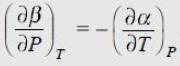
6.17 Show that P
What is inversion temperature? Mention the importance of this temperature in explaining the heating or cooling effect of a gas with the help of the Joule-Thomson inversion curve.
For a gas, if enthalpy is considered to be the function of temperature and pressure, then show that the Joule-Thomson coefficient is\[ \mu_{\mathrm{JT}}=-\frac{1}{C_{P}}\left(\frac{\partial H}{\partial P}\right)_{T} \]
Prove that \(C_{P}\) and \(C_{V}\) of an ideal gas depend only on temperature.
Show that the CV of an ideal gas does not depend upon a specific volume.
Show that\[ \mu_{\mathrm{JT}}=\frac{R T^{2}}{C_{P} P}\left(\frac{\partial Z}{\partial T}\right)_{P} \]where \(Z\) is the compressibility factor.(WBUT, 2006)
For a gas obeying the van der Waals equation of state, prove that the inversion temperature is \(T=\frac{2 a}{R b}\), where \(a\) and \(b\) are van der Waals constants.
What is a residual property? Define residual enthalpy, entropy, and internal energy.
The van der Waals constants for carbon dioxide are a = 3.59 L2-atm/mol2, b = 0.043 L/mol. What is the inversion temperature of the gas?
Derive an expression for the fugacity coefficient of a gas obeying the van der Waals equation of state.
Derive the relations for the estimation of residual enthalpy, entropy, and Gibbs free energy from the following relations:(a) Ideal gas equation of state(b) Compressibility factor(c) Virial coefficient(d) Cubic equation of state.
Show that the Joule-Thomson coefficient (μJT) of an ideal gas is zero.
Using Maxwell's relation, prove that\[ \left(\frac{\partial S}{\partial V}\right)_{T}=\left(\frac{\partial P}{\partial T}\right)_{V}=\frac{\beta}{\alpha} \]
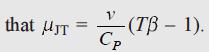
If the three variables H, T, and P are related as f(H, T, P) = 0, then show V that JT (TB - 1). Cp
What is fugacity and fugacity coefficient? How are they related? How does it play an important role in explaining the deviation from ideal gas behaviour?
Calculate \(\Delta A\) and \(\Delta G\) when \(1 \mathrm{~mol}\) of an ideal gas is allowed to expand isothermally at \(300 \mathrm{~K}\) from a pressure of \(100 \mathrm{~atm}\) to \(1 \mathrm{~atm}\).
Using the virial equation of state, estimate the residual enthalpy and entropy for propane at 60°C and 2.5 bar, given that Tc = 370 K, Pc = 42.57 bar, and ω = 0.153.
Explain some important methods for the estimation of the fugacity coefficient of a pure substance.
Show that for an ideal gas, \(\left(\frac{\partial E}{\partial V}\right)_{T}=0\), and for a van der Waals gas, \(\left(\frac{\partial E}{\partial V}\right)_{T}=\frac{a n^{2}}{V^{2}}\).
Estimate the residual entropy, enthalpy and internal energy at 298 K and 10 bar for nitrogen obeying the van der Waals equation of state, given that Tc = 126.2 K and Pc = 34.0 bar.
What is thermodynamic diagram? How can it be categorized? What is its importance? How is the thermodynamic diagram constructed?
Estimate the fugacity of iso-butane at 15 atm and 87°C using the compressibility factor correlation. BP Z=1+- > given that the second virial coefficient, B=-4.28 10 4 m/mol. RT
Using the fundamental property relation \(G=H-T S\), show that\[ \left(\frac{\partial H}{\partial P}\right)_{T}=V-T\left(\frac{\partial V}{\partial T}\right)_{P}=V(1-\alpha T) \]
Show that(a) \(\left(\frac{\partial H}{\partial P}\right)_{T}=\left[\frac{\partial(V / T)}{\partial(1 / T)}\right]_{P}\)(b) \(\frac{\partial}{\partial T}\left(\frac{\Delta G}{T}\right)=-\frac{\Delta H}{T^{2}}\)
If the temperature dependence of vapour pressure of an organic compound is given by\[ \log P=-\frac{1246.038}{T+221.354}+6.95 \]then calculate the enthalpy of vaporization at \(298 \mathrm{~K}\).
The van der Waals constants for nitrogen, \(a=1.39 \mathrm{~L}^{2}-\mathrm{atm} / \mathrm{mol}^{2}, b=0.039 \mathrm{~L} / \mathrm{mol}\). What is the inversion temperature of the gas?
Estimate the residual enthalpy and entropy for \(n\)-octane at \(60^{\circ} \mathrm{C}\) and 5 bar using the virial equation of state, given that \(T_{\mathrm{C}}=569.4 \mathrm{~K}, P_{\mathrm{C}}=24.97 \mathrm{bar}\), and \(\omega=0.398\).
Using the generalized virial coefficient of correlation, estimate the residual enthalpy and entropy for ethylene at \(339.7 \mathrm{~K}\) and \(1 \mathrm{bar}\), given that \(T_{\mathrm{C}}=283 \mathrm{~K}, P_{\mathrm{C}}=51.17 \mathrm{bar}\), and \(\omega=0.089\).
Calculate the residual enthalpy and entropy for propane at \(312 \mathrm{~K}\) and \(2 \mathrm{MPa}\) using the van der Waals equation of state, given that \(a=0.877 \mathrm{~Pa}\left(\mathrm{~m}^{3} / \mathrm{mol}\right)^{2}, b=0.84 \times 10^{-4} \mathrm{~m}^{3} / \mathrm{mol}\).
Estimate the fugacity of a gas obeying the virial equation of state at \(100^{\circ} \mathrm{C}\) and \(50 \mathrm{~atm}\), given that the virial coefficient, \(B=-73 \mathrm{~cm}^{3} / \mathrm{mol}\).
Estimate the fugacity of carbon monoxide at 50 bar and 200 bar, if the following data are applicable at \(273 \mathrm{~K}\) : P (in bar) Z 25 50 100 200 400 0.9890 0.9792 0.9741 1.0196 1.2482
Derive an expression to calculate the change in enthalpy and entropy of a real gas obeying the following equation of state along an isothermal path between the initial and final pressures \(P_{1}\) and \(P_{2}\) respectively:\[ V=\frac{R T}{P}+b-\frac{a}{R T} \]
For a gas which obeys the equation of state \(\left(P+\frac{a}{V^{2}}\right) V=R T\), prove that the JouleThomson coefficient is\[ \mu_{\mathrm{JT}}=\frac{2 a R T}{C_{P} V^{2}\left(P^{2}-\frac{a^{2}}{v^{4}}\right)} \]
Show that \(\left(\frac{\partial C_{P}}{\partial P}\right)_{T}=\frac{6 B}{T^{3}}\) for a gas obeying the equation of state \(V=\frac{R T}{P}+A-\frac{B}{T^{2}}\). [Hint: We know that \(\left(\frac{\partial C_{P}}{\partial P}\right)_{T}=-T\left(\frac{\partial^{2} V}{\partial T^{2}}\right)_{P}\). Find
Showing 1100 - 1200
of 2105
First
5
6
7
8
9
10
11
12
13
14
15
16
17
18
19
Last
Step by Step Answers

 Get 50% OFF
Claim Now
Get 50% OFF
Claim Now