New Semester
Started
Get
50% OFF
Study Help!
--h --m --s
Claim Now
Question Answers
Textbooks
Find textbooks, questions and answers
Oops, something went wrong!
Change your search query and then try again
S
Books
FREE
Study Help
Expert Questions
Accounting
General Management
Mathematics
Finance
Organizational Behaviour
Law
Physics
Operating System
Management Leadership
Sociology
Programming
Marketing
Database
Computer Network
Economics
Textbooks Solutions
Accounting
Managerial Accounting
Management Leadership
Cost Accounting
Statistics
Business Law
Corporate Finance
Finance
Economics
Auditing
Tutors
Online Tutors
Find a Tutor
Hire a Tutor
Become a Tutor
AI Tutor
AI Study Planner
NEW
Sell Books
Search
Search
Sign In
Register
study help
engineering
introduction to chemical engineering thermodynamics
Introduction To Chemical Engineering Thermodynamics 2nd Edition HALDER - Solutions
(a) The following equations have been proposed to represent activity coefficient data for a system at fixed \(T\) and \(P\).\[ \begin{aligned} & \ln \gamma_{1}=x_{2}^{2}\left(0.5+2 x_{1}\right) \\ & \ln \gamma_{2}=x_{1}^{2}\left(1.5-2 x_{2}\right) \end{aligned} \]Do these equations satisfy
The pressure of a gas is given by \(P=\frac{10}{V}\), where \(P\) is in atm and \(V\) is in L. If the gas expands from 10 to \(50 \mathrm{~L}\) and undergoes an increase in internal energy of \(200 \mathrm{cal}\), how much heat will be absorbed during the process?
Show that the Joule-Thomson coefficient of a gas\[ \mu=\frac{V}{C_{P}}(T \beta-1) \]where \(\beta\) is the coefficient of volume expansion and others have their usual meanings.
Deduce the Gibbs-Duhem equation in light of chemical potential to a multi-component system.
Calculate the standard Gibbs free energy change and the equilibrium constant at \(1 \mathrm{bar}\) and \(298 \mathrm{~K}\) for the ammonia synthesis reaction\[ \mathrm{N}_{2}(\mathrm{~g})+3 \mathrm{H}_{2}(\mathrm{~g}) \rightarrow 2 \mathrm{NH}_{3}(\mathrm{~g}) \]given that the standard free
(a) Derive the Clausius-Clapeyron equation in the study of the vaporization process of a pure substance.(b) In a frictionless piston-cylinder assembly, an ideal gas undergoes a compression process from an initial state of 1 bar at \(300 \mathrm{~K}\) to 10 bar at \(300 \mathrm{~K}\). The entire
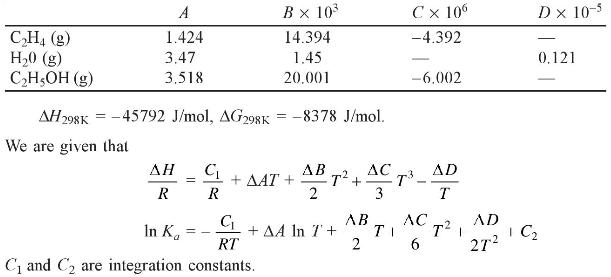
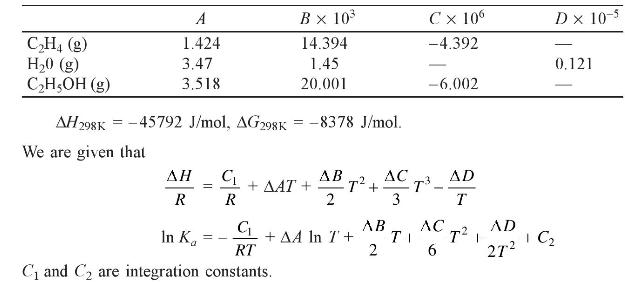
Calculate the equilibrium constant for the vapour phase hydration of ethylene at \(145^{\circ} \mathrm{C}\). The following data are given:\[ \frac{C_{P}}{R}=A+B T+C T^{2}+\frac{D}{T^{2}} \] A B x 103 CH4 (g) 1.424 14.394 Cx 106 -4.392 D x 10-5 - H0 (g) 3.47 CHOH (g) 3.518 1.45 20.001 0.121 -6.002 -
(a) With the help of the \(\mathrm{T}-\mathrm{S}\) diagram, explain the working principle of a vapourcompression refrigeration system. Derive the expression for its C.O.P.(b) An inventor claims to have developed an absorption refrigerating machine that receives heat from a source at \(125^{\circ}
Calculate the equilibrium constant for the vapour phase hydration of ethylene at \(145^{\circ} \mathrm{C}\). The following data are given:\[ \frac{C_{P}}{R}=A+B T+C T^{2}+\frac{D}{T^{2}} \] CH4 (g) H0 (g) CHOH (g) AH 298K = We are given that A B x 103 1.424 14.394 Cx 106 -4.392 D x 10-5 - 3.47 1.45
The following equations have been proposed to represent activity coefficient data for a system at fixed \(T\) and \(P\) :\[ \begin{aligned} & \ln \gamma_{1}=x_{2}^{2}\left(0.5+2 x_{1}\right) \\ & \ln \gamma_{2}=x_{1}^{2}\left(0.5-2 x_{2}\right) \end{aligned} \]Do these equations satisfy the
(a) In a binary liquid system, the enthalpy of species 1 and 2 at constant temperature and pressure is represented by the following equation:\[ H=400 x_{1}+600 x_{2}+x_{1} x_{2}\left(40 x_{1}+20 x_{2}\right) \quad \text { where } H \text { is in } \mathrm{J} / \mathrm{mol} \]Determine the
A rigid and insulated tank of volume of \(2 \mathrm{~m}^{3}\) is divided into two equal compartments by a partition. One compartment contains an ideal gas at \(400 \mathrm{~K}\) and \(3 \mathrm{MPa}\), while the second compartment contains the same gas at \(600 \mathrm{~K}\) and \(1 \mathrm{MPa}\).
What is the standard Gibbs' free energy change of a chemical reaction and how is it related to equilibrium constant?
Derive the relation between the second virial coefficient of van der Waals equation of state with ' \(a\) ' and ' \(b\) '.
Find the change in entropy of an equimolar mixture of oxygen and nitrogen.
Prove the following relation between fugacity and pressure:\[ \ln \left(\frac{f}{P}\right)=\int_{0}^{p} \frac{z-1}{p} d p \]where, \(z=\) two parameter compressibility factor.
Consider the dissociation of 1 mole of nitrogen tetroxide according to the following reaction:\[ \mathrm{N}_{2} \mathrm{O}_{4} \rightarrow 2 \mathrm{NO}_{2} \]Prove that the equilibrium constant in terms of reaction co-ordinate \(Y\) at equilibrium pressure is\[ K=\frac{4 Y^{2} P}{1-Y^{2}} \]The
(a) Distinguish between (i) Intensive and extensive properties (ii) Reversible and irreversible processes.(b) An ideal gas ( \(C_{P}=5 \mathrm{kcal} / \mathrm{kmol}\) and \(\left.C_{V}=3 \mathrm{kcal} / \mathrm{kmol}\right)\) is changed from \(1 \mathrm{~atm}\) and \(22.4 \mathrm{~m}^{3}\) to \(10
(a) What are the conditions when maximum and minimum boiling azeotropes are formed? Prove that for a closed multi-component system, in equilibrium, chemical potential of a component in all phases is the same.(b) The molar volume of a binary liquid mixture at \(T\) and \(P\) is given by \[ V=120
(a) Deduce Gibbs-Duhem relation.(b) A binary liquid mixture of (i) benzene and (ii) toluene is at 760 torr. Vapour pressures of benzene and toluene are represented by the Antoine equation.\[ \begin{aligned} & \log _{10} P_{1}^{\text {sat }}(\text { torr })=6.879-\frac{1196.76}{t\left({ }^{\circ}
(a) What are the criteria based on which refrigerant is chosen for refrigeration? Explain the absorption refrigeration with a flow diagram. Determine the expression of performance efficiency of an ideal absorption refrigeration cycle.(b) What is the difference between Linde and Claude liquefaction
Applying the criterion for equilibrium, derive the Clausius-Clapeyron equation.
Deduce the Gibbs-Duhem-Margules equation for a binary solution starting from Raoult's law.
A binary liquid mixture consists of \(60 \mathrm{~mol}\) per cent ethylene and \(40 \mathrm{~mol}\) per cent propylene. At \(423 \mathrm{~K}\), the vapour pressure of ethylene and propylene are \(15.2 \mathrm{~atm}\) and 9.8 atm respectively. Calculate the total pressure and equilibrium composition
The pure component vapour pressure of two organic liquids \(\mathrm{X}\) and \(\mathrm{Y}\) by Antoine equations are given by\[ \ln P_{1}^{\text {Sat }}=14.35-\frac{2942}{T+220} \]and\[ P_{2}^{\text {Sat }}=14.25-\frac{2960}{T+210} \]where \(P_{1}^{\text {Sat }}\) and \(P_{2}^{\text {Sat }}\)
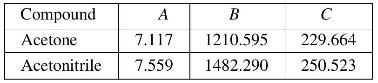
The vapour pressure of acetone, acetonitrile and nitromethane can be represented by Antoine equations as\[ \begin{aligned} & \ln P_{1}^{\text {Sat }}=14.3916-\frac{2795.82}{T+230.0} \\ & \ln P_{2}^{\text {Sat }}=14.2724-\frac{2945.47}{T+224.0} \end{aligned} \]and\[ \ln P_{3}^{\text {Sat
For the system methanol (1)-methyl acetate (2), the activity coefficients for components 1 and 2 are represented by where\[ \begin{aligned} \ln \gamma_{1} & =A x_{2}^{2} \quad \text { and } \quad \ln \gamma_{2}=A x_{1}^{2} \\ A & =2.771-0.00523 T \end{aligned} \]The vapour pressures of the
For a binary system, the excess Gibbs free energy of components 1 and 2 at \(30^{\circ} \mathrm{C}\) is given by \(\frac{G^{\mathrm{E}}}{R T}=0.625 x_{1} x_{2}\). The vapour pressures of components 1 and 2 are given by\[ \ln P_{1}^{\text {Sat }}=13.71-\frac{3800}{T} \quad \text { and } \quad \ln
For a liquid mixture following the two-parameter three-suffix Margules equation, the activity coefficients are represented by\[ \ln \gamma_{1}=x_{2}^{2}\left[A+2(B-A) x_{1}\right] \]and\[ \ln \gamma_{2}=x_{1}^{2}\left[A+2(A-B) x_{2}\right] \]Determine the expression for the excess Gibbs free
An azeotrope consists of \(42.0 \mathrm{~mol}\) per cent acetone (1) and \(58.0 \mathrm{~mol}\) per cent methanol at \(760 \mathrm{~mm} \mathrm{Hg}\) and \(313 \mathrm{~K}\). At \(313 \mathrm{~K}\), the vapour pressure of acetone and methanol are \(786 \mathrm{~mm} \mathrm{Hg}\) and \(551
The azeotrope of the benzene-cyclohexane system has a composition of \(53.2 \mathrm{~mol}\) per cent benzene with a boiling point of \(350.6 \mathrm{~K}\) at \(101.3 \mathrm{kPa}\). At this temperature, the vapour pressure of benzene (1) is \(100.59 \mathrm{kPa}\) and the vapour pressure of
Under atmospheric condition, the acetone-chloroform azeotrope boils at \(64.6^{\circ} \mathrm{C}\) and contains \(33.5 \mathrm{~mol}\) per cent acetone. The vapour pressures of acetone and chloroform at this temperature are \(995 \mathrm{~mm} \mathrm{Hg}\) and \(885 \mathrm{~mm} \mathrm{Hg}\)
The activity coefficients in a binary system are represented by \(\ln \gamma_{1}=A x_{2}^{2}\) and \(\ln \gamma_{2}=A x_{1}^{2}\). Show that if the system forms an azeotrope, the azeotropic composition is given by \(x_{1}=\frac{1}{2}\left(1+\frac{1}{A} \ln \frac{P_{1}^{\text {Sat }}}{P_{2}^{\text
Using the Wilson and NRTL equations, estimate the activity coefficients of the components of a binary system consisting of iso-butanol (1) and iso-propanol (2) at \(50^{\circ} \mathrm{C}\) and \(x_{1}=0.3\). At this temperature, the molar volumes of the components are \(V_{1}=65.2\)
A piston-cylinder assembly contains a binary liquid mixture which comprises \(40 \%\) ethane by mole and \(60 \%\) propane by mole at \(1.5 \mathrm{MPa}\). Applying \(K\)-method, calculate the temperature at which vaporization begins and the composition of the first vapour bubble formed.
A vapour mixture of \(20 \mathrm{~mol}\) per cent methane, \(30 \mathrm{~mol}\) per cent ethane and \(50 \mathrm{~mol}\) per cent propane is available at \(30^{\circ} \mathrm{C}\). Using \(K\)-factors, determine the pressure at which condensation begins if the mixture is isothermally compressed and
For a mixture of \(10 \mathrm{~mol}\) per cent methane, \(20 \mathrm{~mol}\) per cent ethane and \(70 \mathrm{~mol}\) per cent propane at \(10^{\circ} \mathrm{C}\). Determine(a) The dew point pressure.(b) The bubble point pressure.Get \(K\)-values from Fig. 10.5 .
The system acetone (1)-acetonitrile (2)-nitro-methane (3) at \(80^{\circ} \mathrm{C}\) and \(100 \mathrm{kPa}\) has the overall composition \(z_{1}=0.45, z_{2}=0.35\), and \(z_{3}=0.20\). Assuming that Raoult's law is appropriate to this system, determine \(L, V, x_{i}\) and \(y_{i}\). The vapour
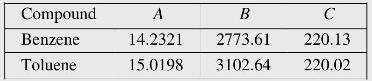
For the benzene-toluene system, \(z_{1}=0.81\) at \(60^{\circ} \mathrm{C}\) and \(70 \mathrm{kPa}\). The vapour pressure of the components are given by the Antoine equation \(\ln P=A-\frac{B}{T+C}\), where \(T\) is in \({ }^{\circ} \mathrm{C}\) and \(P\) is in \(\mathrm{kPa}\). Antoine constants
For the system acetone (1)-carbon tetrachloride (2), the vapour-liquid equilibrium data at \(45^{\circ} \mathrm{C}\) were reported by an experimenter after several observations. Test whether the following data are thermodynamically consistent or not: P (torr) 315.32 x1 y 0.0556 0.2165 339.70 397.77
What do you mean by criterion for equilibrium of a system?
Mention the different criteria for phase equilibrium. What is the necessity for a system to be in equilibrium?
How can equilibrium be classified? When does a system reach equilibrium?
Explain the phase rule for non-reacting system. State Duhem's theorem in substantiating the phase rule.
Enumerate the role of independent variables in vapour-liquid equilibrium.
Show that the chemical potentials of a component in different phases are equal.
What is the condition of phase equilibrium for a single-component system? How does it differ from that of a multicomponent system?
Justify the statement: Fugacities of a pure component in vapour and liquid phases are identical.
With the help of neat schematic representation, explain the importance of vapour-liquid equilibrium of a binary system.
What is the significance of Poynting pressure correction factor in vapour-liquid equilibrium?
What is boiling point diagram? Discuss it for benzene-toluene system.
With the help of temperature-composition diagram, discuss the distillation process. What are the roles of bubble point and curve dew point curve?
Define the term tie line. How does it play an important role in boiling point diagram?
Differentiate between \(P-x-y\) and \(T-x-y\) diagrams in explaining the VLE of a binary system.
Draw the \(T-x-y\) diagram at constant pressure for a minimum boiling azeotrope.
Draw the \(P-x-y\) diagram at constant temperature for a maximum boiling azeotrope.
What is retrograde condensation?
What do you mean by maxcondentherm and maxcondenbar? How do they differ from each other?
What is Raoult's law? How do you explain the deviation from Raoult's law? What are positive and negative deviation of a solution from ideality?
Write down the characteristics of an ideal solution.
What is an azeotrope? How do you categorize an azeotrope? Discuss the minimum boiling azeotrope with the help of phase diagram for a particular system.
Explain the azeotrope formation for nitric acid-water system with graphical representation.
Explain the vapour-liquid equilibrium for a binary system at low pressure.
Derive Margules two-suffix three-parameter equation for the calculation of activity coefficients.
Mention the usefulness of the van Laar equation to determine the activity coefficients of a binary solution.
Differentiate between UNIFAC and UNIQUAC methods.
What is \(K\)-factor? Illustrate the importance of \(K\)-factor.
Define bubble point and dew point. How do you calculate the dew point and bubble point of binary VLE mixture?
How does the \(K\)-factor relate to the bubble point and dew point calculation of a binary vapour-liquid equilibrium mixture?
In case of flash distillation, how do you calculate the flash?
How does the Gibbs-Duhem equation play a significant role for the thermodynamic consistency of VLE data?
Discuss the methods involved in checking the thermodynamic consistency of the vapour-liquid equilibrium data of a binary system.
A piston-cylinder assembly contains a binary liquid mixture which comprises \(30 \%\) ethylene by mole and \(70 \%\) propylene by mole at \(1 \mathrm{MPa}\). Applying \(K\)-method, calculate the temperature at which vaporization begins and the composition of the first bubble formed.
A vapour mixture of \(20 \mathrm{~mol}\) per cent methane, \(35 \mathrm{~mol}\) per cent ethane and \(45 \mathrm{~mol}\) per cent propane is available at \(30^{\circ} \mathrm{C}\). Using \(K\)-factors, determine the pressure at which condensation begins if the mixture is isothermally compressed and
For a mixture of \(15 \mathrm{~mol}\) per cent methane, \(25 \mathrm{~mol}\) per cent ethane and \(60 \mathrm{~mol}\) per cent propane at \(10^{\circ} \mathrm{C}\). Determine(a) Dew point pressure(b) Bubble point pressure.
A liquid mixture of \(25 \mathrm{~mol}\) percent ethylene and \(75 \mathrm{~mol}\) percent propylene at \(-40^{\circ} \mathrm{C}\) is kept in a piston-cylinder assembly. The piston exerts a constant pressure of \(1 \mathrm{MPa}\). Using the \(K\)-method, determine the dew point temperature.
A binary liquid mixture consists of \(50 \mathrm{~mol}\) per cent \(n\)-hexane and \(50 \mathrm{~mol}\) per cent \(n\)-butane. At \(423 \mathrm{~K}\), the vapour pressure of \(n\)-hexane and \(n\)-butane are \(13.1 \mathrm{~atm}\) and \(7.5 \mathrm{~atm}\) respectively. Calculate the total pressure
An equimolar binary liquid mixture consists of two components - methane and propane. At \(443 \mathrm{~K}\), the vapour pressure of methane and propane are \(16.5 \mathrm{~atm}\) and \(9.2 \mathrm{~atm}\) respectively. Calculate the total pressure and equilibrium composition of the vapour phase.
The pure component vapour pressure of two organic liquids-acetone and acetonitrileby Antoine equations are given by \[ \ln P_{1}^{\text {Sat }}=14.54-\frac{2940}{T-36} \]and\[ \ln P_{2}^{\text {Sat }}=14.27-\frac{2945}{T-50} \]where \(P_{1}^{\text {Sat }}\) and \(P_{2}^{\text {Sat }}\) are in
Calculate the composition of liquid and vapour in equilibrium at \(327 \mathrm{~K}\) and \(65 \mathrm{KPa}\). The azeotrope of the ethanol-benzene system has a composition of \(44.8 \mathrm{~mol}\) per cent ethanol with a boiling point of \(68.24^{\circ} \mathrm{C}\) at \(760 \mathrm{~mm}
For the system methanol (1)-methyl acetate (2), the activity coefficients for components 1 and 2 are represented by\[ \ln \gamma_{1}=A x_{2}^{2} \quad \text { and } \quad \ln \gamma_{2}=A x_{1}^{2} \]where\[ A=2.771-0.00523 T \]The vapour pressures of the components are given by the Antoine
For a binary system, the excess Gibbs free energy of components 1 and 2 at \(30^{\circ} \mathrm{C}\) is given by \(\frac{G^{\mathrm{E}}}{R T}=0.500 x_{1} x_{2}\). The vapour pressures of components 1 and 2 are given by\[ \ln P_{1}^{\text {Sat }}=11.92-\frac{4050}{T} \quad \text { and } \quad \ln
An azeotrope consists of \(40.0 \mathrm{~mol}\) per cent acetone (1) and \(60.0 \mathrm{~mol}\) per cent methanol at \(760 \mathrm{~mm} \mathrm{Hg}\) and \(310 \mathrm{~K}\). At \(310 \mathrm{~K}\), the vapour pressure of acetone and methanol are \(780 \mathrm{~mm} \mathrm{Hg}\) and \(542
The azeotrope of the benzene-toluene system has a composition of \(53.2 \mathrm{~mol}\) per cent benzene with a boiling point of \(350.6 \mathrm{~K}\) at \(101.3 \mathrm{kPa}\). At this temperature, the vapour pressure of benzene (1) is \(112.23 \mathrm{kPa}\) and the vapour pressure of toluene (2)
Using the Wilson and NRTL equations, estimate the activity coefficients of the components of a binary system consisting of toluene (1) and cyclohexane (2) at \(60^{\circ} \mathrm{C}\) and \(x_{1}=0.4\). At this temperature, the molar volumes of the components are \(V_{1}=75.2\) \(\mathrm{cm}^{3} /
Wilson's parameters for the chloroform-methanol system at \(35^{\circ} \mathrm{C}\) are given by \(\lambda_{12}-\lambda_{11}=-1.522 \mathrm{~kJ} / \mathrm{mol}-\mathrm{K}\) and \(\lambda_{12}-\lambda_{22}=7.559 \mathrm{~kJ} / \mathrm{mol}-\mathrm{K}\). Estimate the VLE data for the system at
Carbon tetrachloride-ethanol forms an azeotrope at 760 torr, where \(x_{1}=0.613\) and \(T=64.95^{\circ} \mathrm{C}\). Using the van Laar model, predict the \(P-x-y\) data at \(64.95^{\circ} \mathrm{C}\).
Construct the \(P-x-y\) diagram for the cyclohexane-benzene system at \(313 \mathrm{~K}\), given that at this temperature \(P_{1}^{\text {Sat }}=24.62 \mathrm{kPa}\) and \(P_{2}^{\text {Sat }}=24.4 \mathrm{kPa}\). The liquid phase activity coefficients are given by \(\ln \gamma_{1}=0.458
The ternary system \(A-B-C\) at \(80^{\circ} \mathrm{C}\) and \(100 \mathrm{kPa}\) has the overall composition \(z_{1}=0.40\), \(z_{2}=0.30\), and \(z_{3}=0.30\). Assuming that Raoult's law is appropriate to this system, determine \(L, V, x_{i}\) and \(y_{i}\). The vapour pressure of pure species
For the acetone-acetonitrile system, \(z_{1}=0.75\) at \(60^{\circ} \mathrm{C}\) and \(70 \mathrm{kPa}\). The vapour pressures of the components are given by the Antoine equation\[ \ln P=A-\frac{B}{T+C} \]where \(T\) is in \({ }^{\circ} \mathrm{C}\) and \(P\) is in \(\mathrm{kPa}\). Antoine
A mixture containing \(15 \mathrm{~mol}\) per cent ethane, \(35 \mathrm{~mol}\) per cent propane, and \(50 \mathrm{~mol}\) per cent n-butane is brought to a condition of \(40^{\circ} \mathrm{C}\) at pressure \(P\). If the mole fraction of the liquid in the system is 0.40 , what is pressure \(P\)
For the binary system \(n\)-pentanol (1)- \(n\)-hexane (2), determine the activity coefficients at \(31 \mathrm{~K}\) in an equimolar mixture. The Wilson parameters are as follows:\[ \begin{aligned} V_{1} & =109.2 \times 10^{-6} \mathrm{~m}^{3} / \mathrm{mol} \\ V_{2} & =132.5 \times 10^{-6}
n-heptane and toluene form an ideal solution mixture. At \(373 \mathrm{~K}\), their vapour pressures are \(106 \mathrm{kPa}\) and \(74 \mathrm{kPa}\) respectively. Determine the composition of the liquid and vapour in equilibrium at \(373 \mathrm{~K}\) and \(101.3 \mathrm{kPa}\).
Prove that at the azeotropic point, the composition of the vapour and liquid phases are the same.
Ethyl alcohol and hexane form an azeotrope containing \(33.2 \mathrm{~mol}\) per cent ethanol at \(58.7^{\circ} \mathrm{C}\) and \(1 \mathrm{~atm}\) pressure. Determine the van Laar parameters at this temperature. Assume the system to follow modified Raoult's law. The vapour pressures by Antoine
For the ethyl ethanoate- \(n\)-heptane system at \(343.15 \mathrm{~K}\), assuming the system to follow modified Raoult's law, predict whether an azeotrope gets formed or not. If it is so, calculate the azeotrope composition and pressure at \(T=343.15 \mathrm{~K}\). We are given that\[ \ln
For the acetone-cyclohexane system at \(50^{\circ} \mathrm{C}\) and \(x_{1}=0.35\), calculate the activity coefficients of the components using the NRTL equation. We are given that\[ \begin{aligned} b_{12} & =682.21 \mathrm{cal} / \mathrm{mol} \\ b_{21} & =1231.47 \mathrm{cal} / \mathrm{mol} \\
A binary system of species 1 and 2 has vapour and liquid phases in equilibrium at temperature \(T\), for which\[ \begin{aligned} \ln \gamma_{1} & =1.8 x_{2}^{2} \\ \ln \gamma_{2} & =1.8 x_{1}^{2} \\ P_{1}^{\text {Sat }} & =1.24 \text { bar } \\ P_{2}^{\text {Sat }} & =0.89 \text { bar. }
A mixture comprising \(30 \mathrm{~mol}\) per cent methane, \(10 \mathrm{~mol}\) per cent propane and \(30 \mathrm{~mol}\) per cent \(n\)-butane is brought to a condition of \(-15^{\circ} \mathrm{C}\) at pressure \(P\), where it exists as a vapour-liquid mixture in equilibrium. If the mole fraction
Show that the van Laar and Margules equations are consistent with the Gibbs-Duhem equation.
Showing 500 - 600
of 2105
1
2
3
4
5
6
7
8
9
10
11
12
13
14
15
Last
Step by Step Answers

 Get 50% OFF
Claim Now
Get 50% OFF
Claim Now