New Semester
Started
Get
50% OFF
Study Help!
--h --m --s
Claim Now
Question Answers
Textbooks
Find textbooks, questions and answers
Oops, something went wrong!
Change your search query and then try again
S
Books
FREE
Study Help
Expert Questions
Accounting
General Management
Mathematics
Finance
Organizational Behaviour
Law
Physics
Operating System
Management Leadership
Sociology
Programming
Marketing
Database
Computer Network
Economics
Textbooks Solutions
Accounting
Managerial Accounting
Management Leadership
Cost Accounting
Statistics
Business Law
Corporate Finance
Finance
Economics
Auditing
Tutors
Online Tutors
Find a Tutor
Hire a Tutor
Become a Tutor
AI Tutor
AI Study Planner
NEW
Sell Books
Search
Search
Sign In
Register
study help
engineering
introduction to chemical engineering thermodynamics
Introduction To Chemical Engineering Thermodynamics 2nd Edition HALDER - Solutions
Constant boiling mixtures are called(a) Distillates(b) Refluxes(c) Ternary solutions(d) Azeotropes.
The partial pressure of a component of an ideal solution is directly proportional to its mole fraction in the solution. This is known as(a) Henry's law(b) Raoult's law(c) Amagot's law(d) Dalton's law.
In a dilute solution, the solute obeys(a) Henry's law(b) Raoult's law(c) Dalton's law(d) None of these.
The solvent in a dilute solution follows(a) Henry's law(b) Dalton's law(c) Raoult's law(d) None of these.
The ratio of fugacity to fugacity at standard state is called the(a) Activity(b) Activity co-efficient(c) Fugacity coefficient(d) Chemical potential.
Entropy is a(a) State function(b) Path function(c) Both (a) and (b)(d) Neither (a) nor (b).
Entropy can be mathematically expressed as(a) \(d S=\frac{d H_{\text {rev }}}{T}\)(b) \(d S=\frac{d Q_{\text {irrev }}}{T}\)(c) \(d S=\frac{d U_{\mathrm{rev}}}{T}\)(d) None of these.
Choose the correct one:(a) \(S_{\mathrm{s}}>S_{\mathrm{l}}>S_{\mathrm{g}}\)(b) \(S_{\mathrm{s}}S_{\mathrm{s}}\)(d) \(S_{\mathrm{s}}>S_{1}
When solid iodine is sublimed to gaseous iodine, the entropy of the system(a) Decreases(b) Increases(c) Remains constant(d) None of these.
For a system(a) Gauge pressure \(=\) Atmospheric pressure + Absolute pressure(b) Gauge pressure \(=\) Absolute pressure + Atmospheric pressure(c) Gauge pressure \(=\) Atmospheric pressure - Absolute pressure(d) Gauge pressure \(=\) Absolute pressure - Atmospheric pressure.
The state of a system is identified by its(a) Shape(b) Size(c) Properties(d) Surroundings.
Suppose a refrigerator with its door open is operated continuously in a kitchen and the kitchen is isolated from the rest of the house. The temperature of the kitchen will(a) Decrease(b) Increase(c) Not change(d) Increase first and then decrease.
For a closed system, the first law of thermodynamics tells us that(a) \(\oint d Q=\oint d W\)(b) \(d Q=d E+d W\)(c) \(d Q-d W\) is an exact differential(d) All of these.
If an ideal gas undergoes a reversible adiabatic expansion, the work done by the gas is given by(a) \(\frac{P_{2} V_{2}-P_{1} V_{1}}{\gamma-1}\)(b) \(\frac{P_{1} V_{1}-P_{2} V_{2}}{\gamma-1}\)(c) \(\frac{R\left(T_{2}-T_{1}\right)}{\gamma-1}\)(d) None of these.
The area enclosed by a thermodynamic cycle on a \(T-S\) diagram represents the(a) Net work done(b) Net heat interaction(c) Both (a) and (b)(d) Neither (a) nor (b).
When a system undergoes an irreversible (spontaneous) process(a) \(\Delta S_{\text {System }}+\Delta S_{\text {Surroundings }}>0\)(b) \(\Delta S_{\text {System }}+\Delta S_{\text {Surroundings }}
For a pure substance(a) The entropy of saturated vapour decreases with increase in pressure(b) The enthalpy of saturated vapour decreases with increase in pressure(c) The enthalpy of vaporization decreases with increase in pressure(d) None of these.
At critical state the compressibility factor for a van der Waals gas is(a) 0.75(b) 0.5(c) 0.375(d) 1.0 .
Consider two identical closed rigid vessels \(A\) and \(B\). Vessel A contains \(32 \mathrm{~kg}\) oxygen at \(373 \mathrm{~K}\) while \(\mathrm{B}\) contains \(28 \mathrm{~kg}\) nitrogen at \(373 \mathrm{~K}\). If \(p_{\mathrm{A}}\) and \(p_{\mathrm{B}}\) are the corresponding partial pressures in
For a constant temperature process in an ideal gas(a) \(\Delta Q=-\mathrm{ve}\)(b) \(\Delta U=0\)(c) \(\Delta W=0\)(d) \(\Delta U=-\mathrm{ve}\).
A fixed mass of gas emits \(250 \mathrm{~J}\) of heat energy and contracts at a constant pressure of \(1 \times 10^{5} \mathrm{~Pa}\) from \(2.5 \times 10^{-3} \mathrm{~m}^{3}\) to \(1.0 \times 10^{-3} \mathrm{~m}^{3}\). What is the change in the internal energy?(a) \(-250 \mathrm{~J}\)(b) \(100
The basic purpose of a heat engine is to convert(a) Mechanical energy into thermal energy(b) Thermal energy into electrical energy(c) Thermal energy into mechanical energy(d) None of these.
When a system does work on its surroundings, its internal energy will(a) Decrease(b) Increase(c) Stay constant(d) Become more concentrated.
The work output of a \(50 \%\) efficient heat engine giving off \(60 \mathrm{~J}\) of energy as waste heat is(a) \(50 \mathrm{~J}\)(b) \(60 \mathrm{~J}\)(c) \(45 \mathrm{~J}\)(d) \(70 \mathrm{~J}\).
How much work will a heat engine do if it takes in \(80 \mathrm{~J}\) of heat energy from a hightemperature source and expels \(25 \mathrm{~J}\) of waste heat into its surroundings?(a) \(60 \mathrm{~J}\)(b) \(50 \mathrm{~J}\)(c) \(55 \mathrm{~J}\)(d) \(70 \mathrm{~J}\).
How much heat must be transferred into a balloon in order to increase its internal energy by \(18 \mathrm{~J}\) if it does \(12 \mathrm{~J}\) of work on the surrounding air as it expands?(a) \(40 \mathrm{~J}\)(b) \(65 \mathrm{~J}\)(c) \(55 \mathrm{~J}\)(d) \(30 \mathrm{~J}\).
What will be the change in temperature of a \(0.2 \mathrm{~kg}\) iron bar if \(400 \mathrm{~J}\) of energy is transferred into it as heat? \(\left(C_{P}\right.\) for iron \(\left.=450 \mathrm{~J} / \mathrm{kg}^{\circ} \mathrm{C}\right)\)(a) \(4.4^{\circ} \mathrm{C}\)(b) \(7.2^{\circ}
What will be the final equilibrium temperature when \(100 \mathrm{~g}\) of water at \(30^{\circ} \mathrm{C}\) and \(200 \mathrm{~g}\) of water at \(80^{\circ} \mathrm{C}\) are mixed in an insulated container? \(\left(C_{P}\right.\) for water \(\left.=4185 \mathrm{~J} / \mathrm{kg}^{\circ}
The three commonly used temperature scales are(a) Fahrenheit, Celsius and Rankine(b) Fahrenheit, Celsius and Kelvin(c) Fahrenheit, Rankine and Kelvin(d) Celsius, Rankine and Kelvin.
When two bodies are in thermal equilibrium(a) They have the same pressure(b) They have the same temperature(c) They are in a quasi-static state of equilibrium(d) They have the same chemical composition.
Water starts to vaporize at(a) \(100^{\circ} \mathrm{C}\)(b) Saturated temperature(c) Superheated temperature(d) Both (a) and (b).
The driving force of a system to be in chemical equilibrium is(a) Temperature(b) Pressure(c) Free energy(d) Chemical potential.
The relation between the Rankine scale and the Fahrenheit scale is(a) \(T(\mathrm{R})=T\left({ }^{\circ} \mathrm{F}\right)+459.67\)(b) \(T\left({ }^{\circ} \mathrm{F}\right)=T(\mathrm{R})+459.67\)(c) \(T(\mathrm{R})+T\left({ }^{\circ} \mathrm{F}\right)=459.67\)(d) None of these.
The relation between the Celsius scale and the Fahrenheit scale is(a) \(T\left({ }^{\circ} \mathrm{F}\right)-1.8 T\left({ }^{\circ} \mathrm{C}\right)=32\)(b) \(T\left({ }^{\circ} \mathrm{F}\right)=1.8 T\left({ }^{\circ} \mathrm{C}\right)-32\)(c) \(T\left({ }^{\circ} \mathrm{F}\right)=1.8 T\left({
For methanol synthesis reaction\[ \mathrm{CO}(\mathrm{g})+2 \mathrm{H}_{2}(\mathrm{~g}) \rightleftharpoons \mathrm{CH}_{3} \mathrm{OH}(\mathrm{g}) \]Using a feed mixture of carbon monoxide and hydrogen in the stoichiometric proportion, state what equilibrium mole fraction of methanol at 50 bar
Show that for steady state flow process, \(\Delta H=Q-W_{S}\).
What is reaction coordinate? What is its significance in chemical reaction?
An ideal gas \(\left(C_{P}=5, C_{V}=3\right)\) is changed from \(1 \mathrm{~atm}\) and \(22.4 \mathrm{~m}^{3}\) to \(10 \mathrm{~atm}\) and 2.24 \(\mathrm{m}^{3}\) by the reversible process of heating at constant volume followed by cooling at constant pressure. Draw the path in a \(P-V\) diagram
The following experimental data are available for \(\mathrm{CO}_{2}\) gas at \(92^{\circ} \mathrm{C}\) : PR 1 2 3 4 6 8 10 0.856 0.583 0.535 0.620 0.800 0.975 1.160 Find the fugacity of CO2 at 100 atm. Data: For CO2, T = 304.1 K and Pc = 72.9 atm.
What do you mean by extent of reaction? Derive an expression of the relationship between mole fraction of the component and the extent of reaction.
What is the criterion of chemical equilibrium for a reacting system?
Define Joule-Thomson coefficient \(\mu_{\mathrm{TT}}\). Express \(\mu_{\mathrm{TT}}\) in terms of \(C_{P}\) and compressibility factor \(Z\) in the following form:\[ \mu_{\mathrm{JT}}=\frac{R T^{2}}{P C_{P}}\left(\frac{\partial Z}{\partial T}\right)_{P} \quad \text { where } P V=Z R T \]
Give an informatory note on equilibrium constant of the chemical reaction.
Derive the following expression:\[ \left(\frac{\partial C_{P}}{\partial P}\right)_{T}=-T\left(\frac{\partial^{2} V}{\partial T^{2}}\right)_{P} \]
Prove that \(K_{a}=K_{f}=K_{p}\).
What is Clausius-Clapeyron equation?
With an example, explain the importance of multireaction stoichiometry.
With the help of a \(T-S\) diagram describe the vapour compression refrigeration cycle and derive its COP.
What is the standard Gibbs free energy change and how is it related to the equilibrium constant?
For a binary liquid mixture at constant temperature and pressure, excess Gibbs energy is given by\[ \frac{G^{\mathrm{E}}}{R T}=\left(-2.6 x_{1}-1.8 x_{2}\right) x_{1} x_{2} \]Show that these expressions satisfy the Gibbs-Duhem equation.
Define standard state. What is standard free energy of formation of a compound?
Under atmospheric conditions the acetone-chloroform azeotrope boils at \(64.6^{\circ} \mathrm{C}\) and contains 33.5 mole percent acetone. The vapour pressures of acetone and chloroform at this temperature are 995 and \(855 \mathrm{~mm} \mathrm{Hg}\) respectively. Calculate the composition of the
What is the influence of temperature on equilibrium constant? In light of this, derive van't Hoff's equation.
For the reaction\[ \mathrm{CO}_{2}(\mathrm{~g})+\mathrm{H}_{2}(\mathrm{~g}) \rightarrow \mathrm{CO}(\mathrm{g})+\mathrm{H}_{2} \mathrm{O}(\mathrm{g}) \]at \(298 \mathrm{~K}\) is \(8.685 \times 10^{-6}\). Estimate the value of \(K_{a}\) at \(1000 \mathrm{~K}\), assuming that \(\Delta H^{0}\) is
Discuss the condition of feasibility of a chemical reaction in terms of standard Gibbs free energy change.
The following experimental data are available for \(\mathrm{CO}_{2}\) gas at \(92^{\circ} \mathrm{C}\) : PR 1 2 3 4 6 8 10 Z 0.856 0.583 0.535 0.620 0.800 0.975 1.160 The critical temperature for CO2 is 304.1 K and critical pressure is 72.9 atm. Calculate the pressure of gas if the molar volume is
Explain the effect of presence of product and excess of reactant in the initial mixture of the reacting system.
An ideal gas \(\left(C_{P}=5 \mathrm{kcal} / \mathrm{kmol}^{\circ} \mathrm{C}, C_{V}=3 \mathrm{kcal} / \mathrm{kmol}^{\circ} \mathrm{C}\right)\) is changed from \(1 \mathrm{~atm}\) and \(22.4 \mathrm{~m}_{3}\) to \(10 \mathrm{~atm}\) and \(2.24 \mathrm{~m}^{3}\) by the following reversible
Discuss the procedure for the determination of equilibrium constant in a liquid-phase reaction.
A steel casting at a temperature of \(725 \mathrm{~K}\) and weighing \(35 \mathrm{~kg}\) is quenched in \(150 \mathrm{~kg}\) oil at \(275 \mathrm{~K}\). If there is no heat losses, determine the change in entropy. The specific heat \(\left(C_{P}\right)\) of steel is \(0.88 \mathrm{~kJ} /
Determine the equilibrium constant in a homogeneous gas-phase reaction.
State and explain the third law of thermodynamics.
Discuss the equilibria with simultaneous reaction and estimate the equilibrium constant.
(a) With the help of \(T-S\) and \(P-H\) diagrams, explain in detail the working principle of vapour compression cycle of refrigeration.(b) Define(i) Ton of refrigeration(ii) COP.
Enumerate the importance of phase rule for chemically reacting system.
(a) Deduce Gibbs-Duhem equation.(b) The excess Gibbs energy of a binary liquid mixture at constant temperature and pressure is given by \[ \frac{G^{\mathrm{E}}}{R T}=\left(-2.6 x_{1}-1.8 x_{2}\right) x_{1} x_{2} \]Show that the expression satisfies the Gibbs-Duhem equation.
Mention the different steps for the prediction of the number of independent reactions in determining the degrees of freedom.
Under atmospheric conditions the acetone-chloroform azeotrope boils at \(64.6^{\circ} \mathrm{C}\) and contains 33.5 mole per cent acetone. The vapour pressures of acetone and chloroform at this temperature are 995 and \(855 \mathrm{~mm} \mathrm{Hg}\) respectively. Calculate the composition of the
Explain in detail, with neat sketch, the working principle of a fuel cell in producing electrical energy from the chemical energy of a fuel.
(a) Describe the effect of temperature on the equilibrium constant.(b) Industrial \(\mathrm{CH}_{3} \mathrm{OH}\) is prepared according to the reaction \[ \mathrm{CO}(\mathrm{g})+2 \mathrm{H}_{2}(\mathrm{~g})=\mathrm{CH}_{3} \mathrm{OH}(\mathrm{g}) \]Assuming the reaction mixture attains a state of
Mention the areas of application of the fuel cell.
Estimate the standard free energy change and equilibrium constant at \(700 \mathrm{~K}\) for the reaction\[ \mathrm{N}_{2}(\mathrm{~g})+3 \mathrm{H}_{2}(\mathrm{~g})=2 \mathrm{NH}_{3}(\mathrm{~g}) \]given that the standard heat of formation and standard free energy of formation of
Derive the following relation:\[ \left(\frac{\partial C_{V}}{\partial V}\right)_{T}=T\left(\frac{\partial^{2} P}{\partial T^{2}}\right)_{V} \]
What is an azeotropic solution? Explain the maximum boiling azeotrope with the help of a \(T-x-y\) diagram.
Prove that chemical potentials of two phases in equilibrium are equal.
A system was prepared by partially decomposing \(\mathrm{CaCO}_{3}\) into an evacuated space. What is the number of degrees of freedom \((f)\) for the system?
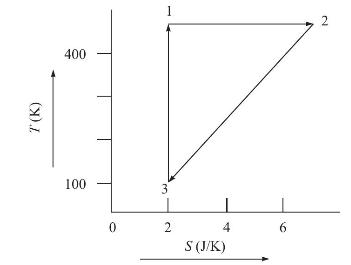
(a) Prove that the entropy of an isolated system either increases or remains constant, but can never decrease.(b) The following figure shows the relationship between temperature and entropy for a closed PVT system during a reversible process. Calculate the heat added to the system for each of the
(a) What are meant by reduced temperature and reduced pressure?(b) Prove that van der Waals constants \((a, b)\) can be expressed in terms of critical temperature and pressure as follows:a=27R2T2c64Pcb=RTc8Pca=27R2Tc264Pcb=RTc8Pc(c) 1 mol1 mol of an ideal gas is reversibly and
(a) Show that in a binary solution if the solute obeys Henry's law, the solvent obeys the Lewis-Randall rule.(b) Estimate the fugacity of liquid acetone at \(110^{\circ} \mathrm{C}\) and \(275 \mathrm{bar}\). At \(110^{\circ} \mathrm{C}\) the vapour pressure of acetone is \(4.360 \mathrm{bar}\) and
(a) With the help of a schematic diagram, describe the Linde liquefaction process.(b) With the help of a \(T-S\) diagram, describe the vapour compression refrigeration cycle. Derive the expression for COP.(c) Calculate the efficiency of an absorption refrigeration cycle if the temperature of the
(a) What is Poynting pressure correction factor? Discuss its application.(b) It is known that benzene (1) and toluene (2) form an ideal liquid solution. If a liquid mixture of benzene and toluene having \(x_{1}=0.6\) is heated in a closed vessel at 760 torr, determine the temperature at which
Discuss the procedure to find out fugacity using generalized virial coefficient correlation.
What is the change in Gibbs free energy if \(N_{\mathrm{A}}\) moles of an ideal gas A at temperature \(T\) and pressure \(P\) is mixed with \(N_{\mathrm{B}}\) moles of an ideal gas B at the same temperature and pressure?
Show that Joule-Thomson coefficient \(\left(\mu_{\mathrm{JT}}\right.\) ) of an ideal gas is zero.
Derive the following expression:where\[ C_{P}-C_{V}=T V \frac{\beta^{2}}{\alpha} \]\(\alpha=\) Isothermal compressibility\(\beta=\) Volume expansivity.
The vapour pressure of a substance can be estimated from the relation\[ \log _{10} P^{\text {Sat }}=A-\frac{B}{T+C} \]where \(P\) is in torr and \(T\) is in \({ }^{\circ} \mathrm{C}\). The values of the constants \(A, B\), and \(C\) for the substance are given in the following lines. Calculate the
(a) Show that for steady flow process, \(\Delta H=Q-W_{\mathrm{S}}\).(b) One mole of air, initially at \(423.15 \mathrm{~K}\left(150^{\circ} \mathrm{C}\right)\) and \(8 \mathrm{bar}\), undergoes the following mechanically reversible changes: It expands isothermally to a pressure such that when it
(a) Derive Clausius-Clapeyron equation in the study of phase change of a pure substance.(b) With the help of a neat sketch, explain the working principle of vapour absorption refrigeration system and derive the expression for COP of this system.(c) What is ton of refrigeration? Define and mention
(a) A gas obeys the equation of state \(P(V-b)=R T\). For this gas, \(b=0.0391 \mathrm{~L} / \mathrm{mol}\). Calculate the fugacity and fugacity coefficient for the gas at \(1000^{\circ} \mathrm{C}\) and \(1000 \mathrm{~atm}\).(b) For a binary liquid mixture at constant temperature and pressure,
(a) What is the basis for the group contribution methods in the prediction of activity coefficients? What are UNIQUAC and UNIFAC methods?(b) Under atmospheric condition the acetone-chloroform azeotrope boils at \(64.6^{\circ} \mathrm{C}\) and contains \(33.5 \mathrm{~mol}\) percent acetone. The
(a) Define the fuel cell. Give the basic construction of the cell.(b) In a laboratory investigation, ethanol is esterified to produce ethyl acetate and water at \(100^{\circ} \mathrm{C}\) and \(1 \mathrm{~atm}\) pressure according to the following equation:\[ \mathrm{CH}_{3}
Prove that van der Waals constants \((a, b)\) can be expressed in terms of critical temperature and pressure as follows:a=27R2T2c64Pcb=RTc8Pca=27R2Tc264Pcb=RTc8Pc
Derive Maxwell's relations.
Justify the following statement with illustration:'Violation of Kelvin-Planck statement leads to the violation of Clausius statement'.
Show that where\[ \left(\frac{\partial U}{\partial V}\right)_{T}=\frac{T \beta}{\kappa}-P \]\(\beta=\) Coefficient of volume expansion\(\kappa=\) Isothermal compressibility.
A spherical balloon of \(1 \mathrm{~m}\) diameter contains a gas at \(120 \mathrm{kPa}\). The gas inside the balloon is heated until the pressure reaches \(360 \mathrm{kPa}\). During heating the pressure of the gas inside the balloon is proportional to the cube of the diameter of the balloon.
(a) The heat capacity at \(1 \mathrm{~atm}\) pressure of solid magnesium in the temperature range of 0 to \(560^{\circ} \mathrm{C}\) is given by the expression\[ C_{P}=6.2+1.33 \times 10^{-3} T+6.78 \times 10^{4} T^{-2} \mathrm{cal} / \mathrm{deg} \text {-g-atom } \]Determine the increase of
(a) State and prove Clausius inequality theorem.(b) Nitrogen is compressed from an initial state of 1 bar and \(25^{\circ} \mathrm{C}\) to a final state of \(5 \mathrm{bar}\) and \(25^{\circ} \mathrm{C}\) by three different reversible processes in a closed system.(i) Heating at constant volume
(a) Two iron blocks of same size and at distinct temperatures \(T_{1}\) and \(T_{2}\) are brought in thermal contact with each other. The transfer process is allowed to take place until the thermal equilibrium is attained. Suppose, after the attainment of equilibrium, that the blocks are at final
(a) Derive the relation between standard Gibbs energy change \(\Delta G^{0}\) and equilibrium constant \(K\).(b) The water gas shift reaction \[ \mathrm{CO}(\mathrm{g})+\mathrm{H}_{2} \mathrm{O}(\mathrm{g}) \rightarrow \mathrm{CO}_{2}+\mathrm{H}_{2} \]is carried out under the following conditions:
Showing 400 - 500
of 2105
1
2
3
4
5
6
7
8
9
10
11
12
13
14
15
Last
Step by Step Answers

 Get 50% OFF
Claim Now
Get 50% OFF
Claim Now