New Semester
Started
Get
50% OFF
Study Help!
--h --m --s
Claim Now
Question Answers
Textbooks
Find textbooks, questions and answers
Oops, something went wrong!
Change your search query and then try again
S
Books
FREE
Study Help
Expert Questions
Accounting
General Management
Mathematics
Finance
Organizational Behaviour
Law
Physics
Operating System
Management Leadership
Sociology
Programming
Marketing
Database
Computer Network
Economics
Textbooks Solutions
Accounting
Managerial Accounting
Management Leadership
Cost Accounting
Statistics
Business Law
Corporate Finance
Finance
Economics
Auditing
Tutors
Online Tutors
Find a Tutor
Hire a Tutor
Become a Tutor
AI Tutor
AI Study Planner
NEW
Sell Books
Search
Search
Sign In
Register
study help
engineering
introduction to chemical engineering thermodynamics
Introduction To Chemical Engineering Thermodynamics 2nd Edition HALDER - Solutions
During the adiabatic compression of a gas in a cylinder, the temperature of the gas rises by \(30^{\circ} \mathrm{C}\). Express the rise in temperature in terms of the Fahrenheit, Kelvin and Rankine scales.
What is the criterion for a thermodynamic system to be at steady state?
Determine the work done while a body of mass \(47 \mathrm{~kg}\) is lifted through a distance of \(20 \mathrm{~m}\). Also calculate the power. The entire process takes time to the tune of \(3 \mathrm{~min} 45 \mathrm{~s}\).
What is the difference between steady and uniform states?
An arbitrary temperature scale is proposed, in which \(20^{\circ}\) is assigned to the ice point and \(75^{\circ}\) is assigned to the steam point. Derive an equation relating this scale to the Celsius scale.
State the zeroth law of thermodynamics. How does it play an important role in measuring temperature?
If a Celsius temperature is two-thirds the corresponding Fahrenheit temperature, determine both the temperatures.
State the phase rule and show how it can be mathematically expressed. What is the importance of degree of freedom? Find the value of degree of freedom for the water system.
A skin diver descends to a depth of \(30 \mathrm{~m}\) in a salt lake where the density is \(1030 \mathrm{~kg} / \mathrm{m}^{3}\). What is the pressure on the diver's body at this depth?
A tank contains \(400 \mathrm{~kg}\) of a fluid. If the volume of the tank is \(2.5 \mathrm{~m}^{3}\), then what is the density of the fluid and what is the specific gravity?
Differentiate between state function and path function. Prove that internal energy is a state function and work is a path function.
Mention the importance of the ideal gas temperature scale in expressing temperatures through other scales.
A mass of \(110 \mathrm{~kg}\) is hung from a spring in a local gravitational field where \(g=9.806 \mathrm{~m} / \mathrm{s}^{2}\), and the spring is found to deflect by \(30 \mathrm{~mm}\). If the same mass is taken to a planet where \(g=5.412 \mathrm{~m} / \mathrm{s}^{2}\). By how much will the
Justify the following statement with an example: 'A reversible process proceeds without any driving force'.
A pump delivers water from a well that is \(50 \mathrm{~m}\) deep. Determine the change in potential energy per \(\mathrm{kg}\) of water. Take \(g=9.81 \mathrm{~m} / \mathrm{s}^{2}\).
'All spontaneous processes are irreversible'. Explain with a common example.
What are the factors responsible for the irreversibility of a process?
A vacuum gauge mounted on a condenser reads \(0.73 \mathrm{~mm} \mathrm{Hg}\). Determine the absolute pressure in the condenser in \(\mathrm{kPa}\) when the atmospheric pressure is \(101.35 \mathrm{kPa}\).
Explain the importance of the demonstration of Joule's experiment in the formulation of the first law of thermodynamics.
The total energy of a typical closed system is given by \(E=25+155 T+0.07 T^{2}\) in Joules. The amount of heat absorbed by the system can be expressed as \(Q=3500+9 T\) in Joules. Estimate the work done during the processes in which the temperature rises from \(350 \mathrm{~K}\) to \(700
The total energy of a typical closed system is given by \(E=50+25 T+0.05 T^{2}\) in Joules. The amount of heat absorbed by the system can be expressed as \(Q=4000+10 T\) in Joules. Estimate the work done during the processes in which temperature rises from 400 Kelvin to 800 Kelvin.
Give a proper concept of energy, internal energy, kinetic energy and potential energy.
The latent heat of vaporization of Freon- 11 at \(23.6^{\circ} \mathrm{C}\) and 1 atm is \(5960 \mathrm{~g}\)-cal \(/ \mathrm{g}-\mathrm{mol}\). Calculate \(\Delta U\) and \(\Delta H\) of this process.
A paddle-wheel is employed in a rigid container for stirring a hot fluid to be cooled. The internal energy of the hot fluid is \(1000 \mathrm{~kJ}\). During the cooling process, the fluid losses \(600 \mathrm{~kJ}\) of heat. For this process, the work done by the paddle-wheel on the fluid is \(100
Justify the following statement: "The first law of thermodynamics is nothing but the law of conservation of energy".
In a stirrer-container assembly, the stirrer performs \(3 \mathrm{hp}\) work on the system containing a certain amount of fluid. The heat developed by stirring is \(5000 \mathrm{~kJ} / \mathrm{hr}\) and is transferred to the surroundings. Determine the change in internal energy of the system.
A stirrer-container assembly contains a certain amount of fluid. The stirrer performs \(3 \mathrm{hp}\) work on the system. The heat developed by stirring is \(4000 \mathrm{~kJ} / \mathrm{h}\) and is transferred to the surroundings. Determine the change in internal energy of the system.
Derive the mathematical expression of the first law of thermodynamics.
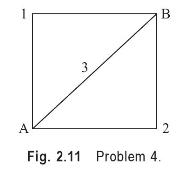
A system consisting of a gas confined in a cylinder undergoes a series of processes shown in Fig. 2.11. During the process A-1-B, \(70 \mathrm{~kJ}\) of heat is added while it does 45 \(\mathrm{kJ}\) of work. Then the system follows the process A-2-B, during which \(55 \mathrm{~kJ}\) of work is
A system consisting of a gas confined in a cylinder undergoes a series of processes shown in Fig. 2.4. During the process A-1-B, \(60 \mathrm{~kJ}\) of heat is added while it does \(35 \mathrm{~kJ}\) of work. Then the system follows the process A-2-B, during which \(50 \mathrm{~kJ}\) of work is
A system undergoes a constant pressure process \(1-2\), during which \(100 \mathrm{~kJ}\) of work done on the system and \(50 \mathrm{~kJ}\) of heat as energy is released to the surroundings. Then the system follows a constant volume process \(2-3\) during which \(80 \mathrm{~kJ}\) of heat is added
What is internal energy? Prove that internal energy is a state function.
A piston-cylinder assembly containing a gas undergoes a process in which the temperature of the system rises from \(100^{\circ} \mathrm{C}\) to \(150^{\circ} \mathrm{C}\). The heat transmission per degree rise in temperature is governed by the equation\[ \frac{d Q}{d T}=1.25
What is the significance of Joule's experiment in finding out the change in internal energy of an ideal gas?
An ideal gas is compressed adiabatically and reversibly in a piston-cylinder assembly from \(30 \mathrm{~L}\) to \(3 \mathrm{~L}\) at \(300 \mathrm{~K}\). Calculate the final temperature, given that heat capacity at constant volume, \(C_{V}=5 \mathrm{cal} / \mathrm{mol}\).
The pressure of a gas is given by \(P=\frac{15}{V}\), where \(P\) is in atmosphere and \(V\) is in litres. If the gas expands from 20 to \(60 \mathrm{~L}\) and undergoes an increase in internal energy of 225 cal. How much heat will be absorbed during the process?
The pressure of a gas is given by \(P=\frac{10}{V}\), where \(P\) is in atmospheres and \(V\) is in litres. If the gas expands from 10 to \(50 \mathrm{~L}\) and undergoes an increase in internal energy of \(200 \mathrm{cal}\). How much heat will be absorbed during the process?
Define the term enthalpy. How does it relate to the internal energy?
In an insulated vessel \(1 \mathrm{~kg}\) of water \(\left(C_{V}=4.78 \mathrm{~kJ} / \mathrm{kg}-\mathrm{K}\right)\) is stirred by a mass of \(40 \mathrm{~kg}\) falling through \(25 \mathrm{~m}\). Calculate the temperature rise of water. Assume \(g=9.81 \mathrm{~m} / \mathrm{s}^{2}\).
What is thermodynamic state and what are state functions?
Prove the following statement: 'For an ideal gas, the internal energy is a function of temperature only'.
A bullet of \(3 \mathrm{~g}\) flying horizontally at \(2 \mathrm{~km} / \mathrm{s}\) strikes a fixed wooden block \((m=6 \mathrm{~kg}\), \(\left.C_{V}=0.14 \mathrm{~kJ} / \mathrm{kg}-\mathrm{K}\right)\) and is embedded in it. Assume that there is no heat loss from the block and that the block does
\mathrm{~kg}\) of water is vaporized in a container at the constant temperature of \(373 \mathrm{~K}\) and the constant pressure of \(1,01,325.0 \mathrm{~N} / \mathrm{m}^{2}\). The specific volume of liquid and vapour at these conditions are \(1.04 \times 10^{-3}\) and \(1.673 \mathrm{~m}^{3} /
Calculate \(\Delta U, \Delta H, Q\) and \(W\) if \(1 \mathrm{~mol}\) of an organic liquid is converted reversibly into vapour at \(353 \mathrm{~K}\) by supplying heat from external source. The expansion of vapour takes place at the pressure of \(1 \mathrm{~atm}\). The heat of vaporization and the
\(0.52 \mathrm{~kg}\) air is heated reversibly at constant pressure from an initial state of \(37^{\circ} \mathrm{C}\) and \(1 \mathrm{kPa}\) until its volume is doubled. Calculate \(\Delta U, \Delta H, Q\), and \(W\) for the process.
State the first law of thermodynamics and mention its importance for a cyclic process.
10 moles of an ideal gas at \(37^{\circ} \mathrm{C}\) are allowed to expand isothermally from an initial pressure of \(15 \mathrm{~atm}\) to a final pressure of \(5 \mathrm{~atm}\) against a constant external pressure of \(1 \mathrm{~atm}\). Calculate \(\Delta U, \Delta H, Q\), and \(W\) for the
One mol of an ideal gas, used as a working substance in a Carnot cycle, operates initially at \(610 \mathrm{~K}\) and \(10^{6} \mathrm{~N} / \mathrm{m}^{2}\) in the compression stage. The gas then expands isothermally to a pressure of \(10^{5} \mathrm{~N} / \mathrm{m}^{2}\) and adiabatically at
5 moles of an ideal gas was initially at \(315 \mathrm{~K}\) and \(20 \mathrm{~atm}\). The expansion of gas takes place adiabatically when the external pressure is reduced to \(7 \mathrm{~atm}\). What will be the final temperature and volume? Also calculate the work done during the process, given
Derive an expression of the work done in a constant-temperature process.
\mathrm{~kg}\) of air at \(50^{\circ} \mathrm{C}\) expands reversibly and adiabatically to 5 times its original volume. The initial pressure of the air mass was \(8 \mathrm{~atm}\). Determine the final pressure, temperature, and work done when the expansion is (i) adiabatic and (ii) isothermal,
Give a brief account of constant-volume and constant-pressure processes.
\mathrm{~mol}\) of an ideal gas was initially at \(293 \mathrm{~K}\) and \(15 \mathrm{~atm}\). The expansion of gas takes place adiabatically when the external pressure is reduced to \(5 \mathrm{~atm}\). What will be the final temperature and volume? Also calculate the work done during the process,
In a constant-volume calorimeter, \(1 \mathrm{~mol}\) of trinitrotoluene (TNT) on explosion produces \(3 \mathrm{~mol}\) of \(\mathrm{CO}\) and \(2 \mathrm{~mol}\) of \(\mathrm{N}_{2}\). When \(0.1572 \mathrm{~g}\) TNT are exploded at \(37^{\circ} \mathrm{C}\), the heat evolved is 450 cal.
\mathrm{~kg}\) of air is heated from an initial state of \(37^{\circ} \mathrm{C}\) and \(101.33 \mathrm{kPa}\) until its temperature reaches \(237^{\circ} \mathrm{C}\). Calculate \(\Delta U, Q, W\), and \(\Delta H\) for the following processes:(i) isochoric process(ii) isobaric process.Air is
\(3 \mathrm{~kg}\) of air at \(45^{\circ} \mathrm{C}\) expands reversibly and adiabatically to 4 times its original volume. The initial pressure of the air mass was \(9 \mathrm{~atm}\). Determine the final pressure, temperature,and work done when the expansion is (i) adiabatic and (ii) isothermal,
Prepare an energy balance for an open system.
What is isothermal expansion? With the help of a neat sketch, substantiate the significance of a porous plug experiment.
In an adiabatic change for an ideal gas, show that the work done in an adiabatic expansion\[ W=\frac{P_{1} V_{1}}{\gamma-1}\left[1-\left(\frac{P_{2}}{P_{1}}\right)^{\frac{\gamma-1}{\gamma}}\right] \]
Show that for an ideal gas the amount of work done by reversible isothermal expansion is always greater than that by irreversible isothermal expansion.
What do you mean by heat capacity and specific heat?
In a frictionless piston-cylinder arrangement, an ideal gas undergoes a compression process from an initial state of 1 bar at 300 K to 10 bars at 300 K. The entire process comprises the following two mechanically reversible processes: (a) Cooling at constant pressure followed by heating at constant
Show that for an ideal gas, when volume and enthalpy are separate functions of temperature and pressure\[ C_{P}-C_{V}=\left[V+\left(\frac{\partial H}{\partial T}\right)_{P}\left(\frac{\partial T}{\partial P}\right)_{H}\right]\left(\frac{\partial P}{\partial T}\right)_{V} \]
Prepare an energy balance over an isothermal compression system.
A certain quantity of an ideal gas is contained in a cylinder and occupies a volume of \(1.0 \mathrm{dm}^{3}\) at \(3 \mathrm{~atm}\) pressure. The gas is transferred by different paths to a final state where it occupies a volume of \(3.0 \mathrm{dm}^{3}\). The paths are mechanically reversible and
A spherical balloon of 1 m diameter contains a gas at 120 kPa. The gas inside the balloon is heated until the pressure reaches 360 kPa. During heating the pressure of the gas inside the balloon is proportional to the cube of the diameter of the balloon. Determine the work done by the gas inside the
1 kmol of argon gas confined in a cylinder undergoes a change from an initial condition of 10 bar and 250 K to a final condition of 1 bar and 300 K. The gas follows the equation PV = RT. Given that Cp = 29.10 kJ/kmol-K and CV= 20.78 kJ/kmol-K, determine the changes in internal energy, enthalpy,
If \(C_{P}=a+b T+C T^{2}\), derive a relation to the isobaric mean heat capacity \(\dot{Q}\).
Hydrogen gas is expanded reversibly and adiabatically from a volume of \(2.12 \mathrm{dm}^{3}\) at a pressure of \(4 \mathrm{~atm}\) and \(32^{\circ} \mathrm{C}\) until the volume is doubled. Determine the following:(i) final temperature and pressure of the gas(ii) \(Q, W, \Delta U\), and \(\Delta
Calculate the molar volume of methane at \(672 \mathrm{~K}\) and 12 bar using the following methods:(a) Ideal gas equation of state(b) Van der Waals equation of state, where \(a=0.2303 \mathrm{Nm}^{4} / \mathrm{mol}^{2}\) and \(b=4.3073 .12\) \(\times 10^{-5}\)(c) Virial equation of state(d) Virial
What are free energy functions? Classify them. Mention the importance of free energy functions in the analysis of thermodynamic processes.
If the internal energy of a substance is considered to be a function of temperature and volume, then show that\[ d U=C_{V} d T+\left(\frac{T \beta}{\alpha}-P\right) d V \]
For an isothermal reversible change of the system\[ -\Delta A_{T}=W_{\max } \]explain the significance of the preceding equation in the light of Helmholtz free energy.
A gas obeys the equation of state \(V=\frac{R T}{P}-\frac{C}{T^{3}}\). Find out the variation of \(C_{P}\) with pressure at constant temperature.
Derive the following relations for a pure substance:(a) \(\left(\frac{\partial H}{\partial T}\right)_{V}=C_{V}+\frac{\beta V}{\alpha}\)(b) \(\left(\frac{\partial H}{\partial P}\right)_{T}=V(1-T \beta)\)(c) \(\left(\frac{\partial H}{\partial P}\right)_{V}=\frac{C_{V} \alpha}{\beta}+V\)(d)
In the study of the phase change process of a pure substance, derive the Clapeyron equation.
Derive an expression to calculate the change in enthalpy and entropy of a real gas undergoing an isothermal compression and obeying the following equation of state:\[ V=\frac{R T}{P}+b-\frac{a}{R T} \]
Show that for a van der Waals gas\[ \alpha=\frac{V-b}{P V-\frac{a}{V}+\frac{2 a b}{V^{2}}} \quad \text { and } \quad \beta=\frac{R}{P V-\frac{a}{V}+\frac{2 a b}{V^{2}}} \]
Show that \(\left(\frac{\partial C_{P}}{\partial P}\right)_{T}=\frac{2 a}{T^{2}}\) for a gas under isenthalpic condition obeying the equation of state\[ V=\frac{R T}{P}+b-\frac{a}{R T} \]
The inlet and outlet diameters of a conduit are \(10 \mathrm{~cm}\) and \(15 \mathrm{~cm}\) respectively. If the velocity of water flowing through the conduit at the inlet is \(5 \mathrm{~m} / \mathrm{s}\), find the rate of flow through the conduit. Also calculate the velocity of water at the
The inlet and outlet diameters of a pipe are \(15 \mathrm{~cm}\) and \(20 \mathrm{~cm}\) respectively. If the velocity of water flowing through the pipe at the inlet is \(7 \mathrm{~m} / \mathrm{s}\), find the rate of flow through the pipe. Determine also the velocity of water at the outlet.
What are the limitations of the continuity equation?
Water flows through a pipe of \(30 \mathrm{~cm}\) diameter. The flow splits into two parts and passes through pipes of diameters \(25 \mathrm{~cm}\) and \(15 \mathrm{~cm}\) respectively. Find the discharge of the pipe of \(15 \mathrm{~cm}\) diameter, if the average velocity of water flowing through
Water flowing through a pipe of \(20 \mathrm{~cm}\) diameter. The flow splits into two parts and passes through pipes of diameters \(15 \mathrm{~cm}\) and \(10 \mathrm{~cm}\) respectively. Find the discharge of the \(10 \mathrm{~cm}\) diameter pipe, if the average velocity of water flowing through
Prove: 'Bernoulli's equation is a restrictive form of energy equation'.
A pipe, through which water is flowing, has diameters \(30 \mathrm{~cm}\) and \(15 \mathrm{~cm}\) at crosssections 1 and 2 respectively. The discharge velocity of the pipe is \(40 \mathrm{~L} / \mathrm{s}\). Cross-section 1 is \(8 \mathrm{~m}\) above and cross-section 2 is \(6 \mathrm{~m}\) above
A pipe, through which water is flowing, has diameters \(30 \mathrm{~cm}\) and \(15 \mathrm{~cm}\) at cross-sections 1 and 2 respectively. The discharge of the pipe is \(40 \mathrm{~L} / \mathrm{s}\). The cross-section 1 is \(8 \mathrm{~m}\) and cross-section 2 is \(6 \mathrm{~m}\) above the
What are the assumption made for the establishment of Bernoulli's equation?
A shell and tube heat exchanger is used to cool lubricating oil by water at the rate of \(120 \mathrm{~kg} / \mathrm{min}\). The oil enters the heat exchanger at \(343 \mathrm{~K}\) and leaves at \(298 \mathrm{~K}\). The specific heat of oil is \(3202 \mathrm{~kJ} / \mathrm{kmol}-\mathrm{K}\). The
Air at \(100 \mathrm{kPa}\) and \(320 \mathrm{~K}\) is to be compressed steadily to \(600 \mathrm{kPa}\) and \(430 \mathrm{~K}\) in a reversible compressor. The mass flow rate of the air is \(0.03 \mathrm{~kg} / \mathrm{s}\) and the heat losses during the process are estimated to be \(15
Establish the mechanical energy balance equation starting from the law of conservation of energy for a control volume.
A nozzle, through which steam at \(500 \mathrm{kPa}\) and \(623 \mathrm{~K}\) is entering at the rate of \(12 \mathrm{~kg} / \mathrm{s}\) and leaving at \(500 \mathrm{kPa}\) and \(523 \mathrm{~K}\), is fitted to a long pipe. The amount of heat loss to the environment is calculated to be \(120
\(7.5 \quad \mathrm{CO}_{2}\) enters an adiabatic compressor at \(100 \mathrm{kPa}\) and \(250 \mathrm{~K}\) at a rate of \(0.1 \mathrm{~m}^{3} / \mathrm{s}\) and leaves at \(500 \mathrm{kPa} . \mathrm{CO}_{2}\) is assumed to behave as an ideal gas. Determine the work of compression per unit mass
Explain the important role of a throttling device for cold production.
Steam at \(800 \mathrm{kPa}\) and \(773 \mathrm{~K}\) enters a nozzle with an enthalpy of \(3480 \mathrm{~kJ} / \mathrm{kg}\) and leaves at \(100 \mathrm{kPa}\) and \(573 \mathrm{~K}\) with an enthalpy of \(3074 \mathrm{~kJ} / \mathrm{kg}\).(a) If the initial enthalpy of the steam is negligible,
A shell and tube heat exchanger is used to cool lubricating oil by water at the rate of \(180 \mathrm{~kg} / \mathrm{min}\). The oil enters the heat exchanger at \(353 \mathrm{~K}\) and leaves at \(308 \mathrm{~K}\). The specific heat of oil is \(3553 \mathrm{~kJ} / \mathrm{kmol}-\mathrm{K}\). The
Exhaust steam at \(100 \mathrm{kPa}\) and \(200^{\circ} \mathrm{C}\) enters the subsonic diffuser of a jet engine steadily with a velocity of \(190 \mathrm{~m} / \mathrm{s}\). The inlet area of the diffuser is \(200 \mathrm{~cm}^{2}\). The steam leaves the diffuser a the velocity of \(70
With the help of a neat sketch, substantiate the significance of a porous plug experiment.
Steam is desired to cool by water in a condenser. Steam enters the condenser at \(50 \mathrm{kPa}\) and \(50^{\circ} \mathrm{C}\) with a flow rate of \(10 \mathrm{~kg} / \mathrm{min}\) and leaves at \(30^{\circ} \mathrm{C}\). The cooling water flows inside the tubes at \(15 \mathrm{kPa}\) and
When can heating effect instead of cooling effect be produced by a throttling device?
Showing 700 - 800
of 2105
1
2
3
4
5
6
7
8
9
10
11
12
13
14
15
Last
Step by Step Answers

 Get 50% OFF
Claim Now
Get 50% OFF
Claim Now