New Semester
Started
Get
50% OFF
Study Help!
--h --m --s
Claim Now
Question Answers
Textbooks
Find textbooks, questions and answers
Oops, something went wrong!
Change your search query and then try again
S
Books
FREE
Study Help
Expert Questions
Accounting
General Management
Mathematics
Finance
Organizational Behaviour
Law
Physics
Operating System
Management Leadership
Sociology
Programming
Marketing
Database
Computer Network
Economics
Textbooks Solutions
Accounting
Managerial Accounting
Management Leadership
Cost Accounting
Statistics
Business Law
Corporate Finance
Finance
Economics
Auditing
Tutors
Online Tutors
Find a Tutor
Hire a Tutor
Become a Tutor
AI Tutor
AI Study Planner
NEW
Sell Books
Search
Search
Sign In
Register
study help
engineering
introduction to chemical engineering thermodynamics
Introductory Chemical Engineering Thermodynamics 2nd Edition J. Elliott, Carl Lira - Solutions
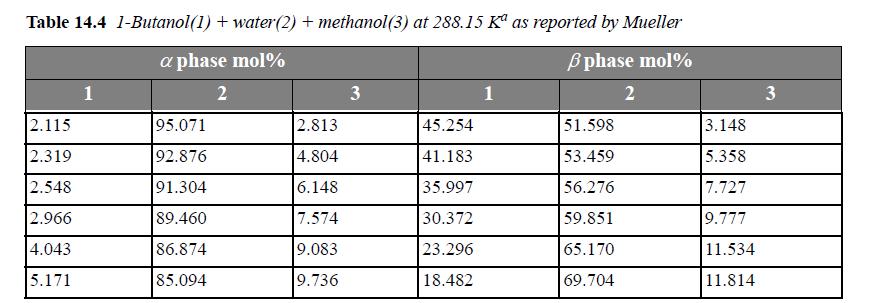
Solve problem 14.15, except use the specified model.(a) The MAB model.(b) The SSCED model.(c) The UNIFAC model.Data from problem 14.15:Calculate the LLE in the system 1-butanol(1) + water(2) + methanol(3) at 288.15 K, using UNIQUAC with the following parameters: r = [3.4543, 0.92, 1.4311]; q =
Consider the system water(1) + methylethylketone(MEK)(2) + propanoic acid(PA)(3). Use UNIFAC to predict the compositions for the coexisting phases at x3α= 0.01, 0.05, and 0.10 at 298.15 K. Let α be the water-rich phase. Plot the results on rectangular coordinates by using x1 as the abscissa
Derive the formulas for the spinodal curves of the Flory-Huggins model and plot the spinodals (T versus xα, xβ) of several polystyrenes in cyclohexane using UNIFAC parameters to estimate the volume of polystyrene relative to ethylbenzene and taking the experimental values of solubility parameters
In the treatment of solid-liquid equilibria, the effects of pressure on melting points are neglected.(a) Draw a schematic of the Gibbs energy of liquid and solid phases versus pressure at constant temperature for a compound for which the molar volume of the solid is less than the molar volume of
Generate a solid-liquid equilibrium T-x diagram for naphthalene(1) + biphenyl(2) assuming ideal solutions. What are the predicted eutectic temperature and composition? The experimental eutectic point is 39.4°C and x biphenyl = 0.555.
At 25°C, the solubility of naphthalene in n-hexane is 11.9 mol%. The liquid phase is nonideal. Use the simple solution model GE /RT = Ax1x2 to predict the solubility at 10°C. (The experimental solubility at 10°C is 6.5mol%, Sunier, A. 1930. J. Phys. Chem. 34:2582).
Phenanthrene and anthracene are structurally very similar. Would you expect them to have similar solubilities in benzene at 25°C? Provide a quantitative answer, and an explanation.
Predict the solubility (in mole fraction) of phenol at the cited conditions using the specified model. (i) Use the MAB model. (ii) Use the SSCED model. (iii) Use the UNIFAC model.(a) Solubility in n-heptane at 25°C.(b) Solubility in ethanol at 25°C.(c) Solubility in a 50/50 mole ratio of heptane
A 50 wt% (22.5 mol%) solution of ethylene glycol + water freezes at about 240 K.(a) What freezing temperature would be predicted by assuming that ethylene glycol and water form an ideal solution? The freezing occurs by formation of water crystals.(b) Does your calculation indicate that the system
Determine the ideal solubility of naphthalene in any solvent at 40°C. Then predict the solubility and compare with the experimental solubility (shown in parentheses) for the specified solvent and specified model. (i) Use the MAB model. (ii) Use the SSCED model. (iii) Use the UNIFAC model.(a)
Determine the ideal solubility of anthracene in any solvent at 20°C. Then predict the solubility and compare with the experimental solubility (shown in parentheses) for the specified solvent and specified model. (i) Use the MAB model. (ii) Use the SSCED model. (iii) Use the UNIFAC model.(a)
Determine the ideal solubility of phenanthrene in any solvent at 20°C. Then predict the solubility and compare with the experimental solubility (shown in parentheses) for the specified solvent and specified model. (i) Use the MAB model. (ii) Use the SSCED model. (iii) Use the UNIFAC model.(a)
Determine the solubility curve for naphthalene in the specified solvent, and compare with the literature data:(a) Acetic acid9(b) n-hexane9(c) Cyclohexanol10(d) Acetone9(e) Chloroform11(f) Methanol9(g) n-butanol9(h) Ethanol12(i) n-propanol12(j) 2-propanol12
The gas condensate from a new gas well in Prudhoe Bay, Alaska has the following weight% of C5, C10, C15, C20, C25, C30, C35, C40, C45, C50, and >C50, respectively: 1, 4, 7, 10, 12, 12, 12, 12, 8, 8, and 14. Estimate the temperature at which wax may begin to precipitate from this liquid.
Generate an SLE phase diagram for phenol(1) + cyclohexane(2).(a) Assume an ideal solution.(b) Use MAB to model liquid phase nonidealities.(c) Use SSCED to model liquid phase nonidealities.(d) Use UNIFAC to model liquid phase nonidealities.(e) Make a comment about how the solubility of phenol in
Create a flow sheet analog to VLE or LLE calculations to find the melting temperature and liquid phase composition for a given solid mixture composition for the following.(a) Ideal solutions of solid and liquid(b) Nonideal solutions of solid and liquid
Create a flow sheet analog to VLE or LLE calculations to find the freezing temperature and solid composition for a given liquid composition when the liquids and solids form a nonideal solution.
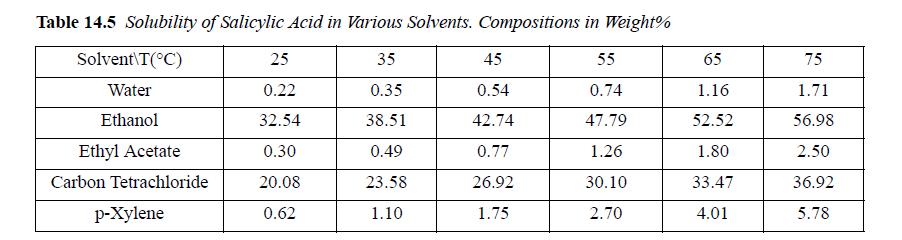
Salicylic acid is similar in structure to aspirin. Shalmashi et al. have measured the data in Table 14.5.(a) Find the value of α for salicylic acid in water that best correlates the data, assuming β = 0.(b) Predict the solubility of the acid in ethanol.(c) Plot log(xacid) versus 1000/T including
Create a flowsheet analog to VLE or LLE flash calculations to find the coexisting liquid and solid compositions that exist for a liquid-solid mixture of specified overall composition that is between the conditions of first freezing and first melting.
Sometimes we would like to enhance the solubility of a drug by adding a cosolvent, instead of adding antisolvent to precipitate. Making optimal use of the data in the previous problem, estimate the amount of ethanol that should be added to water to prepare an aqueous solution of salicylic acid with
Yalkowsky and Rubino (1985)14 have observed roughly linear behavior for logarithmic solubility in mixed solvents when plotted as volume fraction of the solvent/cosolvent. That is, log(xi) = Φ1'log(xi,1) + Φ2'log(xi,2) where xi,j is the solubility in the jth pure solvent and Φi' is the volume
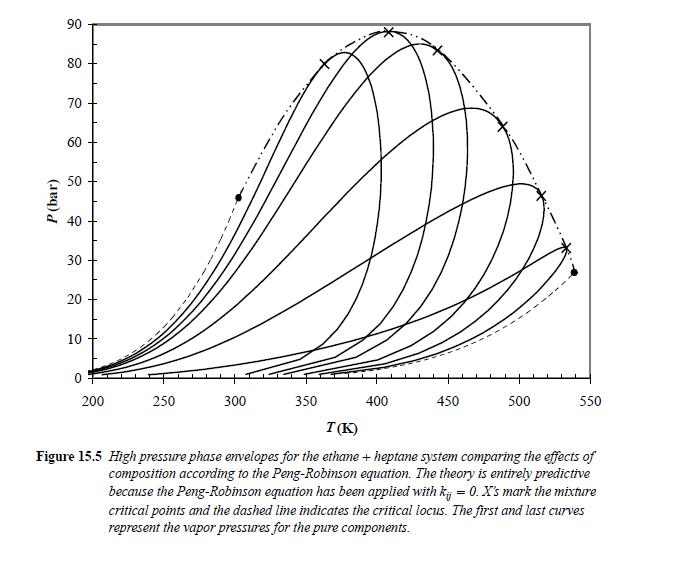
Using Fig. 15.5, without performing additional calculations, sketch the P-x-y diagram at 400 K showing the two-phase region. Make the sketch semi-quantitative to show the values where the phase envelope touches the axes of your diagram. Label the bubble and dew lines. Also indicate the approximate
Repeat all the practice problems from Chapter 10, this time applying the Peng-Robinson equation.Practice problems from Chapter 101. The stream from a gas well consists of 90 mol% methane, 5 mol% ethane, 3 mol% propane, and 2 mol% n-butane. This stream is flashed isothermally at 233 K and 70 bar.
Acrolein (C3H4O) + water exhibits an atmospheric (1 bar) azeotrope at 97.4 wt% acrolein and 52.4°C. For acrolein: Tc = 506 K; Pc =51.6 bar; and ω = 0.330; MW =56.(a) Determine the value of kij for the Peng-Robinson equation that matches this bubble pressure at the same liquid composition
Consider two gases that follow the virial equation. Show that an ideal mixture of the two gases follows the relation B = y1B11 + y2B22.
Laugier and Richon (J. Chem. Eng. Data, 40:153, 1995) report the following data for the H2S + benzene system at 323 K and 2.010 MPa: x1 = 0.626; y1 = 0.986.(a) Quickly estimate the vapor-liquid K-value of H2S at 298 K and 100 bar.(b) Use the data to estimate the kij value, then estimate the error
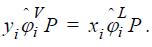
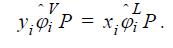
Consider phase equilibria modeled withWhen might ϕi be replaced by ϕi for each phase? When might ϕi = 1 be used for each phase? Discuss the appropriateness of using the virial equation for mixtures to solve phase behavior using the expression ^V L V ₁9 ; P = x ₁ 0 ₁ P. Qi
The system ethyl acetate + methanol forms an azeotrope at 27.8 mol% EA and 62.1°C. For ethyl acetate, Tc = 523.2 K; Pc = 38.3 bar; and ω = 0.362.(a) What is the estimate of the bubble-point pressure from the Peng-Robinson equation of state at this composition and temperature when it is assumed
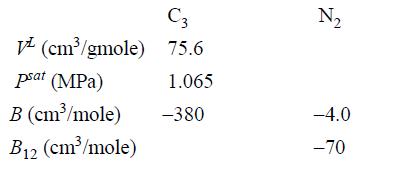
Calculate the molar volume of a binary mixture containing 30 mol% nitrogen(1) and 70 mol% n-butane(2) at 188°C and 6.9 MPa by the following methods.(a) Assume the mixture to be an ideal gas.(b) Assume the mixture to be an ideal solution with the volumes of the pure gases given byand the virial
(a) Assuming zero for the binary interaction parameter (kij = 0) of the Peng Robinson equation, predict whether an azeotrope should be expected in the system CO2 + ethylene at 222 K. Estimate the bubble-point pressure for an equimolar mixture of these components.(b) Assuming a value for the binary
Use the virial equation to consider a mixture of propane and n-butane at 515 K at pressures between 0.1 and 4.5 MPa. Verify that the virial coefficient method is valid by using Eqn. 7.10.(a) Prepare a plot of fugacity coefficient for each component as a function of composition at pressures of 0.1
For the same mixture and experimental conditions as problem 15.4, calculate the fugacity of each component in the mixture, f(^)i. Use methods (a) - (e).Data from problem 15.4:Calculate the molar volume of a binary mixture containing 30 mol% nitrogen(1) and 70 mol% n-butane(2) at 188°C and 6.9 MPa
(a) Assuming zero for the binary interaction parameter (kij = 0) of the Peng-Robinson equation, estimate the bubble pressure and vapor composition of the pentane + acetone system at xp = 0.728, 31.9°C.(b) Assuming a value for the binary interaction parameter (kij = 0.11) of the Peng-Robinson
A vapor mixture of CO2 (1) and i-butane (2) exists at 120°C and 2.5 MPa. Calculate the fugacity of CO2 in this mixture across the composition range using(a) The virial equation for mixtures (b) The Peng-Robinson equation(c) The virial equation for the pure components and an ideal mixture model.
Calculate the dew-point pressure and corresponding liquid composition of a mixture of 30 mol% carbon dioxide, 30% methane, 20% propane, and 20% ethane at 298 K using(a) The shortcut K-ratios(b) The Peng-Robinson equation with kij = 0
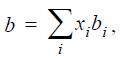
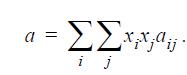
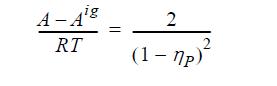
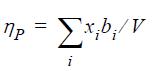
The equation of state below has been suggested for a new equation of state. Derive the expression for the fugacity coefficient of a component. Z=1+4cbp/(1-bp) b = Exibi where C = i Cij = √√√cii C jj (ANS. In Øk = Ok = 4( c-2[x;,,x]hu(1- bp) +(2-1) - hz)
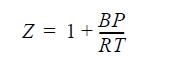
The virial equation Z = 1 + BP/RT may be used to calculate fugacities of components in mixtures. Suppose B = y1B11 + y2B22. (This simple form makes calculations easier. Eqn. 15.1 gives the correct form.) Use this simplified expression and the correct form to calculate the respective fugacity
The Lewis-Randall rule is usually valid for components of high concentration in gas mixtures. Consider a mixture of 90% ethane and 10% propane at 125°C and 170 bar. Estimate f(^)i for ethane.
One of the easiest ways to begin to explore fugacities in nonideal solutions is to model solubilities of crystalline solids dissolved in high pressure gases. In this case, the crystalline solids remain as a pure phase in equilibrium with a vapor mixture, and the fugacity of the “solid”
A vessel initially containing propane at 30°C is connected to a nitrogen cylinder, and the pressure is isothermally increased to 2.07 MPa. What is the mole fraction of propane in the vapor phase? You may assume that the solubility of N2 in propane is small enough that the liquid phase may be
Repeat problem 15.11, except consider naphthalene dissolved in carbon dioxide, using kij = 0.109. The molar volume of crystalline naphthalene is 123 cm3/mol.Data from problem 15.11:One of the easiest ways to begin to explore fugacities in nonideal solutions is to model solubilities of crystalline
A mixture containing 5 mol% ethane, 57 mol% propane, and 38 mol% n-butane is to be processed in a natural gas plant. Estimate the bubble-point pressure, the liquid composition, and K-ratios of the coexisting vapor for this mixture at all pressures above 1 bar at which two phases exist. Set kij = 0.
Vapor-liquid equilibria are usually expressed in terms of K factors in petroleum technology. Use the Peng-Robinson equation to estimate the values for methane and benzene in the benzene + methane system with equimolar feed at 300 K and a total pressure of 30 bar and compare to the estimates based
A storage tank is known to contain the following mixture at 45°C and 15 bar on a mole basis: 31% ethane, 34% propane, 21% n-butane, 14% i-butane. What is the composition of the coexisting vapor and liquid phases, and what fraction of the molar contents of the tank is liquid?
The CRC Handbook lists the atmospheric pressure azeotrope for ethanol + methylethylketone at 74.8°C and 34 wt% ethanol. Estimate the value of the Peng-Robinson k12 for this system.
The CRC Handbook lists the atmospheric pressure azeotrope for methanol + toluene at 63.7°C and 72 wt% methanol. Estimate the value of the Peng-Robinson k12 for this system.
Use the Peng-Robinson equation for the ethane/heptane system.(a) Calculate the P-x-y diagram at 283 K and 373 K. Use k12 = 0. Plot the results.(b) Based on a comparison of your diagrams with what would be predicted by Raoult’s law at 283 K, does this system have positive or negative deviations
One mol of n-butane and one mol of n-pentane are charged into a container. The container is heated to 90°C where the pressure reads 7 bar. Determine the quantities and compositions of the phases in the container.
Consider a mixture of 50 mol% n-pentane and 50 mol% n-butane at 15 bar.(a) What is the dew temperature? What is the composition of the first drop of liquid?(b) At what temperature is the vapor completely condensed if the pressure is maintained at 15 bar? What is the composition of the last drop of
LPG gas is a fuel source used in areas without natural gas lines. Assume that LPG may be modeled as a mixture of propane and n-butane. Since the pressure of the LPG tank varies with temperature, there are safety and practical operating conditions that must be met. Suppose the desired maximum
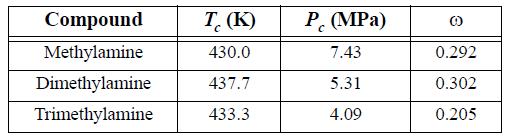
The synthesis of methylamine, dimethylamine, and trimethylamine from methanol and ammonia results in a separation train involving excess ammonia and converted amines. Use the Peng-Robinson equation with kij = 0 to predict whether methylamine + dimethylamine, methylamine + trimethylamine, or
The kij for the pentane + acetone system has been fitted to a single point in problem P15.6. Generate a P-x-y diagram at 312.75 K.Data from problem P15.6A vapor mixture of CO2 (1) and i-butane (2) exists at 120°C and 2.5 MPa. Calculate the fugacity of CO2 in this mixture across the composition
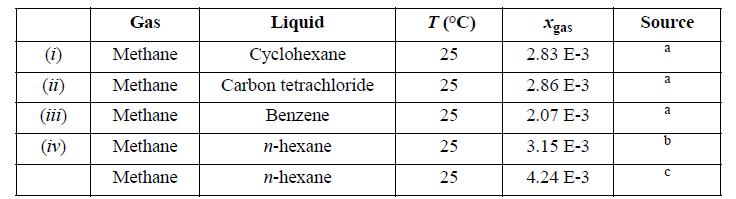
For the gas/solvent systems below, we refer to the “gas” as the low molecular weight component. Experimental solubilities of light gases in liquid hydrocarbons are tabulated below. The partial pressure of the light gas is 1.013 bar partial pressure. Do the following for each assigned system.(a)
Estimate the solubility of carbon dioxide in toluene at 25°C and 1 bar of CO2 partial pressure using the Peng-Robinson equation with a zero binary interaction parameter. The techniques of problem 15.27 may be helpful.Data from Problem 15.27For the gas/solvent systems below, we refer to the
Oxygen dissolved in liquid solvents may present problems during use of the solvents.(a) Using the Peng-Robinson equation and the techniques introduced in problem 15.27, estimate the solubility of oxygen in n-hexane at an oxygen partial pressure of 0.21 bar.(b) From the above results, estimate the
Estimate the solubility of ethylene in n-octane at 1 bar partial pressure of ethylene and 25°C. The techniques of problem 15.27 may be helpful. Does the system follow Henry’s law up to an ethylene partial pressure of 3 bar at this temperature? Provide the vapor compositions and total pressures
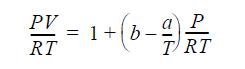
A gas mixture follows the equation of statewhere b is the size parameter,and a is the energetic parameter,Derive the formula for the partial molar enthalpy for component 1 in a binary mixture, where the reference state for both components is the ideal gas state of TR, PR, and the pure component
Henry’s law asserts that f^i = hixi, when xi is near zero, and hi is the Henry’s law constant. Gases at high reduced temperatures can exhibit peculiar trends in their Henry’s law constants. Use the Peng-Robinson equation to predict the Henry’s law constant for hydrogen in decalin at T
The procedure for calculation of the residual enthalpy for a pure gas is shown in Example 8.5. Now consider the residual enthalpy for a binary gas mixture. For this calculation, it is necessary to determine da/dT for the mixture.(a) Write the form of this derivative for a binary mixture in terms of
The vapor-liquid equilibria for the system acetic acid(1) + acetone(2) needs to be characterized in order to simulate an acetic anhydride production process. Experimental data for this system at 760 mmHg have been reported by Othmer (1943)4 as summarized below. Use the data at the equimolar
A gaseous mixture of 30 mol% CO2 and 70 mol% CH4 enters a valve at 70 bar and 40°C and exits at 5.3 bar. Does any CO2 condense? Assume that the mixture follows the virial equation. Assume that any liquid that forms is pure CO2. The vapor pressure of CO2 may be estimated by the shortcut vapor
A mixture of methane and ethylene exists as a single gas phase in a spherical tank (10 m3) on the grounds of a refinery. The mixture is at 298 K and 1 MPa. It is a spring day, and the atmospheric temperature is also 298 K. The mole fraction of ethylene is 20 mol%. Your supervisor wants to draw off
(a) At 298 K, butane follows the equation of state: P(V - b) = RT at moderate pressures, where b is a function of temperature. Calculate the fugacity for butane at a temperature of 298 K and a pressure of 1 MPa. At this temperature, b = -732 cm3/mol.(b) Pentane follows the same equation of state
The Soave equation of state is:where the mixing and combining rules are given by Eqns. 15.8 and 15.9. Develop an expression for the fugacity coefficient and compare it to the expression given by Soave (1972. Chem. Eng. Sci. 27:1197). Z = 1 1-bp ap 1 RT (1+bp)
The following equation of state has been proposed for hard-sphere mixtures:whereDerive an expression for the fugacity coefficient. 2 RT (1-7p)
The equation of state below has been suggested. Derive the expression for the fugacity coefficient. Z=1 + 4cp/(1-bp) where b = C = ΣΣΕ Cij = constant
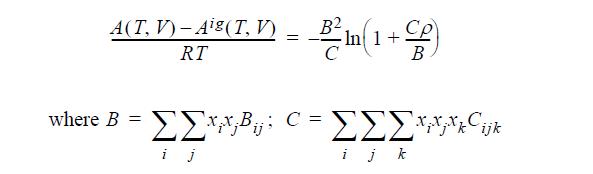
The following free energy model has been suggested as part of a new equation of state for mixtures. Derive the expression for the fugacity coefficient of component 1. A(T, V) - Aig(I, V) RT where B = = Em{1+ Ge - In 1 + Β ΣΣ*: c = ΣΣΣ
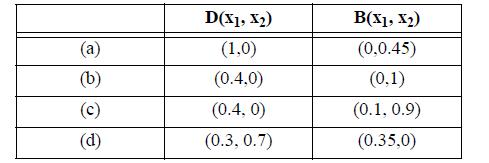
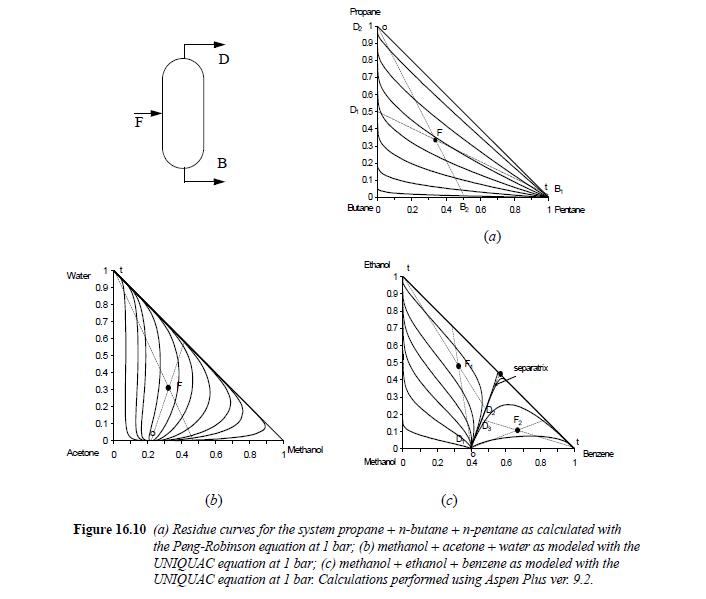
Consider the methanol(1) + water(2) + acetone(3) system with a feed shown in Figure 16.10(a). Rate each of the following products as impossible or possible, and explain. (a) (b) (c) (d) D(X1, X₂) (1,0) (0.4,0) (0.4, 0) (0.3, 0.7) B(X1, X₂) (0.0.45) (0,1) (0.1,0.9) (0.35,0)
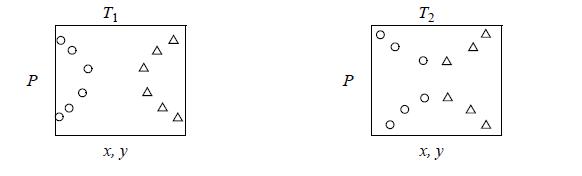
As the research scientist of a company where phase equilibria is under study, you are approached by a laboratory technician with the most recent (and incomplete) high pressure phase equilibria results. The technician expresses concern that the data have not been collected correctly, or that some of
A binary mixture obeys a simple one-term equation for excess Gibbs energy, GE = Ax1x2, where A is a function of temperature: A = 2930 + 5.02E5/T(K) J/mol.(a) Does this system exhibit partial immiscibility? If so, over what temperature range? (b) Suppose component 1 has a normal boiling temperature
Using the value kij = 0.084 fitted to the system methanol(1) + benzene(2), use the Peng- Robinson equation to plot P-x-y behavior of the system at the following temperatures: 350 K, 500 K, 520 K. Plot the T-x-y behavior at the following pressures: 0.15 MPa, 2 MPa, 5.5 MPa. Sketch the P-T projection
Use UNIFAC to model the methanol(1) + methylcyclohexane(2) system. Provide a P-x-y diagram at 60°C and 90°C, and a T-x-y at 0.1013 MPa.
Use UNIFAC to model the methanol(1) + hexane(2) system. Provide a P-x-y diagram at 50°C and 25°C, and a T-x-y at 0.1013 MPa.
Model the system CO2(1) + tetralin(2) using kij = 0.10. Generate a P-x-y diagram at 20°C, 45°C, and a T-x-y at 12 MPa and 22 MPa. What type of phase behavior does the system exhibit?
(a) Rank the following molecules in order of increasing oxidation of carbon and give the oxidation state of C for each: CO2, -COH(aldehyde), -COOH(carboxylic acid), -CO- (ketone), -COH(alcohol), -CH2-, -CH3, CH4.(b) Rank the following C5 molecules in order of decreasing degree of reduction,
For the systems specified below, obtain residue curve maps and plot the range of possible distillate and bottoms compositions for the given feeds. UNIQUAC parameters are provided.(a) methanol(1) + ethanol(2) + ethyl acetate(3), z1 = 0.25, z2 = 0.25, z3 = 0.5, r = [1.4311, 2.1055, 3.4786], q =
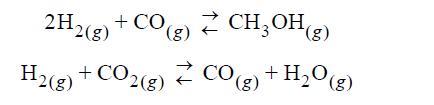
An equimolar mixture of H2 and CO is obtained by the reaction of steam with coal. The product mixture is known as “water-gas.” To enhance the H2 content, steam is mixed with water-gas and passed over a catalyst at 550°C and 1 bar so as to convert CO to CO2 by the reaction:Any unreacted H2O is
Consider an equimolar mixture of methanol(1) + water(2) + acetone(3). Demonstrate that it is not possible to obtain pure acetone as distillate from a single-feed column by generating a residue curve map and applying the bow-tie approximation What compositions are attainable from this feed? Data: r
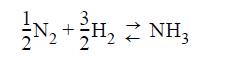
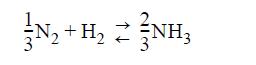
For their homework assignment three students, Julie, John, and Jacob, were working on the formation of ammonia. The feed is a stoichiometric ratio of nitrogen and hydrogen at a particular T and P.Julie, who thought in round numbers of product, wrote:John, who thought in round numbers of nitrogen,
One method for the production of hydrogen cyanide is by the gas-phase nitrogenation of acetylene according to the reaction: N2 + C2H2 ⇆ 2HCN. The feed to a reactor in which the above reaction takes place contains gaseous N2 and C2H2 in their stoichiometric proportions. The reaction temperature
Butadiene can be prepared by the gas-phase catalytic dehydrogenation of 1-butene: C4H8 ⇆ C4H6 + H2. In order to suppress side reactions, the butene is diluted with steam before it passes into the reactor.(a) Estimate the temperature at which the reactor must be operated in order to convert 30% of
The simple statement of the Le Châtelier principle leads one to expect that if the concentration of a reactant were increased, the reaction would proceed so as to consume the added reactant. Nevertheless, consider the gas-phase reaction, N2 + 3H2 ⇆ 2NH3 equilibrated with excess N2 such that
The production of NO by the direct oxidation of nitrogen occurs naturally in internal combustion engines. This reaction is also used to produce nitric oxide commercially in electric arcs in the Berkeland-Eyde process. If air is used as the feed, compute the equilibrium conversion of oxygen at 1 bar
The following reaction reaches equilibrium at the specified conditions.The system initially contains 3 mol H2 for each mole of styrene. Assume ideal gases. For styrene, ΔG°f,298 = 213.18 kJ/mol, ΔH°f,298 = 147.36 kJ/mol.(a) What is Ka at 600°C?(b) What are the equilibrium mole fractions at
Ethylene oxide is an important organic intermediate in the chemical industry. The standard Gibbs energy change at 298 K for the reaction C2H4 + ½O2 ⇆ C2H4O is -79.79 kJ/ mole. This large negative value of ΔG°T indicates that equilibrium is far to the right at 298 K. However, the direct
For the cracking reaction,the equilibrium conversion is negligible at room temperature but becomes appreciable at temperatures above 500 K. For a pressure of 1 bar, neglecting any side reactions, determine:(a) The temperature where the conversion is 75%.(b) The fractional conversion which would be
The water-gas shift reaction is to be carried out at a specified temperature and pressure employing a feed containing only carbon monoxide and steam. Show that the maximum equilibrium mole fraction of hydrogen in the product stream results when the feed contains CO and H2O in their stoichiometric
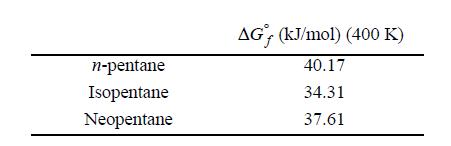
Assuming ideal gas behavior, estimate the equilibrium composition at 400 K and 1 bar of a reactive gaseous mixture containing the three isomers of pentane. Standard formation data at 400 K are n-pentane Isopentane Neopentane AG, (kJ/mol) (400 K) AG₁ 40.17 34.31 37.61
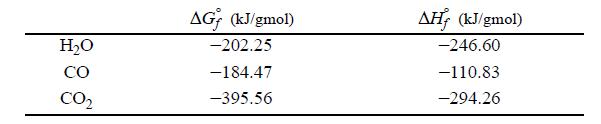
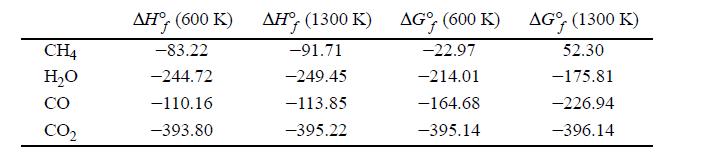
One method for the manufacture of synthesis gas depends on the vapor phase catalytic reaction of methane with steam according to the equation CH4 + H2O ⇆ CO + H2. The only other reaction which ordinarily occurs to an appreciable extent is the water-gas shift reaction. Gibbs energies and
Ethanol can be manufactured by the vapor phase hydration of ethylene according to the reaction: C2H4 + H2O = C2H5OH. The feed to a reactor in which the above reaction takes place is a gas mixture containing 25 mol% ethylene and 75 mol% steam.(a) What is the value of the equilibrium constant, Ka, at
Ethylene is a valuable feedstock for many chemical processes. In future years, when petroleum is not as readily available, ethylene may be produced by dehydration of ethanol. Ethanol may be readily obtained by fermentation of biomass.(a) What percentage of a pure ethanol feed stream will react at
Is there any danger that solid carbon will form at 550°C and 1 bar by the reaction 2CO = Cs + CO2?
Calculate the equilibrium percent conversion of ethylene oxide to ethylene glycol at 298 K and 1 bar if the initial molar ratio of ethylene oxide to water is 3.0.To simplify the calculations, assume that the gas phase is an ideal gas mixture, that γw = 1.0, and that the shortcut K value is
The catalyzed methanol synthesis reaction, CO(g) + 2H2(g) = CH3OH(g), is to be conducted by introducing equimolar feed at 200°C. What are the mole fractions and the temperature at the outlet if the system is adiabatic at 10 bar and the catalyst provides equilibrium conversion without any competing
A gas stream composed of 15 mol% SO2, 20 mol% O2, and 65 mol% N2 enters a catalytic reactor operating and forms SO3 at 480°C and 2 bar.(a) Determine the equilibrium conversion of SO2.(b) Determine the heat transfer required per mole of reactor feed entering at 295 K and 2 bar.
Acetic acid vapor dimerizes according to 2A1 ⇆ A2. Assume that no higher-order associations occur. Supposing that a value for Ka is available, and that the monomers and dimers behave as an ideal gas, derive an expression for yA1 in terms of P and Ka. Then develop an expression for PV/noRT in
(a) As part of a methanol synthesis process similar to problem 17.10, one side reaction that can have an especially unfavorable impact on the catalyst is coke formation. As a first approximation of whether coke (carbon) formation would be significant, estimate the equilibrium extent of coke
Acrylic acid is produced from propylene by the following gas phase reaction:A significant side reaction is the formation of acetic acid:The reactions are carried out at 310°C and 4 bar pressure using a catalyst and air as an oxidant. Steam is added in the ratio 8:1 steam to propylene to stabilize
The 10/25/93 issue of Chemical and Engineering News suggests that the thermodynamic equilibrium in the isomerization of n-butene (CH3CH = CHCH3, a mix of cis and trans isomers) is reached at a temperature of 350°C using a zeolite catalyst. The products are isobutene and 1-butene (CH2=CHCH2CH3).
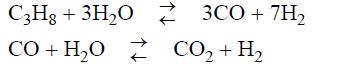
Hydrogen gas can be produced by the following reactions between propane and steam in the presence of a nickel catalyst:Neglecting any other competing reactions:(a) Compute the equilibrium constants at 700 K and 750 K.(b) What is the equilibrium composition of the product gas if the inlet to the
Showing 1300 - 1400
of 2105
First
7
8
9
10
11
12
13
14
15
16
17
18
19
20
21
Last
Step by Step Answers

 Get 50% OFF
Claim Now
Get 50% OFF
Claim Now




![Z= 1 + 4cbp/(1-bp) where b = C = Exibi i Cij = cii C jj bk (ANS. In ok = Ok = 4(c-2[x;,,x]hu(1- bp) + (2-1)-](https://dsd5zvtm8ll6.cloudfront.net/si.question.images/images/question_images/1696/2/3/2/636651a74bc2c18b1696232635996.jpg)