New Semester
Started
Get
50% OFF
Study Help!
--h --m --s
Claim Now
Question Answers
Textbooks
Find textbooks, questions and answers
Oops, something went wrong!
Change your search query and then try again
S
Books
FREE
Study Help
Expert Questions
Accounting
General Management
Mathematics
Finance
Organizational Behaviour
Law
Physics
Operating System
Management Leadership
Sociology
Programming
Marketing
Database
Computer Network
Economics
Textbooks Solutions
Accounting
Managerial Accounting
Management Leadership
Cost Accounting
Statistics
Business Law
Corporate Finance
Finance
Economics
Auditing
Tutors
Online Tutors
Find a Tutor
Hire a Tutor
Become a Tutor
AI Tutor
AI Study Planner
NEW
Sell Books
Search
Search
Sign In
Register
study help
engineering
introduction to quantum mechanics
Introduction To Quantum Mechanics 3rd Edition David J. Griffiths, Darrell F. Schroeter - Solutions
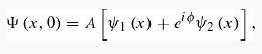
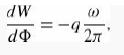
In an interesting version of the energy-time uncertainty principle Δt = τ/π, where τ is the time it takes Ψ(x,t) to evolve into a state orthogonal to Ψ(x,0). Test this out, using a wave function that is a linear combination of two (orthonormal) stationary states of some (arbitrary) potential:
Sequential measurements. An operator Â, representing observable A, has two (normalized) eigenstates Ψ1 and Ψ2, with eigenvalues α1 and α2, respectively. Operator B̂, representing observable B, has two (normalized) eigenstates ∅1 and ∅2, with eigenvalues b1 and b2. The eigenstates are
(a) Find the momentum-space wave function Φn (p,t) for the nth stationary state of the infinite square well.(b) Find the probability density |Φn (p,t)|2. Graph this function, for n = 1, n = 2, n = 5, and n = 10. What are the most probable values of p, forlarge n? Is this what you would have
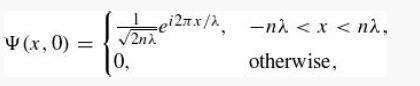
Consider the wave functionwhere n is some positive integer. This function is purely sinusoidal (with wavelength λ) on the interval -nλ < x 2 and |Φ (p,0)|2, and determine their widths ωx, and ωp (the distance between zeros on either side of the main peak). Note what happens to each width as
Find the matrix elements and in the (orthonormal) basis of stationary states for the harmonic oscillator (Equation 2.68). You already calculated the “diagonal” elements (n = n') in Problem 2.12; use the same technique for the general case. Construct the corresponding (infinite) matrices, X and
A harmonic oscillator is in a state such that a measurement of the energy would yield either (1/2) ћω or (3/2) ћω , with equal probability. What is the largest possible value of (p) in such a state? If it assumes this maximal value at time t = 0, what is Ψ (x,t)?
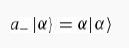
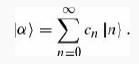
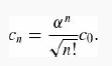
Coherent states of the harmonic oscillator. Among the stationary states of the harmonic oscillator (Equation 2.68) only n = 0 hits the uncertainty limit (σx σp = ћ/2); in general, σx σp = (2n + 1) ћ/2, as you found in Problem 2.12. But certain linear combinations (known as coherent
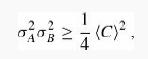
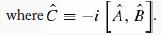
Extended uncertainty principle. The generalized uncertainty principle (Equation 3.62) states that(a) Show that it can be strengthened to readwhere D̂ Ξ ÂB̂ + B̂Â -2 (A) (B). Keep the Re(z) term in Equation 3.60.(b) Check Equation 3.115 for the case B = A (the standard uncertainty
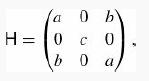
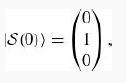
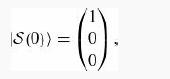
The Hamiltonian for a certain three-level system is represented by the matrixwhere a, b, and c are real numbers.(a) If the system starts out in the statewhat is |S(t)}?(b) If the system starts out in the statewhat is |S(t)}? (a o b Н=10 с 0 o b al
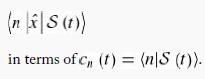
Find the position operator in the basis of simple harmonic oscillator energy states. That is, expressUse Equation 3.114 (nxS (1)) in terms of c,, (t) = (n/S (t)).
Why can’t you do integration-by-parts directly on the middle expression in Equation 1.29—pull the time derivative over onto x, note that ∂x /∂t = 0, and conclude that d(x) / dt = 0?Equation 1.29 d(x) iħ Ə 4x)=√x=19² dx = x (x-3) de. (₁ X- at 2m ax dt (1.29)
Although the overall phase constant of the wave function is of no physical significance (it cancels out whenever you calculate a measurable quantity), the relative phase of the coefficients in Equation 2.17 does matter. For example, suppose we change the relative phase of and in Problem
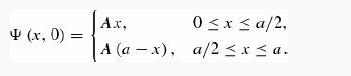
A particle in the infinite square well has the initial wave function(a) Sketch Ψ (x,0), and determine the constant A.(b) Find Ψ (x,t).(c) What is the probability that a measurement of the energy would yield the value E1?(d) Find the expectation value of the energy, using Equation 2.21.Equation
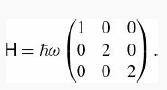
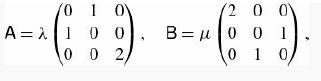
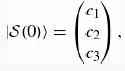
The Hamiltonian for a certain three-level system is represented by the matrixTwo other observables, A and B, are represented by the matriceswhere ω, λ, and μ are positive real numbers.(a) Find the eigenvalues and (normalized) eigenvectors of H,A, and B.(b) Suppose the system starts out in the
Imagine two noninteracting particles, each of mass m, in the infinite square well. If one is in the state (Equation 2.28), and the other in state Ψ1, (l ≠ n), calculate ((x1 - x2)2), assuming(a) They are distinguishable particles, (b) They are identical bosons, and (c) They are
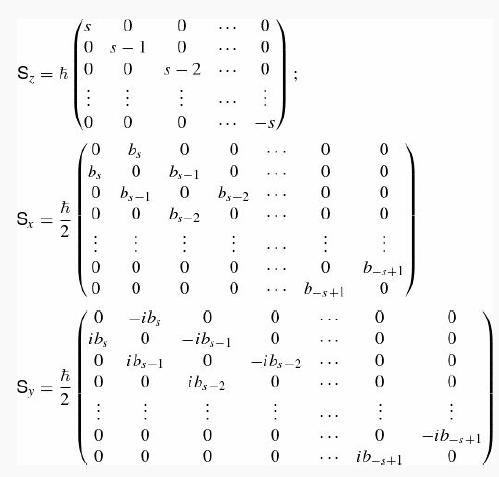
Work out the spin matrices for arbitrary spin s, generalizing spin 1/2 (Equations 4.145 and 4.147), spin 1 (Problem 4.34), and spin 3/2 (Problem 4.61). whereEquations 4.145 Sx S₂ = h 0 Sy || 11 方|2 ħ 方|2 -S ħ 0 S- 0 0b0 0 0 0 0 : 0 ...00 1 bs 0 by-1 0 0 0 -ibs 0 0 ib, 0
Work out the normalization factor for the spherical harmonics, as follows. From Section 4.1.2 we know thatthe problem is to determine the factor Kmℓ (which I quoted, but did not derive, in Equation 4.32). Use Equations 4.120, 4.121, and 4.130 to obtain a recursion relation giving Km+1ℓ in terms
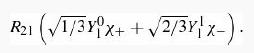
The electron in a hydrogen atom occupies the combined spin and position state(a) If you measured the orbital angular momentum squared (L2), what values might you get, and what is the probability of each?(b) Same for the z component of orbital angular momentum (Lz).(c) Same for the spin angular
Find the matrix representing Sx for a particle of spin 3/2 (using as your basis the eigenstates of Sz). Solve the characteristic equation to determine the eigenvalues of Sx.
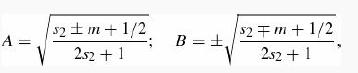
(a) Work out the Clebsch–Gordan coefficients for the case s1 = 1/2, s2 anything.such that is an eigenstate of S2. Use the method of Equations 4.177 through 4.180. If you can’t figure out what Sx(2) (for instance) does to |S2m2>, refer back to Equation 4.136 and the line before Equation
Suppose two spin-1/2 particles are known to be in the singlet configuration (Equation 4.176). Let Sα(1) be the component of the spin angular momentum of particle number 1 in the direction defined by the vector a. Similarly, let Sb(2) be the component of 2’s angular momentum in the directionb.
Construct the spin matrices (Sx, Sy, and Sz) for a particle of spin1. How many eigenstates of Sz are there? Determine the action of Sz, S+, and S- on each of these states. Follow the procedure used in the text for spin 1/2.
Construct the matrix Sr representing the component of spin angular momentum along an arbitrary direction . Use spherical coordinates, for whichFind the eigenvalues and (normalized) eigenspinors of Sr. = sin cos dî+ sin 0 sin pĵ+ cos ok. (4.154)
(a) Find the eigenvalues and eigenspinors of Sy.(b) If you measured Sy on a particle in the general state χ (Equation 4.139), what values might you get, and what is the probability of each? Check that the probabilities add up to 1.(c) If you measured S2y, what values might you get, and with what
For the most general normalized spinor χ (Equation 4.139), compute (Sx), (Sy), (Sz), (S2x), (S2y), and (S2z). Check that (S2x)+(S2y)+(S2z) = (S2).Equation 4.139 X = a b = ax++bx-, (4.139)
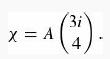
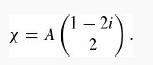
An electron is in the spin state(a) Determine the normalization constant A.(b) Find the expectation values of Sx, Sy, and Sz.(c) Find the “uncertainties” σSx, σSy, and σSz.(d) Confirm that your results are consistent with all three uncertainty principles (Equation 4.100 and its cyclic
(a) Check that the spin matrices (Equations 4.145 and 4.147) obey the fundamental commutation relations for angular momentum, Equation 4.134.(b) Show that the Pauli spin matrices (Equation 4.148) satisfy the product rulewhere the indices stand for x, y, or z, and ∈ jkl is the Levi-Civita
If the electron were a classical solid sphere, with radius(the so-called classical electron radius, obtained by assuming the electron’s mass is attributable to energy stored in its electric field, via the Einstein formula E = mc2), and its angular momentum is (1/2) ћ, then how fast (in m/s)
Two particles (masses m1 and m2) are attached to the ends of a massless rigid rod of length a. The system is free to rotate in three dimensions about the (fixed) center of mass.(a) Show that the allowed energies of this rigid rotor areis the moment of inertia of the system.(b) What are the
In Problem 4.4 you showed thatApply the raising operator to find Y22 (θ,ϕ). Use Equation 4.121 to get the normalization. Y(0,0)=√/15/8л sin cos 9e¹.
(a) What is L+Yℓℓ ? (No calculation allowed!)(b) Use the result of (a), together with Equation 4.130 and the fact that LzYℓℓ = ћℓYℓℓ, to determine Yℓℓ(θ,ϕ), up to a normalization constant.(c) Determine the normalization constant by direct integration. Compare your final
Consider the earth–sun system as a gravitational analog to the hydrogen atom.(a) What is the potential energy function (replacing Equation 4.52)? (Let mE be the mass of the earth, and M the mass of the sun.)(b) What is the “Bohr radius,” αg, for this system? Work out the actual number.(c)
(a) Derive Equation 4.131 from Equation 4.130. Use a test function; otherwise you’re likely to drop some terms.(b) Derive Equation 4.132 from Equations 4.129 and 4.131. Use Equation 4.112.Equation 4.112Equations 4.129Equations 4.130Equations 4.131Equations 4.132 (4.112) • ²74 ± ²7+7+7=z1
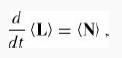
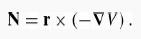
(a) Prove that for a particle in a potential V(r) the rate of change of the expectation value of the orbital angular momentum L is equal to the expectation value of the torque:where(This is the rotational analog to Ehrenfest’s theorem.)(b) Show that d(L)/dt = 0 for any spherically symmetric
A hydrogenic atom consists of a single electron orbiting a nucleus with Z protons. (Z = 1 would be hydrogen itself, Z = 2 is ionized helium, Z = 3 is doubly ionized lithium, and so on.) Determine the Bohr energies, En (Z) the binding energy E1 (Z), the Bohr radius a (Z), and the Rydberg constant R
The raising and lowering operators change the value of m by one unit:where Amℓ and Bmℓ are constants. Question: What are they, if the eigenfunctions are to be normalized? First show that L-+ is the hermitian conjugate of L± (since Lx and Ly are observables, you may assume they are
What is the most probable value of r, in the ground state of hydrogen? (The answer is not zero!)
(a) Using Equation 4.88, work out the first four Laguerre polynomials.Equations 4.88(b) Using Equations 4.86, 4.87, and 4.88, find v(p), for the case n = 5, ℓ = 2.(c) Find v(p) again (for the case n = 5, ℓ= 2), but this time get it from the recursion formula (Equation 4.76).Equation
(a) Find (r) and (r2) for an electron in the ground state of hydrogen. Express your answers in terms of the Bohr radius.(b) Find (x) and (x2) for an electron in the ground state of hydrogen.(c) Find (x2) in the state n = 2, ℓ = 1, m = 1.
(a) Work out all of the canonical commutation relations for components of the operators r and p: [x,y], [x,py], [x,px],[py,pz], and so on.where the indices stand for x, y, or z, and rx, = x, ry, = y, and rz = z.(b) Confirm the three-dimensional version of Ehrenfest’s theorem,(Each of these, of
Use separation of variables in cartesian coordinates to solve the infinite cubical well (or “particle in a box”):(a) Find the stationary states, and the corresponding energies.(b) Call the distinct energies E1,E2,E3, ...., in order of increasing energy. Find E1,E2,E3,E4,E5, and E6. Determine
(a) Suppose Ψ (r,θ, ϕ) = Ae-r/α for some constants A and a. Find E and(b) Do the same for Ψ (r,θ, ϕ) = Ae-r2/α2, assuming V (0) = 0. V(r), assuming V(r)→ 0 asr → ∞0.
Use Equations 4.27, 4.28, and 4.32, to construct Y00 and Y12. Check that they are normalized and orthogonal. d P" (x) = (− 1)" (1-x²) "/¹² (4) dx PIX P(x), (4.27)
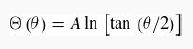
Show thatsatisfies the θ equation (Equation 4.25), for ℓ = m = 0. This is the unacceptable “second solution”—what’s wrong with it?Equation 4.25 (0) = A In [tan (0/2)]
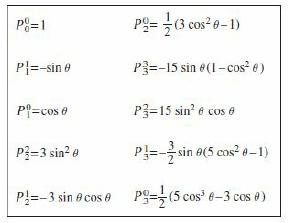
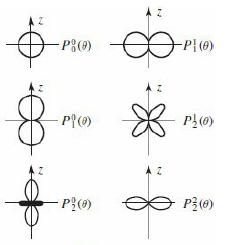
Using Equation 4.32, find Yℓℓ (θ,ϕ) and Y23 (θ,ϕ) . (You can take P23 from Table 4.2, but you’ll have to work out Pℓℓ from Equations 4.27 and 4.28.) Check that they satisfy the angular equation (Equation 4.18), for the appropriate values of and m.Equation 4.32Table 4.2Some
Starting from the Rodrigues formula, derive the orthonormality condition for Legendre polynomials: L P(x) Pe (x)dx = 27/1) Se 20+1 dee. (4.34)
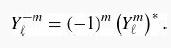
Using Equation 4.32 and footnote 5, show thatEquation 4.32 Y™ = (-1)" (Ym)* .
(a) From the definition (Equation 4.46), construct n1(x) and n2(x) .(b) Expand the sines and cosines to obtain approximate formulas for n1(x) and n2(x), valid when x << 1. Confirm that they blow up at the origin.Equation 4.46 d sin.x je(x) = (-x)' (1-4) x dx X d ne(x) = -(-x)² (14) ² x
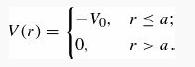
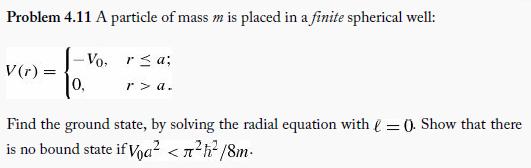
A particle of mass m is placed in a finite spherical well:Find the ground state, by solving the radial equation with ℓ = 0. Show that there is no bound state if V0α2 < π2ћ2/8m. V(r) = -Vo, ra; 0, r>a.
Work out the radial wave functions R30, R31, and R32, using the recursion formula (Equation 4.76). Don’t bother to normalize them.Equation 4.76 Cj+1= 2 (j+l+1-n) (i+1) (+20+2) -Cj. (4.76)
(a) Normalize R20 (Equation 4.82), and construct the function Ψ200.Equation 4.82(b) Normalize R21 (Equation 4.83), and construct Ψ211, Ψ210, and Ψ21-1.Equation 4.83 R20 (r) = CO 2a 2a er/2a (4.82)
(a) Check that Arj1 (kr) satisfies the radial equation with V(r) = 0 and ℓ = 1.(b) Determine graphically the allowed energies for the infinite spherical well, when ℓ = 1. Show that for large N, EN1 ≈ (ћ2π2/2ma2) (N + 1/2)2.First show that j1 (x) = 0 ⇒ x = tan x. Plot x and tan x on the
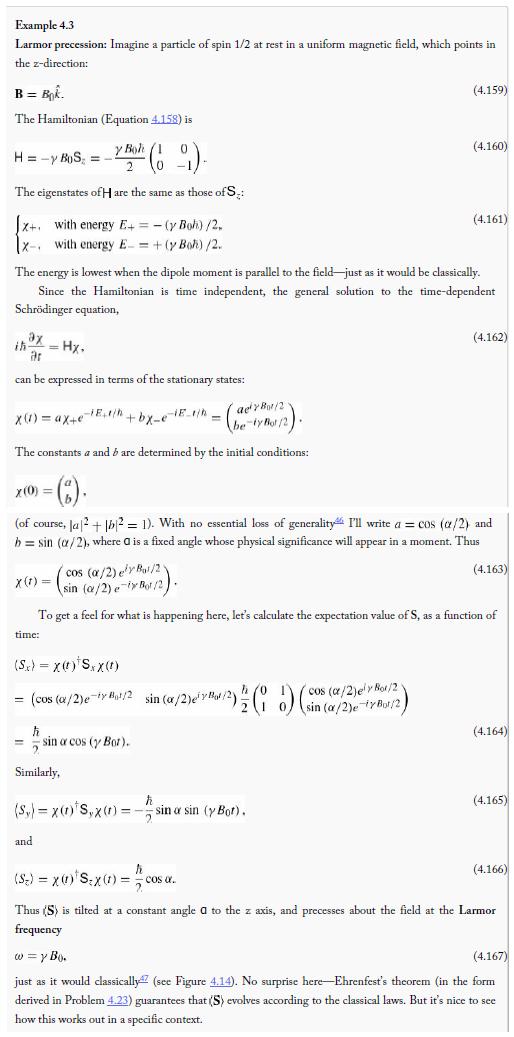
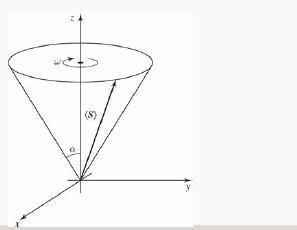
In Example 4.3:(a) If you measured the component of spin angular momentum along the x direction, at time t, what is the probability that you would get +ћ/2?(b) Same question, but for the y component.(c) Same, for the z component.Figures 4.14 Example 4.3 Larmor precession: Imagine a particle of
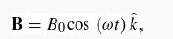
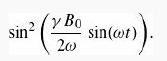
An electron is at rest in an oscillating magnetic fieldwhere B0 and ω are constants.(a) Construct the Hamiltonian matrix for this system.(b) The electron starts out (at t = 0) in the spin-up state with respect to the x axis (that is Determine x(t) at any subsequent time. Beware: This is
(a) Apply S- to |10> (Equation 4.175), and confirm that you get (b) Apply S± to |100> (Equation 4.176), and confirm that you get zero.(c) Show that |11> and |1-1> (Equation 4.175) are eigenstates of S2, with the appropriate eigenvalue. √2h|1-1).
Quarks carry spin 1/2. Three quarks bind together to make a baryon (such as the proton or neutron); two quarks (or more precisely a quark and an antiquark) bind together to make a meson (such as the pion or the kaon). Assume the quarks are in the ground state (so the orbital angular momentum is
Verify Equations 4.175 and 4.176 using the Clebsch–Gordan table. |11) = (10) = -1) = 一个个〉 (I↑↓)+|↓↑)) } |↓↓) S= 1 (triplet). (4.175)
(a) Aparticle of spin 1 and a particle of spin 2 are at rest in a configuration such that the total spin is 3, and its z component is ћ. If you measured the z-component of the angular momentum of the spin-2 particle, what values might you get, and what is the probability of each one? Comment:
Determine the commutator of S2 with Sz(1) (where S Ξ S(1) + S(2)). Generalize your result to show thatBecause Sz(1) does not commute with S2, we cannot hope to find states that are simultaneous eigenvectors of both. In order to form eigenstates of S2 we need linear combinations
Supposewhere B0 and K are constants.(a) Find the fields E and B.(b) Find the allowed energies, for a particle of mass m and charge q, in these fields.where ω1 Ξ qB0/m and ω2 Ξ In two dimensions (x and y, with K = 0) this is the quantum analog to cyclotron motion; ω1 is the classical
Show that Ψ' (Equation 4.197) satisfies the Schrödinger equation (Equation 4.191 with the potentials φ' and A' (Equation 4.196). av 31 = 2m (-ihv-gA)²+qo V. A)² +99] v. (4.191)
Warning: Attempt this problem only if you are familiar with vector calculus. Define the (three-dimensional) probability current by generalization of Problem 1.14:(a) Show that J satisfies the continuity equationwhich expresses local conservation of probability. It follows (from the divergence
The (time-independent) momentum space wave function in three dimensions is defined by the natural generalization of Equation 3.54:(a) Find the momentum space wave function for the ground state of hydrogen (Equation 4.80).(b) Check that ϕ (p) is normalized.(c) Use ϕ (p) to calculate (p2), in the
In Section 2.6 we noted that the finite square well (in one dimension) has at least one bound state, no matter how shallow or narrow it may be. In Problem 4.11 you showed that the finite spherical well (three dimensions) has no bound state, if the potential is sufficiently weak. Question: What
(a) Construct the spatial wave function (Ψ) for hydrogen in the state n = 3, ℓ = 2, m = 1. Express your answer as a function of r, θ, ϕ, and a (the Bohr radius) only—no other variables (ρ, z, etc.) or functions (Y, v, etc.), or constants (A, c0, etc.), or derivatives, allowed (π is okay,
(a) Construct the wave function for hydrogen in the state n = 4, ℓ = 3, m = 3. Express your answer as a function of the spherical coordinates r, θ, and ϕ.(b) Find the expectation value of r in this state. (As always, look up any nontrivial integrals.)(c) If you could somehow measure the
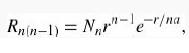
(a) Use the recursion formula (Equation 4.76) to confirm that when ℓ = n-1 the radial wave function takes the formand determine the normalization constant Nn by direct integration.(b) Calculate (r) and (r2) for states of the form Ψn(n-1)m.(c) Show that the “uncertainty” in r (σr) is
Consider the observables A = x2 and B = Lz.(a) Construct the uncertainty principle for σA σB.(b) Evaluate in the hydrogen state Ψnℓm.(c) What can you conclude about (x,y) in this state?
An electron is in the spin state(a) Determine the constant A by normalizing χ.(b) If you measured Sz on this electron, what values could you get, and what is the probability of each? What is the expectation value of Sz?(c) If you measured Sx on this electron, what values could you get, and what is
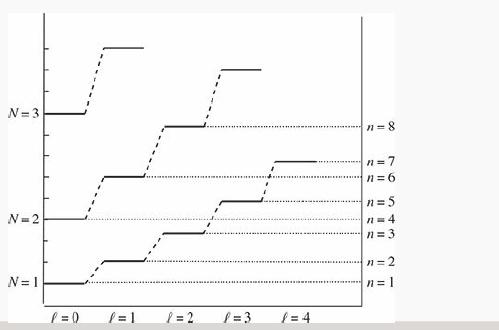
Because the three-dimensional harmonic oscillator potential (see Equation 4.215) is spherically symmetrical, the Schrödinger equation can also be handled by separation of variables in spherical coordinates. Use the power series method (as in Sections 2.3.2 and 4.2.1) to solve the radial equation.
(a) Derive Equation 4.199 from Equation 4.190.(b) Derive Equation 4.211, starting with Equation 4.210.Equation 4.190Equation 4.199Equation 4.210Equation 4.211 = -(-ih-qA)² + qo, 2.m (4.190)
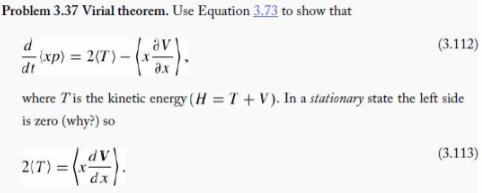
(a) Prove the three-dimensional virial theorem:(for stationary states). refer to Problem 3.37.(b) Apply the virial theorem to the case of hydrogen, and show that(c) Apply the virial theorem to the three-dimensional harmonic oscillator (Problem 4.46), and show that in this case. 2 (T) = (r.
Deduce the condition for minimum uncertainty in Sx and Sy (that is, equality in the expression for a particle of spin 1/2 in the generic state (Equation 4.139).Equation 4.139 os, as, (h/2) |(S₂)|),
Imagine a hydrogen atom at the center of an infinite spherical well of radius b. We will take b to be much greater than the Bohr radius (α) , so the low-n states are not much affected by the distant “wall” at r = b . But since u (b) = 0 we can use the method of Problem 2.61 to solve the radial
(a) At time t = 0 a large ensemble of spin-1/2 particles is prepared, all of them in the spin-up state (with respect to the z axis). They are not subject to any forces or torques. At time t1 > 0 each spin is measured— some along the z direction and others along the x direction (but we aren’t
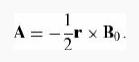
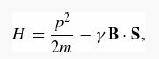
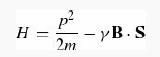
Consider a particle with charge q, mass m, and spin s, in a uniform magnetic field B0. The vector potential can be chosen as(a) Verify that this vector potential produces a uniform magnetic field B0.(b) Show that the Hamiltonian can be writtenwhere ϒ0 = q/2m is the gyromagnetic ratio for orbital
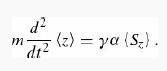
Example 4.4, couched in terms of forces, was a quasi-classical explanation for the Stern–Gerlach effect. Starting from the Hamiltonian for a neutral, spin- 1/2 particle traveling through the magnetic field given by Equation 4.169,use the generalized Ehrenfest theorem (Equation 3.73) to show
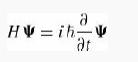
Neither Example 4.4 nor Problem 4.73 actually solved the Schrödinger equation for the Stern–Gerlach experiment. In this problem we will see how to set up that calculation. The Hamiltonian for a neutral, spin- 1/2 particle traveling through a Stern–Gerlach device iswhere B is given by Equation
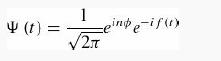
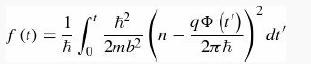
Consider the system of Example 4.6, now with a time-dependent flux Φ (t) through the solenoid. Show thatwithis a solution to the time-dependent Schrödinger equation. √2π 1 = (1) h
The shift in the energy levels in Example 4.6 can be understood from classical electrodynamics. Consider the case where initially no current flows in the solenoid. Now imagine slowly increasing the current.(a) Calculate (from classical electrodynamics) the emf produced by the changing flux and show
(a) Write down the Hamiltonian for two noninteracting identical particles in the infinite square well. Verify that the fermion ground state given in Example 5.1 is an eigenfunction of Ĥ, with the appropriate eigenvalue.(b) Find the next two excited states (beyond the ones given in the example)—
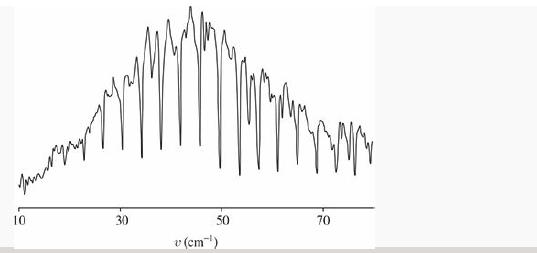
Chlorine has two naturally occurring isotopes, Cl35 and Cl37. Show that the vibrational spectrum of HCl should consist of closely spaced doublets, with a splitting given by ^v = 7.51 x 10⁻⁴ v, where ν is the frequency of the emitted photon. Think of it as a harmonic oscillator, with ω = √k/μ,
In Problem 2.7(d) you got the expectation value of the energy by summing the series in Equation 2.21, but I warned you (in footnote 21) not to try it the “old fashioned way,” (H) = ∫ Ψ (x,0) H Ψ (x,0) dx, because the discontinuous first derivative of Ψ (x,0) renders the second
(a) Write down the time-dependent “Schrödinger equation” in momentum space, for a free particle, and solve it.(b) Find ϕ (p,0) for the traveling gaussian wave packet (Problem 2.42), and construct ϕ (p,0) for this case. Also construct |ϕ (p,0)|2, and it is independent of time.(c) Calculate
Supersymmetry. Consider the two operatorsfor some function W (x) . These may be multiplied in either order to construct two Hamiltonians:V1 and V2 are called supersymmetric partner potentials. The energies and eigenstates of Ĥ1 and Ĥ2 are related in interesting ways.(a) Find the
An operator is defined not just by its action (what it does to the vector it is applied to) but its domain (the set of vectors on which it acts). In a finite-dimensional vector space the domain is the entire space, and we don’t need to worry about it. But for most operators in Hilbert space the
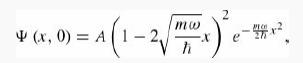
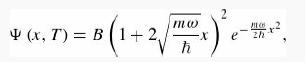
A particle of mass m in the harmonic oscillator potential (Equation 2.44) starts out in the statefor some constant A.(a) Determine A and the coefficients Cn in the expansion of this state in terms of the stationary states of the harmonic oscillator.(b) In a measurement of the particle’s energy,
(a) Show that the wave function of a particle in the infinite square well returns to its original form after a quantum revival time T = 4mα2/πћ. That is: Ψ (x,T) = Ψ (x,0) for any state (not just a stationary state).(b) What is the classical revival time, for a particle of energy E bouncing
In this problem we explore some of the more useful theorems (stated without proof) involving Hermite polynomials.(a) The Rodrigues formula says thatUse it to derive H3 and H4 .(b) The following recursion relation gives you Hn+1 in terms of the two preceding Hermite polynomials:Use it, together with
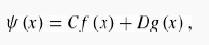
Suppose(a) Solve the (time-independent) Schrödinger equation for this potential.by letting z Ξ αx and y(z) Ξ (1/√α) Ψ (x) (the √a is just so y (z) is normalized with respect to z when Ψ (x) is normalized with respect to x) . What are the constants a and ε? Actually, we might as
Legendre’s differential equation readswhere ℓ is some (non-negative) real number.(a) Assume a power series solution, and obtain a recursion relation for the constants(b) Argue that unless the series truncates (which can only happen if ℓ is an integer), the solution will diverge at x = 1.(c)
The Boltzmann equationgives the probability of finding a system in the state n (with energy En), at temperature T(kB is Boltzmann's constant). The probability here refers to the random thermal distribution, and has nothing to do with quantum indeterminacy. Quantum mechanics will only enter this
Suppose the bottom of the infinite square well is not flat ( V (x) =0), but ratherUse the method of Problem 2.61 to find the three lowest allowed energies numerically, and plot the associated wave functions (use N = 100). V (x) 500 Vo sin (7). a where Vo = ħ² 2ma²
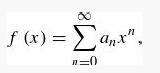
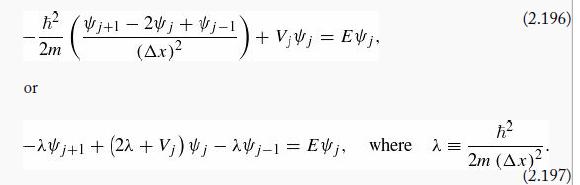
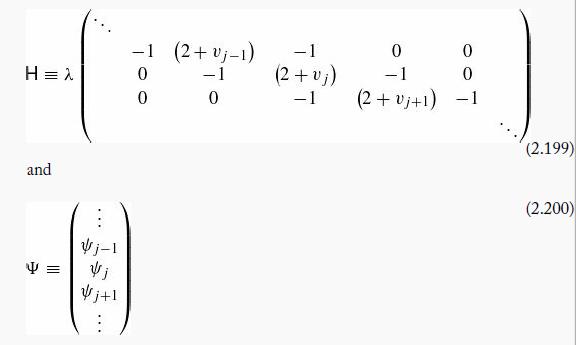
One way to obtain the allowed energies of a potential well numerically is to turn the Schrödinger equation into a matrix equation, by discretizing the variable x. Slice the relevant interval at evenly spaced points, {xj} with xj+1 - xj Ξ Δx, and let Ψj Ξ Ψ (xj) (likewise
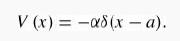
Supposewhere α is some positive constant with the appropriate dimensions. We’d like to find the bound states—solutions to the time-independent Schrödinger equationwith negative energy (E < 0).(a) Let’s first go for the ground state energy, E0. Prove, on dimensional grounds, that there is
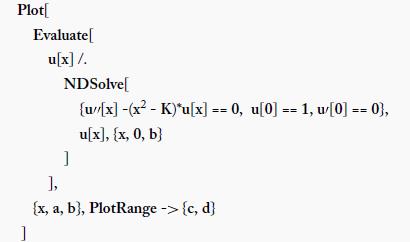
Find the ground state energy of the harmonic oscillator, to five significant digits, by the “wag-the-dog” method. That is, solve Equation 2.73 numerically, varying K until you get a wave function that goes to zero at large ξ. In Mathematica, appropriate input code would be(Here (a,b) is the
The S-matrix (Problem 2.53) tells you the outgoing amplitudes (B and F) and in terms of the incoming amplitudes (A and G) —Equation 2.180. For some purposes it is more convenient to work with the transfer matrix, M, which gives you the amplitudes to the right of the potential (F and G) in
The theory of scattering generalizes in a pretty obvious way to arbitrary localized potentials (Figure 2.21). To the left (Region I), V (x) = 0, soTo the right (Region III), V (x) is again zero, soIn between (Region II), of course, I can’t tell you what is until you specify the potential, but
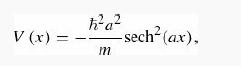
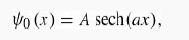
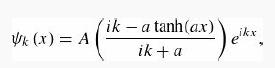
Consider the potentialwhere a is a positive constant, and “sech” stands for the hyperbolic secant.(a) Graph this potential.(b) Check that this potential has the ground stateand find its energy. Normalize Ψ0, and sketch its graph.(c) Show that the function(where as usual) solves the
Show thatsatisfies the time-dependent Schrödinger equation for a particle in a uniform gravitational field,where Ψ0 (x,t) is the free gaussian wave packet (Equation 2.111). Find (x) as a function of time, and comment on the result. mgt - 1281², 1) exp[-1m81 (x + 1 81²)] h (x, t) = Vox+ (2.176)
Showing 300 - 400
of 418
1
2
3
4
5
Step by Step Answers

 Get 50% OFF
Claim Now
Get 50% OFF
Claim Now