New Semester
Started
Get
50% OFF
Study Help!
--h --m --s
Claim Now
Question Answers
Textbooks
Find textbooks, questions and answers
Oops, something went wrong!
Change your search query and then try again
S
Books
FREE
Study Help
Expert Questions
Accounting
General Management
Mathematics
Finance
Organizational Behaviour
Law
Physics
Operating System
Management Leadership
Sociology
Programming
Marketing
Database
Computer Network
Economics
Textbooks Solutions
Accounting
Managerial Accounting
Management Leadership
Cost Accounting
Statistics
Business Law
Corporate Finance
Finance
Economics
Auditing
Tutors
Online Tutors
Find a Tutor
Hire a Tutor
Become a Tutor
AI Tutor
AI Study Planner
NEW
Sell Books
Search
Search
Sign In
Register
study help
engineering
introduction to quantum mechanics
Introduction To Quantum Mechanics 3rd Edition David J. Griffiths, Darrell F. Schroeter - Solutions
Solve Equation 11.17 to second order in perturbation theory, for the general case Ca(0) = a, Cb(0) = b. Ca Hab h == Habe-icol Cb, i =-=-Hex Cas H'ba eiwot (11.17)
Consider a perturbation to a two-level system with matrix elementswhere τ and α are positive constants with the appropriate units.(a) According to first-order perturbation theory, if the system starts off in the state Ca = 1, Cb = 0 at t = -∞, what is the probability that it will be found in
The first term in Equation 11.32 comes from the eiωt/2 part of Cos(ωt), and the second from e-iωt. Thus dropping the first term is formally equivalent to writing Ĥ' = (V/2)e-iωt, which is to say,(The latter is required to make the Hamiltonian matrix hermitian—or, if you prefer, to pick out
You could derive the spontaneous emission rate (Equation 11.63) without the detour through Einstein’s A and B coefficients if you knew the ground state energy density of the electromagnetic field, ρ0(ω), for then it would simply be a case of stimulated emission (Equation 11.54). To do this
As a mechanism for downward transitions, spontaneous emission competes with thermally stimulated emission (stimulated emission for which blackbody radiation is the source). Show that at room temperature (T = 300 K) thermal stimulation dominates for frequencies well below 5 x10¹² Hz, whereas
From the commutators of Lz with x, y, and z (Equation 4.122):obtain the selection rule for Δm and Equation 11.76. Sandwich each commutator between (n'ℓ 'm'| and |nℓ m). [L, x]=ihy. [Ly] =-ihx, [L₂, 2] = 0, (11.77)
The half-life (t1/2) of an excited state is the time it would take for half the atoms in a large sample to make a transition. Find the relation between t1/2 and τ (the “lifetime” of the state).
An electron in the n = 3, ℓ = 0, m = 0 state of hydrogen decays by a sequence of (electric dipole) transitions to the ground state.(a) What decay routes are open to it? Specify them in the following way:(b) If you had a bottle full of atoms in this state, what fraction of them would decay via
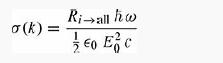
In the photoelectric effect, light can ionize an atom if its energy (ћω) exceeds the binding energy of the electron. Consider the photoelectric effect for the ground state of hydrogen, where the electron is kicked out with momentum ћk. The initial state of the electron is Ψ0(r) (Equation 4.80)
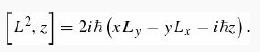
Obtain the selection rule for Δℓ as follows:(a) Derive the commutation relationUse this, and (in the final step) the fact that r.L = r. (rxP) = 0, to demonstrate thatThe generalization from z to r is trivial.(b) Sandwich this commutator between (n'ℓ 'm'| and |nℓ m). and work out the
A particle of mass m is in the ground state of the infinite square well (Equation 2.22). Suddenly the well expands to twice its original size—the right wall moving from a to 2a—leaving the wave function (momentarily) undisturbed. The energy of the particle is now measured.(a) What is the most
Check that Equation 11.103 satisfies the time-dependent Schrödinger equation for the Hamiltonian in Equation 11.97. Also confirm Equation 11.105, and show that the sum of the squares of the coefficients is 1, as required for normalization. Ĥ(t)= B.S= m ħw] 2 = eħ. Bo 2m COS Q eiat sina [sin a
Find Berry’s phase for one cycle of the process in Example 11.4. Use Equation 11.105 to determine the total phase change, and subtract off the dynamical part. You’ll need to expand λ (Equation 11.104) to first order in ω/ω1. 2 = √/w² +w² - 200³ ₁0 Cos α, (11.104)
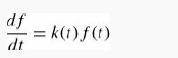
In Problem 11.1 you showed that the solution to(where k(t) is a function of t) isThis suggests that the solution to the Schrödinger equation (11.1) might beIt doesn’t work, because Ĥ(t) is an operator, not a function, and Ĥ(t1) does not (in general) commute with Ĥ(t2).(a) Try calculating
The delta function well (Equation 2.117) supports a single bound state (Equation 2.132). Calculate the geometric phase change when α gradually increases from α1 to α2 . If the increase occurs at a constant rate (dα/dt = c), what is the dynamic phase change for this process? V(x) = -a8
A particle is in the ground state of the harmonic oscillator with classical frequency ω, when suddenly the spring constant quadruples, so ω' = 2ω, without initially changing the wave function (of course, Ψ will now evolve differently, because the Hamiltonian has changed). What is the
In this problem we develop time-dependent perturbation theory for a multi-level system, starting with the generalization of Equations 11.5 and 11.6:At time t = 0 we turn on a perturbation H' (t), so that the total Hamiltonian is(a) Generalize Equation 11.10 to readand show thatwhere(b) If the
For the examples in Problem 11.24 (c) and (d), calculate Cm(t), to first order. Check the normalization condition:and comment on any discrepancy. Suppose you wanted to calculate the probability of remaining in the original state ΨN; would you do better to useProblem 11.24 (c) and (d)(c) For
A particle starts out (at time t = 0) in the Nth state of the infinite square well. Now the “floor” of the well rises temporarily (maybe water leaks in, and then drains out again), so that the potential inside is uniform but time dependent: V0(t), with V0(0) = V0(T) = 0.(a) Solve for the exact
A spin-1/2 particle with gyromagnetic ratio γ, at rest in a static magnetic field B0k̂, precesses at the Larmor frequency ω0 = ϒB0 (Example 4.3). Now we turn on a small transverse radiofrequencyso that the total field is(a) Construct the 2x2 Hamiltonian matrix (Equation 4.158) for this
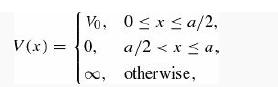
A particle of mass m is initially in the ground state of the (one-dimensional) infinite square well. At time t = 0 a “brick” is dropped into the well, so that the potential becomeswhere V0 << E1. After a time T, the brick is removed, and the energy of the particle is measured. Find the
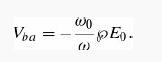
In this problem we will recover the results Section 11.2.1 directly from the Hamiltonian for a charged particle in an electromagnetic field (Equation 4.188). An electromagnetic wave can be described by the potentialswhere in order to satisfy Maxwell’s equations, the wave must be transverse (E0 .
We have encountered stimulated emission, (stimulated) absorption, and spontaneous emission. How come there is no such thing as spontaneous absorption?
(a) Prove properties 12.17, 12.18, 12.19, and 12.20.(b) Show that the time evolution of the density operator is governed by the equation(This is the Schrödinger equation, expressed in terms of ρ̂.)The expectation value of an observable A is dp = [Ĥ.P]- dt iħ (12.26)
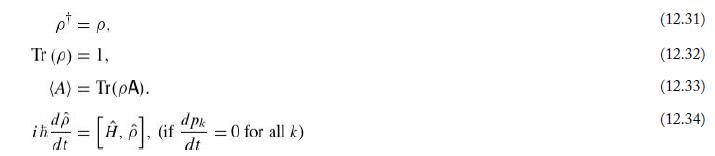
(a) Prove properties 12.31, 12.32, 12.33, and 12.34.(b) Show that Tr(ρ2) ≤ 1, and equal to 1 only if ρ represents a pure state.(c) Show that ρ2 = ρ if and only if ρ represents a pure state. pt = p. Tr (p) = 1, (A) = Tr(pA). dpk ih- iħ¹ = [Â, ô], (if ! dt dt = 0 for all
Einstein’s Boxes. In an interesting precursor to the EPR paradox, Einstein proposed the following gedanken experiment: Imagine a particle confined to a box (make it a one-dimensional infinite square well, if you like). It’s in the ground state, when an impenetrable partition is introduced,
(a) Show that the most general density matrix for a spin-1/2 particle can be written in terms of three real numbers (α1,α2,α3):where σ1,σ2,σ3 are the three Pauli matrices.(b) In the literature, a is known as the Bloch vector. Show that ρ represents a pure state if and only if |a| = 1, and
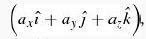
Consider the ordinary vectors in three dimensionswith complex components.(a) Does the subset of all vectors with az = 0 constitute a vector space? If so, what is its dimension; if not, why not?(b) What about the subset of all vectors whose z component is 1?(c) What about the subset of vectors whose
(a) Construct the density matrix for an electron that is either in the state spin up along x (with probability 1/3) or in the state spin down along y (with probability 2/3).(b) Find (Sy) for the electron in (a).
Find the angle (in the sense of Equation A.28) between the vectors a) = (1 + i) î+ (1) ĵ + (i)k and|p) = (4 - i) î+ (0) î+ (2-2i) k.
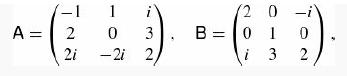
Given the following two matrices:compute: (a) A+B, (b) AB, (c) [A,B] (d) A̅, (e) A*, (f) A+, (g) det(B)(h) B-1. Check that BB-1 = 1. Does A have an inverse? A = - 1 2 2i 1 0 3 2 - 2i 2 B 0 0-i 1 0 i3 2
Prove Equations A.52, A.53, and A.58. Show that the product of two unitary matrices is unitary. Under what conditions is the product of two hermitian matrices hermitian? Is the sum of two unitary matrices necessarily unitary? Is the sum of two hermitian matrices always hermitian? (ST) = TS, (A.52)
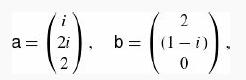
Using the square matrices in Problem A.8, and the column matricesfind: (a) Aa, (b) a +b(c) a̅Bb(d) ab+. a= 2i 2 b = (1-1) -
Consider the collection of all polynomials (with complex coefficients) of degree < N in x.(a) Does this set constitute a vector space (with the polynomials as “vectors”)? If so, suggest a convenient basis, and give the dimension of the space. If not, which of the defining properties does it
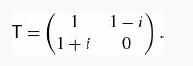
By explicit construction of the matrices in question, show that any matrix T can be written(a) As the sum of a symmetric matrix S and an antisymmetric matrix A;(b) As the sum of a real matrix R and an imaginary matrix M;(c) As the sum of a hermitian matrix H and a skew-hermitian matrix K.
Show that the rows and columns of a unitary matrix constitute orthonormal sets.
Noting that det(T̅) = det(T), show that the determinant of a hermitian matrix is real, the determinant of a unitary matrix has modulus 1 (hence the name), and the determinant of an orthogonal matrix (footnote 13) is either +1 or -1.
It’s obvious that the trace of a diagonal matrix is the sum of its eigenvalues, and its determinant is their product (just look at Equation A.79). It follows (from Equations A.65 and A.68) that the same holds for any diagonalizable matrix. Prove that in factfor any matrix. (The λ’s are the n
Using the standard basis (î ĵ k̂) for vectors in three dimensions:(a) Construct the matrix representing a rotation through angle θ (counterclockwise, looking down the axis toward the origin) about the z axis.(b) Construct the matrix representing a rotation by 120 (counterclockwise, looking
The 2x2 matrix representing a rotation of the xy plane isShow that (except for certain special angles—what are they?) this matrix has no real eigenvalues. (This reflects the geometrical fact that no vector in the plane is carried into itself under such a rotation; contrast rotations in three
In the usual basis (î ĵ k̂), construct the matrix Tx representing a rotation through angle θ about the x axis, and the matrix Ty representing a rotation through angle θ about the y axis. Suppose now we change bases, to î '= ĵ, ĵ' = -î, k̂' = k̂. Construct the matrix S that effects
Show that the first, second, and last coefficients in the characteristic equation (Equation A.73) are:For a 3x3 matrix with elements Tij, what is C1? Cn = (-1)", Cn-1 = (-1)" Tr(T), and Co = det (T). (A.92)
Show that similarity preserves matrix multiplication (that is, if AeBe = Ce, then AfBf = Cf). Similarity does not, in general, preserve symmetry, reality, or hermiticity; show, however, that if S is unitary, and He is hermitian, then Hf is hermitian. Show that S carries an orthonormal basis
Prove that Tr(T1T2) = Tr(T2T1). It follows immediately that Tr(T1T2T3) = Tr(T2T3T1), but is it the case that Tr(T1T2T3) = Tr (T2T1T3), in general? Prove it, or disprove it.
Show that if two matrices commute in one basis, then they commute in any basis. That is:Use Equation A.64. [T₁, T₂] = 0 ⇒ [T{, T₂] = 0. (A.94)
Consider the matrices(a) Verify that they are diagonalizable and that they commute.(b) Find the eigenvalues and eigenvectors of A and verify that its spectrum is degenerate.(c) Are the eigenvectors that you found in part (b) also eigenvectors of B? If not, find the vectors that are simultaneous
Show that the a̅ computed from Equations A.88 and A.90 are eigenvectors of V. a(1) da(¹) +d₂1a(²) a(2)=d₁a¹)+da(²), = (A.88)
Let(a) Verify that T is hermitian.(b) Find its eigenvalues (note that they are real).(c) Find and normalize the eigenvectors (note that they are orthogonal).(d) Construct the unitary diagonalizing matrix S, and check explicitly that it diagonalizes T.(e) Check that and Tr(T) are the same for T as
A hermitian linear transformation must satisfy (α|T̂β) = (T̂α|β) for all vectors |α) and |β). Prove that it is (surprisingly) sufficient that (ϒ|T̂ϒ) = (T̂ϒ|ϒ) for all vectors |ϒ).
Consider the following hermitian matrix:(a) Calculate det (T) and Tr (T).(b) Find the eigenvalues of T. Check that their sum and product are consistent with (a), in the sense of Equation A.93. Write down the diagonalized version of T.(c) Find the eigenvectors of T. Within the degenerate sector,
A unitary transformation is one for which Û+Û = 1.(a) Show that unitary transformations preserve inner products, in the sense that (Ûα|Ûβ) = (α|β), for all vectors |α), β).(b) Show that the eigenvalues of a unitary transformation have modulus 1.(c) Show that the eigenvectors of a
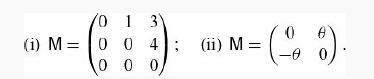
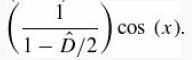
Functions of matrices are typically defined by their Taylor series expansions. For example,(a) Find exp (M), if(b) Show that if M is diagonalizable, thenComment: This is actually true even if M is not diagonalizable, but it’s harder to prove in the general case.(c) Show that if the matrices M and
Prove the following three theorems:(a) For normalizable solutions, the separation constant E must be real. Write E (in Equation 2.7) as E0 + iΓ (with E0 and Γ real), and show that if Equation 1.20 is to hold for all t, Γ must be zero.(b) The time-independent wave function Ψ (x) can always
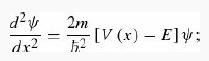
Show that E must exceed the minimum value of V(x) , for every normalizable solution to the time-independent Schrödinger equation. What is the classical analog to this statement?if E < Vmin, then Ψ and its second derivative always have the same sign—argue that such a function cannot be
Show that there is no acceptable solution to the (time-independent) Schrödinger equation for the infinite square well with E = 0 or E < 0.
A particle in the infinite square well has as its initial wave function an even mixture of the first two stationary states:(a) Normalize Ψ (x,0). (That is, find A. This is very easy, if you exploit the orthonormality of Ψ1 and Ψ2 . Recall that, having normalized Ψ at t = 0, you can rest assured
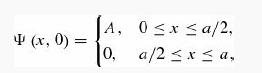
A particle of mass m in the infinite square well (of width a) starts out in the statefor some constant A, so it is (at t = 0) equally likely to be found at any point in the left half of the well. What is the probability that a measurement of the energy (at some later time t) would yield the value
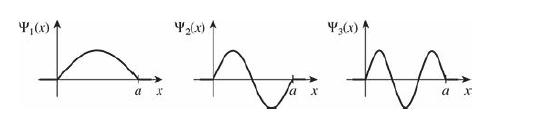
(a) Construct Ψ2 (x).(b) Sketch Ψ0, Ψ1, and Ψ2.(c) Check the orthogonality of Ψ0, Ψ1 and Ψ2, by explicit integration. If you exploit the even-ness and odd-ness of the functions, there is really only one integral left to do.
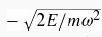
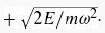
In the ground state of the harmonic oscillator, what is the probability (correct to three significant digits) of finding the particle outside the classically allowed region? Classically, the energy of an oscillator is E = (1/2)ka2 = (1/2) mω2a2 , where a is the amplitude. So the “classically
Use the recursion formula (Equation 2.85) to work out H5 (ξ) and H6 (ξ). Invoke the convention that the coefficient of the highest power of ξ is 2n to fix the overall constant.Equation 2.85 aj +2 = -2 (n-j) (j+1) (j+2) -aj. (2.85)
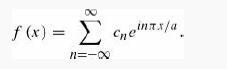
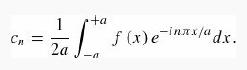
This problem is designed to guide you through a “proof” of Plancherel’s theorem, by starting with the theory of ordinary Fourier series on a finite interval, and allowing that interval to expand to infinity.(a) Dirichlet’s theorem says that “any” function f(x) on the interval [-α +α]
Delta functions live under integral signs, and two expressions (D1(x) and D2 (x)) involving delta functions are said to be equal iffor every (ordinary) function f(x).(a) Show thatwhere c is a real constant. (Be sure to check the case where c is negative.)(b) Let θ (x) be the step function:(In the
Check that the bound state of the delta-function well (Equation 2.132) is orthogonal to the scattering states (Equations 2.134 and 2.135). y(x) = √ma e-ma\x\/h²; h E: ma² 2h² (2.132)
What is the Fourier transform of δ(x)? Using Plancherel’s theorem, show thatThis formula gives any respectable mathematician apoplexy. Although the integral is clearly infinite when x = 0, it doesn’t converge (to zero or anything else) when x ≠ 0, since the integrand oscillates forever.
In this problem you will show that the number of nodes of the stationary states of a one-dimensional potential always increases with energy. Consider two (real, normalized) solutions (Ψn and Ψm) to the time-independent Schrödinger equation (for a given potential V (x) ), with energies En <
A particle in the infinite square well (Equation 2.22) has the initial wave functionDetermine A, find Ψ (x,t), and calculate (x), as a function of time. What is the expectation value of the energy?Equation 2.22 (x, 0) = A sin³ (x/a) (0≤x≤ a).
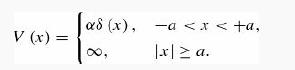
Solve the time-independent Schrödinger equation for a centered infinite square well with a delta-function barrier in the middle:Treat the even and odd wave functions separately. Don’t bother to normalize them. Find the allowed energies (graphically, if necessary). How do they compare with the
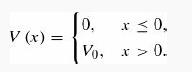
Consider the “step” potential(a) Calculate the reflection coefficient, for the case E < V0, and comment on the answer.(b) Calculate the reflection coefficient for the case E < V0.(c) For a potential (such as this one) that does not go back to zero to the right of the barrier,
Determine the transmission coefficient for a rectangular barrier (same as Equation 2.148, only with V (x) = + V0 > 0 in the region -α < x < a). Treat separately the three cases E < V0, E = V0, and E > V0. Partial for E < V0,Equation 2.148 T¹=1+ v² 0 4E
Derive Equations 2.170 and 2.171.Plug these back into Equations 2.166 and 2.167. Obtain the transmission coefficient, and confirm Equation 2.172. k k ika [sin (fa) 1 eus (c)] : [ers (ta), sin da)] p. i, cos eika F; i- cos (la) D = C = cos cos i (la) (la) F.
Solve the time-independent Schrödinger equation with appropriate boundary conditions for the “centered” infinite square well: V (x) = 0 (for -α < x < + α), V (x) = ∞ (otherwise). Check that your allowed energies are consistent with mine (Equation 2.30), and confirm that your
Imagine a bead of mass m that slides frictionlessly around a circular wire ring of circumference L. (This is just like a free particle, except that Ψ (x+L) = Ψ (x).) Find the stationary states (with appropriate normalization) and the corresponding allowed energies. Note that there are (with one
Consider the double delta-function potentialwhere α and a are positive constants.(a) Sketch this potential.(b) How many bound states does it possess? Find the allowed energies, for α = ћ2 /mα and for α = ћ2 /4mα, and sketch the wave functions.(c) What are the bound state energies in the
If two (or more) distinct solutions to the (time-independent) Schrödinger equation have the same energy E, these states are said to be degenerate. For example, the free particle states are doubly degenerate—one solution representing motion to the right, and the other motion to the left. But we
The Dirac delta function can be thought of as the limiting case of a rectangle of area 1, as the height goes to infinity and the width goes to zero. Show that the delta-function well (Equation 2.117) is a “weak” potential (even though it is infinitely deep), in the sense that z0 → 0 .
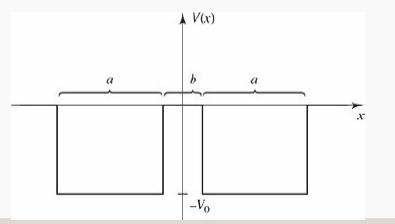
This is a strictly qualitative problem—no calculations allowed! Consider the “double square well” potential (Figure 2.20). Suppose the depth V0 and the width α are fixed, and large enough so that several bound states occur.(a) Sketch the ground state wave function Ψ1 and the first excited
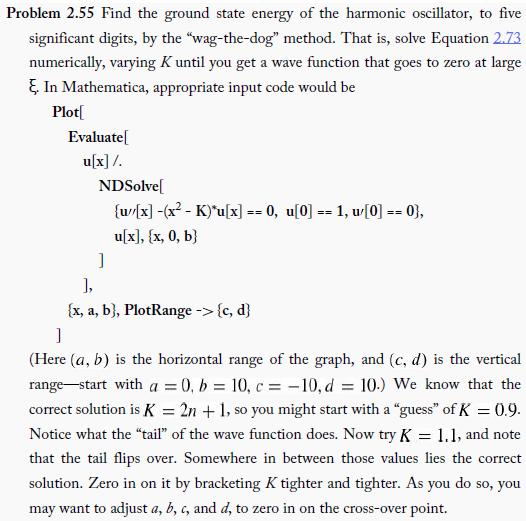
Find the first three excited state energies (to five significant digits) for the harmonic oscillator, by wagging the dog (Problem 2.55). For the first (and third) excited state you will need to set u [0] = = 0, u [0] = = 1.)Problem 2.55 Problem 2.55 Find the ground state energy of the harmonic
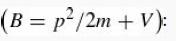
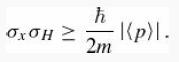
Prove the famous “(your name) uncertainty principle,” relating the uncertainty in position (A = x) to the uncertainty in energyFor stationary states this doesn’t tell you much—why not? (B = p²/2m + V):
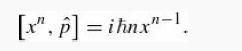
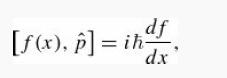
(a) Prove the following commutator identities:(b) Show that(c) Show more generally thatfor any function f(x) that admits a Taylor series expansion.(d) Show that for the simple harmonic oscillatorUse Equation 2.54. [Â+ B.C] = [A.C] + [B.C]. [AB, C] = Â [B.C] + [Â, C] B. (3.64) (3.65)
Show thatIn momentum space, then, the position operator is iћ∂/∂p. More generally,In principle you can do all calculations in momentum space just as well (though not always as easily) as in position space. (x) = ( +* (inan) др ih Фdp. (3.57)
Find ϕ (p,t) for the free particle in terms of the function ϕ (k) introduced in Equation 2.101. Show that for the free particle |ϕ (p,t)|2 is independent of time. The time independence of |ϕ (p,t)|2 for the free particle is a manifestation of momentum conservation in this system.Equation 2.101
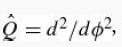
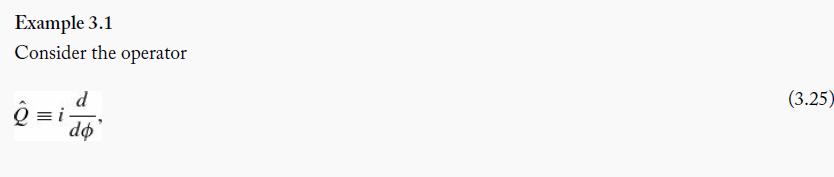
Consider the operatorwhere (as in Example 3.1)ϕ is the azimuthal angle in polar coordinates, and the functions are subject to Equation 3.26. Is hermitian? Find its eigenfunctions and eigenvalues. What is the spectrum of Is the spectrum degenerate?Equation 3.26. P/P=0
Find the momentum-space wave function, ϕ (p,t), for a particle in the ground state of the harmonic oscillator. What is the probability (to two significant digits) that a measurement of p on a particle in this state would yield a value outside the classical range (for the same energy)?
(a) Cite a Hamiltonian from Chapter 2 (other than the harmonic oscillator) that has only a discrete spectrum.(b) Cite a Hamiltonian from Chapter 2 (other than the free particle) that has only a continuous spectrum.(c) Cite a Hamiltonian from Chapter 2 (other than the finite square well) that has
(a) Show that the set of all square-integrable functions is a vector space (refer to Section A.1 for the definition). The main point is to show that the sum of two square-integrable functions is itself square-integrable. Use Equation 3.7. Is the set of all normalized functions a vector space?(b)
Find the first four allowed energies (to five significant digits) for the infinite square well, by wagging the dog.
Show that two noncommuting operators cannot have a complete set of common eigenfunctions. Show that if P̂ and Q̂ have a complete set of common eigenfunctions, then [P̂,Q̂] f = 0 for any function in Hilbert space.
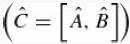
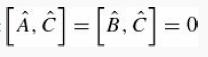
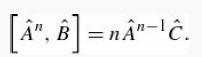
Consider operators  and B̂ that do not commute with each other but do commute with their commutator: (for instance, x̂ and p̂).(a) Show thatYou can prove this by induction on n, using Equation 3.65.(b) Show thatwhere λ is any complex number. Express eλ as a power
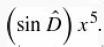
Let (the derivative operator). Find(a)(b) D = d/dx
Consider a three-dimensional vector space spanned by an orthonormal basis |1>,|2>,|3>. Kets |α> and |β> and are given by(a) Construct <α |and <β |(in terms of the dual basis <1|,<2|,<3|).(b) Find <α|β> and <β|α>, and confirm that <β|α> =
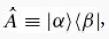
Let be an operator with a complete set of orthonormal eigenvectors:(a) Show that can be written in terms of its spectral decomposition:for any vector |α>.(b) Another way to define a function of is via the spectral decomposition:Show that this is equivalent to Equation 3.100 in
Test the energy-time uncertainty principle for the wave function in Problem 2.5 and the observable x, by calculating σH, σx, and d(x)/dt exactly.Problem 2.5A particle in the infinite square well has as its initial wave function an even mixture of the first two stationary states: (x,0) = A[V₁
Show that the energy-time uncertainty principle reduces to the “your name” uncertainty principle (Problem 3.15), when the observable in question is x. (Problem 3.15)Prove the famous “(your name) uncertainty principle,” relating the uncertainty in position (A = x) to the uncertainty in
Apply Equation 3.73 to the following special cases:(a) Q = 1;(b) Q = H;(c) Q = x;(d) Q = p;In each case, comment on the result, with particular reference to Equations 1.27, 1.33, 1.38, and conservation of energy (see remarks following Equation 2.21). (3.73) - ( 11 ) + ( [0 · ! ] ) = (0) IP P
Solve Equation 3.69 for Ψ(x). (x) and (p) are constants (independent of x). d (-ih-(p)) (p) ia(x - (x)), 4 = dx (3.69)
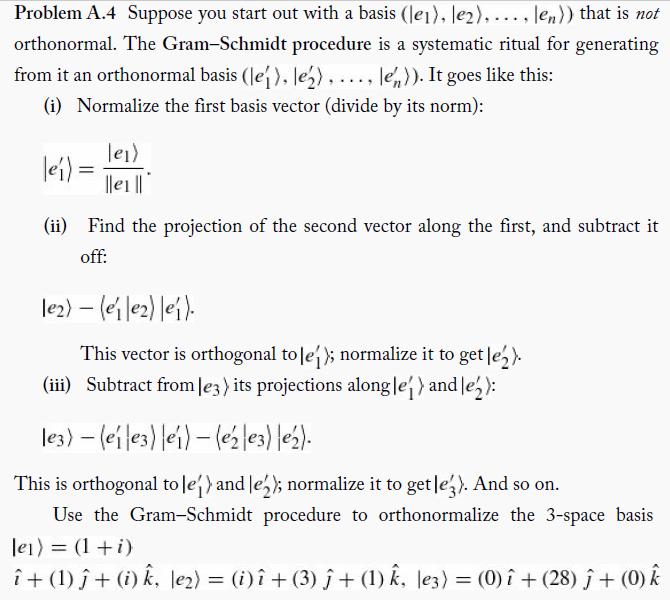
Legendre polynomials. Use the Gram–Schmidt procedure (Problem A.4) to orthonormalize the functions 1, x,x2, and x3, on the interval -1 ≤ x ≤ 1. You may recognize the results—they are (apart from normalization) Legendre polynomials (Problem 2.64 and Table 4.1).(Problem A.4)Problem
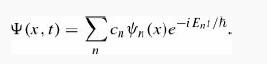
Derive the transformation from the position-space wave function to the “energy-space” wave function (cn (t)) using the technique of Example 3.9. Assume that the energy spectrum is discrete, and the potential is time-independent.Example 3.9Derive the transformation from the position-space wave
An anti-hermitian (or skew-hermitian) operator is equal to minus its hermitian conjugate:(a) Show that the expectation value of an anti-hermitian operator is imaginary.(b) Show that the eigenvalues of an anti-hermitian operator are imaginary.(c) Show that the eigenvectors of an anti-hermitian
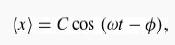
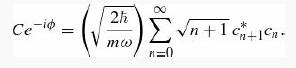
The most general wave function of a particle in the simple harmonic oscillator potential isShow that the expectation value of position iswhere the real constants C and ϕ are given byThus the expectation value of position for a particle in the harmonic oscillator oscillates at the classical
Supportfor constants A and a.(a) Determine A, by normalizing Ψ(x,0).(b) Find (x), (x2), and σx (at time t = 0).(c) Find the momentum space wave function Φ(p,0), and check that it is normalized.(d) Use Φ(p,0) to calculate (p), (p2), and σp (at time t = 0).(e) Check the Heisenberg uncertainty
Showing 200 - 300
of 418
1
2
3
4
5
Step by Step Answers

 Get 50% OFF
Claim Now
Get 50% OFF
Claim Now