New Semester
Started
Get
50% OFF
Study Help!
--h --m --s
Claim Now
Question Answers
Textbooks
Find textbooks, questions and answers
Oops, something went wrong!
Change your search query and then try again
S
Books
FREE
Study Help
Expert Questions
Accounting
General Management
Mathematics
Finance
Organizational Behaviour
Law
Physics
Operating System
Management Leadership
Sociology
Programming
Marketing
Database
Computer Network
Economics
Textbooks Solutions
Accounting
Managerial Accounting
Management Leadership
Cost Accounting
Statistics
Business Law
Corporate Finance
Finance
Economics
Auditing
Tutors
Online Tutors
Find a Tutor
Hire a Tutor
Become a Tutor
AI Tutor
AI Study Planner
NEW
Sell Books
Search
Search
Sign In
Register
study help
engineering
introduction to quantum mechanics
Introduction To Quantum Mechanics 3rd Edition David J. Griffiths, Darrell F. Schroeter - Solutions
Starting with Equation 7.84, and using Equations 7.58, 7.63, 7.66, and 7.85, derive Equation 7.86. E! = - (En)² 2mc² 4n + 1/2 3 (7.58)
The most prominent feature of the hydrogen spectrum in the visible region is the red Balmer line, coming from the transition n = 3 to n = 2. First of all, determine the wavelength and frequency of this line according to the Bohr theory. Fine structure splits this line into several closely-spaced
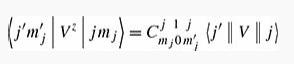
Use the Wigner–Eckart theorem (Equations 6.59–6.61) to prove that the matrix elements of any two vector operators, V and W, are proportional in a basis of angular-momentum eigenstates:Comment: With ℓ replaced by j (the theorem holds regardless of whether the states are eigenstates of orbital,
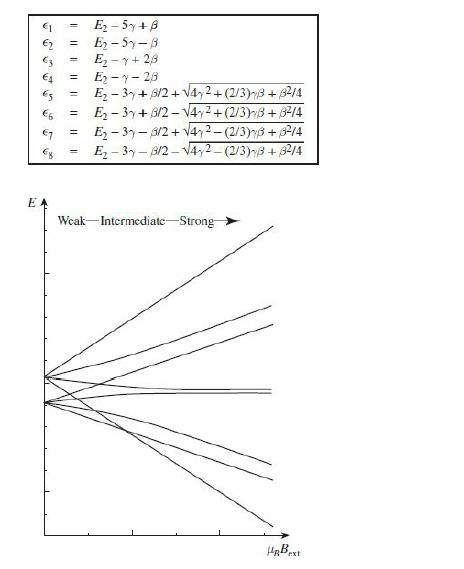
Analyze the Zeeman effect for the n = 3 states of hydrogen, in the weak, strong, and intermediate field regimes. Construct a table of energies (analogous to Table 7.2), plot them as functions of the external field (as in Figure 7.11), and check that the intermediate-field results reduce properly in
If ℓ = 0, then j = s, mj = ms, and the “good” states are the same (|nms) for weak and strong fields. Determine E1z (from Equation 7.74) and the fine structure energies (Equation 7.69), and write down the general result for the ℓ = 0 Zeeman effect—regardless of the strength of the
By appropriate modification of the hydrogen formula, determine the hyperfine splitting in the ground state of (a) Muonic hydrogen (in which a muon—same charge and g-factor as the electron, but 207 times the mass— substitutes for the electron), (b) Positronium (in which a
Consider the (eight) n = 2 states, |2ℓmℓms). Find the energy of each state, under strong-field Zeeman splitting. Express each answer as the sum of three terms: the Bohr energy, the fine structure (proportional to a2), and the Zeeman contribution (proportional to μB Bext). If you ignore fine
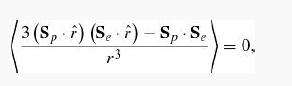
Let a and b be two constant vectors. Show that(the integration is over the usual range: 0 < θ < π, 0 < ∅ < 2π). Use this result to demonstrate thatfor states with ℓ = 0. | (a - ²) (b - ŕ) sino do do = 47 3 (a - b) (7.99)
Work out the matrix elements of H'z and H'fs, and construct the W matrix given in the text, for n = 2.
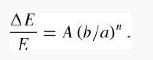
Estimate the correction to the ground state energy of hydrogen due to the finite size of the nucleus. Treat the proton as a uniformly charged spherical shell of radius b, so the potential energy of an electron inside the shell is constant: -e2/(4π∈0b); this isn’t very realistic, but it is the
In this problem you will develop an alternative approach to degenerate perturbation theory. Consider an unperturbed Hamiltonian H0 with two degenerate states Ψ0a and Ψ0b (energy E0), and a perturbation H'. Define the operator that projects onto the degenerate subspace:The Hamiltonian can be
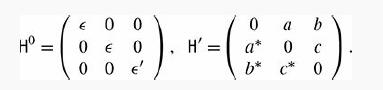
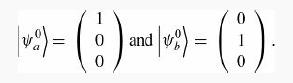
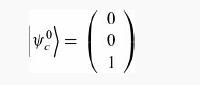
Here is an application of the technique developed in Problem 7.34. Consider the Hamiltonian(a) Find the projection operator PD (it’s a 3 x 3 matrix) that projects onto he subspace spanned byThen construct the matrices H̅0 and H̅'.(b) Solve for the eigenstates of H̅0 and verify…i.
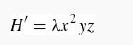
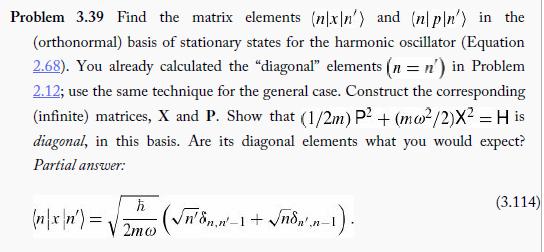
Consider the isotropic three-dimensional harmonic oscillator (Problem 4.46). Discuss the effect (in first order) of the perturbation(for some constant λ) on(a) The ground state;(b) The (triply degenerate) first excited state. Use the answers to Problems 2.12 and 3.39. H' = λx²yz
Van der Waals interaction. Consider two atoms a distance R apart. Because they are electrically neutral you might suppose there would be no force between them, but if they are polarizable there is in fact a weak attraction. To model this system, picture each atom as an electron (mass m, charge -e)
Suppose the Hamiltonian H, for a particular quantum system, is a function of some parameter λ; let En(λ) and Ψn(λ) be the eigenvalues and eigenfunctions of H (λ). The Feynman Hellmann theorem states that(assuming either that En is nondegenerate, or—if degenerate—that the Ψns are the
Consider a three-level system with the unperturbed Hamiltonian(∈a > ∈c) and the perturbationSince the (2x2) matrix W is diagonal (and in fact identically 0) in the basis of states (1,0,0) and (0,1,0), you might assume they are the good states, but they’re not. To see this:(a) Obtain the
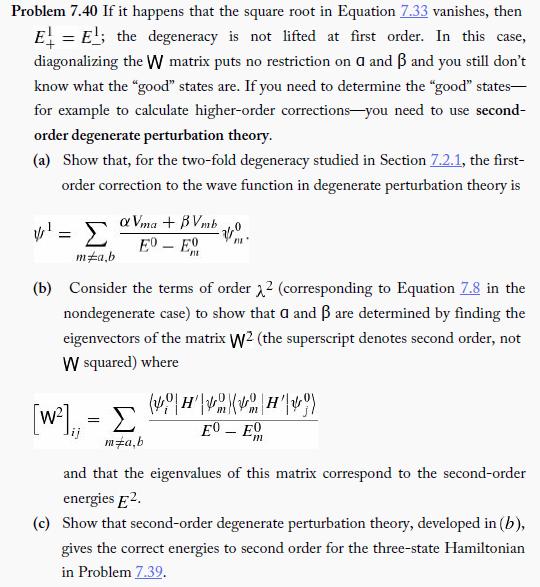
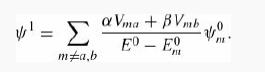
If it happens that the square root in Equation 7.33 vanishes, then E1+ = E1-; the degeneracy is not lifted at first order. In this case, diagonalizing the W matrix puts no restriction on α and β and you still don’t know what the “good” states are. If you need to determine the “good”
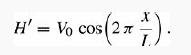
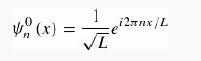
A free particle of mass m is confined to a ring of circumference L such that Ψ (x+L) = Ψ (x). The unperturbed Hamiltonian isto which we add a perturbation(a) Show that the unperturbed states may be writtenfor n = 0, ±1, ±2 and that, apart from n = 0, all of these states are two-fold
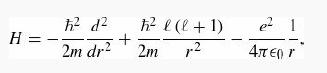
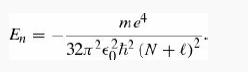
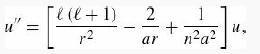
The Feynman–Hellmann theorem (Problem 7.38) can be used to determine the expectation values of 1/r and 1/r2 for hydrogen. The effective Hamiltonian for the radial wave functions is (Equation 4.53)and the eigenvalues (expressed in terms of ℓ) are (Equation 4.70)(a) Use λ = e in the
Prove Kramers’ relation:which relates the expectation values of r to three different powers (s,s-1, and s-2), for an electron in the state Ψnℓm of hydrogen. Rewrite the radial equation (Equation 4.53) in the formand use it to express ∫(ursun) dr in terms of (r3), (rs-1), and (rs-2). Then use
Calculate the wavelength, in centimeters, of the photon emitted under a hyperfine transition in the ground state (n = 1) of deuterium. Deuterium is “heavy” hydrogen, with an extra neutron in the nucleus; the proton and neutron bind together to form a deuteron, with spin 1 and magnetic
(a) Plug s = 0, s = 1, s = 2, and s = 3 into Kramers’ relation (Equation 7.113) to obtain formulas for (r-1), (r), (r2), and (r3). Note that you could continue indefinitely, to find any positive power.(b) In the other direction, however, you hit a snag. Put in s = -1, and show that all you get is
When an atom is placed in a uniform external electric field , the energy levels are shifted—a phenomenon known as the Stark effect (it is the electrical analog to the Zeeman effect). In this problem we analyze the Stark effect for the n = 1 and n = 2 states of hydrogen. Let the field point in the
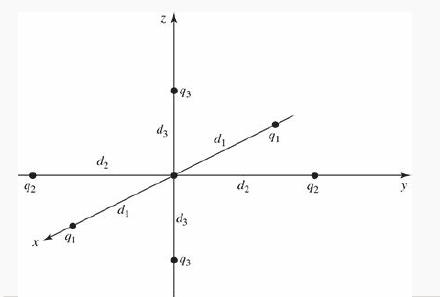
In a crystal, the electric field of neighboring ions perturbs the energy levels of an atom. As a crude model, imagine that a hydrogen atom is surrounded by three pairs of point charges, as shown in Figure 7.14. (Spin is irrelevant to this problem, so ignore it.)(a) Assuming that r << d1, r
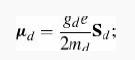
A hydrogen atom is placed in a uniform magnetic field B0 = B0 Ẑ (the Hamiltonian can be written as in Equation 4.230). Use the Feynman– Hellman theorem (Problem 7.38) to show thatwhere the electron’s magnetic dipole moment (orbital plus spin) isThe mechanical angular momentum is defined in
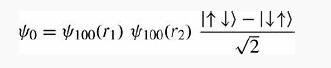
For an atom in a uniform magnetic field B0 = B0 Ẑ, Equation 4.230 giveswhere Lz and Sz refer to the total orbital and spin angular momentum of all the electrons.(a) Treating the terms involving B0 as a perturbation, compute the shift of the ground state energy of a helium atom to second order in
Sometimes it is possible to solve Equation 7.10 directly, without having to expand Ψ1n in terms of the unperturbed wave functions (Equation 7.11). Here are two particularly nice examples.(a) Stark effect in the ground state of hydrogen.(i) Find the first-order correction to the ground state of
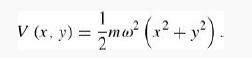
Consider a spinless particle of charge q and mass m constrained to move in the xy plane under the influence of the two-dimensional harmonic oscillator potential(a) Construct the ground state wave function, Ψ0(x,y), and write down its energy. Do the same for the (degenerate) first excited
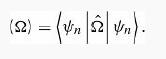
Suppose you want to calculate the expectation value of some observable Ω, in the nth energy eigenstate of a system that is perturbed by H':Replacing Ψn by its perturbation expansion, Equation 7.5,The first-order correction to (Ω) is thereforeor, using Equation 7.13,(assuming the unperturbed
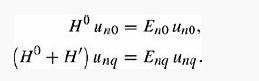
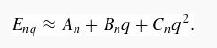
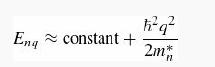
The Hamiltonian for the Bloch functions (Equation 6.12) can be analyzed with perturbation theory by defining H0 and H' such thatIn this problem, don’t assume anything about the form of V (x).(a) Determine the operators H0 and H (express them in terms of p̂).(b) Find Enq to second order in q.
Crandall’s Puzzle. Stationary states of the one-dimensional Schrödinger equation ordinarily respect three “rules of thumb”: (1) The energies are nondegenerate, (2) The ground state has no nodes, the first excited state has one node, the second has two, and so on, and (3) If
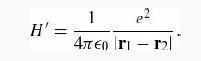
In this problem we treat the electron–electron repulsion term in the helium Hamiltonian (Equation 5.38) as a perturbation,(This will not be very accurate, because the perturbation is not small, in comparison to the Coulomb attraction of the nucleus …but it’s a start.)(a) Find the first-order
Using a trial function of your own devising, obtain an upper bound on the ground state energy for the “bouncing ball” potential (Equation 2.185), and compare it with the exact answer (problem 2.59): Egs = 2.33811 (mg²h²/2)1/3.
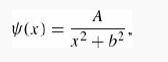
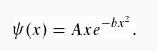
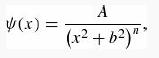
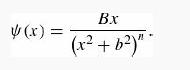
Find the best bound on Egs for the one-dimensional harmonic oscillator using a trial wave function of the form where A is determined by normalization and b is an adjustable parameter. V/(x) = A x² +6²
(a) Prove the following corollary to the variational principle: If (Ψ|Ψgs) = 0, then (H) ≥ Efe, where is the energy of the first excited state. Comment: If we can find a trial function that is orthogonal to the exact ground state, we can get an upper bound on the first excited state. In
Verify Equation 8.63 for the electron–proton potential energy. (-Arcan) = -2 (4700) 4π 2.4περα e² 1+D+21X 1±1²
Suppose we used a minus sign in our trial wave function (Equation 8.38):Without doing any new integrals, find F(x) (the analog to Equation 8.52) for this case, and construct the graph. Show that there is no evidence of bonding. (Since the variational principle only gives an upper bound, this
Using Egs = -79.0 eV for the ground state energy of helium, calculate the ionization energy (the energy required to remove just one electron).
Apply the techniques of this Section to the H − and Li+ ions (each has two electrons, like helium, but nuclear charges and Z = 1 and Z = 3, respectively). Find the effective (partially shielded) nuclear charge, and determine the best upper bound on Egs, for each case. Comment: In the case of H
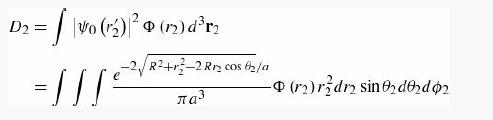
The two-body integrals D2 and χ2 are defined in Equations 8.65 and 8.66. To evaluate D2 we writewhere θ2 is the angle between R and r2 (Figure 8.8), and(a) Consider first the integral over r1. Align the z axis with r2 (which is a constant vector for the purposes of this first integral) so
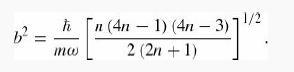
(a) Generalize Problem 8.2, using the trial wave function for arbitrary n.(b) Find the least upper bound on the first excited state of the harmonic oscillator using a trial function of the form(c) Notice that the bounds approach the exact energies as n → ∞ . Why is that? Plot the trial wave
The second derivative of F(x), at the equilibrium point, can be used to estimate the natural frequency of vibration (ω) of the two protons in the hydrogen molecule ion (see Section 2.3). If the ground state energy (ћω/2) of this oscillator exceeds the binding energy of the system, it will fly
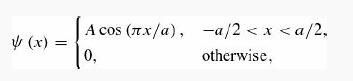
(a) Use a trial wave function of the formto obtain a bound on the ground state energy of the one-dimensional harmonic oscillator. What is the “best” value of a? Compare (H)min with the exact energy. Note: This trial function has a “kink” in it (a discontinuous derivative) at ±a/2; do you
Make a plot of the kinetic energy for both the singlet and triplet states of H2, as a function of R/a. Do the same for the electron-proton potential energy and for the electron–electron potential energy. You should find that the triplet state has lower potential energy than the singlet state for
If the photon had a nonzero mass (mϒ ≠ 0), the Coulomb potential would be replaced by the Yukawa potential,where μ = mϒc/ћ. With a trial wave function of your own devising, estimate the binding energy of a “hydrogen” atom with this potential. Assume μα << 1, and give your answer
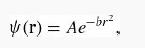
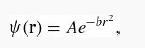
Find the lowest bound on the ground state of hydrogen you can get using a gaussian trial wave functionwhere A is determined by normalization and b is an adjustable parameter. (r) = Ae-br²,
(a) Use the function Ψ(x) = Ax (a-x) (for 0 < x < a, otherwise 0) to get an upper bound on the ground state of the infinite square well.(b) Generalize to a function of the form Ψ(x) = A[x (a-x)]P, for some real number p. What is the optimal value of p, and what is the best bound on the
Find an upper bound on the energy of the first excited state of the hydrogen atom. A trial function with ℓ = 1 will automatically be orthogonal to the ground state (see footnote 6); for the radial part of Ψ you can use the same function as in Problem 8.19.Data from in Problem 8.19.Find the
Suppose you’re given a two-level quantum system whose (time-independent) Hamiltonian H0 admits just two eigenstates, Ψa (with energy Ea), and Ψb (with energy Eb). They are orthogonal, normalized, and nondegenerate (assume Ea is the smaller of the two energies). Now we turn on a
As an explicit example of the method developed in Problem 8.22, consider an electron at rest in a uniform magnetic field B = Bzk̂, for which the Hamiltonian is (Equation 4.158):The eigenspinors, χa and χb, and the corresponding energies, Ea and Eb, are given in Equation 4.161. Now we turn on a
Although the Schrödinger equation for helium itself cannot be solved exactly, there exist “helium-like” systems that do admit exact solutions. A simple example is “rubber-band helium,” in which the Coulomb forces are replaced by Hooke’s law forces:(a) Show that the change of variables
In Problem 8.8 we found that the trial wave function with shielding (Equation 8.28), which worked well for helium, is inadequate to confirm the existence of a bound state for the negative hydrogen ion. Chandrasekhar used a trial wave function of the formwhereIn effect, he allowed two different
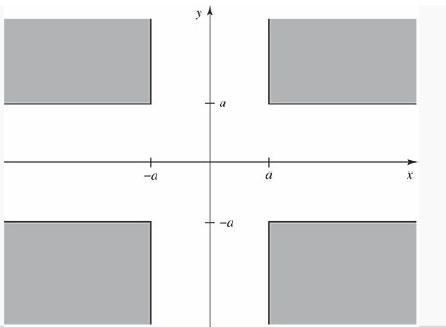
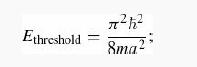
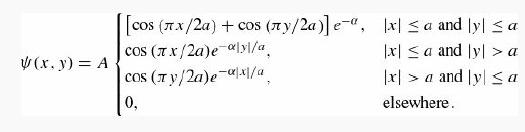
Consider a particle constrained to move in two dimensions in the cross-shaped region shown in Figure 8.10. The “arms” of the cross continue out to infinity. The potential is zero within the cross, and infinite in the shaded areas outside. Surprisingly, this configuration admits a
In Yukawa’s original theory (1934), which remains a useful approximation in nuclear physics, the “strong” force between protons and neutrons is mediated by the exchange of π-mesons. The potential energy iswhere r is the distance between the nucleons, and the range r0 is related to the
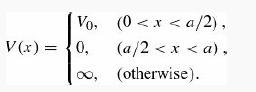
Use the WKB approximation to find the allowed energies (En) of an infinite square well with a “shelf,” of height V0, extending half-way across (Figure 7.3):Express your answer in terms of V0 and E0n Ξ (nπћ)2 /2ma2 (the nth allowed energy for the infinite square well with no shelf). Assume
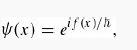
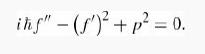
An alternative derivation of the WKB formula (Equation 9.10) is based on an expansion in powers of ћ. Motivated by the free-particle wave function, Ψ = A exp (±ipx/ћ), we writewhere f(x) is some complex function.(a) Put this into Schrödinger’s equation (in the form of Equation 9.1), and show
Performing a variational calculation requires finding the minimum of the energy, as a function of the variational parameters. This is, in general, a very hard problem. However, if we choose the form of our trial wave function judiciously, we can develop an efficient algorithm. In particular,
Existence of Bound States. A potential “well” (in one dimension) is a function V(x) that is never positive (V(x) ≤ 0 for all x), and goes to zero at infinity (V(x) → as x → ± ∞).(a) Prove the following Theorem: If a potential well V1(x) supports at least one bound state, then any
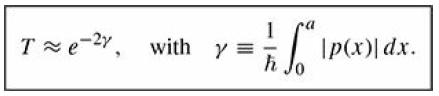
Use Equation 9.23 to calculate the approximate transmission probability for a particle of energy E that encounters a finite square barrier of height V0 > E and width 2α. Compare your answer with the exact result (Problem 2.33), to which it should reduce in the WKB regime T << 1.Equation
Calculate the lifetimes of U238 and Po212, using Equations 9.26 and 9.29.The energy of the emitted alpha particle can be deduced by using Einstein’s formula (E = mc2):where mp is the mass of the parent nucleus, md is the mass of the daughter nucleus, and m∝ is the mass of the alpha particle
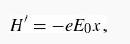
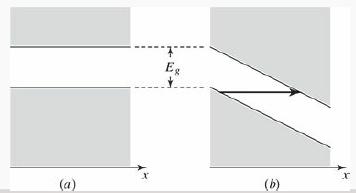
Zener Tunneling. In a semiconductor, an electric field (if it’s large enough) can produce transitions between energy bands—a phenomenon known as Zener tunneling. A uniform electric field E = -E0î,, for whichmakes the energy bands position dependent, as shown in Figure 9.7. It is then possible
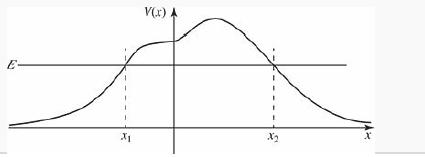
Use appropriate connection formulas to analyze the problem of scattering from a barrier with sloping walls (Figure 9.13).Do not assume C = 0. Calculate the tunneling probability, T = |F|2 / |A|2, and show that your result reduces to Equation 9.23 in the case of a broad, high barrier.Figure 9.13:
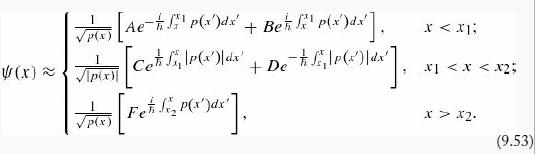
Derive the connection formulas at a downward-sloping turning point, and confirm Equation 9.51. y(x) ≈ D' √IP(x) exp[- 2D' p(x) fx¹ |p (x¹)|dx'], '+1]. sin [/ fx, p (x¹) dx' + x < x; x > X. (9.51)
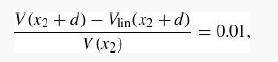
Consider a particle of mass m in the nth stationary state of the harmonic oscillator (angular frequency ω).(a) Find the turning point, x2.(b) How far could you go above the turning point before the error in the linearized potential (Equation 9.33, but with the turning point at x2) reaches 1%?
The “bouncing ball” revisited. Consider the quantum mechanical analog to the classical problem of a ball (mass m) bouncing elastically on the floor.(a) What is the potential energy, as a function of height x above the floor? (For negative x, the potential is infinite—the ball can’t get
Analyze the bouncing ball (Problem 9.6) using the WKB approximation.(a) Find the allowed energies, En, in terms of m, g, and ћ.(b) Now put in the particular values given in Problem 9.6(c), and compare the WKB approximation to the first four energies with the “exact” results.(c) About how large
Use the WKB approximation to find the allowed energies of the harmonic oscillator.
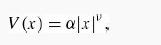
Use the WKB approximation to find the allowed energies of the general power-law potential:where ν is a positive number. Check your result for the case v = 2. V(x) = ax",
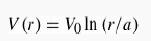
For spherically symmetrical potentials we can apply the WKB approximation to the radial part (Equation 4.37). In the case l = 0 it is reasonable to use Equation 9.48 in the formwhere r0 is the turning point (in effect, we treat r = 0 as an infinite wall). Exploit this formula to estimate the
Use the WKB approximation to find the bound state energy for the potential in Problem 2.52. Compare the exact m/ [(7/1) - (8/6)]- -
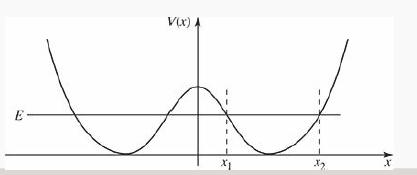
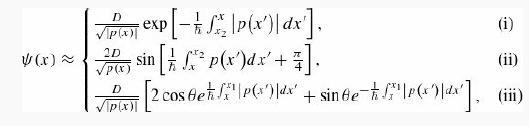
Consider the case of a symmetrical double well, such as the one pictured in Figure 9.14. We are interested in bound states with E < V(0).Figure 9.14: Symmetric double well; Problem 9.17.(a) Write down the WKB wave functions in regions (i) x > x2, (ii) x1 < x < x2, and (iii) 0 < x
Use the WKB approximation in the form of Equation 9.52,to estimate the bound state energies for hydrogen. Don’t forget the centrifugal term in the effective potential (Equation 4.38). The following integral may help:I put a prime on n', because there is no reason to suppose it corresponds to the
Construct the analogs to Equation 10.12 for one-dimensional and two-dimensional scattering. eikr v (r.0) ≈ A {eik² + ƒ(0)²¹hr}. for large r. (10.12)
About how long would it take for a (full) can of beer at room temperature to topple over spontaneously, as a result of quantum tunneling? Treat it as a uniform cylinder of mass m, radius R, and height h. As the can tips, let x be the height of the center above its equilibrium position (h/2). The
Prove Equation 10.33, starting with Equation 10.32. Σiº (20 + 1) [je(ka) + ik ach" (ka)] Pe(cos ) : = 0 8=0 (10.32)
An incident particle of charge q1 and kinetic energy E scatters off a heavy stationary particle of charge q2.(a) Derive the formula relating the impact parameter to the scattering angle.(b) Determine the differential scattering cross-section.(c) Show that the total cross-section for Rutherford
Tunneling in the Stark Effect. When you turn on an external electric field, the electron in an atom can, in principle, tunnel out, ionizing the atom. Question: Is this likely to happen in a typical Stark effect experiment? We can estimate the probability using a crude one-dimensional model, as
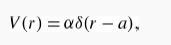
Consider the case of low-energy scattering from a spherical delta-function shell:where α and a are constants. Calculate the scattering amplitude, f(θ), the differential cross-section, D(θ), and the total cross-section, σ. Assume ka << 1, so that only the ℓ = 0 term contributes
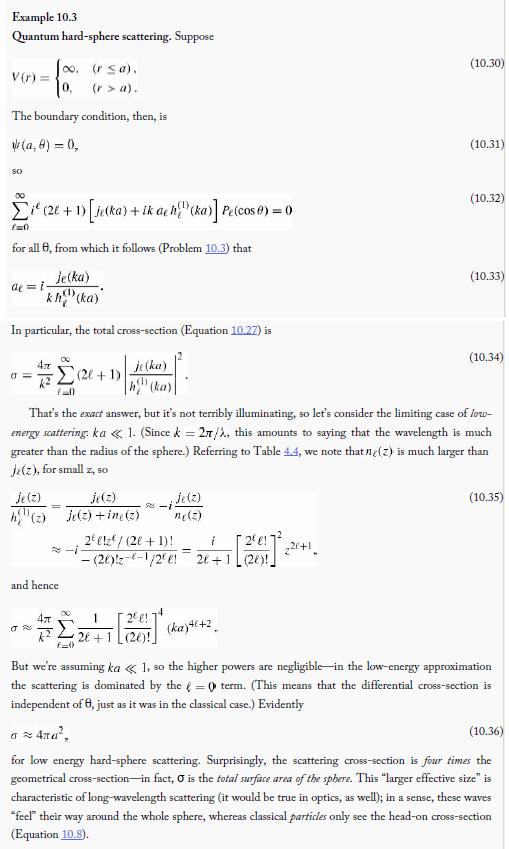
What are the partial wave phase shifts (δℓ) for hard-sphere scattering (Example 10.3)? Example 10.3 Quantum hard-sphere scattering. Suppose V(r) = [0, The boundary condition, then, is V (a. 8) = 0, SO 00 [i (20 + 1) [je(ka) + ik ach() (ka)] Pecos 0) = 0 8=0 [∞o. (rsa). (r>a). for all 8, from
Check that Equation 10.65 satisfies Equation 10.52, by direct substitution. (²+k²) G(r) = 8³ (r). (10.52)
Find the S-wave (ℓ= 0) partial wave phase shift δ0(k) for scattering from a delta-function shell (Problem 10.4). Assume that the radial wave function u(r) goes to 0 as r → 0. o₁¹ [cott - cot cot(ka) + ka (ka)]. B sin² (ka). where = 2maa
Show that the ground state of hydrogen (Equation 4.80) satisfies the integral form of the Schrödinger equation, for the appropriate V and E (note that E is negative, so k = ik, where k Ξ √-2mE/ћ). V100 (1, 0, 0) = ser/a Υπαξ (4.80)
Find the scattering amplitude, in the Born approximation, for soft-sphere scattering at arbitrary energy. Show that your formula reduces to Equation 10.82 in the low-energy limit. f(0, 0) ~ m 2лh² Vo 413 (10.82)
Evaluate the integral in Equation 10.91, to confirm the expression on the right. 2mß 5)-2018 12 f(0) e-pr sin(kr) dr = 2mB 1² (μ² +K²) (10.91)
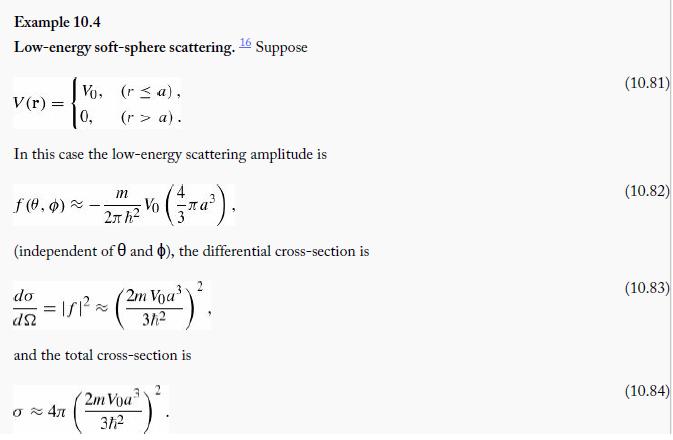
For the potential in Problem 10.4,(a) calculate f(θ), D(θ), and σ, in the low-energy Born approximation;(b) calculate f(θ) for arbitrary energies, in the Born approximation;(c) show that your results are consistent with the answer to Problem 10.4, in the appropriate regime. Example
Find the scattering amplitude for low-energy soft-sphere scattering in the second Born approximation. - (2m Voa³/3h²) [1 − (4m Voa²/5k²)].
Calculate the total cross-section for scattering from a Yukawa potential, in the Born approximation. Express your answer as a function of E.
Use your result in Problem 10.16 to develop the Born approximation for one-dimensional scattering (on the interval -∞ < x < ∞, with no “brick wall” at the origin). That is, choose Ψ0(x) = Aeikr, and assume Ψ(x0) ≈ Ψ0(x0) to evaluate the integral. Show that the reflection
Calculate θ (as a function of the impact parameter) for Rutherford scattering, in the impulse approximation. Show that your result is consistent with the exact expression (Problem 10.1(a)), in the appropriate limit.Problem 10.1(a)(a) Derive the formula relating the impact parameter to the
Find the Green’s function for the one-dimensional Schrödinger equation, and use it to construct the integral form (analogous to Equation 10.66). V(x) = Vo(x) - im 1 Love eiklx-xol V (xo)(xo) dxo. h²k (10.102)
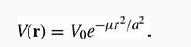
Use the Born approximation to determine the total cross-section for scattering from a gaussian potentialExpress your answer in terms of the constants V0, a, and m (the mass of the incident particle), and k Ξ √2mE/ћ, where E is the incident energy. V(r) = Voe-ur²la²
Use the one-dimensional Born approximation (Problem 10.17) to compute the transmission coefficient (T = 1-R) for scattering from a delta function (Equation 2.117) and from a finite square well (Equation 2.148). Compare your results with the exact answers (Equations 2.144 and 2.172).Problem 10.17Use
Prove the optical theorem, which relates the total cross-section to the imaginary part of the forward scattering amplitude:Use Equations 10.47 and 10.48. J= -Im [ƒ(0)]. 47 k (10.104)
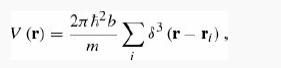
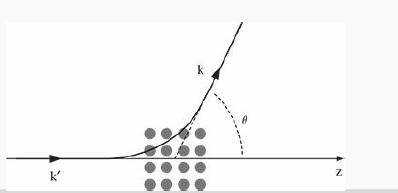
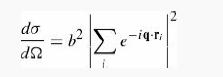
Neutron diffraction. Consider a beam of neutrons scattering from a crystal (Figure 10.14). The interaction between neutrons and the nuclei in the crystal is short ranged, and can be approximated aswhere the ri are the locations of the nuclei and the strength of the potential is expressed in terms
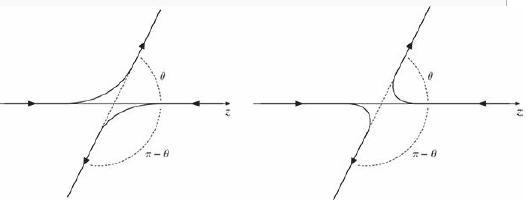
Scattering of identical particles. The results for scattering of a particle from a fixed target also apply to the scattering of two particles in the center of mass frame. With Ψ(R,r) = ΨR (R) Ψr (r), Ψr (r) satisfies(see Problem 5.1) where V(r) is the interaction between the particles (assumed
Two-dimensional scattering theory. By analogy with Section 10.2, develop partial wave analysis for two dimensions.(a) In polar coordinates (r,θ) the Laplacian isFind the separable solutions to the (time-independent) Schrödinger equation, for a potential with azimuthal symmetry (V(r,θ) →
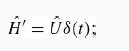
Suppose the perturbation takes the form of a delta function (in time):assume that Uaa = Ubb = 0, and let Uab = U*ba Ξ α. If ca (-∞) = 1 and cb (-∞) = 0, find ca(t) and cb(t), and check that |ca(t)|2 + |cb(t)|2 = 1. What is the net probability (Pa→b for t → ∞) that a
Solve Equation 11.17 for the case of a time-independent perturbation, assuming that ca (0) = 1 and cb(0) = 0. Check that |ca(t)|2 + |cb(t)|2 = 1. Comment: Ostensibly, this system oscillates between “pure Ψa ” and “some Ψb.” Doesn’t this contradict my general assertion that no
Suppose you don’t assume H'aa = H'bb = 0(a) Find Ca(t) and Cb(t) in first-order perturbation theory, for the case Ca(0) = 1 Cb(0) = 0. show that |Ca(1)(t)|2 + |Cb(1)(t)|2 = 1, to first order in Ĥ'.(b) There is a nicer way to handle this problem. LetShow thatwhereSo the equations for and
A hydrogen atom is placed in a (time-dependent) electric field E = E(t)k̂. Calculate all four matrix elements H'ij of the perturbation Ĥ' = eEz between the ground state (n = 1) and the (quadruply degenerate) first excited states (n = 2). Also show that H'ij = 0 for all five states.
Showing 100 - 200
of 418
1
2
3
4
5
Step by Step Answers

 Get 50% OFF
Claim Now
Get 50% OFF
Claim Now