New Semester
Started
Get
50% OFF
Study Help!
--h --m --s
Claim Now
Question Answers
Textbooks
Find textbooks, questions and answers
Oops, something went wrong!
Change your search query and then try again
S
Books
FREE
Study Help
Expert Questions
Accounting
General Management
Mathematics
Finance
Organizational Behaviour
Law
Physics
Operating System
Management Leadership
Sociology
Programming
Marketing
Database
Computer Network
Economics
Textbooks Solutions
Accounting
Managerial Accounting
Management Leadership
Cost Accounting
Statistics
Business Law
Corporate Finance
Finance
Economics
Auditing
Tutors
Online Tutors
Find a Tutor
Hire a Tutor
Become a Tutor
AI Tutor
AI Study Planner
NEW
Sell Books
Search
Search
Sign In
Register
study help
mathematics
a first course in abstract algebra
A First Course In Abstract Algebra 7th Edition John Fraleigh - Solutions
Give an example in M2(Z) showing that matrix multiplication is not commutative.
Show that {1, y,· · ·, yp-¹} is a basis for Zp(y) over Zp(yp), where y is an indeterminate. Referring to Example 51.4, conclude by a degree argument that xp -t is irreducible over Zp(t), where t = yp.Data from in Example 51.4Let E = Zp(y), where y is an indeterminate. Let t = yP, and let F be
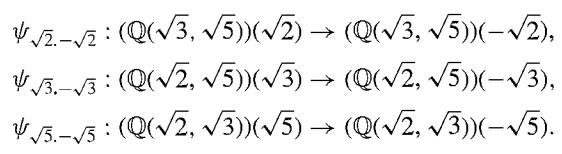
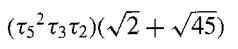
We consider the field E = Q(√2, √3, √5). It can be shown that [E : Q] = 8. In the notation of Theorem 48.3, we have the following conjugation isomorphisms (which are here automorphisms of E):For shorter notation, let τ2 = ψ√2.-√2, τ3 = ψ√3 -√3, and , τ5 = ψ√5.-√5· Compute
Prove that if E is an algebraic extension of a perfect field F, then E is perfect.
Prove that if E is an algebraic extension of a field F, then two algebraic closures F̅ and E̅ of F and E, respectively, are isomorphic.
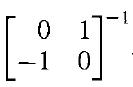
Find by experimentation if necessary. -1 0 [오] -1
Show that every finite group is isomorphic to some Galois group G(K/F) for some finite normal extension K of some field F.
Find the cyclotomic polynomial Φn(x) over Q for n = 1, 2, 3, 4, 5, and 6.
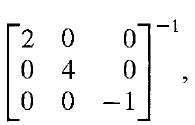
Findby experimentation if necessary. 20 04 。。 0 – 1 - 1
Let F ≤ E ≤ F̅ where F̅ is an algebraic closure of a field F. The field E is a splitting field over F if and onlyif E contains all the zeros in F̅ of every polynomial in F[x] that has a zero in E.
A (possibly infinite) algebraic extension E of a field F is a separable extension of F if for every α ∈ E, F(α)is a separable extension of F, in the sense defined in the text. Show that if E is a (possibly infinite) separableextension of F and K is a (possibly infinite) separable extension of
Prove that the algebraic closure of Q(√π) in C is isomorphic to any algebraic closure of Q̅(x), where Q̅ is the field of algebraic numbers and x is an indeterminate.
Describe the group of the polynomial (x4 - 5x2 + 6) ∈ Q[x] over Q.
Find Φ12(x) in Q[x].
A polynomial f(x) in F[x] splits in an extension field E of F if and only if it factors in E[x] into a product of polynomials of lower degree.
We consider the field E = Q(√2, √3, √5). It can be shown that [E : Q] = 8. In the notation of Theorem 48.3, we have the following conjugation isomorphisms (which are here automorphisms of E):For shorter notation, let τ2 = ψ√2.-√2, τ3 = ψ√3 -√3, and , τ5 = ψ√5.-√5· Compute
Let E be an algebraic extension of a field F. Show that the set of all elements in E that are separable over F forms a subfield of E, the separable closure of F in E.
Prove that if E is a finite extension of a field F, then {E : F} ≤ [E : F].
We consider the field E = Q(√2, √3, √5). It can be shown that [E : Q] = 8. In the notation of Theorem 48.3, we have the following conjugation isomorphisms (which are here automorphisms of E):For shorter notation, let τ2 = ψ√2.-√2, τ3 = ψ√3 -√3, and , τ5 = ψ√5.-√5· Compute
Describe the group of the polynomial (x3 - 1) ∈ Q[x] over Q.
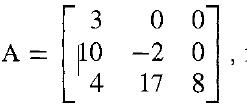
If find det (A). 3 A = 10 4 00 -2 0 17 8 3
An element of C is an algebraic integer if it is a zero of some monic polynomial in Z[x]. Show that the set of all algebraic integers forms a subring of C.
Show that in Q[x], Φ2n(x) = ΦLet n, m E z+ be relatively prime.
Let f(x) be a polynomial in F[x] of degree n. Let E ≤ F be the splitting field of f(x) over F in F̅. Whatbounds can be put on [E : F]?
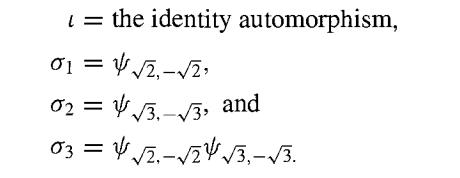
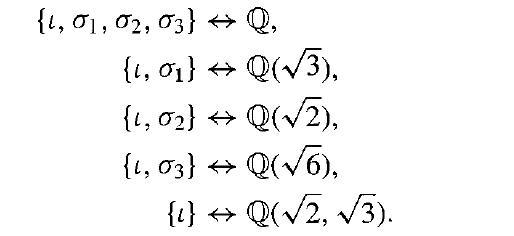
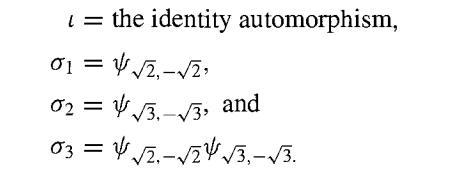
Referring to Example 48.17, find the following fixed fields in E = Q(√2, √3).a. E{σ1.σ3}b. E{σ3}c. E{σ2.σ3}Data from in Example 48.17Consider the field Q(√2, √3). Example 31.9 shows that [Q(√2, √3) : Q] = 4. If we view Q(√2, √3) as (Q(√3))(√2), the conjugation isomorphism
Let E be a finite field of order pn.a. Show that the Frobenius automorphism σp has order n.b. Deduce from part (a) that G(E/Zp) is cyclic of order n with generator σp.
Give an example of two finite normal extensions K1 and K2 of the same field F such that K1 and K2 are not isomorphic fields but G(K1/ F) ≈ G(K2/F).
Let n, m ∈ Z+ be relatively prime. Show that the splitting field in C of xnm - 1 over Q is the same as the splitting field in C of (xn - 1)(xm - 1) over Q.
Mark each of the following true or false.___ a. Let α, β ∈ E, where E ≤ F is a splitting field over F. Then there exists an automorphism of E leaving F fixed and mapping a onto β if and only if irr(α, F) = irr(β, F).___ b. R is a splitting field over Q.___c. R is a splitting field over
Prove that if A, B ∈ Mn(C) are invertible, then AB and BA are invertible also.
Introduce formal derivatives in F[x]. Let F be any field and let f(x) = a0 + a1x +· · ·aixi · · ·anxn The derivatives of f'(x) is the polynomial f(x) = a0 + a1 +· · ·(i .1)aixi-1 +· · ·(n .1)anxn-1 , where i . 1 has its usual meaning for i ∈ Z+ and 1 ∈ F. These are formal
Mark each of the following true or false.___ a. Two different subgroups of a Galois group may have the same fixed field.___ b. In the notation of Theorem 53.6, if F ≤ E < L ≤ K, then λ(E) < λ(L).___ c. If K is a finite normal extension of F, then K is a normal extension of E, where F
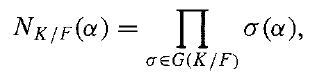
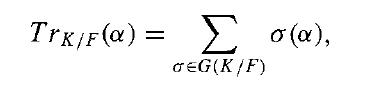
Let K be a finite normal extension of a field F. Prove that for every α ∈ K, the norm of α over F, given byand the trace of α over F, given byare elements of F. Nx/F(a) = Π σ(α), σεG(K/F)
Show by an example that Corollary 50.6 is no longer true if the word irreducible is deleted.Data from Corollary 50.6 CorollaryIf E< F̅ is a splitting field over F, then every irreducible polynomial in F[x] having a zero in E splits in E.Proof If E is a splitting field over F in F̅, then
Introduce formal derivatives in F[x].Continuing the ideas of Exercise 15, shows that:a. D(af(x)) = aD(f(x)) for all f(x) ∈ F[x] and a ∈ F.b. D(f(x)g(x)) = f(x)g'(x) + ƒ'(x)g(x) for all f(x), g(x) ∈ F[x]. c. D((ƒ(x))m) = (m · 1) ƒ (x)m−¹ ƒ'(x) for all f(x) ∈ F[x]. Data from
A finite normal extension K of a field F is abelian over F if G(K/F) is an abelian group. Show that if K is abelian over F and p is a normal extension of F, where F ≤ E ≤ K, then K is abelian over E and E is abelian over F.
Find the fixed field of the automorphism or set of automorphisms of E.τ3
a. Is |G(E/F)| multiplicative for finite towers of finite extensions, that is, is |G(E/F)| = |G(K/E)||G(E/F)| for F ≤ E ≤ K ≤ F?Why or why not? b. Is G(E/F)| multiplicative for finite towers of finite extensions, each of which is a splitting field over the bottom field? Why or why not?
Consider K = Q(√2, √3). Referring to Exercise 17, compute each of the following (see Example 53.3).a. Nk/Q(√2)b. NK/Q(√2 +√3) c. NK/Q(√6)d. NK/Q(2)e. Trk/Q(√2)f. Trk/Q(√2 + √3)g. TrK/Q(√6) h. Trk/Q(2)Data from Exercise 17Let K be a finite normal extension of a field
Let ƒ(x) ∈ F[x], and let a ∈ F̅ be a zero of f(x) of multiplicity v. Show that v > 1 if and only if α is also azero of f'(x).
Show that if a finite extension E of a field F is a splitting field over F, then E is a splitting field of one polynomial in F[x].
Find the fixed field of the automorphism or set of automorphisms of E.τ32
Show from Exercise 17 that every irreducible polynomial over a field F of characteristic 0 is separable.Data from Exercise 17Let ƒ(x) ∈ F[x], and let a ∈ F̅ be a zero of f(x) of multiplicity v. Show that v > 1 if and only if α is also a zero of f'(x).
Find the fixed field of the automorphism or set of automorphisms of E.{τ2, τ3}
Show that if [E : F] = 2, then E is a splitting field over F.
Let K be a normal extension of F, and let K = F(α). Letirr(α, F)=xn+an-1xn-1 +· · · + a1x + a0.Referring to Exercise 17, show thatNk/F(α) = (−1)na0, Trk/F(α) = -an−1.
Show from Exercise 17 that an irreducible polynomial q(x) over a field F of characteristic p ≠ 0 is not separable if and only if each exponent of each term of q(x) is divisible by p.Data from Exercise 17Let ƒ(x) ∈ F[x], and let a ∈ F̅ be a zero of f(x) of multiplicity v. Show that v > 1
Find the fixed field of the automorphism or set of automorphisms of E.τ5τ2
Show that for F ≤ E ≤ F, E is a splitting field over F̅ if and only if E contains all conjugates over F in F̅ for each of its elements.
Let f (x) ∈ F[x] be a polynomial of degree n such that each irreducible factor is separable over F. Show that the order of the group of f(x) over F divides n !.
Generalize Exercise 17, showing that f(x) ∈ F[x] has no zero of multiplicity >1 if and only if f(x) and f'(x)have no common factor in F̅[x] of degree >0.Data from Exercise 17Let ƒ(x) ∈ F[x], and let a ∈ F̅ be a zero of f(x) of multiplicity v. Show that v > 1 if and only if α is
Find the fixed field of the automorphism or set of automorphisms of E.τ5τ3τ2
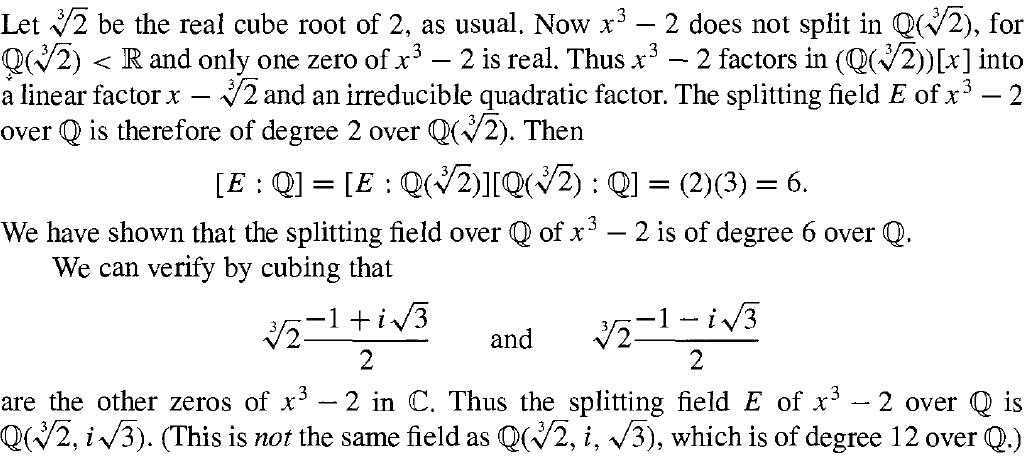
Referring to Example 50.9, show that G(Q(3√2, i√3)/Q(i√3)) ≈ (Z3, +).Data from in Example 50.9 - Let 2 be the real cube root of 2, as usual. Now x³ 2 does not split in Q(V2), for Q(³2) < R and only one zero of x³ - 2 is real. Thus x³ - 2 factors in (Q(2)) [x] into a linear factor x 2
Show that Q(3√2) has only the identity automorphism.
a. Show that each of the automorphisms τ2, τ3 and τ5 is of order 2 in G(E/Q).b. Find the subgroup H of G(E/Q) generated by the elements , τ2, τ3 and τ5, and give the group table. c. Just as was done in Example 48.17, argue that the group H of part (b) is the full group G(E/Q).Data from
Let f(x) ∈ F[x] be a polynomial such that every irreducible factor of f(x) is a separable polynomial over F. Show that the group of f(x) over F can be viewed in a natural way as a group of permutations of the zeros of f(x) in F.
Working a bit harder than in Exercise 20, show that f (x) ∈ F[x] has no zero of multiplicity > 1 if and only if f(x) and f'(x) have no common nonconstant factor in F[x].
Find the fixed field of the automorphism or set of automorphisms of E.{τ2, τ3, τ5}
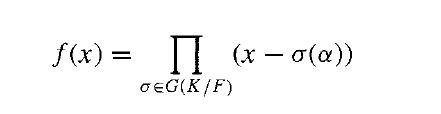
Let K be a finite normal extension of F.a. For a ∈ K, show thatis in F[x]b. Referring to part (a), show that f(x) is a power of irr(α, F), and f(x) = irr(α, F) if and only if K = F(α). f(x) = Π (-σ(α)) σεG(K/F)
Let F be a field and let ζ be a primitive nth root of unity in F, where the characteristic of F is either 0 or does not divide n.a. Show that F(ζ) is a normal extension of F.b. Show that G(F(ζ/F) is abelian.
Describe a feasible computational procedure for determining whether f (x) ∈ F[x] has a zero of multiplicity > 1, without actually finding the zeros of f(x).
a. Show that automorphismof a splitting field E over F of a polynomial f(x) ∈ F[x] permutes the zeroso. b. Show that an automorphism of a splitting field E over F of a polynomial f(x) = ∈ F[x] is completely determined by the permutation of the zeros of f(x) in E given in part (a). c.
A finite normal extension K of a field F is cyclic over F if G(K/F) is a cyclic group.a. Show that if K is cyclic over F and E is a normal extension of F, where F ≤ E ≤ K, then E is cyclic over F and K is cyclic over E.b. Show that if K is cyclic over F, then there exists exactly one field E, F
Correct the definition of the italicized term without reference to the text, if correction is needed, so that it is in a form acceptable for publication.Two elements, α and β, of an algebraic extension E of a field F are conjugate over F if and only if they are both zeros of the same polynomial
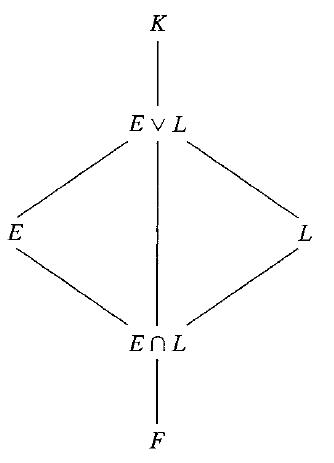
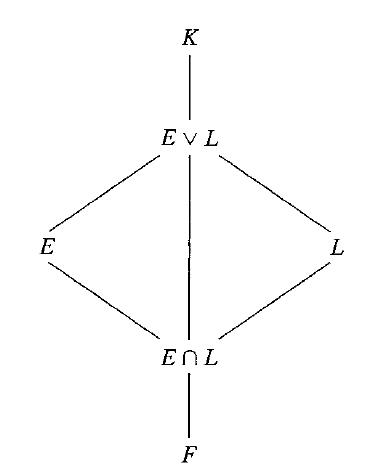
The join E v L of two extension fields E and L of F in F̅ is the smallest subfield of F̅ containing both Eand L. That is, E v L is the intersection of all subfields of F̅ containing both E and L. Let K be a finite normalextension of a field F, and let E and L be extensions of F contained in K as
Let E be the splitting field of x³ - 2 over Q, as in Example 50.9.a. What is the order of G(E/Q)? b. Show that G(E/Q) = S3, the symmetric group on three letters.
With reference to the situation in Exercise 25, describe G{K/(E n L)} in terms of G(K/ E) and G(K/L).Data from Exercise 25The join E v L of two extension fields E and L of F in F̅ is the smallest subfield of F̅ containing both E and L. That is, E v L is the intersection of all subfields of F̅
Correct the definition of the italicized term without reference to the text, if correction is needed, so that it is in a form acceptable for publication.Two elements, α and β, of an algebraic extension E of a field F are conjugate over F if and only if the evaluation homomorphisms ∅α : F[x]
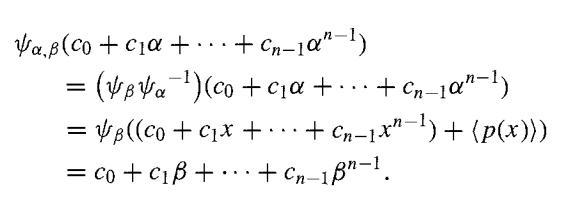
Give a one-sentence synopsis of the "if" part of Theorem 48.3.Data from Theorem 48.3Let F be a field, and let α and β be algebraic over F with deg(α, F) = n. The map ψα.β :F(α) → F(β) defined by ψα.β(c0 + ciα +· · ·+ Cn-1αn-¹) = c0 + c1β + · · ·+ Cn-1βn-1 for
Show that for a prime p, the splitting field over Q of xP - 1 is of degree p - 1 over Q.
The fields Q(√2) and Q(3+√2) are the same, of course. Let α = 3 + √2.a. Find a conjugate β ≠ α of α over Q.b. Referring to part (a), compare the conjugation automorphism ψ√2,-√2 of Q(√2) with the conjugation automorphism ψα.β.
Let F and F̅ ' be two algebraic closures of a field F, and let f(x) ∈ F[x]. Show that the splitting field E overF of f(x) in F̅ is isomorphic to the splitting field E' over F of f(x) in F̅ '.
Give a one-sentence synopsis of the "only if' part of Theorem 48.3. Data from Theorem 48.3:Let F be a field, and let α and β be algebraic over F with deg(α, F) = n. The map ψα.β :F(α) → F(β) defined byfor ci ∈ F is an isomorphism of F(α) onto F(β) if and only if a and are
Describe the value of the Frobenius automorphism σ2 on each element of the finite field of four elements given in Example 29.19. Find the fixed field of σ2.Data from in Example 29.19The polynomial p(x) = x² + x + 1 in Z2[x] is irreducible over Z2 by Theorem 23.10, since neither element 0 nor
We saw in Corollary 23 .17 that the cyclotomic polynomial s irreducible over Q for every prime p. Let ζ be a zero of ∅p(x), and consider the field Q(ζ).a. Show that ζ, ζ2 , · · · , ζp-1 are distinct zeros of ∅p(x), and conclude that they are all the zeros of ∅p(x).b. Deduce
Describe the value of the Frobenius automorphism σ3 on each element of the finite field of nine elements given in Exercise 18 of Section 29. Find the fixed field of σ3.Data from Exercise 18 Section 29Show that the polynomial x2 + 1 is irreducible in Z3[x]. Let a be a zero of x2 + 1 in an
Theorem 48.3 described conjugation isomorphisms for the case where a and β were conjugate algebraic elements over F. Is there a similar isomorphism of F(α) with F(β) in the case that a and β are both transcendental over F?Data from Theorem 48.3Let F be a field, and let α and β be algebraic
Let F be a field of characteristic p ≠ 0. Give an example to show that the map σP : F → F given by σP(α) = aP for a ∈ F need not be an automorphism in the case that Fis infinite. What may go wrong?
Mark each of the following true or false. ___ a. For all α, β ∈ E, there is always an automorphism of E mapping α onto β. ___ b. For α, β algebraic over a field F, there is always an isomorphism of F(α) onto F(β). ___ c. For α, β algebraic and conjugate over a field F,
Let a be algebraic of degree n over F. Show from Corollary 48 .5 that there are at most n different isomorphisms of F(α) onto a subfield of F and leaving F fixed.Data from Corollary 48.5Let α be algebraic over a field F. Every isomorphism ψ mapping F(α) onto a subfieldof F̅ such that ψ(a) = a
Let F(α1, · · ·,αn) be an extension field of F. Show that any automorphism σ of F(α1, · · ·,αn) leaving F fixed is completely determined by then values σ(αi).
Let E be an algebraic extension of a field F, and let σ be an automorphism of E leaving F fixed. Let α ∈ E. Show that σ induces a permutation of the set of all zeros of irr(α, F) that are in E.
Let E be an algebraic extension of a field F. Let S = {σi |i ∈ I} be a collection of automorphisms of E such that every σi leaves each element of F fixed. Show that if S generates the subgroup H of G(E/F), then Es= EH.
Let F be a field, and let x be an indeterminate over F. Determine all automorphisms of F(x) leaving F fixed, by describing their values on x.
Prove the following sequence of theorems. a. An automorphism of a field E carries elements that are squares of elements in E onto elements that are squares of elements of E. b. An automorphism of the field R of real numbers carries positive numbers onto positive numbers. c. If σ is
After working Exercise 21, write down eight matrices that form a group under matrix multiplication that is isomorphic to D4.Data from Exercise 21 Verify that the six matrices form a group under matrix multiplication. What group discussed in this section is isomorphic to this group of six
Let R be an ordered ring. Describe the order ring of a positive element a of R and the monomials x, x2, x3 , · · ·, xn. · · · in R[x] as we did in Example 25.6, but using the set Phigh of Example 25.6 as set of positive elements of R[x].Data from in Example 25.6Let R be an ordered ring. It is
In Exercise let R[x] have the ordering given by i. Plow ii. PHigh as described in Example 25.2. In each case (i) and (ii), list the labels a, b, c, d, e of the given polynomials in an order corresponding to increasing order of the polynomials as described by the
Prove Part 7 of Step 3. You may assume any preceding part of Step 3.
Following the idea of Exercise 31, show that there exists a field of 8 elements; of 16 elements; of 25 elements.Data from Exercise 31Show that there exists an irreducible polynomial of degree 3 in Z3[x]. Show from part (a) that there exists a finite field of 27 elements.
Show, using Exercise 13, that (a, b: a3 = 1 b2 = 1, ba = a2b) gives a group of order 6. Show that it is nonabelian.Data from Exercise 13Let S = {aibj|0 ≤ i < m, 0 ≤ j < n}, that is, S consists of all formal products aibj starting with a0b0 and ending with am-1bn-1. Let r be a
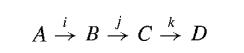
Let A, B, C, and D be additive groups and let be an exact sequence. Show that the following three conditions are equivalent: A B CAD в
Find the Euler characteristic of a 2-sphere with n handles.
Following the ideas of Exercises 7 and 8, prove that ∂2 = 0 in general, i.e., that ∂n-1 (∂n(c)) = 0 for every c ∈ Cn(X), where n may be greater than 3.Data from Exercise 7Define the following concepts so as to generalize naturally the definitions in the text given for dimensions 0. 1, 2,
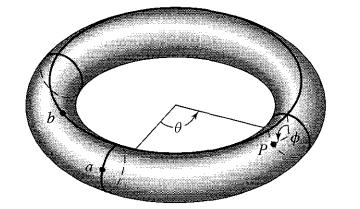
Every point P on a regular torus X can be described by means of two angles θ and ∅, as shown in Fig. 43.16. That is, we can associate coordinates (θ, ∅) with P. For each of the mappings f of the torus X onto itself given below, describe the induced map f*n of Hn(X) into Hn(X) for n = 0, 1,
State whether the given function ν is a Euclidean norm for the given integral domain.The function v for Z given by ν(n) = n2 for nonzero n ∈ Z
Determine whether the element is an irreducible of the indicated domain.5 in Z
Factor the Gaussian integer into a product of irreducibles in Z[i].5
State whether the given function ν is a Euclidean norm for the given integral domain.The function ν for Z[x] given by ν(f(x)) = (degree of f(x)) for f(x) ∈ Z[x], f(x) ≠ 0
Determine whether the element is an irreducible of the indicated domain.-17 in Z
Showing 100 - 200
of 1629
1
2
3
4
5
6
7
8
9
10
11
12
13
14
15
Last
Step by Step Answers

 Get 50% OFF
Claim Now
Get 50% OFF
Claim Now