New Semester
Started
Get
50% OFF
Study Help!
--h --m --s
Claim Now
Question Answers
Textbooks
Find textbooks, questions and answers
Oops, something went wrong!
Change your search query and then try again
S
Books
FREE
Study Help
Expert Questions
Accounting
General Management
Mathematics
Finance
Organizational Behaviour
Law
Physics
Operating System
Management Leadership
Sociology
Programming
Marketing
Database
Computer Network
Economics
Textbooks Solutions
Accounting
Managerial Accounting
Management Leadership
Cost Accounting
Statistics
Business Law
Corporate Finance
Finance
Economics
Auditing
Tutors
Online Tutors
Find a Tutor
Hire a Tutor
Become a Tutor
AI Tutor
AI Study Planner
NEW
Sell Books
Search
Search
Sign In
Register
study help
mathematics
calculus early transcendentals 9th
Calculus Early Transcendentals 9th Edition James Stewart, Daniel K. Clegg, Saleem Watson, Lothar Redlin - Solutions
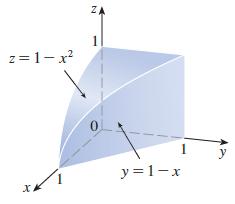
The figure shows the region of integration for the integralRewrite this integral as an equivalent iterated integral in the five other orders. C1-x2 (1-x (x, y, z) dy dz dx
Find the volume of the given solid.One of the wedges cut from the cylinder x2 + 9y2 = a2 by the planes z = 0 and z = mx
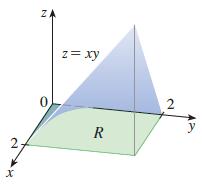
The figure shows a surface and a rectangle R in the xy-plane.(a) Set up an iterated integral for the volume of the solid that lies under the surface and above R.(b) Evaluate the iterated integral to find the volume of the solid. ZA z= xy y R 2
Use a computer algebra system to graph the surface z = x sin y, –3 ≤ x ≤ 3, –π ≤ y ≤ π, and find its surface area correct to four decimal places.
Use cylindrical or spherical coordinates, whichever seems more appropriate.(a) Find the volume enclosed by the torus ρ = sin Φ.(b) Use graphing software to draw the torus.
Use a graph to estimate the x-coordinates of the points of intersection of the curves y = x4 and y = 3x – x2. If D is the region bounded by these curves, estimate ∫∫D x dA.
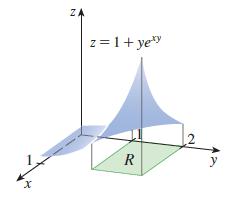
The figure shows a surface and a rectangle R in the xy-plane.(a) Set up an iterated integral for the volume of the solid that lies under the surface and above R.(b) Evaluate the iterated integral to find the volume of the solid. ZA z=1+ ye" R y
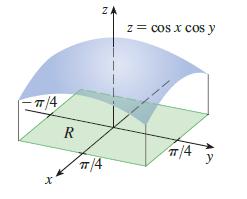
The figure shows a surface and a rectangle R in the xy-plane.(a) Set up an iterated integral for the volume of the solid that lies under the surface and above R.(b) Evaluate the iterated integral to find the volume of the solid. z= cos x cos y - T /4 R T/4 T/4
Find the volume of the given solid.Bounded by the cylinder x2 + y2 = 1 and the planes y = z, x = 0, z = 0 in the first octant
A model for the density δ of the earth’s atmosphere near its surface isδ = 619.09 − 0.000097ρwhere ρ (the distance from the center of the earth) is measured in meters and δ is measured in kilograms per cubic meter. If we take the surface of the earth to be a sphere with radius 6370 km,
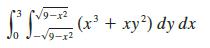
Use polar coordinates to evaluate /9-x2 (x' + xy?) dy dx -V9-x2
The latitude and longitude of a point P in the Northern Hemisphere are related to spherical coordinates ρ, θ, Φ as follows. We take the origin to be the center of the earth and the positive z-axis to pass through the North Pole. The positive x-axis passes through the point where the prime
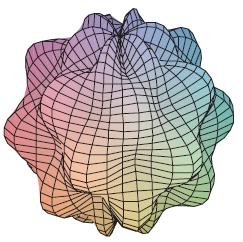
The surfaces ρ = 1 + 1/5 sin mθ sin nΦ have been used as models for tumors. The “bumpy sphere” with m = 6 and n = 5 is shown. Use a computer algebra system to find the volume it encloses.
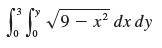
Sketch the solid whose volume is given by the iterated integral. V9 – x dx dy
Assume that the solid has constant density k.Find the moment of inertia about the z-axis of the solid cylinder x2 + y2 ≤ a2, 0 ≤ z ≤ h.
Use a computer algebra system to find the center of mass of the solid tetrahedron with vertices (0, 0, 0), (1, 0, 0), (0, 2, 0), (0, 0, 3) and density function ρ(x, y, z) = x2 + y2 + z2.
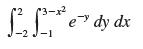
Sketch the solid whose volume is given by the iterated integral. 3-x2 あ e dy dx -1
Assume that the solid has constant density k.Find the moment of inertia about the z-axis of the solid cone √x2 + y2 ≤ z ≤ h.
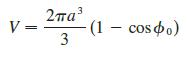
(a) Use cylindrical coordinates to show that the volume of the solid bounded above by the sphere r2 + z2 = a2 and below by the cone z = r cot Φ0 (or Φ = Φ0), where 0 < Φ0 < π/2, is(b) Deduce that the volume of the spherical wedge given by ρ1 ≤ ρ ≤ ρ2, θ1 ≤ θ ≤ θ2, Φ1 ≤
Use a computer algebra system to find the exact volume of the solid.Enclosed by z = 1 – x2 – y2 and z = 0
Use a computer algebra system to compute the iterated integralsDo the answers contradict Fubini’s Theorem? Explain what is happening. i I x - y x - y dx dy Jo Jo (x + y) and o Jo (x + y) dy dx
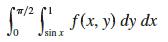
Sketch the region of integration and change the order of integration. w/2 f(x, y) dy dx Jo sin x
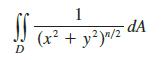
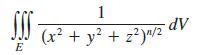
(a) Evaluatewhere n is an integer and D is the region bounded by the circles with center the origin and radii r and R, 0 < r < R.(b) For what values of n does the integral in part (a) have a limit as r → 0+?(c) Findwhere E is the region bounded by the spheres with center the origin and
Find the average height of the points in the solid hemisphere x2 + y2 + z2 ≤ 1, z c 0.
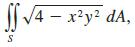
Use Property 10 to estimate the value of the integral.S = {(x, y) | x2 + y2 ≤ 1, x ≥ 0} | V4 - x'y? dA,
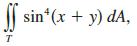
Use Property 10 to estimate the value of the integral.T is the triangle enclosed by the lines y = 0, y = 2x, and x = 1 sin*(x + y) dA,
Prove Property 10. 10 If m < f(x, y) < M for all (x, y) in D, then A(D) f(x, y) dA < M · A(D)
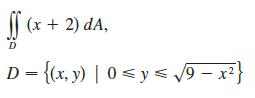
Use geometry or symmetry, or both, to evaluate the double integral. | (x + 2) dA, D D = {(x, y) | 0 < y< 9 - x²
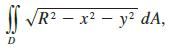
Use geometry or symmetry, or both, to evaluate the double integral.D is the disk with center the origin and radius R | VR? – x? - y² dA, D
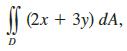
Use geometry or symmetry, or both, to evaluate the double integral.D is the rectangle 0 ≤ x ≤ a, 0 ≤ y ≤ b || (2x + 3y) dA, D
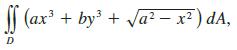
Use geometry or symmetry, or both, to evaluate the double integral.D = [–a, a] × [–b, b] (ax + by + Ja² – x² ) dA, D
Graph the solid bounded by the plane x + y + z = 1 and the paraboloid z = 4 – x2 – y2 and find its exact volume.
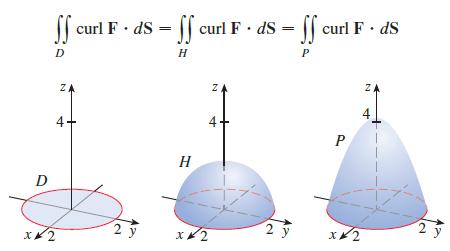
A disk D, a hemisphere H, and a portion P of a paraboloid are shown. Suppose F is a vector field on R3 whose components have continuous partial derivatives. Explain why this statement is true:123 || curl F dS = || curl F dS = || curl F dS -- P H D ZA ZA 4 4+ 4 P H D y 2 y 2 y
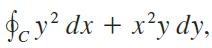
Evaluate the line integral by two methods:(a) Directly(b) Using Green’s Theorem.C is the rectangle with vertices (0, 0), (5, 0), (5, 4), and (0, 4) $cy? dx + x?y dy,
Find(a) The curl(b) The divergence of the vector field.F(x, y, z) = xy2z2 i + x2yz2 j + x2y2z k
Evaluate the line integral, where C is the given plane curve.∫C y ds, C: x = t2, y = 2t, 0 ≤ t ≤ 3
Determine whether the statement is true or false. If it is true, explain why. If it is false, explain why or give an example that disproves the statement.If F is a vector field, then div F is a vector field.
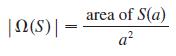
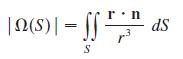
Let S be a smooth parametric surface and let P be a point such that each line that starts at P intersects S at most once. The solid angle Ω(S) subtended by S at P is the set of lines starting at P and passing through S. Let S(a) be the intersection of Ω(S) with the surface of the sphere with
Use Stokes’ Theorem to evaluate ∫∫S curl F · dS.F(x, y, z) = x2 sin z i + y2 j + xy k, S is the part of the paraboloid z = 1 − x2 − y2 that lies above the xy-plane, oriented upward.
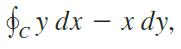
Evaluate the line integral by two methods:(a) Directly(b) Using Green’s Theorem.C is the circle with center the origin and radius 4. $cy dx – x dy,
Find(a) The curl(b) The divergence of the vector field.F(x, y, z) = x3yz2 j + y4z3 k
Evaluate the line integral, where C is the given plane curve.∫C (x/y) ds, C: x = t3, y = t4, 1 ≤ t ≤ 2
Determine whether the statement is true or false. If it is true, explain why. If it is false, explain why or give an example that disproves the statement.If F is a vector field, then curl F is a vector field.
Evaluate the line integral.∫C x ds, C is the arc of the parabola y = x2 from (0, 0) to (1, 1)
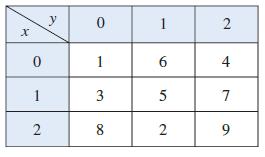
A table of values of a function f with continuous gradient is given. Find ∫C F · dr, where C has parametric equationsx = t2 + 1 y = t3 + t 0 ≤ t ≤ 1 y 1 1 6. 4 1 5 8 9 2. 2. 3. 2.
A surface S consists of the cylinder x2 + y2 = 1, −1 ≤ z ≤ 1, together with its top and bottom disks. Suppose you know that f is a continuous function withEstimate the value of ∫∫S f(x, y, z) dS by using a Riemann sum, taking the patches Sij to be four quarter-cylinders and the top and
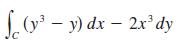
Find the positively oriented simple closed curve C for which the value of the line integralis a maximum. S.( - y) dx – 2x* dy
Evaluate the line integral by two methods:(a) Directly(b) Using Green’s Theorem.C is the triangle with vertices (0, 0), (1, 0), and (1, 2) Se xy dx + x²y dy, 3 у,
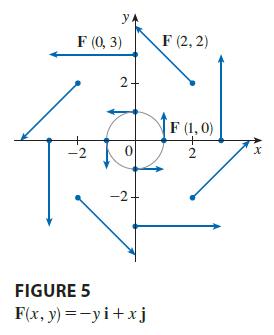
Sketch the vector field F by drawing a diagram like Figure 5 or Figure 9.F(x, y) = i + 1/2 y j y F (0, 3) F (2, 2) 2+ F (1, 0) -2 FIGURE 5 F(x, y) =-yi+xj 2.
Find(a) The curl(b) The divergence of the vector field.F(x, y, z) = xyez i + yzex k
Determine whether the statement is true or false. If it is true, explain why. If it is false, explain why or give an example that disproves the statement.If f has continuous partial derivatives of all orders on R3, then div(curl ∇f) = 0.
Use Stokes’ Theorem to evaluate ∫∫S curl F · dS.F(x, y, z) = tan−1(x2yz2) i + x2y j + x2z2 k, S is the cone x = √y2 + z2, 0 ≤ x ≤ 2, oriented in the direction of the positive x-axis.
Verify that the Divergence Theorem is true for the vector field F on the region E.F(x, y, z) = (x2, −y, z), E is the solid cylinder y2 + z2 ≤ 9, 0 ≤ x ≤ 2
Evaluate the line integral by two methods:(a) Directly(b) Using Green’s Theorem.C consists of the arc of the parabola y = x2 from (0, 0) to (1, 1) and the line segments from (1, 1) to (0, 1) and from (0, 1) to (0, 0) Pox?y? dx + xy dy,
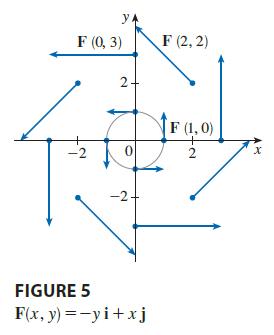
Sketch the vector field F by drawing a diagram like Figure 5 or Figure 9.F(x, y) = x i + 1/2 y j y F (0, 3) F (2, 2) 2+ F (1, 0) -2 FIGURE 5 F(x, y) =-yi+xj 2.
Find(a) The curl(b) The divergence of the vector field.F(x, y, z) = sin yz i + sin zx j + sin xy k
Determine whether the statement is true or false. If it is true, explain why. If it is false, explain why or give an example that disproves the statement.If f has continuous partial derivatives on R3 and C is any circle, then ∫C ∇f · dr = 0.
Suppose that f sx, y, zd − t(sx2 1 y2 1 z 2 ), where t is a function of one variable such that ts2d − 25. Evaluate yyS f sx, y, zd dS, where S is the sphere x2 1 y2 1 z2 − 4.
Investigate the shape of the surface with parametric equations x = sin u, y = sin v, z = sin(u + v). Start by graphing the surface from several points of view. Explain the appearance of the graphs by determining the traces in the horizontal planes z = 0, z = ±1, and z = ±1/2.
Use Green’s Theorem to evaluate the line integral along the given positively oriented curve.∫C yex dx + 2ex dy, C is the rectangle with vertices (0, 0), (3, 0), (3, 4), and (0, 4)
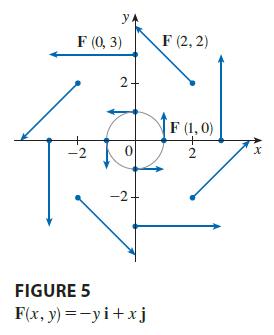
Sketch the vector field F by drawing a diagram like Figure 5 or Figure 9.F(x, y) = −1/2 i + (y − x) j y F (0, 3) F (2, 2) 2+ F (1, 0) -2 FIGURE 5 F(x, y) =-yi+xj 2.
Evaluate the line integral, where C is the given plane curve.∫C (x2y + sin x) dy, C is the arc of the parabola y = x2 from (0, 0) to (π, π2)
Determine whether the statement is true or false. If it is true, explain why. If it is false, explain why or give an example that disproves the statement.If F = P i + Q j and Py = Qx in an open region D, then F is conservative.
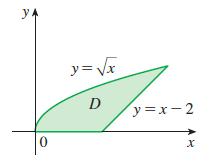
(a) Express the double integral ∫∫D f(x, y) dA as an iterated integral for the given function f and region D.(b) Evaluate the iterated integral.f(x, y) = xy yA y=Vx D y=x-2
Evaluate the double integral by first identifying it as the volume of a solid. le V2 da, R= {(x, y) | 2 < x < 6, -1 < y< 5}
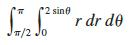
Sketch the region whose area is given by the integral and evaluate the integral. L r dr de (2 sine T/2 Jo
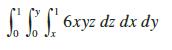
Calculate the iterated integral. SLL 6xyz dz dx dy 10 JI
Determine whether the statement is true or false. If it is true, explain why. If it is false, explain why or give an example that disproves the statement.The integral ∫∫∫E kr3 dz dr dc represents the moment of inertia about the z-axis of a solid E with constant density k.
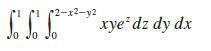
Evaluate the iterated integral. 2-x2-y2 SI xye"dz dy dx o Jo Jo
Find the area of the surface.The part of the cylinder x2 + z2 = 4 that lies above the square with vertices (0, 0), (1, 0), (0, 1), and (1, 1).
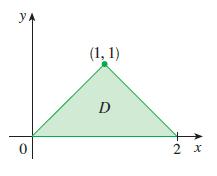
(a) Express the double integral ∫∫D f(x, y) dA as an iterated integral for the given function f and region D.(b) Evaluate the iterated integral.f(x, y) = x + y yA (1, 1) D 2 х
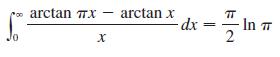
Show thatby first expressing the integral as an iterated integral. arctan x dx arctan TX In T
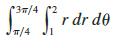
Sketch the region whose area is given by the integral and evaluate the integral. 37/4 (2 r dr de
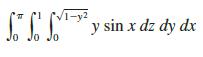
Calculate the iterated integral. 1-y2 y sin x dz dy dx Jo Jo
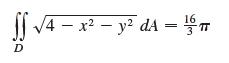
Determine whether the statement is true or false. If it is true, explain why. If it is false, explain why or give an example that disproves the statement.If D is the disk given by x2 + y2 ≤ 4, then | V4 - x2 - y? dA = T 16 D
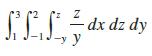
Evaluate the iterated integral. - dx dz dy -y y
(a) Write the definition of the triple integral of f over a rectangular box B.(b) How do you evaluate ∫∫∫B f(x, y, z) dV?(c) How do you define ∫∫∫E f(x, y, z) dV if E is a bounded solid region that is not a box?(d) What is a type 1 solid region? How do you evaluate ∫∫∫E f(x,
Describe in words the surface whose equation is givenΦ = 3π/4
Change from rectangular to cylindrical coordinates.(a) (0, –2, 9)(b) (–1, √3 , 6)
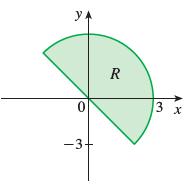
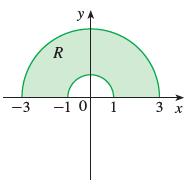
A region R is shown. Decide whether to use polar coordinates or rectangular coordinates and write ∫∫R f(x, y) dA as an iterated integral, where f is an arbitrary continuous function on R. y 4 R 3 x -3+
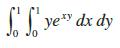
Calculate the iterated integral. ye" dx dy
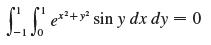
Determine whether the statement is true or false. If it is true, explain why. If it is false, explain why or give an example that disproves the statement. C.C er+y* sin y dx dy = 0 -1 Jo
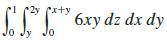
Evaluate the iterated integral. 2y x+y II* 6xy dz dx dy 10 Jy
If a lamina occupies a plane region D and has density function ρ(x, y), write expressions for each of the following in terms of double integrals.(a) The mass.(b) The moments about the axes.(c) The center of mass.(d) The moments of inertia about the axes and the origin.
Find the area of the surface.The part of the plane 6x + 4y + 2z = 1 that lies inside the cylinder x2 + y2 = 25.
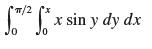
Evaluate the iterated integral. T/2 x sin y dy dx
Show that (( 2e* dy dx - T 4-y e dx dy %3| Jo Jo
The figure shows a lamina that is shaded according to the given density function: darker shading indicates higher density. Estimate the location of the center of mass of the lamina, and then calculate its exact location.ρ(x, y) = xy y A
Change from rectangular to spherical coordinates.(a) (0, 4, −4)(b) (−2, 2, 2√6)
A region R is shown. Decide whether to use polar coordinates or rectangular coordinates and write ∫∫R f(x, y) dA as an iterated integral, where f is an arbitrary continuous function on R. yA R -3 -1 0 1 3 х
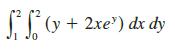
Calculate the iterated integral. 2 2 + 2xe") dx dy
Determine whether the statement is true or false. If it is true, explain why. If it is false, explain why or give an example that disproves the statement. r'e' dy dx = x² dx [ e' dy 13
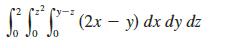
Evaluate the iterated integral. SI (21- y) dx dy dz
Find the area of the surface.The part of the plane 5x + 3y – z + 6 = 0 that lies above the rectangle [1, 4] × [2, 6].
Find the image of the set S under the given transformation. S = {(u, v) | 0 < u < 3, 0< v< 2}; x = 2u + 3v, y = u - v
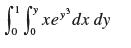
Evaluate the iterated integral. xe dx dy Jo
Find the average value of the function f(x) = ∫1x cos(t2) dt on the interval [0, 1].
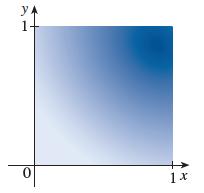
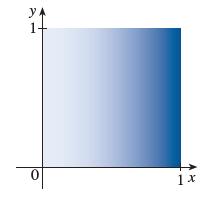
The figure shows a lamina that is shaded according to the given density function: darker shading indicates higher density. Estimate the location of the center of mass of the lamina, and then calculate its exact location.ρ(x, y) = x2 yA 1
Change from rectangular to spherical coordinates.(a) (3, 3, 0)(b) (1, −√3 , 2√3)
Plot the point whose cylindrical coordinates are given. Then find the rectangular coordinates of the point.(a) (2, 5π/6, 1)(b) (8, –2π/3, 5)
Showing 2300 - 2400
of 4932
First
17
18
19
20
21
22
23
24
25
26
27
28
29
30
31
Last
Step by Step Answers

 Get 50% OFF
Claim Now
Get 50% OFF
Claim Now