New Semester
Started
Get
50% OFF
Study Help!
--h --m --s
Claim Now
Question Answers
Textbooks
Find textbooks, questions and answers
Oops, something went wrong!
Change your search query and then try again
S
Books
FREE
Study Help
Expert Questions
Accounting
General Management
Mathematics
Finance
Organizational Behaviour
Law
Physics
Operating System
Management Leadership
Sociology
Programming
Marketing
Database
Computer Network
Economics
Textbooks Solutions
Accounting
Managerial Accounting
Management Leadership
Cost Accounting
Statistics
Business Law
Corporate Finance
Finance
Economics
Auditing
Tutors
Online Tutors
Find a Tutor
Hire a Tutor
Become a Tutor
AI Tutor
AI Study Planner
NEW
Sell Books
Search
Search
Sign In
Register
study help
mathematics
calculus early transcendentals 9th
Calculus Early Transcendentals 9th Edition James Stewart, Daniel K. Clegg, Saleem Watson, Lothar Redlin - Solutions
Find all values of x in the interval [0, 2π] that satisfy the equation.|tan x| = 1
Find all values of x in the interval [0, 2π] that satisfy the equation.2 sin2x = 1
Find all values of x in the interval [0, 2π] that satisfy the equation.3 cot2x = 1
Find all values of x in the interval [0, 2π] that satisfy the equation.2 cos x – 1 = 0
If sin x = 1/3 and sec y = 5/4 , where x and y lie between 0 and π/2, evaluate the expression.cos 2y
If sin x = 1/3 and sec y = 5/4 , where x and y lie between 0 and π/2, evaluate the expression.sin 2y
Show that the equation represents a circle and find the center and radius.2x2 + 2y2 – x + y = 1
Under what condition on the coefficients a, b, and c does the equation x2 + y2 + ax + by + c = 0 represent a circle? When that condition is satisfied, find the center and radius of the circle.
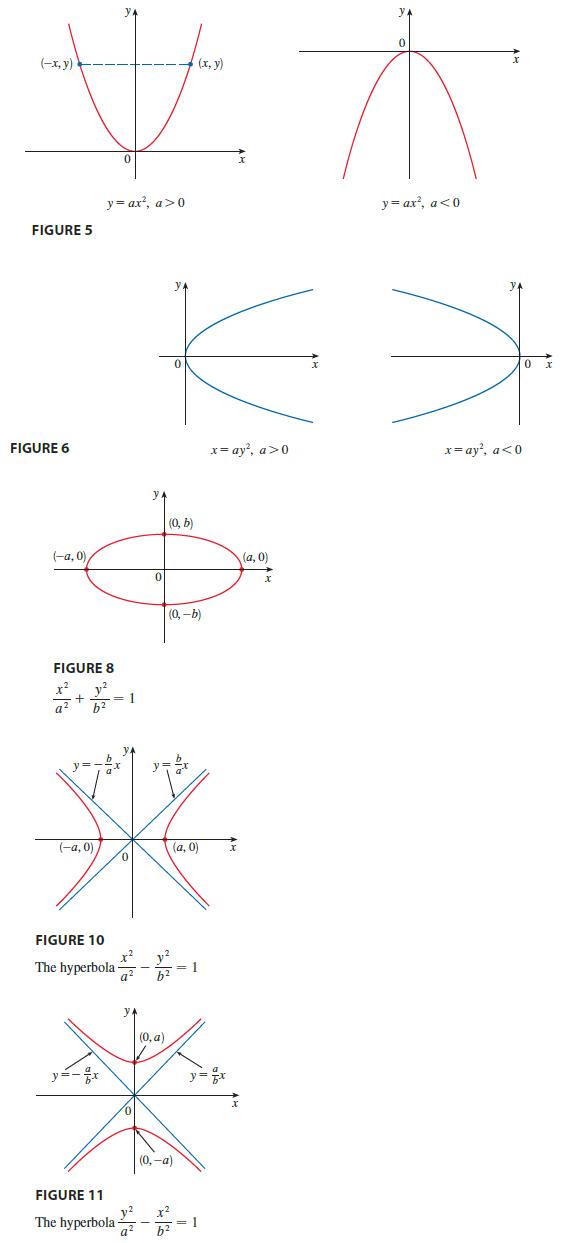
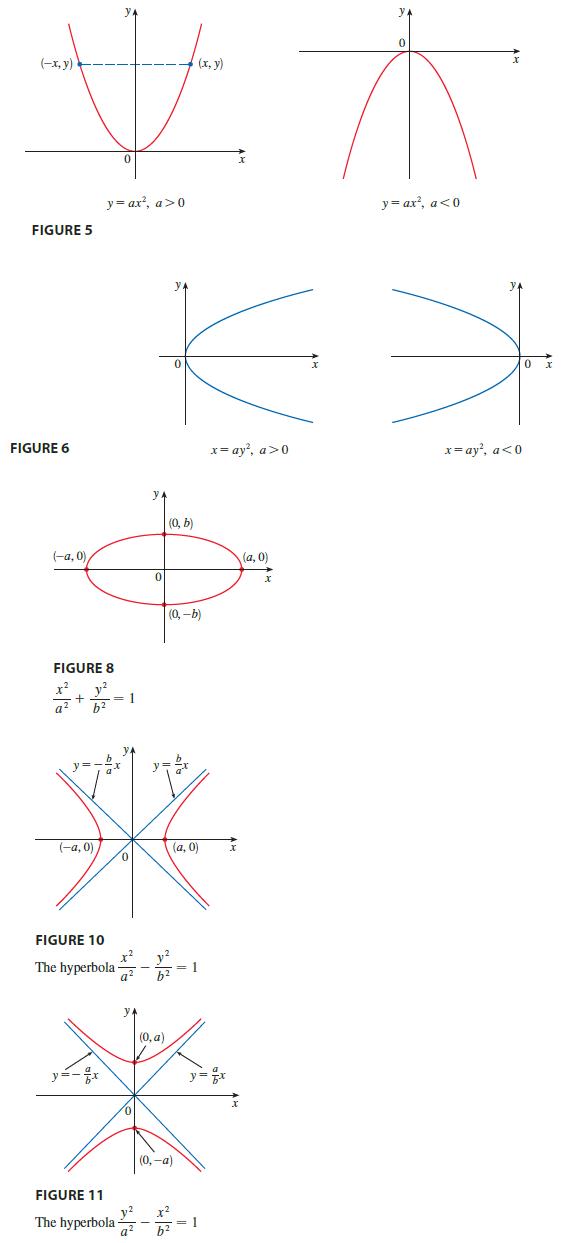
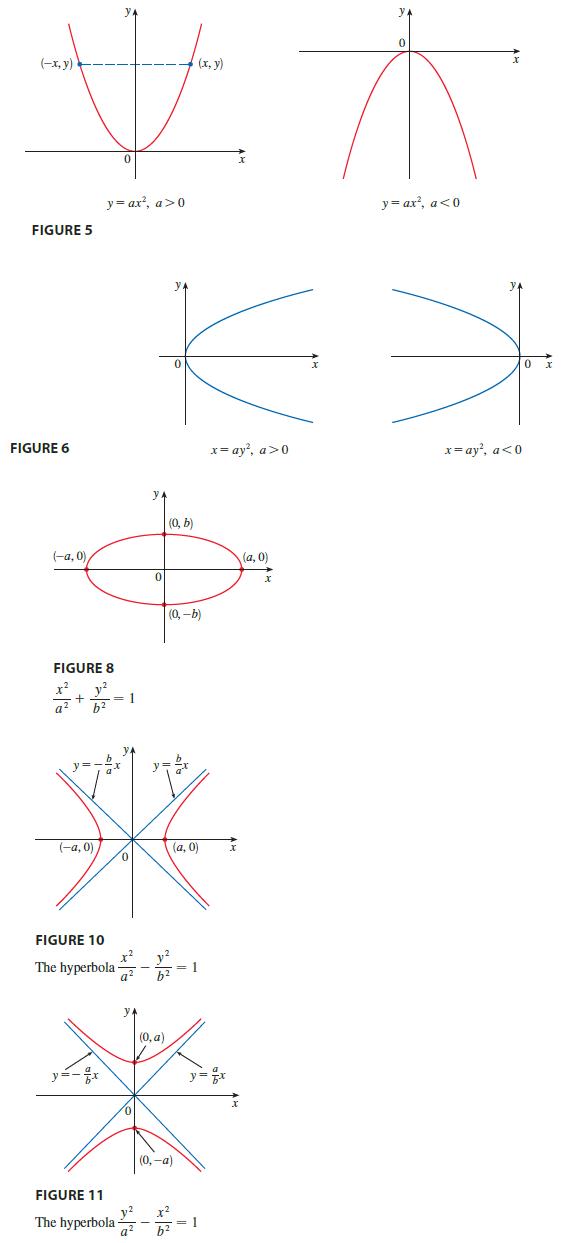
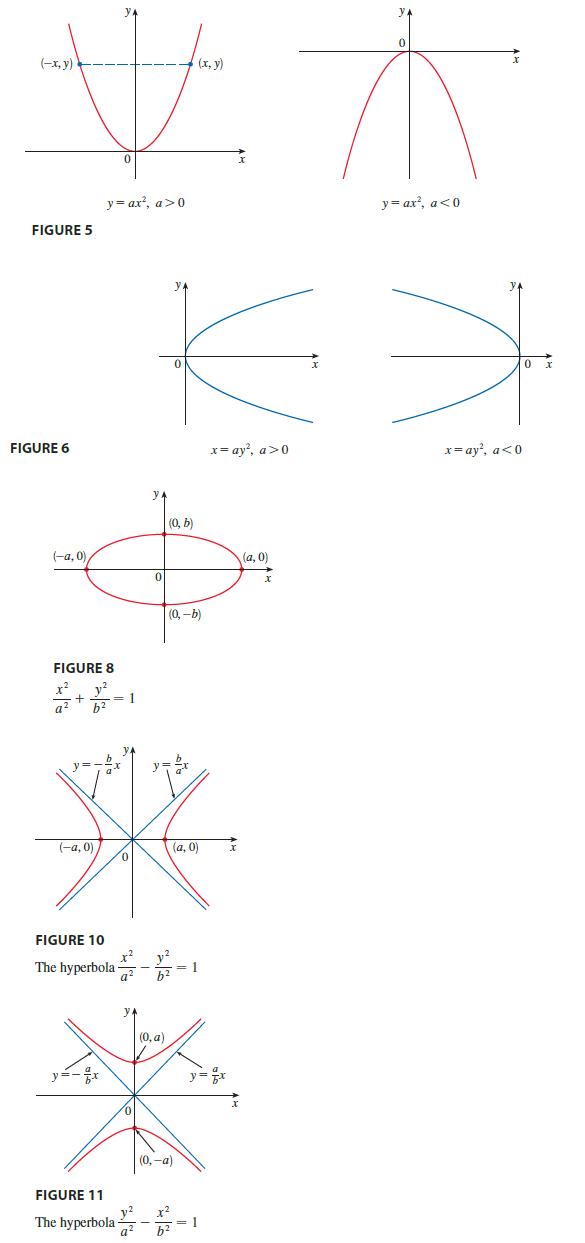
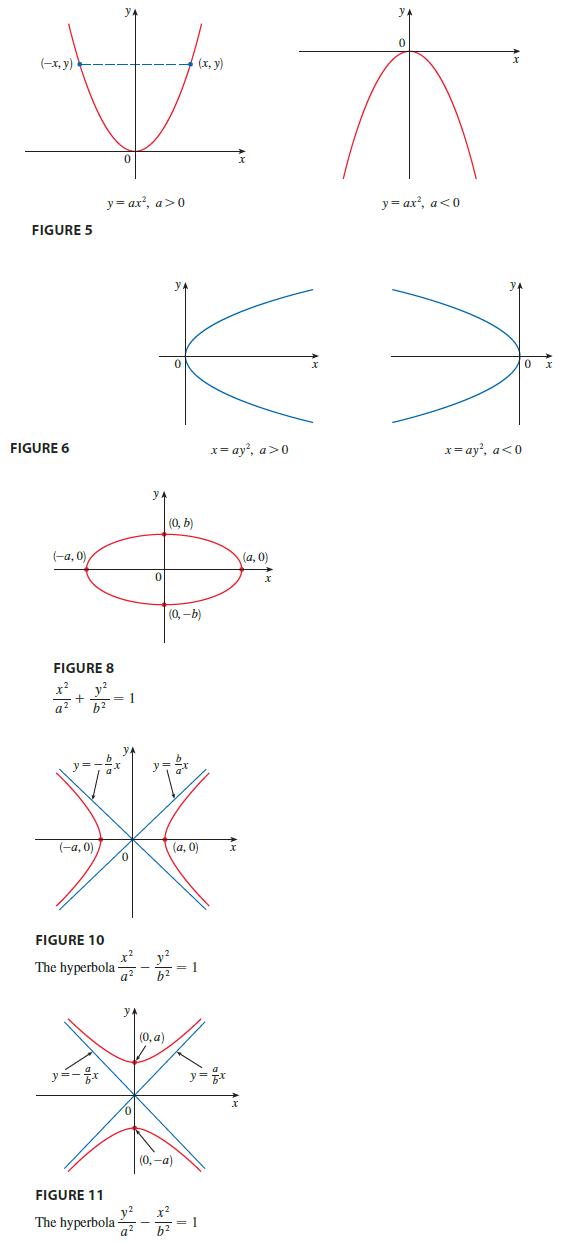
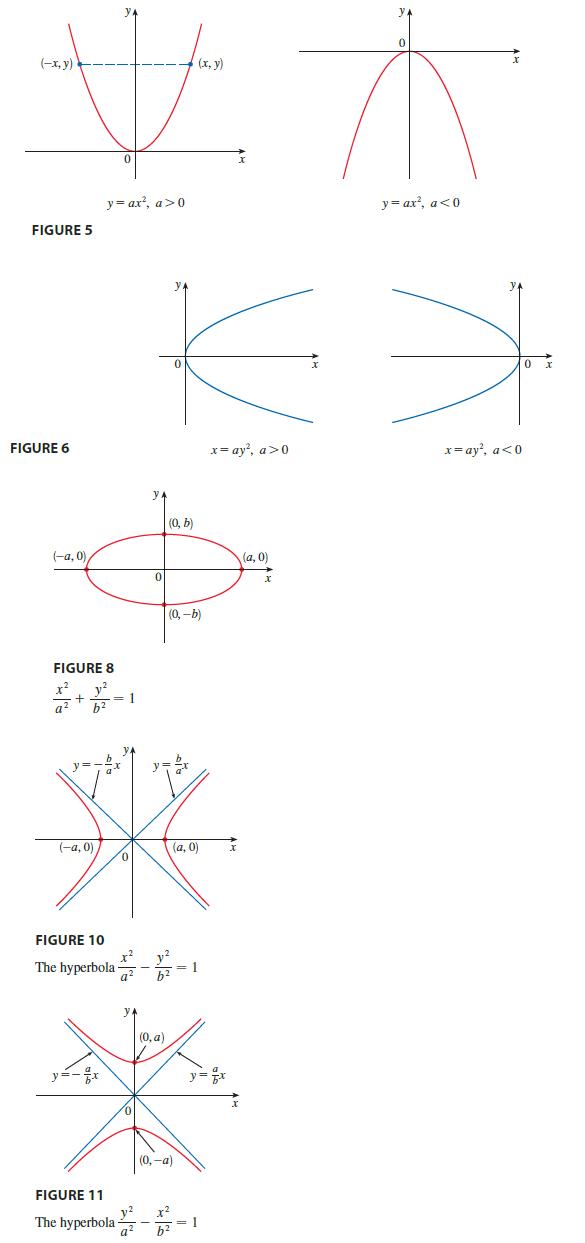
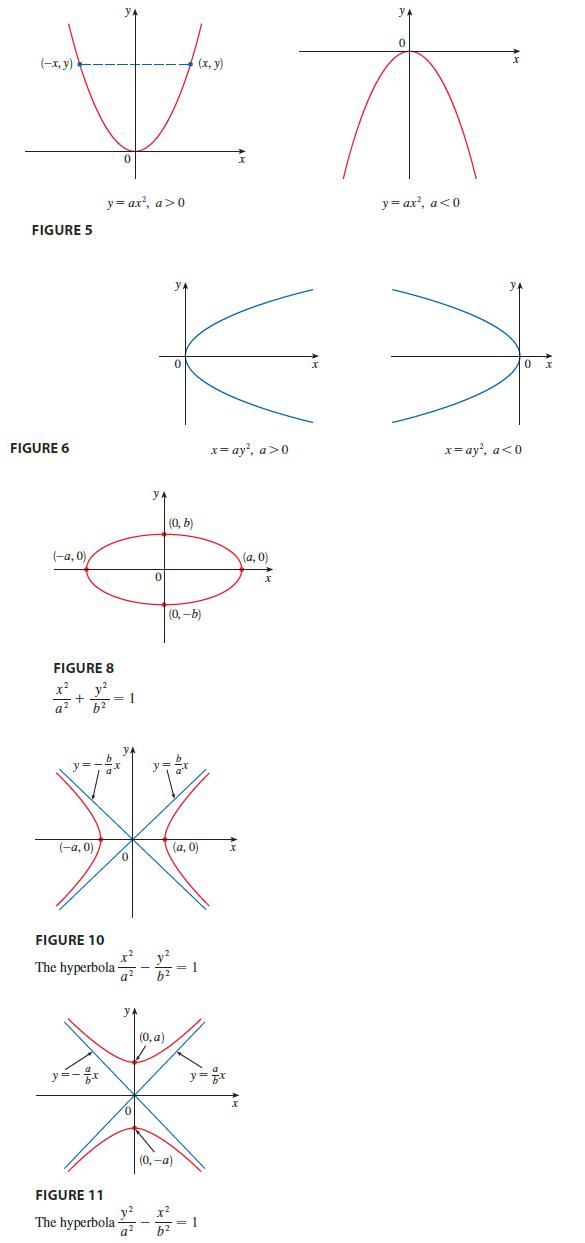
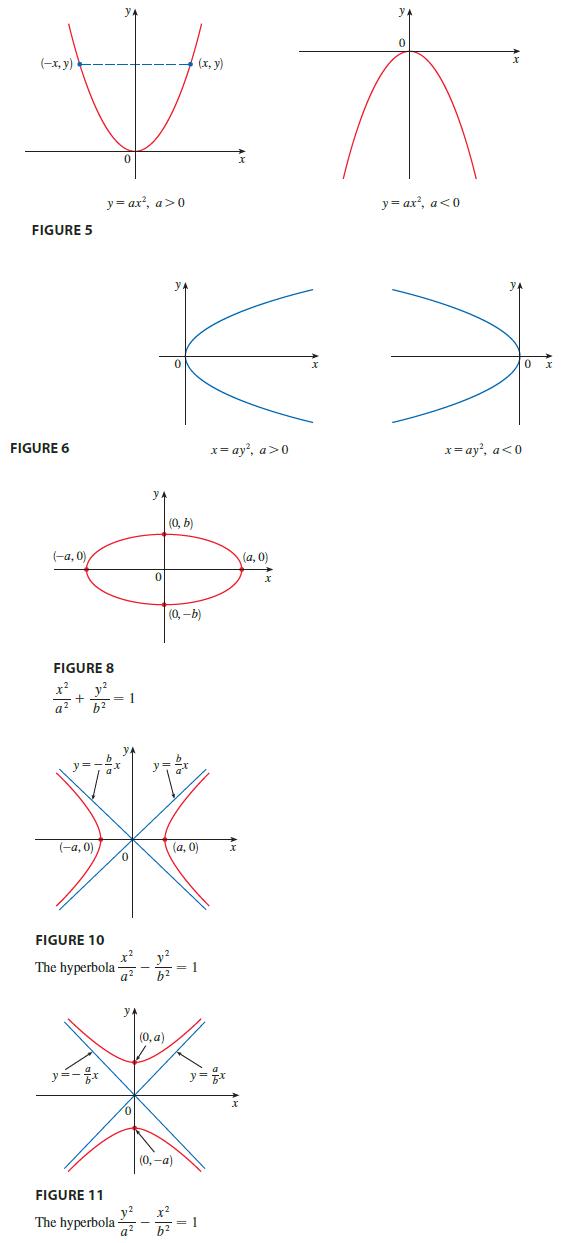
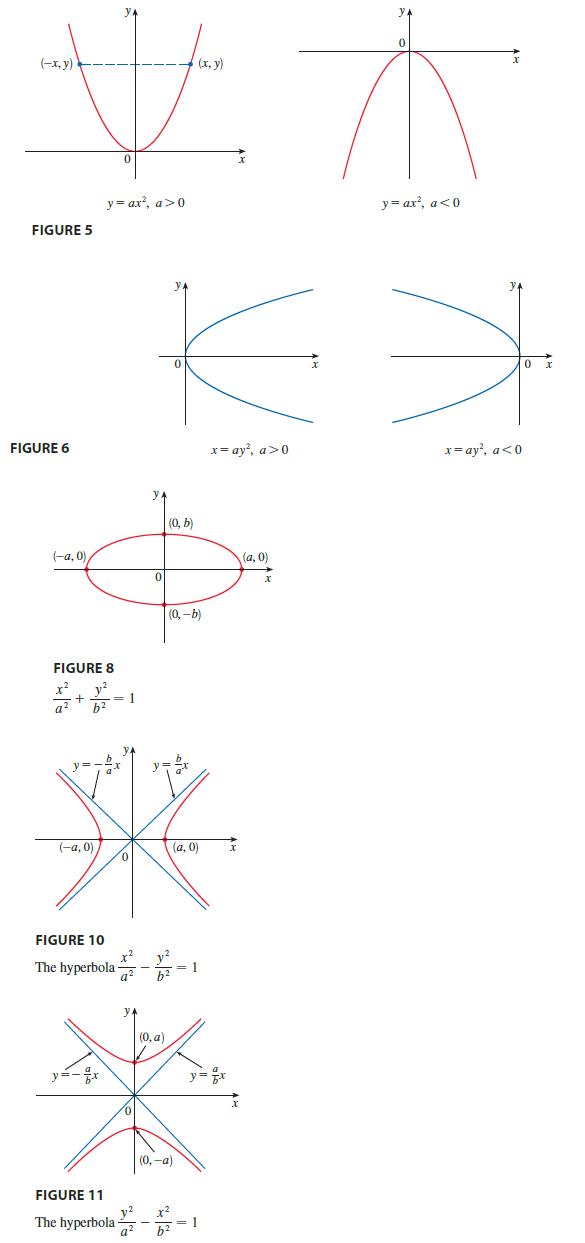
Identify the type of curve and sketch the graph. Do not plot points. Just use the standard graphs given in Figures 5, 6, 8, 10, and 11 and shift if necessary.y = –x2 (-x, v) (x, v) y = ax, a>0 y= ax, a0 x= ay', a
Identify the type of curve and sketch the graph. Do not plot points. Just use the standard graphs given in Figures 5, 6, 8, 10, and 11 and shift if necessary.y2 – x2 = 1 (-x, v) (x, v) y = ax, a>0 y= ax, a0 x= ay', a
Identify the type of curve and sketch the graph. Do not plot points. Just use the standard graphs given in Figures 5, 6, 8, 10, and 11 and shift if necessary.x2 + 4y2 = 16 (-x, v) (x, v) y = ax, a>0 y= ax, a0 x= ay', a
Identify the type of curve and sketch the graph. Do not plot points. Just use the standard graphs given in Figures 5, 6, 8, 10, and 11 and shift if necessary.x = –2y2 (-x, v) (x, v) y = ax, a>0 y= ax, a0 x= ay', a
Identify the type of curve and sketch the graph. Do not plot points. Just use the standard graphs given in Figures 5, 6, 8, 10, and 11 and shift if necessary.16x2 – 25y2 = 400 (-x, v) (x, v) y = ax, a>0 y= ax, a0 x= ay', a
Identify the type of curve and sketch the graph. Do not plot points. Just use the standard graphs given in Figures 5, 6, 8, 10, and 11 and shift if necessary.25x2 + 4y2 = 100 (-x, v) (x, v) y = ax, a>0 y= ax, a0 x= ay', a
Identify the type of curve and sketch the graph. Do not plot points. Just use the standard graphs given in Figures 5, 6, 8, 10, and 11 and shift if necessary.4x2 + y2 = 1 (-x, v) (x, v) y = ax, a>0 y= ax, a0 x= ay', a
Identify the type of curve and sketch the graph. Do not plot points. Just use the standard graphs given in Figures 5, 6, 8, 10, and 11 and shift if necessary.y = x2 + 2 (-x, v) (x, v) y = ax, a>0 y= ax, a0 x= ay', a
Identify the type of curve and sketch the graph. Do not plot points. Just use the standard graphs given in Figures 5, 6, 8, 10, and 11 and shift if necessary.x = y2 – 1 (-x, v) (x, v) y = ax, a>0 y= ax, a0 x= ay', a
Identify the type of curve and sketch the graph. Do not plot points. Just use the standard graphs given in Figures 5, 6, 8, 10, and 11 and shift if necessary.9x2 – 25y2 = 225 (-x, v) (x, v) y = ax, a>0 y= ax, a0 x= ay', a
Determine whether the equation or table defines y as a function of x. ϰ yHeight (in) Shoe size72
Rewrite the expression without using the absolute-value symbol.|2x − 1|
Rewrite the expression without using the absolute-value symbol.|x − 2| if x > 2
Rewrite the expression without using the absolute-value symbol.|x − 2| if x < 2
Use a computer algebra system to find the exact area of the surface z = 1 + 2x + 3y + 4y2, 1 ≤ x ≤ 4, 0 ≤ y ≤ 1.
Use a computer algebra system to find the area of the surface with vector equationr(u, v) = (cos3u cos3v, sin3u cos3v, sin3v)0 ≤ u ≤ π, 0 ≤ v ≤ 2π. State your answer correct to four decimal places.
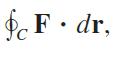
If C is a smooth curve given by a vector function r(t), a ≤ t ≤ b, show that dr r Jc
If the equation of a surface S is z = f(x, y), where x2 + y2 ≤ R2, and you know that |fx| ≤ 1 and |fy| ≤ 1, what can you say about A(S)?
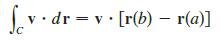
If C is a smooth curve given by a vector function rstd, a ≤ t ≤ b, and v is a constant vector, show that Lv• dr = v · [r(b) – r(a)]
Find the area of the surface.The part of the sphere x2 + y2 + z2 = b2 that lies inside the cylinder x2 + y2 = a2, where 0 < a < b.
Find the area of the surface.The part of the paraboloid y = x2 + z2 that lies within the cylinder x2 + z2 = 16
The temperature at the point (x, y, z) in a substance with conductivity K = 6.5 is u(x, y, z) = 2y2 + 2z2. Find the rate of heat flow inward across the cylindrical surface y2 + z2 = 6, 0 ≤ x ≤ 4.
Find the area of the surface.The part of the surface x = z2 + y that lies between the planes y = 0, y = 2, z = 0, and z = 2
Find the area of the surface.The part of the surface z = xy that lies within the cylinder x2 + y2 = 1
The position of an object with mass m at time t is r(t) = at2 i + bt3 j, 0 ≤ t ≤ 1.(a) What is the force acting on the object at time t ?(b) What is the work done by the force during the time interval 0 ≤ t ≤ 1?
Find the area of the surface.The part of the surface z = 4 − 2x2 + y that lies above the triangle with vertices (0, 0), (1, 0), and (1, 1)
Find the area of the surface.The surface z =(x/2 + y/2), 0
Find the area of the surface.The part of the cone z = √x2 + y that lies between the plane y = x and the cylinder y = x2
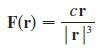
Suppose that F is an inverse square force field, that is,for some constant c, where r = x i + y j + z k.(a) Find the work done by F in moving an object from a point P1 along a path to a point P2 in terms of the distances d1 and d2 from these points to the origin.(b) An example of an inverse square
Find the area of the surface.The part of the plane x + 2y + 3z = 1 that lies inside the cylinder x2 + y2 = 3.
Find the area of the surface.The part of the plane with vector equation r(u, v) = (u + v, 2 − 3u, 1 + u − v) that is given by 0 ≤ u ≤ 2, −1 ≤ v ≤ 1
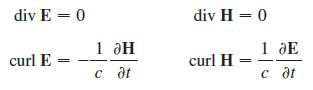
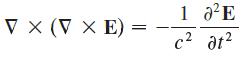
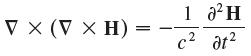
Maxwell’s equations relating the electric field E and magnetic field H as they vary with time in a region containing no charge and no current can be stated as follows:where c is the speed of light. Use these equations to prove the following:a.b.c.d. div E = 0 div H – 0 1 эн 1 JE curl E curl H
Determine whether or not the given set is(a) Open(b) Connected(c) Simply-connected.{(x, y) |(x, y) ≠ (2, 3)}
Find the mass of a thin funnel in the shape of a coneif its density function is ρ(x, y, z) = 10 − z. z = Vx? + y?, 1
Determine whether or not the given set is(a) Open(b) Connected(c) Simply-connected.{(x, y) |1 ≤ x2 + y2 ≤ 4, y ≥ 0}
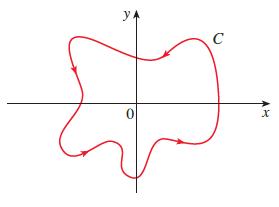
LetEvaluatewhere C is shown in the figure. (2.x + 2xy? - 2y) i + (2y³ + 2x²y + 2x) j x² + y? F(x, y) = %3D
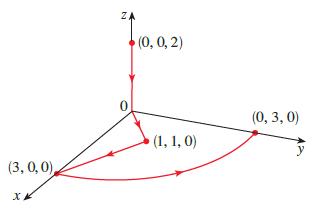
LetEvaluate ∫C F · dr, where C is the curve with initial point (0, 0, 2) and terminal point (0, 3, 0) shown in the figure. F(x, y, z) = (3x²yz – 3y) i + (x'z - 3x) j + (x'y + 2z) k
A particle moves in a velocity field V(x, y) = (x2, x + y2). If it is at position (2, 1) at time t = 3, estimate its location at time t = 3.01.
Use Exercise 35 to show that the line integral ∫C y dx + x dy + xyz dz is not independent of path.Data From Exercise 35:Show that if the vector field F = P i + Q j + R k is conservative and P, Q, R have continuous first-order partial derivatives, then aP aP ƏR aR де ду dz dz ду
Use a computer algebra system to find the flux ofacross the part of the cylinder 4y2 + z2 = 4 that lies above the xy-plane and between the planes x = −2 and x = 2 with upward orientation. Illustrate by graphing the cylinder and the vector field on the same screen. F(x, y, z) = sin(xyz) i + x'yj+
Find an equation of the tangent plane to the given parametric surface at the specified point.r(u, v) = u cos v i + u sin v j + v k; u = 1, v = π/3
Use a computer algebra system to find the value of ∫∫S x2y2z2 dS correct to four decimal places, where S is the part of the paraboloid z = 3 − 2x2 − y2 that lies above the xy-plane.
Find an equation of the tangent plane to the given parametric surface at the specified point.x = u2 + 1, y = v3 + 1, z = u + v; (5, 2, 3)
Let r = x i + y j + z k and r =|r|.If F = r/rp, find div F. Is there a value of p for which div F = 0?
Use a computer algebra system to find the exact value of ∫∫S xyz dS, where S is the surface z = x2y2, 0 ≤ x ≤ 1, 0 ≤ y ≤ 2.
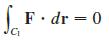
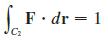
Let F = ∇f , where f(x, y) = sin(x − 2y). Find curves C1 and C2 that are not closed and satisfy the equation.a.b. | F. dr = 0
Use a computer algebra system to find the exact value of ∫C x3y2z ds, where C is the curve with parametric equations x = e−t cos 4t, y = e−t sin 4t, z = e−t, 0 ≤ t ≤ 2π.
Use a computer algebra system to evaluate ∫∫S (x2 + y) + z2) dS correct to four decimal places, where S is the surface z = xey, 0 ≤ x ≤ 1, 0 ≤ y ≤ 1.
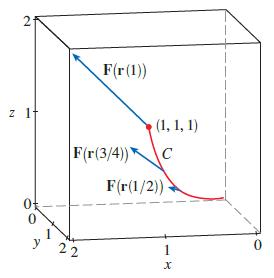
(a) Evaluate the line integral ∫C F · dr, where F(x, y, z) = x i − z j + y k and C is given by r(t) = 2t i + 3t j − t2 k, −1 ≤ t ≤ 1.(b) Illustrate part (a) by graphing C and the vectors from the vector field corresponding to t = ±1 and ± 1/2 (as in Figure 14). F(r(1)) z 1 (1, 1, 1)
Let r = x i + y j + z k and r =|r|.Verify each identity.(a) ∇ · r = 3(b) ∇ · (rr) = 4r(c) ∇2r3 = 12r
Suppose that X and Y are independent random variables, where X is normally distributed with mean 45 and standard deviation 0.5 and Y is normally distributed with mean 20 and standard deviation 0.1. Evaluate a double integral numerically to find the given probability correct to three decimal
Use a computer algebra system to find the mass, center of mass, and moments of inertia of the lamina that occupies the region D and has the given density function.D = {(x, y) | 0 ≤ y ≤ xe–x, 0 ≤ x ≤ 2}; ρ(x, y) = x2y2
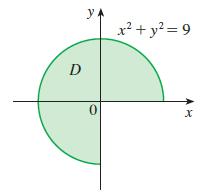
(a) Set up an iterated integral in polar coordinates for the volume of the solid under the graph of the given function and above the region D.(b) Evaluate the iterated integral to find the volume of the solid.f(x, y) = y x? + y? = 9 D
Calculate the value of the multiple integral.∫∫D y dA, where D is the region in the first quadrant that lies above the hyperbola xy = 1 and the line y = x and below the line y = 2.
A lamina with constant density ρ(x, y) = ρ occupies the given region. Find the moments of inertia Ix and Iy and the radii of gyration x̅̅ and y̅̅.The region under the curve y = sin x from x = 0 to x = π
Use spherical coordinates.Evaluate ∫∫∫E y2 dV, where E is the solid hemisphere x2 + y2 + z2 ≤ 9, y ≥ 0.
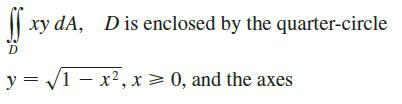
Evaluate the double integral. xy dA, D is enclosed by the quarter-circle D y = V1 – x2, x > 0, and the axes
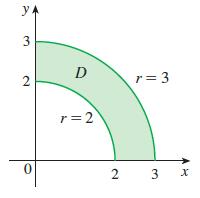
(a) Set up an iterated integral in polar coordinates for the volume of the solid under the graph of the given function and above the region D.(b) Evaluate the iterated integral to find the volume of the solid.f sx, yd − xy2 y. 3 D r= 3 r=2 2 3 2.
Calculate the value of the multiple integral.∫∫D (x2 + y2)3/2 dA, where D is the region in the first quadrant bounded by the lines y = 0 and y = √3 x and the circle x2 + y2 = 9.
Calculate the double integral. x sec'y dA, R- {(x, y) | 0
Use a computer algebra system to find the mass, center of mass, and moments of inertia of the lamina that occupies the region D and has the given density function.D is enclosed by the right loop of the four-leaved rose r = cos 2θ; ρ(x, y) = x2 + y2
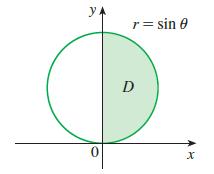
(a) Set up an iterated integral in polar coordinates for the volume of the solid under the graph of the given function and above the region D.(b) Evaluate the iterated integral to find the volume of the solid.f(x, y) = x yA r= sin e D
Calculate the value of the multiple integral.∫∫D x dA, where D is the region in the first quadrant that lies between the circles x2 + y2 = 1 and x2 + y2 = 2
Calculate the double integral. | (y + xy) dA, R = {(x, y) | 0
In the Midpoint Rule for triple integrals we use a triple Riemann sum to approximate a triple integral over a box B, where f(x, y, z) is evaluated at the center (xi(vector), yj(vector), zk(vector)) of the box Bijk. Use the Midpoint Rule to estimate the value of the integral. Divide B into eight
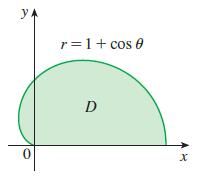
(a) Set up an iterated integral in polar coordinates for the volume of the solid under the graph of the given function and above the region D.(b) Evaluate the iterated integral to find the volume of the solid.f(x, y) = 1 r=1+ cos 0
Calculate the double integral. xy? -dA, R= {(x, y) |0
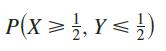
The joint density function for a pair of random variables X and Y is(a) Find the value of the constant C.(b) Find P(X ≤ 1, Y ≤ 1).(c) Find P(X + Y ≤ 1). SCx(1 + y) if 0
Use spherical coordinates.Find the volume of the part of the ball ρ ≤ a that lies between the cones Φ = π/6 and Φ = π/3.
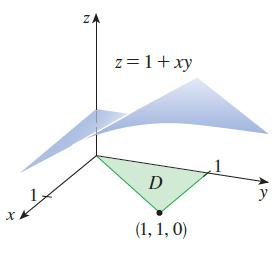
The figure shows a surface and a region D in the xy-plane.(a) Set up an iterated double integral for the volume of the solid that lies under the surface and above D.(b) Evaluate the iterated integral to find the volume of the solid. ZA z=1+xy D (1, 1, 0)
Use cylindrical coordinates.Find the mass of a ball B given by x2 + y2 + z2 ≤ a2 if the density at any point is proportional to its distance from the z-axis.
Calculate the double integral. tan 0 - dA, R={(0, t) | 0 < 0 < T/3,0
(a) Verify thatis a joint density function.(b) If X and Y are random variables whose joint density function is the function f in part (a), find(i)(ii) [4xy if 0
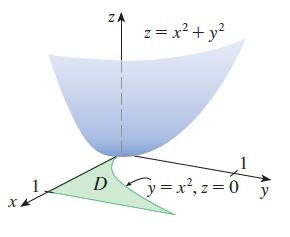
The figure shows a surface and a region D in the xy-plane.(a) Set up an iterated double integral for the volume of the solid that lies under the surface and above D.(b) Evaluate the iterated integral to find the volume of the solid. ZA z= x² + y? Dy=x², z=0 y
Evaluate the integral by making an appropriate change of variables.1where R is the region enclosed by the lines x + y = 1, x + y = 3, y = 2x, y = x/2 dA, R
Use polar coordinates to find the volume of the given solid.Below the cone z = √x2 + y2 and above the ring 1 ≤ x2 + y2 ≤ 4
Calculate the double integral. x sin(x + y) dA, R= [0, 7/6] × [0, 7/3] %3| R
Suppose X and Y are random variables with joint density function(a) Verify that f is indeed a joint density function.(b) Find the following probabilities.(i) P(Y ≥ 1)(ii) P(X ≤ 2, Y ≤ 4)(c) Find the expected values of X and Y. (0.le 0.5r+0.2) if x> 0, y> 0 f(x, y) = otherwise
Use spherical coordinates.(a) Find the volume of the solid that lies above the cone Φ = π/3 and below the sphere ρ = 4 cos Φ.(b) Find the centroid of the solid in part (a).
Find the volume of the given solid.Under the plane 3x + 2y – z = 0 and above the region enclosed by the parabolas y = x2 and x = y2
Calculate the double integral. -dA, R=[0, 1] x [0, 1] 1+ xy %3D R
Find the volume of the given solid.Under the surface z = 1 + x2y2 and above the region enclosed by x = y2 and x = 4
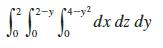
Sketch the solid whose volume is given by the iterated integral. -y (4-y dx dz dy Jo
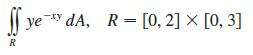
Calculate the double integral. | ye dA, R- [0, 2] x [0, 3] R
Find the volume of the given solid.Under the surface z = xy and above the triangle with vertices (1, 1), (4, 1), and (1, 2)
Calculate the value of the multiple integral.where H is the solid hemisphere that lies above the xy-plane and has center the origin and radius 1. SSSu z°/x? + y? + z? dV, -2
Calculate the double integral. 1 dA, R=[1, 3] × [1, 2] 1+x+ y R
Find the volume of the given solid.Under the surface z = x2y and above the triangle in the xy-plane with vertices (1, 0), (2, 1), and (4, 0).
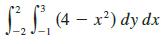
Sketch the solid whose volume is given by the iterated integral. LL (4 - x') dy dx -2 J-1
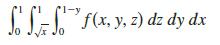
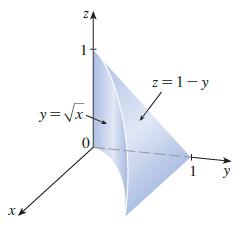
The figure shows the region of integration for the integralRewrite this integral as an equivalent iterated integral in the five other orders. SLES" SK, y, 2) dz dy dx 1-y
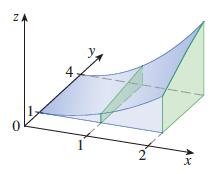
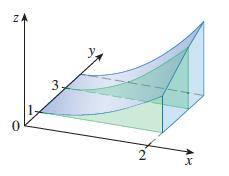
Consider the solid region S that lies under the surface z = x2√y and above the rectangle R = [0, 2] c [1, 4].(a) Find a formula for the area of a cross-section of S in the plane perpendicular to the x-axis at x for 0 ≤ x ≤ 2. Then use the formula to compute the areas of the cross-sections
Find the volume of the given solid.Bounded by the cylinder y2 + z2 = 4 and the planes x = 2y, x = 0, z = 0 in the first octant
Showing 2200 - 2300
of 4932
First
16
17
18
19
20
21
22
23
24
25
26
27
28
29
30
Last
Step by Step Answers

 Get 50% OFF
Claim Now
Get 50% OFF
Claim Now