New Semester
Started
Get
50% OFF
Study Help!
--h --m --s
Claim Now
Question Answers
Textbooks
Find textbooks, questions and answers
Oops, something went wrong!
Change your search query and then try again
S
Books
FREE
Study Help
Expert Questions
Accounting
General Management
Mathematics
Finance
Organizational Behaviour
Law
Physics
Operating System
Management Leadership
Sociology
Programming
Marketing
Database
Computer Network
Economics
Textbooks Solutions
Accounting
Managerial Accounting
Management Leadership
Cost Accounting
Statistics
Business Law
Corporate Finance
Finance
Economics
Auditing
Tutors
Online Tutors
Find a Tutor
Hire a Tutor
Become a Tutor
AI Tutor
AI Study Planner
NEW
Sell Books
Search
Search
Sign In
Register
study help
mathematics
calculus early transcendentals 9th
Calculus Early Transcendentals 9th Edition James Stewart, Daniel K. Clegg, Saleem Watson, Lothar Redlin - Solutions
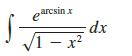
Evaluate the integral. arcsin x xp 1 – x
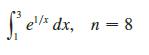
Use(a) The Trapezoidal Rule(b) The Midpoint Rule(c) Simpson’s Rule to approximate the given integral with the specified value of n. ( e'* dx, n = 8
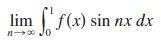
Suppose that f is a positive function such that f' is continuous.(a) How is the graph of y = f(x) sin nx related to the graph of y = f(x) What happens as n → ∞?(b) Make a guess as to the value of the limitbased on graphs of the integrand.(c) Using integration by parts, confirm the guess that
Evaluate the integral.∫ π/20 (2 − sinθ)2 dθ
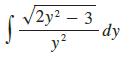
Use the Table of Integrals on the Reference Pages to evaluate the integral. 2y2 - 3 dy y?
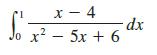
Evaluate the integral. х — 4 х? — 5х + 6
Evaluate the integral.∫ t2 sin βt dt
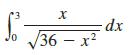
Evaluate the integral. dx 36 x
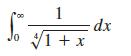
Determine whether the integral is convergent or divergent. Evaluate integrals that are convergent. 1 dx Jo V1 + x
Evaluate the integral.∫ sin x cos x ln(cos x) dx
Determine whether the statement is true or false. If it is true, explain why. If it is false, explain why or give an example that disproves the statement.Ifis convergent, then ∫∞0 f(x) dx is convergent. f(x) dx
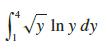
Evaluate the integral. 4 SVy In y dy
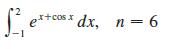
Use(a) The Trapezoidal Rule(b) The Midpoint Rule(c) Simpson’s Rule to approximate the given integral with the specified value of n. e*tcos * dx, n = 6 dx, п - 6
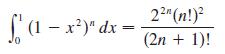
Show that 22 (n!)? (1 - x*)" dx - (2n + 1)!
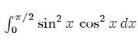
Evaluate the integral. /2 sin? x cos? a da an" x
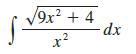
Use the Table of Integrals on the Reference Pages to evaluate the integral. 9x² + 4 dx .2 x2
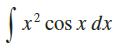
Evaluate the integral.∫ (x2 + 2x) cos x dx
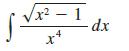
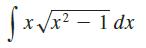
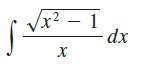
Evaluate the integral. Vx² - 1 dx
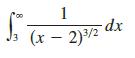
Determine whether the integral is convergent or divergent. Evaluate integrals that are convergent. 1 (x - 2)3/2 13 8.
Evaluate the integral.∫ x (ln x)2 dx
Determine whether the statement is true or false. If it is true, explain why. If it is false, explain why or give an example that disproves the statement.is convergent. 1 as 1
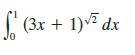
Evaluate the integral. (3x + 1) dx Jo
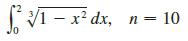
Use(a) The Trapezoidal Rule(b) The Midpoint Rule(c) Simpson’s Rule to approximate the given integral with the specified value of n. - x² dx, n = 10 Jo
If n is a positive integer, prove that ∫10 (ln x)n dx = (–1)nn!.
Evaluate the integral.∫π0 sin2t cos4t dt
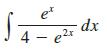
Use the Table of Integrals on the Reference Pages to evaluate the integral. et 4 - е2 dx ,2x e
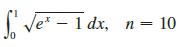
Use(a) The Trapezoidal Rule(b) The Midpoint Rule(c) Simpson’s Rule to approximate the given integral with the specified value of n. I Ve* – 1 dx, n= 10
Evaluate the integral.∫π0 cos4(2t) dt
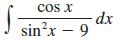
Use the Table of Integrals on the Reference Pages to evaluate the integral. cos x dx sin?x – 9
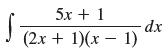
Evaluate the integral. 5х + 1 dx (2х + 1)(х — 1)
Evaluate the integral.∫ w ln w dw
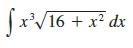
Evaluate the integral. frV16 + x² dx
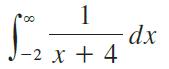
Determine whether the integral is convergent or divergent. Evaluate integrals that are convergent. 1 J-2x + 4 00 dx
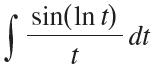
Evaluate the integral. sin(In t) dt t
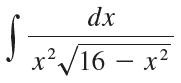
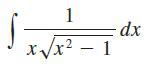
Evaluate the integral. dx x16 - x 2
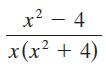
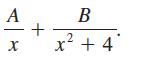
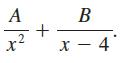
Determine whether the statement is true or false. If it is true, explain why. If it is false, explain why or give an example that disproves the statement.can be put in the form x - 4 .2 x(x² + 4)
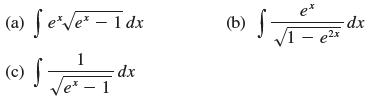
Three integrals are given that, although they look similar, may require different techniques of integration. Evaluate the integrals. (a) fe* e* - 1 dx (e) f/11dx (b) ex /1-ex dx
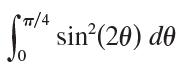
Evaluate the integral. 17/4 0 sin (20 ) d
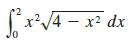
Use the Table of Integrals on the Reference Pages to evaluate the integral. x²/4 - x2 dx
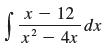
Evaluate the integral. х — 12 dx — 4х .2
Evaluate the integral.∫ (π – x) cos πx dx
Determine whether the integral is convergent or divergent. Evaluate integrals that are convergent. dx
Evaluate the integral.∫π/20 sin3θ cos2θ dθ
Determine whether the statement is true or false. If it is true, explain why. If it is false, explain why or give an example that disproves the statement.can be put in the form x2 + 4 x*(x – 4)
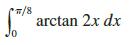
Use the Table of Integrals on the Reference Pages to evaluate the integral. w/8 arctan 2x dx
Evaluate the integral using the indicated trigonometric substitution. Sketch and label the associated right triangle. 4x2 - 25 x= sec 0
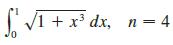
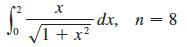
Use(a) The Trapezoidal Rule(b) The Midpoint Rule(c) Simpson’s Rule to approximate the given integral with the specified value of n. IVi + x* dx, n = 4
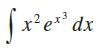
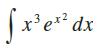
Three integrals are given that, although they look similar, may require different techniques of integration. Evaluate the integrals.a.b.c. fr'e* dx x²e
Evaluate the integral.∫π/20 cos2θ dθ
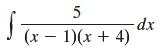
Evaluate the integral. (x - 1)(x + 4)
Evaluate the integral.∫ x sin 10x dx
Determine whether the integral is convergent or divergent. Evaluate integrals that are convergent.∫∞0 e–2x dx
Evaluate the integral.∫21 x5 ln x dx
Determine whether the statement is true or false. If it is true, explain why. If it is false, explain why or give an example that disproves the statement.can be put in the form x2 + 4 x(x2 – 4)
Use(a) The Midpoint Rule(b) Simpson’s Rule to approximate the given integral with the specified value of n. Compare your results to the actual value to determine the error in each approximation. -dx, п — 8 1 + x2
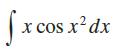
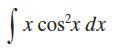
Three integrals are given that, although they look similar, may require different techniques of integration. Evaluate the integrals.a.b.c. x cos x? dx
Evaluate the integral.∫ cos3(t/2) sin2(t/2) dt
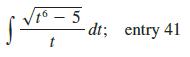
Use the formula in the indicated entry of the Table of Integrals on Reference Pages 6 –10 to evaluate the integral. 10- 5 dt; entry 41
Evaluate the integral.∫ ye–y dy
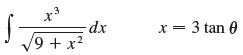
Evaluate the integral using the indicated trigonometric substitution. Sketch and label the associated right triangle. dx 9+ x2 x = 3 tan 0
Determine whether the integral is convergent or divergent. Evaluate integrals that are convergent. 1 = dx 3 -0-
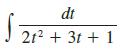
Evaluate the integral. dt 2t2 + 3t + 1
Determine whether the statement is true or false. If it is true, explain why. If it is false, explain why or give an example that disproves the statement.can be put in the form x(x² + 4) x? – 4 2
Use(a) The Midpoint Rule(b) Simpson’s Rule to approximate the given integral with the specified value of n. Compare your results to the actual value to determine the error in each approximation.∫π0 x sin x dx, n = 6
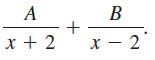
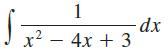
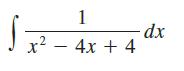
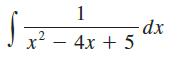
Three integrals are given that, although they look similar, may require different techniques of integration. Evaluate the integrals.a.b.c. 1 х2 — 4х + 3
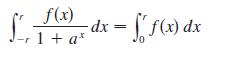
If f is an even function, r > 0, and a > 0, show that _f(x) -r 1 + a* f(x) dx xp *) xp-
Evaluate the integral.∫ sin5(2t) cos2(2t) dt
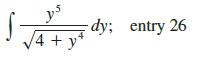
Use the formula in the indicated entry of the Table of Integrals on Reference Pages 6 –10 to evaluate the integral. y5 dy; entry 26 V4 + y*
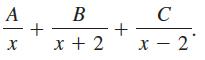
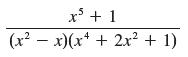
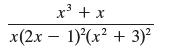
Write out the form of the partial fraction decomposition of the function. Do not determine the numerical values of the coefficients.a.b. x + 1 (x? – x)(x* + 2x² + 1)
Evaluate the integral.∫ te2t dt
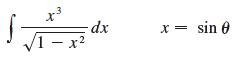
Evaluate the integral using the indicated trigonometric substitution. Sketch and label the associated right triangle. .3 = X sin 0 1-x2
Determine whether the integral is convergent or divergent. Evaluate integrals that are convergent.∫∞12x–3 dx
Evaluate the integral.∫π/60 t sin 2t dt
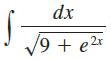
Determine whether the statement is true or false. If it is true, explain why. If it is false, explain why or give an example that disproves the statement.To evaluate we can use the formula in entry 25 of the Table of Integrals to obtain ln(ex + √9 + e2x ) + C. dx 2x
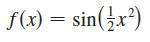
Draw the graph ofin the viewing rectangle [0, 1] by [0, 0.5] and let I = ∫10 f(x) dx.(a) Use the graph to decide whether L2, R2, M2, and T2 underestimate or overestimate I.(b) For any value of n, list the numbers Ln, Rn, Mn, Tn, and I in increasing order.(c) Compute L5, R5, M5, and T5. From the
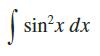
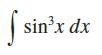
Three integrals are given that, although they look similar, may require different techniques of integration. Evaluate the integrals.a.b.c. | sin?x dx 2.
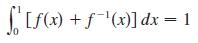
Suppose that f is a function that is continuous and increasing on [0, 1] such that f(0) = 0 and f(1) = 1. Show that [f(x) + f'(x)] dx = 1
Evaluate the integral.∫π/40 sin5x dx
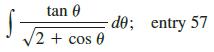
Use the formula in the indicated entry of the Table of Integrals on Reference Pages 6 –10 to evaluate the integral. tan 0 do; entry 57 2 + cos 0
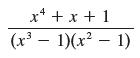
Write out the form of the partial fraction decomposition of the function. Do not determine the numerical values of the coefficients.a.b. x* – 1
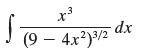
(a) Determine an appropriate trigonometric substitution.(b) Apply the substitution to transform the integral into a trigonometric integral. Do not evaluate the integral. (9 – 4x)/2
Evaluate the integral. sinx e -dx sec x
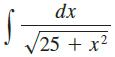
Determine whether the statement is true or false. If it is true, explain why. If it is false, explain why or give an example that disproves the statement.To evaluatean appropriate trigonometric substitution is x = 5 sin θ. dx V25 + x?
Evaluate I(T- x7 - VI- x³) dx.
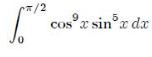
Evaluate the integral. /2 cos°x sin °x dx
Use the formula in the indicated entry of the Table of Integrals on Reference Pages 6 –10 to evaluate the integral. Sxa |x entry 87 arcsin(x) dx;
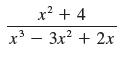
Write out the form of the partial fraction decomposition of the function. Do not determine the numerical values of the coefficients.a.b. x? + 4 x' - 3x? + 2x
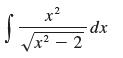
(a) Determine an appropriate trigonometric substitution.(b) Apply the substitution to transform the integral into a trigonometric integral. Do not evaluate the integral. x² dx x² - 2
Evaluate the integral. dx (x + 1)?
Determine whether the statement is true or false. If it is true, explain why. If it is false, explain why or give an example that disproves the statement.∫ x5ex dx can be evaluated by applying integration by parts five times.
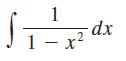
Three integrals are given that, although they look similar, may require different techniques of integration. Evaluate the integrals.a.b.c. 1 dx
Evaluate the integral.∫ cos6y sin3y dy
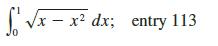
Use the formula in the indicated entry of the Table of Integrals on Reference Pages 6 –10 to evaluate the integral. - x? dx; entry 113
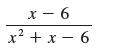
Write out the form of the partial fraction decomposition of the function. Do not determine the numerical values of the coefficients.a.b. х — 6 x? + x - 6
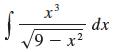
(a) Determine an appropriate trigonometric substitution.(b) Apply the substitution to transform the integral into a trigonometric integral. Do not evaluate the integral. dx 9- x2
Which of the following integrals are improper? Why?a.∫π0 sec x dxb.c.d. '4 dx Jo x - 5
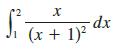
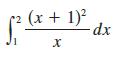
Evaluate the integral. (x + 1)
Determine whether the statement is true or false. If it is true, explain why. If it is false, explain why or give an example that disproves the statement.∫ tan–1x dx can be evaluated using integration by parts.
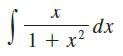
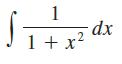
Three integrals are given that, although they look similar, may require different techniques of integration. Evaluate the integrals.a.b.c. 1 + x?
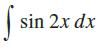
Evaluate the integral.∫ sin3x cos2x dx
Showing 3300 - 3400
of 4932
First
27
28
29
30
31
32
33
34
35
36
37
38
39
40
41
Last
Step by Step Answers

 Get 50% OFF
Claim Now
Get 50% OFF
Claim Now