New Semester
Started
Get
50% OFF
Study Help!
--h --m --s
Claim Now
Question Answers
Textbooks
Find textbooks, questions and answers
Oops, something went wrong!
Change your search query and then try again
S
Books
FREE
Study Help
Expert Questions
Accounting
General Management
Mathematics
Finance
Organizational Behaviour
Law
Physics
Operating System
Management Leadership
Sociology
Programming
Marketing
Database
Computer Network
Economics
Textbooks Solutions
Accounting
Managerial Accounting
Management Leadership
Cost Accounting
Statistics
Business Law
Corporate Finance
Finance
Economics
Auditing
Tutors
Online Tutors
Find a Tutor
Hire a Tutor
Become a Tutor
AI Tutor
AI Study Planner
NEW
Sell Books
Search
Search
Sign In
Register
study help
mathematics
calculus early transcendentals
Calculus Early Transcendentals 2nd edition William L. Briggs, Lyle Cochran, Bernard Gillett - Solutions
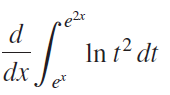
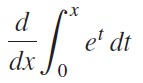
Simplify the following expressions. In t? dt dx . et
Estimate the area of the region bounded by the graph of f(x) = x2 + 2 and the x-axis on 30, 24 in the following ways.a. Divide [0, 2] into n = 4 subintervals and approximate the area of the region using a left Riemann sum. Illustrate the solution geometrically.b. Divide [0, 2] into n = 4
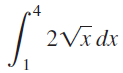
Consider the following definite integrals.a. Write the midpoint Riemann sum in sigma notation for an arbitrary value of n.b. Evaluate each sum using a calculator with n = 20, 50, and 100. Use these values to estimate the value of the integral. 2Vx dx
Use a change of variables to evaluate the following integrals.∫ sec2 10x dx
Simplify the following expressions. d e' dt dx
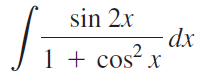
Evaluate the following integrals.(sin 2x = 2 sin x cos x.) sin 2x 1 + cos´ X 2.
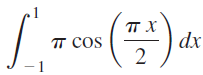
Consider the following definite integrals.a. Write the left and right Riemann sums in sigma notation, for n = 20, 50, and 100. Then evaluate the sums using a calculator.b. Based on your answers to part (a), make a conjecture about the value of the definite integral. тх dx 2 т coS
Use a change of variables to evaluate the following integrals.∫ sec 4w tan 4w dw
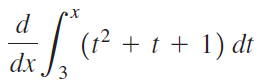
Simplify the following expressions. (t² + t + 1) dt 3 dx
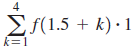
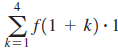
Fill in the blanks with right or midpoint, an interval, and a value of n. In some cases, more than one answer may work.is a ______ Riemann sum for f on the interval [___, ___] with n = ______. 4 |Ef(1.5 k=1 + k) • 1
Prove that for nonzero constants a and b, 1 tan ab dx ах + C. -1 a²x² + b² ||
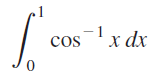
Consider the following definite integrals.a. Write the left and right Riemann sums in sigma notation, for n = 20, 50, and 100. Then evaluate the sums using a calculator.b. Based on your answers to part (a), make a conjecture about the value of the definite integral. cosx dx
Determine whether the following statements are true and give an explanation or counterexample. Assume that f, f', and f" are continuous functions for all real numbers.a. b.
Find the area of the region bounded by the graph of f and the x-axis on the given interval.f(x) = cos x on [π/2, π]
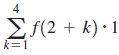
Fill in the blanks with right or midpoint, an interval, and a value of n. In some cases, more than one answer may work.is a ______ Riemann sum for f on the interval [___, ___] with n = ______. 4 Ef(2 + k) • 1 k=1
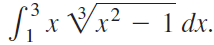
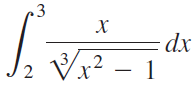
Use the change of variables u3 = x2 - 1 to evaluate the integral Vx² – 1 dx. •3 x
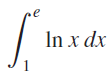
Consider the following definite integrals.a. Write the left and right Riemann sums in sigma notation, for n = 20, 50, and 100. Then evaluate the sums using a calculator.b. Based on your answers to part (a), make a conjecture about the value of the definite integral. In x dx
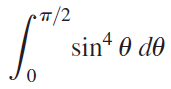
Evaluate the following integrals. • T/2 sin 0 do
Find the area of the region bounded by the graph of f and the x-axis on the given interval.f(x) = sin x on [-π/4, 3π/4]
Fill in the blanks with right or midpoint, an interval, and a value of n. In some cases, more than one answer may work.is a ______ Riemann sum for f on the interval [___, ___] with n = ______. 4 Ef(1 + k) • . k=1
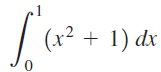
Consider the following definite integrals.a. Write the left and right Riemann sums in sigma notation, for n = 20, 50, and 100. Then evaluate the sums using a calculator.b. Based on your answers to part (a), make a conjecture about the value of the definite integral. (x² + 1) dx
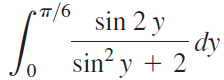
Evaluate the following integrals.sin 2y = 2 sin y cos y T/6 sin 2 y dy sin? y + 2
Find the area of the region bounded by the graph of f and the x-axis on the given interval.f(x) = x(x + 1)(x - 2) on [-1, 2]
Use sigma notation to write the following Riemann sums. Then evaluate each Riemann sum using Theorem 5.1 or a calculator.The midpoint Riemann sum for f(x) = 1 + cos πx on [0, 2] with n = 50
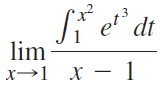
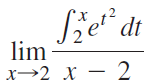
Evaluate the following limits. Si e* dt lim х>1 х — 1
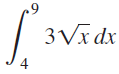
Consider the following definite integrals.a. Write the left and right Riemann sums in sigma notation, for n = 20, 50, and 100. Then evaluate the sums using a calculator.b. Based on your answers to part (a), make a conjecture about the value of the definite integral. 3Vx dx 4
Evaluate the following integrals.∫ x cos2 (x)2 dx
Find the area of the region bounded by the graph of f and the x-axis on the given interval.f(x) = 1/x on [-2, -1]
Use sigma notation to write the following Riemann sums. Then evaluate each Riemann sum using Theorem 5.1 or a calculator.The midpoint Riemann sum for f(x) = x3 on [3, 11] with n = 32
Evaluate the following limits.
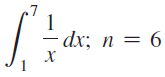
Complete the following steps for the given integral and the given value of n. a. Sketch the graph of the integrand on the interval of integration.b. Calculate Δx and the grid points x0, x1, · · · · , xn, assuming a regular partition.c. Calculate the left and right Riemann sums for the
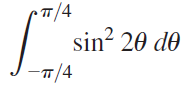
Evaluate the following integrals. -п/4 sin? 20 dө -п/4
Find the area of the region bounded by the graph of f and the x-axis on the given interval.f(x) = x3 - 1 on [-1, 2]
Use sigma notation to write the following Riemann sums. Then evaluate each Riemann sum using Theorem 5.1 or a calculator.The left Riemann sum for f(x) = ex on [0, ln 2] with n = 40
a. Evaluate G(-1) and G(1).b. Use the Fundamental Theorem to find an expression for G'(x), for -2 ≤ x < 0.c. Use the Fundamental Theorem to find an expression for G'(x), for 0 ≤ x ≤ 2.d. Evaluate G'(0) and G'(1). Interpret these values.e. Find a constant C such that F(x) = G(x) + C.
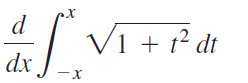
Simplify the following expressions. V1 + t² dt dx
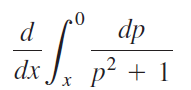
Simplify the following expressions. dp dx p² + 1 х
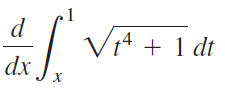
Simplify the following expressions. V14 + 1 dt |dx х х
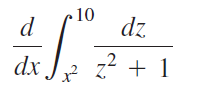
Simplify the following expressions. 10 dz z² + 1 dx
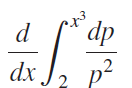
Simplify the following expressions. dp dx
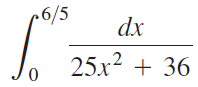
Use a change of variables to evaluate the following integrals. •6/5 dx 25x2 + 36
Use a change of variables to evaluate the following integrals. .3 х dx Vx² – 1
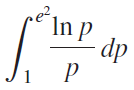
Use a change of variables to evaluate the following integrals. In p dp
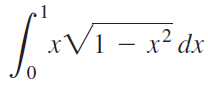
Use a change of variables to evaluate the following integrals. Vi - x² dx х
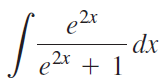
Use a change of variables to evaluate the following integrals. e2r ,2x e&t - dx 2x
Use a change of variables to evaluate the following integrals.∫ sin x sec8 x dx
Use a change of variables to evaluate the following integrals.∫ (x3/2 + 8)5 √x dx
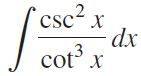
Use a change of variables to evaluate the following integrals. *csc² x cot x .3
Use a change of variables to evaluate the following integrals.∫ (sin5 x + 3 sin3 x - sin x) cos x dx
Suppose f is continuous on (0, ∞) and A(x) is the net area of the region bounded by the graph of f and the t-axis on [0, x]. Show that the local maxima and minima of A occur at the zeros of f. Verify this fact with the function f(x) = x2 - 10x.
If necessary, use two or more substitutions to find the following integrals.tan10 4x sec2 4x dx Begin with u = 4x.
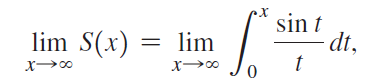
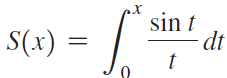
Use a calculator to approximatewhere S is the sine integral function. Explain your reasoning. sin t lim S(x) = lim dt, lim
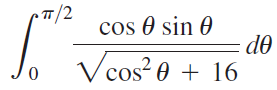
If necessary, use two or more substitutions to find the following integrals. T/2 cos 0 sin 0 dө Vcos? 0 + 16
Show that the sine integral satisfies the (differential) equation xS'(x) + 2S"(x) + xS"'(x) = 0. sin t dt S(x) =
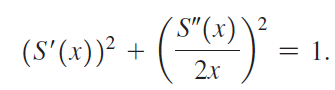
Show that the Fresnel integralsatisfies the (differential) equation
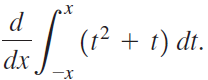
Evaluate Separate the integral into two pieces. (1² + t) dt. dx
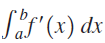
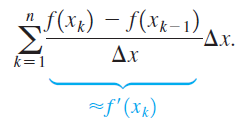
In this exercise, we work with a discrete problem and show why the relationshipisanalogous tob. Simplify the sum in part (a) and show that it is equal to f(b) - f(a).c. Explain the correspondence between the integral relationship and the summation relationship. | Sas"(x) dx = f(b) – f(a)
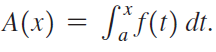
Assume that f is continuous on [a, b] and let A be the area function for f with left endpoint a. Let m* and M* be the absolute minimum and maximum values of f on [a, b], respectively.a. Prove that m*(x - a) ≤ A(x) ≤ M* (x - a) for all x in [a, b]. Use this result and the Squeeze Theorem to
Consider the integral I = ∫sin2 x cos2 x dx.a. Find I using the identity sin 2x = 2 sin x cos x.b. Find I using the identity cos2 x = 1 - sin2 x.c. Confirm that the results in parts (a) and (b) are consistent and compare the work involved in each method.
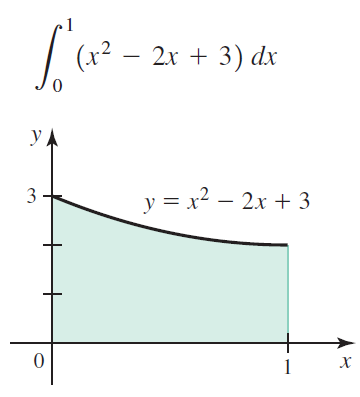
Evaluate the following integrals using the Fundamental Theorem of Calculus. Explain why your result is consistent with the figure. Ге-в (x2 — 2х + 3) dx УА 3 у %3D х2 — 2х + 3 х 1
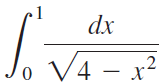
Evaluate the following integrals. dx V4 - x2 – *
Complete the following steps for the given function, interval, and value of n.a. Sketch the graph of the function on the given interval.b. Calculate Δx and the grid points x0, x1, · · · · xn.c. Illustrate the left and right Riemann sums. Then determine which Riemann sum underestimates and
Consider the following limits of Riemann sums for a function f on [a, b]. Identify f and express the limit as a definite integral. lim (4 - x)Axg on [-2, 2] A→0 k=1
Use a change of variables to find the following indefinite integrals. Check your work by differentiating.∫ (x2 + x)10 (2x + 1) dx
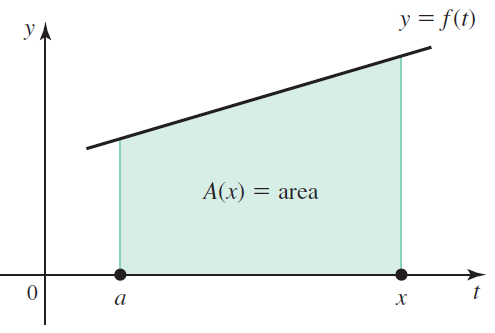
Consider the following functions f and real numbers a (see figure).a. Find and graph the area function b. Verify that A'(x) = f(x).f(t) = 3t + 1, a = 2 A(x) = SÄf(1) dt. y = f(t) A(х) — area х
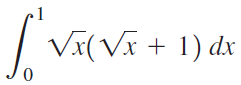
Evaluate the following integrals. || Vã(Vx + 1) dx + 1) dx
Complete the following steps for the given function, interval, and value of n.a. Sketch the graph of the function on the given interval.b. Calculate Δx and the grid points x0, x1, · · · · xn.c. Illustrate the left and right Riemann sums. Then determine which Riemann sum underestimates and
Consider the following limits of Riemann sums for a function f on [a, b]. Identify f and express the limit as a definite integral. *2 + 1)Axz on [0, 2] lim (x A→0 k=1
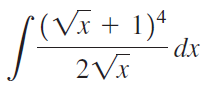
Use a change of variables to find the following indefinite integrals. Check your work by differentiating. (V + 1)ª dx 4 2Vx
Consider the following functions f and real numbers a (see figure).a. Find and graph the area function b. Verify that A'(x) = f(x).f(t) = 2t + 5, a = 0 A(x) = SÄf(1) dt. y = f(t) A(х) — area х
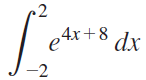
Evaluate the following integrals. e 4x+8 4х+8 -2
Complete the following steps for the given function, interval, and value of n.a. Sketch the graph of the function on the given interval.b. Calculate Δx and the grid points x0, x1, · · · · xn.c. Illustrate the left and right Riemann sums. Then determine which Riemann sum underestimates and
The following functions are negative on the given interval.a. Sketch the function on the given interval.b. Approximate the net area bounded by the graph of f and the x-axis on the interval using a left, right, and midpoint Riemann sum with n = 4.f(x) = x3 - 1 on [-2, 0]
Consider the function f(x) = 3x + 4 on the interval [3, 7]. Show that the midpoint Riemann sum with n = 4 gives the exact area of the region bounded by the graph.
Find the dimensions of the right circular cylinder of maximum volume that can be placed inside a sphere of radius R.
Without evaluating derivatives, which of the functions g(x) = 2x10, h(x) = x10 + 2, and p(x) = x10 - ln 2 have the same derivative as f(x) = x10?
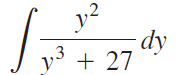
Evaluate the following integrals. y2 dy + 27 y3
Consider the following functions f and real numbers a (see figure).a. Find and graph the area function b. Verify that A'(x) = f(x).f(t) = 4t + 2, a = 0 A(x) = SÄf(1) dt. y = f(t) A(х) — area х
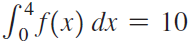
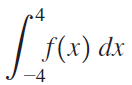
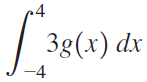
Suppose thatFurthermore, suppose that f is an even function and g is an odd function. Evaluate the following integrals.a.b.c.d.e. Sis(x) dx = 10 f(x) dx -4
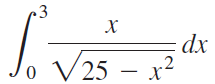
Evaluate the following integrals. .3 dx V25 – x² 25
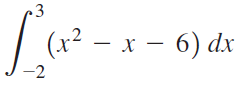
Evaluate the following integrals using the Fundamental Theorem of Calculus. Sketch the graph of the integrand and shade the region whose net area you have found. (x2 - x - 6) dx -2
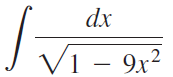
Use a change of variables to find the following indefinite integrals. Check your work by differentiating. dx VI - .2 /1 – 9x²
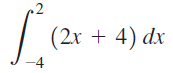
Use geometry (not Riemann sums) to evaluate the following definite integrals. Sketch a graph of the integrand, show the region in question, and interpret your result. .2 (2x + 4) dx -4
Complete the following steps for the given function, interval, and value of n.a. Sketch the graph of the function on the given interval.b. Calculate Δx and the grid points x0, x1, · · · · xn.c. Illustrate the left and right Riemann sums. Then determine which Riemann sum underestimates and
Evaluate the following integrals.∫ x sin x2 cos8 x2 dx
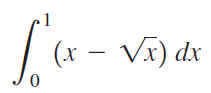
Evaluate the following integrals using the Fundamental Theorem of Calculus. Sketch the graph of the integrand and shade the region whose net area you have found. (x – Vã) dx
Use a change of variables to find the following indefinite integrals. Check your work by differentiating.∫ x9 sin x10 dx
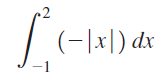
Use geometry (not Riemann sums) to evaluate the following definite integrals. Sketch a graph of the integrand, show the region in question, and interpret your result. | (-\x\) dx
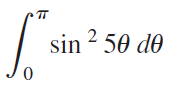
Evaluate the following integrals. sin 2 50 de
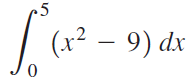
Evaluate the following integrals using the Fundamental Theorem of Calculus. Sketch the graph of the integrand and shade the region whose net area you have found. .5 (x² – 9) dx
Use a change of variables to find the following indefinite integrals. Check your work by differentiating.∫ (x6 - 3x2)4 (x5 - x) dx
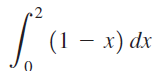
Use geometry (not Riemann sums) to evaluate the following definite integrals. Sketch a graph of the integrand, show the region in question, and interpret your result. (1 — х) dx
The following third- and fourth degree polynomials have a property that makes them relatively easy to graph. Make a complete graph and describe the property.f(x) = x3 - 6x2 - 135x
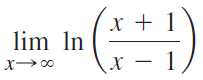
Evaluate the following limits. Use l’Hôpital’s Rule when needed. х lim In х- - 1, х
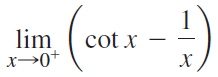
Evaluate the following limits. lim x→0+ cot x
Consider the following functions and express the relationship between a small change in x and the corresponding change in y in the form dy = f'(x) dx. f(x) = ln (1 - x)
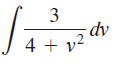
Determine the following indefinite integrals. Check your work by differentiation. 3 dv 4 + v²
Verify that the following functions satisfy the conditions of Theorem 4.5 on their domains. Then find the location and value of the absolute extremum guaranteed by the theorem.f(x) = 4x + 1/√1x
a. Find the critical points of f on the given interval.b. Determine the absolute extreme values of f on the given interval when they exist.c. Use a graphing utility to confirm your conclusions.f(x) = 2x6 - 15x4 + 24x2 on [-2, 2]
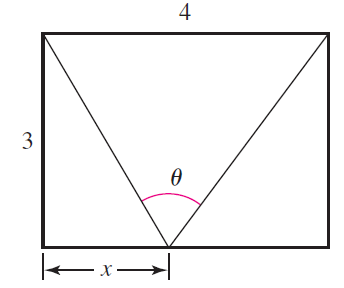
Find the value of x that maximizes θ in the figure. 4 3 – x→|
Showing 3800 - 3900
of 6775
First
32
33
34
35
36
37
38
39
40
41
42
43
44
45
46
Last
Step by Step Answers

 Get 50% OFF
Claim Now
Get 50% OFF
Claim Now








![lim (4 - x)Axg on [-2, 2] A→0 k=1](https://dsd5zvtm8ll6.cloudfront.net/si.question.images/images/question_images/1551/2/7/8/5495c76a1d5556101551261292325.jpg)
![*2 + 1)Axz on [0, 2] lim (x A→0 k=1](https://dsd5zvtm8ll6.cloudfront.net/si.question.images/images/question_images/1551/2/7/8/5135c76a1b1dbddb1551261256883.jpg)