New Semester
Started
Get
50% OFF
Study Help!
--h --m --s
Claim Now
Question Answers
Textbooks
Find textbooks, questions and answers
Oops, something went wrong!
Change your search query and then try again
S
Books
FREE
Study Help
Expert Questions
Accounting
General Management
Mathematics
Finance
Organizational Behaviour
Law
Physics
Operating System
Management Leadership
Sociology
Programming
Marketing
Database
Computer Network
Economics
Textbooks Solutions
Accounting
Managerial Accounting
Management Leadership
Cost Accounting
Statistics
Business Law
Corporate Finance
Finance
Economics
Auditing
Tutors
Online Tutors
Find a Tutor
Hire a Tutor
Become a Tutor
AI Tutor
AI Study Planner
NEW
Sell Books
Search
Search
Sign In
Register
study help
mathematics
calculus early transcendentals
Calculus Early Transcendentals 2nd edition William L. Briggs, Lyle Cochran, Bernard Gillett - Solutions
Evaluate the following integrals.∫ cos3 20x dx
Evaluate the following integrals.∫ sin5 x dx
Evaluate the following integrals.∫ cos4 2θ dθ
Evaluate the following integrals.∫ cos3 x dx
Evaluate the following integrals.∫ sin3 x dx
How would you evaluate ∫ sec12 x tan x dx?
How would you evaluate ∫ tan10 x sec2 x dx?
How would you evaluate ∫ cos2 x sin3 x dx?
What is a reduction formula?
Describe the method used to integrate sinm x cosn x, for m even and n odd.
Describe the method used to integrate sin3 x.
State the three Pythagorean identities.
State the half-angle identities used to integrate sin2 x and cos2 x.
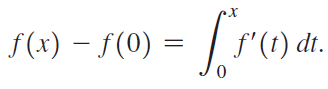
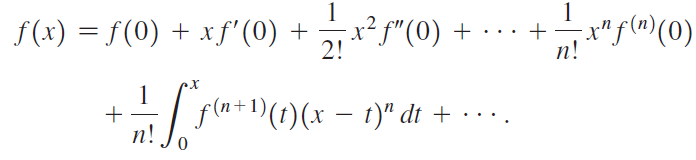
Suppose that a function f has derivatives of all orders near x = 0. By the Fundamental Theorem of Calculus,a. Evaluate the integral using integration by parts to show that
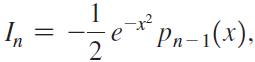
Let In = ∫xne-x2 dx, where n is a nonnegative integer. a. I0 = ∫ e-x2 dx cannot be expressed in terms of elementary functions. Evaluate I1. b. Use integration by parts to evaluate I3.c. Use integration by parts and the result of part (b) to evaluate I5.d. Show that, in
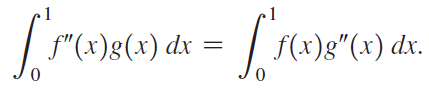
Show that if f and g have continuous second derivatives and f(0) = f(1) = g(0) = g(1) = 0, then frome) f(x)g"(x) dx. f"(x)g(x) dx
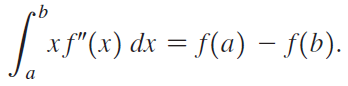
Show that if f has a continuous second derivative on [a, b] and f'(a) = f'(b) = 0, then
Use integration by parts to show that if f' is continuous on [a, b], then
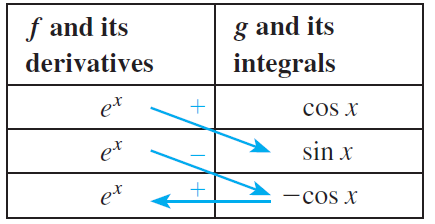
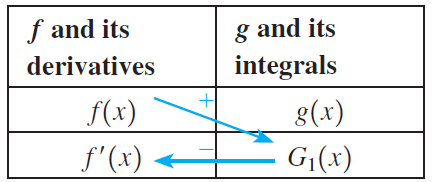
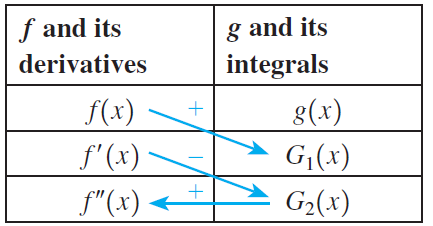
Refer to Exercise 71.a. The following table shows the method of tabular integration applied to ∫ ex cos x dx. Use the table to express ∫ ex cos x dx in terms of the sum of functions and an indefinite integral.b. Solve the equation in part (a) for ∫ ex cos x dx.c. Evaluate ∫e-2x sin 3x
Evaluate the following integrals using tabular integration (refer to Exercise 71).a. ∫ x4 ex dxb. ∫ 7xe3xdxc. d. ∫ (x3 - 2x) sin 2x dxe.
Consider the integral ∫ f(x)g(x) dx, where f and g are sufficiently “smooth” to allow repeated differentiation and integration, respectively. Let Gk represent the result of calculating k indefinite integrals of g, where the constants of integration are omitted.a. Show that integration by
Suppose you evaluate ∫ dx/x using integration by parts. With u = 1/x and dv = dx, you find that du = -1/x2 dx, v = x, andYou conclude that 0 = 1. Explain the problem with the calculation. /4-()- - /()«-- dx dx. dx = 1 + .2
Suppose a mass on a spring that is slowed by friction has the position function s(t) = e-t sin t. a. Graph the position function. At what times does the oscillator pass through the position s = 0?b. Find the average value of the position on the interval [0, π].c. Generalize part (b) and find
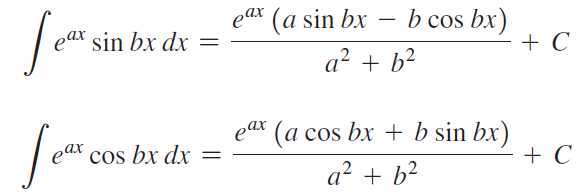
Use integration by parts to derive the following formulas for real numbers a and b. b cos bx) (a sin bx ear eax sin bx dx a² + b² (a cos bx + b sin bx) ear eat cos bx dx a? + b2
Use integration by parts to show that sec' x dx sec x dx. sec x tan x +
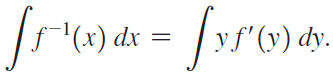
Assume that f has an inverse on its domain.a. Let y = f-1(x) and show that
a. Use integration by parts to show that if f' is continuous,b. Use part (a) to evaluate ∫ xe3x dx. xf'(x) dx = xf(x) · f(x) dx.
Use integration by parts to show that for m ≠ -1,
Let R be the region bounded by y = sin x and the x-axis on the interval [0, π]. Which is greater, the volume of the solid generated when R is revolved about the x-axis or the volume of the solid generated when R is revolved about the y-axis?
Find the area of the region bounded by the curves y = sin x and y = sin-1 x on the interval [0, 1/2].
Find the volume of the solid generated when the region bounded by y = cos x and the x-axis on the interval [0, π/2] is revolved about the y-axis.
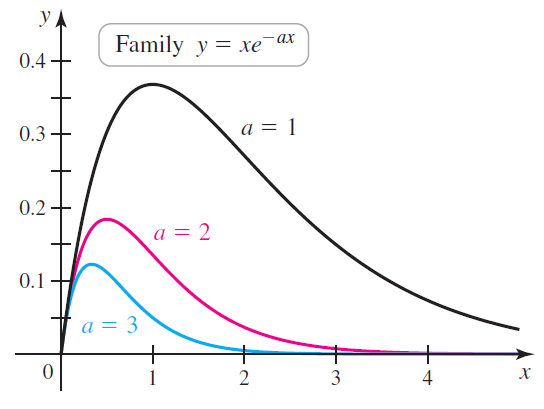
The curves y = xe-ax are shown in the figure for a = 1, 2, and 3.a. Find the area of the region bounded by y = xe-x and the x-axis on the interval [0, 4].b. Find the area of the region bounded by y = xe-ax and the x-axis on the interval [0, 4], where a > 0.c. Find the area of the region
Find the arc length of the function SVIn? t – 1 dt on [e, e³]. f(x) =
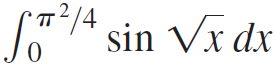
Evaluate using a substitution followed by integration by parts. SA sin Vx dx 2/4 TT
Evaluate ∫ cos √x dx using a substitution followed by integration by parts.
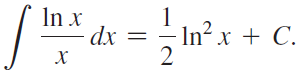
Evaluate ∫sin x cos x dx using integration by parts. Then evaluate the integral using a substitution. Reconcile your answers.
Prove that S log, x dx x) + C. (x In x – In b
a. Evaluate ∫ x ln x2 dx using the substitution u = x2 and evaluating ∫ ln u du.b. Evaluate ∫ x ln x2 dx using integration by parts.c. Verify that your answers to parts (a) and (b) are consistent.
Use a substitution to reduce the following integrals to ∫ ln u du. Then evaluate the resulting integral.∫ (sec2 x) ln (tan x + 2) dx
Use a substitution to reduce the following integrals to ∫ ln u du. Then evaluate the resulting integral.∫ (cos x) ln (sin x) dx
Use the reduction formulas to evaluate the following integrals.∫ ln4 x dx
Use the reduction formulas to evaluate the following integrals.∫ x3 sin x dx
Use the reduction formulas to evaluate the following integrals.∫ x2 cos 5x dx
Use the reduction formulas to evaluate the following integrals.∫ x2 e3x dx
Use integration by parts to derive the following reduction formulas.
Use integration by parts to derive the following reduction formulas.
Use integration by parts to derive the following reduction formulas.
Use integration by parts to derive the following reduction formulas.
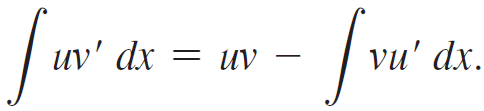
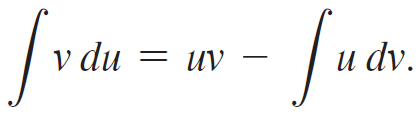
Determine whether the following statements are true and give an explanation or counterexample.a.b.c. ΥT-) υw' dk ν' d uαr uv' dx vu' dx. = UV
Find the volume of the solid that is generated when the given region is revolved as described.The region bounded by f(x) = e-x and the x-axis on [0, ln 2] is revolved about the line x = ln 2.
Find the volume of the solid that is generated when the given region is revolved as described.The region bounded by f(x) = x ln x and the x-axis on [1, e2] is revolved about the x-axis.
Find the volume of the solid that is generated when the given region is revolved as described.The region bounded by f(x) = sin x and the x-axis on [0, π] is revolved about the y-axis.
Find the volume of the solid that is generated when the given region is revolved as described.The region bounded by f(x) = e-x, x = ln 2, and the coordinate axes is revolved about the y-axis.
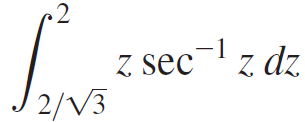
Evaluate the following definite integrals. •2 -1 Z sec¯' z dz 2/V3
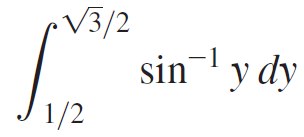
Evaluate the following definite integrals. V3/2 siny dy 1/2
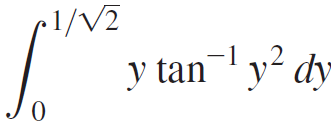
Evaluate the following definite integrals. c1/V2 y tan y² dy Jo
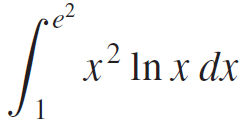
Evaluate the following definite integrals. x² In x dx
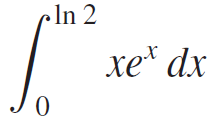
Evaluate the following definite integrals. In 2 xe' dx
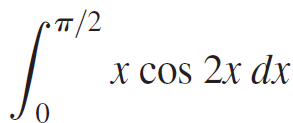
Evaluate the following definite integrals. 7/2 X Cos 2x dx
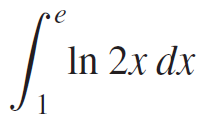
Evaluate the following definite integrals. In 2x dx
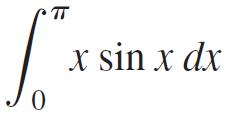
Evaluate the following definite integrals. x sin x dx х
Evaluate the following integrals.∫ x2 e4x dx
Evaluate the following integrals.∫ x2 sin 2x dx
Evaluate the following integrals.∫ e-2θ sin 6θ dθ
Evaluate the following integrals.∫ ex cos x dx
Evaluate the following integrals.∫ x2 ln2 x dx
Evaluate the following integrals.∫ e-x sin 4x dx
Evaluate the following integrals.∫ e3x cos 2x dx
Evaluate the following integrals.∫ t2e-t dt
Evaluate the following integrals.∫ x tan-1 x2 dx
Evaluate the following integrals.∫ x sin x cos x dx
Evaluate the following integrals.∫ x sec-1 x dx, x ≥ 1
Evaluate the following integrals.∫ tan-1 x dx
Evaluate the following integrals.∫ sin-1 x dx
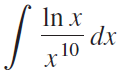
Evaluate the following integrals. In x dx 10
Evaluate the following integrals.∫ x ln x dx
Evaluate the following integrals.∫ x2 ln x dx
Evaluate the following integrals.∫ θ sec2 θ dθ
Evaluate the following integrals.∫ x2 ln x3 dx
Evaluate the following integrals.∫ se-2s ds
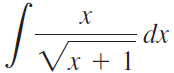
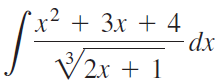
Evaluate the following integrals. х dx Vx + 1
Evaluate the following integrals.∫ 2xe3x dx
Evaluate the following integrals.∫ tet dt
Evaluate the following integrals.∫ x sin 2x dx
Evaluate the following integrals.∫ x cos x dx
What choices for u and dv simplify ∫ tan-1 x dx?
What type of integrand is a good candidate for integration by parts?
Explain how integration by parts is used to evaluate a definite integral.
How would you choose u when evaluating ∫ xn cos ax dx using integration by parts?
How would you choose dv when evaluating ∫ xn eax dx using integration by parts?
On which derivative rule is integration by parts based?
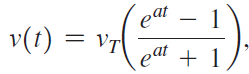
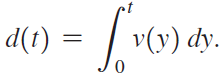
A skydiver in free fall subject to gravitational acceleration and air resistance has a velocity given bywhere vT is the terminal velocity and a > 0 is a physical constant. Find the distance that the skydiver falls after t seconds, which is eat – 1 v(t) = vr eat d0) = [vo)
Let f(x) = √x + 1. Find the area of the surface generated when the region bounded by the graph of f on the interval [0, 1] is revolved about the x-axis.
Find the area of the surface generated when the region bounded by the graph of y = ex + 1/4 e-x on the interval [0, ln 2] is revolved about the x-axis.
Find the length of the curve y = x5/4 on the interval [0, 1]. Write the arc length integral and let u2 = 1 + (5/4)2 √x.)
Consider the region R bounded by the graph of f(x) = 1/x + 2 and the x-axis on the interval [0, 3].a. Find the volume of the solid formed when R is revolved about the x-axis.b. Find the volume of the solid formed when R is revolved about the y-axis.
Consider the region R bounded by the graph of f(x) = √x2 + 1 and the x-axis on the interval [0, 2].a. Find the volume of the solid formed when R is revolved about the x-axis.b. Find the volume of the solid formed when R is revolved about the y-axis.
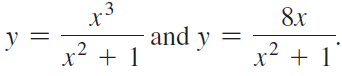
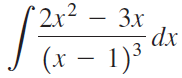
Find the area of the entire region bounded by the curves .3 х 8x and y x² + 1 y + 1 .2 .2 + 1 ||
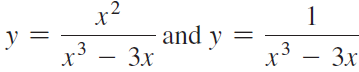
Find the area of the region bounded by the curves on the interval [2, 4]. 1 x2 and y Зх x³ - 3x x3
a. Show that using either u = 2x - 1 or u = x -1/2.b. Show that c. Prove the identity 2 sin-1√x - sin-1 (2x - 1) = π/2. dx sin (2x – 1) + C Vx – x² dx Vx. 2 sinlVx + C using u -1. Vx –
Showing 3300 - 3400
of 6775
First
27
28
29
30
31
32
33
34
35
36
37
38
39
40
41
Last
Step by Step Answers

 Get 50% OFF
Claim Now
Get 50% OFF
Claim Now








![SVIn? t – 1 dt on [e, e³]. f(x) =](https://dsd5zvtm8ll6.cloudfront.net/si.question.images/images/question_images/1551/9/5/6/2575c80f921208471551939004640.jpg)