New Semester
Started
Get
50% OFF
Study Help!
--h --m --s
Claim Now
Question Answers
Textbooks
Find textbooks, questions and answers
Oops, something went wrong!
Change your search query and then try again
S
Books
FREE
Study Help
Expert Questions
Accounting
General Management
Mathematics
Finance
Organizational Behaviour
Law
Physics
Operating System
Management Leadership
Sociology
Programming
Marketing
Database
Computer Network
Economics
Textbooks Solutions
Accounting
Managerial Accounting
Management Leadership
Cost Accounting
Statistics
Business Law
Corporate Finance
Finance
Economics
Auditing
Tutors
Online Tutors
Find a Tutor
Hire a Tutor
Become a Tutor
AI Tutor
AI Study Planner
NEW
Sell Books
Search
Search
Sign In
Register
study help
mathematics
calculus early transcendentals
Calculus Early Transcendentals 2nd edition William L. Briggs, Lyle Cochran, Bernard Gillett - Solutions
Choose the general slicing method, the disk/washer method, or the shell method to answer the following questions.The region bounded by y = (1 - x2)-1/2 and the x-axis over the interval [0, √3/2] is revolved around the y-axis. What is the volume of the solid that is generated?
Choose the general slicing method, the disk/washer method, or the shell method to answer the following questions.The region bounded by the curves y = sec x and y = 2, for 0 ≤ x ≤ π/3, is revolved around the x-axis. What is the volume of the solid that is generated?
Choose the general slicing method, the disk/washer method, or the shell method to answer the following questions.The region bounded by the graphs of x = 0, x = √ln y, and x = √2 - ln y in the first quadrant is revolved about the y-axis. What is the volume of the resulting solid?
Choose the general slicing method, the disk/washer method, or the shell method to answer the following questions.The region bounded by the curves y = 2e-x, y = ex, and the y-axis is revolved about the x-axis. What is the volume of the solid that is generated?
Choose the general slicing method, the disk/washer method, or the shell method to answer the following questions.The region bounded by the curves y = 1 + √x, y = 1 - √x, and the line x = 1 is revolved about the y-axis. Find the volume of the resulting solid by (a) Integrating with respect
Choose the general slicing method, the disk/washer method, or the shell method to answer the following questions.The region bounded by the curves y = -x2 + 2x + 2 and y = 2x2 - 4x + 2 is revolved about the x-axis. What is the volume of the solid that is generated?
Choose the general slicing method, the disk/washer method, or the shell method to answer the following questions.What is the volume of the solid whose base is the region in the first quadrant bounded by y = √x, y = 2 - x, and the y-axis, and whose cross sections perpendicular to the base and
Choose the general slicing method, the disk/washer method, or the shell method to answer the following questions.What is the volume of the solid whose base is the region in the first quadrant bounded by y = √x, y = 2 - x, and the x-axis, and whose cross sections perpendicular to the base and
Choose the general slicing method, the disk/washer method, or the shell method to answer the following questions.What is the volume of the solid whose base is the region in the first quadrant bounded by y = √x, y = 2 - x, and the x-axis, and whose cross sections perpendicular to the base and
The region R in the first quadrant bounded by the parabola y = 4 - x2 and the coordinate axes is revolved about the y-axis to produce a dome-shaped solid. Find the volume of the solid in the following ways.a. Apply the disk method and integrate with respect to y.b. Apply the shell method and
Consider the functions y = x2/a and y = √x/a, where a > 0. Find A(a), the area of the region between the curves.
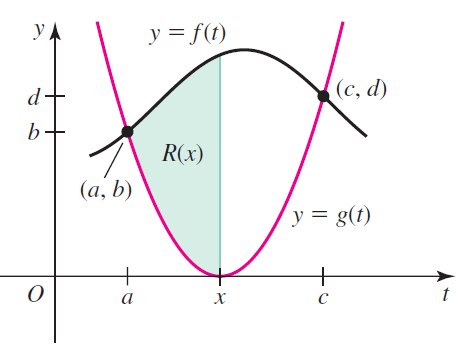
Let R(x) be the area of the shaded region between the graphs of y = f(t) and y = g(t) on the interval [a, x] (see figure).a. Sketch a plausible graph of R, for a ≤ x ≤ c.b. Give expressions for R(x) and R'(x), for a ≤ x ≤ c. УА y = f(t) (c, d) R(x) (a, b) y = g(t) + a х
Use any method to find the area of the region described.The region in the first quadrant bounded by y = x/6 and y = 1 - |x/2 - 1|
Use any method to find the area of the region described.The region in the first quadrant bounded by the curve √x + √y = 1
Use any method to find the area of the region described.The region bounded by y = x2, y = 2x2 - 4x, and y = 0
Use any method to find the area of the region described.The region between y = sin x and y = x on the interval [0, 2π]
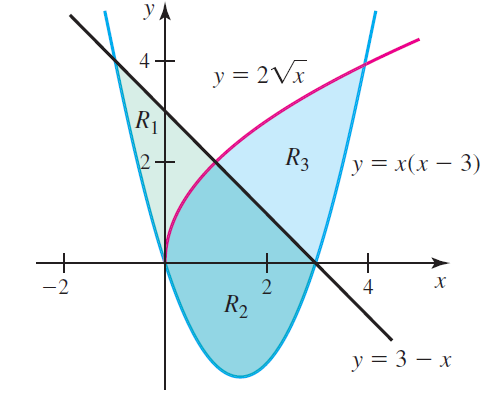
Use any method to find the area of the region described.The regions R1, R2, and R3 (separately) shown in the figure, which are formed by the graphs of y = 2√x, y = 3 - x, and y = x(x - 3) (First find the intersection points by inspection.) y y = 2Vx R1 R3 у%3D х(х — 3) х 4 R2 y = 3 – x 4.
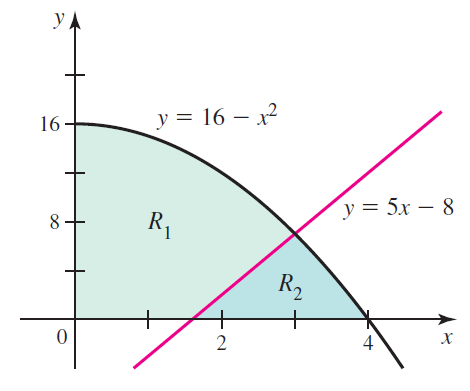
Use any method to find the area of the region described.The regions R1 and R2 (separately) shown in the figure, which are formed by the graphs of y = 16 - x2 and y = 5x - 8 у%3D 16 — х2 16 у 3 5х — 8 R1 R, + 4
Use any method to find the area of the region described.The region in the first quadrant bounded by y = 4x and y = x√25 - x2
Use any method to find the area of the region described.The region in the first quadrant bounded by y = xp and y = p√x, where p = 100 and p = 1000
Tom and Sue took a bike ride, both starting at the same time and position. Tom started riding at 20 mi/hr, and his velocity decreased according to the function v(t) = 20e-2t for t ≥ 0. Sue started riding at 15 mi/hr, and her velocity decreased according to the function u(t) = 15e-t for t ≥ 0.a.
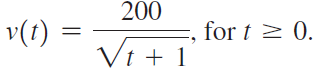
A projectile is fired upward, and its velocity (in m/s) is given by a. Graph the velocity function for t ≥ 0.b. Find and graph the position function for the projectile, for t ≥ 0, assuming s(0) = 0.c. Given unlimited time, can the projectile travel 2500 m? If so, at what time does the distance
A projectile is fired upward, and its velocity in m/s is given by v(t) = 200e-t/10, for t ≥ 0.a. Graph the velocity function for t ≥ 0.b. When does the velocity reach 50 m/s?c. Find and graph the position function for the projectile for t ≥ 0, assuming s(0) = 0.d. Given unlimited time,
Water flows out of a tank at a rate (in m3/hr) given by V'(t) = 15/(t + 1). If the tank initially holds 75 m3 of water, when will the tank be empty?
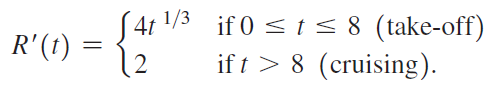
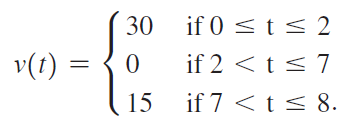
A small plane in flight consumes fuel at a rate (in gal/min) given bya. Find a function R that gives the total fuel consumed, for 0 ≤ t ≤ 8.b. Find a function R that gives the total fuel consumed, for t ≥ 0.c. If the fuel tank capacity is 150 gal, when does the fuel run out? if 0 < t < 8
Starting at the same point on a straight road, Anna and Benny begin running with velocities (in mi/hr) given by vA(t) = 2t + 1 and vB(t) = 4 - t, respectively. a. Graph the velocity functions, for 0 ≤ t ≤ 4.b. If the runners run for 1 hr, who runs farther? Interpret your conclusion
The acceleration of an object moving along a line is given by a(t) = 2 sin(πt/4). The initial velocity and position are v(0) = -8/π and s(0) = 0.a. Find the velocity and position for t ≥ 0.b. What are the minimum and maximum values of s?c. Find the average velocity and average position over the
At t = 0, a car begins decelerating from a velocity of 80 ft/s at a constant rate of 5 ft/s2. Find its position function assuming s(0) = 0.
A projectile is launched vertically from the ground at t = 0, and its velocity in flight (in m/s) is given by v(t) = 20 - 10t. Find the position, displacement, and distance traveled after t seconds, for 0 ≤ t ≤ 4.
The velocity of an object moving along a line is given by v(t) = 20 cos πt (in ft/s). What is the displacement of the object after 1.5 s?
Determine whether the following statements are true and give an explanation or counterexample.a. A region R is revolved about the y-axis to generate a solid S. To find the volume of S, you could use either the disk/washer method and integrate with respect to y or the shell method and integrate with
A 1.5-mm layer of paint is applied to one side of the following surfaces. Find the approximate volume of paint needed. Assume that x and y are measured in meters.The spherical zone generated when the curve y = √8x - x2 on the interval [1, 7] is revolved about the x-axis
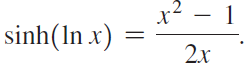
Verify each identity using the definitions of the hyperbolic functions.cosh x + sinh x = ex
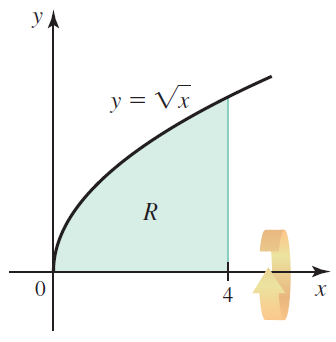
Let R be the region bounded by the following curves. Use the shell method to find the volume of the solid generated when R is revolved about the x-axis.y = √x, y = 0, and x = 4 y y = Vx х 4
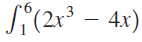
Use Table 5.4 to rewriteas the difference of two integrals. S{(2r³ – 4x)
Use a calculator and right Riemann sums to approximate the area of the given region. Present your calculations in a table showing the approximations for n = 10, 30, 60, and 80 subintervals. Comment on whether your approximations appear to approach a limit.The region bounded by the graph of f(x) =
Use a calculator and right Riemann sums to approximate the area of the given region. Present your calculations in a table showing the approximations for n = 10, 30, 60, and 80 subintervals. Comment on whether your approximations appear to approach a limit.The region bounded by the graph of f(x) =
Use a calculator and right Riemann sums to approximate the area of the given region. Present your calculations in a table showing the approximations for n = 10, 30, 60, and 80 subintervals. Comment on whether your approximations appear to approach a limit.The region bounded by the graph of f(x) =
Use a calculator and right Riemann sums to approximate the area of the given region. Present your calculations in a table showing the approximations for n = 10, 30, 60, and 80 subintervals. Comment on whether your approximations appear to approach a limit.The region bounded by the graph of f (x) =
Use a calculator and right Riemann sums to approximate the area of the given region. Present your calculations in a table showing the approximations for n = 10, 30, 60, and 80 subintervals. Comment on whether your approximations appear to approach a limit.The region bounded by the graph of f (x) =
Complete the following steps for the given function f and interval.a. For the given value of n, use sigma notation to write the left, right, and midpoint Riemann sums. Then evaluate each sum using a calculator.b. Based on the approximations found in part (a), estimate the area of the region bounded
Use a calculator and right Riemann sums to approximate the area of the given region. Present your calculations in a table showing the approximations for n = 10, 30, 60, and 80 subintervals. Comment on whether your approximations appear to approach a limit.The region bounded by the graph of f(x) = 4
Complete the following steps for the given function f and interval.a. For the given value of n, use sigma notation to write the left, right, and midpoint Riemann sums. Then evaluate each sum using a calculator.b. Based on the approximations found in part (a), estimate the area of the region bounded
Complete the following steps for the given function f and interval.a. For the given value of n, use sigma notation to write the left, right, and midpoint Riemann sums. Then evaluate each sum using a calculator.b. Based on the approximations found in part (a), estimate the area of the region bounded
Complete the following steps for the given function f and interval.a. For the given value of n, use sigma notation to write the left, right, and midpoint Riemann sums. Then evaluate each sum using a calculator.b. Based on the approximations found in part (a), estimate the area of the region bounded
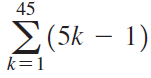
Evaluate the following expressions by two methods.(i) Use Theorem 5.1. (ii) Use a calculator.a. b. c. d. e. f. g. h. 45 Σk k=1 45 Σ(5k-1) k=1
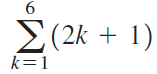
Evaluate the following expressions.a. b. c. d. e. f. g. h. 10 Σε k=1 Σ(2k + 1) k=1
Express the following sums using sigma notation. (Answers are not unique.)a. 1 + 3 + 5 + 7 + g + 99b. 4 + 9 + 14 + g + 44c. 3 + 8 + 13 + g + 63d. 1 1 1:2 2.3 3.4 49 · 50
Express the following sums using sigma notation. (Answers are not unique.)a. 1 + 2 + 3 + 4 + 5 b. 4 + 5 + 6 + 7 + 8 + 9c. 12 + 22 + 32 + 42 d. 1 + 1/2 + 1/3 + 1/4
The velocities (in m/s) of an automobile moving along a straight freeway over a four second period are given in the following table.a. Sketch a smooth curve passing through the data points.b. Find the midpoint Riemann sum approximation to the displacement on [0, 4] with n = 2 and n = 4
The velocities (in mi/hr) of an automobile moving along a straight highway over a two-hour period are given in the following table.a. Sketch a smooth curve passing through the data points.b. Find the midpoint Riemann sum approximation to the displacement on [0, 2] with n = 2 and n = 4. t (hr) 0.25
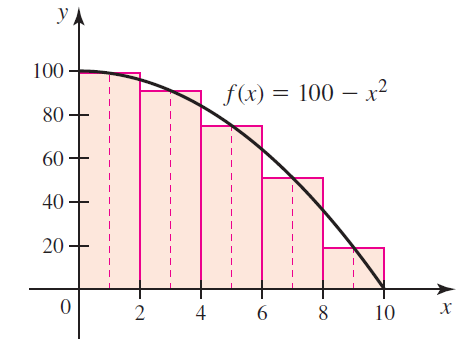
Approximate the area of the region bounded by the graph of f(x) = 100 - x2 and the x-axis on [0, 10] with n = 5 subintervals. Use the midpoint of each subinterval to determine the height of each rectangle (see figure). УА 100 f(x) = 100 – x² 80 60 40 20 х 2 4 8. 10
Complete the following steps for the given function, interval, and value of n.a. Sketch the graph of the function on the given interval.b. Calculate Δx and the grid points x0, x1, · · · · xn.c. Illustrate the left and right Riemann sums. Then determine which Riemann sum underestimates and
Complete the following steps for the given function, interval, and value of n.a. Sketch the graph of the function on the given interval.b. Calculate Δx and the grid points x0, x1, · · · · xn.c. Illustrate the left and right Riemann sums. Then determine which Riemann sum underestimates and
Complete the following steps for the given function, interval, and value of n.a. Sketch the graph of the function on the given interval.b. Calculate Δx and the grid points x0, x1, · · · · xn.c. Illustrate the left and right Riemann sums. Then determine which Riemann sum underestimates and
Find the position and velocity of an object moving along a straight line with the given acceleration, initial velocity, and initial position.a(t) = e-t, v(0) = 60, s(0) = 40
Find the position and velocity of an object moving along a straight line with the given acceleration, initial velocity, and initial position.a(t) = -9.8, v(0) = 20, s(0) = 0
Find the position and velocity of an object moving along a straight line with the given acceleration, initial velocity, and initial position.a(t) = -32, v(0) = 50, s(0) = 0
Find the position and velocity of an object moving along a straight line with the given acceleration, initial velocity, and initial position.a(t) = -32, v(0) = 70, s(0) = 10
A data collection probe is dropped from a stationary balloon, and it falls with a velocity (in m/s) given by v(t) = 9.8t, neglecting air resistance. After 10 s, a chute deploys and the probe immediately slows to a constant speed of 10 m/s, which it maintains until it enters the ocean.a. Graph the
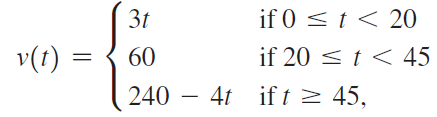
The velocity of a (fast) automobile on a straight highway is given by the functionwhere t is measured in seconds and v has units of m/s.a. Graph the velocity function, for 0 ≤ t ≤ 70. When is the velocity a maximum? When is the velocity zero?b. What is the distance traveled by the automobile in
The velocity (in mi/hr) of a hiker walking along a straight trail is given by v(t) = 3 sin2 (πt/2), for 0 ≤ t ≤ 4. Assume that s(0) = 0 and t is measured in hours.a. Determine and graph the position function, for 0 ≤ t ≤ 4. sin2 t = 1/2 (1 - cos 2t).)b. What is the distance traveled by the
The velocity (in mi/hr) of an airplane flying into a headwind is given by v(t) = 30(16 - t2), for 0 ≤ t ≤ 3. Assume that s(0) = 0 and t is measured in hours.a. Determine and graph the position function, for 0 ≤ t ≤ 3.b. How far does the airplane travel in the first 2 hr?c. How far has the
A cyclist rides down a long straight road at a velocity (in m/min) given by v(t) = 400 - 20t, for 0 ≤ t ≤ 10, where t is measured in minutes.a. How far does the cyclist travel in the first 5 min?b. How far does the cyclist travel in the first 10 min?c. How far has the cyclist traveled when her
A mass hanging from a spring is set in motion, and its ensuing velocity is given by v(t) = 2π cos πt, for t ≥ 0. Assume that the positive direction is upward and that s(0) = 0.a. Determine the position function, for t ≥ 0.b. Graph the position function on the interval [0, 4].c. At what times
Consider an object moving along a line with the following velocities and initial positions.a. Graph the velocity function on the given interval and determine when the object is moving in the positive direction and when it is moving in the negative direction.b. Determine the position function, for t
Consider an object moving along a line with the following velocities and initial positions.a. Graph the velocity function on the given interval and determine when the object is moving in the positive direction and when it is moving in the negative direction.b. Determine the position function, for t
Consider an object moving along a line with the following velocities and initial positions.a. Graph the velocity function on the given interval and determine when the object is moving in the positive direction and when it is moving in the negative direction.b. Determine the position function, for t
Consider an object moving along a line with the following velocities and initial positions.a. Graph the velocity function on the given interval and determine when the object is moving in the positive direction and when it is moving in the negative direction.b. Determine the position function, for t
Consider an object moving along a line with the following velocities and initial positions.a. Graph the velocity function on the given interval and determine when the object is moving in the positive direction and when it is moving in the negative direction.b. Determine the position function, for t
Consider an object moving along a line with the following velocities and initial positions.a. Graph the velocity function on the given interval and determine when the object is moving in the positive direction and when it is moving in the negative direction.b. Determine the position function, for t
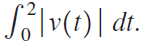
Assume t is time measured in seconds and velocities have units of m/s.a. Graph the velocity function over the given interval. Then determine when the motion is in the positive direction and when it is in the negative direction.b. Find the displacement over the given interval.c. Find the distance
Assume t is time measured in seconds and velocities have units of m/s.a. Graph the velocity function over the given interval. Then determine when the motion is in the positive direction and when it is in the negative direction.b. Find the displacement over the given interval.c. Find the distance
Assume t is time measured in seconds and velocities have units of m/s.a. Graph the velocity function over the given interval. Then determine when the motion is in the positive direction and when it is in the negative direction.b. Find the displacement over the given interval.c. Find the distance
Assume t is time measured in seconds and velocities have units of m/s.a. Graph the velocity function over the given interval. Then determine when the motion is in the positive direction and when it is in the negative direction.b. Find the displacement over the given interval.c. Find the distance
Assume t is time measured in seconds and velocities have units of m/s.a. Graph the velocity function over the given interval. Then determine when the motion is in the positive direction and when it is in the negative direction.b. Find the displacement over the given interval.c. Find the distance
Assume t is time measured in seconds and velocities have units of m/s.a. Graph the velocity function over the given interval. Then determine when the motion is in the positive direction and when it is in the negative direction.b. Find the displacement over the given interval.c. Find the distance
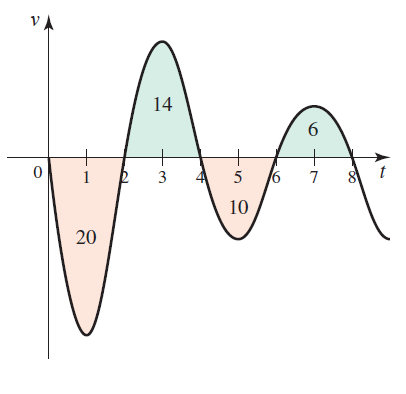
Consider the velocity function shown below of an object moving along a line. Assume time is measured in seconds and distance is measured in meters. The areas of four regions bounded by the velocity curve and the t-axis are also given.a. On what intervals is the object moving in the negative
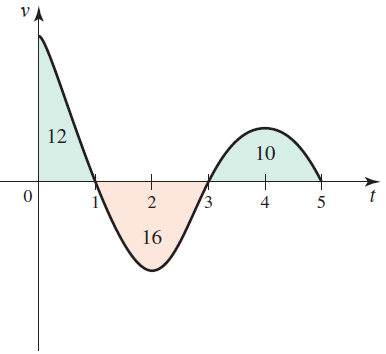
Consider the graph shown in the figure, which gives the velocity of an object moving along a line. Assume time is measured in hours and distance is measured in miles. The areas of three regions bounded by the velocity curve and the t-axis are also given.a. On what intervals is the object moving in
What is the result of integrating a population growth rate between times t = a and t = b, where b > a?
Given the rate of change of a quantity Q and its initial value Q(0), explain how to find the value of Q at a future time t ≥ 0.
Explain how to use definite integrals to find the net change in a quantity, given the rate of change of that quantity.
Given the velocity function v of an object moving along a line, explain how definite integrals can be used to find the displacement of the object.
Suppose the velocity of an object moving along a line is positive. Are displacement and distance traveled equal? Explain.
Explain the meaning of position, displacement, and distance traveled as they apply to an object moving along a line.
Divers who ascend too quickly in the water risk decompression illness. A common recommendation for a maximum rate of ascent is 30 feet/minute with a 5-minute safety stop 15 feet below the surface of the water. Suppose that a diver ascends to the surface in 8 minutes according to the velocity
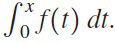
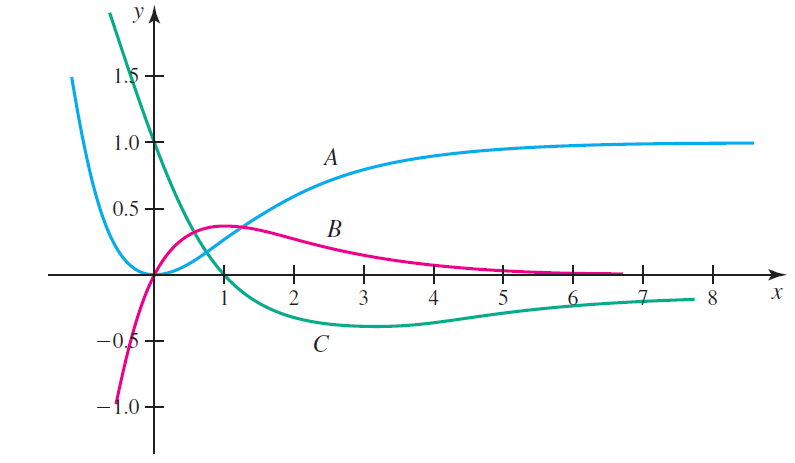
Match the graphs A, B, and C in the figure with the functions f(x), f'(x), and SöS(1) dt. УА 1.5+ 1.0 0.5 + + + + 3 5 х -0,5 -1.0 4)
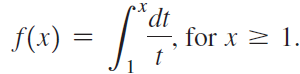
Make a graph of the function Be sure to include all of the evidence you used to arrive at the graph. dt for x 2 1. f(x)
Letfor -2 ≤ x ≤ 2.a. Evaluate H(0).b. Evaluate H'(1).c. Evaluate H'(2).d. Use geometry to evaluate H(2).e. Find the value of s such that H(x) = sH(-x). H(x) = SV4 – ² dt,
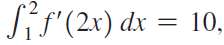
Assume f' is continuous on [2, 4], and f(2) = 4. Evaluate f(4). Sis (2x) dx 10,
The function f satisfies the equationFind f and check your answer by substitution. - 48 = S,f(t) dt. Зx4
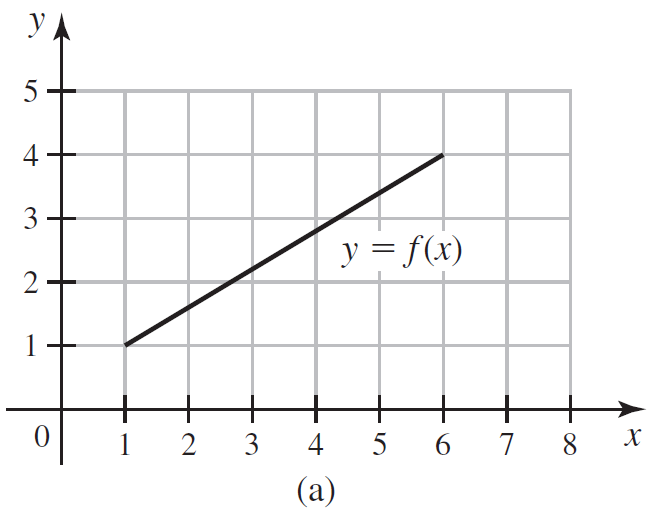
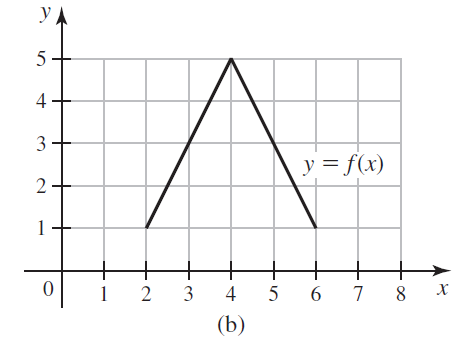
Integration is not needed.a. Find the average value of f shown in the figure on the interval [1, 6] and then find the point(s) c in (1, 6) guaranteed to exist by the Mean Value Theorem for Integrals.b. Find the average value of f shown in the figure on the interval [2, 64 and then find the point(s)
A baseball is launched into the outfield on a parabolic trajectory given by y = 0.01x(200 - x). Find the average height of the baseball over the horizontal extent of its flight.
A particle moves along a line with a velocity given by v(t) = 5 sin pt starting with an initial position s(0) = 0. Find the displacement of the particle between t = 0 and t = 2, which is given byFind the distance traveled by the particle during this interval, which is
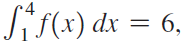
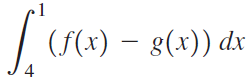
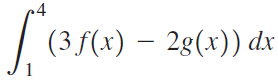
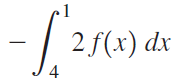
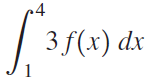
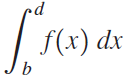
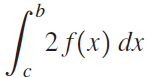
Suppose thatEvaluate the following integrals or state that there is not enough information. Sis(x) dx 6, Si8(x) dx = 4, and Si5(x) dx =
Suppose thatEvaluate the following integrals or state that there is not enough information. Sis(x) dx 6, Si8(x) dx = 4, and Si5(x) dx =
Suppose thatEvaluate the following integrals or state that there is not enough information. Sis(x) dx 6, Si8(x) dx = 4, and Si5(x) dx =
Suppose thatEvaluate the following integrals or state that there is not enough information. Sis(x) dx 6, Si8(x) dx = 4, and Si5(x) dx =
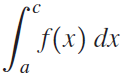
The figure shows the areas of regions bounded by the graph of f and the x-axis. Evaluate the following integrals.a.b.c.d.e.f. |л) f(x) dx f(x) dx
Evaluate the following integrals.∫ y2(3y3 + 1)4 dy
Showing 3500 - 3600
of 6775
First
29
30
31
32
33
34
35
36
37
38
39
40
41
42
43
Last
Step by Step Answers

 Get 50% OFF
Claim Now
Get 50% OFF
Claim Now