New Semester
Started
Get
50% OFF
Study Help!
--h --m --s
Claim Now
Question Answers
Textbooks
Find textbooks, questions and answers
Oops, something went wrong!
Change your search query and then try again
S
Books
FREE
Study Help
Expert Questions
Accounting
General Management
Mathematics
Finance
Organizational Behaviour
Law
Physics
Operating System
Management Leadership
Sociology
Programming
Marketing
Database
Computer Network
Economics
Textbooks Solutions
Accounting
Managerial Accounting
Management Leadership
Cost Accounting
Statistics
Business Law
Corporate Finance
Finance
Economics
Auditing
Tutors
Online Tutors
Find a Tutor
Hire a Tutor
Become a Tutor
AI Tutor
AI Study Planner
NEW
Sell Books
Search
Search
Sign In
Register
study help
mathematics
calculus with applications
Calculus For Business, Economics And The Social And Life Sciences 11th Brief Edition Laurence Hoffmann, Gerald Bradley, David Sobecki, Michael Price - Solutions
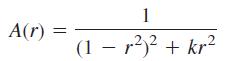
In physics, it can be shown that a particle forced to oscillate in a resisting medium has amplitude A(r) given bywhere r is the ratio of the forcing frequency to the natural frequency of oscillation and k is a positive constant that measures the damping effect of the resisting medium. Show that
Suppose for the situation described in Exercise 65, it costs the fishery C(t) = 50 + 1.2t hundred dollars to maintain and monitor the pond for t weeks after the fish are released, and that each fish harvested after t weeks can be sold for $2.75 per pound.a. If all fish that remain alive in the pond
Sketch a graph of a function that has all the following properties:a. f'(0) = f'(1) = f'(2) = 0 b. f'(x) < 0 when x < 0 and x > 2 c. f'(x) > 0 when 0 < x < 2
When interest rates are low, many homeowners take the opportunity to refinance their mortgages. As rates start to rise, there is often a flurry of activity as latecomers rush in to refinance while they still can do so profitably. Eventually, however, rates reach a level where refinancing begins to
The rate at which a rumor spreads through a community of P people is jointly proportional to the number of people N who have heard the rumor and the number who have not. Show that the rumor is spreading most rapidly when half the people have heard it.
A researcher models the temperature T (in degrees Celsius) during the time period from 6 A.M. to 6 P.M. in a certain city by the functionwhere t is the number of hours after 6 A.M.a. Sketch the graph of T(t).b. At what time is the temperature the greatest? What is the highest temperature of the
Repeat Exercise 60 for the functionf (x) = x2/3(2x − 5)Data from Exercises 60Let f(x) = x1/3(x − 4).a. Find f'(x), and determine intervals of increase and decrease for f(x). Locate all relative extrema on the graph of f(x).b. Find f"(x), and determine intervals of concavity for f(x). Find all
Congresswoman Celesta Gomez has just come out in favor of a controversial bill. A poll suggests that t days after she declares her position on the bill, the percentage of her constituency (those who favor her at the time she declares her position) that still supports her isThe vote is to be taken
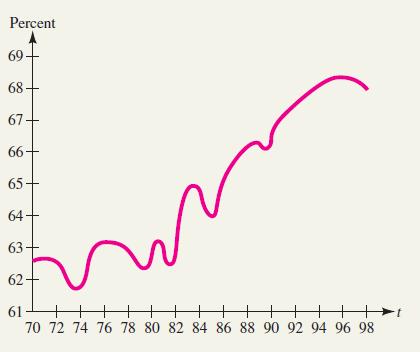
The accompanying graph shows the consumption of the baby boom generation, measured as a percentage of total GDP (gross domestic product) during the time period 1970–1997.a. At what years do relative maxima occur?b. At what years do relative minima occur?c. At roughly what rate was consumption
A company determines that if x thousand dollars are spent on advertising a certain product, then S(x) units of the product will be sold, wherea. Sketch the graph of S(x).b. How many units will be sold if nothing is spent on advertising?c. How much should be spent on advertising to maximize sales?
Let Q(t) denote the number of people in a city of population N0 who have been infected with a certain disease t days after the beginning of an epidemic. Studies indicate that the rate R(Q) at which an epidemic spreads is jointly proportional to the number of people who have contracted the disease
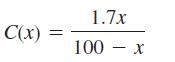
During a nationwide program to immunize the population against a new strain of influenza, public health officials determined that the cost of inoculating x% of the susceptible population would be approximatelymillion dollars.a. Sketch the graph of the cost function C(x).b. Suppose 40 million
Verify the relationships between revenue and levels of elasticity given in the summary box on page 260.Data from summary box on page 260.Levels of Elasticity and the Effect on RevenueIf demand is elastic [E(p) > 1], revenue R decreases as price p increases.If demand is inelastic [E(p) < 1],
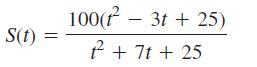
An all-news radio station has made a survey of the listening habits of local residents between the hours of 5:00 P.M. and midnight. The survey indicates that the percentage of the local adult population that is tuned in to the station x hours after 5:00 P.M. isa. At what time between 5:00 P.M. and
An efficiency study of the afternoon shift at a factory (noon to 5 P.M.) indicates that an average worker who arrives on the job at noon will have producedunits t hours later.a. When during the afternoon shift does the worker’s production reach the point of diminishing returns?b. At what time
Let f(x) = x1/3(x − 4).a. Find f'(x), and determine intervals of increase and decrease for f(x). Locate all relative extrema on the graph of f(x).b. Find f"(x), and determine intervals of concavity for f(x). Find all inflection points on the graph of f(x).c. Find all intercepts for the graph of
When a resistor of R ohms is connected across a battery with electromotive force E volts and internal resistance r ohms, a current of I amperes will flow, generating P watts of power, whereAssuming r is constant, what choice of R results in maximum power? I E r+ R and P = PR
Draw a possible graph for the percentage of households adopting a new type of consumer electronic technology if the percentage grows at an increasing rate for the first 2 years, after which the rate of increase declines, with the market penetration of the technology eventually approaching 90%.
A company estimates that when x thousand dollars are spent on the marketing of a certain product, Q(x) units of the product will be sold, wherefor 10 ≤ x ≤ 40. Sketch the graph of Q(x). Where does the graph have an inflection point? What is the significance of the marketing expenditure that
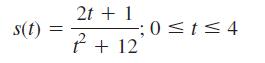
In Exercises 36 and 37, s(t) denotes the position of an object moving along a line.(a) Find the velocity and acceleration of the object, and describe its motion during the indicated time interval.(b) Compute the total distance traveled by the object during the indicated time interval. s(t) 2t +
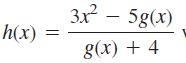
Find h'(0) ifwhere g(0) = 2 and g'(0) = −3. h(x) || 3x² - 5g(x) g(x) + 4
Find h'(−3) if h(x) = [3x2 − 2g(x)][g(x) + 5x] where g(−3) = 1 and g'(−3) = 2.
Sometimes Newton's method fails no matter what initial value x0 is chosen (unless you are lucky enough to choose the root itself). Let f(x) = 3√x and choose x0 arbitrarily (x0 ≠ 0). a. Show that xn+1 = −2xn for n = 0, 1, 2, ... so that the successive guesses generated by Newton's method
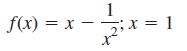
In Exercises 35 through 40, find the equation of the line that is tangent to the graph of the given function at the point (c, f (c)) for the specified value of x = c. 1 f(x)=x2; x x² ; x = 1
Let f(x) = 3x2 − x.a. Find the average rate of change of f(x) with respect to x as x changes from x = 0 to x= 1/16.b. Use calculus to find the instantaneous rate of change of f(x) at x = 0, and compare with the average rate found in part (a).
The ancient Babylonians (circa 1700 B.C.) approximated √N by applying the formulaShow that this formula can be derived from the formula for Newton’s method in Exercise 33, and then use it to estimate √1,265. Repeat the formula until two consecutive approximations agree to four decimal places.
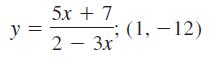
The normal line to the curve y = f(x) at the point P with coordinates (x0, f(x0)) is the line perpendicular to the tangent line at P. In Exercises 32 through 35, find an equation for the normal line to the given curve at the prescribed point. y || 5x+7 2-3x -; (1, -12)
In Exercises 37 and 38, use implicit differentiation to find the second derivative d2y/dx2.x2 + 3y2 = 5
Let f(x) = x4 − 4x3 + 10. Use your graphing utility to graph f(x). Note that there are two real roots of the equation f(x) = 0. Estimate each root using Newton’s method, and then check your results using ZOOM and TRACE or other utility features.
In Exercises 36 and 37, s(t) denotes the position of an object moving along a line.(a) Find the velocity and acceleration of the object, and describe its motion during the indicated time interval.(b) Compute the total distance traveled by the object during the indicated time interval.s(t) = 2t3 −
In Exercises 35 through 40, find the equation of the line that is tangent to the graph of the given function at the point (c, f (c)) for the specified value of x = c. 1 f(x) = −2x²³ +7; x = X - 1
Show that when Newton’s method is applied repeatedly, the nth approximation is obtained from the (n − 1)st approximation by the formula XnXn-1 f(xn-1) f'(xn-1) n = 1, 2, 3, ...
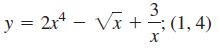
In Exercises 29 through 34, find the equation of the line that is tangent to the graph of the given function at the specified point. 3 y = 2x² = √x + —; (1,4) X
In Exercises 31 through 36, find all points (both coordinates) on the given curve where the tangent line is (a) Horizontal (b) Vertical.x2 − xy + y2 = 3
In Exercises 31 through 36, find all points (both coordinates) on the given curve where the tangent line is (a) Horizontal (b) Vertical.x2 + xy + y2 = 3
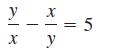
In Exercises 31 through 36, find all points (both coordinates) on the given curve where the tangent line is (a) Horizontal (b) Vertical. y X X y || 5
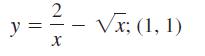
The normal line to the curve y = f(x) at the point P with coordinates (x0, f(x0)) is the line perpendicular to the tangent line at P. In Exercises 32 through 35, find an equation for the normal line to the given curve at the prescribed point. y || 2 X √x; (1, 1)
Find h'(2) if h(x) = (x2 + 3)g(x) where g(2) = 3 and g'(2) = −2.
Let f(x) = x3.a. Compute the slope of the secant line joining the points on the graph of f whose x coordinates are x = 1 and x = 1.1.b. Use calculus to compute the slope of the line that is tangent to the graph when x = 1, and compare with the slope found in part (a).
In Exercises 35 through 40, find the equation of the line that is tangent to the graph of the given function at the point (c, f (c)) for the specified value of x = c.f(x) = x4 − 3x3 + 2x2 − 6; x = 2
In Exercises 31 through 36, find all points (both coordinates) on the given curve where the tangent line is (a) Horizontal (b) Vertical.xy = 16y2 + x
Let f(x) = x3 − x2 − 1.a. Use your graphing utility to graph f(x). Note that there is only one root located between 1 and 2. Use ZOOM and TRACE or other utility features to find the root.b. Using x0 = 1, estimate the root by applying Newton’s method until two consecutive approximations agree
Suppose that a 5-year projection of population trends suggests that t years from now, the population of a certain community will be P thousand, where P(t) = −2t3 + 9t2 + 8t + 200a. At what rate will the population be growing 3 years from now?b. At what rate will the rate of population growth be
The normal line to the curve y = f(x) at the point P with coordinates (x0, f(x0)) is the line perpendicular to the tangent line at P. In Exercises 32 through 35, find an equation for the normal line to the given curve at the prescribed point.y = (x + 3)(1 − √x); (1, 0)
Let f(x) = 2x − x2.a. Compute the slope of the secant line joining the points where x = 0 and x = 1/2.b. Use calculus to compute the slope of the tangent line to the graph of f(x) at x = 0, and compare with the slope found in part (a).
A projectile is launched vertically upward from ground level with an initial velocity of 160 ft/sec.a. When will the projectile hit the ground?b. What is the impact velocity?c. When will the projectile reach its maximum height? What is the maximum height?
Let f(x) = x2.a. Compute the slope of the secant line joining the points on the graph of f whose x coordinates are x = −2 and x = −1.9.b. Use calculus to compute the slope of the line that is tangent to the graph when x = −2, and compare with the slope found in part (a).
In Exercises 29 through 34, find the equation of the line that is tangent to the graph of the given function at the specified point.y = (x2 − x)(3 + 2x); (−1, 2)
The normal line to the curve y = f(x) at the point P with coordinates (x0, f(x0)) is the line perpendicular to the tangent line at P. In Exercises 32 through 35, find an equation for the normal line to the given curve at the prescribed point.y = x2 + 3x − 5; (0, −5)
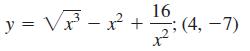
In Exercises 29 through 34, find the equation of the line that is tangent to the graph of the given function at the specified point. 16 y =√₁²-x² +1 (4₁-7)
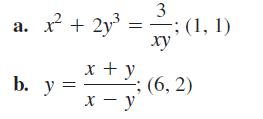
Use implicit differentiation to find the slope of the line that is tangent to the given curve at the specified point. a. 12 + 2y-³ b. У x + y х-у 3 ; (1, 1) ху (6,2)
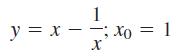
In Exercises 25 through 32, find the rate of change dy/dx where x = x0. 1 y = x ; xo X = 1 =
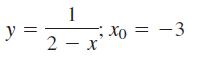
In Exercises 25 through 32, find the rate of change dy/dx where x = x0. y= 1 2 - х Хо -3 =
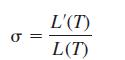
The (linear) thermal expansion coefficient of an object is defined to bewhere L(T) is the length of the object when the temperature is T. Suppose a 50-meter span of a bridge is built of steel with σ = 1.4 × 10⁻⁵ per degree Celsius. Approximately how much will the length change during a year
Use implicit differentiation to find d2y/dx2 if 3x2 − 2y2 = 6.
In Exercises 31 through 36, find all points (both coordinates) on the given curve where the tangent line is (a) Horizontal (b) Vertical.x2 + xy + y = 3
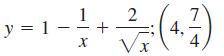
In Exercises 29 through 34, find the equation of the line that is tangent to the graph of the given function at the specified point. y = 1 - X + 2 Vx (4.7)
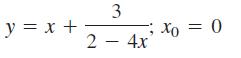
In Exercises 28 through 31, find the rate of change dy/dx for the prescribed value of x0. y = x + 3 2 - 4x Xo = 0
Use implicit differentiation to find the slope of the line that is tangent to the given curve at the specified point.a. xy3 = 8; (1, 2)b. x2y − 2xy3 + 6 = 2x + 2y; (0, 3)
Stefan’s law in physics states that a body emits radiant energy according to the formula R(T) = kT4, where R is the amount of energy emitted from a surface whose temperature is T (in degrees kelvin) and k is a positive constant. Estimate the percentage change in R that results from a 2% increase
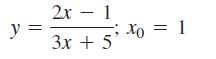
In Exercises 28 through 31, find the rate of change dy/dx for the prescribed value of x0. y || 2x - 1 3x + 5 1 I = 0x
Use implicit differentiation to find d2y/dx2 if 4x2 + y2 = 1.
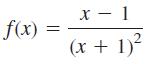
Find the second derivative:a. f(x) = 4x3 − 3xb. f(x) = 2x(x + 4)3c. f(x) = I- x (x + 1)²
In Exercises 31 through 36, find all points (both coordinates) on the given curve where the tangent line is (a) Horizontal (b) Vertical.x + y2 = 9
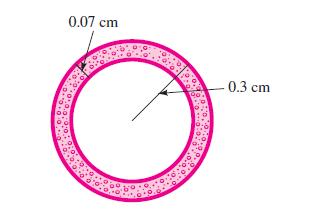
In arteriosclerosis, fatty material called plaque gradually builds up on the walls of arteries, impeding the flow of blood, which, in turn, can lead to stroke and heart attacks. Consider a model in which the carotid artery is represented as a circular cylinder with cross-sectional radius R = 0.3 cm
In Exercises 23 through 30, find the equation of the tangent line to the given curve at the specified point.(1− x + y)3 = x + 7; (1, 2)
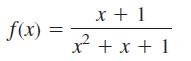
In Exercises 24 through 27, find all points on the graph of the given function where the tangent line is horizontal. f(x) = x + 1 x²2² + x + 1
In Exercises 25 through 32, find the rate of change dy/dx where x = x0.y = x2 − 2x; x0 = 1
Find dy/dx by implicit differentiation.a. x2y = 1b. (1 − 2xy3)5 = x + 4y
In Exercises 29 through 34, find the equation of the line that is tangent to the graph of the given function at the specified point.y = x5 − 3x3 − 5x + 2; (1, −5)
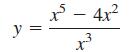
In Exercises 1 through 28, differentiate the given function. y 1 - 4x² 3 Х
In Exercises 23 through 30, find the equation of the tangent line to the given curve at the specified point.(x2 + 2y)3 = 2xy2 + 64; (0, 2)
In Exercises 29 through 34, find the equation of the line that is tangent to the graph of the given function at the specified point.y = −x3 − 5x2 + 3x − 1; (−1, −8)
In Exercises 25 through 32, find the rate of change dy/dx where x = x0.y = x(1 − x); x0 = −1
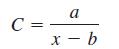
Cardiac output is the volume (cubic centimeters) of blood pumped by a person’s heart each minute. One way of measuring cardiac output C is by Fick’s formulawhere x is the concentration of carbon dioxide in the blood entering the lungs from the right side of the heart and a and b are positive
In Exercises 28 through 31, find the rate of change dy/dx for the prescribed value of x0.y = (x2 + 3)(5 − 2x3); x0 = 1
Use the chain rule to find dy/dx for the given value of x.a. y = u − u2; u = x − 3; for x = 0b. 1/2 = (a + 1)^. u y = , U = u √x - 1; for x 34 9
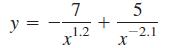
In Exercises 1 through 28, differentiate the given function. 7 1.2 X + in -2.1 X
In Exercises 23 through 30, find the equation of the tangent line to the given curve at the specified point.x2y3 − 2xy = 6x + y + 1; (0, −1)
In Exercises 25 through 32, find the rate of change dy/dx where x = x0.y = 6 − 2x; x0 = 3
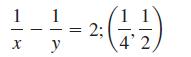
In Exercises 23 through 30, find the equation of the tangent line to the given curve at the specified point. X 1 y = 2; 1 1 42,
In Exercises 1 through 28, differentiate the given function.y = x2(x3 − 6x + 7)
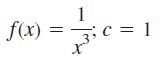
In Exercises 13 through 24, compute the derivative of the given function and find the equation of the line that is tangent to its graph for the specified value x = c. 1 f(x) = ²3 c = 1 X
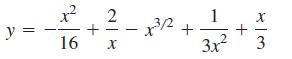
In Exercises 1 through 28, differentiate the given function. y || x² 2 + 16 X - 13/2 + 1 2 3x² + X 3
In Exercises 28 through 31, find the rate of change dy/dx for the prescribed value of x0.y = (x2 + 2)(x + √x); x0 = 4
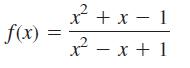
In Exercises 24 through 27, find all points on the graph of the given function where the tangent line is horizontal. f(x) || x²2² + x - 1 x² = x + 1
A tiny spherical balloon is inserted into a clogged artery. If the balloon has an inner diameter of 0.01 millimeter (mm) and is made from material 0.0005 mm thick, approximately how much material is inserted into the artery?
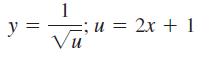
Use the chain rule to find dy/dx.a. y = (u + 1)2; u = 1 − xb. y || 1 Vu =;u= 2x + 1
In Exercises 25 through 32, find the rate of change dy/dx where x = x0.y = 3x + 5; x0 = −1
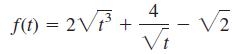
In Exercises 1 through 28, differentiate the given function. 4 f(t) = 2√1²³ + -√2 Vt
In Exercises 23 through 30, find the equation of the tangent line to the given curve at the specified point.xy2 − x2y = 6; (2, −1)
In Exercises 23 through 30, find the equation of the tangent line to the given curve at the specified point.xy = 2; (2, 1)
In Exercises 25 through 32, find the rate of change dy/dx where x = x0.y = −17; x0 = 14
Use the chain rule to find dy/dx for the given value of x.a. y = u3 − 4u2 + 5u + 2; u = x2 + 1; for x = 1b. y = √u, u = x2 + 2x − 4; for x = 2
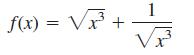
In Exercises 1 through 28, differentiate the given function. N 1 + * ^ = (x)ƒ
In Exercises 19 through 23, find an equation for the tangent line to the given curve at the point where x = x0. y = (3√x + x)(2 - x²); x = 1
In Exercises 24 through 27, find all points on the graph of the given function where the tangent line is horizontal.f(x) = (x + 1)(x2 − x − 2)
In Exercises 23 through 30, find the equation of the tangent line to the given curve at the specified point.x2 − y3 = 2x; (1, −1)
An environmental study of a certain community suggests that t years from now, the average level of carbon monoxide in the air will be Q(t) = 0.05t2 + 0.1t + 3.4 parts per million. By approximately how much will the carbon monoxide level change during the coming 6 months?
In Exercises 23 through 30, find the equation of the tangent line to the given curve at the specified point.x2 = y3; (8, 4)
Showing 3300 - 3400
of 8662
First
27
28
29
30
31
32
33
34
35
36
37
38
39
40
41
Last
Step by Step Answers

 Get 50% OFF
Claim Now
Get 50% OFF
Claim Now