New Semester
Started
Get
50% OFF
Study Help!
--h --m --s
Claim Now
Question Answers
Textbooks
Find textbooks, questions and answers
Oops, something went wrong!
Change your search query and then try again
S
Books
FREE
Study Help
Expert Questions
Accounting
General Management
Mathematics
Finance
Organizational Behaviour
Law
Physics
Operating System
Management Leadership
Sociology
Programming
Marketing
Database
Computer Network
Economics
Textbooks Solutions
Accounting
Managerial Accounting
Management Leadership
Cost Accounting
Statistics
Business Law
Corporate Finance
Finance
Economics
Auditing
Tutors
Online Tutors
Find a Tutor
Hire a Tutor
Become a Tutor
AI Tutor
AI Study Planner
NEW
Sell Books
Search
Search
Sign In
Register
study help
mathematics
college algebra graphs and models
College Algebra 7th Edition Robert F Blitzer - Solutions
In Exercises 14–19, solve each polynomial equation.(2x + 1)(3x - 2)3(2x - 7) = 0
In Exercises 13–18, graph each equation in a rectangular coordinate system. If two functions are given, graph both in the same system.f(x) = x2(x - 3)
In Exercises 11–20, write an equation that expresses each relationship. Then solve the equation for y.x varies directly as z and inversely as the difference between y and w.
A company manufactures and sells bath cabinets. The function P(x) = -x2 + 150x - 4425 models the company’s daily profit, P(x), when x cabinets are manufactured and sold per day. How many cabinets should be manufactured and sold per day to maximize the company’s profit? What is the maximum daily
In Exercises 19–20, let f(x) = 2x2 - x - 1 and g(x) = 4x - 1.Find (f ° g)(x).
In Exercises 17–38, use the vertex and intercepts to sketch the graph of each quadratic function. Give the equation of the parabola’s axis of symmetry. Use the graph to determine the function’s domain and range.f(x) = (x - 3)2 + 2
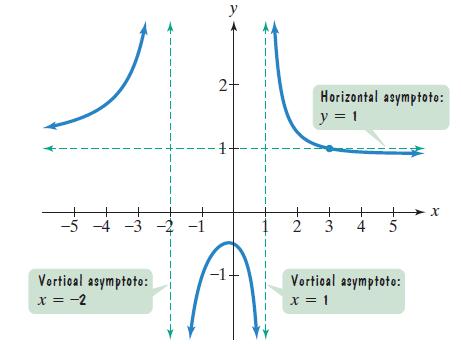
Use the graph of the rational function in the figure shown to complete each statement in Exercises 15–20. 1 -5 -4 -3 -2 -1 Vertical asymptoto: x = -2 y 2+ - 1+ -1+ 1 2 Horizontal asymptoto: y = 1 + 3 w. + 4 5 Vortical asymptoto: x = 1 x
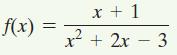
In Exercises 16–21, find the domain of each rational function and graph the function. f(x) || x + 1 x² + 2x - 3
In Exercises 17–24,a. List all possible rational roots.b. Use synthetic division to test the possible rational roots and find an actual root.c. Use the quotient from part (b) to find the remaining roots and solve the equation. x³ - 5x² + 17x 5x² 13 17x 13 = 0
In Exercises 17–32, divide using synthetic division. (5x² 12x 8) = (x + 3) - -
In Exercises 19–24,a. Use the Leading Coefficient Test to determine the graph’s end behavior.b. Determine whether the graph has y-axis symmetry, origin symmetry, or neither.c. Graph the function.f(x) = 4x - x3
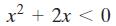
Solve each polynomial inequality in Exercises 1–42 and graph the solution set on a real number line. Express each solution set in interval notation. x² + 2x < 0 X
In Exercises 19–24, use the Leading Coefficient Test to determine the end behavior of the graph of the polynomial function.f(x) = 11x3 - 6x2 + x + 3
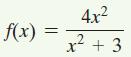
In Exercises 16–21, find the domain of each rational function and graph the function. f(x) = 4x² 2 x² + 3
In Exercises 17–24,a. List all possible rational roots.b. Use synthetic division to test the possible rational roots and find an actual root.c. Use the quotient from part (b) to find the remaining roots and solve the equation. 6x³ + 25x² 24x + 5 = 0
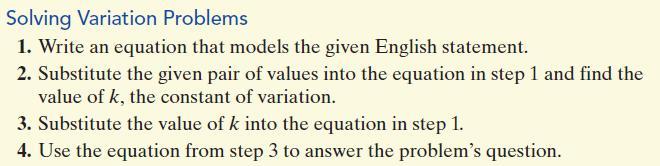
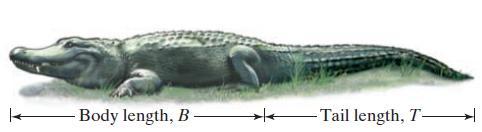
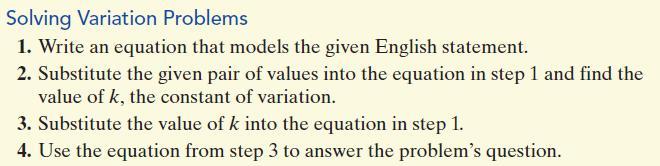
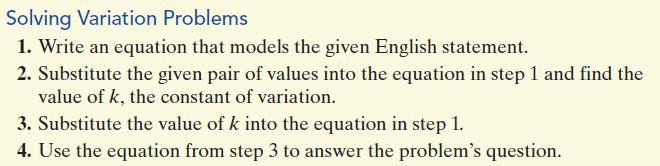
Use the four-step procedure for solving variation problems given on page 445 to solve Exercises 21–36.An alligator’s tail length, T, varies directly as its body length, B. An alligator with a body length of 4 feet has a tail length of 3.6 feet. What is the tail length of an alligator whose body
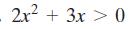
Solve each polynomial inequality in Exercises 1–42 and graph the solution set on a real number line. Express each solution set in interval notation. 2x2 + 3x > 0
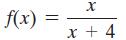
In Exercises 21–36, find the vertical asymptotes, if any, and the values of x corresponding to holes, if any, of the graph of each rational function. f(x) = X x + 4
In Exercises 17–32, divide using synthetic division. (4x³ 3x² + 3x - 1) = (x - 1) -
In Exercises 11–20, write an equation that expresses each relationship. Then solve the equation for y.x varies directly as z and inversely as the sum of y and w.
Among all pairs of numbers whose sum is -18, find a pair whose product is as large as possible. What is the maximum product?
In Exercises 17–38, use the vertex and intercepts to sketch the graph of each quadratic function. Give the equation of the parabola’s axis of symmetry. Use the graph to determine the function’s domain and range.y - 1 = (x - 3)2
In Exercises 19–24,a. Use the Leading Coefficient Test to determine the graph’s end behavior.b. Determine whether the graph has y-axis symmetry, origin symmetry, or neither.c. Graph the function.f(x) = 2x3 + 3x2 - 8x - 12
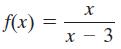
In Exercises 21–36, find the vertical asymptotes, if any, and the values of x corresponding to holes, if any, of the graph of each rational function. f(x) X x-3
In Exercises 17–24,a. List all possible rational roots.b. Use synthetic division to test the possible rational roots and find an actual root.c. Use the quotient from part (b) to find the remaining roots and solve the equation. 2x3 - 5x² - 6x + 4 = 0
In Exercises 17–32, divide using synthetic division. (5x³6x² + 3x + 11) = (x - 2)
In Exercises 19–24, use the Leading Coefficient Test to determine the end behavior of the graph of the polynomial function.f(x) = 5x4 + 7x2 - x + 9
The base of a triangle measures 40 inches minus twice the measure of its height. For what measure of the height does the triangle have a maximum area? What is the maximum area?
In Exercises 17–38, use the vertex and intercepts to sketch the graph of each quadratic function. Give the equation of the parabola’s axis of symmetry. Use the graph to determine the function’s domain and range.y - 3 = (x - 1)2
A company is planning to manufacture portable satellite radio players. The fixed monthly cost will be $300,000 and it will cost $10 to produce each player.a. Write the average cost function, C̅, of producing x players.b. What is the horizontal asymptote for the graph of this function and what does
In Exercises 19–24,a. Use the Leading Coefficient Test to determine the graph’s end behavior.b. Determine whether the graph has y-axis symmetry, origin symmetry, or neither.c. Graph the function.f(x) = -x4 + 25x2
In Exercises 19–24, use the Leading Coefficient Test to determine the end behavior of the graph of the polynomial function.f(x) = 11x4 - 6x2 + x + 3
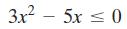
Solve each polynomial inequality in Exercises 1–42 and graph the solution set on a real number line. Express each solution set in interval notation. 3x² - 5x ≤ 0 =
Use the four-step procedure for solving variation problems given on page 445 to solve Exercises 21–36.An object’s weight on the Moon, M, varies directly as its weight on Earth, E. Neil Armstrong, the first person to step on the Moon on July 20, 1969, weighed 360 pounds on Earth (with all of his
In Exercises 17–24,a. List all possible rational roots.b. Use synthetic division to test the possible rational roots and find an actual root.c. Use the quotient from part (b) to find the remaining roots and solve the equation. x42x³5x² + 8x + 4 = 0
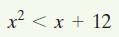
Solve each inequality in Exercises 23–24 and graph the solution set on a real number line. Express each solution set in interval notation. x² < x + 12 t
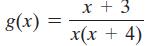
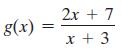
In Exercises 21–36, find the vertical asymptotes, if any, and the values of x corresponding to holes, if any, of the graph of each rational function. g(x) x + 3 x(x + 4)
In Exercises 17–38, use the vertex and intercepts to sketch the graph of each quadratic function. Give the equation of the parabola’s axis of symmetry. Use the graph to determine the function’s domain and range.f(x) = 2(x + 2)2 - 1
In Exercises 17–32, divide using synthetic division. (6x52x³+4x²-3x + 1) = (x - 2)
In Exercises 23–24, divide, using synthetic division if possible.(6x4 - 3x3 - 11x2 + 2x + 4) , (3x2 - 1)
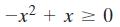
Solve each polynomial inequality in Exercises 1–42 and graph the solution set on a real number line. Express each solution set in interval notation. 0=x+zx-
In Exercises 17–38, use the vertex and intercepts to sketch the graph of each quadratic function. Give the equation of the parabola’s axis of symmetry. Use the graph to determine the function’s domain and range. f(x) = -(x − 1)² 2
In Exercises 19–24,a. Use the Leading Coefficient Test to determine the graph’s end behavior.b. Determine whether the graph has y-axis symmetry, origin symmetry, or neither.c. Graph the function.f(x) = -x4 + 6x3 - 9x2
In Exercises 19–24, use the Leading Coefficient Test to determine the end behavior of the graph of the polynomial function.f(x) = -5x4 + 7x2 - x + 9
In Exercises 23–24, divide, using synthetic division if possible.(2x4 - 13x3 + 17x2 + 18x - 24) , (x - 4)
Use the four-step procedure for solving variation problems given on page 445 to solve Exercises 21–36.The height that a ball bounces varies directly as the height from which it was dropped. A tennis ball dropped from 12 inches bounces 8.4 inches. From what height was the tennis ball dropped if it
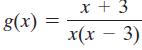
In Exercises 21–36, find the vertical asymptotes, if any, and the values of x corresponding to holes, if any, of the graph of each rational function. g(x) x + 3 x(x − 3)
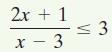
Solve each inequality in Exercises 23–24 and graph the solution set on a real number line. Express each solution set in interval notation. 2x + 1 x - 3 ≤ 3
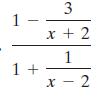
In Exercises 89–94, the equation for f is given by the simplified expression that results after performing the indicated operation. Write the equation for f and then graph the function. 1- 1+ 3 x + 2 1 x-2
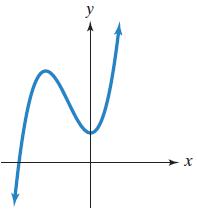
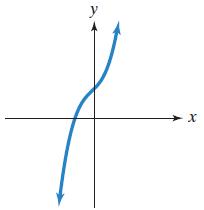
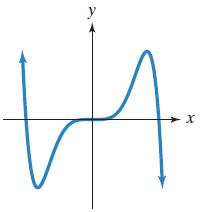
In Exercises 93–96, the graph of a polynomial function is given. What is the smallest degree that each polynomial could have? У X
In Exercises 89–94, the equation for f is given by the simplified expression that results after performing the indicated operation. Write the equation for f and then graph the function. X x + 1 X
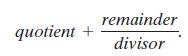
In Exercises 95–98, use long division to rewrite the equation for g in the formThen use this form of the function’s equation and transformations of f(x) = 1/x to graph g. quotient + remainder divisor
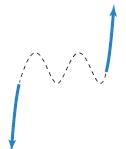
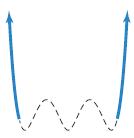
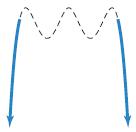
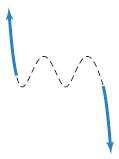
Write a polynomial function that imitates the end behavior of each graph in Exercises 90–93. The dashed portions of the graphs indicate that you should focus only on imitating the left and right behavior of the graph and can be flexible about what occurs between the left and right ends. Then use
In Exercises 93–96, the graph of a polynomial function is given. What is the smallest degree that each polynomial could have? X
In Exercises 93–96, the graph of a polynomial function is given. What is the smallest degree that each polynomial could have? y -X
In Exercises 91–94, determine whether each statement is true or false. If the statement is false, make the necessary change(s) to produce a true statement.The maximum value of y for the quadratic function f(x) = -x2 + x + 1 is 1.
In Exercises 94–97, determine whether each statement makes sense or does not make sense, and explain your reasoning.When solving f(x) > 0, where f is a polynomial function, I only pay attention to the sign of f at each test value and not the actual function value.
In Exercises 94–97, use a graphing utility with a viewing rectangle large enough to show end behavior to graph each polynomial function.f(x) = x3 + 13x2 + 10x - 4
In Exercises 95–96, find the axis of symmetry for each parabola whose equation is given. Use the axis of symmetry to find a second point on the parabola whose y-coordinate is the same as the given point.f(x) = 3(x + 2)2 - 5; (-1, -2)
In Exercises 94–97, determine whether each statement makes sense or does not make sense, and explain your reasoning.I’m solving a polynomial inequality that has a value for which the polynomial function is undefined.
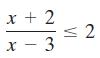
Solve each inequality in Exercises 86–91 using a graphing utility. x + 2 x - 3 VI 2
In Exercises 87–90, determine whether each statement is true or false. If the statement is false, make the necessary change(s) to produce a true statement.Every polynomial equation of degree n has n distinct solutions.
Write a polynomial function that imitates the end behavior of each graph in Exercises 90–93. The dashed portions of the graphs indicate that you should focus only on imitating the left and right behavior of the graph and can be flexible about what occurs between the left and right ends. Then use
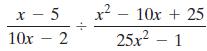
In Exercises 89–94, the equation for f is given by the simplified expression that results after performing the indicated operation. Write the equation for f and then graph the function. x-5 10x 2 ÷ +² - 10x + 25 25x² - 1
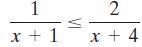
Solve each inequality in Exercises 86–91 using a graphing utility. 1 x + 1 VI 2 x + 4
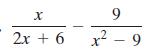
In Exercises 89–94, the equation for f is given by the simplified expression that results after performing the indicated operation. Write the equation for f and then graph the function. X 2x + 6 9 1²-9
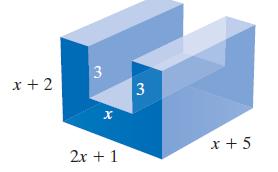
If the volume of the solid shown in the figure is 208 cubic inches, find the value of x. x+2 3 X 2x + 1 3 x + 5
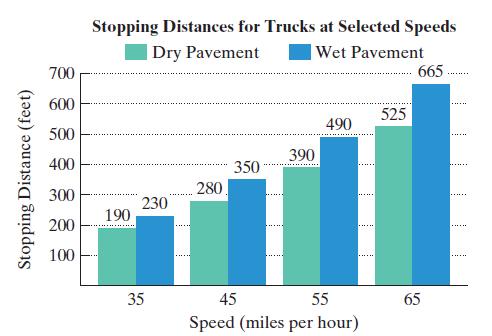
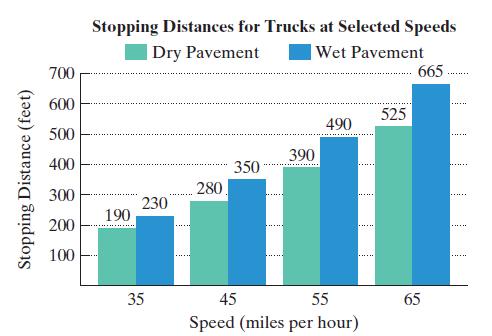
The graph shows stopping distances for trucks at various speeds on dry roads and on wet roads. Use this information to solve Exercises 92–93.a. Use the statistical menu of your graphing utility and the quadratic regression program to obtain the quadratic function that models a truck’s stopping
In this exercise, we lead you through the steps involved in the proof of the Rational Zero Theorem. Consider the polynomial equationand let p/q be a rational root reduced to lowest terms.a. Substitute p/q for x in the equation and show that the equation can be written asb. Why is p a factor of the
Write a polynomial function that imitates the end behavior of each graph in Exercises 90–93. The dashed portions of the graphs indicate that you should focus only on imitating the left and right behavior of the graph and can be flexible about what occurs between the left and right ends. Then use
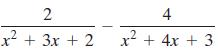
In Exercises 89–94, the equation for f is given by the simplified expression that results after performing the indicated operation. Write the equation for f and then graph the function. 2 x² + 3x + 2 2 4 2 x² + 4x + 3
The graph shows stopping distances for trucks at various speeds on dry roads and on wet roads. Use this information to solve Exercises 92–93.a. Use the statistical menu of your graphing utility and the quadratic regression program to obtain the quadratic function that models a truck’s stopping
In Exercises 91–94, determine whether each statement is true or false. If the statement is false, make the necessary change(s) to produce a true statement.No quadratic functions have a range of (-∞,∞).
Write a polynomial function that imitates the end behavior of each graph in Exercises 90–93. The dashed portions of the graphs indicate that you should focus only on imitating the left and right behavior of the graph and can be flexible about what occurs between the left and right ends. Then use
In Exercises 91–94, determine whether each statement is true or false. If the statement is false, make the necessary change(s) to produce a true statement.The vertex of the parabola described by f(x) = 2(x - 5)2 - 1 is at (5, 1).
In Exercises 91–94, determine whether each statement is true or false. If the statement is false, make the necessary change(s) to produce a true statement.The graph of f(x) = -2(x + 4)2 - 8 has one y-intercept and two x-intercepts.
In Exercises 41–64,a. Use the Leading Coefficient Test to determine the graph’s end behavior.b. Find the x-intercepts. State whether the graph crosses the x-axis, or touches the x-axis and turns around, at each intercept.c. Find the y-intercept.d. Determine whether the graph has y-axis
How can the Division Algorithm be used to check the quotient and remainder in a long division problem?
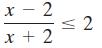
Solve each rational inequality in Exercises 43–60 and graph the solution set on a real number line. Express each solution set in interval notation. x-2 x + 2 VI
A ball is thrown upward and outward from a height of 6 feet. The height of the ball, f(x), in feet, can be modeled bywhere x is the ball’s horizontal distance, in feet, from where it was thrown.a. What is the maximum height of the ball and how far from where it was thrown does this occur?b. How
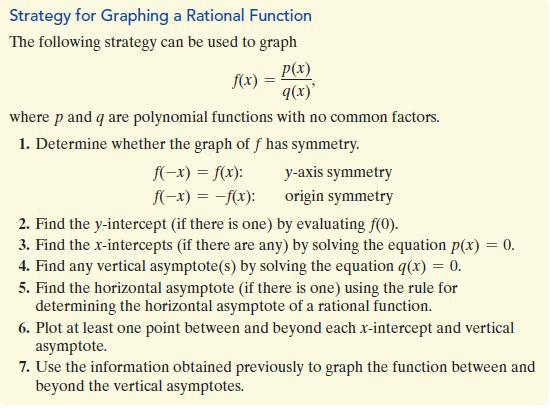
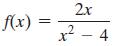
In Exercises 57–80, follow the seven steps to graph each rational function.Seven Steps are given below Strategy for Graphing a Rational Function The following strategy can be used to graph p(x) f(x) q(x)' where p and q are polynomial functions with no common factors. 1. Determine whether the
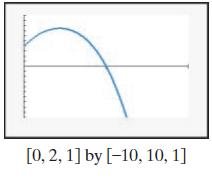
Exercises 53–60 show incomplete graphs of given polynomial functions.a. Find all the zeros of each function.b. Without using a graphing utility, draw a complete graph of the function.f(x) = -5x4 + 4x3 - 19x2 + 16x + 4 [0, 2, 1] by [-10, 10, 1]
Solve: √x + √x-5 = 5.
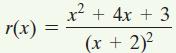
In Exercises 57–64, find the vertical asymptotes, if any, the horizontal asymptote, if one exists, and the slant asymptote, if there is one, of the graph of each rational function. Then graph the rational function. r(x) 2 x² + 4x + 3 (x + 2)²
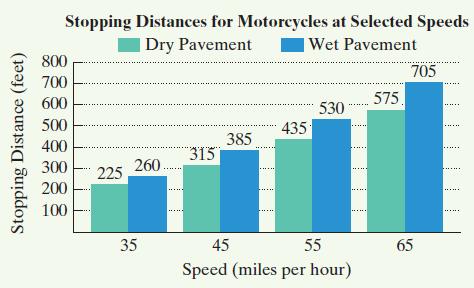
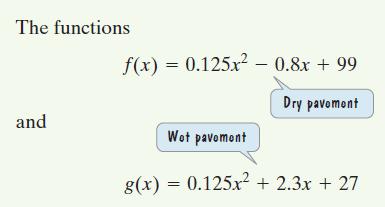
The graph shows stopping distances for motorcycles at various speeds on dry roads and on wet roads.model a motorcycle’s stopping distance, f(x) or g(x), in feet, traveling at x miles per hour. Function f models stopping distance on dry pavement and function g models stopping distance on wet
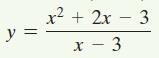
In Exercises 57–64, find the vertical asymptotes, if any, the horizontal asymptote, if one exists, and the slant asymptote, if there is one, of the graph of each rational function. Then graph the rational function. y = x² + 2x - 3 x - 3
In Exercises 41–64,a. Use the Leading Coefficient Test to determine the graph’s end behavior.b. Find the x-intercepts. State whether the graph crosses the x-axis, or touches the x-axis and turns around, at each intercept.c. Find the y-intercept.d. Determine whether the graph has y-axis
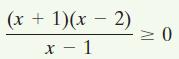
In Exercises 69–74, solve each inequality and graph the solution set on a real number line. (x + 1)(x - 2) x-1 ≥ 0
In Exercises 41–64,a. Use the Leading Coefficient Test to determine the graph’s end behavior.b. Find the x-intercepts. State whether the graph crosses the x-axis, or touches the x-axis and turns around, at each intercept.c. Find the y-intercept.d. Determine whether the graph has y-axis
In Exercises 69–74, solve each inequality and graph the solution set on a real number line. 0 < x + 2 9 - x
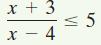
In Exercises 69–74, solve each inequality and graph the solution set on a real number line. x + 3 x - 4 VI 5
Explain how to perform synthetic division. Use the division problem in Exercise 57 to support your explanation.Data from Exercise 57Explain how to perform long division of polynomials. Use2x3 - 3x2 - 11x + 7 divided by x - 3 in your explanation.
In Exercises 69–74, solve each inequality and graph the solution set on a real number line.x3 + 2x2 > 3x
Explain how the Remainder Theorem can be used to find f(-6) if f(x) = x4 + 7x3 + 8x2 + 11x + 5. What advantage is there to using the Remainder Theorem in this situation rather than evaluating f(-6) directly?
Use the position function s(t) = -16t2 + v0t + s0 to solve this problem. A projectile is fired vertically upward from ground level with an initial velocity of 48 feet per second. During which time period will the projectile’s height exceed 32 feet?
Many areas of Northern California depend on the snowpack of the Sierra Nevada mountain range for their water supply. The volume of water produced from melting snow varies directly as the volume of snow. Meteorologists have determined that 250 cubic centimeters of snow will melt to 28 cubic
The distance that a body falls from rest is directly proportional to the square of the time of the fall. If skydivers fall 144 feet in 3 seconds, how far will they fall in 10 seconds?
The pitch of a musical tone varies inversely as its wavelength. A tone has a pitch of 660 vibrations per second and a wavelength of 1.6 feet. What is the pitch of a tone that has a wavelength of 2.4 feet?
The loudness of a stereo speaker, measured in decibels, varies inversely as the square of your distance from the speaker. When you are 8 feet from the speaker, the loudness is 28 decibels. What is the loudness when you are 4 feet from the speaker?
The time required to assemble computers varies directly as the number of computers assembled and inversely as the number of workers. If 30 computers can be assembled by 6 workers in 10 hours, how long would it take 5 workers to assemble 40 computers?
Showing 8700 - 8800
of 13634
First
81
82
83
84
85
86
87
88
89
90
91
92
93
94
95
Last
Step by Step Answers

 Get 50% OFF
Claim Now
Get 50% OFF
Claim Now