New Semester
Started
Get
50% OFF
Study Help!
--h --m --s
Claim Now
Question Answers
Textbooks
Find textbooks, questions and answers
Oops, something went wrong!
Change your search query and then try again
S
Books
FREE
Study Help
Expert Questions
Accounting
General Management
Mathematics
Finance
Organizational Behaviour
Law
Physics
Operating System
Management Leadership
Sociology
Programming
Marketing
Database
Computer Network
Economics
Textbooks Solutions
Accounting
Managerial Accounting
Management Leadership
Cost Accounting
Statistics
Business Law
Corporate Finance
Finance
Economics
Auditing
Tutors
Online Tutors
Find a Tutor
Hire a Tutor
Become a Tutor
AI Tutor
AI Study Planner
NEW
Sell Books
Search
Search
Sign In
Register
study help
mathematics
precalculus
Thomas Calculus Early Transcendentals 13th Edition Joel R Hass, Christopher E Heil, Maurice D Weir - Solutions
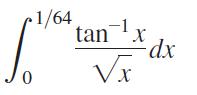
Use series to approximate the values of the integral with an error of magnitude less than 10-8. 0 1/64 tan Vx x dx
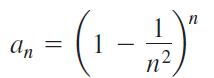
Which of the sequences {an} converge, and which diverge? Find the limit of each convergent sequence. = an 1 2 n n
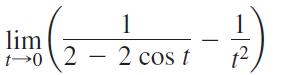
a. Use power series to evaluate the limit.b. Then use a grapher to support your calculation. 1 lim m (2 - 2 cost - ²)
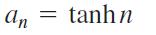
Which of the sequences {an} converge, and which diverge? Find the limit of each convergent sequence. an = tanhn
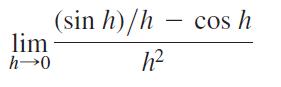
a. Use power series to evaluate the limit.b. Then use a grapher to support your calculation. lim h→0 (sin h)/h - cos h h²
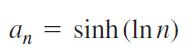
Which of the sequences {an} converge, and which diverge? Find the limit of each convergent sequence. an = sinh(lnn)
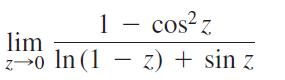
a. Use power series to evaluate the limit.b. Then use a grapher to support your calculation. 1 - cos² z lim zo ln (1z) + sin z
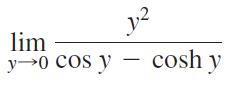
a. Use power series to evaluate the limit.b. Then use a grapher to support your calculation. y² lim yo cos y cosh y
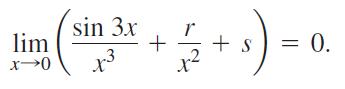
Use a series representation of sin 3x to find values of r and s for which lim x→0 sin 3x x3 + + S = 0.
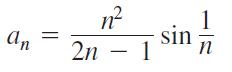
Which of the sequences {an} converge, and which diverge? Find the limit of each convergent sequence. an = n² 2n 1 sin n
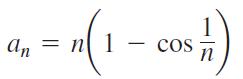
Which of the sequences {an} converge, and which diverge? Find the limit of each convergent sequence. An = n(1 - COS n
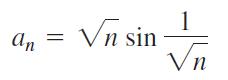
Which of the sequences {an} converge, and which diverge? Find the limit of each convergent sequence. an = 'n sin √n
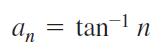
Which of the sequences {an} converge, and which diverge? Find the limit of each convergent sequence. an = tan ¹ n
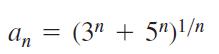
Which of the sequences {an} converge, and which diverge? Find the limit of each convergent sequence. an = (3n+ 5n)1/n
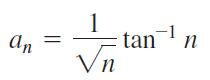
Which of the sequences {an} converge, and which diverge? Find the limit of each convergent sequence. an = 1 tan¯¯¹ n =tan-1 √n
Find a closed-form formula for the nth partial sum of the seriesand use it to determine the convergence or divergence of the series. Σ=2ln(1 − (1/n?))
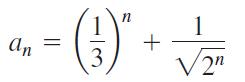
Which of the sequences {an} converge, and which diverge? Find the limit of each convergent sequence. an 3 n + 1 V2n
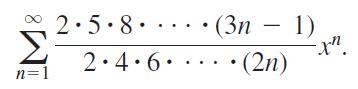
Find the radius of convergence of the series n=1 2.5.8. • (3n — 1) (2n) 2.4.6. -X".
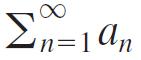
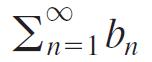
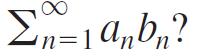
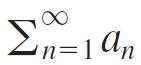
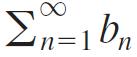
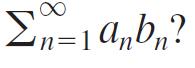
Ifandare convergent series of nonnegative numbers, can anything be said aboutGive reasons for your answer. 8 Σn=1 an
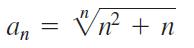
Which of the sequences {an} converge, and which diverge? Find the limit of each convergent sequence. an || "√√n² + n
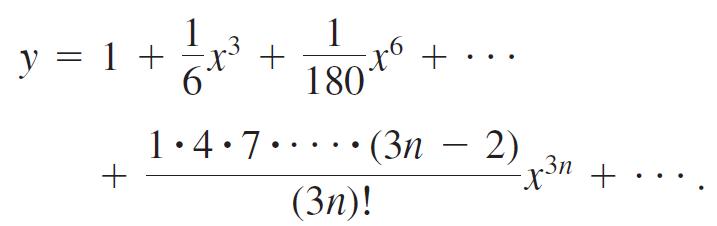
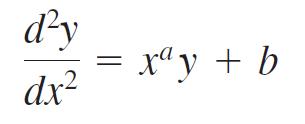
a. Find the interval of convergence of the seriesb. Show that the function defined by the series satisfies a differential equation of the formand find the values of the constants a and b. y = 1 + + 3 + 1.4.7.. 1 180 . про • (3п — 2) (Зи)! -x³n +
Ifandare divergent series of nonnegative numbers, can anything be said aboutGive reasons for your answer. 8 n=1 an 1
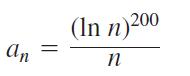
Which of the sequences {an} converge, and which diverge? Find the limit of each convergent sequence. An (In n) 200 n
Evaluateby finding the limits as n→∞ of the series’ nth partial sum. Σk-2 (1/(k² − 1))
Compare the accuracies of the approximations sin x ≈ x and sin x ≈ 6x/(6 + x2) by comparing the graphs of ƒ(x) = sin x - x and g(x) = sin x - (6x/(6 + x2)). Describe what you find.
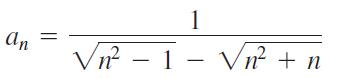
Which of the sequences {an} converge, and which diverge? Find the limit of each convergent sequence. 1 an √√n² − 1 = √√√n² + n - -
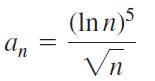
Which of the sequences {an} converge, and which diverge? Find the limit of each convergent sequence. an (Inn)5 Vn
Make up an infinite series of nonzero terms whose sum isa. 1 b. -3 c. 0.
Which of the sequences {an} converge, and which diverge? Find the limit of each convergent sequence. ann- - Vn² - n
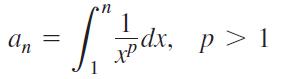
Which of the sequences {an} converge, and which diverge? Find the limit of each convergent sequence. = 12 - f. 2 pdx. an xpdx, p > 1
For what values of r does the infinite seriesconverge? Find the sum of the series when it converges. 1 + 2r + ² + 2r³ + r4 + 2√5 + 6 +
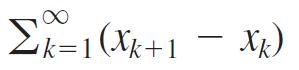
Prove that the sequence {xn} and the seriesboth converge or both diverge. Σ=1(xk+1 Χ.)
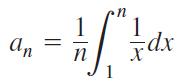
Which of the sequences {an} converge, and which diverge? Find the limit of each convergent sequence. an || #S," / dx n 1
Find the value of b for which 1 + eb + e²b + e³b + = 9.
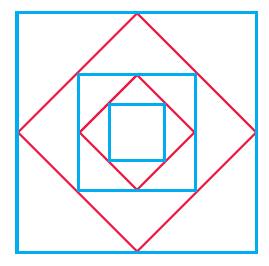
The accompanying figure shows the first five of a sequence of squares. The outermost square has an area of 4 m2. Each of the other squares is obtained by joining the midpoints of the sides of the squares before it. Find the sum of the areas of all the squares.
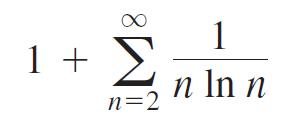
Use the result in Exercise 91 to show thatdiverges.Exercise 91Suppose that a1, a2, a3,· · ·, an are positive numbers satisfying the following conditions:i) a1 ≥ a2 ≥ a3 ≥ · · ·;ii) the series a2 + a4 + a8 + a16 + · · · diverges. Show that the seriesdiverges. 1 + M8 n=2 1 n ln n
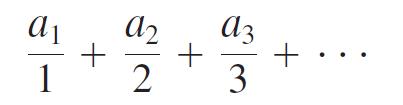
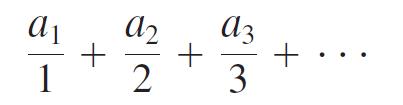
Suppose that a1, a2, a3,· · ·, an are positive numbers satisfying the following conditions:i) a1 ≥ a2 ≥ a3 ≥ · · ·;ii) The series a2 + a4 + a8 + a16 + · · · diverges. Show that the seriesdiverges. a1 аг + 1 2 + аз 3 +
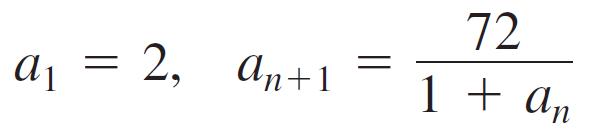
Assume that each sequence converges and find its limit. a1 2. = an+1 72 1 + an
a. Find the Maclaurin series for the function x2/(1 + x).b. Does the series converge at x = 1? Explain.
Assume that each sequence converges and find its limit. a 1 = -4, A₂+1 V8 + 2an
Assume that each sequence converges and find its limit. a ₁ 5, an+1 √5an
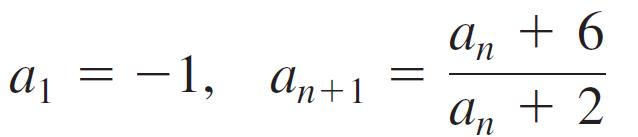
Assume that each sequence converges and find its limit. an 2 + "p 9 + "p I= = 'p -1, an+1
Assume that each sequence converges and find its limit. 0, an+1 a₁ = 0, V8 + 2an
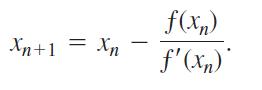
The following sequences come from the recursion formula for Newton’s method,Do the sequences converge? If so, to what value? In each case, begin by identifying the function ƒ that generates the sequence.a.b.c. Xn+1 = Xn f(x₂) f'(x₂)
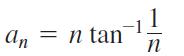
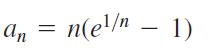
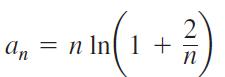
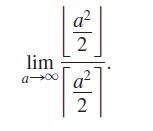
a. Suppose that ƒ(x) is differentiable for all x in [0, 1] and that ƒ(0) = 0. Define sequence {an} by the rule an = nƒ(1/n). Show that limn→∞an = ƒ′(0). Use the result in part (a) to find the limits of the following sequences {an}.b.c.d. = an n tan n
A sequence of rational numbers is described as follows:Here the numerators form one sequence, the denominators form a second sequence, and their ratios form a third sequence. Let xn and yn be, respectively, the numerator and the denominator of the nth fraction rn = xn/yn.a. Verify that x12 - 2y12 =
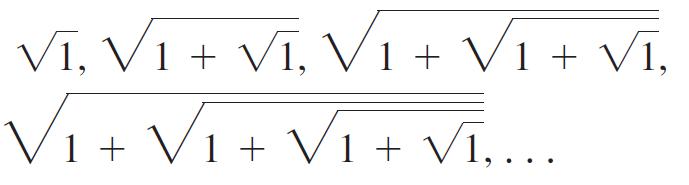
Assume that each sequence converges and find its limit. VI. V₁ + VI, V1 + V1 + V₁₂ V₁ + V₁ + V₁ + VI,... 1 1 V1
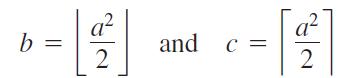
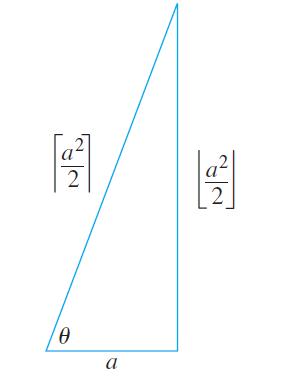
A triple of positive integers a, b, and c is called a Pythagorean triple if a2 + b2 = c2. Let a be an odd positive integer and letbe, respectively, the integer floor and ceiling for a2/2.a. Show that a2 + b2 = c2. b. By direct calculation, or by appealing to the accompanying figure, find b
Assume that each sequence converges and find its limit. a 1 = 3, an+1 = 12 - Van
The first term of a sequence is x1 = 1. Each succeeding term is the sum of all those that come before it:Write out enough early terms of the sequence to deduce a general formula for xn that holds for n ≥ 2. Xn+1 x₁ + x₂ + ... + xn. =
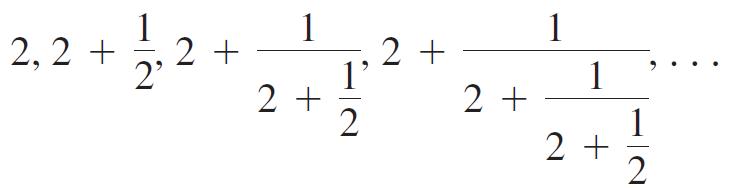
Assume that each sequence converges and find its limit. 2,2 + 2 + 2² - 1 2 + 1' 2 2 + 2 + 1 1 2 + 1 - 2
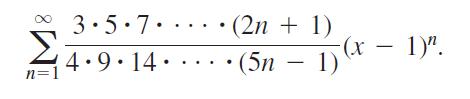
Find the radius of convergence of the series Σ n=1 3.5.7. 4.9.14. (2n + 1) · (5n – 1)' (r - 1)".
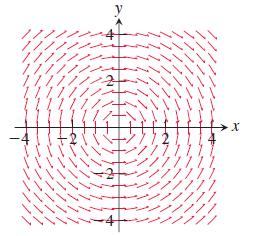
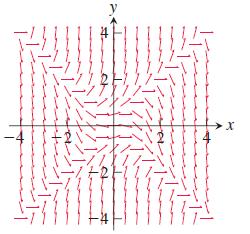
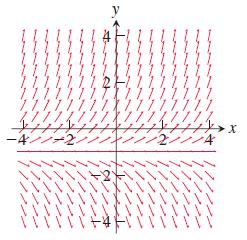
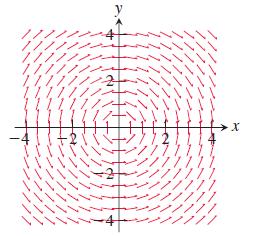
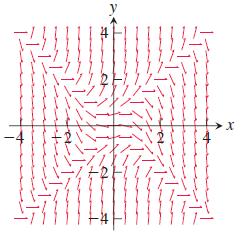
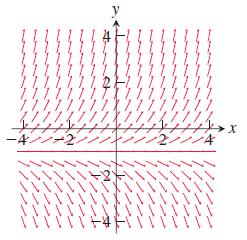
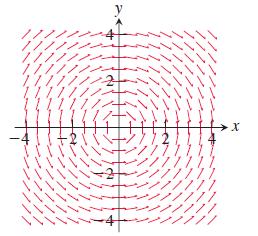
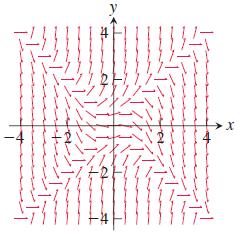
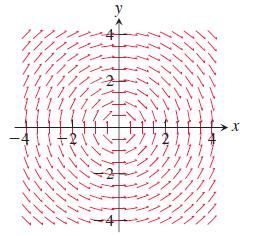
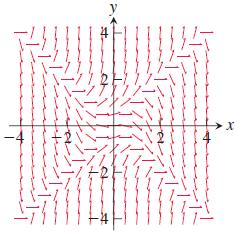
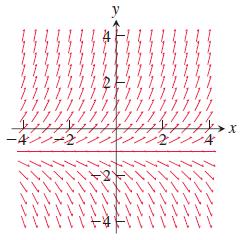
Match the differential equations with their slope fields, graphed here.(a)(b)(c)(d)y′ = x + y 77 2. 4 77.2 - 11 The X
Match the differential equations with their slope fields, graphed here.(a)(b)(c)(d) 77 2. 4 77.2 - 11 The X
Match the differential equations with their slope fields, graphed here.(a)(b)(c)(d)y′ = y + 1 77 2. 4 77.2 - 11 The X
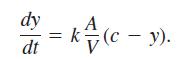
Under some conditions, the result of the movement of a dissolved substance across a cell’s membrane is described by the equationIn this equation, y is the concentration of the substance inside the cell and dy/dt is the rate at which y changes over time. The letters k, A, V, and c stand for
A 66-kg cyclist on a 7-kg bicycle starts coasting on level ground at 9 m / sec. The k in Equation (1) is about 3.9 kg / sec.a. About how far will the cyclist coast before reaching a complete stop?b. How long will it take the cyclist’s speed to drop to 1m/sec? v = v₁e (k/m) (1)
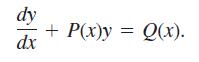
Assume the hypotheses of Exercise 3, and assume that y1(x) and y2(x) are both solutions to the firstorder linear equation satisfying the initial condition y(x0) = y0.a. Verify that y(x) = y1(x) - y2(x) satisfies the initial value problemb. For the integrating factor ν(x) = e∫P(x) dx, show
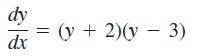
a. Identify the equilibrium values. Which are stable and which are unstable?b. Construct a phase line. Identify the signs of y′ and y″.c. Sketch several solution curves. dy dx = (y + 2)(y - 3)
Suppose that an Iowa class battleship has mass around 51,000 metric tons (51,000,000 kg) and a k value in Equation (1) of about 59,000 kg / sec. Assume that the ship loses power when it is moving at a speed of 9 m / sec.a. About how far will the ship coast before it is dead in the water?b. About
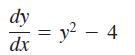
a. Identify the equilibrium values. Which are stable and which are unstable?b. Construct a phase line. Identify the signs of y′ and y″.c. Sketch several solution curves. dy dx = y² - 4
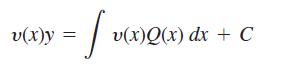
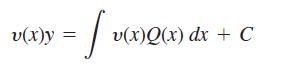
a. Assume that P(x) and Q(x) are continuous over the interval [a, b]. Use the Fundamental Theorem of Calculus, Part 1, to show that any function y satisfying the equationfor ν(x) = e∫P(x) dx is a solution to the first-order linear equation.b. If then show that any solution y in part (a)
Match the differential equations with their slope fields, graphed here.(a)(b)(c)(d)y′ = y2 - x2 77 2. 4 77.2 - 11 The X
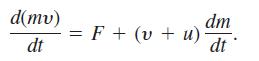
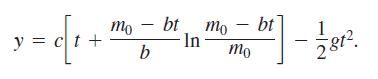
If an external force F acts upon a system whose mass varies with time, Newton’s law of motion isIn this equation, m is the mass of the system at time t, ν is its velocity, and ν + u is the velocity of the mass that is entering (or leaving) the system at the rate dm/dt. Suppose that a rocket of
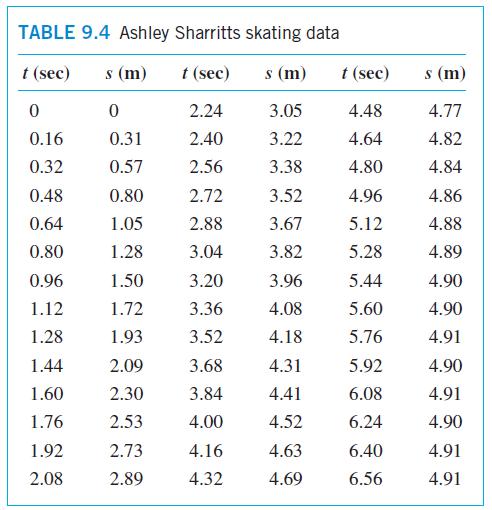
The data in Table 9.4 were collected with a motion detector and a CBL™ by Valerie Sharritts, then a mathematics teacher at St. Francis DeSales High School in Columbus, Ohio. The table shows the distance s (meters) coasted on inline skates in t sec by her daughter Ashley when she was 10 years old.
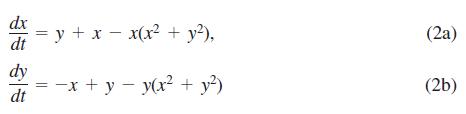
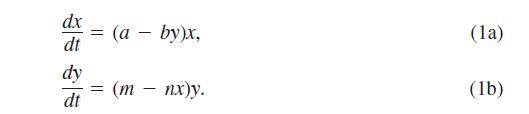
For the system (2a) and (2b), show that any trajectory starting on the unit circle x2 + y2 = 1 will traverse the unit circle in a periodic solution. First introduce polar coordinates and rewrite the system as dr/dt = r(1 - r2) and -dθ/dt = -1. dx dt dy dt = y + x - x(x2+y2), = x + y -
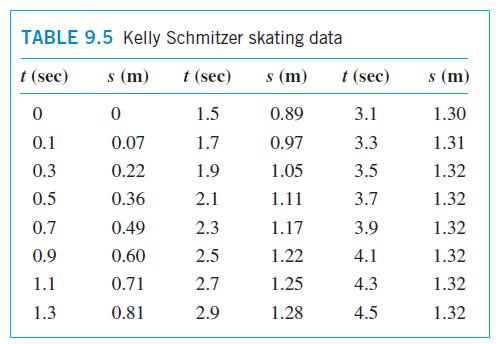
Table 9.5 shows the distance s (meters) coasted on inline skates in terms of time t (seconds) by Kelly Schmitzer. Find a model for her position in the form of Equation (2). Her initial velocity was ν0 = 0.80 m/sec, her mass m = 49.90 kg (110 lb), and her total coasting distance was 1.32 m. TABLE
What is a first-order differential equation? When is a function a solution of such an equation?
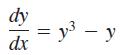
a. Identify the equilibrium values. Which are stable and which are unstable?b. Construct a phase line. Identify the signs of y′ and y″.c. Sketch several solution curves. dy dx y³ - y
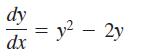
a. Identify the equilibrium values. Which are stable and which are unstable?b. Construct a phase line. Identify the signs of y′ and y″.c. Sketch several solution curves. dy dx =y² - 2y
Develop a model for the growth of trout and bass, assuming that in isolation trout demonstrate exponential decay [so that a < 0 in Equations (1a) and (1b)] and that the bass population grows logistically with a population limit M. Analyze graphically the motion in the vicinity of the rest points
What is a general solution? A particular solution?
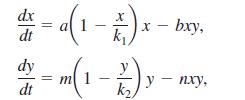
Consider another competitive-hunter model defined by dx = dt - a ( 1 - / -) -£x - bxy, dy dt 1-2-), y = m 1 nxy,
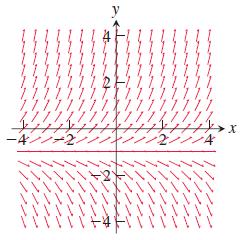
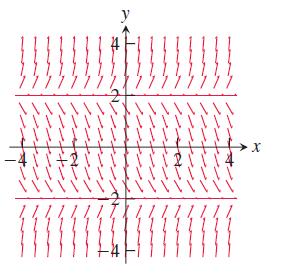
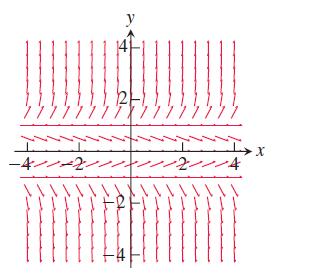
Copy the slope fields and sketch in some of the solution curves.y′ = (y + 2)(y - 2) 144 WWW
What is the slope field of a differential equation y′ = ƒ(x, y)? What can we learn from such fields?
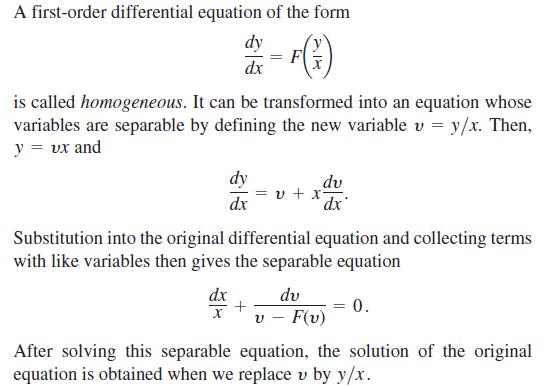
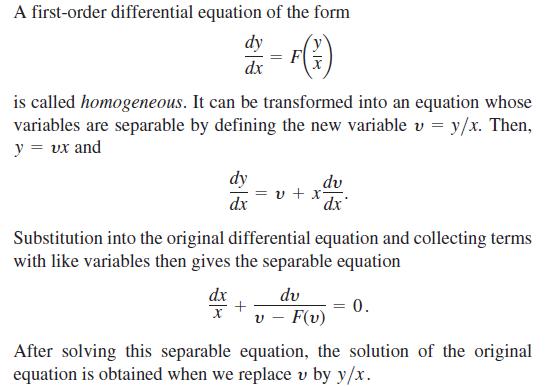
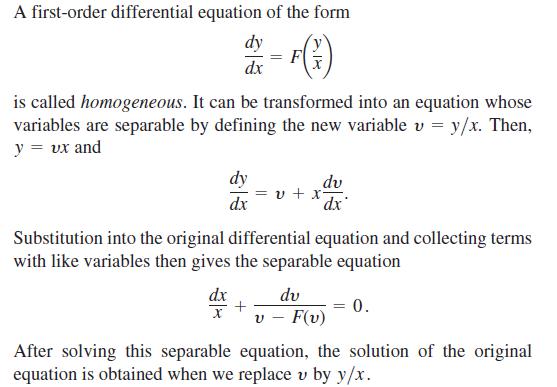
Solve the homogeneous equations. First put the equation in the form of a homogeneous equation.x2 dy + (y2 - xy) dx = 0 A first-order differential equation of the form dy dx is called homogeneous. It can be transformed into an equation whose variables are separable by defining the new variable v =
Copy the slope fields and sketch in some of the solution curves.y′ = y(y + 1)(y - 1) جل y ////// ار مرحوم -
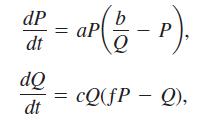
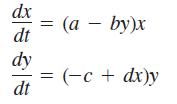
Consider the following economic model. Let P be the price of a single item on the market. Let Q be the quantity of the item available on the market. Both P and Q are functions of time. If one considers price and quantity as two interacting species, the following model might be proposed:where a, b,
How might the competitive-hunter model be validated? Include a discussion of how the various constants a, b, m, and n might be estimated. How could state conservation authorities use the model to ensure the survival of both species?
Describe Euler’s method for solving the initial value problem y′ = ƒ(x, y), y(x0) = y0 numerically. Give an example. Comment on the method’s accuracy. Why might you want to solve an initial value problem numerically?
Find the orthogonal trajectories of the family of curves. Sketch several members of each family.y = mx
a. Identify the equilibrium values. Which are stable and which are unstable?b. Construct a phase line. Identify the signs of y′ and y″.c. Sketch several solution curves.y′ = √y, y > 0
Solve the homogeneous equations. First put the equation in the form of a homogeneous equation.(xey/x + y) dx - x dy = 0 A first-order differential equation of the form dy dx is called homogeneous. It can be transformed into an equation whose variables are separable by defining the new variable v =
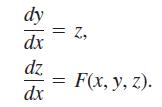
Show that the second-order differential equation y″ = F(x, y, y′) can be reduced to a system of two first-order differential equationsCan something similar be done to the nth-order differential equation y(n) = F(x, y, y′, y″,c, y(n-1))? dy dx dz dx Z, = F(x, y, z).
Solve the homogeneous equations. First put the equation in the form of a homogeneous equation.(x + y) dy + (x - y) dx = 0 A first-order differential equation of the form dy dx is called homogeneous. It can be transformed into an equation whose variables are separable by defining the new variable v
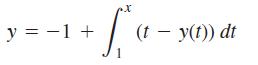
Write an equivalent first-order differential equation and initial condition for y. X ¹ + ₁*« 1 y = -1 + (t - y(t)) dt
a. Identify the equilibrium values. Which are stable and which are unstable?b. Construct a phase line. Identify the signs of y′ and y″.c. Sketch several solution curves.y′ = y - √y, y > 0
What is an orthogonal trajectory of a family of curves? Describe how one is found for a given family of curves.
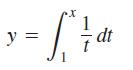
Write an equivalent first-order differential equation and initial condition for y. y S, 7 dt
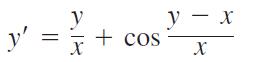
Solve the homogeneous equations. First put the equation in the form of a homogeneous equation. y' = X + cos y - x X
Find the orthogonal trajectories of the family of curves. Sketch several members of each family.kx2 + y2 = 1
a. Identify the equilibrium values. Which are stable and which are unstable?b. Construct a phase line. Identify the signs of y′ and y″.c. Sketch several solution curves.y′ = (y - 1)(y - 2)(y - 3)
What is an autonomous differential equation? What are its equilibrium values? How do they differ from critical points? What is a stable equilibrium value? Unstable?
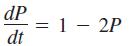
The autonomous differential equations represent models for population growth. For each exercise, use a phase line analysis to sketch solution curves for P(t), selecting different starting values P(0). Which equilibria are stable, and which are unstable? dP dt = 1 - 2P
Write an equivalent first-order differential equation and initial condition for y. y = 2- •X T 0 (1 + y(t)) sin t dt
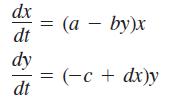
In 1925 Lotka and Volterra introduced the predator-prey equations, a system of equations that models the populations of two species, one of which preys on the other. Let x(t) represent the number of rabbits living in a region at time t, and y(t) the number of foxes in the same region. As time
Find the orthogonal trajectories of the family of curves. Sketch several members of each family.2x2 + y2 = c2
In 1925 Lotka and Volterra introduced the predator-prey equations, a system of equations that models the populations of two species, one of which preys on the other. Let x(t) represent the number of rabbits living in a region at time t, and y(t) the number of foxes in the same region. As time
a. Identify the equilibrium values. Which are stable and which are unstable?b. Construct a phase line. Identify the signs of y′ and y″.c. Sketch several solution curves.y′ = y3 - y2
How do you construct the phase line for an autonomous differential equation? How does the phase line help you produce a graph which qualitatively depicts a solution to the differential equation?
Showing 10100 - 10200
of 29454
First
95
96
97
98
99
100
101
102
103
104
105
106
107
108
109
Last
Step by Step Answers

 Get 50% OFF
Claim Now
Get 50% OFF
Claim Now