New Semester
Started
Get
50% OFF
Study Help!
--h --m --s
Claim Now
Question Answers
Textbooks
Find textbooks, questions and answers
Oops, something went wrong!
Change your search query and then try again
S
Books
FREE
Study Help
Expert Questions
Accounting
General Management
Mathematics
Finance
Organizational Behaviour
Law
Physics
Operating System
Management Leadership
Sociology
Programming
Marketing
Database
Computer Network
Economics
Textbooks Solutions
Accounting
Managerial Accounting
Management Leadership
Cost Accounting
Statistics
Business Law
Corporate Finance
Finance
Economics
Auditing
Tutors
Online Tutors
Find a Tutor
Hire a Tutor
Become a Tutor
AI Tutor
AI Study Planner
NEW
Sell Books
Search
Search
Sign In
Register
study help
mathematics
precalculus
Thomas Calculus Early Transcendentals 13th Edition Joel R Hass, Christopher E Heil, Maurice D Weir - Solutions
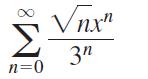
(a) Find the series’ radius and interval of convergence. For what values of x does the series converge (b) Absolutely(c) Conditionally? 8 n=0 Vnxn 3n
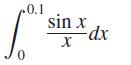
Use series to approximate the values of the integrals with an error of magnitude less than 10-8. 0 0.1 sin x -dx X
Express each of the numbers as the ratio of two integers. 0.234 = 0.234 234 234...
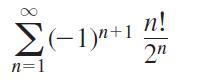
Which of the series converge absolutely, which converge, and which diverge? Give reasons for your answers. Σ(-1)+1 n=1 n! 2n
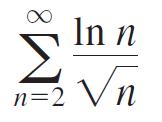
Which of the series converge, and which diverge? Give reasons for your answers. ∞ n=2 In n Vn
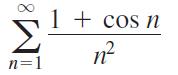
Which of the series converge, and which diverge? Use any method, and give reasons for your answers. 1 + cos n Σ ₂2 n=1 Η
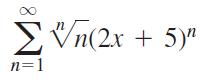
(a) Find the series’ radius and interval of convergence. For what values of x does the series converge (b) Absolutely, (c) Conditionally? Σn(2x + 5)" n=1
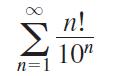
Use any method to determine if the series converges or diverges. Give reasons for your answer. ∞ n=1 n! 10"
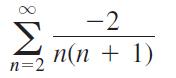
Find the sums of the serie. -2 Σ n(n + 1) n=2
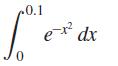
Use series to approximate the values of the integrals with an error of magnitude less than 10-8. 0.1 J. 0 e-x² dx
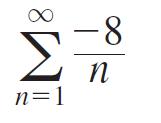
Which of the series converge, and which diverge? Give reasons for your answers. ∞ n=1 -8 n
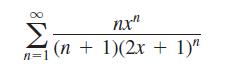
Find all values of x for whichconverges absolutely. n=1 nx" (n + 1)(2x + 1)"
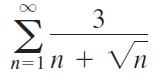
Which of the series converge, and which diverge? Use any method, and give reasons for your answers. 00 3 Σ n=1n + √n
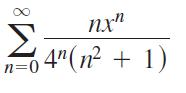
(a) Find the series’ radius and interval of convergence. For what values of x does the series converge (b) Absolutely, (c) Conditionally? nxn Σ n=04" (n² + 1)
Use power series operations to find the Taylor series at x = 0 for the function.x ln (1 + 2x)
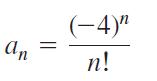
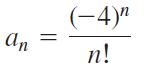
Which of the sequences whose nth terms appear converge, and which diverge? Find the limit of each convergent sequence. an (-4)" n!
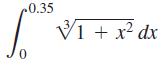
Use series to estimate the integrals’ values with an error of magnitude less than 10-5. (The answer section gives the integrals’ values rounded to seven decimal places.) 0 0.35 √1 + x² dx
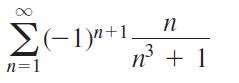
Which of the series converge absolutely, which converge, and which diverge? Give reasons for your answers. ∞ Σ(-1)+1 n=1 n n³ + 1
Express each of the numbers as the ratio of two integers. 0.23 0.23 23 23...
What is absolute convergence? Conditional convergence? How are the two related?
Each of the series is the value of the Taylor series at x = 0 of a function ƒ(x) at a particular point. What function and what point? What is the sum of the series? TT - TT 775 + 3! 5! _2n+1 TT (2n + 1)! + (-1)". +
Replace x by -x in the Taylor series for ln (1 + x) to obtain a series for ln (1 - x). Then subtract this from the Taylor series for ln (1 + x) to show that for |x| < 1, + + 2 x + = X- x + In
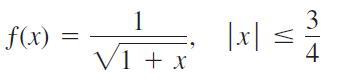
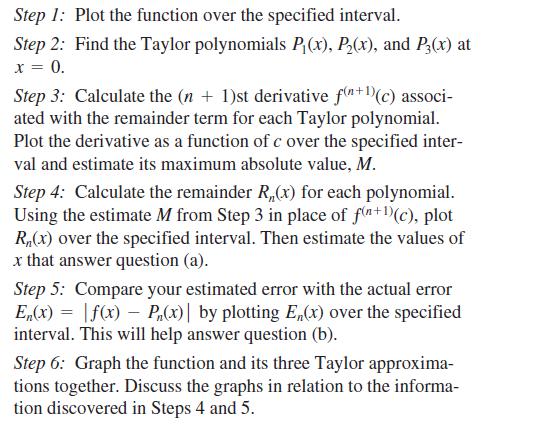
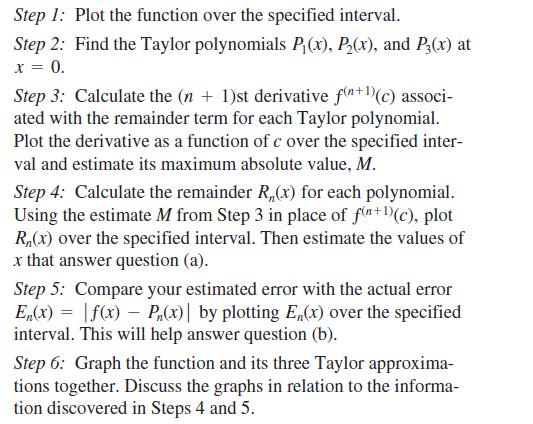
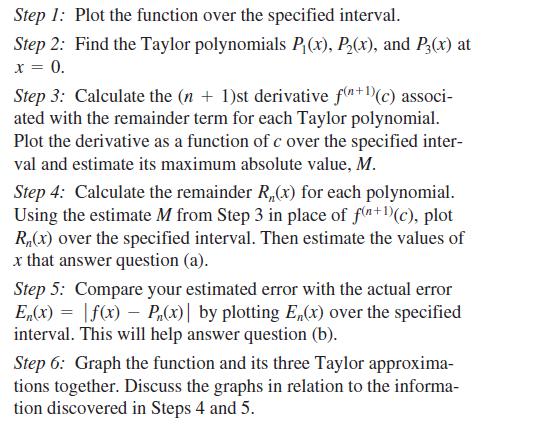
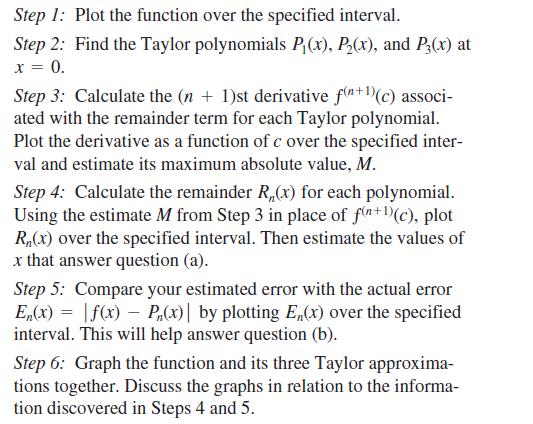
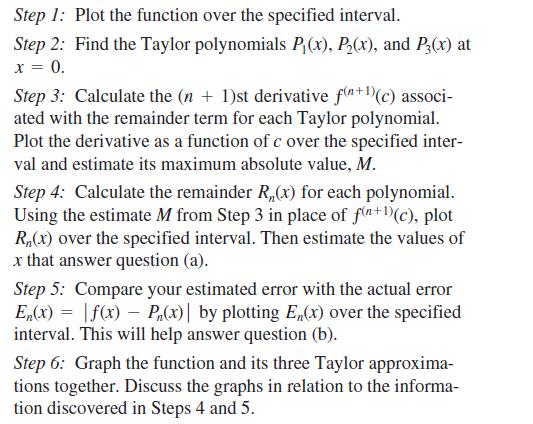
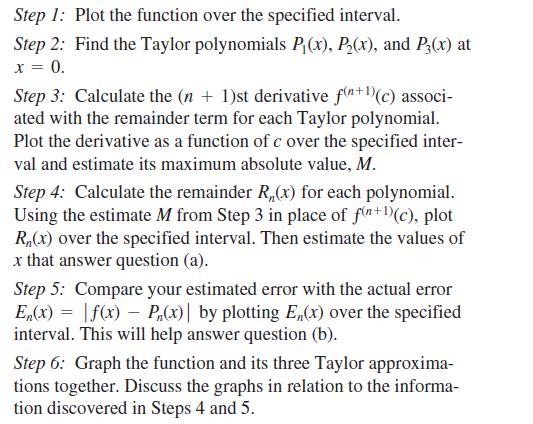
Taylor’s formula with n = 1 and a = 0 gives the linearization of a function at x = 0. With n = 2 and n = 3 we obtain the standard quadratic and cubic approximations. In these exercises we explore the errors associated with these approximations. We seek answers to two questions:a. For what values
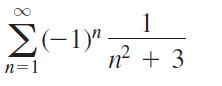
Determine how many terms should be used to estimate the sum of the entire series with an error of less than 0.001. 8 1 Σ(1)" - n² + 3 n=1
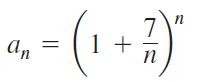
Which of the sequences {an} converge, and which diverge? Find the limit of each convergent sequence. an 1 + n 7 n
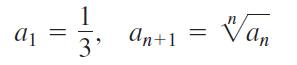
Which of the series ∑∞n =1an defined by the formulas converge, and which diverge? Give reasons for your answers. a1 3 an+1 = Van
Each of the series is the value of the Taylor series at x = 0 of a function ƒ(x) at a particular point. What function and what point? What is the sum of the series? 1 TT 9.2! + TTA 81.4! 772n 32n (2n)! + (-1)"- +
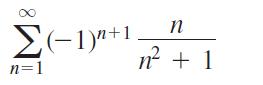
Determine how many terms should be used to estimate the sum of the entire series with an error of less than 0.001. Σ(-1)+1 n=1 n n² + 1
Each of the series is the value of the Taylor series at x = 0 of a function ƒ(x) at a particular point. What function and what point? What is the sum of the series? 1 + In 2 + (In 2)² 2! + .. + (In 2)" n! +
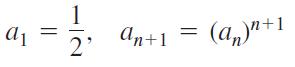
Which of the series ∑∞n =1an defined by the formulas converge, and which diverge? Give reasons for your answers. = a1 2' an+1 = (an)n +1
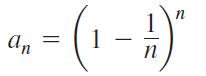
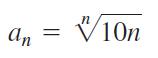
Which of the sequences {an} converge, and which diverge? Find the limit of each convergent sequence. an = 1 n n
Taylor’s formula with n = 1 and a = 0 gives the linearization of a function at x = 0. With n = 2 and n = 3 we obtain the standard quadratic and cubic approximations. In these exercises we explore the errors associated with these approximations. We seek answers to two questions:a. For what values
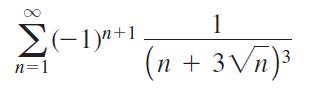
Determine how many terms should be used to estimate the sum of the entire series with an error of less than 0.001. Σ(-1)+1 n=1 1 (n + 3√n)³
Taylor’s formula with n = 1 and a = 0 gives the linearization of a function at x = 0. With n = 2 and n = 3 we obtain the standard quadratic and cubic approximations. In these exercises we explore the errors associated with these approximations. We seek answers to two questions:a. For what values
The seriesconverges to sin x for all x.a. Find the first six terms of a series for cos x. For what values of x should the series converge?b. By replacing x by 2x in the series for sin x, find a series that converges to sin 2x for all x.c. Using the result in part (a) and series multiplication,
Which of the sequences {an} converge, and which diverge? Find the limit of each convergent sequence. an = n 10n
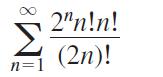
Which of the series converge, and which diverge? Give reasons for your answers. n=1 2"n!n! (2n)!
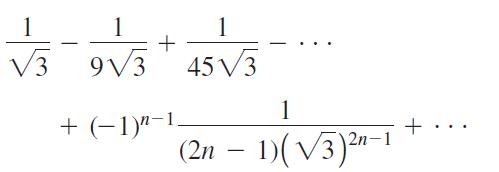
Each of the series is the value of the Taylor series at x = 0 of a function ƒ(x) at a particular point. What function and what point? What is the sum of the series? 1 √3 1 1 + 9√3 45√3 1 (2n − 1)(√√3)²n–1 + (−1)n-1. +
Show that the Taylor series for ƒ(x) = tan-1 x diverges for |x| > 1.
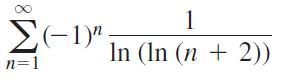
Determine how many terms should be used to estimate the sum of the entire series with an error of less than 0.001. 1 In (In (n + 2)) Σ(1)". n=1
Taylor’s formula with n = 1 and a = 0 gives the linearization of a function at x = 0. With n = 2 and n = 3 we obtain the standard quadratic and cubic approximations. In these exercises we explore the errors associated with these approximations. We seek answers to two questions:a. For what values
The seriesconverges to ex for all x.a. Find a series for (d/dx)ex. Do you get the series for ex? Explain your answer.b. Find a series for ∫ex dx. Do you get the series for ex? Explain your answer.c. Replace x by -x in the series for ex to find a series that converges to e-x for all x. Then
Which of the sequences {an} converge, and which diverge? Find the limit of each convergent sequence. n ₂2 U = UD
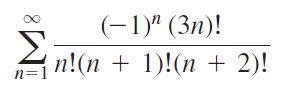
Which of the series converge, and which diverge? Give reasons for your answers. (-1)" (3n)! Σ n!(n + 1)!(n + 2)! n=1
Find Taylor series at x = 0 for the function. 1 1 - 2x
About how many terms of the Taylor series for tan-1 x would you have to use to evaluate each term on the righthand side of the equationwith an error of magnitude less than 10-6? In contrast, the convergence of is so slow that even 50 terms will not yield two-place accuracy. = 48 tan 1 18 +32
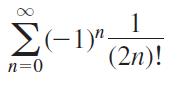
Approximate the sums with an error of magnitude less than 5 * 10-6. 1 Σ(1)". (2n)! n=0
Taylor’s formula with n = 1 and a = 0 gives the linearization of a function at x = 0. With n = 2 and n = 3 we obtain the standard quadratic and cubic approximations. In these exercises we explore the errors associated with these approximations. We seek answers to two questions:a. For what values
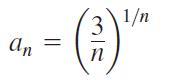
Which of the sequences {an} converge, and which diverge? Find the limit of each convergent sequence. An || = 3 n 1/n
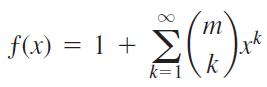
Use the following steps to prove that the binomial series in Equation (1) converges to (1 + x)m.a. Differentiate the seriesto show thatb. Define g(x) = (1 + x)-m ƒ(x) and show that g′(x) = 0.c. From part (b), show that ƒ(x) = (1 + x)m. f(x) = 1 + m Ž(1).** k=1
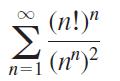
Which of the series converge, and which diverge? Give reasons for your answers. n=1 (n!)n (n")2
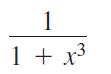
Find Taylor series at x = 0 for the function. 1 1 + x³
Taylor’s formula with n = 1 and a = 0 gives the linearization of a function at x = 0. With n = 2 and n = 3 we obtain the standard quadratic and cubic approximations. In these exercises we explore the errors associated with these approximations. We seek answers to two questions:a. For what values
Approximate the sums with an error of magnitude less than 5 * 10-6. Σ+1)! n=0 n!
The seriesconverges to sec x for -π/2 6 x 6 π/2.a. Find the first five terms of a power series for the function ln |sec x + tan x|. For what values of x should the series converge?b. Find the first four terms of a series for sec x tan x. For what values of x should the series converge?c. Check
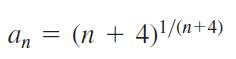
Which of the sequences {an} converge, and which diverge? Find the limit of each convergent sequence. = An (n + 4)¹/(n+4)
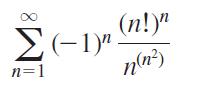
Which of the series converge, and which diverge? Give reasons for your answers. Σ(1)" n=1 (n!)" n(n)
Find Taylor series at x = 0 for the function.sin πx
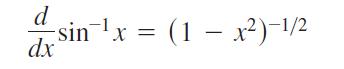
a. Use the binomial series and the fact thatto generate the first four nonzero terms of the Taylor series for sin-1 x. What is the radius of convergence?b. Use your result in part (a) to find the first five nonzero terms of the Taylor series for cos-1 x. d dx sin ¹x = (1-x²)-1/2
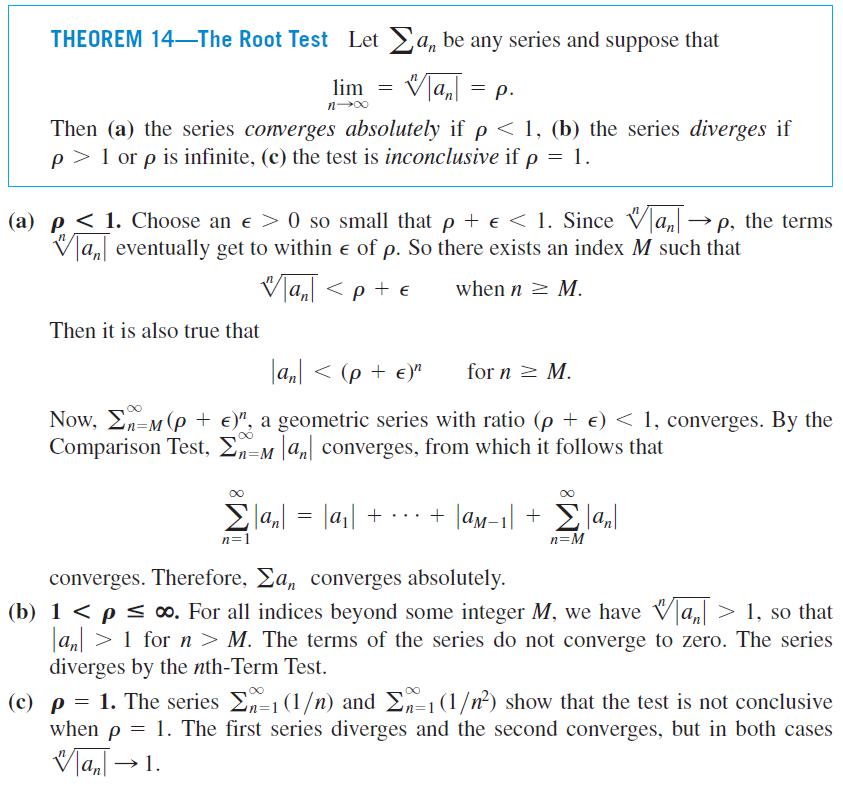
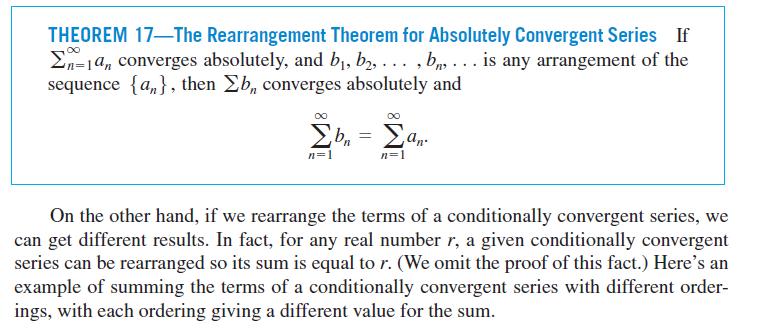
a. The seriesdoes not meet one of the conditions of Theorem 14. Which one?b. Use Theorem 17 to find the sum of the series in part (a). T + T 1 4 + 1 + 8 + 3n +
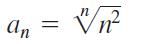
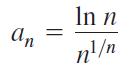
Which of the sequences {an} converge, and which diverge? Find the limit of each convergent sequence. an || In n n²¹/n
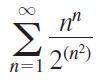
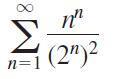
Which of the series converge, and which diverge? Give reasons for your answers. x nn Σ n=1 2(n²)
Which of the sequences {an} converge, and which diverge? Find the limit of each convergent sequence. an = In n ln(n + 1)
To find the sum of this series, express 1/(1 - x) as a geometric series, differentiate both sides of the resulting equation with respect to x, multiply both sides of the result by x, differentiate again, multiply by x again, and set x equal to 1/2. What do you get?
Which of the series converge, and which diverge? Give reasons for your answers. ∞ n" Σ (2²) ² n=1
Which of the sequences {an} converge, and which diverge? Find the limit of each convergent sequence. an || = n 4"n
Find Taylor series at x = 0 for the function.cos (x5/3)
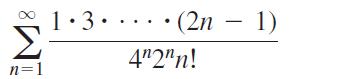
Which of the series converge, and which diverge? Give reasons for your answers. 8W |n=1 1.3 (2n-1) • 4"2"n!
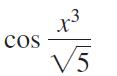
Find Taylor series at x = 0 for the function. COS V5
Show that the sum of the first 2n terms of the seriesis the same as the sum of the first n terms of the seriesDo these series converge? What is the sum of the first 2n + 1 terms of the first series? If the series converge, what is their sum? 1 T N + - + 1 1 + 4 4 - 1 + T 1 6 +
Find the first four nonzero terms of the Taylor series generated by ƒ at x = a.ƒ(x) = 1/x at x = a > 0
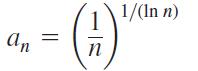
Which of the sequences {an} converge, and which diverge? Find the limit of each convergent sequence. an = n 1/(Inn)
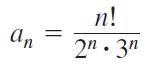
Which of the sequences {an} converge, and which diverge? Find the limit of each convergent sequence. an = n! 2n. 3n
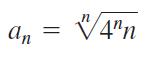
Letdiverges. Recall from the Laws of Exponents that 2(n2) = (2n)n. an [n/2¹, 1/2", if n is a prime number otherwise.
Find the first four nonzero terms of the Taylor series generated by ƒ at x = a.ƒ(x) = 1/(x + 1) at x = 3
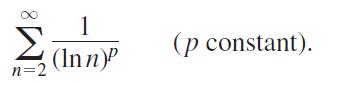
Show that neither the Ratio Test nor the Root Test provides information about the convergence of Σ n=2 1 (Inn)P (p constant).
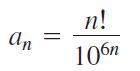
Which of the sequences {an} converge, and which diverge? Find the limit of each convergent sequence. An n! 106п
Find the first four nonzero terms of the Taylor series generated by ƒ at x = a. f(x) = √3 + x² at x x = -1
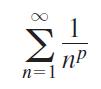
Neither the Ratio Test nor the Root Test helps with p-series. Try them onand show that both tests fail to provide information about convergence. 8 n=1 1 пр
Which of the sequences {an} converge, and which diverge? Find the limit of each convergent sequence. An (-4)" n!
Any real number in the interval [0, 1] can be represented by a decimal (not necessarily unique) aswhere di is one of the integers 0, 1, 2, 3, . . . , 9. Prove that the series on the right-hand side always converges. 0.djd₂d3d4... || d₁ d₂ + 10 10² + dz d₁ + 10³ 104 +
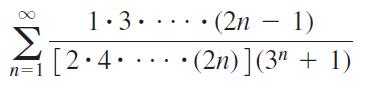
Which of the series converge, and which diverge? Give reasons for your answers. 00 Σ n=1 1.3..... [2.4. (2n . (2n - 1) • (2n)](3¹ + 1)
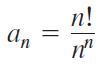
Which of the sequences {an} converge, and which diverge? Find the limit of each convergent sequence. An = n! nn
Find the first four nonzero terms of the Taylor series generated by ƒ at x = a.ƒ(x) = 1/(1 - x) at x = 2
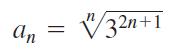
Which of the sequences {an} converge, and which diverge? Find the limit of each convergent sequence. An = n 32n+1
Find Taylor series at x = 0 for the function.e-x2
Find Taylor series at x = 0 for the function.e(πx2)
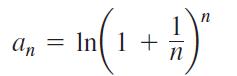
Which of the sequences {an} converge, and which diverge? Find the limit of each convergent sequence. = an In 1 + n n
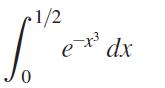
Use series to approximate the values of the integral with an error of magnitude less than 10-8. 0 1/2 ex³ dx
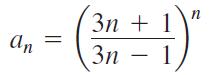
Which of the sequences {an} converge, and which diverge? Find the limit of each convergent sequence. An = 3n + 1 3n - 1 n
In the alternating harmonic series, suppose the goal is to arrange the terms to get a new series that converges to -1/2. Start the new arrangement with the first negative term, which is -1/2. Whenever you have a sum that is less than or equal to -1/2, start introducing positive terms, taken in
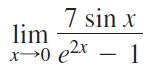
a. Use power series to evaluate the limit.b. Then use a grapher to support your calculation. 7 sin x lim x0e²x - 1
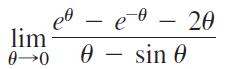
a. Use power series to evaluate the limit.b. Then use a grapher to support your calculation. оч - од — од lim 0→0 0 - sin 0
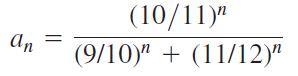
Which of the sequences {an} converge, and which diverge? Find the limit of each convergent sequence. an = (10/11)n (9/10) + (11/12)"
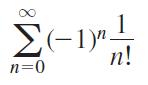
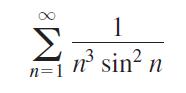
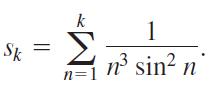
It is not yet known whether the seriesconverges or diverges. Use a CAS to explore the behavior of the series by performing the following steps.a. Define the sequence of partial sumsWhat happens when you try to find the limit of sk as k→∞? Does your CAS find a closed form answer for this
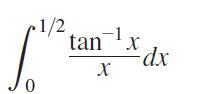
Use series to approximate the values of the integral with an error of magnitude less than 10-8. 0 1/2 tan X ¹x X -dx
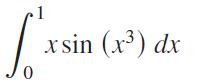
Use series to approximate the values of the integral with an error of magnitude less than 10-8. S 0 xsin (x³) dx
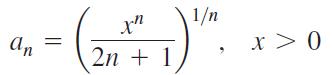
Which of the sequences {an} converge, and which diverge? Find the limit of each convergent sequence. an = xn 2n + 1 1/n , x > 0
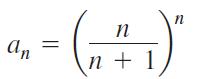
Which of the sequences {an} converge, and which diverge? Find the limit of each convergent sequence. an n n 1 + 1)" n+
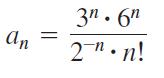
Which of the sequences {an} converge, and which diverge? Find the limit of each convergent sequence. an || 3n. 6n 2.n!
Showing 10000 - 10100
of 29454
First
94
95
96
97
98
99
100
101
102
103
104
105
106
107
108
Last
Step by Step Answers

 Get 50% OFF
Claim Now
Get 50% OFF
Claim Now