New Semester
Started
Get
50% OFF
Study Help!
--h --m --s
Claim Now
Question Answers
Textbooks
Find textbooks, questions and answers
Oops, something went wrong!
Change your search query and then try again
S
Books
FREE
Study Help
Expert Questions
Accounting
General Management
Mathematics
Finance
Organizational Behaviour
Law
Physics
Operating System
Management Leadership
Sociology
Programming
Marketing
Database
Computer Network
Economics
Textbooks Solutions
Accounting
Managerial Accounting
Management Leadership
Cost Accounting
Statistics
Business Law
Corporate Finance
Finance
Economics
Auditing
Tutors
Online Tutors
Find a Tutor
Hire a Tutor
Become a Tutor
AI Tutor
AI Study Planner
NEW
Sell Books
Search
Search
Sign In
Register
study help
mathematics
precalculus
Calculus Of A Single Variable 11th Edition Ron Larson, Bruce H. Edwards - Solutions
Find the Taylor series generated by ƒ at x = a.ƒ(x) = x3 - 2x + 4, a = 2
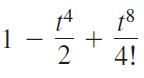
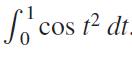
Estimate the error if cos t2 is approximated byin the integral 1 +
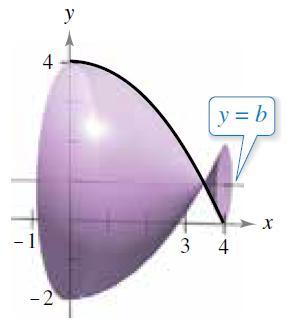
The function y = 4 -(x2/4) on the interval [0, 4] is revolved about the line y = b (see figure).(a) Find the volume of the resulting solid as a function of b.(b) Use a graphing utility to graph the function in part (a), and use the graph to approximate the value of b that minimizes the volume of
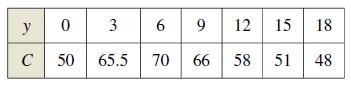
The circumference C (in inches) of a vase is measured at three-inch intervals starting at its base. The measurements are shown in the table, where y is the vertical distance in inches from the base.(a) Use the data to approximate the volume of the vase by summing the volumes of approximating
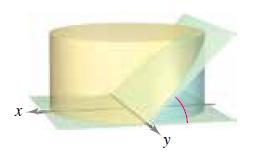
Two planes cut a right circular cylinder to form a wedge. One plane is perpendicular to the axis of the cylinder and the second makes an angle of degrees with the first (see figure).(a) Find the volume of the wedge if θ = 45°.(b) Find the volume of the wedge for an arbitrary angle θ.Assuming
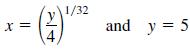
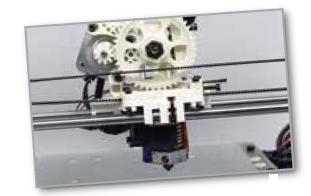
A 3D printer is used to create a plastic drinking glass. The equations given to the printer for the inside of the glass are where x and y are measured in inches. What is the total volume that the drinking glass can hold when the region bounded by the graphs of the equations is revolved about the
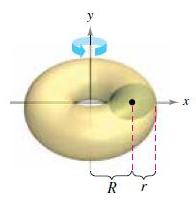
(a) Show that the volume of the torus shown in the figure is given by the integral 8πR ∫r0 √r2 - y2 dy, where R > r > 0.(b) Find the volume of the torus. y R r X
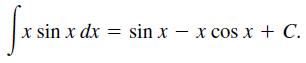
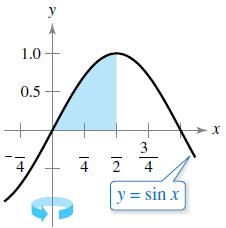
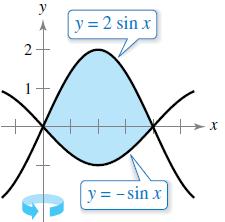
(a) Use differentiation to verify that(b) Use the result of part (a) to find the volume of the solid generated by revolving each plane region about the y-axis.(i)(ii) fx x sin x dx = sin x X cos x + C.
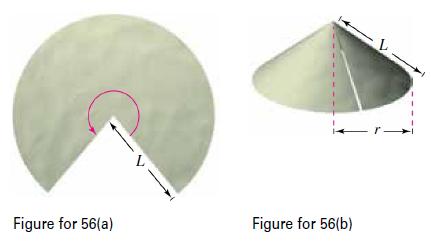
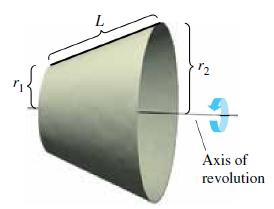
(a) Given a circular sector with radius L and central angle θ (see figure), show that the area of the sector is given by S = 1/2 L2θ.(b) By joining the straight-line edges of the sector in part (a), a right circular cone is formed (see figure) and the lateral surface area of the cone is the same
(a) Use differentiation to verify that (b) Use the result of part (a) to find the volume of the solid generated by revolving each plane region about the y-axis.(i)(ii) x sin x dx sin x x cos x + C. -
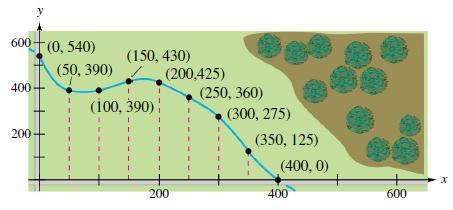
Property bounded by two perpendicular roads and a stream is shown in the figure. All distances are measured in feet.(a) Use the regression capabilities of a graphing utility to fit a fourth-degree polynomial to the path of the stream.(b) Use the model in part (a) to approximate the area of the
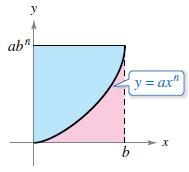
Consider the region bounded by the graphs of y = axn, y = abn, and x = 0, as shown in the figure.(a) Find the ratio R1(n) of the area of the region to the area of the circumscribed rectangle.(b) Find lim n ∞ R1(n) and compare the result with the area of the circumscribed rectangle.(c) Find the
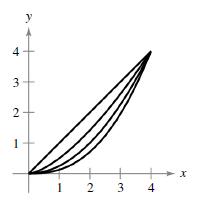
The figure shows the graphs of the functions y1 = x, y2 = 1/2x3/2, y3 = 1/4x2, and y4 = 1/8 x5/2 on the interval [0, 4]. To print an enlarged copy of the graph, go to MathGraphs.com.(a) Label the functions.(b) Without calculating, list the functions in order of increasing arc length.(c) Verify your
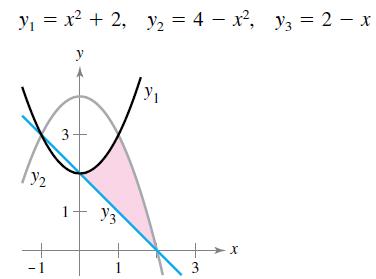
Find the area of the given region bounded by the graphs of y1, y2, and y3, as shown in the figure. y₁ = x² + 2, Y₂ = 4 x², Y₁ = 2 - x 1/2 3 1 y Y3 Y₁ 3 X
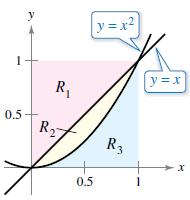
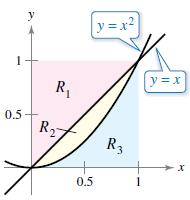
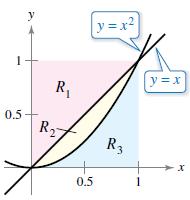
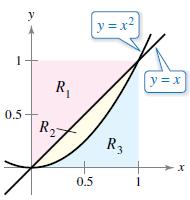
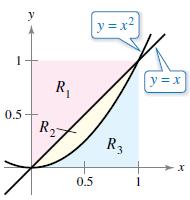
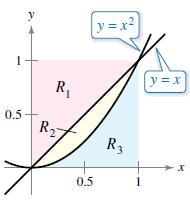
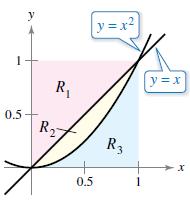
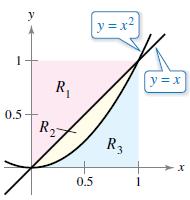
Find the volume of the solid generated by revolving the specified region about the given line.R3 about y = 1 0.5 y R₁ R₂ 0.5 y=x² R3 1 y = x
Consider the solid formed by revolving the region bounded by y = √x, y = 0, x = 1, and x = 3 about the x-axis.Find the value of x in the interval [1, 3] that divides the solid into three parts of equal volume.
Find the volume of the solid generated by revolving the specified region about the given line.R3 about x = 0 0.5 y R₁ R₂ 0.5 y=x² R3 1 y = x
Consider the solid formed by revolving the region bounded by y = √x, y = 0, x = 1, and x = 3 about the x-axis.Find the value of x in the interval [1, 3] that divides the solid into two parts of equal volume.
Find the volume of the solid generated by revolving the specified region about the given line.R3 about x = 1 0.5 y R₁ R₂ 0.5 y=x² R3 1 y = x
Find the volume of the solid generated by revolving the specified region about the given line.R2 about y = 0 0.5 y R₁ R₂ 0.5 y=x² R3 1 y = x
Consider the function f(x) = 1/4ex + e-x.Compare the definite integral of f on the interval [a, b] with the arc length of f over the interval [a, b].
Find the volume of the solid generated by revolving the specified region about the given line.R2 about y = 1 0.5 y R₁ R₂ 0.5 y=x² R3 1 y = x
Write and evaluate the definite integral that represents the area of the surface generated by revolving the curve on the indicated interval about the y-axis.y = 1 - x2/4, 0 ≤ x ≤ 2
Find the volume of the solid generated by revolving the specified region about the given line.R1 about x = 0 0.5 y R₁ R₂ 0.5 y=x² R3 1 y = x
Write and evaluate the definite integral that represents the area of the surface generated by revolving the curve on the indicated interval about the y-axis.y = 9 - x2, 0 ≤ x ≤ 3
Find the volume of the solid generated by revolving the specified region about the given line.R1 about x = 1 0.5 y R₁ R₂ 0.5 y=x² R3 1 y = x
Write and evaluate the definite integral that represents the area of the surface generated by revolving the curve on the indicated interval about the y-axis.y = 3√x + 2, 1 ≤ x ≤ 8
Find the volume of the solid generated by revolving the specified region about the given line.R1 about y = 0 0.5 y R₁ R₂ 0.5 y=x² R3 1 y = x
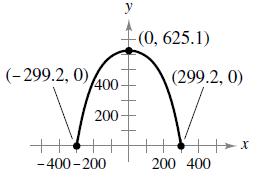
The Gateway Arch in St. Louis, Missouri, is closely approximated by the inverted catenary y = 693.8597 - 68.7672 cosh 0.0100333x, -299.2239 ≤ x ≤ 299.2239.Use the integration capabilities of a graphing utility to approximate the length of this curve (see figure). (-299.2,
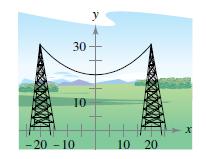
An electric cable is hung between two towers that are 40 meters apart (see figure). The cable takes the shape of a catenary whose equation is y = 10(ex/20 + e-x/20), -20 ≤ x ≤ 20 where x and y are measured in meters. Find the arc length of the cable between the two towers. 30 10 -20-10 y 10 20 X
Write and evaluate the definite integral that represents the area of the surface generated by revolving the curve on the indicated interval about the x-axis.y = √9 - x2, -2 ≤ x ≤ 2
Write and evaluate the definite integral that represents the area of the surface generated by revolving the curve on the indicated interval about the x-axis.y = √4 - x2, -1 ≤ x ≤ 1
A solid is generated by revolving the region bounded by y = 9 - x2 and x = 0 about the y-axis. Explain why you can use the shell method with limits of integration x = 0 and x = 3 to find the volume of the solid.
Find the volume of the solid generated by revolving the region bounded by the graphs of the equations about the y-axis.y = x3/8, y = 0, x = 4
Find the volume of the solid generated by revolving the region bounded by the graphs of the equations about the y-axis.y = √3x - 2, x = 0, y = 0, y = 1
Find the volume of the solid generated by revolving the region bounded by the graphs of the equations about the y-axis.y = 3(2 - x), y = 0, x = 0
Find the volume of the solid generated by revolving the region bounded by the graphs of the equations about the x-axis.y = √x, y = -1/2x + 4, x = 0, x = 8
Find the volume of the solid generated by revolving the region bounded by the graphs of the equations about the x-axis.y = e-3x, y = 0, x = 0, x = 2
Find Mx, My, and (x̅, y̅) for the lamina of uniform density ρ bounded by the graphs of the equations.x = y + 2, x = y2
(a) Sketch the graph of the function, highlighting the part indicated by the given interval,(b) Write a definite integral that represents the arc length of the curve over the indicated interval and observe that the integral cannot be evaluated with the techniques studied so far, and(c) Use the
Find the volume of the solid generated by revolving the region bounded by the graphs of the equations about the x-axis.y = 6/x, y = 0, x = 1, x = 3
Find Mx, My, and (x̅, y̅) for the lamina of uniform density ρ bounded by the graphs of the equations.x = -y, x = 2y - y2
Find the volume of the solid generated by revolving the region bounded by the graphs of the equations about the x-axis. y 1 3x + 5 y = 0, x = 0, x = 2
(a) Sketch the graph of the function, highlighting the part indicated by the given interval,(b) Write a definite integral that represents the arc length of the curve over the indicated interval and observe that the integral cannot be evaluated with the techniques studied so far, and(c) Use the
Find the volume of the solid generated by revolving the region bounded by the graphs of the equations about the x-axis.y = x√4 - x2, y = 0
Find Mx, My, and (x̅, y̅) for the lamina of uniform density ρ bounded by the graphs of the equations.x = 3y - y2, x = 0
(a) Sketch the graph of the function, highlighting the part indicated by the given interval,(b) Write a definite integral that represents the arc length of the curve over the indicated interval and observe that the integral cannot be evaluated with the techniques studied so far, and(c) Use the
Find Mx, My, and (x̅, y̅) for the lamina of uniform density ρ bounded by the graphs of the equations.x = 4 - y2, x = 0
(a) Sketch the graph of the function, highlighting the part indicated by the given interval,(b) Write a definite integral that represents the arc length of the curve over the indicated interval and observe that the integral cannot be evaluated with the techniques studied so far, and(c) Use the
Use the shell method to find the volume of the solid generated by revolving the region bounded by the graphs of the equations about the given line.y = 3x - x2, y = x2, about the line x = 2
Find Mx, My, and (x̅, y̅) for the lamina of uniform density ρ bounded by the graphs of the equations.y = x2/3, y = 4
(a) Sketch the graph of the function, highlighting the part indicated by the given interval,(b) Write a definite integral that represents the arc length of the curve over the indicated interval and observe that the integral cannot be evaluated with the techniques studied so far, and(c) Use the
Find the volume of the solid generated by revolving the region bounded by the graphs of the equations about the line x = 5.x = y2, x = 4
Find Mx, My, and (x̅,y̅) for the lamina of uniform density ρ bounded by the graphs of the equations.y = x2/3, y = 0, x = 8
(a) Sketch the graph of the function, highlighting the part indicated by the given interval,(b) Write a definite integral that represents the arc length of the curve over the indicated interval and observe that the integral cannot be evaluated with the techniques studied so far(c) Use the
Find the volume of the solid generated by revolving the region bounded by the graphs of the equations about the line x = 5.y = 2 -x/2, y = 0, y = 1, x = 0
Find Mx, My, and (x̅, y̅) for the lamina of uniform density ρ bounded by the graphs of the equations.y = √x + 1, y = 1/3x + 1
(a) Sketch the graph of the function, highlighting the part indicated by the given interval,(b) Write a definite integral that represents the arc length of the curve over the indicated interval and observe that the integral cannot be evaluated with the techniques studied so far(c) Use the
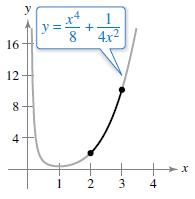
Find the arc length of the graph of the function over the indicated interval.y = x4/8 + 1/4x2, [2, 3] 16 12 00 8 4 y y = 1 8 2 4x² 3 4 -X
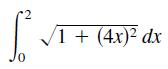
Name a function for which the integral below represents the arc length of the function on the interval [0, 2] 2 So 1 + (4x)² dx
How do you know when work is done by a force?
Compare the representative rectangles for the disk and shell methods.
Explain how to find the arc length of a function that is a smooth curve on the interval [a, b].
The equation for the moment about the origin of a one-dimensional system is M0 = 5(-3) + 2(-1) + 1(1) + 5(2) + 1(6). Is the system in equilibrium? Explain.
What is the relationship between the disk method and the washer method?
Describe Hooke’s Law in your own words.
In your own words, describe when it is necessary to use more than one integral to find the volume of a solid of revolution.
What are two ways to write the increment of work?
Explain how to find the volume of a solid with a known cross section.
Find the distance between the points using(a) The Distance Formula and(b) Integration.(2, 1), (5, 3)
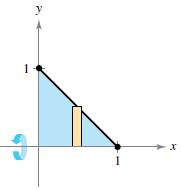
Write and evaluate the definite integral that represents the volume of the solid formed by revolving the region about the x-axis.y = -x + 1 1 y 1
Write and evaluate the definite integral that represents the volume of the solid formed by revolving the region about the x-axis.y = √x 4 3 2 1 y 1 2 3 4 x
Find the center of mass of the given system of point masses lying on the x-axis.m1 = 0.1, m2 = 0.2, m3 = 0.2, m4 = 0.5x1 = 1, x2 = 2, x3 = 3, x4 = 4
Find the distance between the points using(a) The Distance Formula and(b) Integration.(-2, 2), (4, -6)
Write and evaluate the definite integral that represents the volume of the solid formed by revolving the region about the y-axis.y = x2 4 3 2 y 2 زرا 4 X
Write and evaluate the definite integral that represents the volume of the solid formed by revolving the region about the y-axis.y = x2/3 X I y I
Write and evaluate the definite integral that represents the volume of the solid formed by revolving the region about the y-axis.y = √16 - x2 4 3 درا 2 1 y 2 3 - x
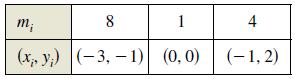
Find the center of mass of the given system of point masses. m; 8 1 4 (x, y) (-3,-1) (0,0) (-1,2)
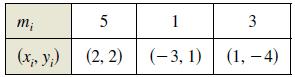
Find the center of mass of the given system of point masses. mi (x, y;) 5 (2, 2) 1 3 (-3, 1) (1,-4)
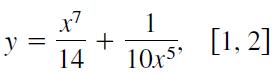
Find the arc length of the graph of the function over the indicated interval. = y X7 + 14 1 10x5⁹ [1, 2]
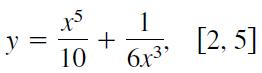
Find the arc length of the graph of the function over the indicated interval. X5 = y 10 1 6x³³ [2,5]
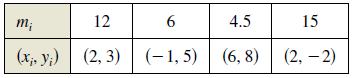
Find the center of mass of the given system of point masses. m; 12 (x, y) (2, 3) (2, 3) 6 (-1,5) (-1,5) 4.5 (6, 8) 15 (2,-2)
Describe the condition for a curve to be rectifiable between two points.
Find the center of mass of the given system of point masses. m; (x₁, y₁) 3 (-2,-3) 4 2 (5,5) (7, 1) 1 (0,0) 6 (-3,0)
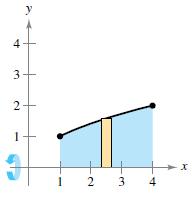
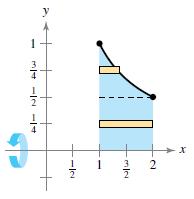
Use the shell method to write and evaluate the definite integral that represents the volume of the solid generated by revolving the plane region about the x-axis.y = 1/x . MIN 14 x -2. I 12 +
Use the shell method to write and evaluate the definite integral that represents the volume of the solid generated by revolving the plane region about the y-axis.y = √2x - 5, y = 0, x = 4
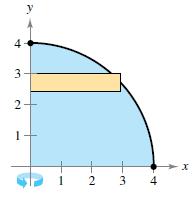
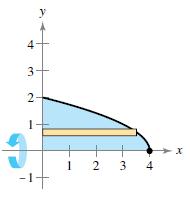
Use the shell method to write and evaluate the definite integral that represents the volume of the solid generated by revolving the plane region about the x-axis.x + y2 = 4 3 2 1- + -1 12 3 4 X
Find Mx, My, and (x̅,y̅) for the lamina of uniform density ρ bounded by the graphs of the equations.y = 1/2x, y = 0, x = 2
Use Hooke’s Law to determine the work done by the variable force in the spring problem.Six joules of work is required to stretch a spring 0.5 meter from its natural length. Find the work required to stretch the spring an additional 0.25 meter.
Find Mx, My, and (x̅,y̅) for the lamina of uniform density ρ bounded by the graphs of the equations.y = 6 - x, y = 0, x = 0
Find Mx, My, and (x̅,y̅) for the lamina of uniform density ρ bounded by the graphs of the equations.y = √x, y = 0, x = 4
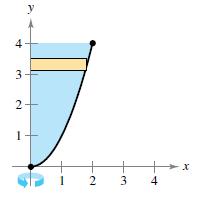
Use the shell method to write and evaluate the definite integral that represents the volume of the solid generated by revolving the plane region about the x-axis.y = 4x2, x = 0, y = 4
Find Mx, My, and (x̅,y̅) for the lamina of uniform density ρ bounded by the graphs of the equations.y = 1/3x2, y = 0, x = 2
Find the volume of the solid generated by revolving the region bounded by the graphs of the equations about the line y = 4.y = 2/1 + x, y = 0, x = 0, x = 4
Find Mx, My, and (x̅,y̅) for the lamina of uniform density ρ bounded by the graphs of the equations.y = x2, y = x3
Use the shell method to write and evaluate the definite integral that represents the volume of the solid generated by revolving the plane region about the x-axis.y = 3 - x, y = 0, x = 6
Find the volume of the solid generated by revolving the region bounded by the graphs of the equations about the line y = 4.y = √1 - x, x = 0, y = 0
Find Mx, My, and (x̅,y̅) for the lamina of uniform density ρ bounded by the graphs of the equations.y = √x, y = 1/2x
(a) Sketch the graph of the function, highlighting the part indicated by the given interval,(b) Write a definite integral that represents the arc length of the curve over the indicated interval and observe that the integral cannot be evaluated with the techniques studied so far, and(c) Use the
Use the shell method to write and evaluate the definite integral that represents the volume of the solid generated by revolving the plane region about the x-axis.y = 1 - √x, y = x + 1, y = 0
Showing 9700 - 9800
of 29454
First
91
92
93
94
95
96
97
98
99
100
101
102
103
104
105
Last
Step by Step Answers

 Get 50% OFF
Claim Now
Get 50% OFF
Claim Now