New Semester
Started
Get
50% OFF
Study Help!
--h --m --s
Claim Now
Question Answers
Textbooks
Find textbooks, questions and answers
Oops, something went wrong!
Change your search query and then try again
S
Books
FREE
Study Help
Expert Questions
Accounting
General Management
Mathematics
Finance
Organizational Behaviour
Law
Physics
Operating System
Management Leadership
Sociology
Programming
Marketing
Database
Computer Network
Economics
Textbooks Solutions
Accounting
Managerial Accounting
Management Leadership
Cost Accounting
Statistics
Business Law
Corporate Finance
Finance
Economics
Auditing
Tutors
Online Tutors
Find a Tutor
Hire a Tutor
Become a Tutor
AI Tutor
AI Study Planner
NEW
Sell Books
Search
Search
Sign In
Register
study help
mathematics
precalculus
Thomas Calculus Early Transcendentals 13th Edition Joel R Hass, Christopher E Heil, Maurice D Weir - Solutions
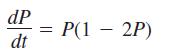
The autonomous differential equations represent models for population growth. For each exercise, use a phase line analysis to sketch solution curves for P(t), selecting different starting values P(0). Which equilibria are stable, and which are unstable? dP dt = P(1 - 2P)
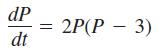
The autonomous differential equations represent models for population growth. For each exercise, use a phase line analysis to sketch solution curves for P(t), selecting different starting values P(0). Which equilibria are stable, and which are unstable? / dP dt = 2P(P - 3)
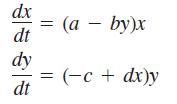
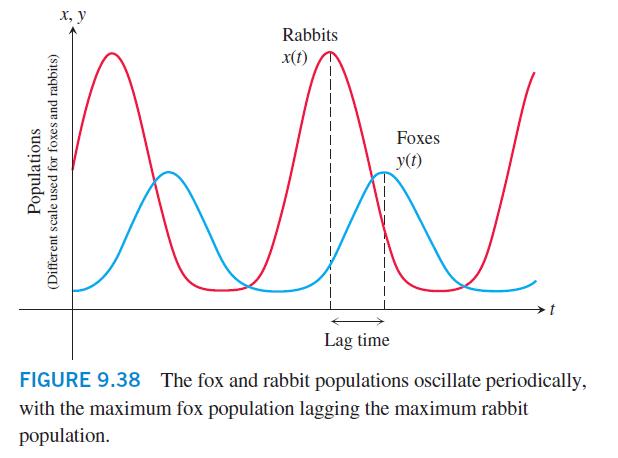
In 1925 Lotka and Volterra introduced the predator-prey equations, a system of equations that models the populations of two species, one of which preys on the other. Let x(t) represent the number of rabbits living in a region at time t, and y(t) the number of foxes in the same region. As time
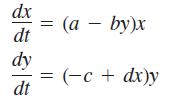
In 1925 Lotka and Volterra introduced the predator-prey equations, a system of equations that models the populations of two species, one of which preys on the other. Let x(t) represent the number of rabbits living in a region at time t, and y(t) the number of foxes in the same region. As time
Find the orthogonal trajectories of the family of curves. Sketch several members of each family.y = ce-x
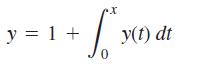
Write an equivalent first-order differential equation and initial condition for y. y = 1 + px 0 y(t) dt
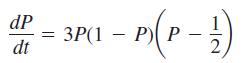
The autonomous differential equations represent models for population growth. For each exercise, use a phase line analysis to sketch solution curves for P(t), selecting different starting values P(0). Which equilibria are stable, and which are unstable? dP dt = P)(P-1) 3P(1-P) P-
Why is the exponential model unrealistic for predicting long-term population growth? How does the logistic model correct for the deficiency in the exponential model for population growth? What is the logistic differential equation? What is the form of its solution? Describe the graph of the
Use Euler’s method to calculate the first three approximations to the given initial value problem for the specified increment size. Calculate the exact solution and investigate the accuracy of your approximations. Round your results to four decimal places. y' = 1 − ¾, y(2) = −1, dx - = 0.5
Find the orthogonal trajectories of the family of curves. Sketch several members of each family.y = ekx
What is an autonomous system of differential equations? What is a solution to such a system? What is a trajectory of the system?
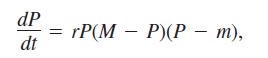
The fish and game department in a certain state is planning to issue hunting permits to control the deer population (one deer per permit). It is known that if the deer population falls below a certain level m, the deer will become extinct. It is also known that if the deer population rises above
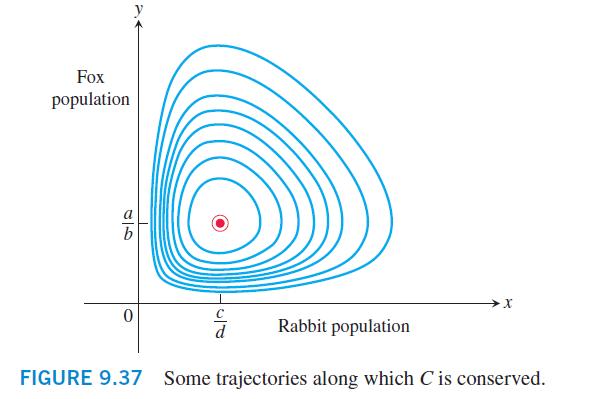
While x and y may change over time, C(t) does not. Thus, C is a conserved quantity and its existence gives a conservation law. A trajectory that begins at a point (x, y) at time t = 0 gives a value of C that remains unchanged at future times. Each value of the constant C gives a trajectory for the
Show that the curves 2x2 + 3y2 = 5 and y2 = x3 are orthogonal.
Along each trajectory, both the rabbit and fox populations fluctuate between their maximum and minimum levels. The maximum and minimum levels for the rabbit population occur where the trajectory intersects the horizontal line y = a/b. For the fox population, they occur where the trajectory
Find the family of solutions of the given differential equation and the family of orthogonal trajectories. Sketch both families.a. x dx + y dy = 0b. x dy - 2y dx = 0
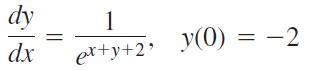
Use Euler’s method to solve the initial value problem graphically, starting at x0 = 0 witha. dx = 0.1.b. dx = -0.1. dy 1 dx ex+y+2, y(0) = = -2
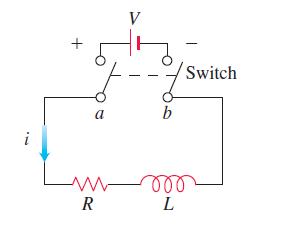
The accompanying diagram represents an electrical circuit whose total resistance is a constant R ohms and whose self-inductance, shown as a coil, is L henries, also a constant. There is a switch whose terminals at a and b can be closed to connect a constant electrical source of V volts. we
If a body of mass m falling from rest under the action of gravity encounters an air resistance proportional to the square of velocity, then the body’s velocity t seconds into the fall satisfies the equationwhere k is a constant that depends on the body’s aerodynamic properties and the density
Use Euler’s method to calculate the first three approximations to the given initial value problem for the specified increment size. Calculate the exact solution and investigate the accuracy of your approximations. Round your results to four decimal places.y′ = x(1 - y), y(1) = 0, dx = 0.2
A tank initially contains 100 gal of brine in which 50 lb of salt are dissolved. A brine containing 2 lb /gal of salt runs into the tank at the rate of 5 gal /min. The mixture is kept uniform by stirring and flows out of the tank at the rate of 4 gal /min.a. At what rate (pounds per minute) does
Suppose that a healthy population of some species is growing in a limited environment and that the current population P0 is fairly close to the carrying capacity M0. You might imagine a population of fish living in a freshwater lake in a wilderness area. Suddenly a catastrophe such as the Mount St.
Use Euler’s method to calculate the first three approximations to the given initial value problem for the specified increment size. Calculate the exact solution and investigate the accuracy of your approximations. Round your results to four decimal places.y′ = 2xy + 2y, y(0) = 3, dx = 0.2
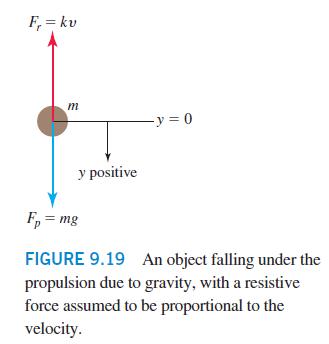
Suppose that a pearl is sinking in a thick fluid, like shampoo, subject to a frictional force opposing its fall and proportional to its velocity. Suppose that there is also a resistive buoyant force exerted by the shampoo. According to Archimedes’ principle, the buoyant force equals the weight of
A 200-gal tank is half full of distilled water. At time t = 0, a solution containing 0.5 lb / gal of concentrate enters the tank at the rate of 5 gal / min, and the well-stirred mixture is withdrawn at the rate of 3 gal / min.a. At what time will the tank be full?b. At the time the tank is full,
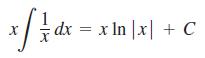
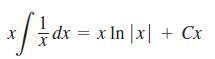
Is either of the following equations correct? Give reasons for your answers.a.b. x / / / dx dx = x ln |x| + C
Use Euler’s method to calculate the first three approximations to the given initial value problem for the specified increment size. Calculate the exact solution and investigate the accuracy of your approximations. Round your results to four decimal places.y′ = y2(1 + 2x), y(-1) = 1, dx = 0.5
Solve the exponential growth / decay initial value problem for y as a function of t by thinking of the differential equation as a firstorder linear equation with P(x) = -k and Q(x) = 0: dt ky (k constant), y(0) = Yo
A tank contains 100 gal of fresh water. A solution containing 1 lb / gal of soluble lawn fertilizer runs into the tank at the rate of 1 gal / min, and the mixture is pumped out of the tank at the rate of 3 gal / min. Find the maximum amount of fertilizer in the tank and the time required to reach
Solve the following initial value problem for u as a function of t:a. As a first-order linear equation.b. As a separable equation. du k + U dt = 0 (k and m positive constants), u(0) = uo
Use Euler’s method to calculate the first three approximations to the given initial value problem for the specified increment size. Calculate the exact solution and investigate the accuracy of your approximations. Round your results to four decimal places.y′ = 2xex2, y(0) = 2, dx = 0.1
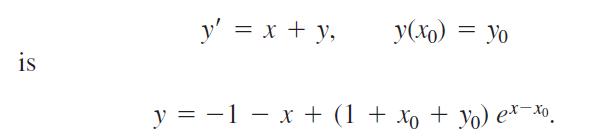
Show that the solution of the initial value problem is y' = x + y₂ y(xo) Yo = y = −1 − x + (1 + x + y) ex-xo.
An executive conference room of a corporation contains 4500 ft3 of air initially free of carbon monoxide. Starting at time t = 0, cigarette smoke containing 4% carbon monoxide is blown into the room at the rate of 0.3 ft3/min. A ceiling fan keeps the air in the room well circulated and the air
A body of mass m is projected vertically downward with initial velocity ν0. Assume that the resisting force is proportional to the square root of the velocity and find the terminal velocity from a graphical analysis.
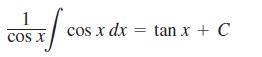
Is either of the following equations correct? Give reasons for your answers.a.b. 1 COS X cos x dx COS = tan x + C
Use Euler’s method to calculate the first three approximations to the given initial value problem for the specified increment size. Calculate the exact solution and investigate the accuracy of your approximations. Round your results to four decimal places.y′ = yex, y(0) = 2, dx = 0.5
Use Euler’s method with dx = 0.05 to estimate y(c) where y is the solution to the given initial value problem. c = 3; dy dx = x - 2y x + 1' y(0) = 1
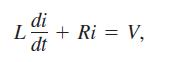
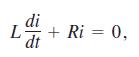
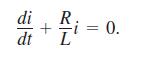
If the switch is thrown open after the current in an RL circuit has built up to its steady-state value I = V/R, the decaying current obeys the equationwhich is Equation (5) with V = 0.a. Solve the equation to express i as a function of t.b. How long after the switch is thrown will it take the
A sailboat is running along a straight course with the wind providing a constant forward force of 50 lb. The only other force acting on the boat is resistance as the boat moves through the water. The resisting force is numerically equal to five times the boat’s speed, and the initial velocity is
Use the Euler method with dx = 0.2 to estimate y(1) if y′ = y and y(0) = 1. What is the exact value of y(1)?
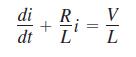
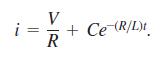
a. Show that the solution of the equationisb. Then use the initial condition i(0) = 0 to determine the value of C. This will complete the derivation of Equation (7).c. Show that i = V/R is a solution of Equation (6) and that i = Ce-(R/L)t satisfies the equation di + dt Ri= L V L
Use the Euler method with dx = 0.2 to estimate y(2) if y′ = y/x and y(1) = 2. What is the exact value of y(2)?
Use the Euler method with dx = 0.5 to estimate y(5) if y′ = y2/√x and y(1) = -1. What is the exact value of y(5)?
Use the Euler method with dx = 1/3 to estimate y(2) if y′ = x sin y and y(0) = 1. What is the exact value of y(2)?
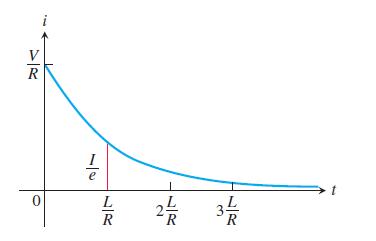
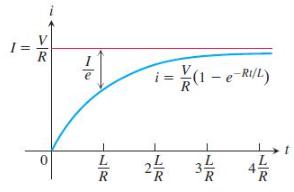
Engineers call the number L/R the time constant of the RL circuit in Figure 9.9. The significance of the time constant is that the current will reach 95% of its final value within 3 time constants of the time the switch is closed (Figure 9.9). Thus, the time constant gives a built-in measure of how
Use Euler’s method with dx = 0.05 to estimate y(c) where y is the solution to the given initial value problem. c = 4; с dy dx x² - 2y + 1 y(1) = 1
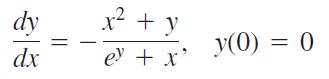
Use Euler’s method to solve the initial value problem graphically, starting at x0 = 0 witha. dx = 0.1.b. dx = -0.1. dy dx x² + y ey + xy(0) = 0
What integral equation is equivalent to the initial value problemy′ = ƒ(x), y(x0) = y0?
Obtain a slope field and add to it graphs of the solution curves passing through the given points.y′ = y witha. (0, 1) b. (0, 2) c. (0, -1)
Obtain a slope field and add to it graphs of the solution curves passing through the given points.y′ = 2(y - 4) witha. (0, 1) b. (0, 4) c. (0, 5)
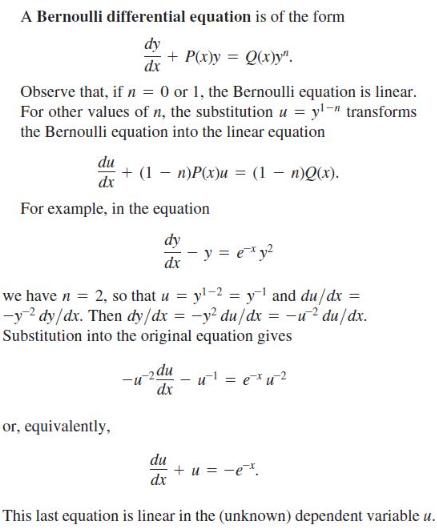
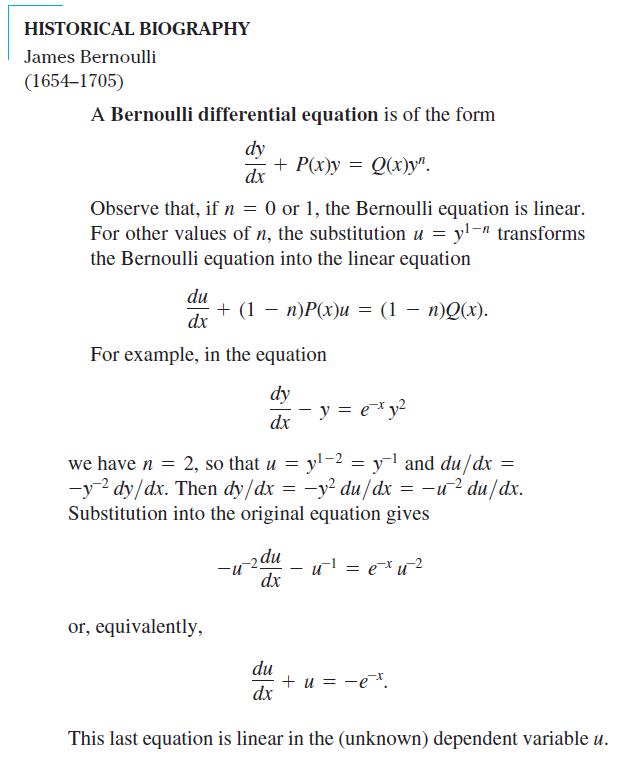
Solve the Bernoulli equationsy′ - y = xy2 A Bernoulli differential equation is of the form dy dx + P(x)y = Q(x)y". Observe that, if n = 0 or 1, the Bernoulli equation is linear. For other values of n, the substitution u = yl-" transforms the Bernoulli equation into the linear equation du dx For
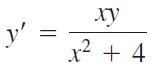
Obtain a slope field and add to it graphs of the solution curves passing through the given points.witha. (0, 2) b. (0, -6) c. (-2√3, -4) y' = xy x² + 4
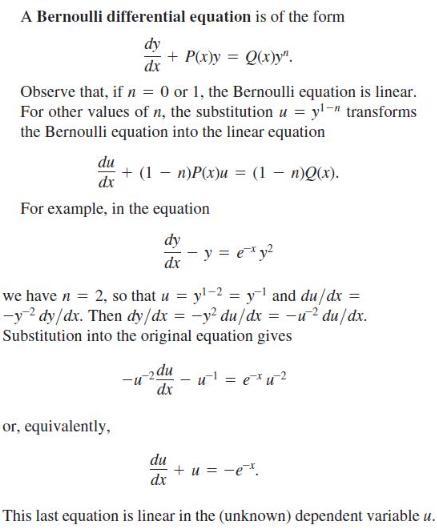
Solve the Bernoulli equationsy′ - y = -y2 A Bernoulli differential equation is of the form dy dx + P(x)y = Q(x)y". Observe that, if n = 0 or 1, the Bernoulli equation is linear. For other values of n, the substitution u = yl-" transforms the Bernoulli equation into the linear equation du dx For
Obtain a slope field and add to it graphs of the solution curves passing through the given points.y′ = y(x + y) witha. (0, 1) b. (0, -2) c. (0, 1/4) d. (-1, -1)
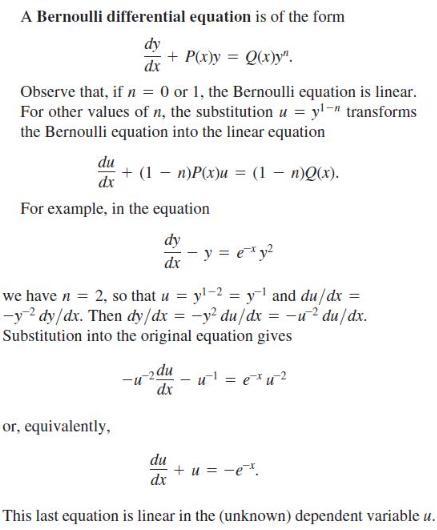
Solve the Bernoulli equations.xy′ + y = y-2 A Bernoulli differential equation is of the form dy dx + P(x)y = Q(x)y". Observe that, if n = 0 or 1, the Bernoulli equation is linear. For other values of n, the substitution u = yl-" transforms the Bernoulli equation into the linear equation du dx For
How many seconds after the switch in an RL circuit is closed will it take the current i to reach half of its steady-state value? Notice that the time depends on R and L and not on how much voltage is applied.
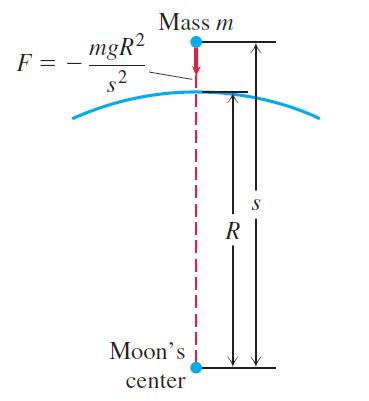
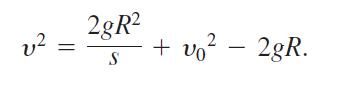
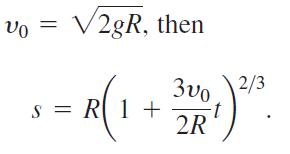
The gravitational attraction F exerted by an airless moon on a body of mass m at a distance s from the moon’s center is given by the equation F = -mg R2s-2, where g is the acceleration of gravity at the moon’s surface and R is the moon’s radius. The force F is negative because it acts in the
Solve the Bernoulli equations.x2y′ + 2xy = y3 HISTORICAL BIOGRAPHY James Bernoulli (1654-1705) A Bernoulli differential equation is of the form dy dx Observe that, if n = 0 or 1, the Bernoulli equation is linear. For other values of n, the substitution u = y¹-n transforms the Bernoulli equation
Obtain a slope field and add to it graphs of the solution curves passing through the given points.y′ = y2 witha. (0, 1) b. (0, 2) c. (0, -1) d. (0, 0)
Obtain a slope field and add to it graphs of the solution curves passing through the given points.y′ = (y - 1)(x + 2) witha. (0, -1) b. (0, 1) c. (0, 3) d. (1, - 1)
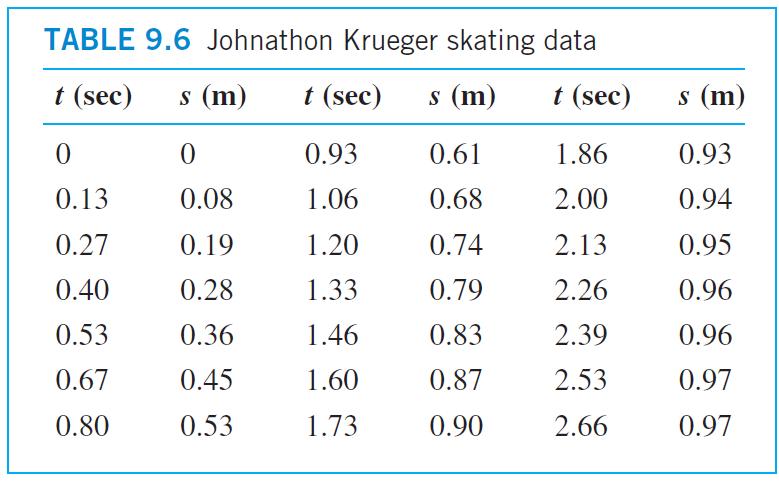
Table 9.6 shows the distance s (meters) coasted on inline skates in t sec by Johnathon Krueger. Find a model for his position in the form of Equation (2) of Section 9.3. His initial velocity was ν0 = 0.86 m/sec, his mass m = 30.84 kg (he weighed 68 lb), and his total coasting distance 0.97 m.
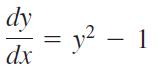
a. Identify the equilibrium values. Which are stable and which are unstable?b. Construct a phase line. Identify the signs of y′ and y″.c. Sketch a representative selection of solution curves. = 1 - 4: dx Ар
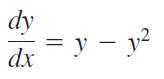
a. Identify the equilibrium values. Which are stable and which are unstable?b. Construct a phase line. Identify the signs of y′ and y″.c. Sketch a representative selection of solution curves. dy dx = y - y²
a. Use a CAS to plot the slope field of the differential equationover the region -3 ≤ x ≤ 3 and -3 ≤ y ≤ 3.b. Separate the variables and use a CAS integrator to find the general solution in implicit form.c. Using a CAS implicit function grapher, plot solution curves for the arbitrary
Sketch part of the equation’s slope field. Then add to your sketch the solution curve that passes through the point P(1, -1). Use Euler’s method with x0 = 1 and dx = 0.2 to estimate y(2). Round your answers to four decimal places. Find the exact value of y(2) for comparison.y′ = x
Obtain a slope field and graph the particular solution over the specified interval. Use your CAS DE solver to find the general solution of the differential equation.y′ = y(2 - y), y(0) = 1/2; 0 ≤ x ≤ 4, 0 ≤ y ≤ 3
Sketch part of the equation’s slope field. Then add to your sketch the solution curve that passes through the point P(1, -1). Use Euler’s method with x0 = 1 and dx = 0.2 to estimate y(2). Round your answers to four decimal places. Find the exact value of y(2) for comparison.y′ = 1/x
Obtain a slope field and graph the particular solution over the specified interval. Use your CAS DE solver to find the general solution of the differential equation.y′ = (sin x)(sin y), y(0) = 2; -6 ≤ x ≤ 6, -6 ≤ y ≤ 6
Sketch part of the equation’s slope field. Then add to your sketch the solution curve that passes through the point P(1, -1). Use Euler’s method with x0 = 1 and dx = 0.2 to estimate y(2). Round your answers to four decimal places. Find the exact value of y(2) for comparison.y′ = xy
Exercises have no explicit solution in terms of elementary functions. Use a CAS to explore graphically each of the differential equations.y′ = cos (2x - y), y(0) = 2; 0 ≤ x ≤ 5, 0 ≤ y ≤ 5
Sketch part of the equation’s slope field. Then add to your sketch the solution curve that passes through the point P(1, -1). Use Euler’s method with x0 = 1 and dx = 0.2 to estimate y(2). Round your answers to four decimal places. Find the exact value of y(2) for comparison.y′ = 1/y
Exercises have no explicit solution in terms of elementary functions. Use a CAS to explore graphically each of the differential equations.y′ = y(1/2 - ln y), y(0) = 1/3; 0 ≤ x ≤ 4, 0 ≤ y ≤ 3
Use a CAS to find the solutions of y′ + y = ƒ(x) subject to the initial condition y(0) = 0, if ƒ(x) isa. 2x b. sin 2x c. 3ex/2 d. 2e-x/2 cos 2x.Graph all four solutions over the interval -2 ≤ x ≤ 6 to compare the results.
Use Euler’s method with the specified step size to estimate the value of the solution at the given point x*. Find the value of the exact solution at x*.y′ = 2xex2, y(0) = 2, dx = 0.1, x* = 1
Use Euler’s method with the specified step size to estimate the value of the solution at the given point x*. Find the value of the exact solution at x*.y′ = 2y2(x - 1), y(2) = -1/2, dx = 0.1, x* = 3
Use Euler’s method with the specified step size to estimate the value of the solution at the given point x*. Find the value of the exact solution at x*.y′ = √x/y, y > 0, y(0) = 1, dx = 0.1, x* = 1
Use Euler’s method with the specified step size to estimate the value of the solution at the given point x*. Find the value of the exact solution at x*.y′ = 1 + y2, y(0) = 0, dx = 0.1, x* = 1
Use a CAS to explore graphically each of the differential equations. Perform the following steps to help with your explorations.a. Plot a slope field for the differential equation in the given xy-window.b. Find the general solution of the differential equation using your CAS DE solver.c. Graph the
Use a CAS to explore graphically each of the differential equations. Perform the following steps to help with your explorations.a. Plot a slope field for the differential equation in the given xy-window.b. Find the general solution of the differential equation using your CAS DE solver.c. Graph the
Use a CAS to explore graphically each of the differential equations. Perform the following steps to help with your explorations.a. Plot a slope field for the differential equation in the given xy-window.b. Find the general solution of the differential equation using your CAS DE solver.c. Graph the
Use a CAS to explore graphically each of the differential equations. Perform the following steps to help with your explorations.a. Plot a slope field for the differential equation in the given xy-window.b. Find the general solution of the differential equation using your CAS DE solver.c. Graph the
Solve the initial value problems for y as a function of x. (x² + 1)² dy 小 dx √x² + 1, y(0) = 1
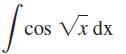
Evaluate the integrals. Some integrals do not require integration by parts. I cos cos √x dx
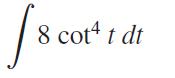
Use reduction formulas to evaluate the integrals. s 8 cot4 t dt
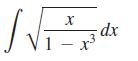
Evaluate the integral. X HE 1-x³ dx
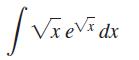
Evaluate the integrals. Some integrals do not require integration by parts. √x eVx dx
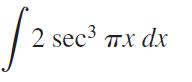
Use reduction formulas to evaluate the integrals. √² 2 sec³ πx dx Tx
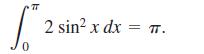
A direct calculation shows thatHow close do you come to this value by using the Trapezoidal Rule with n = 6? Simpson’s Rule with n = 6? Try them and find out. JO 2 sin² x dx = π.
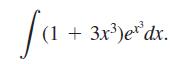
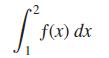
The functions y = ex3 and y = x3ex3 do not have elementary antiderivatives, but y = (1 + 3x3)ex3 does.Evaluate fa (1 + 3x³) ex dx.
A team of medical practitioners determines that in a population of 1000 females with ages ranging from 20 to 35 years, the length of pregnancy from conception to birth is approximately normally distributed with a mean of 266 days and a standard deviation of 16 days. How many of these females would
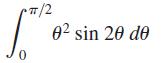
Evaluate the integrals. Some integrals do not require integration by parts. 0 TT/2 02 sin 20 de
Find the centroid of the region bounded by the x-axis, the curve y = csc x, and the lines x = π/6, x = 5π/6.
You are planning to use Simpson’s Rule to estimate the value of the integralwith an error magnitude less than 10-5. You have determined that |ƒ(4)(x)| ≤ 3 throughout the interval of integration. How many subintervals should you use to ensure the required accuracy? (Remember that for
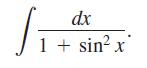
Use the substitution u = tan x to evaluate the integral dx 1+ sin² x
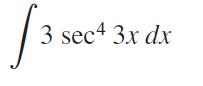
Use reduction formulas to evaluate the integrals. [3 3 sec4 3x dx
In a population of 500 adult Swedish males, medical researchers find their brain weights to be approximately normally distributed with mean μ = 1400 gm and standard deviation σ = 100 gm.a. What percentage of brain weights are between 1325 and 1450 gm?b. How many males in the population would you
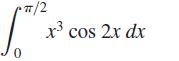
Evaluate the integrals. Some integrals do not require integration by parts. T/2 S™ 0 x³ cos 2x dx
Use Simpson’s Rule to approximate the average value of the temperature functionfor a 365-day year. This is one way to estimate the annual mean air temperature in Fairbanks, Alaska. The National Weather Service’s official figure, a numerical average of the daily normal mean air temperatures for
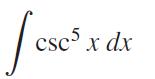
Use reduction formulas to evaluate the integrals. Jes csc5 x dx
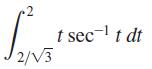
Evaluate the integrals. Some integrals do not require integration by parts. 2/√3 t sec-¹ t dt
Showing 10200 - 10300
of 29454
First
96
97
98
99
100
101
102
103
104
105
106
107
108
109
110
Last
Step by Step Answers

 Get 50% OFF
Claim Now
Get 50% OFF
Claim Now