New Semester
Started
Get
50% OFF
Study Help!
--h --m --s
Claim Now
Question Answers
Textbooks
Find textbooks, questions and answers
Oops, something went wrong!
Change your search query and then try again
S
Books
FREE
Study Help
Expert Questions
Accounting
General Management
Mathematics
Finance
Organizational Behaviour
Law
Physics
Operating System
Management Leadership
Sociology
Programming
Marketing
Database
Computer Network
Economics
Textbooks Solutions
Accounting
Managerial Accounting
Management Leadership
Cost Accounting
Statistics
Business Law
Corporate Finance
Finance
Economics
Auditing
Tutors
Online Tutors
Find a Tutor
Hire a Tutor
Become a Tutor
AI Tutor
AI Study Planner
NEW
Sell Books
Search
Search
Sign In
Register
study help
mathematics
precalculus
Thomas Calculus Early Transcendentals 13th Edition Joel R Hass, Christopher E Heil, Maurice D Weir - Solutions
The region bounded by the curves y = ± 4/√x and the lines x = 1 and x = 4 is revolved about the y-axis to generate a solid.a. Find the volume of the solid.b. Find the center of mass of a thin plate covering the region if the plate’s density at the point (x, y) is δ(x) = 1/x.c. Sketch the
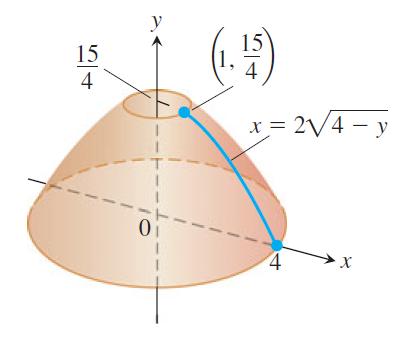
Find the areas of the surfaces generated by revolving the curves about the indicated axes. If you have a grapher, you may want to graph these curves to see what they look like. x = 2√4-y, 0≤ y ≤ 15/4; y-axis
Do the following.a. Set up an integral for the length of the curve.b. Graph the curve to see what it looks like.c. Use your grapher’s or computer’s integral evaluator to find the curve’s length numerically. x = V1 - y²2, -1/2 ≤ y ≤ 1/2
A triangular plate ABC is submerged in water with its plane vertical. The side AB, 4 ft long, is 6 ft below the surface of the water, while the vertex C is 2 ft below the surface. Find the force exerted by the water on one side of the plate.
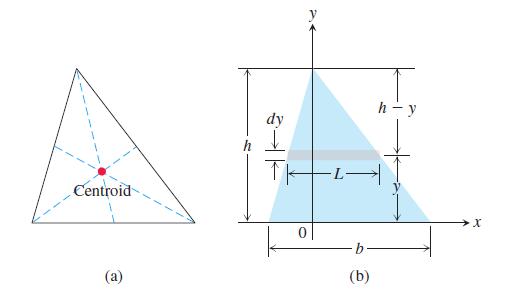
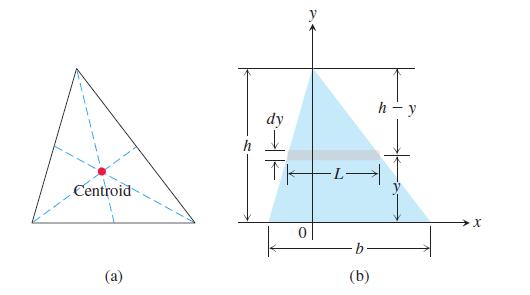
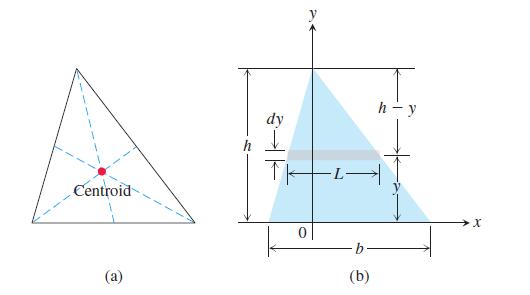
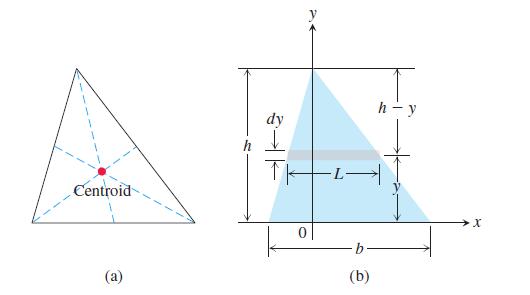
You may recall that the point inside a triangle that lies one-third of the way from each side toward the opposite vertex is the point where the triangle’s three medians intersect. Show that the centroid lies at the intersection of the medians by showing that it too lies one-third of the way from
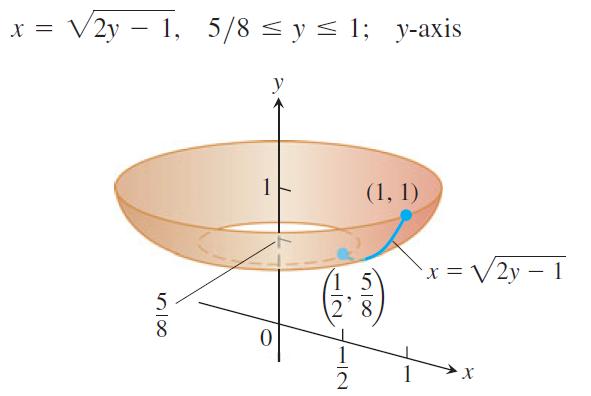
Find the areas of the surfaces generated by revolving the curves about the indicated axes. If you have a grapher, you may want to graph these curves to see what they look like. X = V2y 1, 5/8 ≤ y ≤ 1; y-axis 518 y 1 (1, 1) -id 518 2 x = √2y - 1 X
A vertical right-circular cylindrical tank measures 30 ft high and 20 ft in diameter. It is full of kerosene weighing 51.2 lb/ft3. How much work does it take to pump the kerosene to the level of the top of the tank?
Do the following.a. Set up an integral for the length of the curve.b. Graph the curve to see what it looks like.c. Use your grapher’s or computer’s integral evaluator to find the curve’s length numerically.x = sin y, 0 ≤ y ≤ π
Use the shell method to find the volumes of the solids generated by revolving the regions bounded by the curves and line about the x-axis.x = 2y - y2, x = 0
Use the result in Exercise 19 to find the centroids of the triangles whose vertices appear. Assume a, b > 0.(-1, 0), (1, 0), (0, 3)Data from in Exercise 19You may recall that the point inside a triangle that lies one-third of the way from each side toward the opposite vertex is the point where
The region between the curve y = 2/x and the x-axis from x = 1 to x = 4 is revolved about the x-axis to generate a solid.a. Find the volume of the solid.b. Find the center of mass of a thin plate covering the region if the plate’s density at the point (x, y) is δ(x) = √x.c. Sketch the plate
A vertical rectangular plate is submerged in a fluid with its top edge parallel to the fluid’s surface. Show that the force exerted by the fluid on one side of the plate equals the average value of the pressure up and down the plate times the area of the plate.
Use the result in Exercise 19 to find the centroids of the triangles whose vertices appear. Assume a, b > 0.(0, 0), (1, 0), (0, 1)Data from in Exercise 19You may recall that the point inside a triangle that lies one-third of the way from each side toward the opposite vertex is the point where
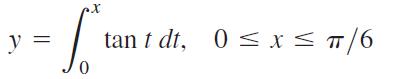
Do the following.a. Set up an integral for the length of the curve.b. Graph the curve to see what it looks like.c. Use your grapher’s or computer’s integral evaluator to find the curve’s length numerically. y = X 0 tant dt, 0≤ x ≤ π/6
Use the shell method to find the volumes of the solids generated by revolving the regions bounded by the curves and line about the x-axis.x = 2y - y2, x = y
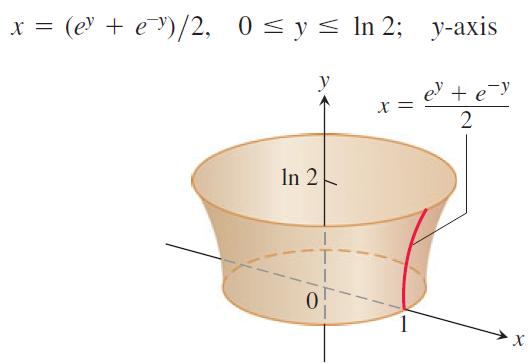
Find the areas of the surfaces generated by revolving the curves about the indicated axes. If you have a grapher, you may want to graph these curves to see what they look like. x = (e³ + e)/2, 0≤ y ≤ In 2; y-axis e³ + ey 2 In 2 0 X = 1 X
Find the volumes of the solids generated by revolving the regions bounded by the lines and curves about the x-axis.y = x2, y = 0, x = 2
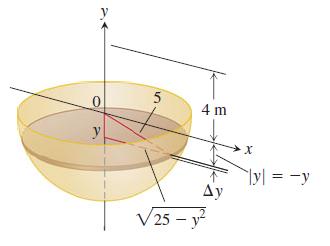
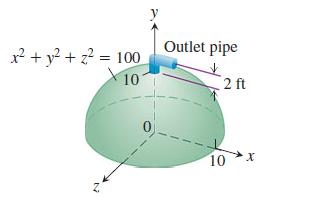
We model pumping from spherical containers the way we do from other containers, with the axis of integration along the vertical axis of the sphere. Use the figure here to find how much work it takes to empty a full hemispherical water reservoir of radius 5 m by pumping the water to a height of 4 m
Do the following.a. Set up an integral for the length of the curve.b. Graph the curve to see what it looks like.c. Use your grapher’s or computer’s integral evaluator to find the curve’s length numerically.y2 + 2y = 2x + 1 from (-1, -1) to (7, 3)
Find the volumes of the solids generated by revolving the regions bounded by the lines and curves about the x-axis.y = x3, y = 0, x = 2
Use the result in Exercise 19 to find the centroids of the triangles whose vertices appear. Assume a, b > 0.(0, 0), (a, 0), (0, a)Data from in Exercise 19You may recall that the point inside a triangle that lies one-third of the way from each side toward the opposite vertex is the point where
A right-circular cylindrical tank of height 10 ft and radius 5 ft is lying horizontally and is full of diesel fuel weighing 53 lb/ft3. How much work is required to pump all of the fuel to a point 15 ft above the top of the tank?
Do the following.a. Set up an integral for the length of the curve.b. Graph the curve to see what it looks like.c. Use your grapher’s or computer’s integral evaluator to find the curve’s length numerically.y = sin x - x cos x, 0 ≤ x ≤ π
You are in charge of the evacuation and repair of the storage tank shown here. The tank is a hemisphere of radius 10 ft and is full of benzene weighing 56 lb/ft3. A firm you contacted says it can empty the tank for 1/2¢ per foot-pound of work. Find the work required to empty the tank by pumping
Use the shell method to find the volumes of the solids generated by revolving the regions bounded by the curves and line about the x-axis.y = x, y = 2x, y = 2
Find the volumes of the solids generated by revolving the regions bounded by the lines and curves about the x-axis.y = √9 - x2, y = 0
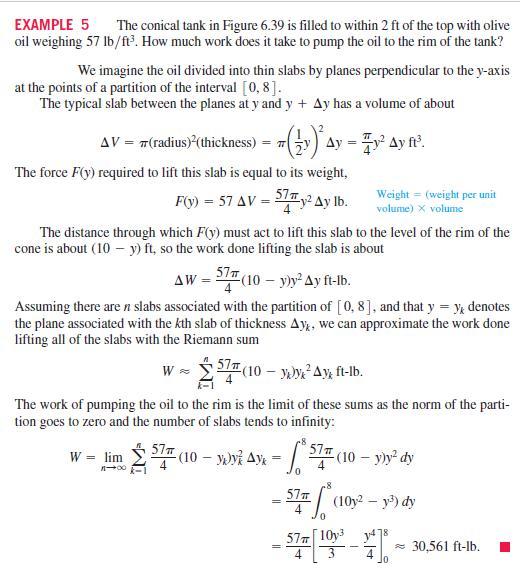
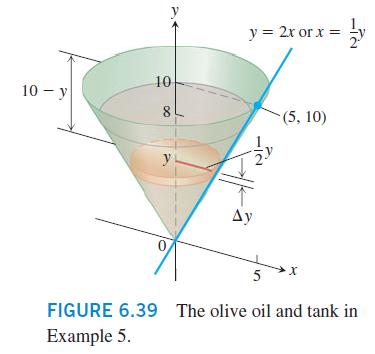
Suppose that, instead of being full, the tank in Example 5 is only half full. How much work does it take to pump the remaining oil to a level 4 ft above the top of the tank?Example 5In Figure 6.39 EXAMPLE 5 The conical tank in Figure 6.39 is filled to within 2 ft of the top with olive oil weighing
Use the shell method to find the volumes of the solids generated by revolving the regions bounded by the curves and line about the x-axis.y = √x, y = 0, y = x - 2
Find the volumes of the solids generated by revolving the regions bounded by the lines and curves about the x-axis.y = x - x2, y = 0
Find the areas of the surfaces generated by revolving the curves about the indicated axes. If you have a grapher, you may want to graph these curves to see what they look like.y = (1/3)(x2 + 2)3/2, 0 ≤ x ≤ √2; y-axis. Express ds = √dx2 + dy2 in terms of dx, and evaluate the integral S =
The reservoir is filled to a depth of 5 ft, and the water is to be pumped to the same level as the top. How much work does it take?
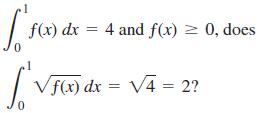
a. If b. If Give reasons for your answers. S $ f f(x) 7f(x) dx = 7, does f(x) dx = 1?
a. Set up an integral for the area of the surface generated by revolving the given curve about the indicated axis.b. Graph the curve to see what it looks like. If you can, graph the surface too.c. Use your utility’s integral evaluator to find the surface’s area numerically.y = tan x, 0 ≤ x
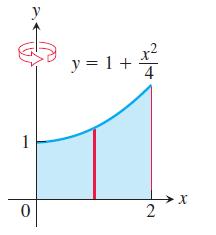
Use the shell method to find the volumes of the solids generated by revolving the shaded region about the indicated axis. 1 0 y=1+ 2² 2
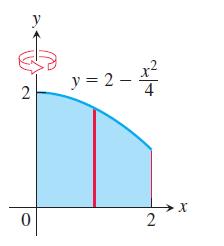
Use the shell method to find the volumes of the solids generated by revolving the shaded region about the indicated axis. y 2 10 y=2-1²2 2 X
Find the lengths of the curves. If you have a grapher, you may want to graph these curves to see what they look like.y = (1/3)(x2 + 2)3/2 from x = 0 to x = 3
How do you define and calculate the volumes of solids by the method of slicing? Give an example.
It took 1800 J of work to stretch a spring from its natural length of 2 m to a length of 5 m. Find the spring’s force constant.
Find the center of mass of a thin plate of constant density δ covering the given region.The region bounded by the parabola y = x2 and the line y = 4
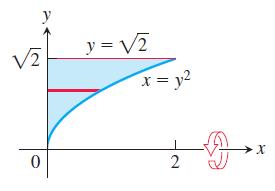
Use the shell method to find the volumes of the solids generated by revolving the shaded region about the indicated axis. V2 y 0 y = √2 x = y² 2 ņ →X
a. Set up an integral for the area of the surface generated by revolving the given curve about the indicated axis.b. Graph the curve to see what it looks like. If you can, graph the surface too.c. Use your utility’s integral evaluator to find the surface’s area numerically.y = x2, 0 ≤ x ≤
Find the lengths of the curves. If you have a grapher, you may want to graph these curves to see what they look like.y = x3/2 from x = 0 to x = 4
How are the disk and washer methods for calculating volumes derived from the method of slicing? Give examples of volume calculations by these methods.
A spring has a natural length of 10 in. An 800-lb force stretches the spring to 14 in.a. Find the force constant.b. How much work is done in stretching the spring from 10 in. to 12 in.?c. How far beyond its natural length will a 1600-lb force stretch the spring?
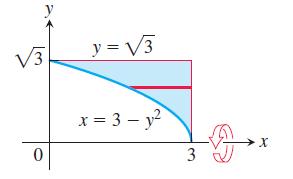
Use the shell method to find the volumes of the solids generated by revolving the shaded region about the indicated axis. √3 y 0 y = √3 x=3-y² 3 J X<
Find the center of mass of a thin plate of constant density δ covering the given region.The region bounded by the parabola y = 25 - x2 and the x-axis
a. Set up an integral for the area of the surface generated by revolving the given curve about the indicated axis.b. Graph the curve to see what it looks like. If you can, graph the surface too.c. Use your utility’s integral evaluator to find the surface’s area numerically.xy = 1, 1 ≤ y ≤
Find the lengths of the curves. If you have a grapher, you may want to graph these curves to see what they look like.x = (y3/3) + 1/(4y) from y = 1 to y = 3
Describe the method of cylindrical shells. Give an example.
A force of 2 N will stretch a rubber band 2 cm (0.02 m). Assuming that Hooke’s Law applies, how far will a 4-N force stretch the rubber band? How much work does it take to stretch the rubber band this far?
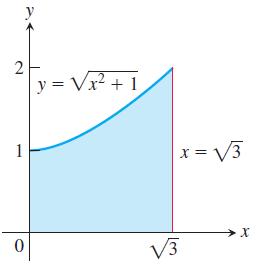
Use the shell method to find the volumes of the solids generated by revolving the shaded region about the indicated axis.The y-axis 2 1 y=√x² + 1 x=√√√3 √3 → X
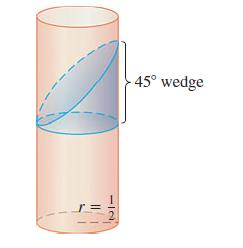
Consider a right-circular cylinder of diameter 1. Form a wedge by making one slice parallel to the base of the cylinder completely through the cylinder, and another slice at an angle of 45° to the first slice and intersecting the first slice at the opposite edge of the cylinder. Find the volume of
Find the center of mass of a thin plate of constant density δ covering the given region.The region bounded by the parabola y = x - x2 and the line y = -x
a. Set up an integral for the area of the surface generated by revolving the given curve about the indicated axis.b. Graph the curve to see what it looks like. If you can, graph the surface too.c. Use your utility’s integral evaluator to find the surface’s area numerically.x = sin y, 0 ≤ y
Find the lengths of the curves. If you have a grapher, you may want to graph these curves to see what they look like.x = (y3/2/3) - y1/2 from y = 1 to y = 9
How do you find the length of the graph of a smooth function over a closed interval? Give an example. What about functions that do not have continuous first derivatives?
If a force of 90 N stretches a spring 1 m beyond its natural length, how much work does it take to stretch the spring 5 m beyond its natural length?
Find the center of mass of a thin plate of constant density δ covering the given region.The region enclosed by the parabolas y = x2 - 3 and y = -2x2
Find the volume of the solid formed by revolving the region bounded by the graphs of y = x and y = x2 about the line y = x.
a. Set up an integral for the area of the surface generated by revolving the given curve about the indicated axis.b. Graph the curve to see what it looks like. If you can, graph the surface too.c. Use your utility’s integral evaluator to find the surface’s area numerically.x1/2 + y1/2 = 3 from
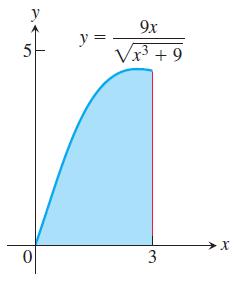
Use the shell method to find the volumes of the solids generated by revolving the shaded region about the indicated axis.The y-axis y 5 0 y = 9x Vx³ +9 3 → X
a. Set up an integral for the area of the surface generated by revolving the given curve about the indicated axis.b. Graph the curve to see what it looks like. If you can, graph the surface too.c. Use your utility’s integral evaluator to find the surface’s area numerically. X = So tant dt, 0≤
Find the lengths of the curves. If you have a grapher, you may want to graph these curves to see what they look like.x = (y4/4) + 1/(8y2) from y = 1 to y = 2
It takes a force of 21,714 lb to compress a coil spring assembly on a New York City Transit Authority subway car from its free height of 8 in. to its fully compressed height of 5 in.a. What is the assembly’s force constant?b. How much work does it take to compress the assembly the first half
How do you define and calculate the area of the surface swept out by revolving the graph of a smooth function y = ƒ(x), a ≤ x ≤ b, about the x-axis? Give an example.
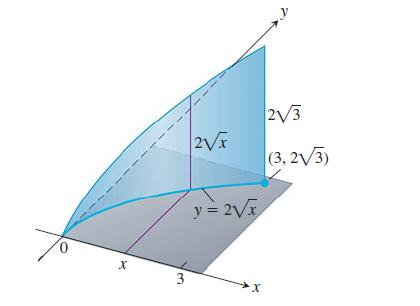
At points on the curve y = 2√x, line segments of length h = y are drawn perpendicular to the xy-plane. Find the area of the surface formed by these perpendiculars from (0, 0) to (3, 2√3). 0 X 3 2√x y = 2√x X 2√3 (3,2√3)
Find the center of mass of a thin plate of constant density δ covering the given region.The region bounded by the y-axis and the curve x = y - y3, 0 ≤ y ≤ 1
a. Set up an integral for the area of the surface generated by revolving the given curve about the indicated axis.b. Graph the curve to see what it looks like. If you can, graph the surface too.c. Use your utility’s integral evaluator to find the surface’s area numerically.y + √2y = x, 1 ≤
Find the lengths of the curves. If you have a grapher, you may want to graph these curves to see what they look like.x = (y3/6) + 1/(2y) from y = 2 to y = 3
A bathroom scale is compressed 1/16 in. when a 150-lb person stands on it. Assuming that the scale behaves like a spring that obeys Hooke’s Law, how much does someone who compresses the scale 1/8 in. weigh? How much work is done compressing the scale 1/8 in.?
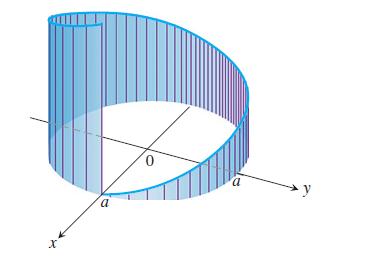
At points on a circle of radius a, line segments are drawn perpendicular to the plane of the circle, the perpendicular at each point P being of length ks, where s is the length of the arc of the circle measured counterclockwise from (a, 0) to P and k is a positive constant, as shown here. Find the
How do you define and calculate the work done by a variable force directed along a portion of the x-axis? How do you calculate the work it takes to pump a liquid from a tank? Give examples.
Find the center of mass of a thin plate of constant density δ covering the given region.The region bounded by the parabola x = y2 - y and the line y = x
a. Set up an integral for the area of the surface generated by revolving the given curve about the indicated axis.b. Graph the curve to see what it looks like. If you can, graph the surface too.c. Use your utility’s integral evaluator to find the surface’s area numerically. y = f* VP - 1 dl. S
Find the lengths of the curves. If you have a grapher, you may want to graph these curves to see what they look like. y = (x³/3) + x² + x + 1/(4x + 4), 0≤x≤ 2
Find the lateral (side) surface area of the cone generated by revolving the line segment y = x/2, 0 ≤ x ≤ 4, about the x-axis. Check your answer with the geometry formula Lateral surface area = 11/13 X base circumference X slant height. 2
Find the lengths of the curves. If you have a grapher, you may want to graph these curves to see what they look like.y = (3/4)x4/3 - (3/8)x2/3 + 5, 1 ≤ x ≤ 8
Find the lengths of the curves. If you have a grapher, you may want to graph these curves to see what they look like. y = ln x x² 8 from x = 1 to x = 2
A mountain climber is about to haul up a 50-m length of hanging rope. How much work will it take if the rope weighs 0.624 N/m?
Use the shell method to find the volumes of the solids generated by revolving the regions bounded by the curves and lines about the y-axis.y = x, y = -x/2, x = 2
How do you calculate the force exerted by a liquid against a portion of a flat vertical wall? Give an example.
Find the center of mass of a thin plate of constant density δ covering the given region.The region bounded by the x-axis and the curve y = cos x, -π/2 ≤ x ≤ π/2
Find the lateral surface area of the cone generated by revolving the line segment y = x/2, 0 ≤ x ≤ 4, about the y-axis. Check your answer with the geometry formula Lateral surface area = X base circumference X slant height. 2
Find the lengths of the curves. If you have a grapher, you may want to graph these curves to see what they look like. y 2 In x 4 from x 1 to x = 3 =
A bag of sand originally weighing 144 lb was lifted at a constant rate. As it rose, sand also leaked out at a constant rate. The sand was half gone by the time the bag had been lifted to 18 ft. How much work was done lifting the sand this far?
Use the shell method to find the volumes of the solids generated by revolving the regions bounded by the curves and lines about the y-axis.y = 2x, y = x/2, x = 1
Find the center of mass of a thin plate of constant density δ covering the given region.The region between the curve y = sec2 x, -π/4 ≤ x ≤ π/4 and the x-axis
What is a center of mass? a centroid?
A particle of mass m starts from rest at time t = 0 and is moved along the x-axis with constant acceleration a from x = 0 to x = h against a variable force of magnitude F(t) = t2. Find the work done.
An electric elevator with a motor at the top has a multistrand cable weighing 4.5 lb/ft. When the car is at the first floor, 180 ft of cable are paid out, and effectively 0 ft are out when the car is at the top floor. How much work does the motor do just lifting the cable when it takes the car from
Use the shell method to find the volumes of the solids generated by revolving the regions bounded by the curves and lines about the y-axis.y = x2, y = 2 - x, x = 0, for x ≥ 0
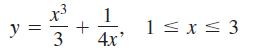
Find the lengths of the curves. If you have a grapher, you may want to graph these curves to see what they look like. y 3 + 4x' 1 ≤ x ≤ 3
How do you locate the center of mass of a thin flat plate of material? Give an example.
Find the center of mass of a thin plate of constant density δ covering the given region.The region between the curve y = 1/x and the x-axis from x = 1 to x = 2. Give the coordinates to two decimal places.
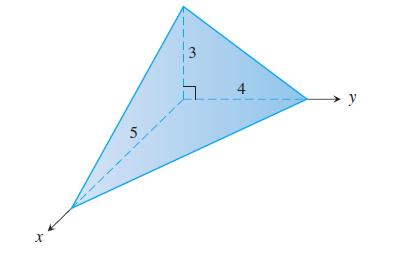
Find the volume of the given right tetrahedron. X ک 3 نیا 4
Suppose a 1.6-oz golf ball is placed on a vertical spring with force constant k = 2 lb/in. The spring is compressed 6 in. and released. About how high does the ball go (measured from the spring’s rest position)?
When a particle of mass m is at (x, 0), it is attracted toward the origin with a force whose magnitude is k/x2. If the particle starts from rest at x = b and is acted on by no other forces, find the work done on it by the time it reaches x = a, 0 < a < b.
Use the shell method to find the volumes of the solids generated by revolving the regions bounded by the curves and lines about the y-axis.y = 2 - x2, y = x2, x = 0
Find the lengths of the curves. If you have a grapher, you may want to graph these curves to see what they look like. y || 5 1 12x³¹ 1 2 ≤x≤1
How do you locate the center of mass of a thin plate bounded by two curves y = ƒ(x) and y = g(x) over a ≤ x ≤ b?
Showing 10800 - 10900
of 29454
First
102
103
104
105
106
107
108
109
110
111
112
113
114
115
116
Last
Step by Step Answers

 Get 50% OFF
Claim Now
Get 50% OFF
Claim Now