New Semester
Started
Get
50% OFF
Study Help!
--h --m --s
Claim Now
Question Answers
Textbooks
Find textbooks, questions and answers
Oops, something went wrong!
Change your search query and then try again
S
Books
FREE
Study Help
Expert Questions
Accounting
General Management
Mathematics
Finance
Organizational Behaviour
Law
Physics
Operating System
Management Leadership
Sociology
Programming
Marketing
Database
Computer Network
Economics
Textbooks Solutions
Accounting
Managerial Accounting
Management Leadership
Cost Accounting
Statistics
Business Law
Corporate Finance
Finance
Economics
Auditing
Tutors
Online Tutors
Find a Tutor
Hire a Tutor
Become a Tutor
AI Tutor
AI Study Planner
NEW
Sell Books
Search
Search
Sign In
Register
study help
mathematics
precalculus
Thomas Calculus Early Transcendentals 13th Edition Joel R Hass, Christopher E Heil, Maurice D Weir - Solutions
Evaluate the definite integral. Use a graphing utility to verify your result. 2 J-1 2x dx
Find the derivative of the function.y = coth-1(e2x)
Find the indefinite integral.∫x(5-x2) dx
Find the derivative of the function.y = 2x sinh-1(2x) - √1 + 4x2
Solve the equation accurate to three decimal places.log6(x + 1) = 2
Find the indefinite integral.∫(4 - x)6(4 - x)2 dx
Find the derivative of the function.y = x tanh-1 x + ln√1 - x2
Solve the equation accurate to three decimal places.log5 x2 = 4.1
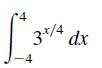
Evaluate the definite integral. Use a graphing utility to verify your result. 4 3x/4 dx J-4
Find the indefinite integral.∫32x /1 + 32x dx
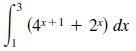
Evaluate the definite integral. Use a graphing utility to verify your result. 3 fi (4x+1 + 2x) dx
Find the derivative of the function.f (x) = 3x-1
Find the indefinite integral.∫2sin x cos x dx
Find the derivative of the function.f (x) = 53x
Find the derivative of the function.g(t) = 23t /t2
Find the derivative of the function.f (x) = x(4-3x)
Explain why sin 2π = 0 does not imply that arcsin 0 = 2π.
Evaluate the definite integral. Use a graphing utility to verify your result.∫10 (5x - 3x) dx
Find the derivative of the function.g(x) = log3 √1 - x
Find the derivative of the function.h(x) = log5 x/x - 1
Find the area of the region bounded by the graphs of the equations. Use a graphing utility to verify your result.y = log4 x/x, y = 0, x = 1, x = 5
Find the derivative of the function.y = x2x+1
Find the area of the region bounded by the graphs of the equations. Use a graphing utility to verify your result.y = 3cos x sin x, y = 0, x = 0, x = π
Find the derivative of the function.y = (3x + 5)x
What happens to the rate of change of the exponential function y = ax as a becomes larger?
What happens to the rate of change of the logarithmic function y = loga x as a becomes larger?
Consider the function f (x) = log10 x.(a) What is the domain of f?(b) Find f-1.(c) Let x be a real number between 1000 and 10,000. Determine the interval in which f (x) will be found.(d) Determine the interval in which x will be found if f (x) is negative.(e) When f (x) is increased by one unit, x
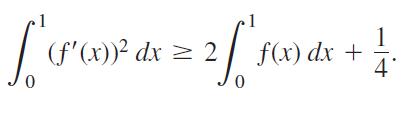
If ƒ is continuously differentiable on [0, 1] and ƒ(1) = ƒ(0) = -1/6, prove that ] 0 2 / Fox (f'(x))² dx ≥ 2 f(x) dx + 1/ 4
A manufacturer of light bulbs finds that the mean lifetime of a bulb is 1200 hours. Assume the life of a bulb is exponentially distributed.a. Find the probability that a bulb will last less than its guaranteed lifetime of 1000 hours.b. In a batch of light bulbs, what is the expected time until half
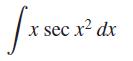
Evaluate the integrals. Some integrals do not require integration by parts. [x x sec x² dx
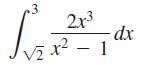
Evaluate each integral using any algebraic method or trigonometric identity you think is appropriate, and then use a substitution to reduce it to a standard form. 3 √2 2x³ x² - 1 - dx
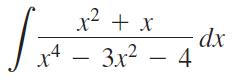
Express the integrand as a sum of partial fractions and evaluate the integrals. S x² + x X xp. x4 - 3x² - 4
A biologist models the time in minutes until a bee arrives at a flowering plant with an exponential distribution having a mean of 4 minutes. If 1000 flowers are in a field, how many can be expected to be pollinated within 5 minutes?
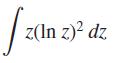
Evaluate the integrals by using a substitution prior to integration by parts. √ 20 z(In z)² dz
What values of p have the following property: The area of the region in the first quadrant enclosed by the curve y = x-p, the y-axis, the line x = 1, and the interval [0, 1] on the x-axis is infinite but the volume of the solid generated by revolving the region about one of the coordinate axes is
Evaluate each integral using any algebraic method or trigonometric identity you think is appropriate, and then use a substitution to reduce it to a standard form. (csc x sec x) (sin x + cos x) dx
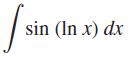
Evaluate the integrals by using a substitution prior to integration by parts. [s sin (In x) dx
What values of p have the following property: The area of the region between the curve y = x-p, 1 ≤ x < ∞, and the x-axis is infinite but the volume of the solid generated by revolving the region about the x-axis is finite.
The digestion time in hours of a fixed amount of food is exponentially distributed with a mean of 1 hour. What is the probability that the food is digested in less than 30 minutes?
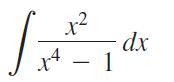
Express the integrand as a sum of partial fractions and evaluate the integrals. S zx x4 1 dx
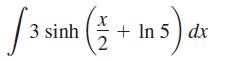
Evaluate each integral using any algebraic method or trigonometric identity you think is appropriate, and then use a substitution to reduce it to a standard form. [² 3 sinh ( ½ + In 5 ) dx
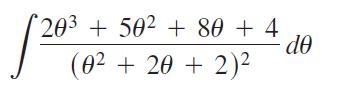
Express the integrand as a sum of partial fractions and evaluate the integrals. 203 +502 + 80 + 4 [203 (0² +20 + 2)² de
The instructions for the integrals have two parts, one for the Trapezoidal Rule and one for Simpson’s Rule.I. Using the Trapezoidal Rulea. Estimate the integral with n = 4 steps and find an upper bound for |ET|.b. Evaluate the integral directly and find |ET|.c. Use the formula (|ET|/(true value))
Estimate the minimum number of subintervals needed to approximate the integrals with an error of magnitude less than 10-4 by (a) The Trapezoidal Rule and (b) Simpson’s Rule. Г .2 1 x dx
Verify that the functions are probability density functions for a continuous random variable X over the given interval. Determine the specified probability. f(x) = xe over [0, ∞), P(1 ≤X ≤ 3)
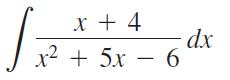
Express the integrand as a sum of partial fractions and evaluate the integrals. x + 4 X² r2 + 5x − 6 dx
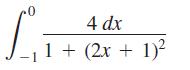
Evaluate each integral using any algebraic method or trigonometric identity you think is appropriate, and then use a substitution to reduce it to a standard form. L₁ 4 dx 1 + (2x + 1)²
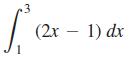
Estimate the minimum number of subintervals needed to approximate the integrals with an error of magnitude less than 10-4 by (a) The Trapezoidal Rule and (b) Simpson’s Rule. S (2x - 1) dx
Verify that the functions are probability density functions for a continuous random variable X over the given interval. Determine the specified probability. f(x) = = In x x² over [1,00), P(2 < X < 15)
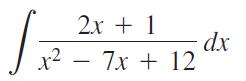
Express the integrand as a sum of partial fractions and evaluate the integrals. S 2x + 1 x² - 7x + 12 dx
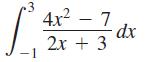
Evaluate each integral using any algebraic method or trigonometric identity you think is appropriate, and then use a substitution to reduce it to a standard form. -1 4x² - 7 2x + 3 dx
Verify that the functions are probability density functions for a continuous random variable X over the given interval. Determine the specified probability. f(x) = 3 2 x (2 - x) over [0, 1], P(0.5 > X)
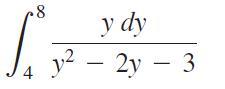
Express the integrand as a sum of partial fractions and evaluate the integrals. 4 8 y dy ,2 y² - 2y - 3
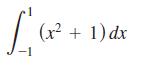
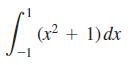
Estimate the minimum number of subintervals needed to approximate the integrals with an error of magnitude less than 10-4 by (a) The Trapezoidal Rule and (b) Simpson’s Rule. -1 (x² + 1)dx
What is an improper integral of Type I? Type II? How are the values of various types of improper integrals defined? Give examples.
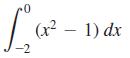
Estimate the minimum number of subintervals needed to approximate the integrals with an error of magnitude less than 10-4 by (a) The Trapezoidal Rule and (b) Simpson’s Rule. -2 (x² 1) dx
Find the length of the graph of the function y = ln (1 - x2), 0 ≤ x ≤ 1/2.
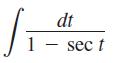
Evaluate each integral using any algebraic method or trigonometric identity you think is appropriate, and then use a substitution to reduce it to a standard form. Si dt 1 - sect
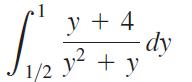
Express the integrand as a sum of partial fractions and evaluate the integrals. 1 y + 4 dy 1/2 y² + y
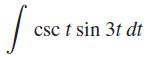
Evaluate each integral using any algebraic method or trigonometric identity you think is appropriate, and then use a substitution to reduce it to a standard form. s csc t sin 3t dt
Verify that the functions are probability density functions for a continuous random variable X over the given interval. Determine the specified probability. f(x): = sin 2TX π.χ2 over 200 1059' ∞). P(X < π/6)
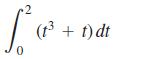
Estimate the minimum number of subintervals needed to approximate the integrals with an error of magnitude less than 10-4 by (a) The Trapezoidal Rule and (b) Simpson’s Rule. La (t³ + t) dt
What tests are available for determining the convergence and divergence of improper integrals that cannot be evaluated directly? Give examples of their use.
The region in the first quadrant that is enclosed by the x-axis and the curve y = 3x√1 - x is revolved about the y-axis to generate a solid. Find the volume of the solid.
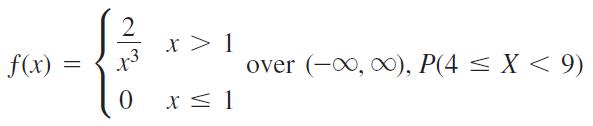
Verify that the functions are probability density functions for a continuous random variable X over the given interval. Determine the specified probability. f(x) = 2 0 x > 1 x ≤ 1 over (-∞, ∞), P(4 ≤ X < 9)
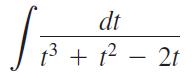
Express the integrand as a sum of partial fractions and evaluate the integrals. dt Si √₁³ + 14²2 - 21 +2
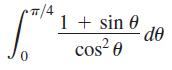
Evaluate each integral using any algebraic method or trigonometric identity you think is appropriate, and then use a substitution to reduce it to a standard form. 7/4 1 + sin 0 cos²0 de
What is a random variable? What is a continuous random variable? Give some specific examples.
The region in the first quadrant that is enclosed by the x-axis, the curve y = 5/(x√5 - x), and the lines x = 1 and x = 4 is revolved about the x-axis to generate a solid. Find the volume of the solid.
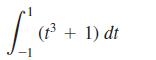
Estimate the minimum number of subintervals needed to approximate the integrals with an error of magnitude less than 10-4 by (a) The Trapezoidal Rule (b) Simpson’s Rule. J-1 (1³ + 1) dt
What is a probability density function? What is the probability that a continuous random variable has a value in the interval [c, d]?
Verify that the functions are probability density functions for a continuous random variable X over the given interval. Determine the specified probability. TT f(x) = sin x over [0, π/2], PT < X < 4
The region in the first quadrant enclosed by the coordinate axes, the curve y = ex, and the line x = 1 is revolved about the y-axis to generate a solid. Find the volume of the solid.
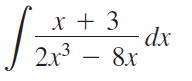
Express the integrand as a sum of partial fractions and evaluate the integrals. 12 x + 3 2x³ - 8x - dx
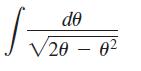
Evaluate each integral using any algebraic method or trigonometric identity you think is appropriate, and then use a substitution to reduce it to a standard form. dᎾ V20 - 02 2002
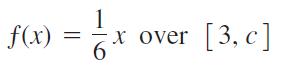
Find the value of the constant c so that the given function is a probability density function for a random variable over the specified interval. f(x) = 6 xover [3, c]
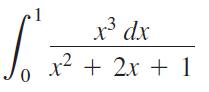
Express the integrand as a sum of partial fractions and evaluate the integrals. S 0 x³ dx 3 x² + 2x + 1 X'
Estimate the minimum number of subintervals needed to approximate the integrals with an error of magnitude less than 10-4 by (a) The Trapezoidal Rule and (b) Simpson’s Rule. 2 S sp. -S
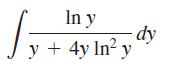
Evaluate each integral using any algebraic method or trigonometric identity you think is appropriate, and then use a substitution to reduce it to a standard form. In y √y + 2 - dy y + 4y In² y
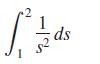
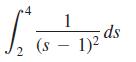
Estimate the minimum number of subintervals needed to approximate the integrals with an error of magnitude less than 10-4 by (a) The Trapezoidal Rule and (b) Simpson’s Rule. 1 ds (s 1)² 2
What is an exponentially decreasing probability density function? What are some typical events that might be modeled by this distribution? What do we mean when we say such distributions are memoryless?
The region in the first quadrant that is bounded above by the curve y = ex - 1, below by the x-axis, and on the right by the line x = ln 2 is revolved about the line x = ln 2 to generate a solid. Find the volume of the solid.
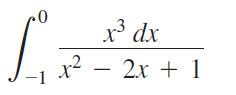
Express the integrand as a sum of partial fractions and evaluate the integrals. .0 T -1 x³ dx x² - 2x + 1
Evaluate each integral using any algebraic method or trigonometric identity you think is appropriate, and then use a substitution to reduce it to a standard form. 2V √y dy 2√y
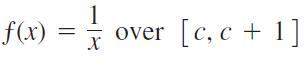
Find the value of the constant c so that the given function is a probability density function for a random variable over the specified interval. f(x) = 1 X over [c, c + 1]
What is the expected value of a continuous random variable? What is the expected value of an exponentially distributed random variable?
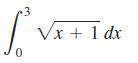
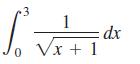
Estimate the minimum number of subintervals needed to approximate the integrals with an error of magnitude less than 10-4 by (a) The Trapezoidal Rule and (b) Simpson’s Rule. 0 √x + 1 dx
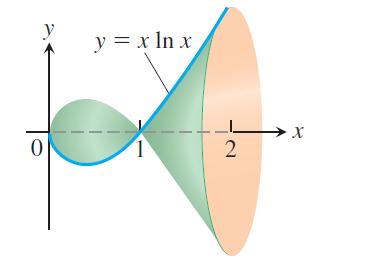
The region between the x-axis and the curveis revolved about the x-axis to generate the solid shown here.a. Show that ƒ is continuous at x = 0.b. Find the volume of the solid. y = f(x) = Jo, 1x In x, x = 0 0≤x≤2
Find the value of the constant c so that the given function is a probability density function for a random variable over the specified interval. f(x) = 4e-²x over [0, c]
Let R be the “triangular” region in the first quadrant that is bounded above by the line y = 1, below by the curve y = ln x, and on the left by the line x = 1. Find the volume of the solid generated by revolving R abouta. The x-axis. b. The line y = 1.
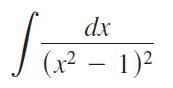
Express the integrand as a sum of partial fractions and evaluate the integrals. La dx (x² - 1)²
Estimate the minimum number of subintervals needed to approximate the integrals with an error of magnitude less than 10-4 by (a) The Trapezoidal Rule and (b) Simpson’s Rule. 3 - 1 √x + 1 dx
What is the median of a continuous random variable? What is the median of an exponential distribution?
Find the volume of the solid generated by revolving the region R abouta. The y-axis. b. The line x = 1.
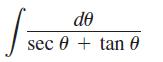
Evaluate each integral using any algebraic method or trigonometric identity you think is appropriate, and then use a substitution to reduce it to a standard form. de sec 0 + tan 0
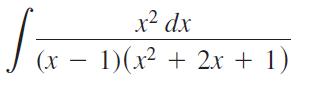
Express the integrand as a sum of partial fractions and evaluate the integrals. x² dx (x - 1)(x² + 2x + 1) S
Find the value of the constant c so that the given function is a probability density function for a random variable over the specified interval. f(x) = - cxV/25 – x² over [0,5]
What does the variance of a random variable measure? What is the standard deviation of a continuous random variable X?
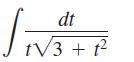
The integrals are in no particular order. Evaluate each integral using any algebraic method or trigonometric identity you think is appropriate, and then use a substitution to reduce it to a standard form. S₁V dt t√3+1²
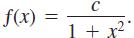
LetFind the value of c so that ƒ is a probability density function. If ƒ is a probability density function for the random variable X, find the probability P(1 ≤ X f(x) || C 1 + x 2
Showing 10600 - 10700
of 29454
First
100
101
102
103
104
105
106
107
108
109
110
111
112
113
114
Last
Step by Step Answers

 Get 50% OFF
Claim Now
Get 50% OFF
Claim Now