New Semester
Started
Get
50% OFF
Study Help!
--h --m --s
Claim Now
Question Answers
Textbooks
Find textbooks, questions and answers
Oops, something went wrong!
Change your search query and then try again
S
Books
FREE
Study Help
Expert Questions
Accounting
General Management
Mathematics
Finance
Organizational Behaviour
Law
Physics
Operating System
Management Leadership
Sociology
Programming
Marketing
Database
Computer Network
Economics
Textbooks Solutions
Accounting
Managerial Accounting
Management Leadership
Cost Accounting
Statistics
Business Law
Corporate Finance
Finance
Economics
Auditing
Tutors
Online Tutors
Find a Tutor
Hire a Tutor
Become a Tutor
AI Tutor
AI Study Planner
NEW
Sell Books
Search
Search
Sign In
Register
study help
mathematics
precalculus
Precalculus Concepts Through Functions A Unit Circle Approach To Trigonometry 5th Edition Michael Sullivan - Solutions
Problems 99–107 are based on previously learned material. The purpose of these problems is to keep the material fresh in your mind so that you are better prepared for later sections, a final exam, or subsequent courses such as calculus.Use the quadratic formula to find the real zeros of the
Problems 99–107 are based on previously learned material. The purpose of these problems is to keep the material fresh in your mind so that you are better prepared for later sections, a final exam, or subsequent courses such as calculus.Solve: |5x − 3| = 7
Problems 99–107 are based on previously learned material. The purpose of these problems is to keep the material fresh in your mind so that you are better prepared for later sections, a final exam, or subsequent courses such as calculus.Determine whether the function f (x) = −3x + 2 is
Problems 99–107 are based on previously learned material. The purpose of these problems is to keep the material fresh in your mind so that you are better prepared for later sections, a final exam, or subsequent courses such as calculus.Find the function that is finally graphed if the graph of f
Problems 99–107 are based on previously learned material. The purpose of these problems is to keep the material fresh in your mind so that you are better prepared for later sections, a final exam, or subsequent courses such as calculus.The midpoint of a line segment is (3, −5) and one endpoint
Problems 99–107 are based on previously learned material. The purpose of these problems is to keep the material fresh in your mind so that you are better prepared for later sections, a final exam, or subsequent courses such as calculus.Find the quotient and remainder if 4x3 − 7x2 + 5 is divided
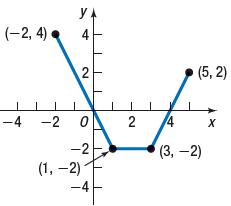
Problems 106–109 are based on previously learned material. The purpose of these problems is to keep the material fresh in your mind so that you are better prepared for later sections, a final exam, or subsequent courses such as calculus.Let f (x) = 2x − 7 . Evaluate f (−4). (-2,4) YA 4 2 -4
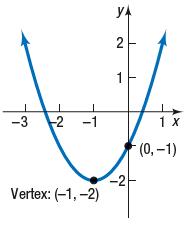
In Problems 61–66, determine the quadratic function whose graph is given. -3 -2 -1 Vertex: (-1,-2) YA 2 1 -2 1 x (0, -1)
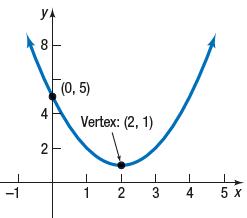
In Problems 61–66, determine the quadratic function whose graph is given. -1 YA y 4 2 (0,5) Vertex: (2, 1) I 12 T I 3 4 I 5 x
In Problems 33–44, graph the function f by starting with the graph of y = x2 and using transformations (shifting, compressing, stretching, and/or reflecting). If necessary, write f in the form f ( x) = a( x − h)2 + k.f (x) = 2/3 x2 + 4/3x − 1
In Problems 45–60,(a) Find the vertex and the axis of symmetry of each quadratic function, and determine whether the graph is concave up or concave down.(b) Find the y-intercept and the x-intercepts, if any.(c) Use parts (a) and (b) to graph the function.(d) Find the domain and the range of the
In Problems 45–60,(a) Find the vertex and the axis of symmetry of each quadratic function, and determine whether the graph is concave up or concave down.(b) Find the y-intercept and the x-intercepts, if any.(c) Use parts (a) and (b) to graph the function.(d) Find the domain and the range of the
In Problems 45–60,(a) Find the vertex and the axis of symmetry of each quadratic function, and determine whether the graph is concave up or concave down.(b) Find the y-intercept and the x-intercepts, if any.(c) Use parts (a) and (b) to graph the function.(d) Find the domain and the range of the
In Problems 45–60,(a) Find the vertex and the axis of symmetry of each quadratic function, and determine whether the graph is concave up or concave down.(b) Find the y-intercept and the x-intercepts, if any.(c) Use parts (a) and (b) to graph the function.(d) Find the domain and the range of the
In Problems 45–60,(a) Find the vertex and the axis of symmetry of each quadratic function, and determine whether the graph is concave up or concave down.(b) Find the y-intercept and the x-intercepts, if any.(c) Use parts (a) and (b) to graph the function.(d) Find the domain and the range of the
In Problems 67–74, determine, without graphing, whether the given quadratic function has a maximum value or a minimum value, and then find the value.f (x) = 4x2 − 8x + 3
Find the distance from the vertex of the parabola f (x) = 2(x − 3)2 + 5 to the center of the circle (x + 3)2 + (y − 1)2 = 4.
Find the distance from the vertex of the parabola g(x) = −3x2 + 6x + 1 to the center of the circle x2 + y2 + 10x + 8y + 32 = 0.
Find the point on the line y = x that is closest to the point (3, 1).
Suppose f (x) = x3 − 7x2 − 5x + 35. From calculus, the derivative of f is given by f (x) = 3x2 − 14x − 5. The function f is increasing where f (x) > 0 and decreasing where f (x) < 0. The numbers at the endpoints must be tested separately to determine if they should be included in the
Suppose f (x) = 3x4 − 8x3 + 6x + 1. From calculus, the second derivative of f is given by f (x) = 36x2 − 48x. The function f is concave up where f (x) > 0 and concave down where f (x) < 0. Determine where f is concave up and where f is concave down.
Problems 113–122 are based on previously learned material. The purpose of these problems is to keep the material fresh in your mind so that you are better prepared for later sections, a final exam, or subsequent courses such as calculus.Determine whether x2 + 4y2 = 16 is symmetric with respect to
Problems 113–122 are based on previously learned material. The purpose of these problems is to keep the material fresh in your mind so that you are better prepared for later sections, a final exam, or subsequent courses such as calculus.Solve the inequality 27 − x ≥ 5x + 3. Write the solution
Problems 113–122 are based on previously learned material. The purpose of these problems is to keep the material fresh in your mind so that you are better prepared for later sections, a final exam, or subsequent courses such as calculus.Find the center and radius of the circle x2 + y2 − 10x +
Problems 113–122 are based on previously learned material. The purpose of these problems is to keep the material fresh in your mind so that you are better prepared for later sections, a final exam, or subsequent courses such as calculus.Find the function whose graph is the graph of y = √x, but
Problems 113–122 are based on previously learned material. The purpose of these problems is to keep the material fresh in your mind so that you are better prepared for later sections, a final exam, or subsequent courses such as calculus. If g(x)= 18(2²/x + 12). 8, find g
Problems 113–122 are based on previously learned material. The purpose of these problems is to keep the material fresh in your mind so that you are better prepared for later sections, a final exam, or subsequent courses such as calculus.Find an equation of the line that contains the point (14,
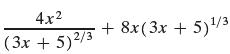
Problems 113–122 are based on previously learned material. The purpose of these problems is to keep the material fresh in your mind so that you are better prepared for later sections, a final exam, or subsequent courses such as calculus.Write as a single quotient with positive exponents.
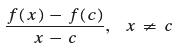
Problems 113–122 are based on previously learned material. The purpose of these problems is to keep the material fresh in your mind so that you are better prepared for later sections, a final exam, or subsequent courses such as calculus.If f (x) = x2 + 5x, find and simplify f(x) = f(c) x-c x -
Problems 113–122 are based on previously learned material. The purpose of these problems is to keep the material fresh in your mind so that you are better prepared for later sections, a final exam, or subsequent courses such as calculus.State the domain and range of the relation given below. Is
Problems 113–122 are based on previously learned material. The purpose of these problems is to keep the material fresh in your mind so that you are better prepared for later sections, a final exam, or subsequent courses such as calculus.If f (x) = 3x2 − 25x + 28, find f (7).
Answers are given at the end of these exercises.Find the intercepts of the equation y = x2 − 9.
Answers are given at the end of these exercises.Find the real solutions of the equation 2x2 + 7x − 4 = 0.
Answers are given at the end of these exercises.To complete the square of x2 − 5x, add the number ______.
Answers are given at the end of these exercises.To graph y = (x − 4)2, shift the graph of y = x2 to the_____ a distance of______ units.
Answers are given at the end of these exercises.Find the discriminant of 2x2 − 5x − 8 = 0. Then identify the number of real solutions of the equation.
Open the “Quadratic Functions” interactive figure, which is available in the Video & Resource Library of MyLab Math (under Sullivan Guided Visualizations) or at bit.ly/3raFUGB.(a) Set the values of a , h , and k as follows: a = 2, h = 3, k = −4. What is the equation of the quadratic
Open the “Discriminant” interactive figure, which is available in the Video & Resource Library of MyLab Math (under Sullivan Guided Visualizations) or at bit.ly/3raFUGB. Be sure to check the “Discriminant” box.(a) S et the value of a to − 1, b to − 1, and c to 2. How many x
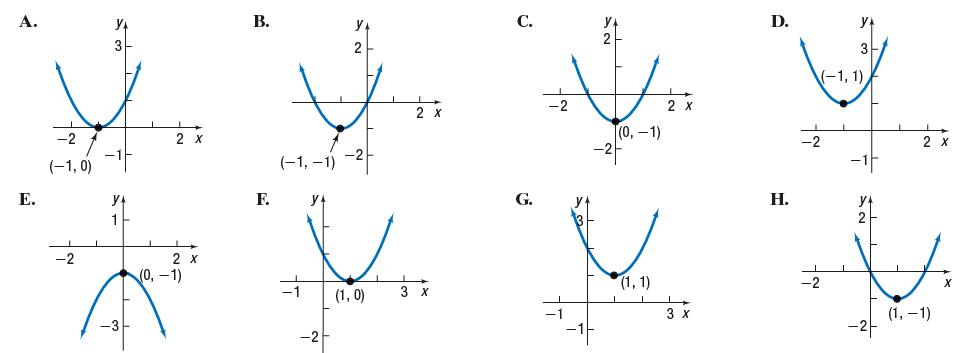
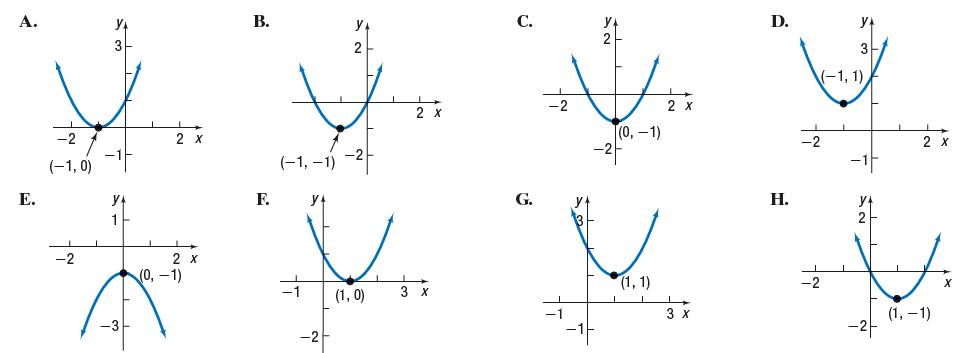
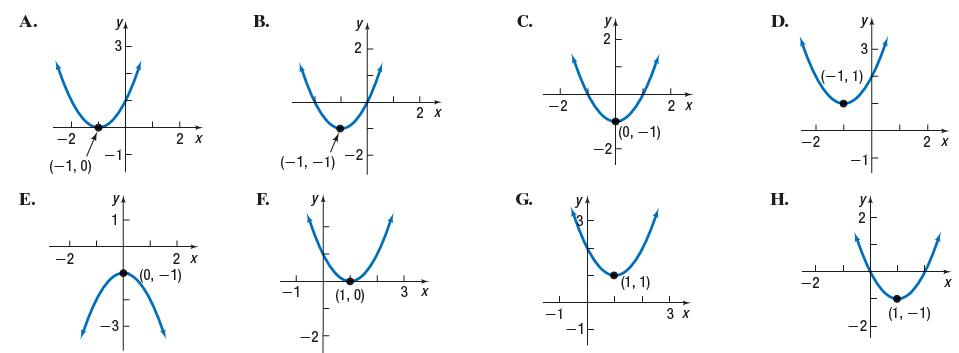
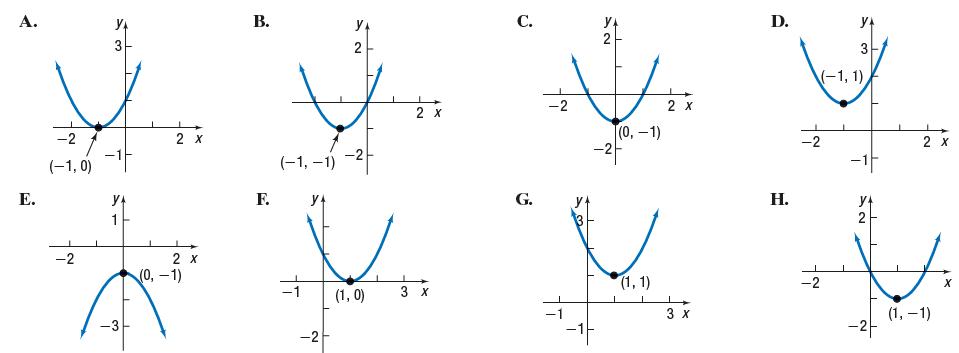
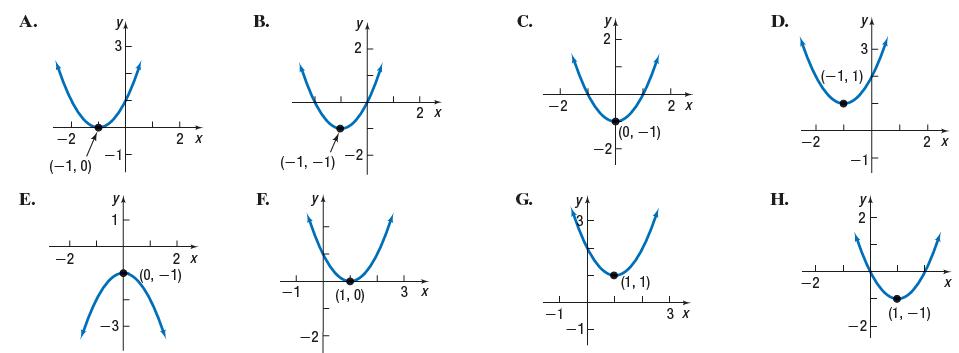
In Problems 17–24, match each graph to one the following functions.f (x) = x2 − 2x + 1 A. E. -2 (-1,0) -2 YA 3 Y₁ 1 -3 2 X 2 X (0, -1) B. F. (-1, -1) y+ -2- y 2 -2 (1, 0) 2 x 3 x C. G. -2 2 -2 Jr. 2 x (0, -1) (1, 1) 3 x D. H. (-1, 1) 2 2 x (1, -1) -2-- X
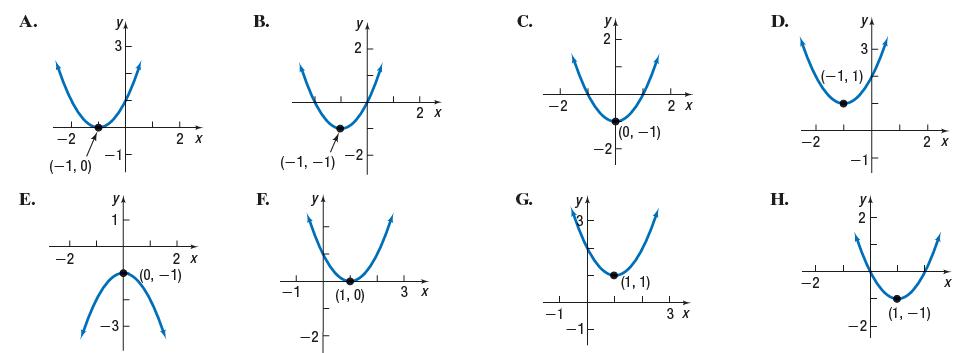
In Problems 17–24, match each graph to one the following functions.f (x) = x2 + 2x + 1 A. E. -2 (-1,0) -2 YA 3 Y₁ 1 -3 2 X 2 X (0, -1) B. F. (-1, -1) y+ -2- y 2 -2 (1, 0) 2 x 3 x C. G. -2 2 -2 Jr. 2 x (0, -1) (1, 1) 3 x D. H. (-1, 1) 2 2 x (1, -1) -2-- X
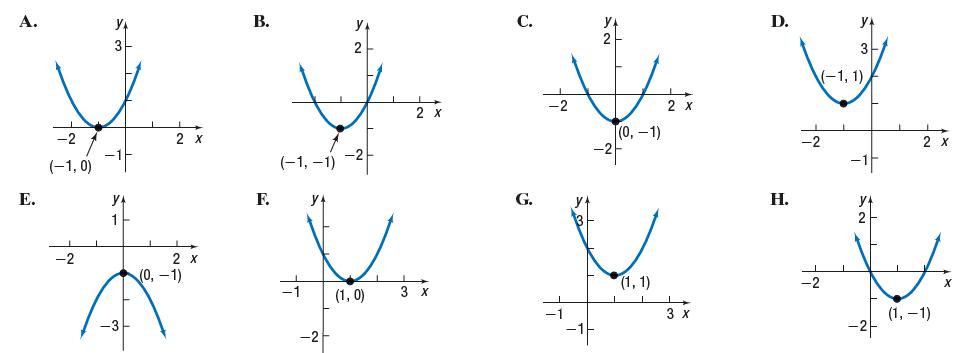
In Problems 17–24, match each graph to one the following functions.f (x) = x2 − 1 A. E. -2 (-1,0) -2 YA 3 Y₁ 1 -3 2 X 2 X (0, -1) B. F. (-1, -1) y+ -2- y 2 -2 (1, 0) 2 x 3 x C. G. -2 2 -2 Jr. 2 x (0, -1) (1, 1) 3 x D. H. (-1, 1) 2 2 x (1, -1) -2-- X
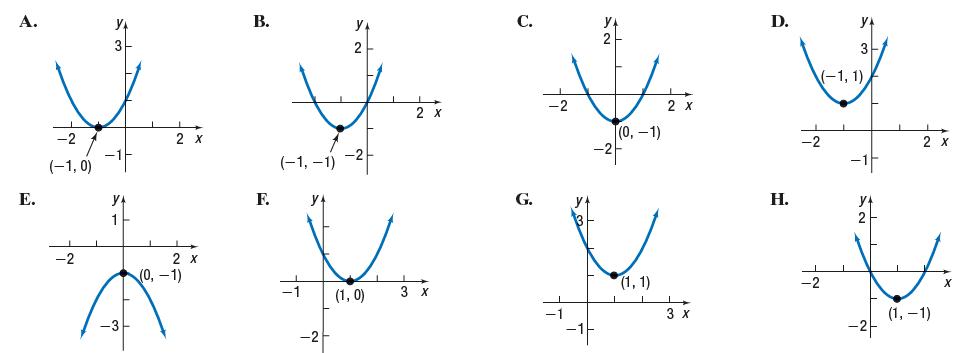
In Problems 17–24, match each graph to one the following functions.f (x) = x2 + 2x A. E. -2 (-1,0) -2 YA 3 Y₁ 1 -3 2 X 2 X (0, -1) B. F. (-1, -1) y+ -2- y 2 -2 (1, 0) 2 x 3 x C. G. -2 2 -2 Jr. 2 x (0, -1) (1, 1) 3 x D. H. (-1, 1) 2 2 x (1, -1) -2-- X
In Problems 17–24, match each graph to one the following functions.f (x) = −x2 − 1 A. E. -2 (-1,0) -2 YA 3 Y₁ 1 -3 2 X 2 X (0, -1) B. F. (-1, -1) y+ -2- y 2 -2 (1, 0) 2 x 3 x C. G. -2 2 -2 Jr. 2 x (0, -1) (1, 1) 3 x D. H. (-1, 1) 2 2 x (1, -1) -2-- X
In Problems 17–24, match each graph to one the following functions.f (x) = x2 − 2x + 2 A. E. -2 (-1,0) -2 YA 3 Y₁ 1 -3 2 X 2 X (0, -1) B. F. (-1, -1) y+ -2- y 2 -2 (1, 0) 2 x 3 x C. G. -2 2 -2 Jr. 2 x (0, -1) (1, 1) 3 x D. H. (-1, 1) 2 2 x (1, -1) -2-- X
Answers are given at the end of these exercises.Complete the square of 3x2 + 7x. Factor the new expression.
In Problems 17–24, match each graph to one the following functions.f (x) = x2 − 2x A. E. -2 (-1,0) -2 YA 3 Y₁ 1 -3 2 X 2 X (0, -1) B. F. (-1, -1) y+ -2- y 2 -2 (1, 0) 2 x 3 x C. G. -2 2 -2 Jr. 2 x (0, -1) (1, 1) 3 x D. H. (-1, 1) 2 2 x (1, -1) -2-- X
In Problems 17–24, match each graph to one the following functions.f (x) = x2 + 2x + 2 A. E. -2 (-1,0) -2 YA 3 Y₁ 1 -3 2 X 2 X (0, -1) B. F. (-1, -1) y+ -2- y 2 -2 (1, 0) 2 x 3 x C. G. -2 2 -2 Jr. 2 x (0, -1) (1, 1) 3 x D. H. (-1, 1) 2 2 x (1, -1) -2-- X
The graph of a quadratic function is called a(n) ___________.
The vertical line passing through the vertex of a parabola is called the_________________.
True or False The graph of f (x) = 2x2 + 3x − 4 is concave up.
True or False The y-coordinate of the vertex of f (x) = −x2 + 4x + 5 is f (2).
True or False If the discriminant b2 − 4ac = 0, the graph of f (x) = ax2 + bx + c, a ≠ 0, touches the x -axis at its vertex.
If b2 − 4ac > 0, which conclusion can be made about the graph of f (x) = ax2 + bx + c, a ≠ 0?(a) The graph has two distinct x -intercepts.(b) The graph has no x -intercepts.(c) The graph has three distinct x -intercepts.(d) The graph has one x -intercept.
In Problems 25–32,(a) Find the vertex and axis of symmetry of each quadratic function.(b) Determine whether the graph is concave up or concave down.(c) Graph the quadratic function.f (x) = (x − 3)2 − 2
In Problems 25–32,(a) Find the vertex and axis of symmetry of each quadratic function.(b) Determine whether the graph is concave up or concave down.(c) Graph the quadratic function.f (x) = −( x + 4)2 − 1
In Problems 25–32,(a) Find the vertex and axis of symmetry of each quadratic function.(b) Determine whether the graph is concave up or concave down.(c) Graph the quadratic function.f (x) = −2(x − 3)2 + 5
In Problems 25–32,(a) Find the vertex and axis of symmetry of each quadratic function.(b) Determine whether the graph is concave up or concave down.(c) Graph the quadratic function.f (x) = 3(x + 1)2 − 4
In Problems 25–32,(a) Find the vertex and axis of symmetry of each quadratic function.(b) Determine whether the graph is concave up or concave down.(c) Graph the quadratic function.f (x) = 2(x − 6)2 + 3
In Problems 25–32,(a) Find the vertex and axis of symmetry of each quadratic function.(b) Determine whether the graph is concave up or concave down.(c) Graph the quadratic function.f (x) = 1/2( x + 1)2 − 3
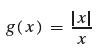
In Problems 9 – 14, find the domain of each function. g(x) = |x| X
Graph y = √x.
The intercepts of the equation x2 + 4y2 = 16 are ______.
If x = −2, the value of the expression 3x2 − x + 1/x is ______.
Graph y = 1/x.
Answers are given at the end of these exercises.To complete the square of x2 + 6x ,______ (add/subtract) ______.
Answers are given at the end of these exercises.Simplify: √82 − 4 . 2 . 3
Answers are given at the end of these exercises.Solve: (x − 3)(3x + 5) = 0
True or False If y varies directly with x, then y = k/x, where k is a constant.
Answers are given at the end of these exercises.(a) Factor: x2 − 5x − 6(b) Factor: 2x2 − x − 3
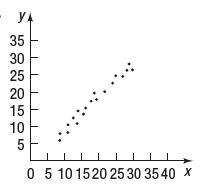
In Problems 5 – 10, examine each scatter plot and determine whether the relation is linear or nonlinear. YA 35 30 25 20 15 10 5 сл 0 5 10 15 20 25 30 35 40 X
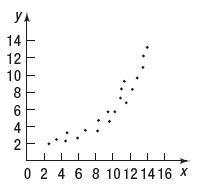
In Problems 5 – 10, examine each scatter plot and determine whether the relation is linear or nonlinear. У У+ 14 12 10 8 N P 0 00 6 4 2 0 2 4 6 8 10 12 1416 X
Answers are given at the end of these exercises.If f (4) = 10, what point is on the graph of f ?
Answers are given at the end of these exercises.Is − 3 a zero of f ( x) = x2 + 4x + 3?
Answers are given at the end of these exercises.How many real zeros can a quadratic function have?
Answers are given at the end of these exercises.State the quadratic formula.
True or False T he function f (x) = 2/3x + 15 is increasing on the interval (− ∞, ∞).
Answers are given at the end of these exercises.When a quadratic equation has a repeated solution, it is called a(n)______ root or a root of_______, ______.
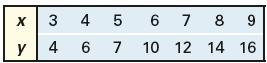
In Problems 11–16:(a) Draw a scatter plot.(b) Select two points from the scatter plot, and find an equation of the line containing the points selected.(c) Graph the line found in part (b) on the scatter plot.(d) Use a graphing utility to find the line of best fit.(e) What is the correlation
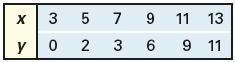
In Problems 11–16:(a) Draw a scatter plot.(b) Select two points from the scatter plot, and find an equation of the line containing the points selected.(c) Graph the line found in part (b) on the scatter plot.(d) Use a graphing utility to find the line of best fit.(e) What is the correlation
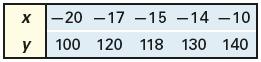
In Problems 11–16:(a) Draw a scatter plot.(b) Select two points from the scatter plot, and find an equation of the line containing the points selected.(c) Graph the line found in part (b) on the scatter plot.(d) Use a graphing utility to find the line of best fit.(e) What is the correlation
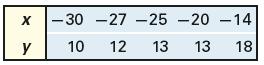
In Problems 11–16:(a) Draw a scatter plot.(b) Select two points from the scatter plot, and find an equation of the line containing the points selected.(c) Graph the line found in part (b) on the scatter plot.(d) Use a graphing utility to find the line of best fit.(e) What is the correlation
Answers are given at the end of these exercises.True or False If x2 = p and p > 0, then x = √p.
A quadratic equation is sometimes called a equation.(a) First-degree(b) Second-degree(c) Third-degree(d) Fourth-degree
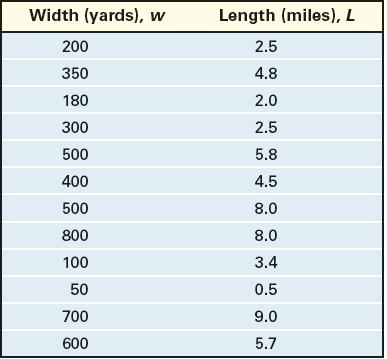
Tornadoes The following data represent the width (in yards) and length (in miles) of various tornadoes.(a) Draw a scatter plot of the data, treating width as the independent variable.(b) What type of relation appears to exist between the width and the length of tornadoes?(c) Select two points and
In Problems 13 – 26, find the zeros of each quadratic function by factoring. What are the x-intercepts of the graph of the function?f (x) = x2 − 9x
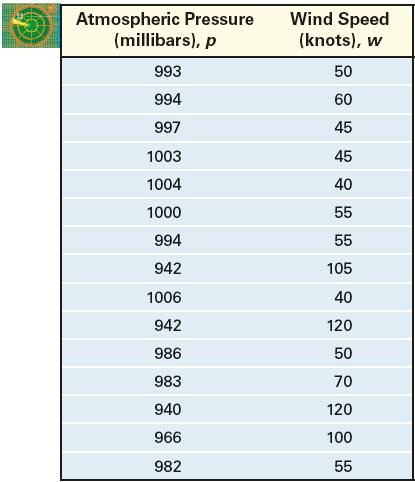
The data at the top of the next column represent the atmospheric pressure p (in millibars) and the wind speed w (in knots) measured during various tropical systems in the Atlantic Ocean.(a) Use a graphing utility to draw a scatter plot of the data, treating atmospheric pressure as the independent
In Problems 13 – 26, find the zeros of each quadratic function by factoring. What are the x-intercepts of the graph of the function?f (x) = x2 + 4x
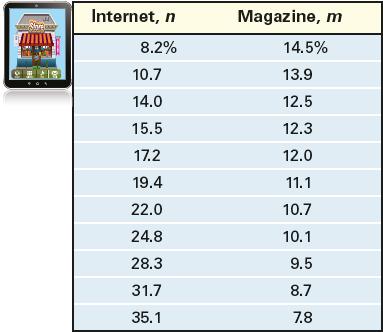
The following data represent the percentages of U.S. advertising spending for Internet ads, n, and magazine ads, m, over time.(a) Draw a scatter plot of the data, treating percentage of spending on Internet ads as the independent variable. Does the relation appear to be linear?(b) Use a graphing
In Problems 13 – 26, find the zeros of each quadratic function by factoring. What are the x-intercepts of the graph of the function?g (x) = x2 − 25
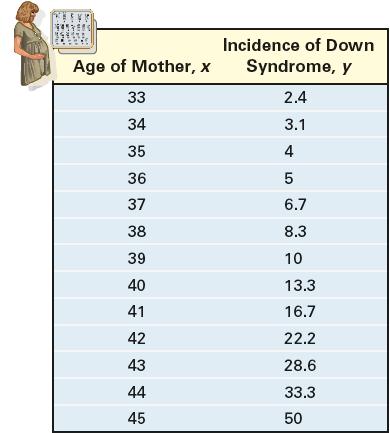
A biologist would like to know how the age of a mother affects the incidence of Down syndrome. The following data represent the age of the mother and the incidence of Down syndrome per 1000 pregnancies. Draw a scatter plot treating age of the mother as the independent variable. Would it make sense
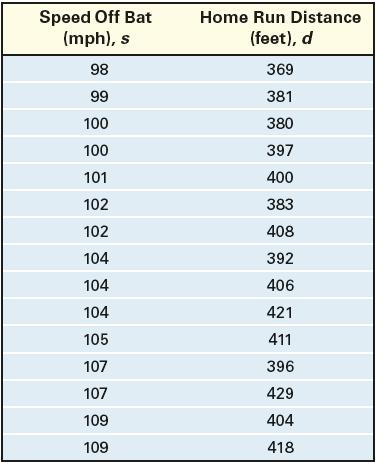
In the sport of baseball or softball, a traditional home run occurs when a batted ball travels over a fence in the field of play on a fly (that is, without hitting the ground). A baseball analyst wishes to find a function that relates the distance, d, of a home run and the speed, s, of the ball off
In Problems 13 – 26, find the zeros of each quadratic function by factoring. What are the x-intercepts of the graph of the function?G (x) = x2 − 9
In Problems 13 – 26, find the zeros of each quadratic function by factoring. What are the x-intercepts of the graph of the function?F (x) = x2 + x − 6
In Problems 13 – 26, find the zeros of each quadratic function by factoring. What are the x-intercepts of the graph of the function?H (x) = x2 + 7x + 6
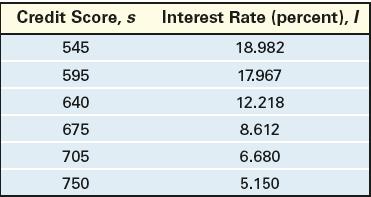
A Fair Isaacs Corporation (FICO) score is used to determine a person’s creditworthiness. An economist wishes to find a function that relates the interest rate (in percent) of a 36-month auto loan, I, to a person’s FICO score, s. Consider the following data.(a) Does the relation defined by the
In Problems 13 – 26, find the zeros of each quadratic function by factoring. What are the x-intercepts of the graph of the function?g (x) = 2x2 − 5x − 3
In Problems 13 – 26, find the zeros of each quadratic function by factoring. What are the x-intercepts of the graph of the function?f (x) = 3x2 + 5x + 2
In Problems 21 – 26,(a) Find the zero of each linear function(b) Graph each function using the zero and y -intercept.g (x) = 2x − 8
In Problems 13 – 26, find the zeros of each quadratic function by factoring. What are the x-intercepts of the graph of the function?P(x) = 3x2 − 48
In Problems 21 – 26,(a) Find the zero of each linear function(b) Graph each function using the zero and y -intercept.g(x) = 3x + 12
Showing 4900 - 5000
of 29454
First
43
44
45
46
47
48
49
50
51
52
53
54
55
56
57
Last
Step by Step Answers

 Get 50% OFF
Claim Now
Get 50% OFF
Claim Now