New Semester
Started
Get
50% OFF
Study Help!
--h --m --s
Claim Now
Question Answers
Textbooks
Find textbooks, questions and answers
Oops, something went wrong!
Change your search query and then try again
S
Books
FREE
Study Help
Expert Questions
Accounting
General Management
Mathematics
Finance
Organizational Behaviour
Law
Physics
Operating System
Management Leadership
Sociology
Programming
Marketing
Database
Computer Network
Economics
Textbooks Solutions
Accounting
Managerial Accounting
Management Leadership
Cost Accounting
Statistics
Business Law
Corporate Finance
Finance
Economics
Auditing
Tutors
Online Tutors
Find a Tutor
Hire a Tutor
Become a Tutor
AI Tutor
AI Study Planner
NEW
Sell Books
Search
Search
Sign In
Register
study help
mathematics
precalculus
Thomas Calculus Early Transcendentals 13th Edition Joel R Hass, Christopher E Heil, Maurice D Weir - Solutions
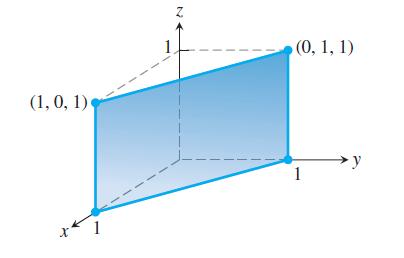
Integrate G(x, y, z) = x - y - z over the portion of the plane x + y = 1 in the first octant between z = 0 and z = 1 (1, 0, 1) X 1 (0, 1, 1) 1 y
Integrate g(x, y, z) = x4y(y2 + z2) over the portion of the cylinder y2 + z2 = 25 that lies in the first octant between the planes x = 0 and x = 1 and above the plane z = 3.
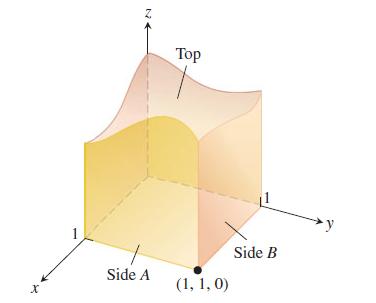
The base of the closed cubelike surface shown here is the unit square in the xy-plane. The four sides lie in the planes x = 0, x = 1, y = 0, and y = 1. The top is an arbitrary smooth surface whose identity is unknown. Let F = xi - 2yj + (z + 3)k and suppose the outward flux of F through Side A is 1
Use a parametrization to express the area of the surface as a double integral. Then evaluate the integral.The portion of the plane y + 2z = 2 inside the cylinder x2 + y2 = 1
a. Show that the outward flux of the position vector field F = xi + yj + zk through a smooth closed surface S is three times the volume of the region enclosed by the surface.b. Let n be the outward unit normal vector field on S. Show that it is not possible for F to be orthogonal to n at every
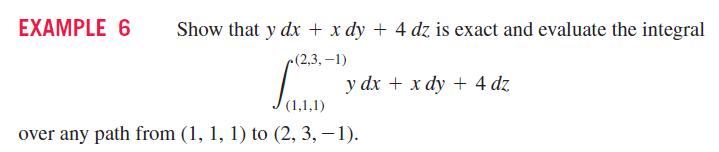
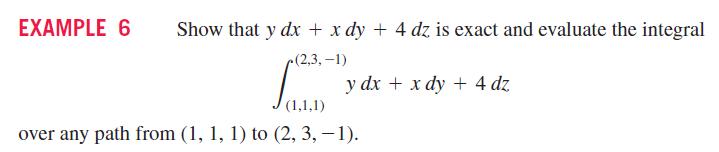
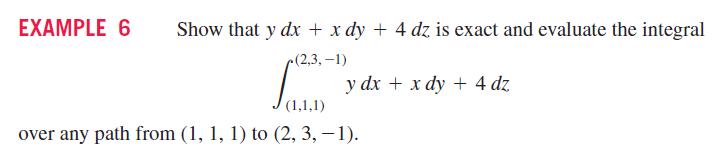
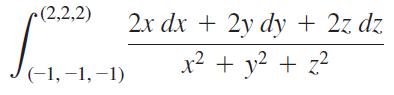
Although they are not defined on all of space R3, the fields associated with are conservative. Find a potential function for each field and evaluate the integrals as in Example 6. EXAMPLE 6 Show that y dx + x dy + 4 dz is exact and evaluate the integral (2,3,-1) y dx + x dy + 4 dz (1,1,1) over any
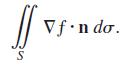
Let S be the surface of the portion of the solid sphere x2 + y2 + z2 ≤ a2 that lies in the first octant and letCalculate(∇ƒ · n is the derivative of ƒ in the direction of outward normal n.) f(x, y, z) = ln√x² + y² +
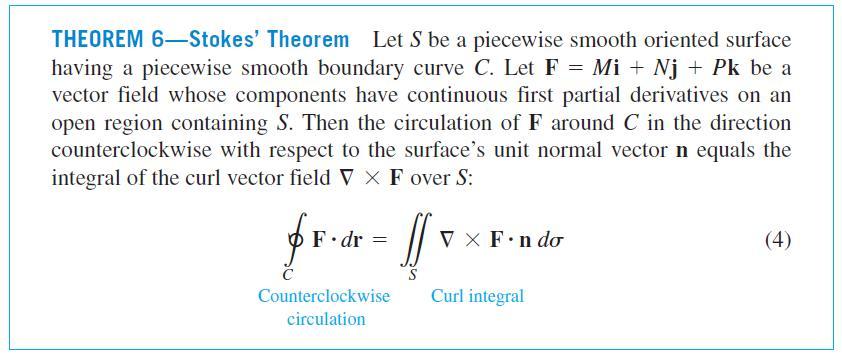
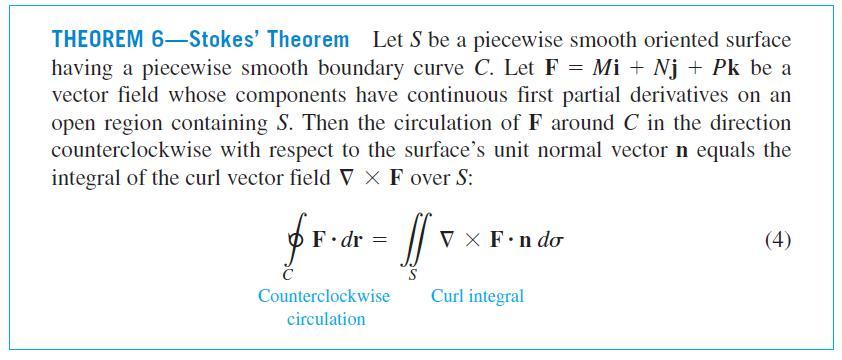
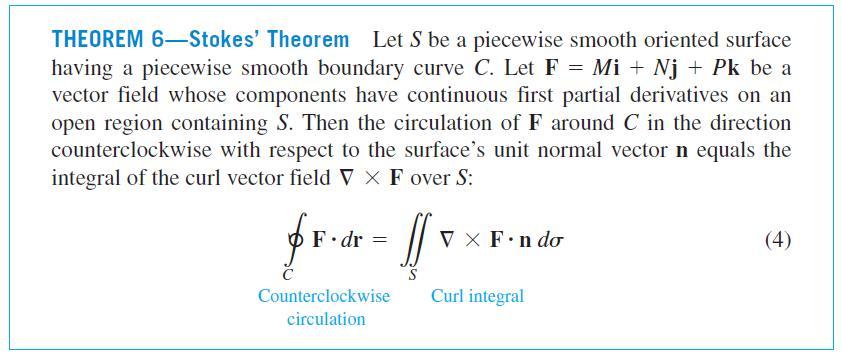
Verify Stokes’ Theorem for the vector field F = 2xyi + xj + ( y + z)k and surface z = 4 - x2 - y2, z ≥ 0, oriented with unit normal n pointing upward. THEOREM 6-Stokes' Theorem Let S be a piecewise smooth oriented surface having a piecewise smooth boundary curve C. Let F = Mi + Nj + Pk be
The state of Wyoming is bounded by the meridians 111°3′ and 104°3′ west longitude and by the circles 41° and 45° north latitude. Assuming that Earth is a sphere of radius R = 3959 mi, find the area of Wyoming.
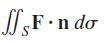
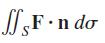
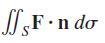
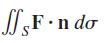
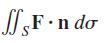
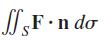
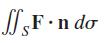
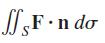
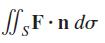
Use a parametrization to find the fluxacross the surface in the specified direction.Outward (normal away from the x-axis) through the surface cut from the parabolic cylinder z = 4 - y2 by the planes x = 0, x = 1, and z = 0 JsF.n do JJ S
Use a parametrization to express the area of the surface as a double integral. Then evaluate the integral.The portion of the plane z = -x inside the cylinder x2 + y2 = 4
Find the counterclockwise circulation of F = (y + ex ln y)i + (ex/y)j around the boundary of the region that is bounded above by the curve y = 3 - x2 and below by the curve y = x4 + 1.
Find parametrizations for the surfaces.The portion of the sphere x2 + y2 + z2 = 36 between the planes z = -3 and z = 3√3
Find the work done by F in moving a particle once counterclockwise around the given curve.F = 2xy3i + 4x2y2jC: The boundary of the “triangular” region in the first quadrant enclosed by the x-axis, the line x = 1, and the curve y = x3
Use a parametrization to express the area of the surface as a double integral. Then evaluate the integral.The portion of the cone z = 2√x2 + y2 between the planes z = 2 and z = 6
Use a parametrization to find the fluxacross the surface in the specified direction.Outward (normal away from the yz-plane) through the surface cut from the parabolic cylinder y = x2, -1 ≤ x ≤ 1, by the planes z = 0 and z = 2 JsF.n do JJ S
Let F = ( y cos 2x)i + ( y2 sin 2x)j + (x2y + z)k. Is there a vector field A such that F = ∇ * A? Explain your answer.
Find the work done by F in moving a particle once counterclockwise around the given curve.F = (4x - 2y)i + (2x - 4y)jC: The circle (x - 2)2 + (y - 2)2 = 4
Use a parametrization to express the area of the surface as a double integral. Then evaluate the integral.The portion of the cone z = √x2 + y2/3 between the planes z = 1 and z = 4/3
Find parametrizations for the surfaces.The portion of the paraboloid z = -(x2 + y2)/2 above the plane z = -2
Although they are not defined on all of space R3, the fields associated with are conservative. Find a potential function for each field and evaluate the integrals as in Example 6. EXAMPLE 6 Show that y dx + x dy + 4 dz is exact and evaluate the integral (2,3,-1) y dx + x dy + 4 dz (1,1,1) over any
Use Equation (8) and Stokes’ Theorem to show that the circulations of the following fields around the boundary of any smooth orientable surface in space are zero. a. F = 2xi + 2yj + 2zk c. F = V X (xi + yj + zk) d. F = Vf b. F = V(xy²7³)
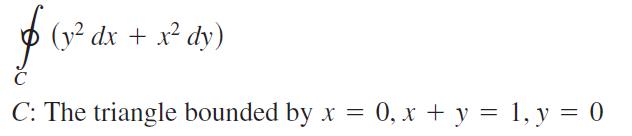
Apply Green’s Theorem to evaluate the integrals. f (y² dx + x² dy) C C: The triangle bounded by X = 0, x + y = 1, y = 0
Find parametrizations for the surfaces.The cone z = 1 + √x2 + y2, z ≤ 3
Use a parametrization to express the area of the surface as a double integral. Then evaluate the integral.The portion of the cylinder x2 + y2 = 1 between the planes z = 1 and z = 4
Although they are not defined on all of space R3, the fields associated with are conservative. Find a potential function for each field and evaluate the integrals as in Example 6. EXAMPLE 6 Show that y dx + x dy + 4 dz is exact and evaluate the integral (2,3,-1) y dx + x dy + 4 dz (1,1,1) over any
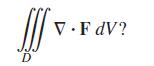
Let F be a field whose components have continuous first partial derivatives throughout a portion of space containing a region D bounded by a smooth closed surface S. If |F| ≤ 1, can any bound be placed on the size ofGive reasons for your answer. [ D V.F dV?
Use a parametrization to find the fluxacross the surface in the specified direction.Across the portion of the sphere x2 + y2 + z2 = a2 in the first octant in the direction away from the origin JsF.n do JJ S
Let ƒ(x, y, z) = (x2 + y2 + z2)-1/2. Show that the clockwise circulation of the field F = ∇ƒ around the circle x2 + y2 = a2 in the xy-plane is zeroa. By taking r = (a cos t)i + (a sin t)j, 0 ≤ t ≤ 2π, and integrating F · dr over the circle.b. By applying Stokes’ Theorem. THEOREM
Find parametrizations for the surfaces.The portion of the plane 4x + 2y + 4z = 12 that lies above the square 0 ≤ x ≤ 2, 0 ≤ y ≤ 2 in the first quadrant
Use a parametrization to express the area of the surface as a double integral. Then evaluate the integral.The portion of the cylinder x2 + z2 = 10 between the planes y = -1 and y = 1
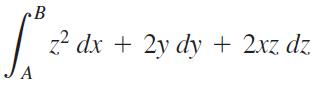
Show that the values of the integrals do not depend on the path taken from A to B. B z² dx + 2y dy + 2xz dz A
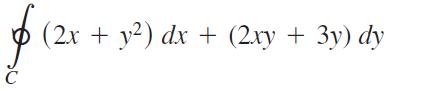
Apply Green’s Theorem to evaluate the integrals.C: Any simple closed curve in the plane for which Green’s Theorem holds $ C (2x + y2) dx + (2xy + 3y) dy
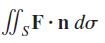
Use a parametrization to find the fluxacross the surface in the specified direction.Outward through the portion of the cylinder x2 + y2 = 1 cut by the planes z = 0 and z = a JsF.n do JJ S
Find parametrizations for the surfaces.The portion of the hemisphere x2 + y2 + z2 = 10, y ≥ 0, in the first octant
Show that if F = xi + yj + zk, then ∇ * F = 0.
Use a parametrization to express the area of the surface as a double integral. Then evaluate the integral.The portion of the paraboloid z = x2 + y2 between the planes z = 1 and z = 4
Compute the net outward flux of the vector field F = (xi + yj + zk)/(x2 + y2 + z2)3/2 across the ellipsoid 9x2 + 4y2 + 6z2 = 36.
Find a vector field with twice-differentiable components whose curl is xi + yj + zk or prove that no such field exists.
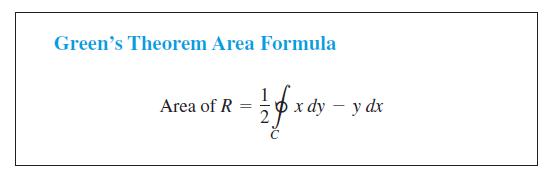
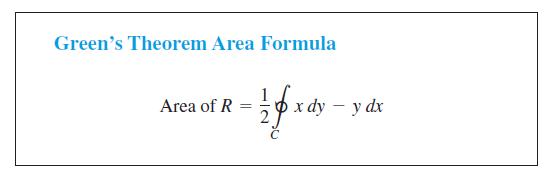
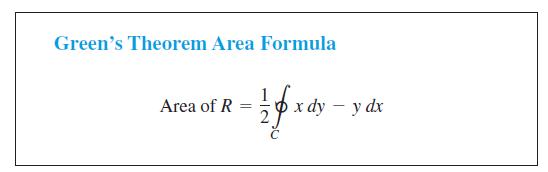
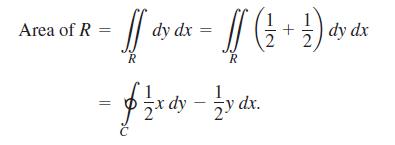
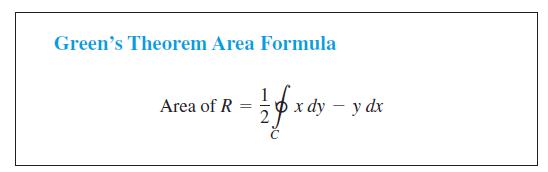
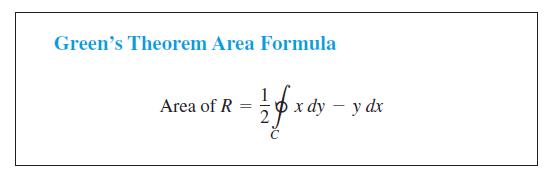
Use the Green’s Theorem area formula given above to find the areas of the regions enclosed by the curvesThe circle r(t) = (a cos t)i + (a sin t)j, 0 ≤ t ≤ 2πIf a simple closed curve C in the plane and the region R it encloses satisfy the hypotheses of Green’s Theorem, the area of R is
Use the Green’s Theorem area formula given above to find the areas of the regions enclosed by the curves.The ellipse r(t) = (a cos t)i + (b sin t)j, 0 ≤ t ≤ 2πIf a simple closed curve C in the plane and the region R it encloses satisfy the hypotheses of Green’s Theorem, the area of R is
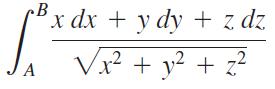
Show that the values of the integrals do not depend on the path taken from A to B. B ³x dx + ydy + z dz √x² + y² + z ² ΤΑ А
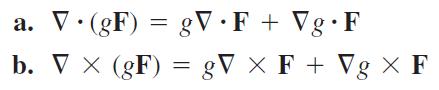
Let F be a differentiable vector field and let g(x, y, z) be a differentiable scalar function. Verify the following identities. a. V (gF) =gV F + Vg • F b. VX (gF) = gV XF + Vg X F
Use a parametrization to find the fluxacross the surface in the specified direction.Outward (normal away from the z-axis) through the cone z = √x2 + y2, 0 ≤ z ≤ 1 JsF.n do JJ S
Does Stokes’ Theorem say anything special about circulation in a field whose curl is zero? Give reasons for your answer. THEOREM 6-Stokes' Theorem Let S be a piecewise smooth oriented surface having a piecewise smooth boundary curve C. Let F = Mi + Nj + Pk be a vector field whose components have
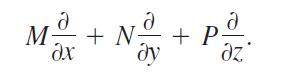
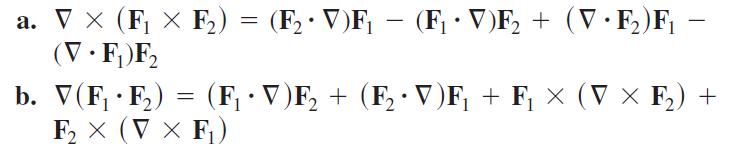
If F = Mi + Nj + Pk is a differentiable vector field, we define the notation F · ∇ to meanFor differentiable vector fields F1 and F2, verify the following identities. Mº Əx + NO dy + po əz
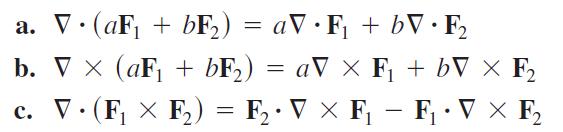
Let F1 and F2 be differentiable vector fields and let a and b be arbitrary real constants. Verify the following identities. a. V. (aF₁ + bF₂) = a√• F₁ +bV.F₂ b. VX (aF₁+bF₂) = a × F₁ + bV × F₂ X V. (F₁× F₂) = F₂.V × F₁ X 1 c. V F₁V X F₂ 2
Use a parametrization to find the fluxacross the surface in the specified direction.Outward (normal away from the z-axis) through the cone z = √x2 + y2, 0 ≤ z ≤ 2 JsF.n do JJ S
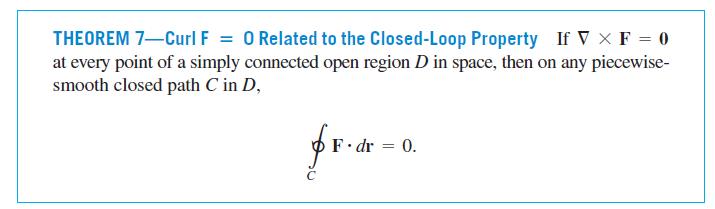
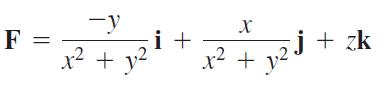
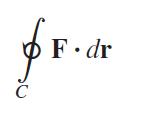
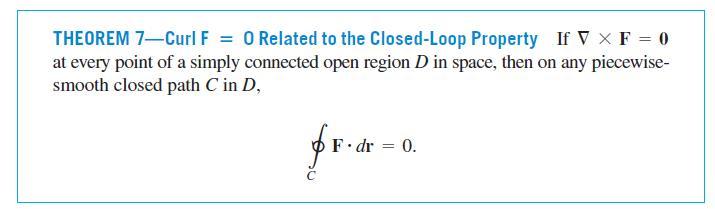
Show that the curl ofis zero but thatis not zero if C is the circle x2 + y2 = 1 in the xy-plane. (Theorem 7 does not apply here because the domain of F is not simply connected. The field F is not defined along the z-axis so there is no way to contract C to a point without leaving the domain of F.)
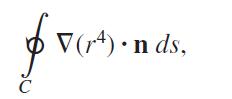
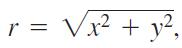
Let R be a region in the xy-plane that is bounded by a piecewise smooth simple closed curve C and suppose that the moments of inertia of R about the x- and y-axes are known to be Ix and Iy . Evaluate the integralwherein terms of Ix and Iy. C V(4) n ds,
Use the Green’s Theorem area formula given above to find the areas of the regions enclosed by the curvesThe astroid r(t) = (cos3 t)i + (sin3 t)j, 0 ≤ t ≤ 2πIf a simple closed curve C in the plane and the region R it encloses satisfy the hypotheses of Green’s Theorem, the area of R is given
Find a potential function for F. F 2 — A+ (). = ܕܐ {(x, y): > 0}
Use a parametrization to express the area of the surface as a double integral. Then evaluate the integral.The lower portion cut from the sphere x2 + y2 + z2 = 2 by the cone z = √x2 + y2
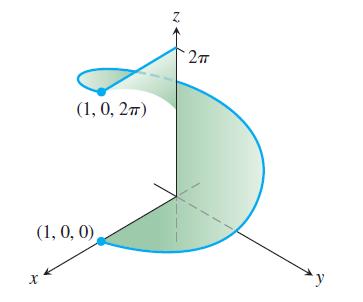
Find the surface area of the helicoid r(r, θ) = (r cos θ)i + (r sin θ)j + θk, 0 ≤ θ ≤ 2π, 0 ≤ r ≤ 1, in the accompanying figure. (1, 0, 2TT) (1, 0, 0) X N 2TT
Use the Green’s Theorem area formula given above to find the areas of the regions enclosed by the curves.One arch of the cycloid x = t - sin t, y = 1 - cos tIf a simple closed curve C in the plane and the region R it encloses satisfy the hypotheses of Green’s Theorem, the area of R is given
Find a potential function for F. F = (eln y)i + ( = y + sin z + (y cos z)k
Use a parametrization to find the fluxacross the surface in the specified direction.Outward (normal away from the z-axis) through the portion of the cone z = √x2 + y2 between the planes z = 1 and z = 2 JsF.n do JJ S
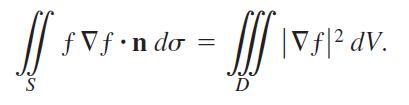
A function ƒ(x, y, z) is said to be harmonic in a region D in space if it satisfies the Laplace equationthroughout D.a. Suppose that ƒ is harmonic throughout a bounded region D enclosed by a smooth surface S and that n is the chosen unit normal vector on S. Show that the integral over S of ∇ƒ
Use a parametrization to express the area of the surface as a double integral. Then evaluate the integral.The portion of the sphere x2 + y2 + z2 = 4 between the planes z = -1 and z = √3
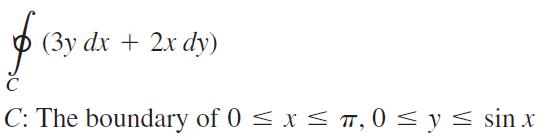
Apply Green’s Theorem to evaluate the integrals. $ C C: The boundary of 0 ≤ x ≤ π, 0 ≤ y ≤ sin x (3y dx + 2x dy)
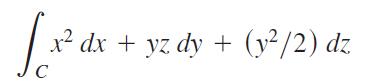
Evaluatealong the line segment C joining (0, 0, 0) to (0, 3, 4). 10.1² C x² dx + yz dy + (y²/2) dz
Use a parametrization to find the fluxacross the surface in the specified direction.Upward across the portion of the plane x + y + z = 2a that lies above the square 0 ≤ x ≤ a, 0 ≤ y ≤ a, in the xy-plane JsF.n do JJ S
Use a parametrization to find the fluxacross the surface in the specified direction.Across the sphere x2 + y2 + z2 = a2 in the direction away from the origin JsF.n do JJ S
Calculate the net outward flux of the vector fieldover the surface S surrounding the region D bounded by the planes y = 0, z = 0, z = 2 - y and the parabolic cylinder z = 1 - x2. F = xyi + (sin xz + y²)j + (e¹y² + x)k
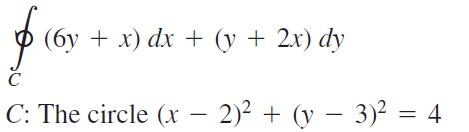
Apply Green’s Theorem to evaluate the integrals. $ f (6y + x) dx + (y + 2x) dy C C: The circle (x 2)² + (y - 3)² = 4
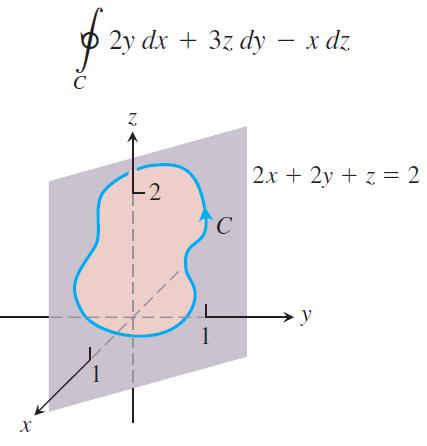
Let C be a simple closed smooth curve in the plane 2x + 2y + z = 2, oriented as shown here. Show thatdepends only on the area of the region enclosed by C and not on the position or shape of C. X √ 2y dx + 3z dy - x dz C 1 Z I -2 1 C 2x + 2y + z = 2 y
Use a parametrization to express the area of the surface as a double integral. Then evaluate the integral.The cap cut from the paraboloid z = 2 - x2 - y2 by the cone z = √x2 + y2
Among all rectangular solids defined by the inequalities 0 ≤ x ≤ a, 0 ≤ y ≤ b, 0 ≤ z ≤ 1, find the one for which the total flux of F = (-x2 - 4xy)i - 6yzj + 12zk outward through the six sides is greatest. What is the greatest flux?
Find parametrizations for the surfaces.The portion of the paraboloid y = 2(x2 + z2), y ≤ 2, that lies above the xy-plane
Interchange ƒ and g in Equation (10) to obtain a similar formula. Then subtract this formula from Equation (10) to show thatThis equation is Green’s second formula.Data from Exercise 29Suppose that ƒ and g are scalar functions with continuous first- and second-order partial derivatives
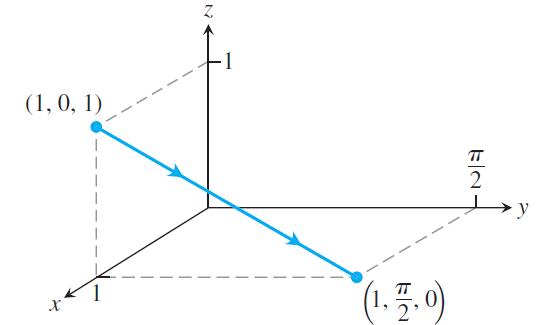
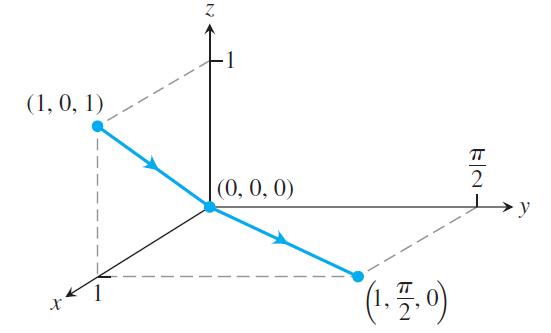
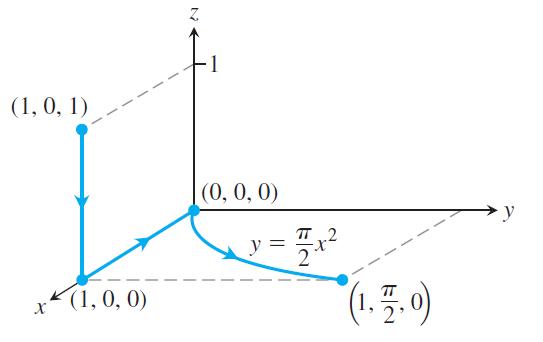
Find the work done by F = eyzi + (xzeyz + z cos y)j + (xyeyz + sin y)k over the following paths from (1, 0, 1) to (1, π/2, 0).a. The line segment x = 1, y = πt/2, z = 1 - t, 0 ≤ t ≤ 1b. The line segment from (1, 0, 1) to the origin followed by the line segment from the origin to (1, π/2,
Which of the fields are conservative, and which are not?F = (xi + yj + zk)/(x2 + y2 + z2)3/2
Suppose that ƒ and g are scalar functions with continuous first- and second-order partial derivatives throughout a region D that is bounded by a closed piecewise smooth surface S. Show thatEquation (10) is Green’s first formula. S fVg n do = ff (f V²g + Vf. Vg) dV. D (10)
Find the surface integral of the field F over the portion of the given surface in the specified direction.F(x, y, z) = -i + 2j + 3kS: rectangular surface z = 0, 0 ≤ x ≤ 2, 0 ≤ y ≤ 3, direction k
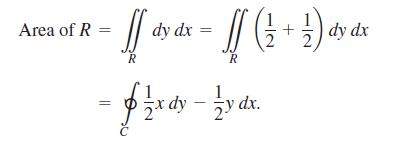
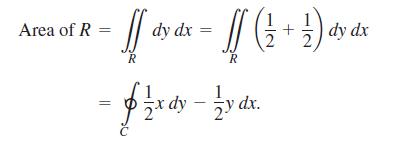
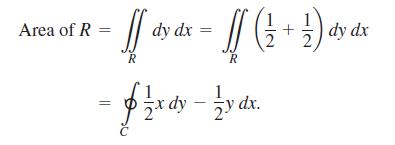
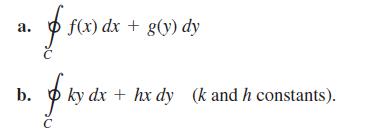
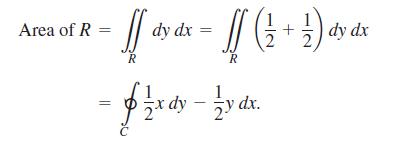
Let C be the boundary of a region on which Green’s Theorem holds. Use Green’s Theorem to calculateIf a simple closed curve C in the plane and the region R it encloses satisfy the hypotheses of Green’s Theorem, the area of R is given byThe reason is that by Equation (4), run backward, a. b. $
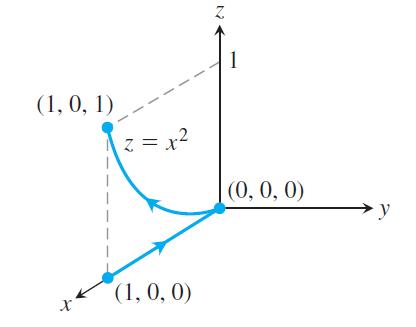
Find the work done by F = (x2 + y)i + (y2 + x)j + zezk over the following paths from (1, 0, 0) to (1, 0, 1).a. The line segment x = 1, y = 0, 0 ≤ z ≤ 1b. The helix r(t) = (cos t)i + (sin t)j + (t/2π)k, 0 ≤ t ≤ 2πc. The x-axis from (1, 0, 0) to (0, 0, 0) followed by the parabola z = x2, y
Which of the fields are conservative, and which are not?F = xi + yj + zk
Use a parametrization to find the fluxacross the surface in the specified direction.F = 4xi + 4yj + 2k outward (normal away from the z-axis) through the surface cut from the bottom of the paraboloid z = x2 + y2 by the plane z = 1 JsF.n do JJ S
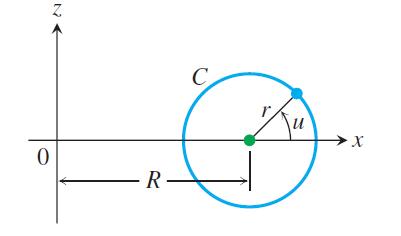
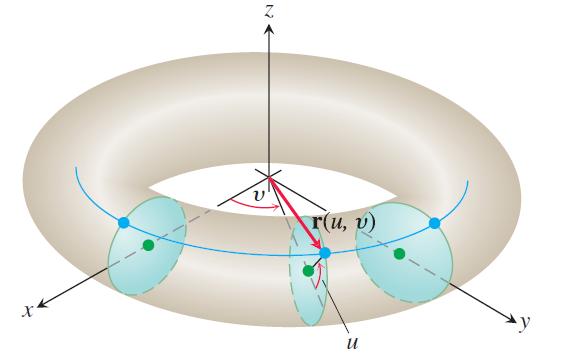
a. A torus of revolution (doughnut) is obtained by rotating a circle C in the xz-plane about the z-axis in space. If C has radius r > 0 and center (R, 0, 0), show that a parametrization of the torus iswhere 0 ≤ u ≤ 2π and 0 ≤ y ≤ 2π are the angles in the figure.b. Show that the surface
Find the surface integral of the field F over the portion of the given surface in the specified direction.F(x, y, z) = yx2i - 2j + xzkS: rectangular surface y = 0, -1 ≤ x ≤ 2, 2 ≤ z ≤ 7, direction -j
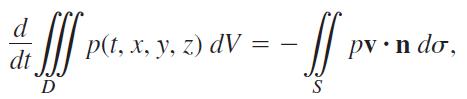
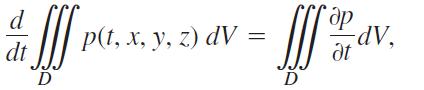
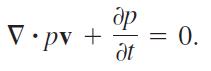
Let v(t, x, y, z) be a continuously differentiable vector field over the region D in space and let p(t, x, y, z) be a continuously differentiable scalar function. The variable t represents the time domain. The Law of Conservation of Mass asserts thatwhere S is the surface enclosing D.a. Give a
Which of the fields are conservative, and which are not?F = xeyi + yezj + zexk
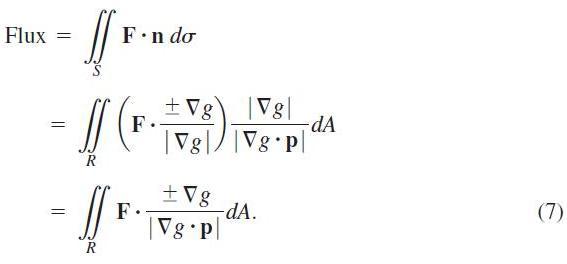
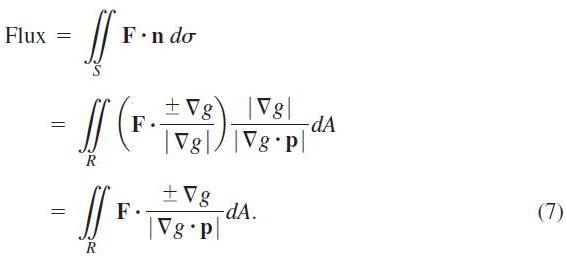
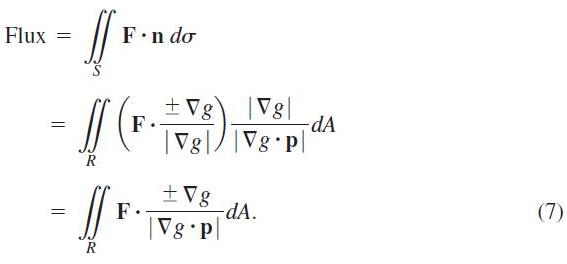
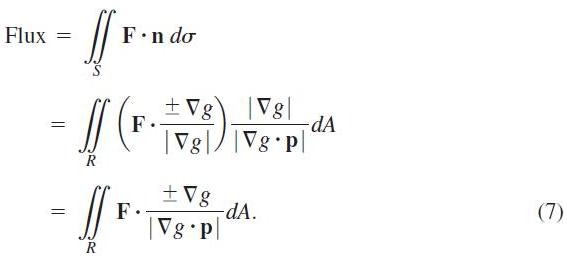
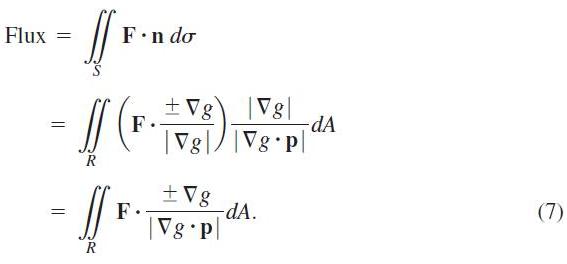
Use Equation (7) to find the surface integral of the field F over the portion of the sphere x2 + y2 + z2 = a2 in the first octant in the direction away from the origin.F(x, y, z) = zk Flux = - [[F₁ F.n do JJ ( R F ff F R +Vg |Vg| VgVg p +Vg Vg p -dA. dA (7)
Which of the fields are conservative, and which are not?F = (i + zj + yk)/(x + yz)
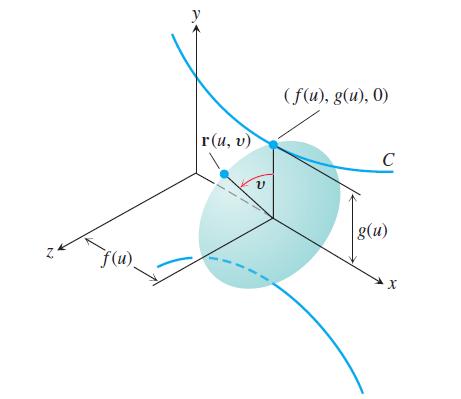
Suppose that the parametrized curve C: (ƒ(u), g(u)) is revolved about the x-axis, where g(u) > 0 for a ≤ u ≤ b.a. Show thatis a parametrization of the resulting surface of revolution, where 0 ≤ ν ≤ 2π is the angle from the xy-plane to the point r(u, ν) on the surface. Notice that
Let Iy be the moment of inertia about the y-axis of the region in Exercise 35. Show thatData from in Exercise 35Let A be the area and x̄ the x-coordinate of the centroid of a region R that is bounded by a piecewise smooth, simple closed curve C in the xy-plane. Show that $x dy - x²y dx = ly. ¼ f
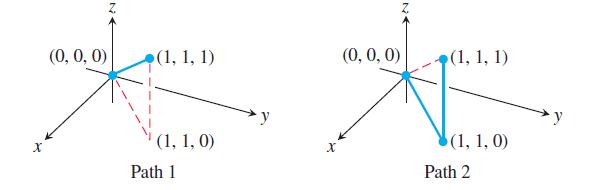
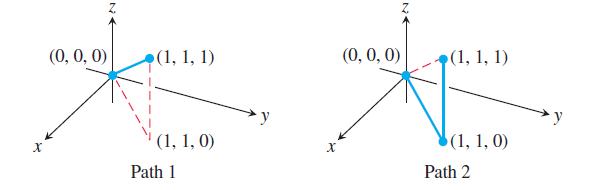
Find the work done by each field along the paths from (0, 0, 0) to (1, 1, 1) in Exercise 1.F = 2xyi + x2j + kData from Exercise 1The accompanying figure shows two polygonal paths in space joining the origin to the point (1, 1, 1). Integrate ƒ(x, y, z) = 2x - 3y2 - 2z + 3 over each path. NE (0, 0,
Let A be the area and x̄ the x-coordinate of the centroid of a region R that is bounded by a piecewise smooth, simple closed curve C in the xy-plane. Show that 2 1 f x² d y = -√xy dx C C 3 C x² dy - xy dx = AX.
Use Equation (7) to find the surface integral of the field F over the portion of the sphere x2 + y2 + z2 = a2 in the first octant in the direction away from the origin.F(x, y, z) = xi + yj + zk Flux = - ff F₂ F.n do |Vg| JJ (₁ F R ± √g Vg|Vg pl ff F R +Vg Vg.p -dA. dA
Find the work done by each field along the paths from (0, 0, 0) to (1, 1, 1) in Exercise 1.F = 2xyi + j + x2kData from Exercise 1The accompanying figure shows two polygonal paths in space joining the origin to the point (1, 1, 1). Integrate ƒ(x, y, z) = 2x - 3y2 - 2z + 3 over each path. NE (0, 0,
Find a parametrization of the hyperboloid of two sheets (z2/c2) - (x2/a2) - (y2/b2) = 1.
Use Equation (7) to find the surface integral of the field F over the portion of the sphere x2 + y2 + z2 = a2 in the first octant in the direction away from the origin.F(x, y, z) = zxi + zyj + z2k Flux = - ff F₂ F.n do |Vg| JJ (₁ F R ± √g Vg|Vg pl ff F R +Vg Vg.p -dA. dA
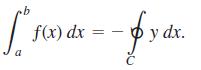
Suppose that a nonnegative function y = ƒ(x) has a continuous first derivative on [a, b]. Let C be the boundary of the region in the xy-plane that is bounded below by the x-axis, above by the graph of ƒ, and on the sides by the lines x = a and x = b. Show that So a f(x) dx -fydr. C с
By experiment, you find that a force field F performs only half as much work in moving an object along path C1 from A to B as it does in moving the object along path C2 from A to B. What can you conclude about F? Give reasons for your answer.
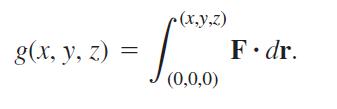
Suppose that F = ∇ƒ is a conservative vector field andShow that ∇g = F. g(x, y, z) p(x,y,z) So (0,0,0) F. dr.
Use Equation (7) to find the surface integral of the field F over the portion of the sphere x2 + y2 + z2 = a2 in the first octant in the direction away from the origin.F(x, y, z) = yi - xj + k Flux = - ff F₂ F.n do |Vg| JJ (₁ F R ± √g Vg|Vg pl ff F R +Vg Vg.p -dA. dA
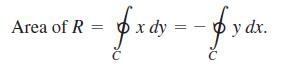
Show that if R is a region in the plane bounded by a piecewise smooth, simple closed curve C, then Area of R = fx dy = -fydx.
You have been asked to find the path along which a force field F will perform the least work in moving a particle between two locations. A quick calculation on your part shows F to be conservative. How should you respond? Give reasons for your answer.
Find potential functions for the field.F = (z cos xz)i + eyj + (x cos xz)k
Use Equation (7) to find the surface integral of the field F over the portion of the sphere x2 + y2 + z2 = a2 in the first octant in the direction away from the origin.F(x, y, z) = -yi + xj Flux = - ff F₂ F.n do |Vg| JJ (₁ F R ± √g Vg|Vg pl ff F R +Vg Vg.p -dA. dA
Showing 6500 - 6600
of 29454
First
59
60
61
62
63
64
65
66
67
68
69
70
71
72
73
Last
Step by Step Answers

 Get 50% OFF
Claim Now
Get 50% OFF
Claim Now