New Semester
Started
Get
50% OFF
Study Help!
--h --m --s
Claim Now
Question Answers
Textbooks
Find textbooks, questions and answers
Oops, something went wrong!
Change your search query and then try again
S
Books
FREE
Study Help
Expert Questions
Accounting
General Management
Mathematics
Finance
Organizational Behaviour
Law
Physics
Operating System
Management Leadership
Sociology
Programming
Marketing
Database
Computer Network
Economics
Textbooks Solutions
Accounting
Managerial Accounting
Management Leadership
Cost Accounting
Statistics
Business Law
Corporate Finance
Finance
Economics
Auditing
Tutors
Online Tutors
Find a Tutor
Hire a Tutor
Become a Tutor
AI Tutor
AI Study Planner
NEW
Sell Books
Search
Search
Sign In
Register
study help
mathematics
precalculus
Thomas Calculus Early Transcendentals 13th Edition Joel R Hass, Christopher E Heil, Maurice D Weir - Solutions
Find potential functions for the field.F = 2i + (2y + z)j + (y + 1)k
a. How are the constants a, b, and c related if the following differential form is exact? (ay2 + 2czx) dx + y(bx + cz) dy + (ay2 + cx2) dzb. For what values of b and c will F = (y2 + 2czx)i + y(bx + cz)j + ( y2 + cx2)k be a gradient field?
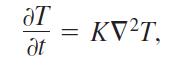
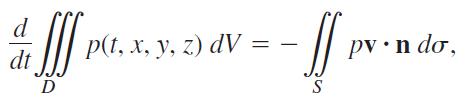
Let T(t, x, y, z) be a function with continuous second derivatives giving the temperature at time t at the point (x, y, z) of a solid occupying a region D in space. If the solid’s heat capacity and mass density are denoted by the constants c and r, respectively, the quantity cρT is called the
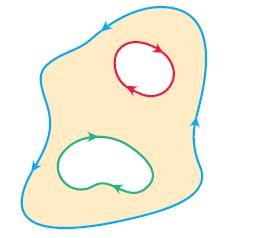
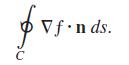
Green’s Theorem holds for a region R with any finite number of holes as long as the bounding curves are smooth, simple, and closed and we integrate over each component of the boundary in the direction that keeps R on our immediate left as we go alonga. Let ƒ(x, y) = ln (x2 + y2) and let C be the
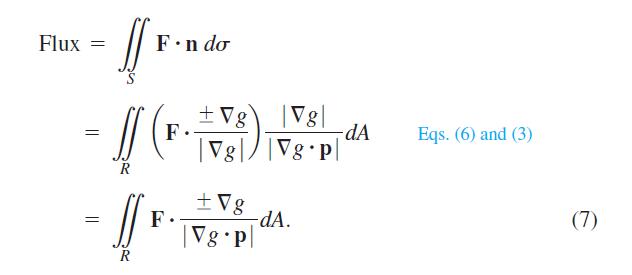
Use Equation (7) to find the surface integral of the field F over the portion of the sphere x2 + y2 + z2 = a2 in the first octant in the direction away from the origin. Flux = [[ F.n do = = - // (-) F R - [[* F R |Vg| Vg Vg pl +Vg |Vg.p -dA. -dA Eqs. (6) and (3) (7)
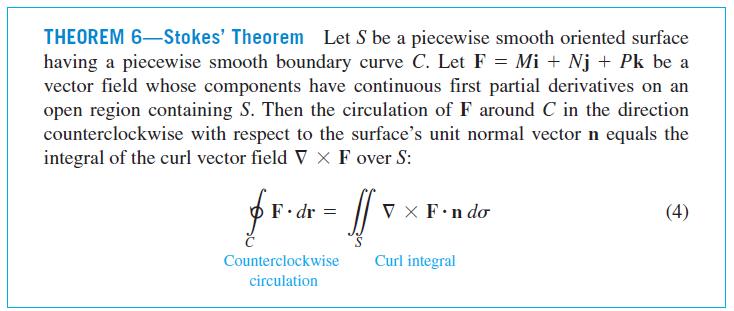
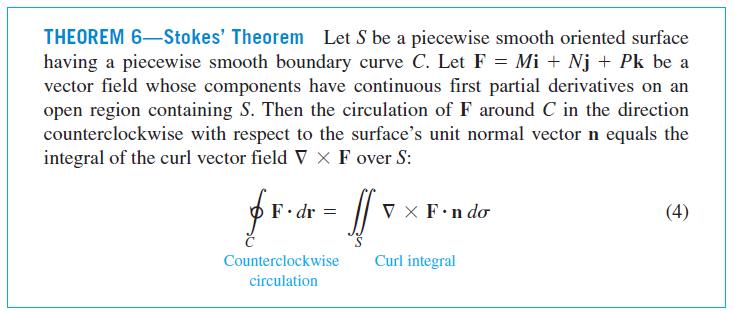
Use the curl integral in Stokes’ Theorem to find the circulation of the field F around the curve C in the indicated direction.C: The ellipse in which the plane 2x + 6y - 3z = 6 meets the cylinder x2 + y2 = 1, counterclockwise as viewed from above THEOREM 6-Stokes' Theorem Let S be a piecewise
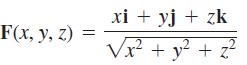
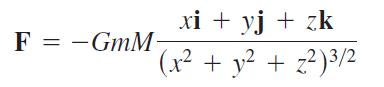
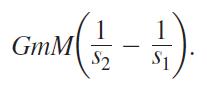
a. Find a potential function for the gravitational fieldb. Let P1 and P2 be points at distance s1 and s2 from the origin. Show that the work done by the gravitational field in part (a) in moving a particle from P1 to P2 is xi + yj + zk (x² + F = -GmM- + y² + z2²)³/2
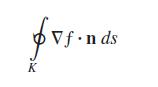
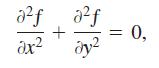
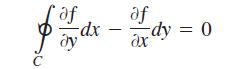
Assuming that all the necessary derivatives exist and are continuous, show that if ƒ(x, y) satisfies the Laplace equationthenfor all closed curves C to which Green’s Theorem applies. (The converse is also true: If the line integral is always zero, then ƒ satisfies the Laplace equation.)
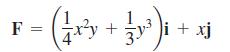
Among all smooth, simple closed curves in the plane, oriented counterclockwise, find the one along which the work done byis greatest. F = 1 ( 1 x ²0 + 3 i + xj
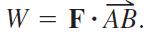
Show that the work done by a constant force field F = ai + bj + ck in moving a particle along any path from A to B is W = F.AB.
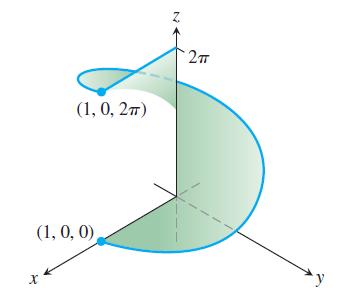
Find the flow of the field F = ∇(x2zey)a. Once around the ellipse C in which the plane x + y + z = 1 intersects the cylinder x2 + z2 = 25, clockwise as viewed from the positive y-axis.b. Along the curved boundary of the helicoid in Exercise 27 from (1, 0, 0) to (1, 0, 2π).Data from Exercise
Use the curl integral in Stokes’ Theorem to find the circulation of the field F around the curve C in the indicated direction.C: The circle in which the plane z = -y meets the sphere x2 + y2 + z2 = 4, counterclockwise as viewed from above THEOREM 6-Stokes' Theorem Let S be a piecewise smooth
Find the area of the surface cut from the paraboloid x2 + y2 - z = 0 by the plane z = 2.
Find the area of the region cut from the plane x + 2y + 2z = 5 by the cylinder whose walls are x = y2 and x = 2 - y2.
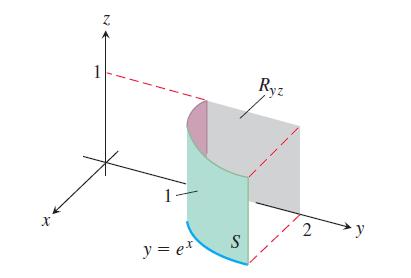
Let S be the portion of the cylinder y = ex in the first octant that projects parallel to the x-axis onto the rectangle Ryz: 1 ≤ y ≤ 2, 0 ≤ z ≤ 1 in the yz-plane. Let n be the unit vector normal to S that points away from the yz-plane. Find the flux of the field F(x, y, z) = -2i + 2yj + zk
Find the flux of the field F(x, y, z) = z2i + xj - 3zk outward through the surface cut from the parabolic cylinder z = 4 - y2 by the planes x = 0, x = 1, and z = 0.
Find the flux of the field F(x, y, z) = 4xi + 4yj + 2k outward (away from the z-axis) through the surface cut from the bottom of the paraboloid z = x2 + y2 by the plane z = 1.
Find the area of the band cut from the paraboloid x2 + y2 - z = 0 by the planes z = 2 and z = 6.
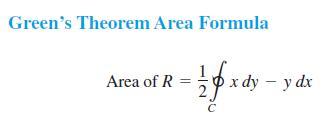
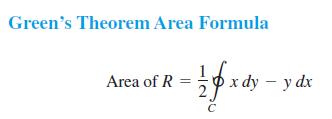
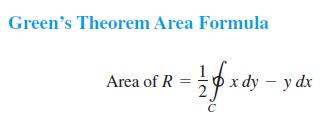
Establish Equation (7) to finish the proof of the special case of Green’s Theorem. $ N dy = [[ R ƏN ax dx dy. (7)
Use a CAS and Green’s Theorem to find the counterclockwise circulation of the field F around the simple closed curve C. Perform the following CAS steps.a. Plot C in the xy-plane.b. Determine the integrand (∂N/∂x) - (∂M/∂y) for the tangential form of Green’s Theorem.c. Determine the
Find the area of the portion of the surface x2 - 2z = 0 that lies above the triangle bounded by the lines x = √3, y = 0, and y = x in the xy-plane.
Let S be the portion of the cylinder y = ln x in the first octant whose projection parallel to the y-axis onto the xz-plane is the rectangle Rxz: 1 ≤ x ≤ e, 0 ≤ z ≤ 1. Let n be the unit vector normal to S that points away from the xz-plane. Find the flux of F = 2yj + zk through S in the
The streamlines of a planar fluid flow are the smooth curves traced by the fluid’s individual particles. The vectors F = M(x, y)i + N(x, y)j of the flow’s velocity field are the tangent vectors of the streamlines. Show that if the flow takes place over a simply connected region R (no holes or
Find the mass of a thin wire lying along the curve r(t) = √2ti + √2tj + (4 - t2)k, 0 ≤ t ≤ 1, if the density at t is (a) δ = 3t and (b) δ = 1.
Find the area of the surface x2 - 2y - 2z = 0 that lies above the triangle bounded by the lines x = 2, y = 0, and y = 3x in the xy-plane.
Find the outward flux of the field F = 2xyi + 2yzj + 2xzk across the surface of the cube cut from the first octant by the planes x = a, y = a, z = a.
Can anything be said about the curl component of a conservative two-dimensional vector field? Give reasons for your answer.
Find the center of mass of a thin wire lying along the curve r(t) = ti + 2tj + (2/3)t3/2k, 0 ≤ t ≤ 2, if the density at t is δ = 3√5 + t.
Find the area of the cap cut from the sphere x2 + y2 + z2 = 2 by the cone z = √x2 + y2.
Find the outward flux of the field F = xzi + yzj + k across the surface of the upper cap cut from the solid sphere x2 + y2 + z2 ≤ 25 by the plane z = 3.
Use a CAS and Green’s Theorem to find the counterclockwise circulation of the field F around the simple closed curve C. Perform the following CAS steps.a. Plot C in the xy-plane.b. Determine the integrand (∂N/∂x) - (∂M/∂y) for the tangential form of Green’s Theorem.c. Determine the
Find the center of mass and the moments of inertia about the coordinate axes of a thin wire lying along the curveif the density at t is δ = 1/(t + 1). r(t) = ti + 2門+卡片 3 0 ≤ t ≤ 2,
Find the centroid of the surface cut from the cylinder y2 + z2 = 9, z ≥ 0, by the planes x = 0 and x = 3 (resembles the surface in Example 6). EXAMPLE 6 Find the flux of F = yzj + z²k outward through the surface S cut from the cylinder y² + z² = 1, z 0, by the planes x = 0 and x = 1.
Use a CAS and Green’s Theorem to find the counterclockwise circulation of the field F around the simple closed curve C. Perform the following CAS steps.a. Plot C in the xy-plane.b. Determine the integrand (∂N/∂x) - (∂M/∂y) for the tangential form of Green’s Theorem.c. Determine the
Find the area of the ellipse cut from the plane z = cx (c a constant) by the cylinder x2 + y2 = 1.
Find the centroid of the portion of the sphere x2 + y2 + z2 = a2 that lies in the first octant.
Find the area of the upper portion of the cylinder x2 + z2 = 1 fthat lies between the planes x = ±1/2 and y = ±1/2.
A slender metal arch lies along the semicircle y = √a2 - x2 in the xy-plane. The density at the point (x, y) on the arch is δ(x, y) = 2a - y. Find the center of mass.
Find the area of the portion of the paraboloid x = 4 - y2 - z2 that lies above the ring 1 ≤ y2 + z2 ≤ 4 in the yz-plane.
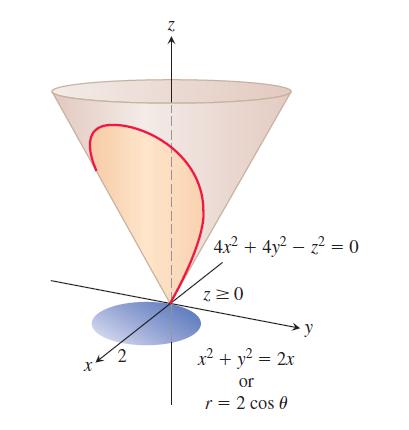
Find the moment of inertia about the z-axis of a thin shell of constant density δ cut from the cone 4x2 + 4y2 - z2 = 0, z ≥ 0, by the circular cylinder x2 + y2 = 2x. Xx 2 Z 4x² + 4y²-2²2² = 0 Z≥0 x² + y² = 2x or r = 2 cos 0
Use a CAS and Green’s Theorem to find the counterclockwise circulation of the field F around the simple closed curve C. Perform the following CAS steps.a. Plot C in the xy-plane.b. Determine the integrand (∂N/∂x) - (∂M/∂y) for the tangential form of Green’s Theorem.c. Determine the
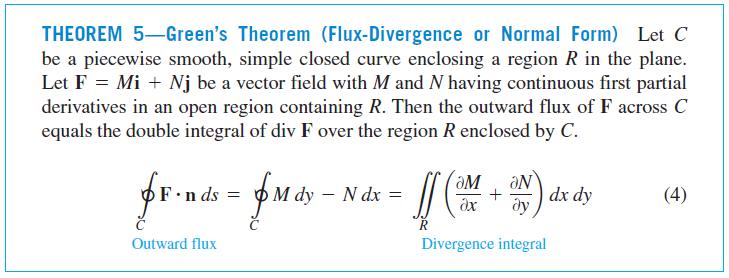
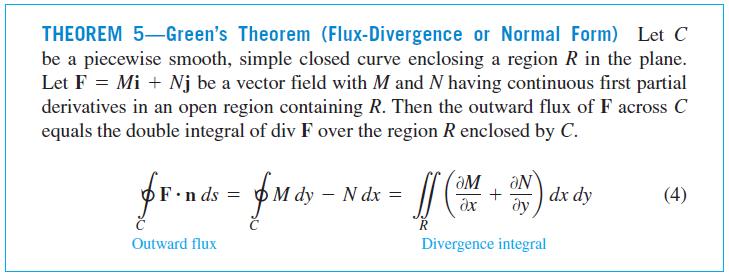
Use Green’s Theorem to find the counterclockwise circulation and outward flux for the fields and curves.F = (2xy + x)i + (xy - y)jC: The square bounded by x = 0, x = 1, y = 0, y = 1 THEOREM 5-Green's Theorem (Flux-Divergence or Normal Form) Let C be a piecewise smooth, simple closed curve
A wire of constant density d = 1 lies along the curve r(t) = (et cos t)i + (et sin t)j + etk, 0 ≤ t ≤ ln 2. Find z̄ and Iz.
Find the center of mass and the moment of inertia about the z-axis of a thin shell of constant density δ cut from the cone x2 + y2 - z2 = 0 by the planes z = 1 and z = 2.
Find the area of the surface x2 - 2 ln x + √15y - z = 0 above the square R: 1 ≤ x ≤ 2, 0 ≤ y ≤ 1, in the xy-plane.
Find the moment of inertia about the z-axis of the surface of the cube cut from the first octant by the planes x = 1, y = 1, and z = 1 if the density is δ = 1.
a. Find the moment of inertia about a diameter of a thin spherical shell of radius a and constant density δ. (Work with a hemispherical shell and double the result.)b. Use the Parallel Axis Theorem and the result in part (a) to find the moment of inertia about a line tangent to the shell.
Find the area of the surface 2x3/2 + 2y3/2 - 3z = 0 above the square R: 0 ≤ x ≤ 1, 0 ≤ y ≤ 1, in the xy-plane.
Find Iz and the center of mass of a thin shell of density δ(x, y, z) = z cut from the upper portion of the sphere x2 + y2 + z2 = 25 by the plane z = 3.
Find the mass and center of mass of a wire of constant density δ that lies along the helix r(t) = (2 sin t)i + (2 cos t)j + 3tk, 0 ≤ t ≤ 2π.
Find the area of the surface cut from the paraboloid x2 + y + z2 = 2 by the plane y = 0.
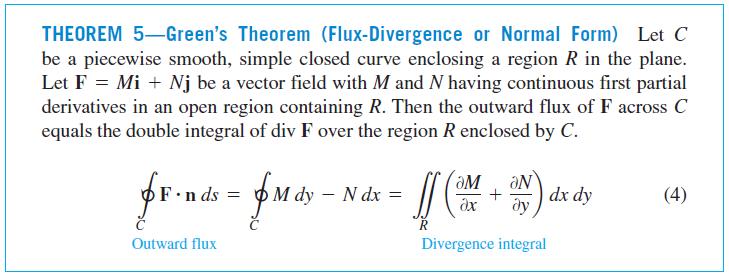
Use Green’s Theorem to find the counterclockwise circulation and outward flux for the fields and curves.F = (y - 6x2)i + (x + y2)jC: The triangle made by the lines y = 0, y = x, and x = 1 THEOREM 5-Green's Theorem (Flux-Divergence or Normal Form) Let C be a piecewise smooth, simple closed curve
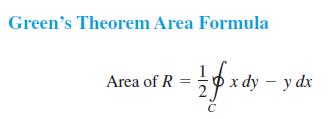
a. Show that the outward flux of the position vector field F = xi + yj across any closed curve to which Green’s Theorem applies is twice the area of the region enclosed by the curve.b. Let n be the outward unit normal vector to a closed curve to which Green’s Theorem applies. Show that it is
Find the centroid of the lateral surface of a solid cone of base radius a and height h (cone surface minus the base).
Find the area of the surfaces.The surface cut from the bottom of the paraboloid z = x2 + y2 by the plane z = 3
Find the area of the surfaces.The surface cut from the “nose” of the paraboloid x = 1 - y2 - z2 by the yz-plane
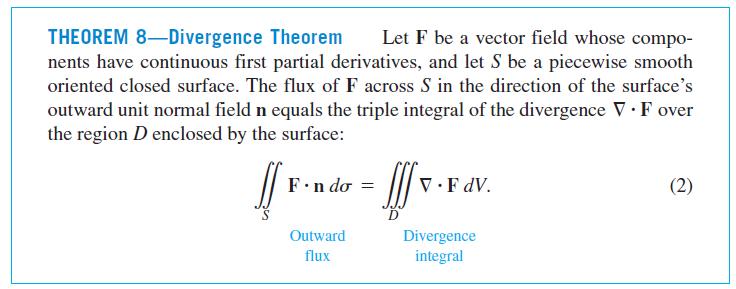
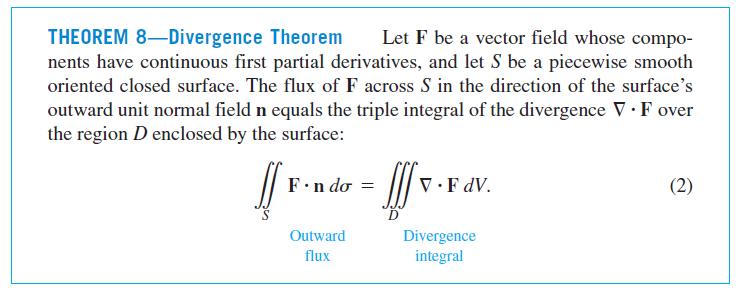
Use the Divergence Theorem to find the flux of F = xy2i + x2yj + yk outward through the surface of the region enclosed by the cylinder x2 + y2 = 1 and the planes z = 1 and z = -1. THEOREM 8-Divergence Theorem Let F be a vector field whose compo- nents have continuous first partial derivatives, and
Find the area of the surfaces.The portion of the cone z = 2x2 + y2 that lies over the region between the circle x2 + y2 = 1 and the ellipse 9x2 + 4y2 = 36 in the xy-plane.
Find the area of the surfaces.The triangle cut from the plane 2x + 6y + 3z = 6 by the bounding planes of the first octant. Calculate the area three ways, using different explicit forms.
Find the flux of F = (3z + 1)k upward across the hemisphere x2 + y2 + z2 = a2, z ≥ 0 (a) With the Divergence Theorem and (b) By evaluating the flux integral directly. THEOREM 8-Divergence Theorem Let F be a vector field whose compo- nents have continuous first partial derivatives, and let S be
Find the area of the surfaces.The surface in the first octant cut from the cylinder y = (2/3)z3/2 by the planes x = 1 and y = 16/3
Find the outward flux of F across the boundary of D.F = 2xyi + 2yzj + 2xzkD: The cube cut from the first octant by the planes x = 1, y = 1, z = 1
Find the area of the surfaces.The portion of the plane y + z = 4 that lies above the region cut from the first quadrant of the xz-plane by the parabola x = 4 - z2
Find the outward flux of F across the boundary of D.F = xzi + yzj + kD: The entire surface of the upper cap cut from the solid sphere x2 + y2 + z2 ≤ 25 by the plane z = 3
Find the outward flux of F across the boundary of D.F = -2xi - 3yj + zkD: The upper region cut from the solid sphere x2 + y2 + z2 ≤ 2 by the paraboloid z = x2 + y2
Find the outward flux of F across the boundary of D.F = (6x + y)i - (x + z)j + 4yzkD: The region in the first octant bounded by the cone z = √x2 + y2, the cylinder x2 + y2 = 1, and the coordinate planes
Let S be the surface that is bounded on the left by the hemisphere x2 + y2 + z2 = a2, y ≤ 0, in the middle by the cylinder x2 + z2 = a2, 0 ≤ y ≤ a, and on the right by the plane y = a. Find the flux of F = yi + zj + xk outward across S.
Find the outward flux of the field F = 3xz2i + yj - z3k across the surface of the solid in the first octant that is bounded by the cylinder x2 + 4y2 = 16 and the planes y = 2z, x = 0, and z = 0.
Assuming that the triangle inequality |a + b| ≤ |a| + |b| holds for any two numbers a and b, show thatfor any n numbers. |x₁ + x₂ + + x₂| = |x₁| + |x₂| ++ xn
Show that if r ≠ 1, thenfor every positive integer n. 1+r+²+. .. + ph .. 1 - pn+1 1-r
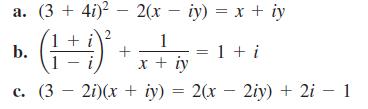
Solve the following equations for the real numbers, x and y. a. (3+4i)²2(x - iy) = x + iy 2 1 1 + i x + iy c. (32i)(x + y) = 2(x - 2iy) + 2i - 1 b. + i +
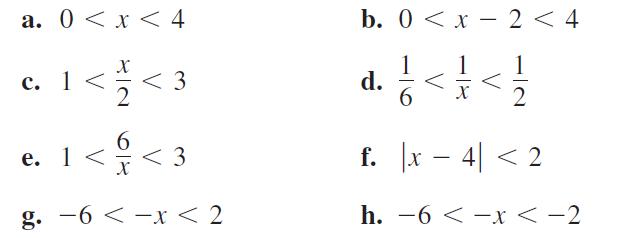
If 2 < x < 6, which of the following statements about x are necessarily true, and which are not necessarily true? a. 0
How may the following complex numbers be obtained from z = x + iy geometrically? Sketch. a. 7 Z C. Z b. (-z) d. 1/z
Express 1/9 as a repeating decimal, using a bar to indicate the repeating digits. What are the decimal representations of 2/9? 3/9? 8/9? 9/9?
A particle moves from A to B in the coordinate plane. Find the increments Δx and Δy in the particle’s coordinates. Also find the distance from A to B.A(-3, 2), B(-1, -2)
Find (a, b) · (c, d) = (ac - bd, ad + bc).a. (2, 3) · (4, -2)b. (2, -1) · (-2, 3)c. (-1, -2) · (2, 1)
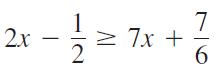
Solve the inequalities and show the solution sets on the real line. 2x 1 2 AI 7x + 7 6
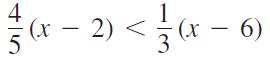
Solve the inequalities and show the solution sets on the real line. 좋다. 2) < n (x - 6) (x - 2)
A particle moves from A to B in the coordinate plane. Find the increments Δx and Δy in the particle’s coordinates. Also find the distance from A to B.A(-3.2, -2), B(-8.1, -2)
Solve the inequalities and show the solution sets on the real line.-2x > 4
Describe the graphs of the equation.x2 + y2 = 1
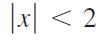
Solve the inequalities, expressing the solution sets as intervals or unions of intervals. Also, show each solution set on the real line. |x|< 2
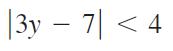
Solve the inequalities, expressing the solution sets as intervals or unions of intervals. Also, show each solution set on the real line. |3y - 7기 < 4
Solve the inequalities and show the solution sets on the real line.5x - 3 ≤ 7 - 3x
Describe the graphs of the equation.x2 + y2 ≤ 3
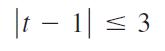
Solve the inequalities, expressing the solution sets as intervals or unions of intervals. Also, show each solution set on the real line. |t - 1| ≤ 3
Plot the points and find the slope (if any) of the line they determine. Also find the common slope (if any) of the lines perpendicular to line AB.A(-1, 2), B(-2, -1)
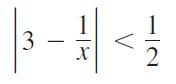
Solve the inequalities, expressing the solution sets as intervals or unions of intervals. Also, show each solution set on the real line. 3 - V
Plot the points and find the slope (if any) of the line they determine. Also find the common slope (if any) of the lines perpendicular to line AB.A(2, 3), B(-1, 3)
Find an equation for (a) The vertical line and (b) The horizontal line through the given point.(-1, 4/3)
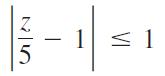
Solve the inequalities, expressing the solution sets as intervals or unions of intervals. Also, show each solution set on the real line. 1 VI 1
Find an equation for (a) The vertical line and (b) The horizontal line through the given point.(0, -√2)
Write an equation for each line described.Passes through (-1, 1) with slope -1
Use De Moivre’s Theorem to express the trigonometric functions in terms of cos θ and sin θ.cos 4θ De Moivre's Theorem (cos+ i sin 0)" = cos ne + i sin no. (14)
Write an equation for each line described.Passes through (3, 4) and (-2, 5)
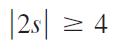
Solve the inequalities, expressing the solution sets as intervals or unions of intervals. Also, show each solution set on the real line. |2s| ≥ 4
Write an equation for each line described.Has slope -5/4 and y-intercept 6
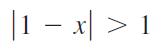
Solve the inequalities, expressing the solution sets as intervals or unions of intervals. Also, show each solution set on the real line. |1 − x| > 1 -
Show that |xn| = |x|n for every positive integer n and every real number x.
Write an equation for each line described.Passes through (-12, -9) and has slope 0
Showing 6600 - 6700
of 29454
First
60
61
62
63
64
65
66
67
68
69
70
71
72
73
74
Last
Step by Step Answers

 Get 50% OFF
Claim Now
Get 50% OFF
Claim Now