New Semester
Started
Get
50% OFF
Study Help!
--h --m --s
Claim Now
Question Answers
Textbooks
Find textbooks, questions and answers
Oops, something went wrong!
Change your search query and then try again
S
Books
FREE
Study Help
Expert Questions
Accounting
General Management
Mathematics
Finance
Organizational Behaviour
Law
Physics
Operating System
Management Leadership
Sociology
Programming
Marketing
Database
Computer Network
Economics
Textbooks Solutions
Accounting
Managerial Accounting
Management Leadership
Cost Accounting
Statistics
Business Law
Corporate Finance
Finance
Economics
Auditing
Tutors
Online Tutors
Find a Tutor
Hire a Tutor
Become a Tutor
AI Tutor
AI Study Planner
NEW
Sell Books
Search
Search
Sign In
Register
study help
mathematics
precalculus
Thomas Calculus Early Transcendentals 13th Edition Joel R Hass, Christopher E Heil, Maurice D Weir - Solutions
Use De Moivre’s Theorem to express the trigonometric functions in terms of cos θ and sin θ.sin 4θ De Moivre's Theorem (cos+ i sin 0)" = cos ne + i sin no. (14)
Write an equation for each line described.Has y-intercept 4 and x-intercept -1
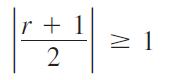
Solve the inequalities, expressing the solution sets as intervals or unions of intervals. Also, show each solution set on the real line. r + 1 2 ≥ 1
Write an equation for each line described.Passes through (5, -1) and is parallel to the line 2x + 5y = 15
Write an equation for each line described.Passes through (4, 10) and is perpendicular to the line 6x - 3y = 5
Find the line’s x- and y-intercepts and use this information to graph the line.3x + 4y = 12
Find the line’s x- and y-intercepts and use this information to graph the line.√2x - √3y = √6
Solve the inequalities. Express the solution sets as intervals or unions of intervals and show them on the real line. Use the result √a2 = |a| as appropriate.x2 < 2
Is there anything special about the relationship between the lines Ax + By = C1 and Bx - Ay = C2 (A ≠ 0, B ≠ 0)? Give reasons for your answer.
Solve the inequalities. Express the solution sets as intervals or unions of intervals and show them on the real line. Use the result √a2 = |a| as appropriate.4 < x2 < 9
A particle starts at A(-2, 3) and its coordinates change by increments Δx = 5, Δy = -6. Find its new position.
Solve the inequalities. Express the solution sets as intervals or unions of intervals and show them on the real line. Use the result √a2 = |a| as appropriate.(x - 1)2 < 4
Find the three cube roots of -8i.
The coordinates of a particle change by Δx = 5 and Δy = 6 as it moves from A(x, y) to B(3, -3). Find x and y.
Find the six sixth roots of 64.
Solve the inequalities. Express the solution sets as intervals or unions of intervals and show them on the real line. Use the result √a2 = |a| as appropriate.x2 - x < 0
Find an equation for the circle with the given center C(h, k) and radius a. Then sketch the circle in the xy-plane. Include the circle’s center in your sketch. Also, label the circle’s xand y-intercepts, if any, with their coordinate pairs.C(0, 2), a = 2
Find the four solutions of the equation z4 - 2z2 + 4 = 0.
Do not fall into the trap of thinking |-a| = a. For what real numbers a is this equation true? For what real numbers is it false?
Find an equation for the circle with the given center C(h, k) and radius a. Then sketch the circle in the xy-plane. Include the circle’s center in your sketch. Also, label the circle’s xand y-intercepts, if any, with their coordinate pairs.C(-1, 5), a = √10
Find the six solutions of the equation z6 + 2z3 + 2 = 0.
Solve the equation |x - 1| = 1 - x.
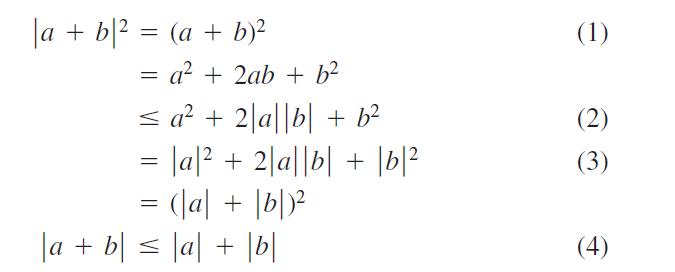
Give the reason justifying each of the numbered steps in the following proof of the triangle inequality. |a + b ² = (a + b)² 29 + 9pr + ₂D = ≤ a² + 2ab + b² z|9| + |9||1|2 + z|P| = = (a + b)² = |9| + |p| = |a + p | (1) (2) (3) (4)
Find an equation for the circle with the given center C(h, k) and radius a. Then sketch the circle in the xy-plane. Include the circle’s center in your sketch. Also, label the circle’s xand y-intercepts, if any, with their coordinate pairs.C(-√3, -2), a = 2
Find all solutions of the equation x4 + 4x2 + 16 = 0.
Graph the circles whose equations are given. Label each circle’s center and intercepts (if any) with their coordinate pairs.x2 + y2 + 4x - 4y + 4 = 0
Solve the equation x4 + 1 = 0.
Prove that |ab| = |a| |b| for any numbers a and b.
Graph the circles whose equations are given. Label each circle’s center and intercepts (if any) with their coordinate pairs.x2 + y2 - 3y - 4 = 0
Show with an Argand diagram that the law for adding complex numbers is the same as the parallelogram law for adding vectors.
If |x| ≤ 3 and x > -1/2, what can you say about x?
Graph the circles whose equations are given. Label each circle’s center and intercepts (if any) with their coordinate pairs.x2 + y2 - 4x + 4y = 0
Show that the conjugate of the sum (product, or quotient) of two complex numbers, z1 and z2, is the same as the sum (product, or quotient) of their conjugates.
Graph the inequality |x| + |y| ≤ 1.
Graph the parabolas. Label the vertex, axis, and intercepts in each case.y = x2 - 2x - 3
For any number a, prove that |-a| = |a|.
Graph the parabolas. Label the vertex, axis, and intercepts in each case.y = -x2 + 4x
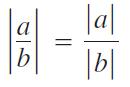
a. If b is any nonzero real number, prove that |1/b| = 1/ |b|.b. Prove thatfor any numbers a and b ≠ 0. b = lal 101
Describe the regions defined by the inequalities and pairs of inequalitie. x² + y² + 6y < 0, y> -3
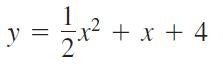
Graph the parabolas. Label the vertex, axis, and intercepts in each case. y 2 x + x + 4 2
Describe the regions defined by the inequalities and pairs of inequalitie. < ₂²₁² + zx 1, x² + y² < 4
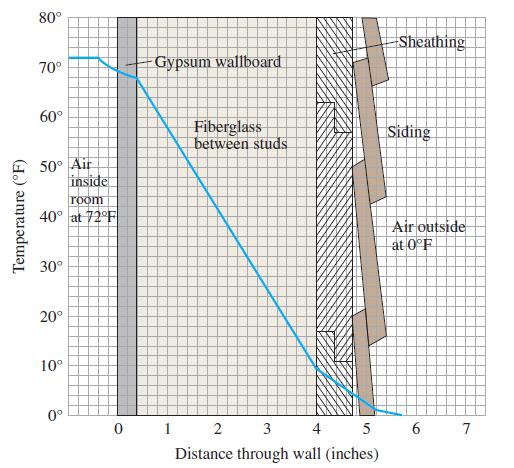
By measuring slopes in the figure, estimate the temperature change in degrees per inch for (a) The gypsum wallboard; (b) The fiberglass insulation; (c) The wood sheathing. Temperature (°F) 80° 70° 60° 50° Air inside room 40° at 72°F 30° 20° 10° 0° Gypsum wallboard Fiberglass between
Let a be any positive number. Prove that |x| > a if and only if x > a or x < -a.
Graph the parabolas. Label the vertex, axis, and intercepts in each case.y = -x2 - 6x - 5
Describe the regions defined by the inequalities and pairs of inequalitie.x2 + y2 > 7
Describe the regions defined by the inequalities and pairs of inequalitie.(x - 1)2 + y2 ≤ 4
Write an inequality that describes the points that lie inside the circle with center (-2, 1) and radius √6.
Write a pair of inequalities that describe the points that lie inside or on the circle with center (0, 0) and radius √2, and on or to the right of the vertical line through (1, 0).
Graph the two equations and find the points at which the graphs intersect.y = 2x, x2 + y2 = 1
Graph the two equations and find the points at which the graphs intersect.y - x = 1, y = x2
Graph the two equations and find the points at which the graphs intersect.y = -x2, y = 2x2 - 1
Graph the two equations and find the points at which the graphs intersect.x2 + y2 = 1, (x - 1)2 + y2 = 1
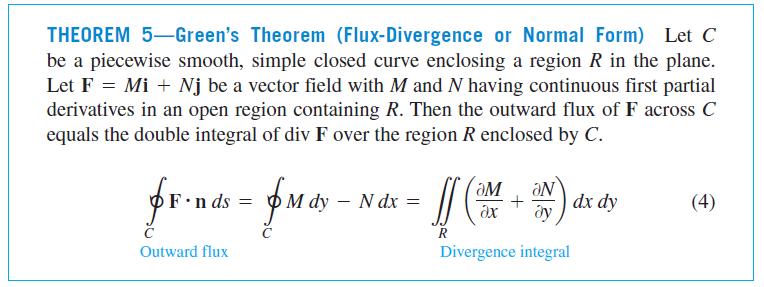
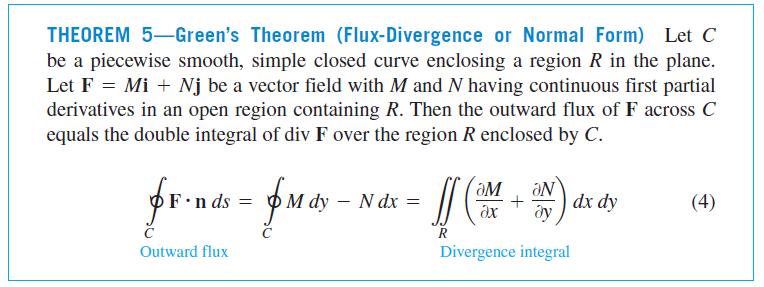
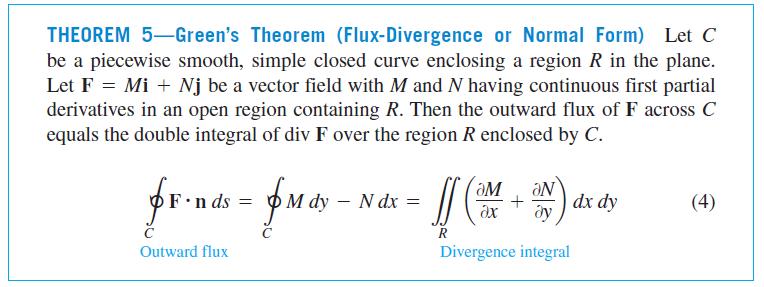
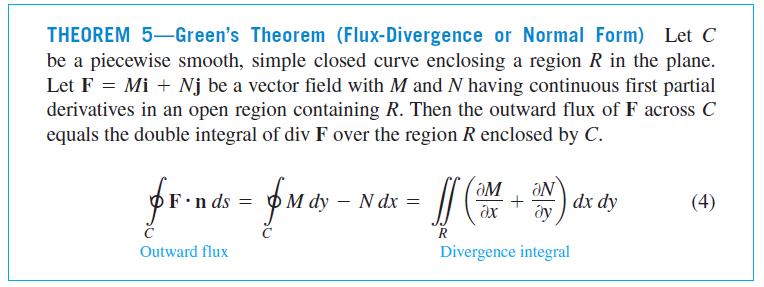
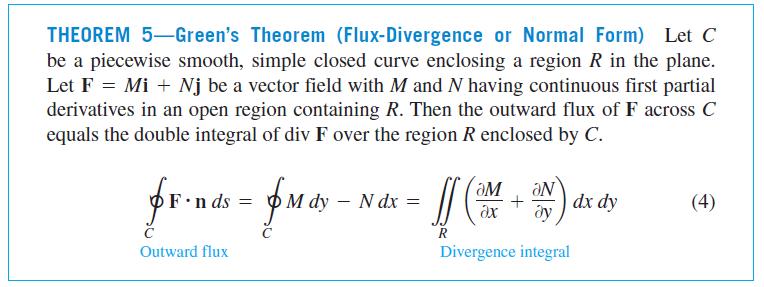
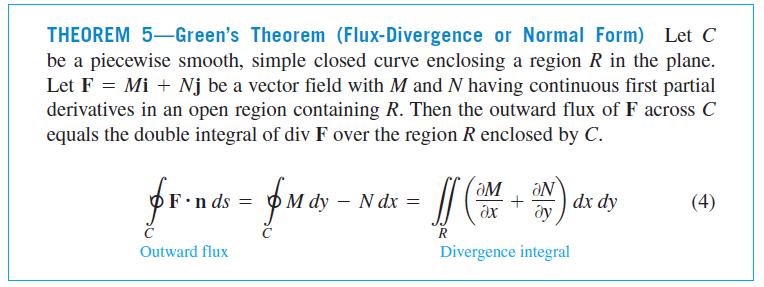
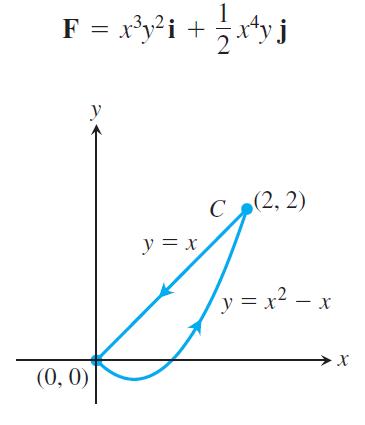
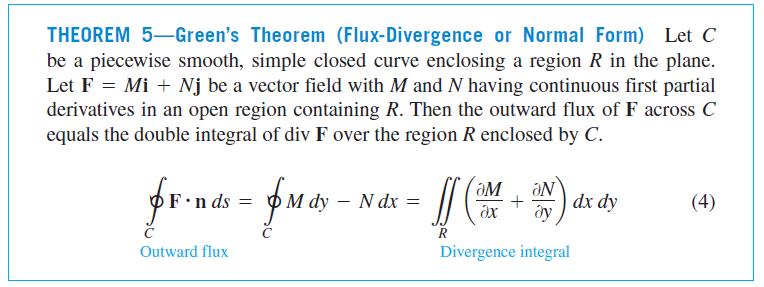
Use Green’s Theorem to find the counterclockwise circulation and outward flux for the field F and curve C.F = (x2 + 4y)i + (x + y2)jC: The square bounded by x = 0, x = 1, y = 0, y = 1 THEOREM 5-Green's Theorem (Flux-Divergence or Normal Form) Let C be a piecewise smooth, simple closed curve
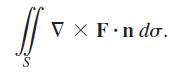
Let n be the outer unit normal of the elliptical shelland letFind the value of S: 4x² +9y² + 36z² = 36, z ≥ 0,
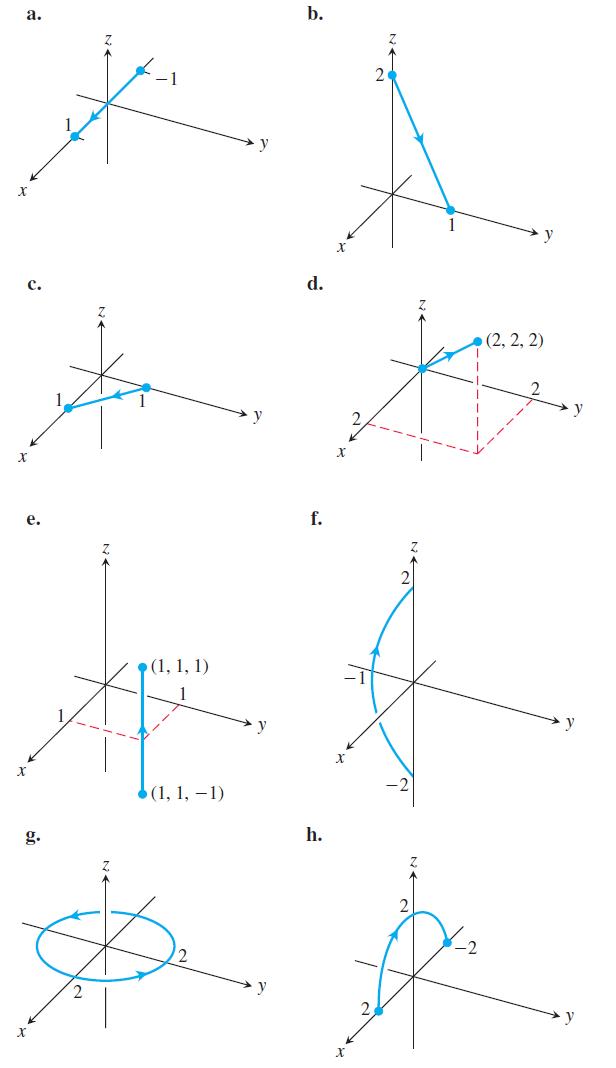
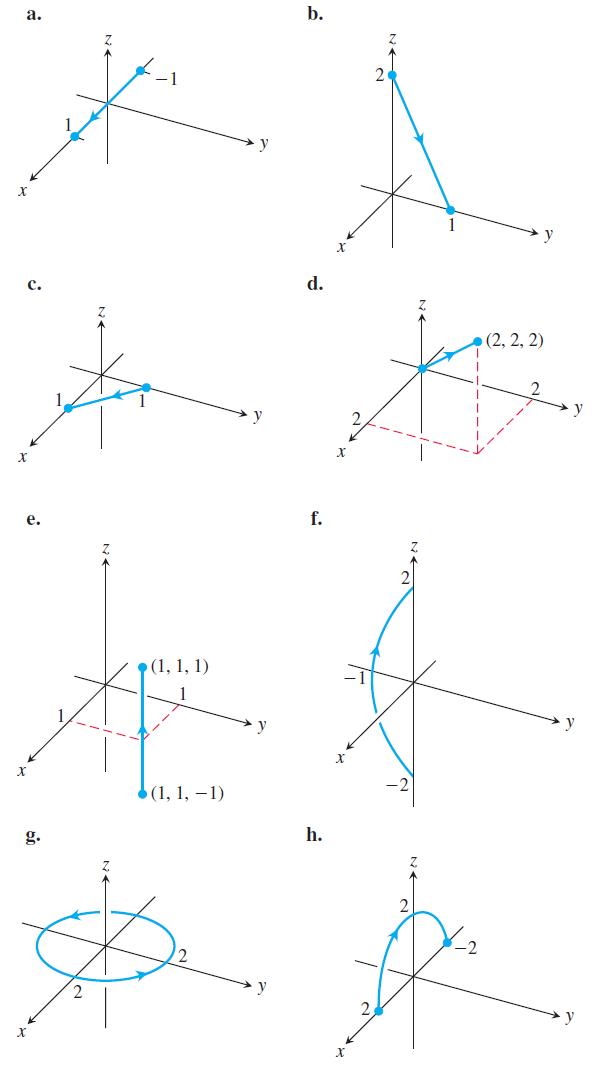
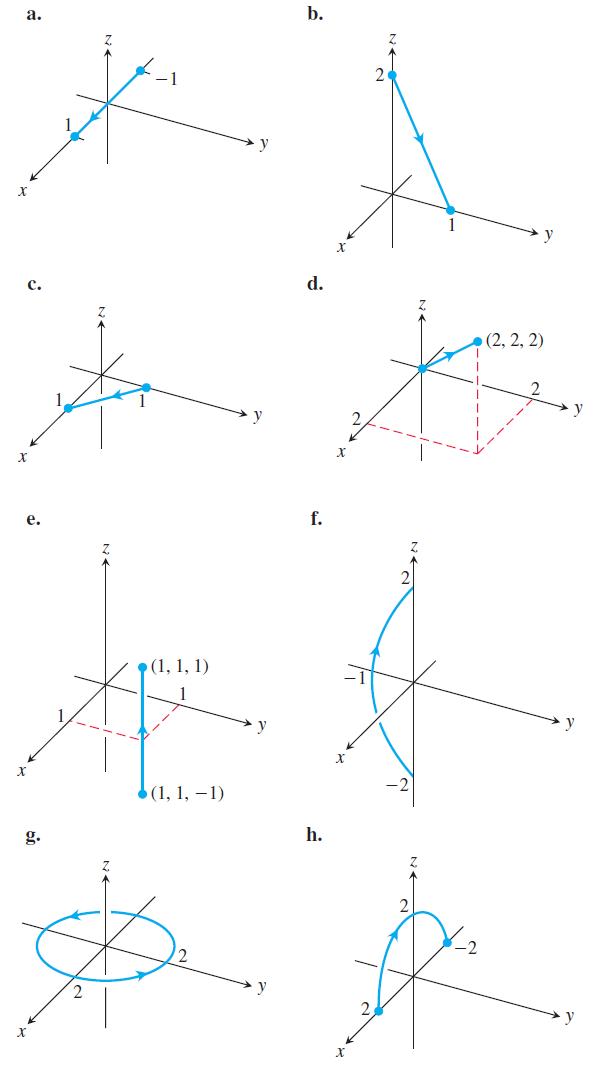
Match the vector equations with the graphs (a)–(h) given here.r(t) = tj + (2 - 2t)k, 0 ≤ t ≤ 1 a. C. e. 2 1 (1, 1, 1) (1, 1, -1) b. d. f. h. X X X (2, 2, 2) y
Match the vector equations with the graphs (a)–(h) given here.r(t) = (t2 - 1)j + 2tk, -1 ≤ t ≤ 1 a. C. e. 2 1 (1, 1, 1) (1, 1, -1) b. d. f. h. X X X (2, 2, 2) y
Integrate the given function over the given surface.F(x, y, z) = z - x, over the cone z = √x2 + y2, 0 ≤ z ≤ 1
Use Green’s Theorem to find the counterclockwise circulation and outward flux for the field F and curve C.F = (y2 - x2)i + (x2 + y2)jC: The triangle bounded by y = 0, x = 3, and y = x THEOREM 5-Green's Theorem (Flux-Divergence or Normal Form) Let C be a piecewise smooth, simple closed curve
Let n be the outer unit normal (normal away from the origin) of the parabolic shelland letFind the value of S: 4x² + y + z² = 4, y = 0,
Give a formula F = M(x, y)i + N(x, y)j for the vector field in the plane that has the properties that F = 0 at (0, 0) and that at any other point (a, b), F is tangent to the circle x2 + y2 = a2 + b2 and points in the clockwise direction with magnitude |F| = √a2 + b2.
Find all points (a, b, c) on the sphere x2 + y2 + z2 = R2 where the vector field F = yz2i + xz2j + 2xyzk is normal to the surface and F(a, b, c) ≠ 0.
Specify three properties that are special about conservative fields. How can you tell when a field is conservative?
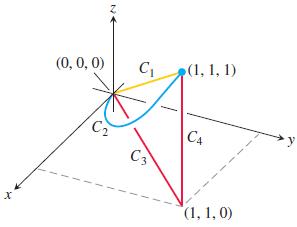
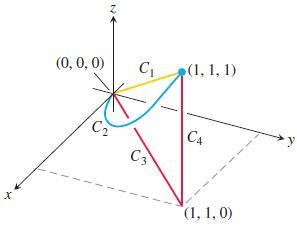
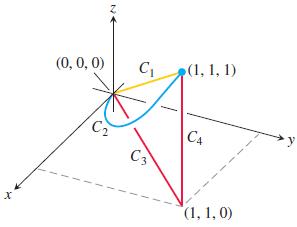
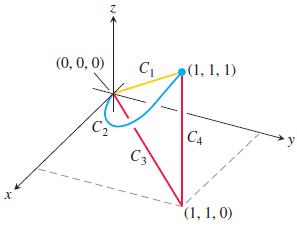
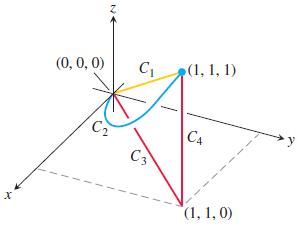
Find the line integrals of F from (0, 0, 0) to (1, 1, 1) over each of the following paths in the accompanying figure.a. The straight-line path C1: r(t) = ti + tj + tk, 0 ≤ t ≤ 1b. The curved path C2: r(t) = ti + t2j + t4k, 0 ≤ t ≤ 1c. The path C3 ∪ C4 consisting of the line segment from
Which fields are conservative, and which are not?F = (ex cos y)i - (ex sin y)j + zk
Find a potential function ƒ for the field F.F = 2xi + 3yj + 4zk
What is special about path independent fields?
Match the vector equations with the graphs (a)–(h) given here.r(t) = (2 cos t)i + (2 sin t)k, 0 ≤ t ≤ π a. C. e. 2 1 (1, 1, 1) (1, 1, -1) b. d. f. h. X X X (2, 2, 2) y
Find a parametrization of the surface.The portion of the sphere x2 + y2 + z2 = 3 between the planes z = √3/2 and z = -√3/2
Use Green’s Theorem to find the counterclockwise circulation and outward flux for the field F and curve C.F = (x + y)i - (x2 + y2)jC: The triangle bounded by y = 0, x = 1, and y = x THEOREM 5-Green's Theorem (Flux-Divergence or Normal Form) Let C be a piecewise smooth, simple closed curve
Use Green’s Theorem to find the counterclockwise circulation and outward flux for the field F and curve C.F = (xy + y2)i + (x - y)j THEOREM 5-Green's Theorem (Flux-Divergence or Normal Form) Let C be a piecewise smooth, simple closed curve enclosing a region R in the plane. Let F = Mi + Nj be a
Find the line integrals of F from (0, 0, 0) to (1, 1, 1) over each of the following paths in the accompanying figure.a. The straight-line path C1: r(t) = ti + tj + tk, 0 ≤ t ≤ 1b. The curved path C2: r(t) = ti + t2j + t4k, 0 ≤ t ≤ 1c. The path C3 ∪ C4 consisting of the line segment from
Integrate the given function over the given surface.H(x, y, z) = x2√5 - 4z, over the parabolic dome z = 1 - x2 - y2, z ≥ 0
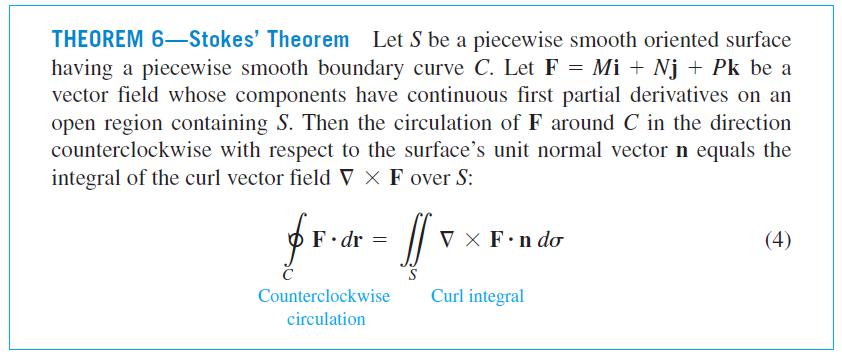
Let S be the cylinder x2 + y2 = a2, 0 ≤ z ≤ h, together with its top, x2 + y2 ≤ a2, z = h. Let F = -yi + xj + x2k. Use Stokes’ Theorem to find the flux of ∇ * F outward through S. THEOREM 6-Stokes' Theorem Let S be a piecewise smooth oriented surface having a piecewise smooth boundary
Find the mass of a spherical shell of radius R such that at each point (x, y, z) on the surface the mass density δ(x, y, z) is its distance to some fixed point (a, b, c) of the surface.
Find a potential function ƒ for the field F.F = (y + z)i + (x + z)j + (x + y)k
Use Green’s Theorem to find the counterclockwise circulation and outward flux for the field F and curve C.F = (x + 3y)i + (2x - y)j THEOREM 5-Green's Theorem (Flux-Divergence or Normal Form) Let C be a piecewise smooth, simple closed curve enclosing a region R in the plane. Let F = Mi + Nj be a
What is a potential function? Show by example how to find a potential function for a conservative field.
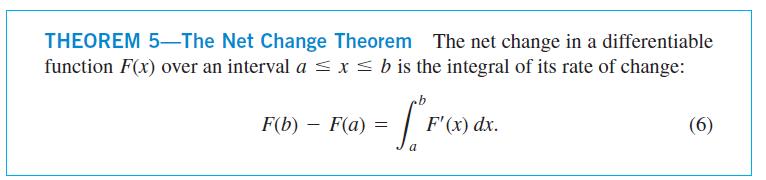
What is Green’s Theorem? Discuss how the two forms of Green’s Theorem extend the Net Change Theorem. THEOREM 5-The Net Change Theorem The net change in a differentiable function F(x) over an interval a ≤ x ≤ b is the integral of its rate of change: F(b) - F(a) - [Fa = F'(x) dx. (6)
Find a parametrization of the surface.The upper portion cut from the sphere x2 + y2 + z2 = 8 by the plane z = -2
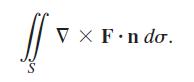
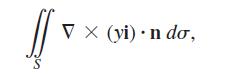
Evaluatewhere S is the hemisphere x2 + y2 + z2 = 1, z ≥ 0. [[ ' S VX (yi). n do,
Integrate the given function over the given surface. H(x, y, z) = yz, over the part of the sphere x2 + y2 + z2 = 4 that lies above the cone z = √x2 + y2
Find the line integrals of F from (0, 0, 0) to (1, 1, 1) over each of the following paths in the accompanying figure.a. The straight-line path C1: r(t) = ti + tj + tk, 0 ≤ t ≤ 1b. The curved path C2: r(t) = ti + t2j + t4k, 0 ≤ t ≤ 1c. The path C3 ∪ C4 consisting of the line segment from
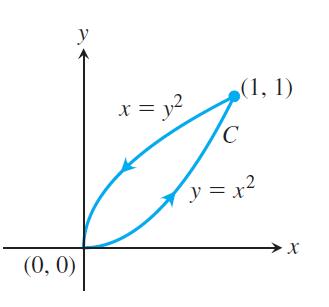
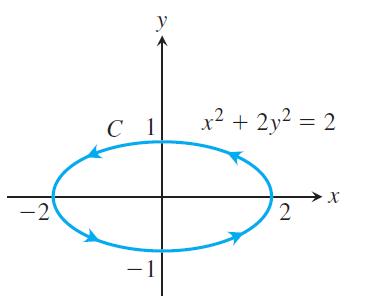
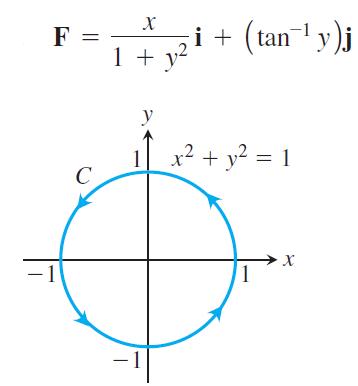
Use Green’s Theorem to find the counterclockwise circulation and outward flux for the field F and curve C. THEOREM 5-Green's Theorem (Flux-Divergence or Normal Form) Let C be a piecewise smooth, simple closed curve enclosing a region R in the plane. Let F = Mi + Nj be a vector field with M and N
Find a potential function ƒ for the field F. F = (lnx + sec2(x + ))i + sec2(r + y) + 2ܐ y + z² + + 2ܐ Z ܐ + ܚ k
Find the line integrals of F from (0, 0, 0) to (1, 1, 1) over each of the following paths in the accompanying figure.a. The straight-line path C1: r(t) = ti + tj + tk, 0 ≤ t ≤ 1b. The curved path C2: r(t) = ti + t2j + t4k, 0 ≤ t ≤ 1c. The path C3 ∪ C4 consisting of the line segment from
Find a potential function ƒ for the field F.F = ey+2z(i + xj + 2xk)
What is a differential form? What does it mean for such a form to be exact? How do you test for exactness? Give examples.
Use Green’s Theorem to find the counterclockwise circulation and outward flux for the field F and curve C. THEOREM 5-Green's Theorem (Flux-Divergence or Normal Form) Let C be a piecewise smooth, simple closed curve enclosing a region R in the plane. Let F = Mi + Nj be a vector field with M and N
Find the line integrals of F from (0, 0, 0) to (1, 1, 1) over each of the following paths in the accompanying figure.a. The straight-line path C1: r(t) = ti + tj + tk, 0 ≤ t ≤ 1b. The curved path C2: r(t) = ti + t2j + t4k, 0 ≤ t ≤ 1c. The path C3 ∪ C4 consisting of the line segment from
Suppose F = ∇ * A, whereDetermine the flux of F outward through the hemisphere x2 + y2 + z2 = 1, z ≥ 0. A = (y + √z)i + e¹yzj + cos (xz) k.
Find a parametrization of the surface.The surface cut from the parabolic cylinder z = 4 - y2 by the planes x = 0, x = 2, and z = 0
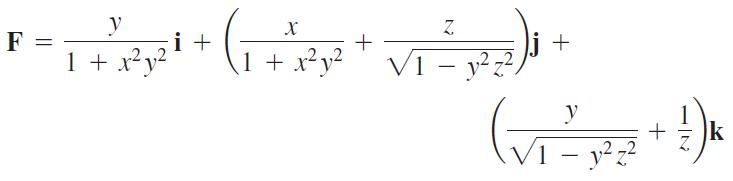
Find a potential function ƒ for the field F. F = y 1 + x²y² · (²²2² = 1^ + ²²²x + 1). i+ + y (V-2 1- y² 7² + ½ ) K k
Integrate the given function over the given surface. Integrate G(x, y, z) = x + y + z over the surface of the cube cut from the first octant by the planes x = a, y = a, z = a.
Find a potential function ƒ for the field F.F = (y sin z)i + (x sin z)j + (xy cos z)k
Find a parametrization of the surface.The surface cut from the parabolic cylinder y = x2 by the planes z = 0, z = 3, and y = 2
Integrate the given function over the given surface. Integrate G(x, y, z) = y + z over the surface of the wedge in the first octant bounded by the coordinate planes and the planes x = 2 and y + z = 1.
How do you calculate the area of a parametrized surface in space? Of an implicitly defined surface F(x, y, z) = 0? Of the surface which is the graph of z = ƒ(x, y)? Give examples.
Repeat Exercise 11 for the flux of F across the entire unit sphere.Data from Exercise 11Suppose F = ∇ * A, whereDetermine the flux of F outward through the hemisphere x2 + y2 + z2 = 1, z ≥ 0. A = (y + √z)i + e¹yzj + cos (xz) k.
Find a parametrization of the surface.The portion of the cylinder y2 + z2 = 9 between the planes x = 0 and x = 3
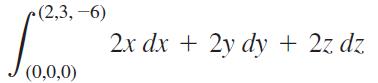
Show that the differential forms in the integrals are exact. Then evaluate the integrals. (2,3, -6) (0,0,0) 2x dx + 2y dy + 2z dz
Showing 6700 - 6800
of 29454
First
61
62
63
64
65
66
67
68
69
70
71
72
73
74
75
Last
Step by Step Answers

 Get 50% OFF
Claim Now
Get 50% OFF
Claim Now