New Semester
Started
Get
50% OFF
Study Help!
--h --m --s
Claim Now
Question Answers
Textbooks
Find textbooks, questions and answers
Oops, something went wrong!
Change your search query and then try again
S
Books
FREE
Study Help
Expert Questions
Accounting
General Management
Mathematics
Finance
Organizational Behaviour
Law
Physics
Operating System
Management Leadership
Sociology
Programming
Marketing
Database
Computer Network
Economics
Textbooks Solutions
Accounting
Managerial Accounting
Management Leadership
Cost Accounting
Statistics
Business Law
Corporate Finance
Finance
Economics
Auditing
Tutors
Online Tutors
Find a Tutor
Hire a Tutor
Become a Tutor
AI Tutor
AI Study Planner
NEW
Sell Books
Search
Search
Sign In
Register
study help
mathematics
precalculus
Calculus Of A Single Variable 11th Edition Ron Larson, Bruce H. Edwards - Solutions
Integrate the given function over the given surface. Integrate G(x, y, z) = xyz over the surface of the rectangular solid cut from the first octant by the planes x = a, y = b, and z = c.
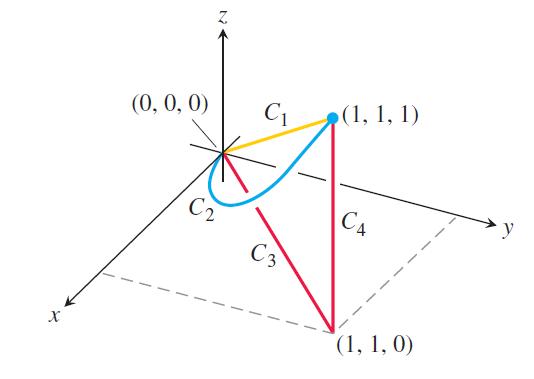
Find the line integrals of F from (0, 0, 0) to (1, 1, 1) over each of the following paths in the accompanying figure.a. The straight-line path C1: r(t) = ti + tj + tk, 0 ≤ t ≤ 1b. The curved path C2: r(t) = ti + t2j + t4k, 0 ≤ t ≤ 1c. The path C3 ∪ C4 consisting of the line segment from
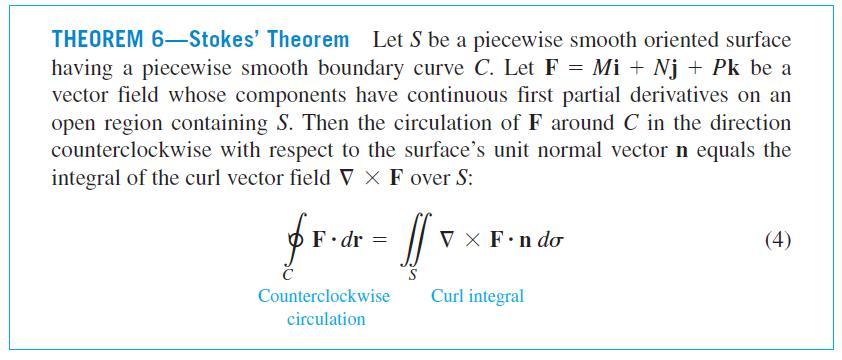
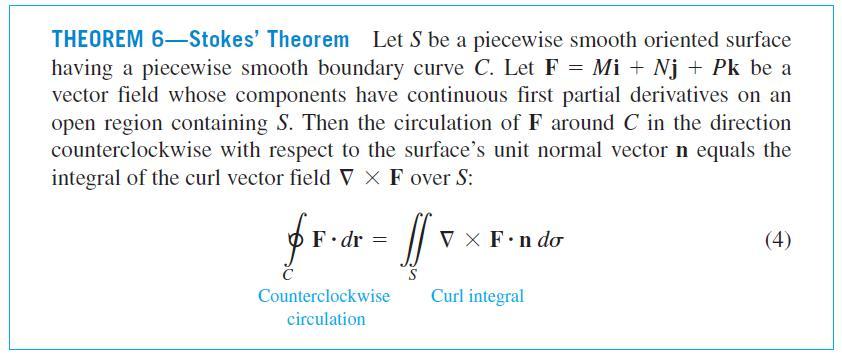
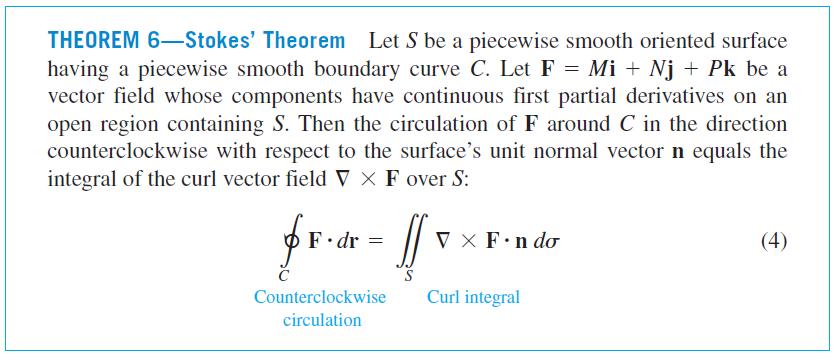
Use the surface integral in Stokes’ Theorem to calculate the flux of the curl of the field F across the surface S in the direction of the outward unit normal n.F = 2zi + 3xj + 5ykS: r(r, θ) = (r cos θ)i + (r sin θ)j + (4 - r2)k, 0 ≤ r ≤ 2, 0 ≤ θ ≤ 2π THEOREM 6-Stokes' Theorem Let S
Find the area of the elliptical region cut from the plane x + y + z = 1 by the cylinder x2 + y2 = 1.
How do you integrate a scalar function over a parametrized surface? Of surfaces that are defined implicitly or in explicit form? Give examples.
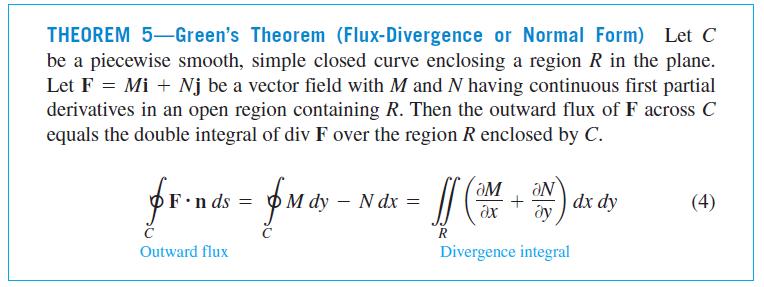
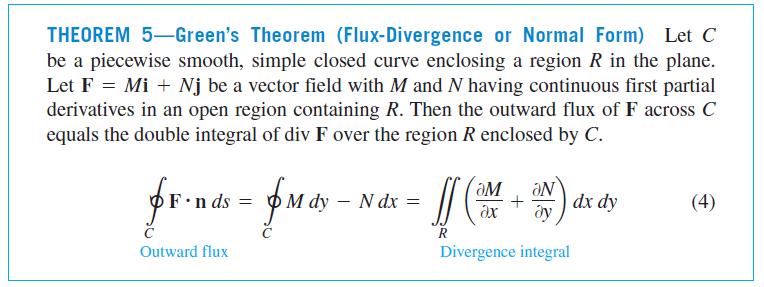
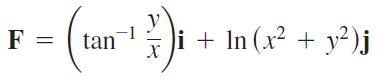
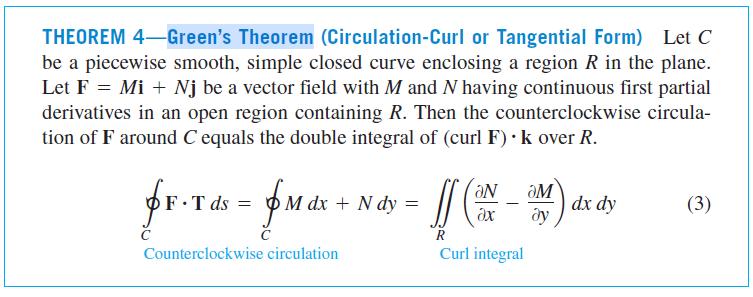
Use Green’s Theorem to find the counterclockwise circulation and outward flux for the field F and curve C.F = (x + ex sin y)i + (x + ex cos y)jC: The right-hand loop of the lemniscate r2 = cos 2θ THEOREM 5-Green's Theorem (Flux-Divergence or Normal Form) Let C be a piecewise smooth, simple
Find a parametrization of the surface.The portion of the cylinder x2 + z2 = 4 above the xy-plane between the planes y = -2 and y = 2
Integrate the given function over the given surface. Integrate G(x, y, z) = xyz over the surface of the rectangular solid bounded by the planes x = ±a, y = ±b, and z = ±c.
Find the area of the cap cut from the paraboloid y2 + z2 = 3x by the plane x = 1.
What is an oriented surface? What is the surface integral of a vector field in three-dimensional space over an oriented surface? How is it related to the net outward flux of the field? Give examples.
Find the area of the cap cut from the top of the sphere x2 + y2 + z2 = 1 by the plane z = √2/2.
Find a parametrization of the surface.The portion of the plane x + y + z = 1a. Inside the cylinder x2 + y2 = 9b. Inside the cylinder y2 + z2 = 9
Integrate the given function over the given surface. Integrate G(x, y, z) = x√y2 + 4 over the surface cut from the parabolic cylinder y2 + 4z = 16 by the planes x = 0, x = 1, and z = 0.
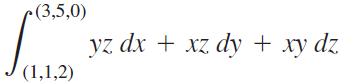
Show that the differential forms in the integrals are exact. Then evaluate the integrals. (3,5,0) S012, 1² yz dx + xz dy + xy dz
Use Green’s Theorem to find the counterclockwise circulation and outward flux for the field F and curve C.C: The boundary of the region defined by the polar coordinate inequalities 1 ≤ r ≤ 2, 0 ≤ θ ≤ π. THEOREM 5-Green's Theorem (Flux-Divergence or Normal Form) Let C be a piecewise
Find the line integrals along the given path C. Lo (x - y) dx, where C: x = t, y = 2t + 1, for 0 ≤ t ≤ 3
Use the surface integral in Stokes’ Theorem to calculate the flux of the curl of the field F across the surface S in the direction of the outward unit normal n.F = (y - z)i + (z - x)j + (x + z)kS: r(r, θ) = (r cos θ)i + (r sin θ)j + (9 - r2)k, 0 ≤ r ≤ 3, 0 ≤ θ ≤ 2π THEOREM 6-Stokes'
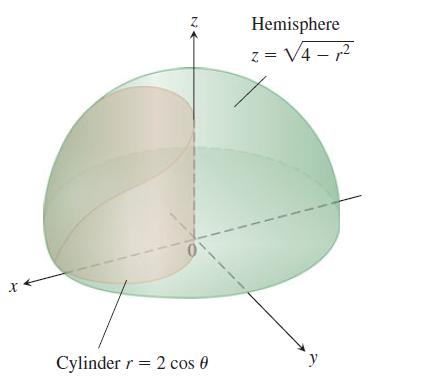
a. Find the area of the surface cut from the hemisphere x2 + y2 + z2 = 4, z ≥ 0, by the cylinder x2 + y2 = 2x.b. Find the area of the portion of the cylinder that lies inside the hemisphere. X 2. O Cylinder r = 2 cos 0 Hemisphere z = √4-² y
What is Stokes’ Theorem? Explain how it generalizes Green’s Theorem to three dimensions. THEOREM 6-Stokes' Theorem Let S be a piecewise smooth oriented surface having a piecewise smooth boundary curve C. Let F = Mi + Nj + Pk be a vector field whose components have continuous first partial
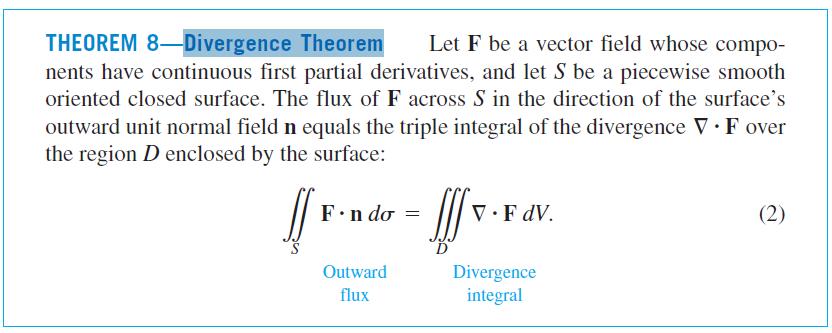
Use the Divergence Theorem to find the outward flux of F across the boundary of the region D. Use the Divergence Theorem to find the outward flux of F across the boundary of the region D. THEOREM 8-Divergence Theorem Let F be a vector field whose compo- nents have continuous first partial
Show that the differential forms in the integrals are exact. Then evaluate the integrals. (1,2,3) (0,0,0) 2xy dx + (x²z²) dy - 2yz dz
Find the line integrals along the given path C. Lydy. dy, where C: x = 1, y = f², for 1 ≤ t ≤ 2
Integrate the given function over the given surface. Integrate G(x, y, z) = x + y + z over the portion of the plane 2x + 2y + z = 2 that lies in the first octant.
What is the curl of a vector field? How can you interpret it?
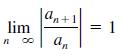
What can you conclude about the convergence or divergence of Σan? lim n co an+1 an = 1 ||
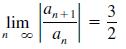
What can you conclude about the convergence or divergence of Σan? lim n+ an || 3
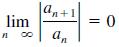
What can you conclude about the convergence or divergence of Σan? 0 = an n+1 [+"p\ 00 lim
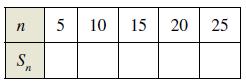
(a) Use the Ratio Test to verify that the series converges,(b) Use a graphing utility to find the indicated partial sum Sn and complete the table,(c) Use a graphing utility to graph the first 10 terms of the sequence of partial sums,(d) Use the table to estimate the sum of the series, and(e)
Determine the convergence or divergence of the series. 18 n (-1)^+1 n+ 1
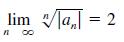
What can you conclude about the convergence or divergence of Σ an? lima = 2 11 00
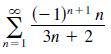
Determine the convergence or divergence of the series. 18 n=1 (-1)"+1 n n 3n + 2
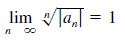
What can you conclude about the convergence or divergence of Σ an? lima = 1 n100
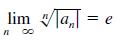
What can you conclude about the convergence or divergence of Σ an? lim a n 00
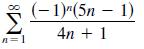
Determine the convergence or divergence of the series. n=1 (-1)^(5n-1) 4n+ 1
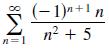
Determine the convergence or divergence of the series. 18 n=1 (-1)^+¹ n n² + 5
You want to compare the series ∑an and ∑bn, where an > 0, bn > 0, and ∑bn converges. For 1 ≤ n ≤ 5, an > bn, and for n ≥ 6, an < bn. Explain whether the Direct Comparison Test can be used to compare the two series.
Determine the convergence or divergence of the series. 18 "=1 (-1)" 3″
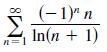
Determine the convergence or divergence of the series. 18 n= (-1)" n In(n + 1)
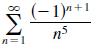
Determine the convergence or divergence of the series. 18 n=1 (-1)" 16
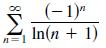
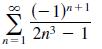
Determine the convergence or divergence of the series. 18 n= (-1) In(n+1)
When using the Limit Comparison Test, describe in your own words how to choose a series for comparison.
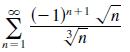
Determine the convergence or divergence of the series. 18 n² 1 (-1)" /n
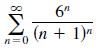
Use the Ratio Test to determine the convergence or divergence of the series. If the Ratio Test is inconclusive, determine the convergence or divergence of the series using other methods. 00 n=1 8n
A sequence {an} is bounded below and nonincreasing. Does {an} converge or diverge? Use a graph to support your conclusion.
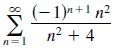
Determine the convergence or divergence of the series. 18 n=1 (-1)"+1 n² n² + 4
Use the Ratio Test to determine the convergence or divergence of the series. If the Ratio Test is inconclusive, determine the convergence or divergence of the series using other methods. 00 n=1 5 n!
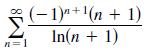
Determine the convergence or divergence of the series. (-1)+¹(n + 1) In(n + 1)
Use the Ratio Test to determine the convergence or divergence of the series. If the Ratio Test is inconclusive, determine the convergence or divergence of the series using other methods. n=1 (n − 1)! In
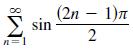
Determine the convergence or divergence of the series. n=1 sin (2n-1)n 2
Simplify the ratio of factorials. n! (n − 3)!
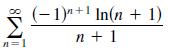
Determine the convergence or divergence of the series. IM8 (-1)+¹ In(n + 1) n+ 1
Determine the convergence or divergence of the series. 00 n= 1 -сos nл n
Use the Ratio Test to determine the convergence or divergence of the series. If the Ratio Test is inconclusive, determine the convergence or divergence of the series using other methods. 18 n=0 n 2" (n + 2)!
Use the Ratio Test to determine the convergence or divergence of the series. If the Ratio Test is inconclusive, determine the convergence or divergence of the series using other methods. 18 n=1 ן (6)
Determine the convergence or divergence of the series. 18 n=0 (-1)n n!
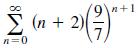
Use the Ratio Test to determine the convergence or divergence of the series. If the Ratio Test is inconclusive, determine the convergence or divergence of the series using other methods. Σ (n n + 2) (²7) " n=0 9\n+1
Use the Ratio Test to determine the convergence or divergence of the series. If the Ratio Test is inconclusive, determine the convergence or divergence of the series using other methods. 00 9n n=1
Use the Ratio Test to determine the convergence or divergence of the series. If the Ratio Test is inconclusive, determine the convergence or divergence of the series using other methods. 00 n=1 n 3″
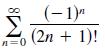
Determine the convergence or divergence of the series. 18 n=0 (-1) (2n + 1)!
Use the Ratio Test to determine the convergence or divergence of the series. If the Ratio Test is inconclusive, determine the convergence or divergence of the series using other methods. 18 n=0 6⁰ (n + 1)³
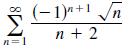
Determine the convergence or divergence of the series. (-1)+1 √√n n+ 2
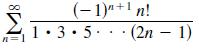
Determine the convergence or divergence of the series. n= (-1)+¹n! 1.3.5 (2n-1) .
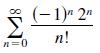
Use the Ratio Test to determine the convergence or divergence of the series. If the Ratio Test is inconclusive, determine the convergence or divergence of the series using other methods. 18 n=0 (-1) 2n n!
Determine the convergence or divergence of the series. Ž (-1)+1√√√n n
Determine the convergence or divergence of the series. 1.3.5 1.4.7 Σ (-1)+1. n=1 . (2n-1) (3n - 2)
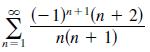
Use the Ratio Test to determine the convergence or divergence of the series. If the Ratio Test is inconclusive, determine the convergence or divergence of the series using other methods. n=1 (-1)+¹(n + 2) n(n + 1)
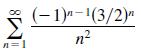
Use the Ratio Test to determine the convergence or divergence of the series. If the Ratio Test is inconclusive, determine the convergence or divergence of the series using other methods. n=1 (-1)²-¹(3/2)n n²
Use the Ratio Test to determine the convergence or divergence of the series. If the Ratio Test is inconclusive, determine the convergence or divergence of the series using other methods. 18 n=1 (2n)! n³
Determine the convergence or divergence of the series. n=1 2(-1)+1 en en Σ(-1)²+¹ csch n n=1
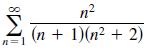
Use the Ratio Test to determine the convergence or divergence of the series. If the Ratio Test is inconclusive, determine the convergence or divergence of the series using other methods. n=1 n² (n + 1)(n² + 2)
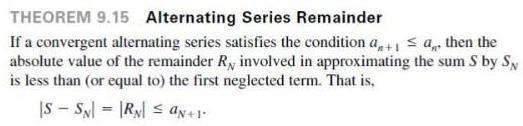
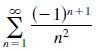
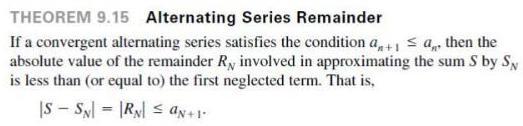
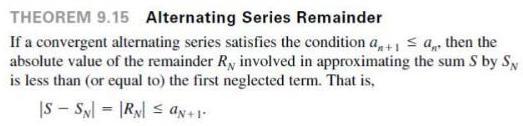
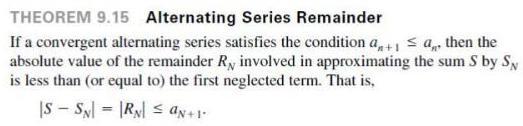
Use Theorem 9.15 to determine the number of terms required to approximate the sum of the series with an error of less than 0.001. THEOREM 9.15 Alternating Series Remainder If a convergent alternating series satisfies the condition a,+1 a,, then the absolute value of the remainder R, involved in
Use the Ratio Test to determine the convergence or divergence of the series. If the Ratio Test is inconclusive, determine the convergence or divergence of the series using other methods. 00 n! n=1 n
Determine the convergence or divergence of the series. n=1 2(-1)"+1 en + en 2 (−1)²+1 sech n n=1
Use the Ratio Test to determine the convergence or divergence of the series. If the Ratio Test is inconclusive, determine the convergence or divergence of the series using other methods. 00 0=" n!
Use the Ratio Test to determine the convergence or divergence of the series. If the Ratio Test is inconclusive, determine the convergence or divergence of the series using other methods. 18 n=0 5n 2n + 1
Use the Ratio Test to determine the convergence or divergence of the series. If the Ratio Test is inconclusive, determine the convergence or divergence of the series using other methods. 18 n=0 6⁰ (n + 1)n
Use the Ratio Test to determine the convergence or divergence of the series. If the Ratio Test is inconclusive, determine the convergence or divergence of the series using other methods. 18 n=0 (n!)² (3n)!
Use Theorem 9.15 to determine the number of terms required to approximate the sum of the series with an error of less than 0.001. THEOREM 9.15 Alternating Series Remainder If a convergent alternating series satisfies the condition a,+1 a,, then the absolute value of the remainder R, involved in
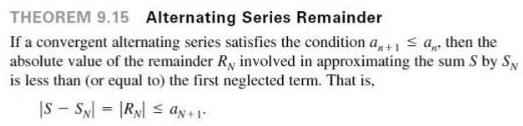
Use Theorem 9.15 to determine the number of terms required to approximate the sum of the series with an error of less than 0.001. THEOREM 9.15 Alternating Series Remainder If a convergent alternating series satisfies the condition a,+1 a,, then the absolute value of the remainder R, involved in
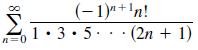
Use the Ratio Test to determine the convergence or divergence of the series. If the Ratio Test is inconclusive, determine the convergence or divergence of the series using other methods. n=0 (-1)+¹n! 1.3.5 (2n + 1) -
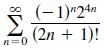
Use the Ratio Test to determine the convergence or divergence of the series. If the Ratio Test is inconclusive, determine the convergence or divergence of the series using other methods. 18 n=0 (-1)"24n (2n + 1)!
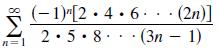
Use the Ratio Test to determine the convergence or divergence of the series. If the Ratio Test is inconclusive, determine the convergence or divergence of the series using other methods. n=1 (-1) [2.4.6. 2.5.8 - (2n)] (3n - 1)
Use Theorem 9.15 to determine the number of terms required to approximate the sum of the series with an error of less than 0.001. THEOREM 9.15 Alternating Series Remainder If a convergent alternating series satisfies the condition a,+1 a,, then the absolute value of the remainder R, involved in
Use Theorem 9.15 to determine the number of terms required to approximate the sum of the series with an error of less than 0.001. THEOREM 9.15 Alternating Series Remainder If a convergent alternating series satisfies the condition a,+1 a,, then the absolute value of the remainder R, involved in
Use the Root Test to determine the convergence or divergence of the series. 18 n=0 e -Зи
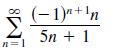
Determine whether the series converges absolutely or conditionally, or diverges. 18 n=1 (-1)"+In 5n+ 1
Use the Root Test to determine the convergence or divergence of the series. 18 n= =2 n (In n)"
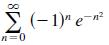
Determine whether the series converges absolutely or conditionally, or diverges. 18 Σ (−1)" en n=0
Use the Root Test to determine the convergence or divergence of the series. 18 и A= (n!)" (n")2
Determine whether the series converges absolutely or conditionally, or diverges. 18 n=2 (-1)" n n³-5
Determine whether the series converges absolutely or conditionally, or diverges. 18 n=1 (-1)+1 n
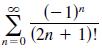
Determine whether the series converges absolutely or conditionally, or diverges. 18 n=0 (-1) (2n + 1)!
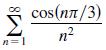
Determine whether the series converges absolutely or conditionally, or diverges. 18 n=1 cos(nπ/3) n² со
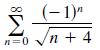
Determine whether the series converges absolutely or conditionally, or diverges. 18 n=0 (-1)^ √n + 4
Determine whether the series converges absolutely or conditionally, or diverges. 18 COS Nπ n=on + 1 0
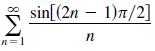
Determine whether the series converges absolutely or conditionally, or diverges. n=1 sin[(2n-1)/2] n
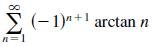
Determine whether the series converges absolutely or conditionally, or diverges. Σ (-1)+1 arctan n n=1
Determine the convergence or divergence of the series using any appropriate test from this chapter. Identify the test used. 18 n=1 n 2n² + 1
Determine the convergence or divergence of the series using any appropriate test from this chapter. Identify the test used. 18 n=1 5n 2n 1
Determine the convergence or divergence of the series using any appropriate test from this chapter. Identify the test used. 18 n= 2n 4n² - 1
Showing 6800 - 6900
of 29454
First
62
63
64
65
66
67
68
69
70
71
72
73
74
75
76
Last
Step by Step Answers

 Get 50% OFF
Claim Now
Get 50% OFF
Claim Now