New Semester
Started
Get
50% OFF
Study Help!
--h --m --s
Claim Now
Question Answers
Textbooks
Find textbooks, questions and answers
Oops, something went wrong!
Change your search query and then try again
S
Books
FREE
Study Help
Expert Questions
Accounting
General Management
Mathematics
Finance
Organizational Behaviour
Law
Physics
Operating System
Management Leadership
Sociology
Programming
Marketing
Database
Computer Network
Economics
Textbooks Solutions
Accounting
Managerial Accounting
Management Leadership
Cost Accounting
Statistics
Business Law
Corporate Finance
Finance
Economics
Auditing
Tutors
Online Tutors
Find a Tutor
Hire a Tutor
Become a Tutor
AI Tutor
AI Study Planner
NEW
Sell Books
Search
Search
Sign In
Register
study help
mathematics
precalculus
Thomas Calculus Early Transcendentals 13th Edition Joel R Hass, Christopher E Heil, Maurice D Weir - Solutions
Find the eccentricity of the ellipse. Then find and graph the ellipse’s foci and directrices.169x2 + 25y2 = 4225
Give parametric equations and parameter intervals for the motion of a particle in the xy-plane. Identify the particle’s path by finding a Cartesian equation for it. Graph the Cartesian equation. Indicate the portion of the graph traced by the particle and the direction of motion.x = 4 sin t, y =
Find the polar coordinates, -π ≤ θ < π and r ≥ 0, of the following points given in Cartesian coordinates.a. (-2, -2)b. (0, 3)c. (-√3, 1)d. (5, -12)
Find an equation for the hyperbola with foci (0, -2) and (0, 2) that passes through the point (12, 7).
Find an equation for the line tangent to the curve at the point defined by the given value of t. Also, find the value of d2y/dx2 at this point.x = 2t2 + 3, y = t4, t = -1
What are polar coordinates? What equations relate polar coordinates to Cartesian coordinates? Why might you want to change from one coordinate system to the other?
Find the areas of the region.Shared by the circles r = 2 cos θ and r = 2 sin θ
Find an equation for the line in the xy-plane that is tangent to the curve at the point corresponding to the given value of t. Also, find the value of d2y/dx2 at this point.x = (1/2) tan t, y = (1/2) sec t; t = π/3
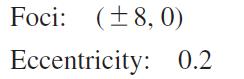
Give the foci or vertices and the eccentricities of ellipses centered at the origin of the xy-plane. In each case, find the ellipse’s standard-form equation in Cartesian coordinates. Foci: (+8, 0) Eccentricity: 0.2
Identify the symmetries of the curves. Then sketch the curves in the xy-plane.r2 = cos θ
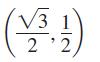
Find the polar coordinates, -π ≤ θ a. (-2, 0) b. (1, 0)c. (0, -3) d. √3 1 22 −2
Give equations of parabolas. Find each parabola’s focus and directrix. Then sketch the parabola. Include the focus and directrix in your sketch.y2 = 12x
Find the polar coordinates, 0 ≤ θ < 2π and r ≤ 0, of the following points given in Cartesian coordinates.a. (3, 3) b. (-1, 0)c. (-1, √3) d. (4, -3)
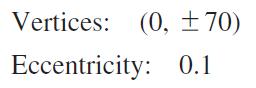
Give the foci or vertices and the eccentricities of ellipses centered at the origin of the xy-plane. In each case, find the ellipse’s standard-form equation in Cartesian coordinates. Vertices: (0, +70) Eccentricity: 0.1
Find an equation for the line tangent to the curve at the point defined by the given value of t. Also, find the value of d2y/dx2 at this point.x = 1/t, y = -2 + ln t, t = 1
Find the areas of the region.Shared by the circles r = 1 and r = 2 sin θ
What consequence does the lack of uniqueness of polar coordinates have for graphing? Give an example.
Find an equation for the line in the xy-plane that is tangent to the curve at the point corresponding to the given value of t. Also, find the value of d2y/dx2 at this point.x = 1 + 1/t2, y = 1 - 3/t; t = 2
Identify the symmetries of the curves. Then sketch the curves in the xy-plane.r2 = sin θ
Give parametric equations and parameter intervals for the motion of a particle in the xy-plane. Identify the particle’s path by finding a Cartesian equation for it. Graph the Cartesian equation. Indicate the portion of the graph traced by the particle and the direction of motion.x = 1 + sin t, y
Give equations of parabolas. Find each parabola’s focus and directrix. Then sketch the parabola. Include the focus and directrix in your sketch.x2 = 6y
How do you graph equations in polar coordinates? Include in your discussion symmetry, slope, behavior at the origin, and the use of Cartesian graphs. Give examples.
Find an equation for the line tangent to the curve at the point defined by the given value of t. Also, find the value of d2y/dx2 at this point.x = t - sin t, y = 1 - cos t, t = π/3
Identify the symmetries of the curves. Then sketch the curves in the xy-plane.r2 = -sin θ
Give parametric equations and parameter intervals for the motion of a particle in the xy-plane. Identify the particle’s path by finding a Cartesian equation for it. Graph the Cartesian equation. Indicate the portion of the graph traced by the particle and the direction of motion.x = t2, y = t6 -
Find the areas of the region.Shared by the circle r = 2 and the cardioid r = 2(1 - cos θ)
Eliminate the parameter to express the curve in the form y = ƒ(x).a. x = 4t2, y = t3 - 1b. x = cos t, y = tan t
Give equations of parabolas. Find each parabola’s focus and directrix. Then sketch the parabola. Include the focus and directrix in your sketch.x2 = -8y
Graph the sets of points whose polar coordinates satisfy the equations and inequalitie.r = 2
What points in the xy-plane satisfy the equations and inequalities? Draw a figure for each exercise.(x2 - y2 - 1)(x2 + y2 - 25)(x2 + 4y2 - 4) = 0
Find an equation for the line tangent to the curve at the point defined by the given value of t. Also, find the value of d2y/dx2 at this point.x = cos t, y = 1 + sin t, t = π/2
How do you find the area of a region 0 ≤ r1(θ) ≤ r ≤ r2(θ), α ≤ θ ≤ β, in the polar coordinate plane? Give examples.
Find the areas of the region.Shared by the cardioids r = 2(1 + cos θ) and r = 2(1 - cos θ)
Give parametric equations and parameter intervals for the motion of a particle in the xy-plane. Identify the particle’s path by finding a Cartesian equation for it. Graph the Cartesian equation. Indicate the portion of the graph traced by the particle and the direction of motion. X t t -
Identify the symmetries of the curves. Then sketch the curves in the xy-plane.r2 = -cos θ
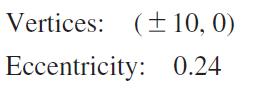
Give the foci or vertices and the eccentricities of ellipses centered at the origin of the xy-plane. In each case, find the ellipse’s standard-form equation in Cartesian coordinates. Vertices: (10,0) Eccentricity: 0.24
Give equations of parabolas. Find each parabola’s focus and directrix. Then sketch the parabola. Include the focus and directrix in your sketch.y2 = -2x
Graph the sets of points whose polar coordinates satisfy the equations and inequalitie.0 ≤ r ≤ 2
What are Taylor polynomials? Of what use are they?
Express each of the numbers as the ratio of two integers. 1.414 = 1.414 414 414 ...
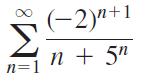
Which of the series converge absolutely, which converge, and which diverge? Give reasons for your answers. n=1 (-2)n+1 n + 5”
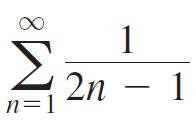
Which of the series converge, and which diverge? Give reasons for your answers. n=1 1 2n - 1
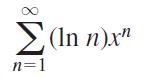
(a) Find the series’ radius and interval of convergence. For what values of x does the series converge (b) Absolutely, (c) Conditionally? Σ(In n)xn n=1
Use power series operations to find the Taylor series at x = 0 for the function.sin x · cos x
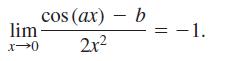
Find values of a and b for which cos (ax) - b 2x² lim- x-0 = - 1.
What is the Taylor series generated by a function ƒ(x) at a point x = a? What information do you need about ƒ to construct the series? Give an example.
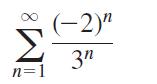
Use any method to determine if the series converges or diverges. Give reasons for your answer. 8 Σ n=1 (-2)" 3n
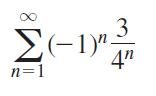
Find the sums of the serie. 3 1n ∑(-1)"; n=1
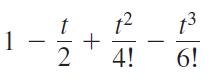
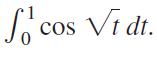
Estimate the error if cos √t is approximated byin the integral t 1 2 4! 6!
Express each of the numbers as the ratio of two integers. 1.24123 = 1.24 123 123 123 ...
Find the Taylor series generated by ƒ at x = a.ƒ(x) = 2x3 + x2 + 3x - 8, a = 1
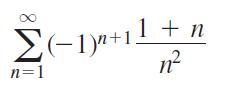
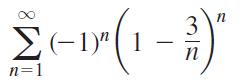
Which of the series converge absolutely, which converge, and which diverge? Give reasons for your answers. Σ(−1)n+1¹+n n² n=1
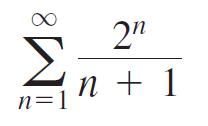
Which of the series converge, and which diverge? Give reasons for your answers. n=1 2n n + 1
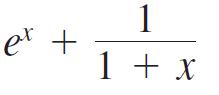
Use power series operations to find the Taylor series at x = 0 for the function. et + 1 1 + x
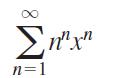
(a) Find the series’ radius and interval of convergence. For what values of x does the series converge (b) Absolutely, (c) Conditionally? Σπχ" |=u
Use any method to determine if the series converges or diverges. Give reasons for your answer. Σ(1)" n=1 n 3 n
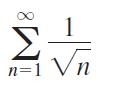
Which of the series converge absolutely, which converge conditionally, and which diverge? Give reasons for your answers. χ 1 Σ n=1 Vn
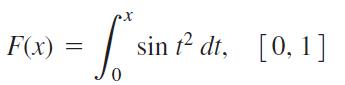
Find a polynomial that will approximate F(x) throughout the given interval with an error of magnitude less than 10-3. = √² si 0 F(x) = sin t² dt, [0, 1]
Find the Taylor series generated by ƒ at x = a.ƒ(x) = x4 + x2 + 1, a = -2
Express each of the numbers as the ratio of two integers. 3.142857 3.142857 142857 ...
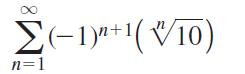
Which of the series converge absolutely, which converge, and which diverge? Give reasons for your answers. Σ(−1)"+1(310) n=1
Which of the series converge, and which diverge? Give reasons for your answers. n=1 1 + n n
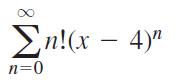
(a) Find the series’ radius and interval of convergence. For what values of x does the series converge (b) Absolutely, (c) Conditionally? Σn!(x − 4)" n=0
Use power series operations to find the Taylor series at x = 0 for the function.cos x - sin x
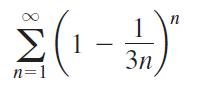
Use any method to determine if the series converges or diverges. Give reasons for your answer. 00 n=1 n 1 3n
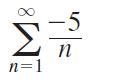
Which of the series converge absolutely, which converge conditionally, and which diverge? Give reasons for your answers. Σ n=1 -5 η
Find the Taylor series generated by ƒ at x = a.ƒ(x) = 3x5 - x4 + 2x3 + x2 - 2, a = -1
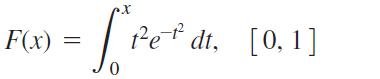
Find a polynomial that will approximate F(x) throughout the given interval with an error of magnitude less than 10-3. F(x) = X [fet dr. te dt, [0, 1] 0
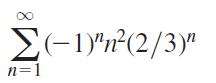
Which of the series converge absolutely, which converge, and which diverge? Give reasons for your answers. Σ(-1)"n?(2/3)" _n=1
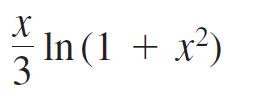
Use power series operations to find the Taylor series at x = 0 for the function. X 3 In (1 + x²)
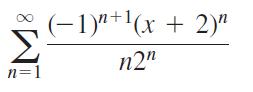
(a) Find the series’ radius and interval of convergence. For what values of x does the series converge (b) Absolutely, (c) Conditionally? n=1 (-1)n+¹(x + 2)n n2n
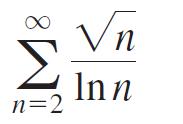
Which of the series converge, and which diverge? Give reasons for your answers. 8 n=2 Vn Inn
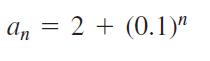
Which of the sequences {an} converge, and which diverge? Find the limit of each convergent sequence. an 2 (0.1)" = +
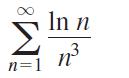
Use any method to determine if the series converges or diverges. Give reasons for your answer. n=1 In n n³
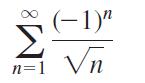
Which of the series converge absolutely, which converge conditionally, and which diverge? Give reasons for your answers. (-1)" Σ Vn M8 n=1
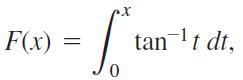
Find a polynomial that will approximate F(x) throughout the given interval with an error of magnitude less than 10-3.(a) [0, 0.5] (b) [0, 1] F(x) = So 0 tan-¹t dt,
Find the Taylor series generated by ƒ at x = a.ƒ(x) = 1/x2, a = 1
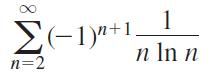
Which of the series converge absolutely, which converge, and which diverge? Give reasons for your answers. ∞ 1 n ln n Σ(-1)+1. n=2
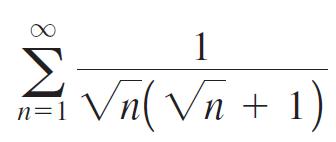
Which of the series converge, and which diverge? Give reasons for your answers. Σ n=1 1 Vn( √n + 1)
Use power series operations to find the Taylor series at x = 0 for the function.ln (1 + x) - ln (1 - x)
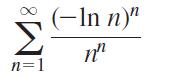
Use any method to determine if the series converges or diverges. Give reasons for your answer. (-In n)" Σ m n=1
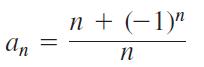
Which of the sequences {an} converge, and which diverge? Find the limit of each convergent sequence. an n+ (−1)n n
What is Taylor’s formula? What does it say about the errors involved in using Taylor polynomials to approximate functions? In particular, what does Taylor’s formula say about the error in a linearization? A quadratic approximation?
Find the Taylor series generated by ƒ at x = a.ƒ(x) = 1/(1 - x)3, a = 0
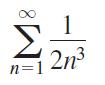
Which of the series converge absolutely, which converge conditionally, and which diverge? Give reasons for your answers. x 1 Σ 2n³ n=1
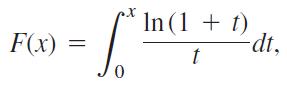
Find a polynomial that will approximate F(x) throughout the given interval with an error of magnitude less than 10-3.(a) [0, 0.5] (b) [0, 1] F(x) = 0 In (1 + 1) t -dt,
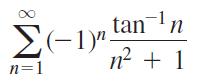
Which of the series converge absolutely, which converge, and which diverge? Give reasons for your answers. ∞ tan n Σ(1)"! n² + 1 n=1
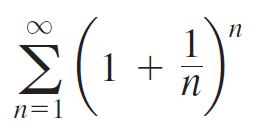
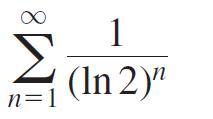
Which of the series converge, and which diverge? Give reasons for your answers. ∞ n=1 1 (In 2)"
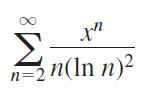
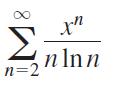
(a) Find the series’ radius and interval of convergence. For what values of x does the series converge (b) Absolutely, (c) Conditionally? xn Σ n=2 n(In n)2
Find the first four nonzero terms in the Maclaurin series for the function.ex sin x
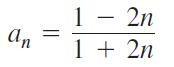
Which of the sequences {an} converge, and which diverge? Find the limit of each convergent sequence. an || 1 2n 1 + 2n
Use any method to determine if the series converges or diverges. Give reasons for your answer. Σ n=1 η n
What is the binomial series? On what interval does it converge? How is it used?
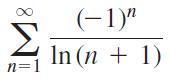
Which of the series converge absolutely, which converge conditionally, and which diverge? Give reasons for your answers. n=1 (-1)" In (n + 1)
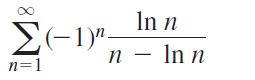
Which of the series converge absolutely, which converge, and which diverge? Give reasons for your answers. Σ(1)". n=1 n In n - In n
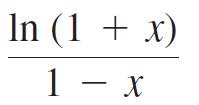
Find the first four nonzero terms in the Maclaurin series for the function. In (1 + x) 1 - X
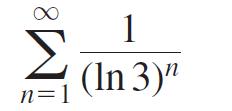
Which of the series converge, and which diverge? Give reasons for your answers. x n=1 1 n (In 3)"
Find the Taylor series generated by ƒ at x = a.ƒ(x) = ex, a = 2
(a) Find the series’ radius and interval of convergence. For what values of x does the series converge (b) Absolutely, (c) Conditionally? ∞ Σ n=2 -n nlnn
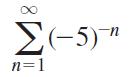
Which of the series converge absolutely, which converge, and which diverge? Give reasons for your answers. Σ(5) " n=1
Showing 9100 - 9200
of 29454
First
85
86
87
88
89
90
91
92
93
94
95
96
97
98
99
Last
Step by Step Answers

 Get 50% OFF
Claim Now
Get 50% OFF
Claim Now