New Semester
Started
Get
50% OFF
Study Help!
--h --m --s
Claim Now
Question Answers
Textbooks
Find textbooks, questions and answers
Oops, something went wrong!
Change your search query and then try again
S
Books
FREE
Study Help
Expert Questions
Accounting
General Management
Mathematics
Finance
Organizational Behaviour
Law
Physics
Operating System
Management Leadership
Sociology
Programming
Marketing
Database
Computer Network
Economics
Textbooks Solutions
Accounting
Managerial Accounting
Management Leadership
Cost Accounting
Statistics
Business Law
Corporate Finance
Finance
Economics
Auditing
Tutors
Online Tutors
Find a Tutor
Hire a Tutor
Become a Tutor
AI Tutor
AI Study Planner
NEW
Sell Books
Search
Search
Sign In
Register
study help
mathematics
precalculus
Thomas Calculus Early Transcendentals 13th Edition Joel R Hass, Christopher E Heil, Maurice D Weir - Solutions
Sketch the surfaces.16x2 + 4y2 = 1
Find the distance from the point to the line.(2, 1, -1); x = 2t, y = 1 + 2t, z = 2t
Use the result of Exercise 32 to find an equation for the line through P parallel to v. Then sketch the line. Include v in your sketch as a vector starting at the origin.P(-2, 1), v = i - jExercise 32Show that the vector v = ai + bj is parallel to the line bx - ay = c by establishing that the slope
Find the areas of the parallelograms whose vertices are given.A(-1, 2), B(2, 0), C(7, 1), D(4, 3)
Write inequalities to describe the set.The half-space consisting of the points on and below the xy-plane
Sketch the surfaces.x2 + y2 - z2 = 4
Ifand B is the point (5, 1, 3), find A. AB = i +4j - 2k
Find the distance from the point to the line.(3, -1, 4); x = 4 - t, y = 3 + 2t, z = -5 + 3t
Use the result of Exercise 32 to find an equation for the line through P parallel to v. Then sketch the line. Include v in your sketch as a vector starting at the origin.P(0, -2), v = 2i + 3jExercise 32Show that the vector v = ai + bj is parallel to the line bx - ay = c by establishing that the
Find the areas of the parallelograms whose vertices are given.A(-6, 0), B(1, -4), C(3, 1), D(-4, 5)
Write inequalities to describe the set.The upper hemisphere of the sphere of radius 1 centered at the origin
Sketch the surfaces.x2 + z2 = y
Find the distance from the point to the line.(-1, 4, 3); x = 10 + 4t, y = -3, z = 4t
Find the distance from the point to the plane.(2, -3, 4), x + 2y + 2z = 13
Use the result of Exercise 32 to find an equation for the line through P parallel to v. Then sketch the line. Include v in your sketch as a vector starting at the origin.P(1, 2), v = -i - 2jExercise 32Show that the vector v = ai + bj is parallel to the line bx - ay = c by establishing that the
Ifand A is the point (-2, -3, 6), find B. AB = -7i+ 3j + 8k
Find the points in which the line x = 1 + 2t, y = -1 - t, z = 3t meets the three coordinate planes.
Find the areas of the parallelograms whose vertices are given.A(0, 0, 0), B(3, 2, 4), C(5, 1, 4), D(2, -1, 0)
Write inequalities to describe the set.The (a) Interior and (b) Exterior of the sphere of radius 1 centeredat the point (1, 1, 1)
Sketch the surfaces.x2 + z2 = 1
Find the distance from the point to the plane.(0, 0, 0), 3x + 2y + 6z = 6
Use the result of Exercise 32 to find an equation for the line through P parallel to v. Then sketch the line. Include v in your sketch as a vector starting at the origin.P(1, 3), v = 3i - 2jExercise 32Show that the vector v = ai + bj is parallel to the line bx - ay = c by establishing that the
Find the point in which the line through the origin perpendicular to the plane 2x - y - z = 4 meets the plane 3x - 5y + 2z = 6.
Find the areas of the parallelograms whose vertices are given.A(1, 0, -1), B(1, 7, 2), C(2, 4, -1), D(0, 3, 2)
Sketch the surfaces.16y2 + 9z2 = 4x2
Find the distance from the point to the plane.(0, 1, 1), 4y + 3z = -12
Find the work done by a force F = 5i (magnitude 5 N) in moving an object along the line from the origin to the point (1, 1).
Find the acute angle between the planes x = 7 and x + y + √2z = -3.
Let u = 2i + j, v = i + j, and w = i - j. Find scalars a and b such that u = av + bw.
Find the distance between points P1 and P2.P1(1, 1, 1), P2(3, 3, 0)
Find the areas of the triangles whose vertices are given.A(0, 0), B(-2, 3), C(3, 1)
Sketch the surfaces.z = -(x2 + y2)
Find the distance from the point to the plane.(2, 2, 3), 2x + y + 2z = 4
The Union Pacific’s Big Boy locomotive could pull 6000-ton trains with a tractive effort (pull) of 602,148 N (135,375 lb). At this level of effort, about how much work did Big Boy do on the (approximately straight) 605-km journey from San Francisco to Los Angeles?
Find the acute angle between the planes x + y = 1 and y + z = 1.
Let u = i - 2j, v = 2i + 3j, and w = i + j. Write u = u1 + u2, where u1 is parallel to v and u2 is parallel to w.
Find the areas of the triangles whose vertices are given.A(-1, -1), B(3, 3), C(2, 1)
Find the distance between points P1 and P2.P1(-1, 1, 5), P2(2, 5, 0)
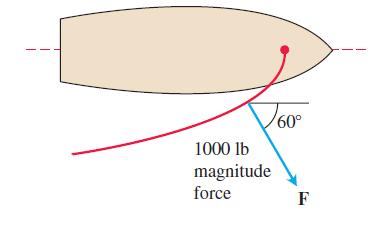
The wind passing over a boat’s sail exerted a 1000-lb magnitude force F as shown here. How much work did the wind perform in moving the boat forward 1 mi? Answer in foot-pounds. 1000 lb magnitude force 60° F
Sketch the surfaces.y2 - x2 - z2 = 1
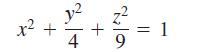
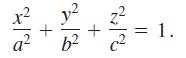
a. Express the area A of the cross-section cut from the ellipsoidby the plane z = c as a function of c.b. Use slices perpendicular to the z-axis to find the volume of the ellipsoid in part (a).c. Now find the volume of the ellipsoidDoes your formula give the volume of a sphere of radius a if a = b
Find the distance from the point to the plane.(0, -1, 0), 2x + y + 2z = 4
How much work does it take to slide a crate 20 m along a loading dock by pulling on it with a 200-N force at an angle of 30° from the horizontal?
Find parametric equations for the line in which the planes x + 2y + z = 1 and x - y + 2z = -8 intersect.
An airplane is flying in the direction 25° west of north at 800 km / h. Find the component form of the velocity of the airplane, assuming that the positive x-axis represents due east and the positive y-axis represents due north.
Find the areas of the triangles whose vertices are given.A(-5, 3), B(1, -2), C(6, -2)
Find the distance between points P1 and P2.P1(1, 4, 5), P2(4, -2, 7)
Sketch the surfaces.4y2 + z2 - 4x2 = 4
Find the distance from the point to the plane.(1, 0, -1), -4x + y + z = 4
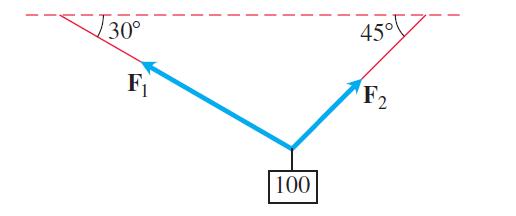
Consider a 100-N weight suspended by two wires as shown in the accompanying figure. Find the magnitudes and components of the force vectors F1 and F2. 30° F₁ 100 45° F₂
Show that the line in which the planes x + 2y - 2z = 5 and 5x - 2y - z = 0 intersect is parallel to the line x = -3 + 2t, y = 3t, z = 1 + 4t.
Find the areas of the triangles whose vertices are given.A(-6, 0), B(10, -5), C(-2, 4)
Find the distance between points P1 and P2.P1(3, 4, 5), P2(2, 3, 4)
Find the distance from the plane x + 2y + 6z = 1 to the plane x + 2y + 6z = 10.
The planes 3x + 6z = 1 and 2x + 2y - z = 3 intersect in a line.a. Show that the planes are orthogonal.b. Find equations for the line of intersection.
Find the areas of the triangles whose vertices are given.A(1, 0, 0), B(0, 2, 0), C(0, 0, -1)
Find the distance between points P1 and P2.P1(0, 0, 0), P2(2, -2, -2)
Find the distance from the line x = 2 + t, y = 1 + t, z = -(1/2) - (1/2)t to the plane x + 2y + 6z = 10.
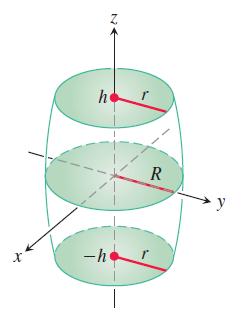
The barrel shown here is shaped like an ellipsoid with equal pieces cut from the ends by planes perpendicular to the z-axis. The crosssections perpendicular to the z-axis are circular. The barrel is 2h units high, its midsection radius is R, and its end radii are both r. Find a formula for the
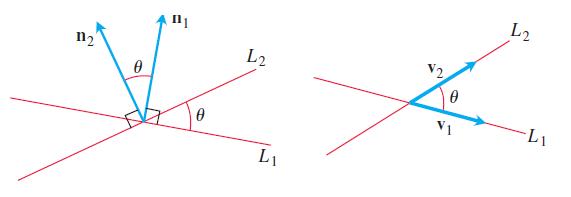
that do not cross at right angles is the same as the angle determined by vectors normal to the lines or by the vectors parallel to the lines.Use this fact and the results of Exercise 31 or 32 to find the acute angles between the lines.y = √3x - 1, y = -√3x + 2Exercise 31Show that v = ai + bj is
Find an equation for the plane that passes through the point (1, 2, 3) parallel to u = 2i + 3j + k and v = i - j + 2k.
Find the centers and radii of the sphere.(x + 2)2 + y2 + (z - 2)2 = 8
Find the centers and radii of the sphere. (x - 1)² + y + 2 + (z + 3)² = 25
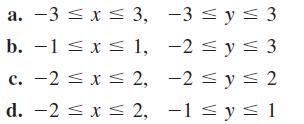
Plot the surfaces over the indicated domains. If you can, rotate the surface into different viewing positions.z = y2, -2 ≤ x ≤ 2, -0.5 ≤ y ≤ 2 a. -3 ≤ x ≤ 3, b. -1 ≤ x ≤ 1, c. -2 ≤ x ≤ 2, d. 2 ≤ x ≤ 2, -3 ≤ y ≤ 3 -2 ≤ y ≤ 3 -2≤ y ≤ 2 -1 ≤ y ≤ 1
Use a calculator to find the acute angles between the planes to the nearest hundredth of a radian.2x + 2y + 2z = 3, 2x - 2y - z = 5
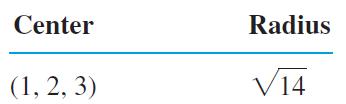
Find equations for the spheres whose centers and radii are given. Center (1, 2, 3) Radius V14
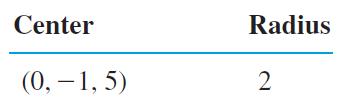
Find equations for the spheres whose centers and radii are given. Center (0, -1,5) Radius 2
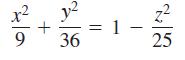
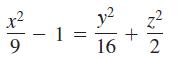
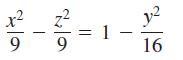
Use a CAS to plot the surface. Identify the type of quadric surface from your graph. + || 1 -
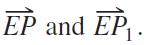
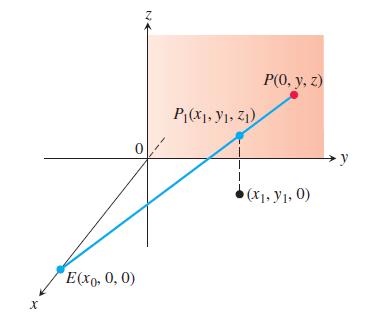
In computer graphics and perspective drawing, we need to represent objects seen by the eye in space as images on a two-dimensional plane. Suppose that the eye is at E(x0, 0, 0) as shown here and that we want to represent a point P1(x1, y1, z1) as a point on the yz-plane. We do this by projecting P1
Here is another typical problem in computer graphics. Your eye is at (4, 0, 0). You are looking at a triangular plate whose vertices are at (1, 0, 1), (1, 1, 0), and (-2, 2, 2). The line segment from (1, 0, 0) to (0, 2, 2) passes through the plate. What portion of the line segment is hidden from
Suppose L1 and L2 are disjoint (nonintersecting) nonparallel lines. Is it possible for a nonzero vector to be perpendicular to both L1 and L2? Give reasons for your answer.
The graph of (x/a) + (y/b) + (z/c) = 1 is a plane for any nonzero numbers a, b, and c. Which planes have an equation of this form?
Find a plane through the origin that is perpendicular to the plane M: 2x + 3y + z = 12 in a right angle. How do you know that your plane is perpendicular to M?
Find two different planes whose intersection is the line x = 1 + t, y = 2 - t, z = 3 + 2t . Write equations for each plane in the form Ax + By + Cz = D.
How can you tell when two planes A1x + B1y + C1z = D1 and A2x + B2y + C2z = D2 are parallel? Perpendicular? Give reasons for your answer.
Use Equations (3) to generate a parametrization of the line through P(2, -4, 7) parallel to v1 = 2i - j + 3k. Then generate another parametrization of the line using the point P2(-2, -2, 1) and the vector v2 = -i + (1/2)j - (3/2)k. x = xo + tv₁, y = yo + tv₂, Z = Zo + tv3, -∞0 < t
Use a CAS to plot the surface. Identify the type of quadric surface from your graph. - 영 +
Is the line x = 1 - 2t, y = 2 + 5t, z = -3t parallel to the plane 2x + y - z = 8? Give reasons for your answer.
Given two lines in space, either they are parallel, they intersect, or they are skew (lie in parallel planes). Determine whether the lines, taken two at a time, are parallel, intersect, or are skew. If they intersect, find the point of intersection. Otherwise, find the distance between the two
Find the point equidistant from the points (0, 0, 0), (0, 4, 0), (3, 0, 0), and (2, 2, -3).
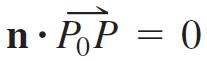
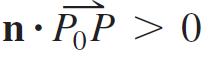
The equationrepresents the plane through P0 normal to n. What set does the inequalityrepresent? n. PP = 0
Given two lines in space, either they are parallel, they intersect, or they are skew (lie in parallel planes). Determine whether the lines, taken two at a time, are parallel, intersect, or are skew. If they intersect, find the point of intersection. Otherwise, find the distance between the two
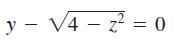
Use a CAS to plot the surface. Identify the type of quadric surface from your graph. y-√4-z² = 0 V4
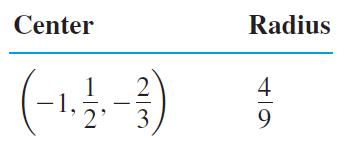
Find equations for the spheres whose centers and radii are given. Center 2 (-1.-/-/-/-) 3 Radius 419
Use a CAS to plot the surface. Identify the type of quadric surface from your graph. 16 18 - || 1
Find equations for the line in the plane z = 3 that makes an angle of π/6 rad with i and an angle of π/3 rad with j. Describe the reasoning behind your answer.
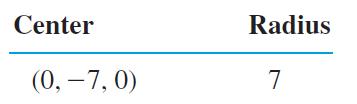
Find equations for the spheres whose centers and radii are given. Center (0, -7,0) Radius 7
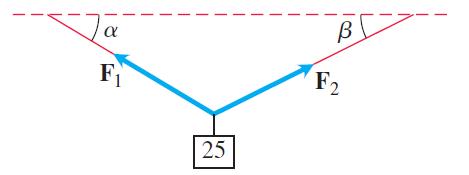
Consider a 25-N weight suspended by two wires as shown in the accompanying figure. If the magnitudes of vectors F1 and F2 are both 75 N, then angles α and β are equal. Find α. Ja F₁ 25 B F₂
Find the point on the sphere x2 + (y - 3)2 + (z + 5)2 = 4 nearesta. The xy-plane. b. The point (0, 7, -5).
Find the points in which the line x = 1 + 2t, y = -1 - t, z = 3t meets the coordinate planes. Describe the reasoning behind your answer.
Find an equation for the set of all points equidistant from the point (0, 0, 2) and the xy-plane.
Use the component form to generate an equation for the plane through P1(4, 1, 5) normal to n1 = i - 2j + k. Then generate another equation for the same plane using the point P2(3, -2, 0) and the normal vector n2 = -√2i + 2√2j - √2k.
Find an equation for the set of all points equidistant from the planes y = 3 and y = -1.
Show that the point P(3, 1, 2) is equidistant from the points A(2, -1, 3) and B(4, 3, 1).
Find the perimeter of the triangle with vertices A(-1, 2, 1), B(1, -1, 3), and C(3, 4, 5).
Find the centers and radii of the spheres.2x2 + 2y2 + 2z2 + x + y + z = 9
Find parametrizations for the lines in which the planes intersect.5x - 2y = 11, 4y - 5z = -17
Find a formula for the distance from the point P(x, y, z) to thea. xy-plane. b. yz-plane. c. xz-plane.
Find the point in which the line meets the plane.x = 1 - t, y = 3t, z = 1 + t; 2x - y + 3z = 6
Find a formula for the distance from the point P(x, y, z) to thea. x-axis. b. y-axis. c. z-axis.
Showing 8800 - 8900
of 29454
First
82
83
84
85
86
87
88
89
90
91
92
93
94
95
96
Last
Step by Step Answers

 Get 50% OFF
Claim Now
Get 50% OFF
Claim Now