New Semester
Started
Get
50% OFF
Study Help!
--h --m --s
Claim Now
Question Answers
Textbooks
Find textbooks, questions and answers
Oops, something went wrong!
Change your search query and then try again
S
Books
FREE
Study Help
Expert Questions
Accounting
General Management
Mathematics
Finance
Organizational Behaviour
Law
Physics
Operating System
Management Leadership
Sociology
Programming
Marketing
Database
Computer Network
Economics
Textbooks Solutions
Accounting
Managerial Accounting
Management Leadership
Cost Accounting
Statistics
Business Law
Corporate Finance
Finance
Economics
Auditing
Tutors
Online Tutors
Find a Tutor
Hire a Tutor
Become a Tutor
AI Tutor
AI Study Planner
NEW
Sell Books
Search
Search
Sign In
Register
study help
mathematics
precalculus
Thomas Calculus Early Transcendentals 13th Edition Joel R Hass, Christopher E Heil, Maurice D Weir - Solutions
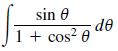
Find or evaluate the integral. sin 1 + cos²0 de
Find the centroid of the region bounded by the graphs of the inequalities. y ≤ 3 √x² +9 ننا y ≥ 0, x ≥ 4, x ≤ 4
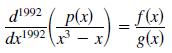
Let p(x) be a nonzero polynomial of degree less than 1992 having no non constant factor in common with x3 - x. Letfor polynomials f (x) and g(x). Find the smallest possible degree of f (x). (x)d 2661P dx-1992 1.₂³ x = g(x)
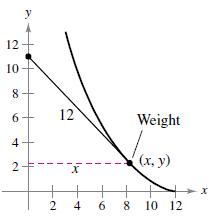
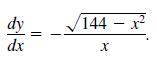
A person moves from the origin along the positive y-axis pulling a weight at the end of a 12-meter rope (see figure). Initially, the weight is located at the point (12, 0).(a) Show that the slope of the tangent line of the path of the weight is(b) Use the result of part (a) to find the equation of
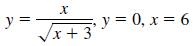
Find the area of the region bounded by the graphs of the equations. y = X √x + 3 y = 0, x = 6
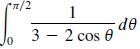
Find or evaluate the integral. *π/2 10 1 3-2 cos e de
Find the centroid of the region bounded by the graphs of the inequalities. y ≤ x², (x − 4)² + y² ≤ 16, y ≥ 0 <
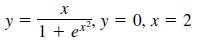
Find the area of the region bounded by the graphs of the equations. y = X 1 + et²) , y = 0, x = 2
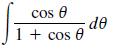
Find or evaluate the integral. COS 1 + cos 0 de
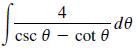
Find or evaluate the integral. 4 csc 8-cot - de 8
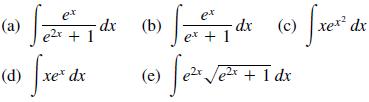
State the method or integration formula you would use to find the antiderivative. Explain why you chose that method or formula. Do not integrate. ex e²x + 1 (a) (4) fxe dx dx (b) ex fecet (e) ex + 1 2) fe²². dx (c) [xer² /e²x + 1 dx dx
Consider the region bounded by the graphs of y = x√16 - x2, y = 0, x = 0, and x = 4.Find the volume of the solid generated by revolving the region about the y-axis.
Each of the series is the value of the Taylor series at x = 0 of a function ƒ(x) at a particular point. What function and what point? What is the sum of the series? 2 3 - 4 8 + 18 81 2n n3n + (−1)n-1.
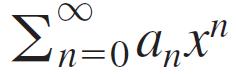
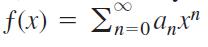
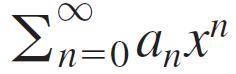
A function defined by a power serieswith a radius of convergence R > 0 has a Taylor series that converges to the function at every point of (-R, R). Show this by showing that the Taylor series generated byis the series itself.An immediate consequence of this is that series likeandobtained by
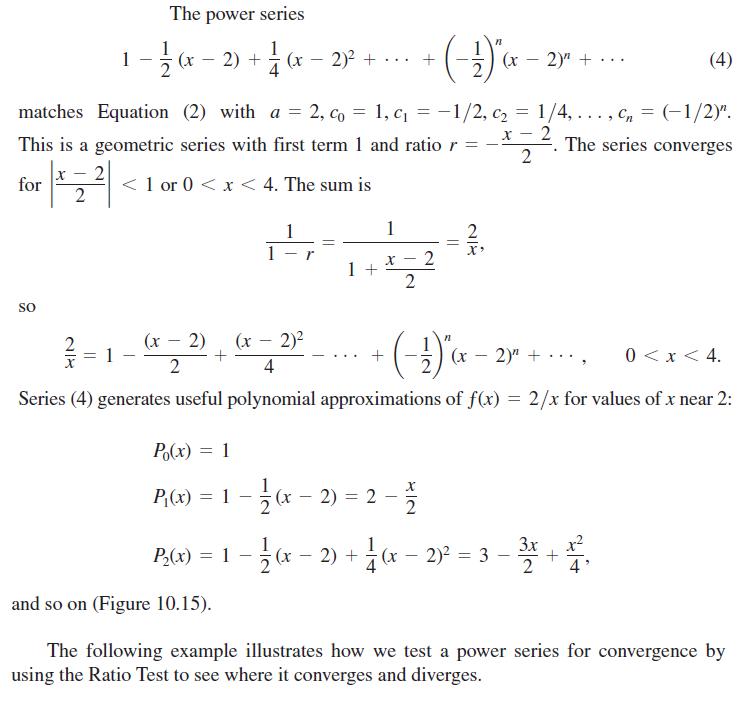
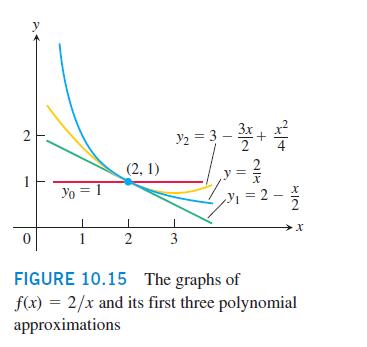
In Example 2 we represented the function ƒ(x) = 2/x as a power series about x = 2. Use a geometric series to represent ƒ(x) as a power series about x = 1, and find its interval of convergence. In Example 2In Equation 2 for SO matches This is a geometric series with first term 1 and ratio r =
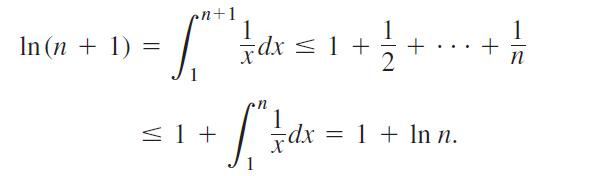
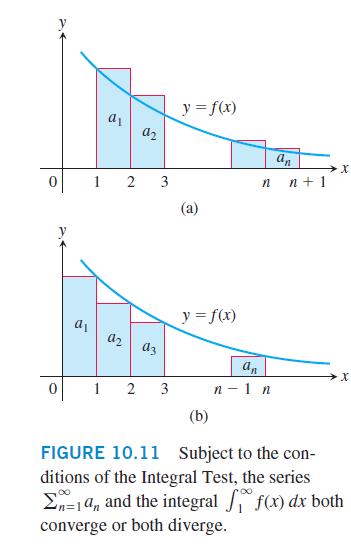
a. Draw illustrations like those in Figures 10.11a and 10.11b to show that the partial sums of the harmonic series satisfy the inequalitiesb. There is absolutely no empirical evidence for the divergence of the harmonic series even though we know it diverges. The partial sums just grow too slowly.
Find the Taylor series generated by ex at x = 1. Compare your answer with the formula in Exercise 37.Exercise 37Use the Taylor series generated by ex at x = a to show that et + 1 = - ea| 1 + (x – a) + [i (x - )2 2! + ...]
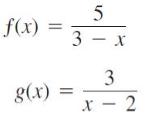
Represent the function g(x) in Exercise 50 as a power series about x = 5, and find the interval of convergence.Data from in Exercise 50Use a geometric series to represent each of the given functions as a power series about x = 0, and find their intervals of convergence. f(x) || g(x) 5 3-x X = 3 x-2
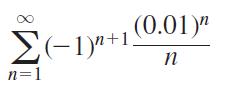
Estimate the magnitude of the error involved in using the sum of the first four terms to approximate the sum of the entire series. n=1 (0.01)n (-1)+1. n
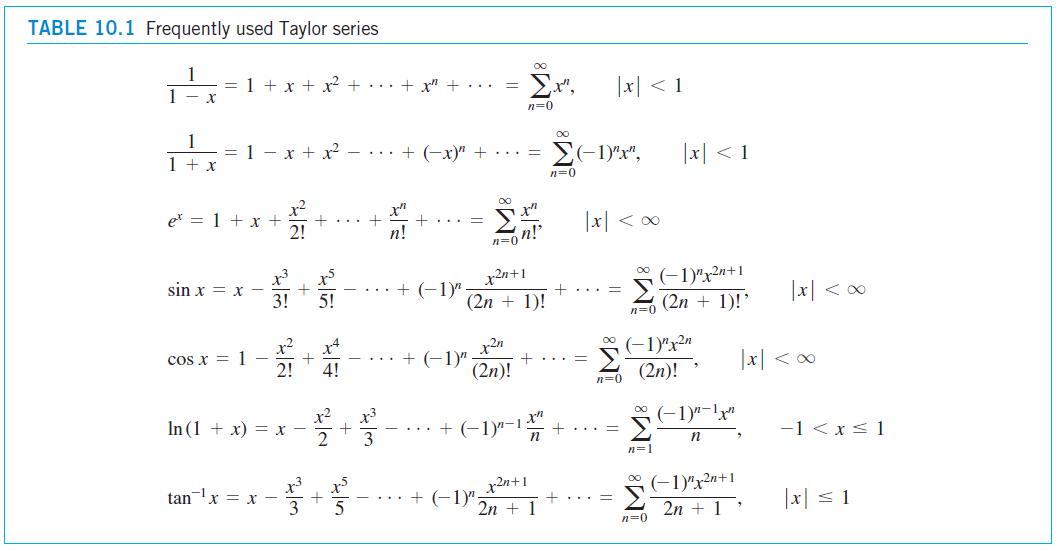
Use Table 10.1 to find the sum of each series. 1 + + + + +
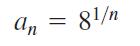
Which of the sequences {an} converge, and which diverge? Find the limit of each convergent sequence. an = 81/n =
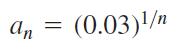
Which of the sequences {an} converge, and which diverge? Find the limit of each convergent sequence. an = (0.03)¹/n
The seriesconverges to tan x for -π/2 a. Find the first five terms of the series for ln |sec x|. For what values of x should the series converge?b. Find the first five terms of the series for sec2 x. For what values of x should this series converge?c. Check your result in part (b) by squaring the
What is a Maclaurin series?
Estimate the magnitude of the error involved in using the sum of the first four terms to approximate the sum of the entire series. 1 1 + t = Σ(1)"1", 0
Find Taylor series at x = 0 for the function. sin 2x 3
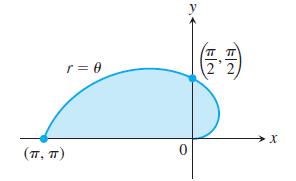
Find the areas of the region.Bounded by the spiral r = u for 0 ≤ θ ≤ π (TT, TT) r = 0 y 0 FIN X
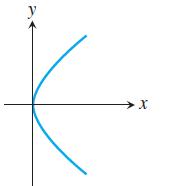
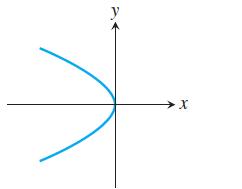
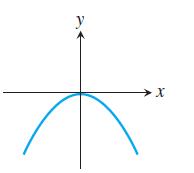
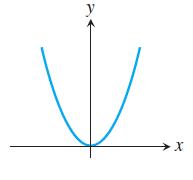
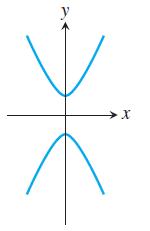
Match the parabolas with the following equations: x2 = 2y, x2 = -6y, y2 = 8x, y2 = -4x.Then find each parabola’s focus and directrix. > X
Find an equation for the line tangent to the curve at the point defined by the given value of t. Also, find the value of d2y/dx2 at this point.x = 2 cos t, y = 2 sin t, t = π/4
What is a parametrization of a curve in the xy-plane? Does a function y = ƒ(x) always have a parametrization? Are parametrizations of a curve unique? Give examples.
Give parametric equations and parameter intervals for the motion of a particle in the xy-plane. Identify the particle’s path by finding a Cartesian equation for it. Graph the Cartesian equation and indicate the direction of motion and the portion traced by the particle.x = t/2, y = t + 1; -∞
Identify the symmetries of the curves. Then sketch the curves in the xy-plane.r = 1 + cos θ
Find the eccentricity of the ellipse. Then find and graph the ellipse’s foci and directrices.16x2 + 25y2 = 400
Give parametric equations and parameter intervals for the motion of a particle in the xy-plane. Identify the particle’s path by finding a Cartesian equation for it. Graph the Cartesian equation. Indicate the portion of the graph traced by the particle and the direction of motion.x = 3t, y = 9t2,
Which polar coordinate pairs label the same point?a. (3, 0) b. (-3, 0) c. (2, 2π/3)d. (2, 7π/3) e. (-3, π) f. (2, π/3)g. (-3, 2π) h. (-2, -π/3)
Find an equation for the parabola with focus (4, 0) and directrix x = 3. Sketch the parabola together with its vertex, focus, and directrix.
Find an equation for the line tangent to the curve at the point defined by the given value of t. Also, find the value of d2y/dx2 at this point.x = sin 2πt, y = cos 2πt, t = -1/6
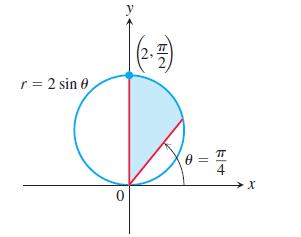
Find the areas of the region.Bounded by the circle r = 2 sin u for π/4 ≤ θ ≤ π/2 r = 2 sin 0 0 (图) 2 4 X
Match the parabolas with the following equations: x2 = 2y, x2 = -6y, y2 = 8x, y2 = -4x.Then find each parabola’s focus and directrix. y X<
Match the parabolas with the following equations: x2 = 2y, x2 = -6y, y2 = 8x, y2 = -4x.Then find each parabola’s focus and directrix. y X<
Give some typical parametrizations for lines, circles, parabolas, ellipses, and hyperbolas. How might the parametrized curve differ from the graph of its Cartesian equation?
Give parametric equations and parameter intervals for the motion of a particle in the xy-plane. Identify the particle’s path by finding a Cartesian equation for it. Graph the Cartesian equation and indicate the direction of motion and the portion traced by the particle.x = √t, y = 1 - √t; t
Identify the symmetries of the curves. Then sketch the curves in the xy-plane.r = 2 - 2 cos θ
Find the eccentricity of the ellipse. Then find and graph the ellipse’s foci and directrices.7x2 + 16y2 = 112
Give parametric equations and parameter intervals for the motion of a particle in the xy-plane. Identify the particle’s path by finding a Cartesian equation for it. Graph the Cartesian equation. Indicate the portion of the graph traced by the particle and the direction of motion.x = -√t, y = t,
Which polar coordinate pairs label the same point?a. (-2, π/3) b. (2, -π/3) c. (r, θ)d. (r, θ + π) e. (-r, θ) f. (2, -2π/3)g. (-r, θ + π) h. (-2, 2π/3)
Find an equation for the line tangent to the curve at the point defined by the given value of t. Also, find the value of d2y/dx2 at this point.x = 4 sin t, y = 2 cos t, t = π/4
Identify the symmetries of the curves. Then sketch the curves in the xy-plane.r = 1 - sin θ
Find the eccentricity of the ellipse. Then find and graph the ellipse’s foci and directrices.2x2 + y2 = 2
Give parametric equations and parameter intervals for the motion of a particle in the xy-plane. Identify the particle’s path by finding a Cartesian equation for it. Graph the Cartesian equation. Indicate the portion of the graph traced by the particle and the direction of motion.x = 2t - 5, y =
Plot the following points (given in polar coordinates). Then find all the polar coordinates of each point.a. (2, π/2) b. (2, 0)c. (-2, π/2) d. (-2, 0)
Find an equation for the curve traced by the point P(x, y) if the distance from P to the vertex of the parabola x2 = 4y is twice the distance from P to the focus. Identify the curve.
Find an equation for the line tangent to the curve at the point defined by the given value of t. Also, find the value of d2y/dx2 at this point.x = cos t, y = √3 cos t, t = 2π/3
What is the formula for the slope dy/dx of a parametrized curve x = ƒ(t), y = g(t)? When does the formula apply? When can you expect to be able to find d2y/dx2 as well? Give examples.
Find the areas of the region.Inside the cardioid r = a(1 + cos θ), a > 0
Give parametric equations and parameter intervals for the motion of a particle in the xy-plane. Identify the particle’s path by finding a Cartesian equation for it. Graph the Cartesian equation and indicate the direction of motion and the portion traced by the particle.x = -2 cos t, y = 2 sin t;
Identify the symmetries of the curves. Then sketch the curves in the xy-plane.r = 1 + sin θ
Find the eccentricity of the ellipse. Then find and graph the ellipse’s foci and directrices.2x2 + y2 = 4
Give parametric equations and parameter intervals for the motion of a particle in the xy-plane. Identify the particle’s path by finding a Cartesian equation for it. Graph the Cartesian equation. Indicate the portion of the graph traced by the particle and the direction of motion.x = 3 - 3t, y =
Match the parabolas with the following equations: x2 = 2y, x2 = -6y, y2 = 8x, y2 = -4x.Then find each parabola’s focus and directrix.
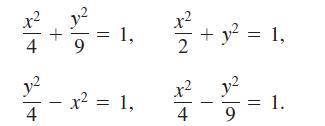
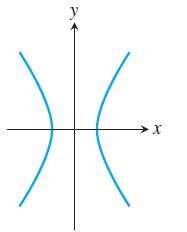
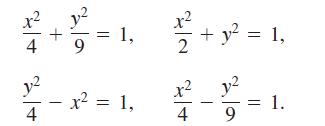
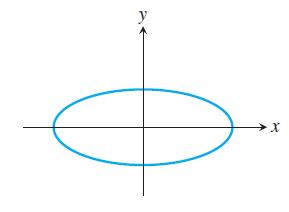
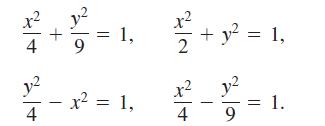
Match each conic section with one of these equations:Then find the conic section’s foci and vertices. If the conic section is a hyperbola, find its asymptotes as well. 4 + 1, x² = 1, + y = 1, y? 9 ย = 1.
Match each conic section with one of these equations:Then find the conic section’s foci and vertices. If the conic section is a hyperbola, find its asymptotes as well. 4 + 1, x² = 1, + y = 1, y? 9 ย = 1.
Plot the following points (given in polar coordinates). Then find all the polar coordinates of each point.a. (3, π/4) b. (-3, π/4)c. (3, -π/4) d. (-3, -π/4)
A line segment of length a + b runs from the x-axis to the y-axis. The point P on the segment lies a units from one end and b units from the other end. Show that P traces an ellipse as the ends of the segment slide along the axes.
Find an equation for the line tangent to the curve at the point defined by the given value of t. Also, find the value of d2y/dx2 at this point.x = t, y = √t, t = 1/4
How can you sometimes find the area bounded by a parametrized curve and one of the coordinate axes?
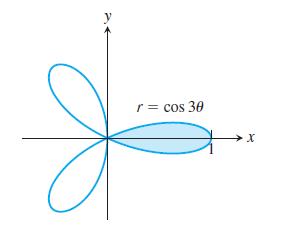
Find the areas of the region.Inside one leaf of the three-leaved rose r = cos 3θ r = cos 30 X
Find the areas of the region.Inside one leaf of the four-leaved rose r = cos 2θ
Give parametric equations and parameter intervals for the motion of a particle in the xy-plane. Identify the particle’s path by finding a Cartesian equation for it. Graph the Cartesian equation and indicate the direction of motion and the portion traced by the particle.x = -cos t, y = cos2 t; 0
Identify the symmetries of the curves. Then sketch the curves in the xy-plane.r = 2 + sin θ
Find the eccentricity of the ellipse. Then find and graph the ellipse’s foci and directrices.3x2 + 2y2 = 6
Give parametric equations and parameter intervals for the motion of a particle in the xy-plane. Identify the particle’s path by finding a Cartesian equation for it. Graph the Cartesian equation. Indicate the portion of the graph traced by the particle and the direction of motion.x = cos 2t, y =
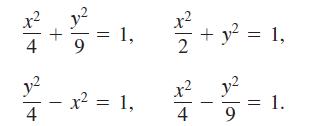
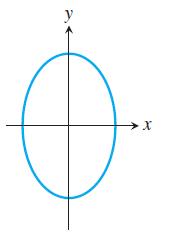
Match each conic section with one of these equations:Then find the conic section’s foci and vertices. If the conic section is a hyperbola, find its asymptotes as well. 4 + 1, x² = 1, + y = 1, y? 9 ย = 1.
Find the Cartesian coordinates of the points in Exercise 1.Data from in Exercise 1Which polar coordinate pairs label the same point?a. (3, 0) b. (-3, 0) c. (2, 2π/3)d. (2, 7π/3) e. (-3, π) f. (2, π/3)g. (-3, 2π) h. (-2, -π/3)
The vertices of an ellipse of eccentricity 0.5 lie at the points (0, ±2). Where do the foci lie?
Find an equation for the line tangent to the curve at the point defined by the given value of t. Also, find the value of d2y/dx2 at this point.x = sec2 t - 1, y = tan t, t = -π/4
How do you find the length of a smooth parametrized curve x = ƒ(t), y = g(t), a ≤ t ≤ b? What does smoothness have to do with length? What else do you need to know about the parametrization in order to find the curve’s length? Give examples.
Give parametric equations and parameter intervals for the motion of a particle in the xy-plane. Identify the particle’s path by finding a Cartesian equation for it. Graph the Cartesian equation and indicate the direction of motion and the portion traced by the particle.x = 4 cos t, y = 9 sin t; 0
Identify the symmetries of the curves. Then sketch the curves in the xy-plane.r = 1 + 2 sin θ
Find the eccentricity of the ellipse. Then find and graph the ellipse’s foci and directrices.9x2 + 10y2 = 90
Give parametric equations and parameter intervals for the motion of a particle in the xy-plane. Identify the particle’s path by finding a Cartesian equation for it. Graph the Cartesian equation. Indicate the portion of the graph traced by the particle and the direction of motion.x = cos (π - t),
Find the Cartesian coordinates of the following point.a. (√2, π/4) b. (1, 0)c. (0, π/2) d. (-√2, π/4)e. (-3, 5π/6) f. (5, tan-1(4/3))g. (-1, 7π) h. (2√3, 2π/3)
Find an equation for the ellipse of eccentricity 2 / 3 that has the line x = 2 as a directrix and the point (4, 0) as the corresponding focus.
Find an equation for the line tangent to the curve at the point defined by the given value of t. Also, find the value of d2y/dx2 at this point.x = sec t, y = tan t, t = π/6
Find parametric equations and a parameter interval for the motion of a particle in the xy-plane that traces the ellipse 16x2 + 9y2 = 144 once counterclockwise.
What is the arc length function for a smooth parametrized curve? What is its arc length differential?
Find the areas of the region.Inside one loop of the lemniscate r2 = 4 sin 2θ
Match each conic section with one of these equations:Then find the conic section’s foci and vertices. If the conic section is a hyperbola, find its asymptotes as well. 4 + 1, x² = 1, + y = 1, y? 9 ย = 1.
Identify the symmetries of the curves. Then sketch the curves in the xy-plane.r = sin (θ/2)
Find the eccentricity of the ellipse. Then find and graph the ellipse’s foci and directrices.6x2 + 9y2 = 54
Give parametric equations and parameter intervals for the motion of a particle in the xy-plane. Identify the particle’s path by finding a Cartesian equation for it. Graph the Cartesian equation. Indicate the portion of the graph traced by the particle and the direction of motion.x = 4 cos t, y =
Find the polar coordinates, 0 ≤ θ < 2π and r ≥ 0, of the following points given in Cartesian coordinates.a. (1, 1) b. (-3, 0)c. (√3, -1) d. (-3, 4)
One focus of a hyperbola lies at the point (0, -7) and the corresponding directrix is the line y = -1. Find an equation for the hyperbola if its eccentricity is (a) 2, (b) 5.
Find an equation for the line tangent to the curve at the point defined by the given value of t. Also, find the value of d2y/dx2 at this point.x = -√t + 1, y = √3t, t = 3
Under what conditions can you find the area of the surface generated by revolving a curve x = ƒ(t), y = g(t), a ≤ t ≤ b, about the x-axis? the y-axis? Give examples.
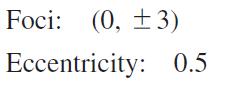
Give the foci or vertices and the eccentricities of ellipses centered at the origin of the xy-plane. In each case, find the ellipse’s standard-form equation in Cartesian coordinates. Foci: (0, 3) Eccentricity: 0.5
Find the areas of the region.Inside the six-leaved rose r2 = 2 sin 3θ
Find parametric equations and a parameter interval for the motion of a particle that starts at the point (-2, 0) in the xy-plane and traces the circle x2 + y2 = 4 three times clockwise.
Identify the symmetries of the curves. Then sketch the curves in the xy-plane.r = cos (θ/2)
Give parametric equations and parameter intervals for the motion of a particle in the xy-plane. Identify the particle’s path by finding a Cartesian equation for it. Graph the Cartesian equation. Indicate the portion of the graph traced by the particle and the direction of motion. x = sin t, y =
Showing 9000 - 9100
of 29454
First
84
85
86
87
88
89
90
91
92
93
94
95
96
97
98
Last
Step by Step Answers

 Get 50% OFF
Claim Now
Get 50% OFF
Claim Now