New Semester
Started
Get
50% OFF
Study Help!
--h --m --s
Claim Now
Question Answers
Textbooks
Find textbooks, questions and answers
Oops, something went wrong!
Change your search query and then try again
S
Books
FREE
Study Help
Expert Questions
Accounting
General Management
Mathematics
Finance
Organizational Behaviour
Law
Physics
Operating System
Management Leadership
Sociology
Programming
Marketing
Database
Computer Network
Economics
Textbooks Solutions
Accounting
Managerial Accounting
Management Leadership
Cost Accounting
Statistics
Business Law
Corporate Finance
Finance
Economics
Auditing
Tutors
Online Tutors
Find a Tutor
Hire a Tutor
Become a Tutor
AI Tutor
AI Study Planner
NEW
Sell Books
Search
Search
Sign In
Register
study help
mathematics
precalculus
Calculus Of A Single Variable 11th Edition Ron Larson, Bruce H. Edwards - Solutions
Find the centers and radii of the spheres.3x2 + 3y2 + 3z2 + 2y - 2z = 9
Find parametrizations for the lines in which the planes intersect.3x - 6y - 2z = 3, 2x + y - 2z = 2
Find the volume of a parallelepiped if four of its eight vertices are A(0, 0, 0), B(1, 2, 0), C(0, -3, 2), and D(3, -4, 5).
Find the vector from the origin to the point of intersection of the medians of the triangle whose vertices are A(1, -1, 2), B(2, 1, 3), and C(-1, 2, -1).
Show that a unit vector in the plane can be expressed as u = (cos θ)i + (sin θ)j, obtained by rotating i through an angle θ in the counterclockwise direction. Explain why this form gives every unit vector in the plane.
Use a calculator to find the acute angles between the planes to the nearest hundredth of a radian.4y + 3z = -12, 3x + 2y + 6z = 6
Is v = 2i - 4j + k related in any special way to the plane 2x + y = 5? Give reasons for your answer.
Let ABCD be a general, not necessarily planar, quadrilateral in space. Show that the two segments joining the midpoints of opposite sides of ABCD bisect each other.
Find the point in which the line meets the plane.x = 2, y = 3 + 2t, z = -2 - 2t; 6x + 3y - 4z = -12
Find parametrizations for the lines in which the planes intersect.x - 2y + 4z = 2, x + y - 2z = 5
Find parametrizations for the lines in which the planes intersect.x + y + z = 1, x + y = 2
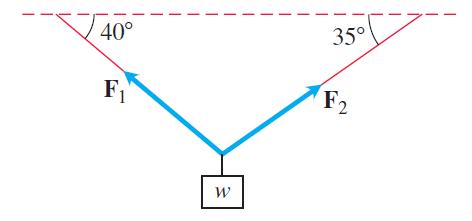
Consider a w-N weight suspended by two wires as shown in the accompanying figure. If the magnitude of vector F2 is 100 N, find w and the magnitude of vector F1. 40° F₁ W 35° F₂ I
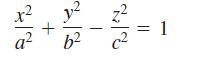
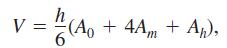
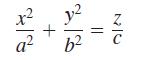
a. Find the volume of the solid bounded by the hyperboloidand the planes z = 0 and z = h, h > 0.b. Express your answer in part (a) in terms of h and the areas A0 and Ah of the regions cut by the hyperboloid from the planes z = 0 and z = h.c. Show that the volume in part (a) is also given by the
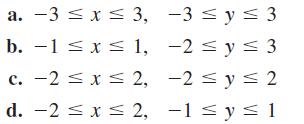
Plot the surfaces over the indicated domains. If you can, rotate the surface into different viewing positions.z = x2 + 2y2 over a. -3 ≤ x ≤ 3, b. -1 ≤ x ≤ 1, c. -2 ≤ x ≤ 2, d. 2 ≤ x ≤ 2, -3 ≤ y ≤ 3 -2 ≤ y ≤ 3 -2≤ y ≤ 2 -1 ≤ y ≤ 1
Find the angles between the planes.5x + y - z = 10, x - 2y + 3z = -1
Vectors are drawn from the center of a regular n-sided polygon in the plane to the vertices of the polygon. Show that the sum of the vectors is zero.
Find the areas of the triangles whose vertices are given.A(1, -1, 1), B(0, 1, 1), C(1, 0, -1)
Show that the volume of the segment cut from the paraboloidby the plane z = h equals half the segment’s base times its altitude. || 12 +
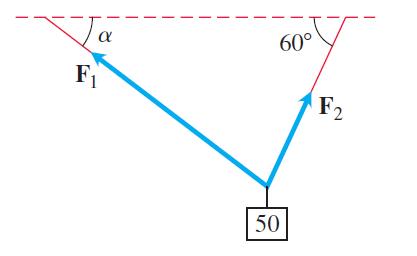
Consider a 50-N weight suspended by two wires as shown in the accompanying figure. If the magnitude of vector F1 is 35 N, find angle α and the magnitude of vector F2. α F₁ 60° 50 F2
Find the angles between the planes.x + y = 1, 2x + y - 2z = 2
Find the distance between points P1 and P2.P1(5, 3, -2), P2(0, 0, 0)
Find the areas of the triangles whose vertices are given.A(0, 0, 0), B(-1, 1, -1), C(3, 0, 3)
Why is completing the square useful when you are considering integration by trigonometric substitution?
In your own words, explain how to solve a basic equation obtained in a partial fraction decomposition that involves quadratic factors.
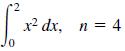
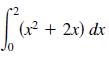
Use the Trapezoidal Rule and Simpson’s Rule to approximate the value of the definite integral for the given value of n. Round your answer to four decimal places and compare the results with the exact value of the definite integral. x² dx, n = 4
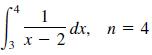
Use the Trapezoidal Rule and Simpson’s Rule to approximate the value of the definite integral for the given value of n. Round your answer to four decimal places and compare the results with the exact value of the definite integral. 1 J3 √3 x - 2 dx, dx, n = 4
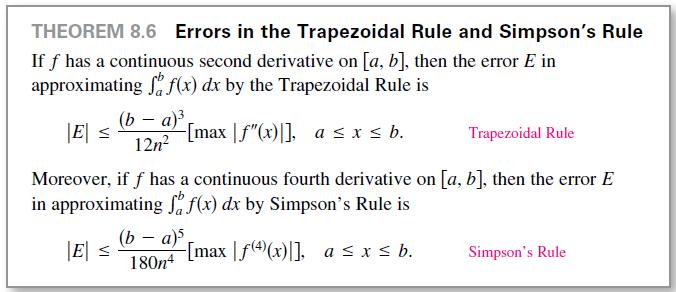
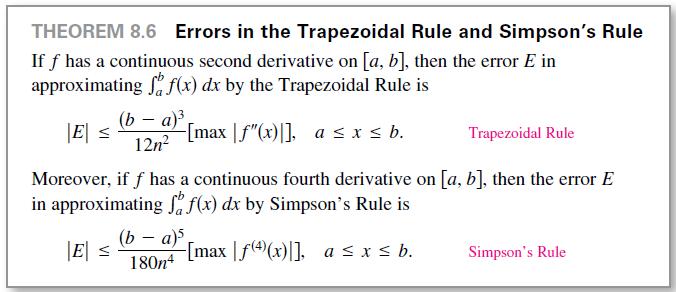
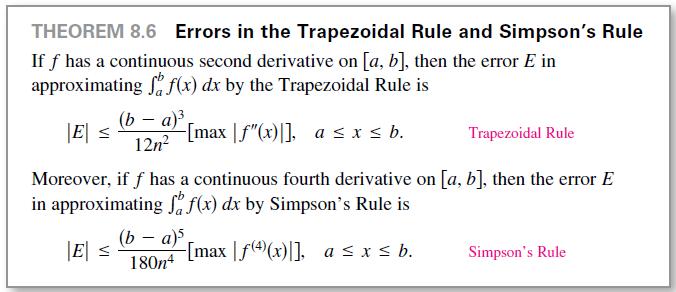
Use the error formulas in Theorem 8.6 to estimate the errors in approximating the integral, with n = 4, using(a) The Trapezoidal Rule and (b) Simpson’s Rule. THEOREM 8.6 Errors in the Trapezoidal Rule and Simpson's Rule If f has a continuous second derivative on [a, b], then the error E
Use partial fractions to find the indefinite integral. x + 2 X + 5x dx
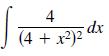
Find the indefinite integral using the substitution x = 2 tan θ. 4 (4 + x²)² -dx
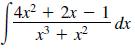
Use partial fractions to find the indefinite integral. 4x² + 2x - x³ + x² 1 -dx
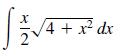
Find the indefinite integral using the substitution x = 2 tan θ. X /4 + x² dx
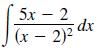
Use partial fractions to find the indefinite integral. fox- 5x – 2 (x - 2)² ¡dx
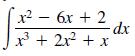
Use partial fractions to find the indefinite integral. x² - 6x + 2 - dx x²³ + 2x² + x
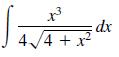
Find the indefinite integral using the substitution x = 2 tan θ. 1³ 4√√√4+x² ax
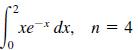
Use the Trapezoidal Rule and Simpson’s Rule to approximate the value of the definite integral for the given value of n. Round your answer to four decimal places and compare the results with the exact value of the definite integral. 2 xe * dx, n = 4
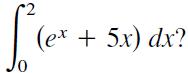
Would you use numerical integration to evaluate Explain. 2 (ex + 5x) dx? Jo
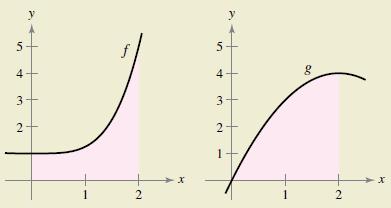
The function f is concave upward on the interval [0, 2] and the function g is concave downward on the interval [0, 2], as shown in the figure.(a) Using the Trapezoidal Rule with n = 4, which integral would be overestimated,Which integral would be underestimated? Explain your reasoning.(b) Which
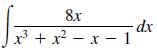
Use partial fractions to find the indefinite integral. 8.x x³ + x²-x-1 dx
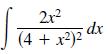
Find the indefinite integral using the substitution x = 2 tan θ. 2x² (4 + x²)² dx
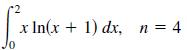
Use the Trapezoidal Rule and Simpson’s Rule to approximate the value of the definite integral for the given value of n. Round your answer to four decimal places and compare the results with the exact value of the definite integral. 2 x ln(x + 1) dx, n = 4 Jo
Approximate the definite integral using the Trapezoidal Rule and Simpson’s Rule with n = 4. Compare these results with the approximation of the integral using a graphing utility. 2 S² √1 + x³ dx
Use partial fractions to find the indefinite integral. .6 – لج 7x³ + x 3 dx
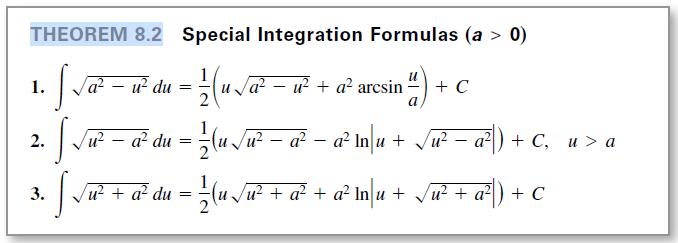
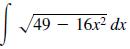
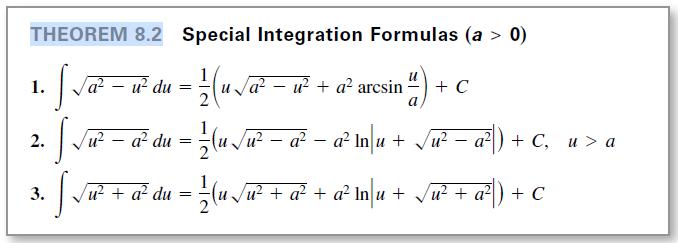
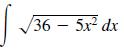
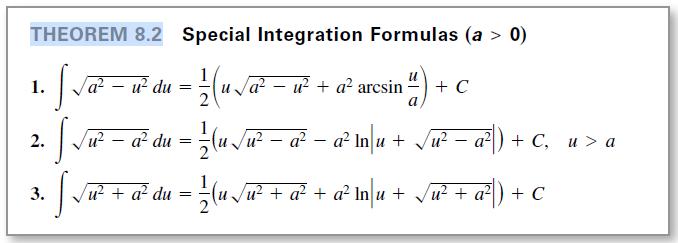
Use the Special Integration Formulas (Theorem 8.2) to find the indefinite integral. THEOREM 8.2 Special Integration Formulas (a > 0) 1. · √ - và tư du u và ta arcsin - 12/0 s là ²) + c a² u² = a² 1 2. S / u² − a² du = -²-(u √/u² − a² − a² In[u + √u² − a²]) + C, u>
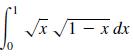
Approximate the definite integral using the Trapezoidal Rule and Simpson’s Rule with n = 4. Compare these results with the approximation of the integral using a graphing utility. S √x √√1-x dx 0/
Use partial fractions to find the indefinite integral. X 6x - 8 dx
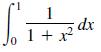
Approximate the definite integral using the Trapezoidal Rule and Simpson’s Rule with n = 4. Compare these results with the approximation of the integral using a graphing utility. "1 1 1 + x² dx
Use the Special Integration Formulas (Theorem 8.2) to find the indefinite integral. THEOREM 8.2 Special Integration Formulas (a > 0) 1. · √ - và tư du u và ta arcsin - 12/0 s là ²) + c a² u² = a² 1 2. S / u² − a² du = -²-(u √/u² − a² − a² In[u + √u² − a²]) + C, u>
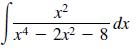
Use partial fractions to find the indefinite integral. x² ·2x² - 8 dx
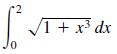
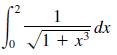
Approximate the definite integral using the Trapezoidal Rule and Simpson’s Rule with n = 4. Compare these results with the approximation of the integral using a graphing utility. 2 1 /1 + x³ dx
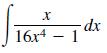
Use partial fractions to find the indefinite integral. X 16x4 - 1 dx
Use the Special Integration Formulas (Theorem 8.2) to find the indefinite integral. THEOREM 8.2 Special Integration Formulas (a > 0) 1. · √ - và tư du u và ta arcsin - 12/0 s là ²) + c a² u² = a² 1 2. S / u² − a² du = -²-(u √/u² − a² − a² In[u + √u² − a²]) + C, u>
Approximate the definite integral using the Trapezoidal Rule and Simpson’s Rule with n = 4. Compare these results with the approximation of the integral using a graphing utility. 4 √xex dx
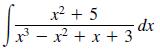
Use partial fractions to find the indefinite integral. x² + 5 ³x²+x+3 dx
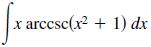
Use a table of integrals to find the indefinite integral. x arccsc(x² + 1) dx
Approximate the definite integral using the Trapezoidal Rule and Simpson’s Rule with n = 4. Compare these results with the approximation of the integral using a graphing utility. 3 In x dx
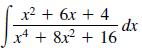
Use partial fractions to find the indefinite integral. x² + 6x + 4 x4 + 8x² + 16 dx
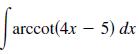
Use a table of integrals to find the indefinite integral. arccot(4x 5) dx -
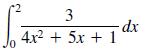
Use partial fractions to evaluate the definite integral. Use a graphing utility to verify your result. Jo 3 4x² + 5x + 1 dx
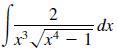
Use a table of integrals to find the indefinite integral. 2 x²³√√x4-1 =dx
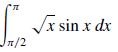
Approximate the definite integral using the Trapezoidal Rule and Simpson’s Rule with n = 4. Compare these results with the approximation of the integral using a graphing utility. IL Jπ/2 √x sin x dx
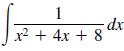
Use a table of integrals to find the indefinite integral. 1 x² + 4x + 8 dx
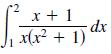
Use partial fractions to evaluate the definite integral. Use a graphing utility to verify your result. 2 J I + x x(x² + 1) dx
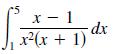
Use partial fractions to evaluate the definite integral. Use a graphing utility to verify your result. x - 1 x²(x + 1) -dx
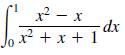
Use partial fractions to evaluate the definite integral. Use a graphing utility to verify your result. xp - لح + x + ] لاج X x - x
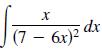
Use a table of integrals to find the indefinite integral. X (7-6x)² dx
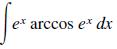
Use a table of integrals to find the indefinite integral. ex arccos ex dx
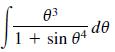
Use a table of integrals to find the indefinite integral. 13 1 + sin 04 - de
Use the error formulas in Theorem 8.6 to estimate the errors in approximating the integral, with n = 4, using(a) The Trapezoidal Rule and (b) Simpson’s Rule. THEOREM 8.6 Errors in the Trapezoidal Rule and Simpson's Rule If f has a continuous second derivative on [a, b], then the error E
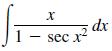
Use a table of integrals to find the indefinite integral. X - sec x² dx
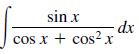
Use substitution and partial fractions to find the indefinite integral. sin x cos x + cos²x - dx
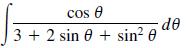
Use a table of integrals to find the indefinite integral. cos 3+2 sin 0+ sin² 0. do
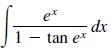
Use a table of integrals to find the indefinite integral. ex 1 - tan ex dx
Use the error formulas in Theorem 8.6 to find n such that the error in the approximation of the definite integral is less than or equal to 0.00001 using(a) The Trapezoidal Rule(b) Simpson’s Rule. THEOREM 8.6 Errors in the Trapezoidal Rule and Simpson's Rule If f has a continuous second derivative
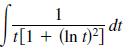
Use a table of integrals to find the indefinite integral. 1 t[1 + (Int)] dt
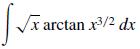
Use a table of integrals to find the indefinite integral. | √x² x arctan x³/2 dx
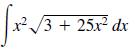
Use a table of integrals to find the indefinite integral. √x² √/3 + 25x² dx
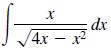
Complete the square and find the indefinite integral. X 4x - x dx
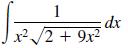
Use a table of integrals to find the indefinite integral. 1 x²√√√2 + 9x² dx
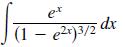
Use a table of integrals to find the indefinite integral. er (1-e²x)³/20 dx
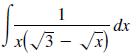
Use substitution and partial fractions to find the indefinite integral. 1 x(√√3-√x) - dx
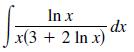
Use a table of integrals to find the indefinite integral. In x x(3+2 In x) dx
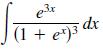
Use a table of integrals to find the indefinite integral. e³x 3x 3 (1 + e*)³ dx
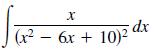
Use a table of integrals to find the indefinite integral. X (x² - 6x + 10)² dx
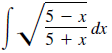
Use a table of integrals to find the indefinite integral. N 5-x 5 + x dx
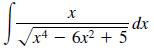
Use a table of integrals to find the indefinite integral. X x4 - 6x² + 5 dx
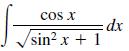
Use a table of integrals to find the indefinite integral. cos x sin² x + 1 dx
Use a table of integrals to evaluate the definite integral. x4 In x dx
Use a table of integrals to find the indefinite integral. [ cot Ꮎ dᎾ
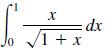
Use a table of integrals to evaluate the definite integral. 19 X 1 + x dx
Use a table of integrals to evaluate the definite integral. S² 2x³e² dx
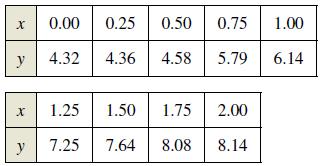
The table lists several measurements gathered in an experiment to approximate an unknown continuous function y = f (x).(a) Approximate the integral ∫20 f(x) dx using the Trapezoidal Rule and Simpson’s Rule.(b) Use a graphing utility to find a model of the form y = ax3 + bx2 + cx + d for the
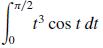
Use a table of integrals to evaluate the definite integral. (π/2 t³ cos t dt 3
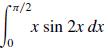
Use a table of integrals to evaluate the definite integral. Cπ/2 x sin 2x dx
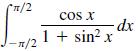
Use a table of integrals to evaluate the definite integral. (π/2 [13 COS X -1/2 1 + sin² x° - dx
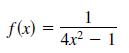
Find the average value offrom x = 1 to x = 4. f(x) = 1 4x² 1
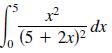
Use a table of integrals to evaluate the definite integral. x² 2 (5 + 2x)² xp. ax
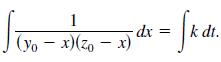
In a chemical reaction, one unit of compound Y and one unit of compound Z are converted into a single unit of compound X. Let x be the amount of compound X formed. The rate of formation of X is proportional to the product of the amounts of unconverted compounds Y and Z. So, dx/dt = k(y0 - x)(z0 -
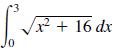
Use a table of integrals to evaluate the definite integral. 3 fo √x² + 16 dx
Find the arc length of the graph of the function over the given interval.y = ln x, [1, 5]
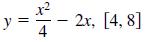
Find the arc length of the graph of the function over the given interval. = 22-2 y - 2x, [4, 8] 4
Showing 8900 - 9000
of 29454
First
83
84
85
86
87
88
89
90
91
92
93
94
95
96
97
Last
Step by Step Answers

 Get 50% OFF
Claim Now
Get 50% OFF
Claim Now