New Semester
Started
Get
50% OFF
Study Help!
--h --m --s
Claim Now
Question Answers
Textbooks
Find textbooks, questions and answers
Oops, something went wrong!
Change your search query and then try again
S
Books
FREE
Study Help
Expert Questions
Accounting
General Management
Mathematics
Finance
Organizational Behaviour
Law
Physics
Operating System
Management Leadership
Sociology
Programming
Marketing
Database
Computer Network
Economics
Textbooks Solutions
Accounting
Managerial Accounting
Management Leadership
Cost Accounting
Statistics
Business Law
Corporate Finance
Finance
Economics
Auditing
Tutors
Online Tutors
Find a Tutor
Hire a Tutor
Become a Tutor
AI Tutor
AI Study Planner
NEW
Sell Books
Search
Search
Sign In
Register
study help
mathematics
precalculus
Thomas Calculus Early Transcendentals 13th Edition Joel R Hass, Christopher E Heil, Maurice D Weir - Solutions
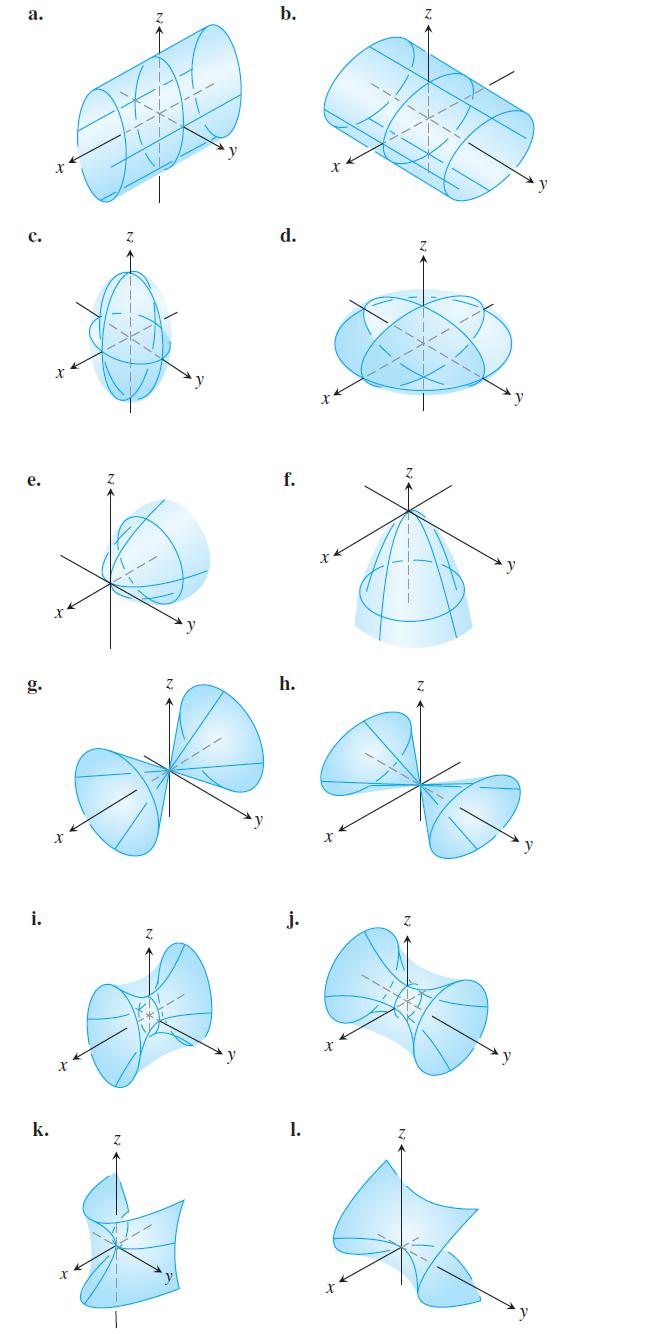
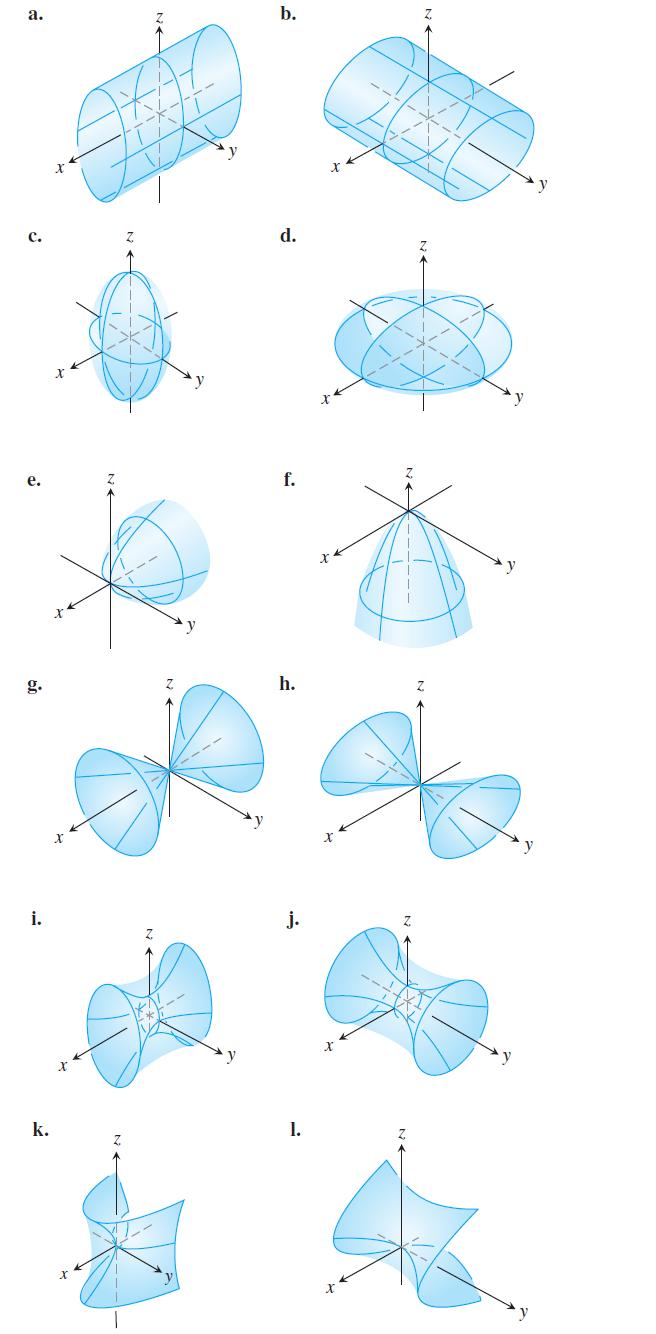
Match the equation with the surface it defines. Also, identify each surface by type (paraboloid, ellipsoid, etc.). The surfaces are labeled (a)–(1).z = -4x2 - y2 a. C. e. g. i. k. X X Z NE b. d. f. h. j. 1. X y
Express the vectors in terms of their lengths and directions.√2i + √2j
Give a geometric description of the set of points in space whose coordinates satisfy the given pairs of equations.x2 + y2 + z2 = 1, x = 0
Sketch the coordinate axes and then include the vectors u, v, and u * v as vectors starting at the origin.u = i, v = j
Find parametric equations for the lines.The line through (0, -7, 0) perpendicular to the plane x + 2y + 2z = 13
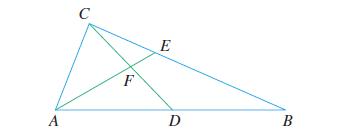
In the figure here, D is the midpoint of side AB of triangle ABC, and E is one-third of the way between C and B. Use vectors to prove that F is the midpoint of line segment CD. A C F E D B
Find the component form of the vector.The vectorwhere O is the origin and P is the midpoint of segment RS, where R = (2, -1) and S = (-4, 3) OP
What is the determinant formula for calculating the cross product of two vectors relative to the Cartesian i, j, k-coordinate system? Use it in an example.
Find the angles between the vectors to the nearest hundredth of a radian. u = V3i - 7j, v = √3i + j - 2k
Express the vectors in terms of their lengths and directions.-i - j
Give a geometric description of the set of points in space whose coordinates satisfy the given pairs of equations.x2 + y2 + z2 = 25, y = -4
Sketch the coordinate axes and then include the vectors u, v, and u * v as vectors starting at the origin.u = i - k, v = j
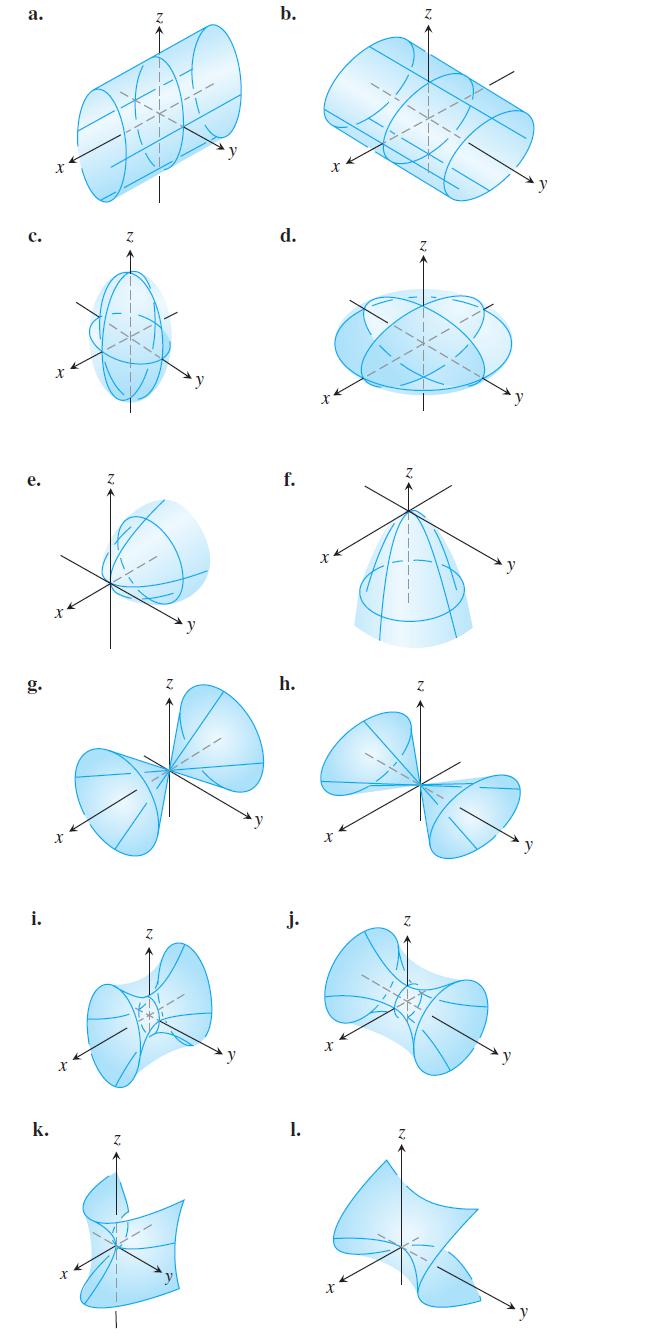
Match the equation with the surface it defines. Also, identify each surface by type (paraboloid, ellipsoid, etc.). The surfaces are labeled (a)–(1).x2 + 4z2 = y2 a. C. e. g. i. k. X X Z NE b. d. f. h. j. 1. X y
Find parametric equations for the lines.The line through (2, 3, 0) perpendicular to the vectors u = i + 2j + 3k and v = 3i + 4j + 5k
How do you find equations for lines, line segments, and planes in space? Give examples. Can you express a line in space by a single equation? A plane?
Express the vectors in terms of their lengths and directions.Velocity vector v = (-2 sint)i + (2 cos t)j when t = π/2.
Give a geometric description of the set of points in space whose coordinates satisfy the given pairs of equations.x2 + y2 + (z + 3)2 = 25, z = 0
Sketch the coordinate axes and then include the vectors u, v, and u * v as vectors starting at the origin.u = i - k, v = j + k
Find the angles between the vectors to the nearest hundredth of a radian. u = i + √2j - √2k, v = i + j + k
Find parametric equations for the lines.The x-axis
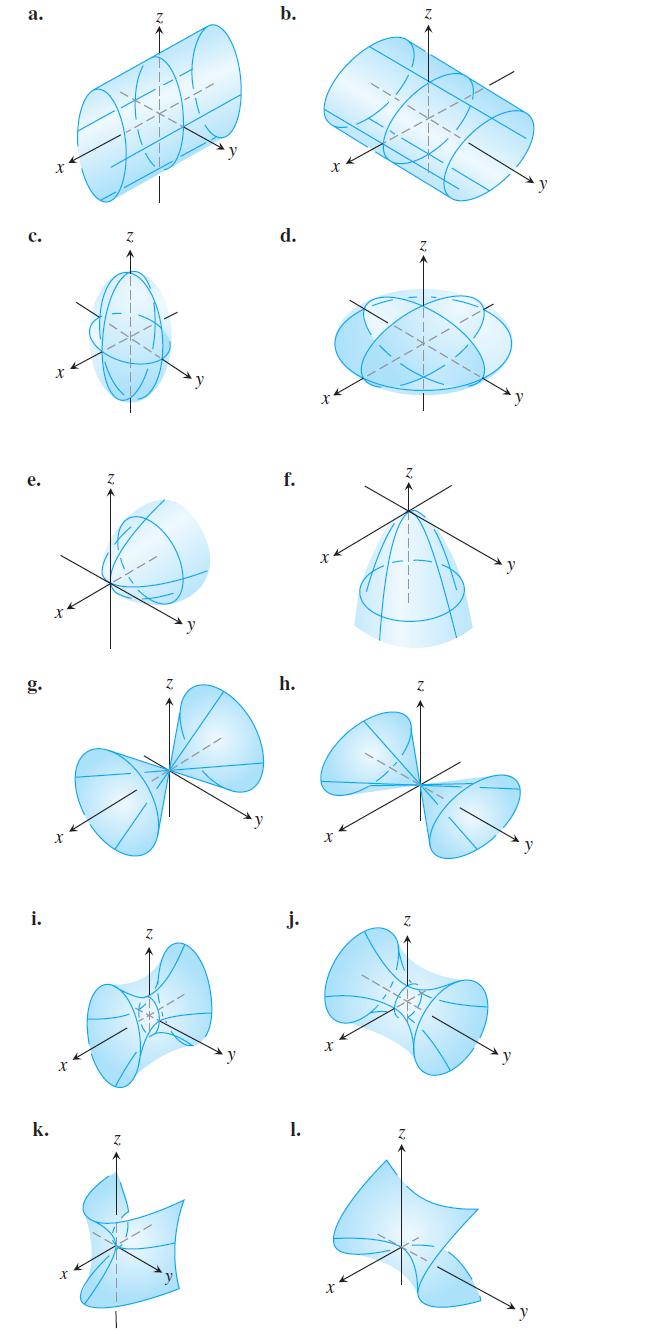
Match the equation with the surface it defines. Also, identify each surface by type (paraboloid, ellipsoid, etc.). The surfaces are labeled (a)–(1).9x2 + 4y2 + 2z2 = 36 a. C. e. g. i. k. X X Z NE b. d. f. h. j. 1. X y
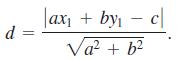
Use vectors to show that the distance from P1(x1, y1) to the line ax + by = c is d = |ax₁ +by₁ = c Va² + b²
Find the component form of the vector.The vector from the point A = (2, 3) to the origin
How do you find the distance from a point to a line in space? From a point to a plane? Give examples.
Express the vectors in terms of their lengths and directions.Velocity vector v = (et cos t - et sin t)i + (et sin t + et cos t)j when t = ln 2.
Give a geometric description of the set of points in space whose coordinates satisfy the given pairs of equations.x2 + (y - 1)2 + z2 = 4, y = 0
Sketch the coordinate axes and then include the vectors u, v, and u * v as vectors starting at the origin.u = 2i - j, v = i + 2j
Express the vectors in terms of their lengths and directions.2i - 3j + 6k
Match the equation with the surface it defines. Also, identify each surface by type (paraboloid, ellipsoid, etc.). The surfaces are labeled (a)–(1).y2 + z2 = x2 a. C. e. g. i. k. X X Z NE b. d. f. h. j. 1. X y
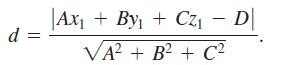
a. Use vectors to show that the distance from P1(x1, y1, z1) to the plane Ax + By + Cz = D isb. Find an equation for the sphere that is tangent to the planes x + y + z = 3 and x + y + z = 9 if the planes 2x - y = 0 and 3x - z = 0 pass through the center of the sphere. d = |Ax₁ + By₁ + Cz₁ −
Find the component form of the vector.The sum ofandwhere A = (1, -1), B = (2, 0), C = (-1, 3), and D = (-2, 2) AB
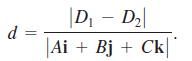
a. Show that the distance between the parallel planes Ax + By + Cz = D1 and Ax + By + Cz = D2 isb. Find the distance between the planes 2x + 3y - z = 6 and 2x + 3y - z = 12.c. Find an equation for the plane parallel to the plane 2x - y + 2z = -4 if the point (3, 2, -1) is equidistant from the two
Prove that four points A, B, C, and D are coplanar (lie in a common plane) if and only if AD (AB X BC) = 0.
Find parametric equations for the lines.The z-axis
Find the component form of the vector.The unit vector that makes an angle θ = 2π/3 with the positive x-axis
Find the measures of the angles of the triangle whose vertices are A = (-1, 0), B = (2, 1), and C = (1, -2).
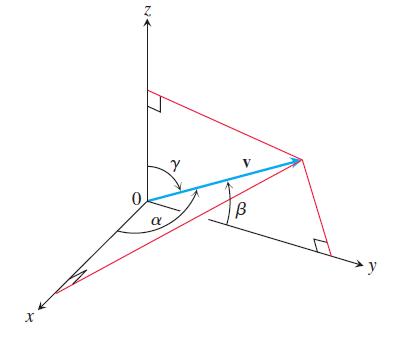
The direction angles α, β, and γ of a vector v = ai + bj + ck are defined as follows:α is the angle between v and the positive x-axis (0 ≤ α ≤ π)β is the angle between v and the positive y-axis (0 ≤ β ≤ π)γ is the angle between v and the positive z-axis (0 ≤ γ ≤ π).a. Show
What are box products? What significance do they have? How are they evaluated? Give an example.
Find the component form of the vector.The unit vector obtained by rotating the vector 120° counterclockwise about the origin (0, 1)
Give a geometric description of the set of points in space whose coordinates satisfy the given pairs of equations.x2 + y2 = 4, z = y
Sketch the coordinate axes and then include the vectors u, v, and u * v as vectors starting at the origin.u = i + j, v = i - j
Sketch the surfaces.x2 + y2 = 4
Find parametrizations for the line segments joining the points. Draw coordinate axes and sketch each segment, indicating the direction of increasing t for your parametrization.(0, 0, 0), (1, 1, 3 / 2)
Find the component form of the vector.The unit vector that makes an angle θ = -3π/4 with the positive x-axis
Find the measures of the angles between the diagonals of the rectangle whose vertices are A = (1, 0), B = (0, 3), C = (3, 4), and D = (4, 1).
How do you find equations for spheres in space? Give examples.
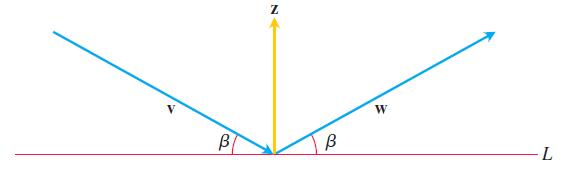
The accompanying figure shows nonzero vectors v, w, and z, with z orthogonal to the line L, and v and w making equal angles β with L. Assuming |v| = |w|, find w in terms of v and z. B Z В W L
Express the vectors in terms of their lengths and directions.i + 2j - k
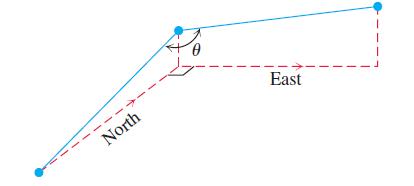
A water main is to be constructed with a 20% grade in the north direction and a 10% grade in the east direction. Determine the angle θ required in the water main for the turn from north to east. North 0 East
Give a geometric description of the set of points in space whose coordinates satisfy the given pairs of equations.x2 + y2 + z2 = 4, y = x
Sketch the coordinate axes and then include the vectors u, v, and u * v as vectors starting at the origin.u = j + 2k, v = i
Sketch the surfaces.z = y2 - 1
Find the component form of the vector.The unit vector obtained by rotating the vector135° counterclockwise about the origin (1,0)
Find parametrizations for the line segments joining the points. Draw coordinate axes and sketch each segment, indicating the direction of increasing t for your parametrization.(0, 0, 0), (1, 0, 0)
Let P be a plane in space and let v be a vector. The vector projection of v onto the plane P, projP v, can be defined informally as follows. Suppose the sun is shining so that its rays are normal to the plane P. Then projP v is the “shadow” of v onto P. If P is the plane x + 2y + 6z = 6 and v =
How do you find the intersection of two lines in space? A line and a plane? Two planes? Give examples.
Give a geometric description of the set of points in space whose coordinates satisfy the given pairs of equations.y = x2, z = 0
Find a vector 2 units long in the direction of v = 4i - j + 4k.
a. Find the area of the triangle determined by the points P, Q, and R.b. Find a unit vector perpendicular to plane PQR.P(1, -1, 2), Q(2, 0, -1), R(0, 2, 1)
Find parametrizations for the line segments joining the points. Draw coordinate axes and sketch each segment, indicating the direction of increasing t for your parametrization.(1, 0, 0), (1, 1, 0)
Sketch the surfaces.x2 + 4z2 = 16
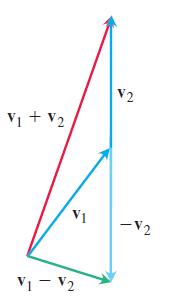
In the accompanying figure, it looks as if v1 + v2 and v1 - v2 are orthogonal. Is this mere coincidence, or are there circumstances under which we may expect the sum of two vectors to be orthogonal to their difference? Give reasons for your answer. V₁ + V2 V1 V1 V2 V2 -V2
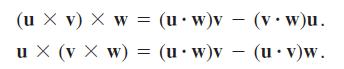
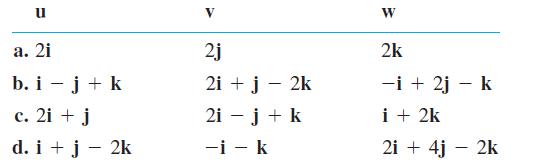
The triple vector products (u * v) * w and u * (v * w) are usually not equal, although the formulas for evaluating them from components are similar:Verify each formula for the following vectors by evaluating its two sides and comparing the results. (u X v) X w = (uw)v (vw)u. u x (v x w) = (uw)v -
What is a cylinder? Give examples of equations that define cylinders in Cartesian coordinates.
Give a geometric description of the set of points in space whose coordinates satisfy the given pairs of equations.z = y2, x = 1
Express each vector in the form v = v1i + v2j + v3k.if P1 is the point (5, 7, -1) and P2 is the point (2, 9, -2) 店
Find a vector 5 units long in the direction opposite to the direction of v = (3/5)i + (4/5)k.
a. Find the area of the triangle determined by the points P, Q, and R.b. Find a unit vector perpendicular to plane PQR.P(1, 1, 1), Q(2, 1, 3), R(3, -1, 1)
Sketch the surfaces.4x2 + y2 = 36
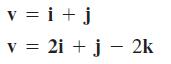
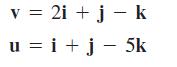
Find |v|, |u|, v · u, u · v, v * u, u * v, |v * u|, the angle between v and u, the scalar component of u in the direction of v, and the vector projection of u onto v. v = i + j v = 2i + j - 2k
Find parametrizations for the line segments joining the points. Draw coordinate axes and sketch each segment, indicating the direction of increasing t for your parametrization.(1, 1, 0), (1, 1, 1)
What are quadric surfaces? Give examples of different kinds of ellipsoids, paraboloids, cones, and hyperboloids (equations and sketches).
a. Find the area of the triangle determined by the points P, Q, and R.b. Find a unit vector perpendicular to plane PQR.P(2, -2, 1), Q(3, -1, 2), R(3, -1, 1)
Describe the sets of points in space whose coordinates satisfy the given inequalities or combinations of equations and inequalities.a. x ≥ 0, y ≥ 0, z = 0 b. x ≥ 0, y ≤ 0, z = 0
Sketch the surfaces.9x2 + y2 + z2 = 9
Find parametrizations for the line segments joining the points. Draw coordinate axes and sketch each segment, indicating the direction of increasing t for your parametrization.(0, 1, 1), (0, -1, 1)
Sketch the surfaces.z2 - x2 - y2 = 1
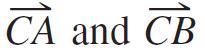
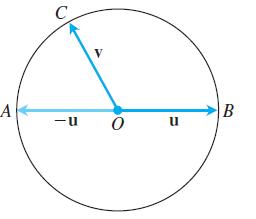
Suppose that AB is the diameter of a circle with center O and that C is a point on one of the two arcs joining A and B. Show thatare orthogonal. CA and CB
Express each vector in the form v = v1i + v2j + v3k.if P1 is the point (1, 2, 0) and P2 is the point (-3, 0, 5) 店
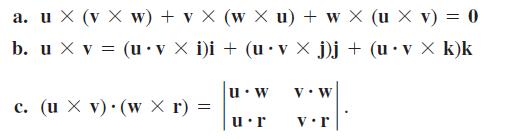
Show that if u, v, w, and r are any vectors, then a. u x (v Xw) + vX (w Xu) + w x (u X v) = 0 + (u • v × k)k b. ux v = (u.v × i)i + (u • v × j)j c. (u X v) (w X r) = u. W u.r V. W V r
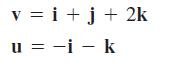
Find |v|, |u|, v · u, u · v, v * u, u * v, |v * u|, the angle between v and u, the scalar component of u in the direction of v, and the vector projection of u onto v. v = i + j + 2k u = -i - k
a. Find the area of the triangle determined by the points P, Q, and R.b. Find a unit vector perpendicular to plane PQR.P(-2, 2, 0), Q(0, 1, -1), R(-1, 2, -2)
Describe the sets of points in space whose coordinates satisfy the given inequalities or combinations of equations and inequalities.a. 0 ≤ x ≤ 1 b. 0 ≤ x ≤ 1, 0 ≤ y ≤ 1c. 0 ≤ x ≤ 1, 0 ≤ y ≤ 1, 0 ≤ z ≤ 1
Express each vector in the form v = v1i + v2j + v3k.if A is the point (-7, -8, 1) and B is the point (-10, 8, 1) > AB
Sketch the surfaces.4x2 + 4y2 + z2 = 16
Find parametrizations for the line segments joining the points. Draw coordinate axes and sketch each segment, indicating the direction of increasing t for your parametrization.(0, 2, 0), (3, 0, 0)
Prove or disprove the formula u × (u × (u × v))•w = -|u|²u -|u|²u.v X w.
Find projv u. v = 2i + j - k u = i + j5k
Show that the diagonals of a rhombus (parallelogram with sides of equal length) are perpendicular.
Verify that (u * v) · w = (v * w) · u = (w * u) · v and find the volume of the parallelepiped (box) determined by u, v, and w. n 2i > 2j W 2k
Describe the sets of points in space whose coordinates satisfy the given inequalities or combinations of equations and inequalities.a. x2 + y2 + z2 ≤ 1 b. x2 + y2 + z2 > 1
Express each vector in the form v = v1i + v2j + v3k.if A is the point (1, 0, 3) and B is the point (-1, 4, 5) AB
Sketch the surfaces.4x2 + 9y2 + 4z2 = 36
Find parametrizations for the line segments joining the points. Draw coordinate axes and sketch each segment, indicating the direction of increasing t for your parametrization.(2, 0, 2), (0, 2, 0)
By forming the cross product of two appropriate vectors, derive the trigonometric identity sin (AB) = sin A cos B - cos A sin B.
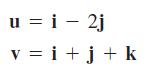
Find projv u. u = i - 2j v=i+j+ k
Verify that (u * v) · w = (v * w) · u = (w * u) · v and find the volume of the parallelepiped (box) determined by u, v, and w. u i-j+k V 2i + j - 2k W -i + 2j - k
Show that squares are the only rectangles with perpendicular diagonals.
Express each vector in the form v = v1i + v2j + v3k.5u - v if u (1, 1,-1) and v = (2,0, 3)
Describe the sets of points in space whose coordinates satisfy the given inequalities or combinations of equations and inequalities.a. x2 + y2 ≤ 1, z = 0 b. x2 + y2 ≤ 1, z = 3c. x2 + y2 ≤ 1, no restriction on z
Showing 8600 - 8700
of 29454
First
80
81
82
83
84
85
86
87
88
89
90
91
92
93
94
Last
Step by Step Answers

 Get 50% OFF
Claim Now
Get 50% OFF
Claim Now