New Semester
Started
Get
50% OFF
Study Help!
--h --m --s
Claim Now
Question Answers
Textbooks
Find textbooks, questions and answers
Oops, something went wrong!
Change your search query and then try again
S
Books
FREE
Study Help
Expert Questions
Accounting
General Management
Mathematics
Finance
Organizational Behaviour
Law
Physics
Operating System
Management Leadership
Sociology
Programming
Marketing
Database
Computer Network
Economics
Textbooks Solutions
Accounting
Managerial Accounting
Management Leadership
Cost Accounting
Statistics
Business Law
Corporate Finance
Finance
Economics
Auditing
Tutors
Online Tutors
Find a Tutor
Hire a Tutor
Become a Tutor
AI Tutor
AI Study Planner
NEW
Sell Books
Search
Search
Sign In
Register
study help
physics
college physics 2nd
College Physics 2nd Edition OpenStax - Solutions
A piano tuner hears a beat every 2.00 s when listening to a 264.0-Hz tuning fork and a single piano string. What are the two possible frequencies of the string?
If a wind instrument, such as a tuba, has a fundamental frequency of 32.0 Hz, what are its first three overtones? It is closed at one end. (The overtones of a real tuba are more complex than this example, because it is a tapered tube.)
What are the first three overtones of a bassoon that has a fundamental frequency of 90.0 Hz? It is open at both ends. (The overtones of a real bassoon are more complex than this example, because its double reed makes it act more like a tube closed at one end.)
What length should an oboe have to produce a fundamental frequency of 110 Hz on a day when the speed of sound is 343 m/s? It is open at both ends.
What is the length of a tube that has a fundamental frequency of 176 Hz and a first overtone of 352 Hz if the speed of sound is 343 m/s?
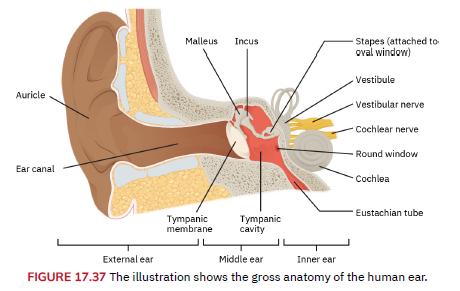
The ear canal resonates like a tube closed at one end. (See Figure 17.37.) If ear canals range in length from 1.80 to 2.60 cm in an average population, what is the range of fundamental resonant frequencies? Take air temperature to be 37.0°C, which is the same as body temperature. How does this
(a) Find the length of an organ pipe closed at one end that produces a fundamental frequency of 256 Hz when air temperature is 18.0°C. (b) What is its fundamental frequency at 25.0°C?
By what fraction will the frequencies produced by a wind instrument change when air temperature goes from 10.0°C to 30.0°C? That is, find the ratio of the frequencies at those temperatures.
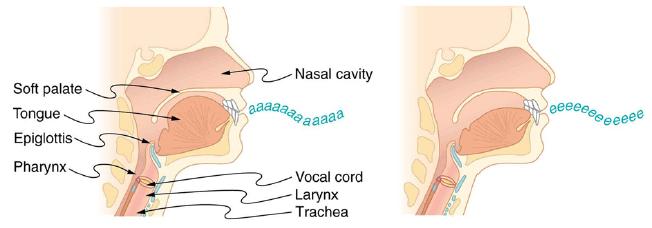
A crude approximation of voice production is to consider the breathing passages and mouth to be a resonating tube closed at one end. (See Figure 17.29.)(a) What is the fundamental frequency if the tube is 0.240-m long, by taking air temperature to be 37.0°C? (b) What would this frequency become
(a) Students in a physics lab are asked to find the length of an air column in a tube closed at one end that has a fundamental frequency of 256 Hz. They hold the tube vertically and fill it with water to the top, then lower the water while a 256-Hz tuning fork is rung and listen for the first
What frequencies will a 1.80-m-long tube produce in the audible range at 20.0°C if: (a) The tube is closed at one end?(b) It is open at both ends?
The factor of 10-12 in the range of intensities to which the ear can respond, from threshold to that causing damage after brief exposure, is truly remarkable. If you could measure distances over the same range with a single instrument and the smallest distance you could measure was 1 mm, what would
The frequencies to which the ear responds vary by a factor of 103. Suppose the speedometer on your car measured speeds differing by the same factor of 103, and the greatest speed it reads is 90.0 mi/ h. What would be the slowest nonzero speed it could read?
Can the average person tell that a 2002-Hz sound has a different frequency than a 1999-Hz sound without playing them simultaneously?
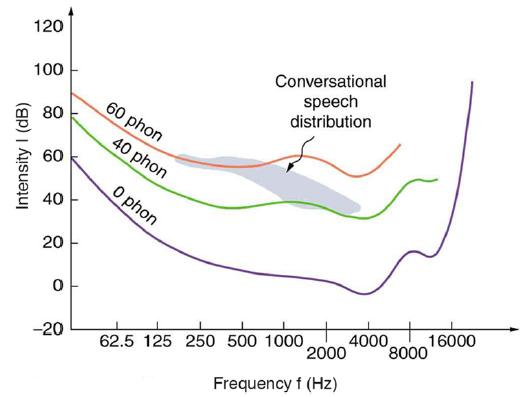
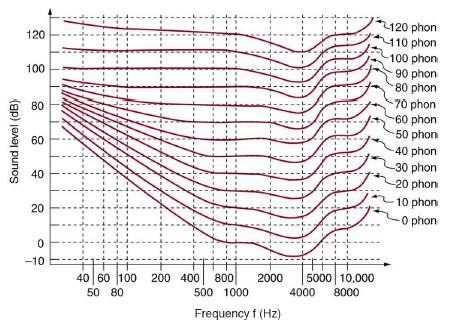
Based on the graph in Figure 17.34, what is the threshold of hearing in decibels for frequencies of 60, 400, 1000, 4000, and 15,000 Hz? Note that many AC electrical appliances produce 60 Hz, music is commonly 400 Hz, a reference frequency is 1000 Hz, your maximum sensitivity is near 4000 Hz, and
Can you tell that your roommate turned up the sound on the TV if its average sound intensity level goes from 70 to 73 dB?
What sound intensity levels must sounds of frequencies 60, 3000, and 8000 Hz have in order to have the same loudness as a 40-dB sound of frequency 1000 Hz (that is, to have a loudness of 40 phons)?
(a) What are the loudnesses in phons of sounds having frequencies of 200, 1000, 5000, and 10,000 Hz, if they are all at the same 60.0-dB sound intensity level?(b) If they are all at 110 dB?(c) If they are all at 20.0 dB?
Suppose a person has a 50-dB hearing loss at all frequencies. By how many factors of 10 will lowintensity sounds need to be amplified to seem normal to this person? Note that smaller amplification is appropriate for more intense sounds to avoid further hearing damage.
If a woman needs an amplification of 5.0 × 10¹² times the threshold intensity to enable her to hear at all frequencies, what is her overall hearing loss in dB? Note that smaller amplification is appropriate for more intense sounds to avoid further damage to her hearing from levels above 90 dB.
(a) What is the intensity in watts per meter squared of a just barely audible 200-Hz sound? (b) What is the intensity in watts per meter squared of a barely audible 4000-Hz sound?
(a) Find the intensity in watts per meter squared of a 60.0-Hz sound having a loudness of 60 phons.(b) Find the intensity in watts per meter squared of a 10,000-Hz sound having a loudness of 60 phons.
A child has a hearing loss of 60 dB near 5000 Hz, due to noise exposure, and normal hearing elsewhere. How much more intense is a 5000-Hz tone than a 400-Hz tone if they are both barely audible to the child?
What is the ratio of intensities of two sounds of identical frequency if the first is just barely discernible as louder to a person than the second?
What is the sound intensity level in decibels of ultrasound of intensity 105 W/m2, used to pulverize tissue during surgery?
Is 155-dB ultrasound in the range of intensities used for deep heating? Calculate the intensity of this ultrasound and compare this intensity with values quoted in the text.
Find the sound intensity level in decibels of 2.00 x 10⁻² W/m2 ultrasound used in medical diagnostics.
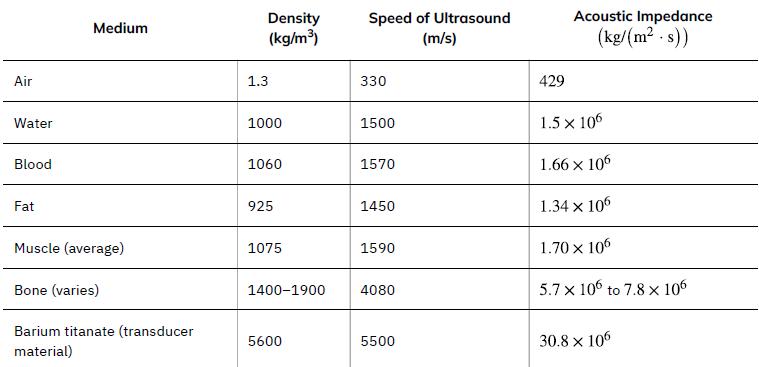
In the clinical use of ultrasound, transducers are always coupled to the skin by a thin layer of gel or oil, replacing the air that would otherwise exist between the transducer and the skin. (a) Using the values of acoustic impedance given in Table 17.5 calculate the intensity reflection
The time delay between transmission and the arrival of the reflected wave of a signal using ultrasound traveling through a piece of fat tissue was 0.13 ms. At what depth did this reflection occur?
(a) Find the size of the smallest detail observable in human tissue with 20.0-MHz ultrasound.(b) Is its effective penetration depth great enough to examine the entire eye (about 3.00 cm is needed)? (c) What is the wavelength of such ultrasound in 0°C air?
(a) Echo times are measured by diagnostic ultrasound scanners to determine distances to reflecting surfaces in a patient. What is the difference in echo times for tissues that are 3.50 and 3.60 cm beneath the surface? (This difference is the minimum resolving time for the scanner to see details as
(a) How far apart are two layers of tissue that produce echoes having round-trip times (used to measure distances) that differ by 0.750 μs? (b) What minimum frequency must the ultrasound have to see detail this small?
(a) A bat uses ultrasound to find its way among trees. If this bat can detect echoes 1.00 ms apart, what minimum distance between objects can it detect? (b) Could this distance explain the difficulty that bats have finding an open door when they accidentally get into a house?
Ultrasound reflected from an oncoming bloodstream that is moving at 30.0 cm/s is mixed with the original frequency of 2.50 MHz to produce beats. What is the beat frequency? (Assume that the frequency of 2.50 MHz is accurate to seven significant figures.)
If 1.80 x 10²⁰ electrons move through a pocket calculator during a full day's operation, how many coulombs of charge moved through it?
To start a car engine, the car battery moves 3.75 X 10²¹ electrons through the starter motor. How many coulombs of charge were moved?
A certain lightning bolt moves 40.0 C of charge. How many fundamental units of charge |qe| is this?
Suppose a speck of dust in an electrostatic precipitator has 1.0000 x 10¹² protons in it and has a net charge of -5.00 nC (a very large charge for a small speck). How many electrons does it have?
An amoeba has 1.00 x 10¹⁶ protons and a net charge of 0.300 pC.(a) How many fewer electrons are there than protons?(b) If you paired them up, what fraction of the protons would have no electrons?
What net charge would you place on a 100 g piece of sulfur if you put an extra electron on 1 in 1012 of its atoms? (Sulfur has an atomic mass of 32.1.)
How many coulombs of positive charge are there in 4.00 kg of plutonium, given its atomic mass is 244 and that each plutonium atom has 94 protons?
What is the repulsive force between two pith balls that are 8.00 cm apart and have equal charges of – 30.0 nC?
(a) How strong is the attractive force between a glass rod with a 0.700 μC charge and a silk cloth with a-0.600 μC charge, which are 12.0 cm apart, using the approximation that they act like point charges?(b) Discuss how the answer to this problem might be affected if the charges are distributed
Two point charges exert a 5.00 N force on each other. What will the force become if the distance between them is increased by a factor of three?
How far apart must two point charges of 75.0 nC (typical of static electricity) be to have a force of 1.00 N between them?
If two equal charges each of 1 C each are separated in air by a distance of 1 km, what is the magnitude of the force acting between them? You will see that even at a distance as large as 1 km, the repulsive force is substantial because 1 C is a very significant amount of charge.
A test charge of +2 μC is placed halfway between a charge of +6 μC and another of +4 μC separated by 10 cm.(a) What is the magnitude of the force on the test charge? (b) What is the direction of this force (away from or toward the +6 μC charge)?
Bare free charges do not remain stationary when close together. To illustrate this, calculate the acceleration of two isolated protons separated by 2.00 nm (a typical distance between gas atoms). Explicitly show how you follow the steps in the Problem-Solving Strategy for electrostatics.
(a) By what factor must you change the distance between two point charges to change the force between them by a factor of 10? (b) Explain how the distance can either increase or decrease by this factor and still cause a factor of 10 change in the force.
Suppose you have a total charge qtot that you can split in any manner. Once split, the separation distance is fixed. How do you split the charge to achieve the greatest force?
(a) Find the ratio of the electrostatic to gravitational force between two electrons. (b) What is this ratio for two protons?(c) Why is the ratio different for electrons and protons?
At what distance is the electrostatic force between two protons equal to the weight of one proton?
A certain five cent coin contains 5.00 g of nickel. What fraction of the nickel atoms’ electrons, removed and placed 1.00 m above it, would support the weight of this coin? The atomic mass of nickel is 58.7, and each nickel atom contains 28 electrons and 28 protons.
(a) Two point charges totaling 8.00 μC exert a repulsive force of 0.150 N on one another when separated by 0.500 m. What is the charge on each?(b) What is the charge on each if the force is attractive?
Two point charges q1 and q2 are 3.00 m apart, and their total charge is 20 μC.(a) If the force of repulsion between them is 0.075N, what are magnitudes of the two charges?(b) If one charge attracts the other with a force of 0.525N, what are the magnitudes of the two charges? Note that you may need
What is the magnitude and direction of an electric field that exerts a 2.00 x 10⁻⁵ N upward force on a-1.75 μC charge?
What is the magnitude and direction of the force exerted on a 3.50 μC charge by a 250 N/C electric field that points due east?
Calculate the magnitude of the electric field 2.00 m from a point charge of 5.00 mC (such as found on the terminal of a Van de Graaff).
(a) What magnitude point charge creates a 10,000 N/C electric field at a distance of 0.250 m?(b) How large is the field at 10.0 m?
Calculate the initial (from rest) acceleration of a proton in a 5.00 × 10⁶ N/C electric field (such as created by a research Van de Graaff). Explicitly show how you follow the steps in the Problem- Solving Strategy for electrostatics.
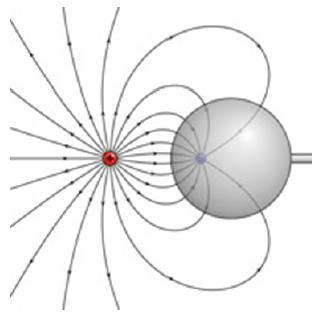
Sketch the electric field lines in the vicinity of two opposite charges, where the negative charge is three times greater in magnitude than the positive. (See Figure 18.43 for a similar situation).
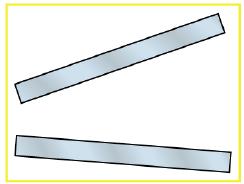
Sketch the electric field between the two conducting plates shown in Figure 18.46, given the top plate is positive and an equal amount of negative charge is on the bottom plate. Be certain to indicate the distribution of charge on the plates.
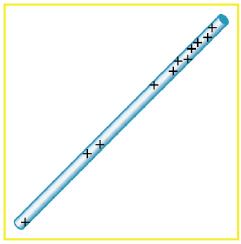
Sketch the electric field lines in the vicinity of the charged insulator in Figure 18.47 noting its nonuniform charge distribution. XX
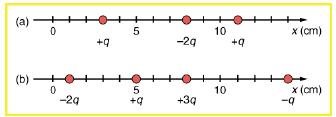
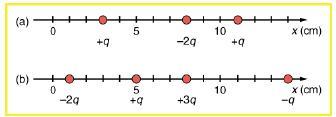
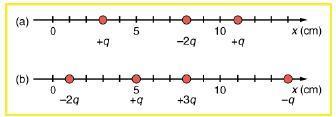
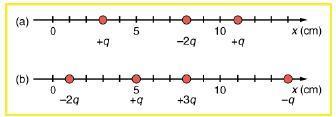
What is the force on the charge located at x = 8.00 cm in Figure 18.48(a) given that q= 1.00 μC? (a) (b) 0 +0 0 -29 +9 5 5 +q -2q +3q 10 10 +9 x (cm) x (cm) -q
(a) Find the total electric field at x = 11.00cm in Figure 18.48(b). (b) If the charges are allowed to move and eventually be brought to rest by friction, what will the final charge configuration be? (That is, will there be a single charge, double charge, etc., and what will its value(s) be?)
(a) Find the electric field at x = 5.00 cm in Figure 18.48(a), given that q = 1.00 μC.(b) At what position between 3.00 and 8.00 cm is the total electric field the same as that for-2q alone?(c) Can the electric field be zero anywhere between 0.00 and 8.00 cm? (d) At very large positive or
(a) Find the total Coulomb force on a charge of 2.00 nC located at x = 4.00 cm in Figure 18.48 (b), given that q = 1.00 μC.(b) Find the x-position at which the electric field is zero in Figure 18.48 (b). (a) (b) 0 +0 0 -29 +9 5 5 +q -2q +3q 10 10 +9 x (cm) x (cm) -q
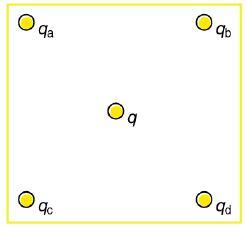
(a) Using the symmetry of the arrangement, determine the direction of the electric field at the center of the square in Figure 18.49, given that qa= qb= -1.00 μC and qc = qd=+1.00 μC.(b) Calculate the magnitude of the electric field at the location of q, given that the square is 5.00 cm on a
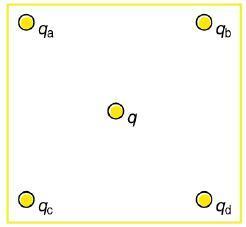
Find the electric field at the location of qa in Figure 18.49 given that qb= qc = qd = + 2.00 nC, q = - 1.00 nC, and the square is 20.0 cm on a side. eb qc Oq ab O qd
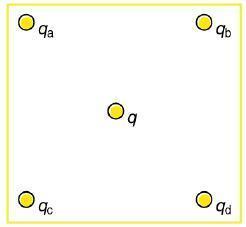
Find the total Coulomb force on the charge q in Figure 18.49, given that q = 1.00 μC, qa = 2.00 μC, qb = -3.00 μC, qc = - 4.00 μC, and qd = + 1.00 μC. The square is 50.0 cm on a side. qa O qc Oq O qb O qd
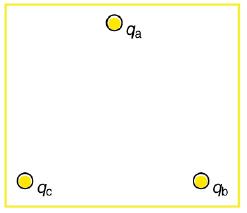
(a) Find the electric field at the location of qa in Figure 18.50, given that qb= +10.00 μC and qc = -5.00 μC.(b) What is the force on da, given that qa = +1.50 nC? qc O da qb
(a) What is the electric field 5.00 m from the center of the terminal of a Van de Graaff with a 3.00 mC charge, noting that the field is equivalent to that of a point charge at the center of the terminal? (b) At this distance, what force does the field exert on a 2.00 μC charge on the Van de
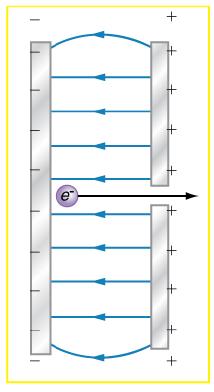
A simple and common technique for accelerating electrons is shown in Figure 18.51, where there is a uniform electric field between two plates. Electrons are released, usually from a hot filament, near the negative plate, and there is a small hole in the positive plate that allows the electrons to
(a) What is the direction and magnitude of an electric field that supports the weight of a free electron near the surface of Earth?(b) Discuss what the small value for this field implies regarding the relative strength of the gravitational and electrostatic forces.
Earth has a net charge that produces an electric field of approximately 150 N/C downward at its surface. (a) What is the magnitude and sign of the excess charge, noting the electric field of a conducting sphere is equivalent to a point charge at its center? (b) What acceleration will the field
Point charges of 25.0 μC and 45.0 μC are placed 0.500 m apart. (a) At what point along the line between them is the electric field zero? (b) What is the electric field halfway between them?
Calculate the angular velocity of an electron orbiting a proton in the hydrogen atom, given the radius of the orbit is 0.530 x 10⁻¹⁰ m. You may assume that the proton is stationary and the centripetal force is supplied by Coulomb attraction.
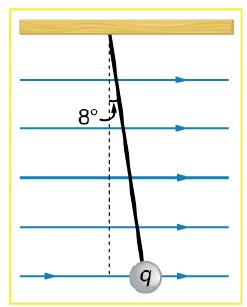
A 5.00 g charged insulating ball hangs on a 30.0 cm long string in a uniform horizontal electric field as shown in Figure 18.52. Given the charge on the ball is 1.00 μC, find the strength of the field. 8°- b
The practical limit to an electric field in air is about 3.00 x 10⁶ N/C. Above this strength, sparking takes place because air begins to ionize and charges flow, reducing the field.(a) Calculate the distance a free proton must travel in this field to reach 3.00% of the speed of light, starting from
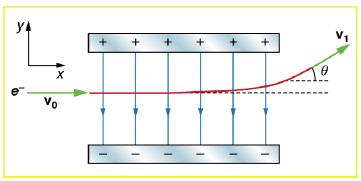
Figure 18.53 shows an electron passing between two charged metal plates that create an 100 N/C vertical electric field perpendicular to the electron's original horizontal velocity. (These can be used to change the electron's direction, such as in an oscilloscope.) The initial speed of the electron
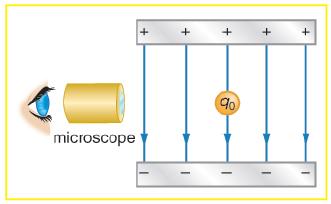
The classic Millikan oil drop experiment was the first to obtain an accurate measurement of the charge on an electron. In it, oil drops were suspended against the gravitational force by a vertical electric field. (See Figure 18.54.) Given the oil drop to be 1.00 μm in radius and have a density of
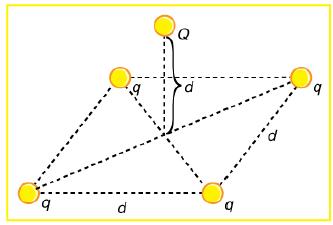
(a) In Figure 18.55, four equal charges q lie on the corners of a square. A fifth charge Q is on a mass m directly above the center of the square, at a height equal to the length d of one side of the square. Determine the magnitude of q in terms of Q, m, and d, if the Coulomb force is to equal the
(a) Calculate the electric field strength near a 10.0 cm diameter conducting sphere that has 1.00 C of excess charge on it. (b) What is unreasonable about this result? (c) Which assumptions are responsible?
A wrecking yard inventor wants to pick up cars by charging a 0.400 m diameter ball and inducing an equal and opposite charge on the car. If a car has a 1000 kg mass and the ball is to be able to lift it from a distance of 1.00 m:(a) What minimum charge must be used? (b) What is the electric field
Consider two insulating balls with evenly distributed equal and opposite charges on their surfaces, held with a certain distance between the centers of the balls. Construct a problem in which you calculate the electric field (magnitude and direction) due to the balls at various points along a line
Consider identical spherical conducting space ships in deep space where gravitational fields from other bodies are negligible compared to the gravitational attraction between the ships. Construct a problem in which you place identical excess charges on the space ships to exactly counter their
Find the ratio of speeds of an electron and a negative hydrogen ion (one having an extra electron) accelerated through the same voltage, assuming non-relativistic final speeds. Take the mass of the hydrogen ion to be 1.67 x 10⁻²⁷ kg.
An evacuated tube uses an accelerating voltage of 40 kV to accelerate electrons to hit a copper plate and produce x rays. Non-relativistically, what would be the maximum speed of these electrons?
A bare helium nucleus has two positive charges and a mass of 6.64 x 10⁻²⁷ kg.(a) Calculate its kinetic energy in joules at 2.00% of the speed of light. (b) What is this in electron volts? (c) What voltage would be needed to obtain this energy?
Singly charged gas ions are accelerated from rest through a voltage of 13.0 V. At what temperature will the average kinetic energy of gas molecules be the same as that given these ions?
The temperature near the center of the Sun is thought to be 15 million degrees Celsius (1.5 x 10⁷ °C). Through what voltage must a singly charged ion be accelerated to have the same energy as the average kinetic energy of ions at this temperature?
A lightning bolt strikes a tree, moving 20.0 C of charge through a potential difference of 1.00 x 10² MV. (a) What energy was dissipated?(b) What mass of water could be raised from 15°C to the boiling point and then boiled by this energy? (c) Discuss the damage that could be caused to the tree
A 12.0V battery-operated bottle warmer heats 50.0 g of glass, 2.50 x 10² g of baby formula, and 2.00 x 10² g of aluminum from 20.0°C to 90.0°C.(a) How much charge is moved by the battery?(b) How many electrons per second flow if it takes 5.00 min to warm the formula?
A battery-operated car utilizes a 12.0V system. Find the charge the batteries must be able to move in order to accelerate the 750 kg car from rest to 25.0 m/s, make it climb a 2.00 x 10² m high hill, and then cause it to travel at a constant 25.0 m/s by exerting a 5.00 x 10² N force for an hour.
Fusion probability is greatly enhanced when appropriate nuclei are brought close together, but mutual Coulomb repulsion must be overcome. This can be done using the kinetic energy of high- temperature gas ions or by accelerating the nuclei toward one another.(a) Calculate the potential energy of
(a) Find the voltage near a 10.0 cm diameter metal sphere that has 8.00 C of excess positive charge on it.(b) What is unreasonable about this result?(c) Which assumptions are responsible?
Consider a battery used to supply energy to a cellular phone. Construct a problem in which you determine the energy that must be supplied by the battery, and then calculate the amount of charge it must be able to move in order to supply this energy. Among the things to be considered are the energy
Show that units of V/m and N/C for electric field strength are indeed equivalent.
What is the strength of the electric field between two parallel conducting plates separated by 1.00 cm and having a potential difference (voltage) between them of 1.50 x 10⁴ V?
The electric field strength between two parallel conducting plates separated by 4.00 cm is 7.50 x 10⁴ V/m.(a) What is the potential difference between the plates? (b) The plate with the lowest potential is taken to be at zero volts. What is the potential 1.00 cm from that plate (and 3.00 cm from
Showing 1800 - 1900
of 3651
First
12
13
14
15
16
17
18
19
20
21
22
23
24
25
26
Last
Step by Step Answers

 Get 50% OFF
Claim Now
Get 50% OFF
Claim Now