New Semester
Started
Get
50% OFF
Study Help!
--h --m --s
Claim Now
Question Answers
Textbooks
Find textbooks, questions and answers
Oops, something went wrong!
Change your search query and then try again
S
Books
FREE
Study Help
Expert Questions
Accounting
General Management
Mathematics
Finance
Organizational Behaviour
Law
Physics
Operating System
Management Leadership
Sociology
Programming
Marketing
Database
Computer Network
Economics
Textbooks Solutions
Accounting
Managerial Accounting
Management Leadership
Cost Accounting
Statistics
Business Law
Corporate Finance
Finance
Economics
Auditing
Tutors
Online Tutors
Find a Tutor
Hire a Tutor
Become a Tutor
AI Tutor
AI Study Planner
NEW
Sell Books
Search
Search
Sign In
Register
study help
physics
principles communications systems
Engineering Electromagnetics 8th edition William H. Hayt, John A.Buck - Solutions
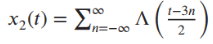
Find the energies and powers of the following signals (note that 0 and ˆž are possible answers). Tell which are energy signals and which are power signals.(a) x1(t) = cos(10Ï€t) u(t) u(2 - t)(b)(c) x3(t) = e-|t| cos (2Ï€t)(d) x4(t) = II (t/2) + Δ (t) X
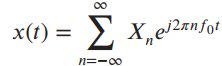
Using the uniqueness property of the Fourier series, find exponential Fourier series for the following signals (f0 is an arbitrary frequency):(a) x1(t) = sin2(2πf0t)(b) x2(t) = cos(2πf0t) + sin(4πf0t)(c) x3(t) = sin(4πf0t) cos(4πf0t)(d) x4(t) = cos3(2πf0t)(e) x5(t) = sin(2πf0t)
Expand the signal x(t) = 2t2 in a complex exponential Fourier series over the interval |t| ≤ 2. Sketch the signal to which the Fourier series converges for all t.
Ifare the Fourier coefficients of a real signal, x(t), fill in all the steps to show that:(a) (b) Xn is a real, even function of n for x(t) even.(c) Xn is imaginary and an odd function of n for x(t) odd. (d) x(t) = -x(t + T0/2) (half wave odd symmetry) implies that Xn = 0, n even.
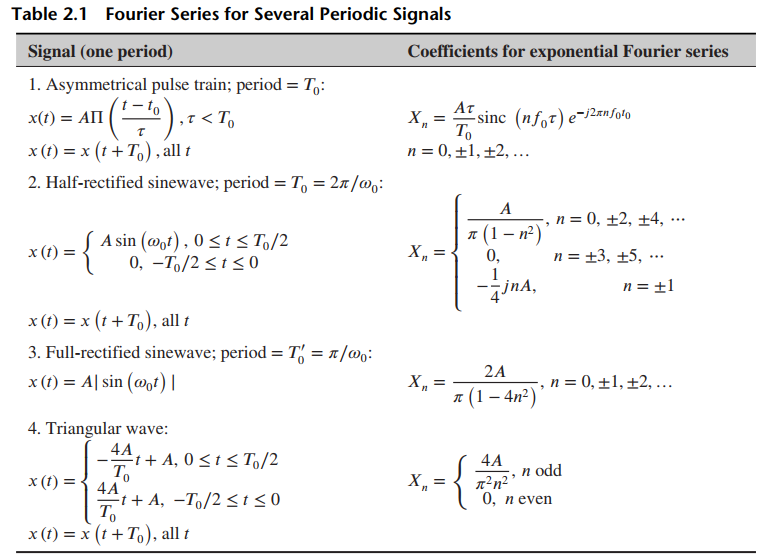
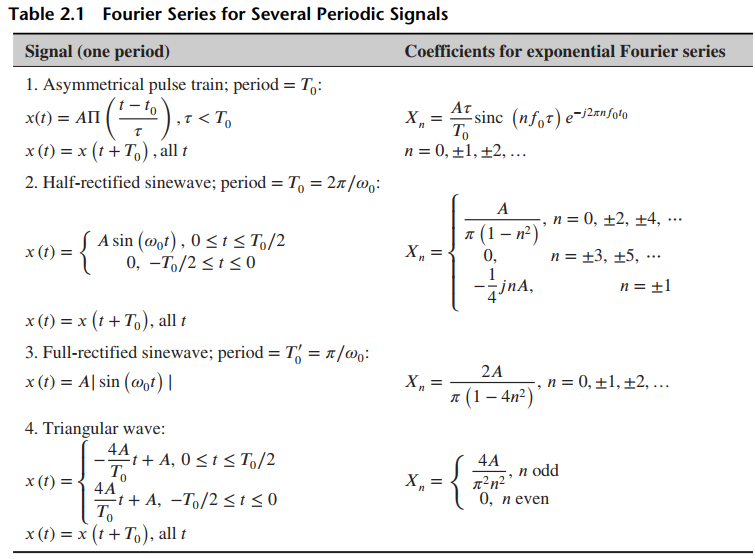
Obtain the complex exponential Fourier series coefficients for the (a) pulse train, (b) half-rectified sinewave, (c) full-rectified sinewave, and (d) triangular waveform as given in Table 2.1. Table 2.1 Fourier Series for Several Periodic Signals Signal (one period) Coefficients for exponential
Find the ratio of the power contained in a rectangular pulse train for |n f0| ≤ τ -1 to the total power for each of the following cases:(a) τ/T0 = 1/2(b) τ/T0 = 1/5(c) τ/T0 = 1/10(d) τ/T0 = 1/20
(a) If x(t) has the Fourier and y(t) = x(t - t0), show that Yn = Xne-j2Ï€nf0t0 where the Yn's are the Fourier coefficient for y(t).(b) Verify the theorem proved in part (a) by examining the Fourier coefficients for x(t) = cos(ω0t) and y(t) = sin(ω0t). ο0
Use the Fourier series expansions of periodic square wave and triangular wave signals to find the sum of the following series: (a) 1 - 1/3 + 1/5 - 1/7 + ....(b) 1 + 1/9 + 1/25 + 1/49 + ....Write down the Fourier series in each case and evaluate it for a particular, appropriately chosen value
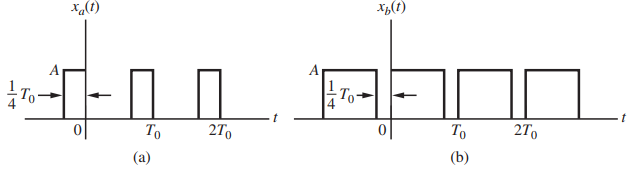
Using the results given in Table 2.1 for the Fourier coefficients of a pulse train, plot the double-sided amplitude and phase spectra for the wave forms shown in Figure 2.34.(Note that xb(t) = -xa(t) + A.How is a sign change and DC level shift manifested in the spectrum of the waveform?)Figure 2.34
Sketch each signal given below and find its Fourier transform. Plot the amplitude and phase spectra of each signal (A and τ are positive constants).(a) x1(t) = A exp (-t/τ) u(t) (b) x2(t) = A exp (t/τ) u(-t)(c) x3(t) = x1 (t) - x2 (t) (d) x4(t) = x1 (t) + x2 (t). Does the result
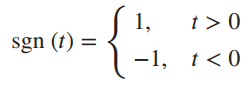
(a) Use the Fourier transform of x(t) = exp (-αt) u (t) - exp (αt) u (-t) where α > 0 (b) Use the result above and the relation u(t) = 1/2[sgn (t) + 1] to find Fourier transform of the unit step.(c) Use the integration theorem and the Fourier transform of the unit impulse function
(a) Given II(t) ↔ sinc(f), find the Fourier transforms of the following signals using the frequency-translation followed by the time-delay theorem. (i) x1(t) = II (t - 1) exp [j4π(t - 1)](ii) x2(t) = II (t + 1) exp [j4π(t + 1)] (b) Repeat the above, but now applying the time
By applying appropriate theorems and using the signals defined in Problem 2.28, find Fourier transforms of the following signals:(a) xa (t) = 1/2 x1 (t) + 1/2 x1 (-t)(b) xb (t) = 1/2 x2 (t) + 1/2 x2 (-t)
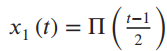
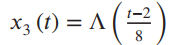
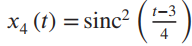
Use the superposition, scale-change, and time-delay theorems along with the transform pairs II(t) †” sinc(f), sinc(t) †” II(f), ˆ§ (t), †” sinc2(f), and sinc2(t) †” ˆ§ (f) to find Fourier transforms of the following:(a) (b) x2
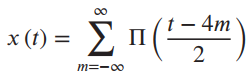
Use the Poisson sum formula to obtain the Fourier series of the signal οο 4m ΣπΠ x (t) = П m -ο
Without actually computing them, but using appropriate sketches, tell if the Fourier transforms of the signals given below are real, imaginary, or neither; even, odd, or neither. Give your reasoning in each case. (a) x1(t) = II (t + 1/2) - II (t - 1/2)(b) x2(t) = II(t/2) + II (t) (c)
Find and plot the energy spectral densities of the following signals. Dimension your plots fully. Use appropriate Fourier-transforms pairs and theorems.(a) x1(t) = 10e-5tu (t)(b) x2(t) = 10 sine (2t)(c) x3(t) = 3II(2t)(d) x4(t) = 3II(2t) cos(10πt)
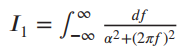
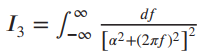
Evaluate the following integrals using Rayleigh€™s energy theorem (Parseval€™s theorem for Fourier transforms).(a)(b)(c)(d) I = L 00 a2+(2xf )² -∞ I, = [ sinc 2(7 f)df 00 %3D
Obtain and sketch the convolutions of the following signals.(a) y1(t) = e-atu(t) ∗ Il(t - τ), a and τ positive constants(b) y2(t) = [II(t/2) + II(t)] ∗ Il(t)(c) y3(t) = e-α|t| ∗ II(t), a > 0 (d) y4 (t) = x(t) ∗ u (t), where x(t) is any energy signal [you will have to assume a
Find the signals corresponding to the following spectra. Make use of appropriate Fourier-transform theorems.(a) X1 (f) = 2 cos (2πf) II (f) exp (-j4πf) (b) X2 (f) = Λ (f/2) exp (-j5πf) (c) X3 (f) = [II(f + 4/2) + II (f - 4/2)] exp (-j8πf)
Given the following signals, suppose that all energy spectral components outside the bandwidth |f| ≤ W are removed by an ideal filter, while all energy spectral components within this bandwidth are kept. Find the ratio of energy kept to total energy in each case. (α, β, and τ are
(a) Find the Fourier transform of the cosine pulse x(t) = AII (2t / T0) cos (ω0t), where ω0= 2π / T0Express your answer in terms of a sum of sinc functions. Provide MATLAB plots of x(t) and X(f) [note that X(f) is real].(b) Obtain the Fourier transform of the raised
Provide plots of the following functions of time and find their Fourier transforms. Tell which ones should be real and even functions of f and which ones should be imaginary and odd functions of f. Do your results bear this out?(a)(b)(c)(d) x4 (t) = Λ (t - 1) - Λ (t + 1)(e)
(a) Obtain the time-average auto correlation function of x(t) = 3 + 6 cos (20πt) + 3 sin (20πt). (Combine the cosine and sine terms into a single cosine with a phase angle.)(b) Obtain the power spectral density of the signal of part (a). What is its total average power?
Find the power spectral densities and average powers of the following signals.(a) x1 (t) = 2 cos (20πt + π/3)(b) x2 (t) = 3 sin (30πt)(c) x3 (t) = 5 sin (10πt - π/6)(d) x4 (t) = 3 sin (30πt) + 5 sin (10πt - π/6)
By applying the properties of the auto correlation function, determine whether the following are acceptablefor auto correlation functions. In each case, tell why or why not.(a) R1 (τ) = 2 cos(10πτ) + cos (30πτ)(b) R2 (τ) = 1 + 3 cos (30πτ)(c) R3 (τ) = 3 cos (20πτ + π / 3)(d) R4 (τ) =
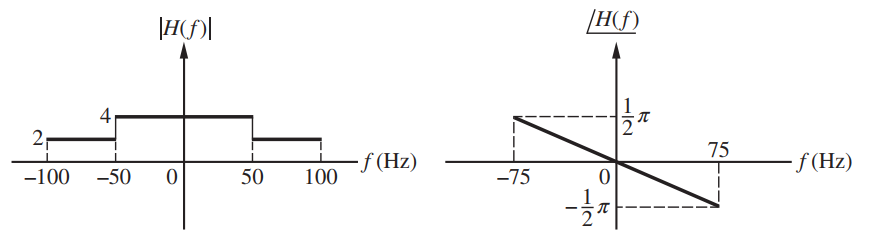
A filter has amplitude response and phase shift shown in Figure 2.39. Find the output for each of the inputs given below. For which cases is the transmission distortionless? Tell what type of distortion is imposed for the others.(a) cos (48Ï€t) + 5 cos (126Ï€t)(b) cos
Find the auto correlation functions of the signals having the following power spectral densities. Also give their average powers.(a) S1 (f) = 4δ (f - 15) + 4δ (f + 15)(b) S2 (f) = 9δ (f - 20) + 9δ (f + 20)(c) S3 (f) = 16δ (f - 5) + 16δ (f + 5)(d) S4 (f) = 9δ (f - 20) + 9δ (f + 20) + 16δ (f
Find the auto correlation functions corresponding to the following signals.(a) x1 (t) = 2 cos(10πt + π/3)(b) x2 (t) = 2 sin(10πt + π/3)(c) x3 (t) = Re [3 exp (j10πt) + 4j exp (j10πt)](d) x4 (t) = x1 (t) + x2 (t)
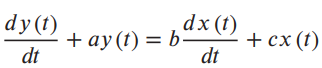
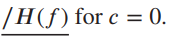
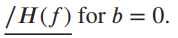
A system is governed by the differential equation (a, b, and c are non-negative constants) (a) Find H(f) (b) Find and plot |H (f)| and (c) Find and plot |H (f)| and dy (t) dx (t) + ay (t) = b dt +cx (t) dt /H(f) for c = 0. %D
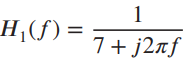
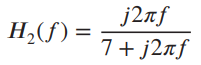
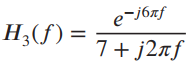
For each of the following transfer functions, determine the unit impulse response of the system.(a) (b) (c)(d) H,(f) = 7+ j2nf j2nf 7+ j2¤f Н.(Г) %3
A filter has frequency response function H(f) = II (f / 2B) and input x(t) = 2W sinc (2W t).(a) Find the output y (t) for W < B.(b) Find the output y (t) for W > B.(c) In which case does the output suffer distortion? What influenced your answer?
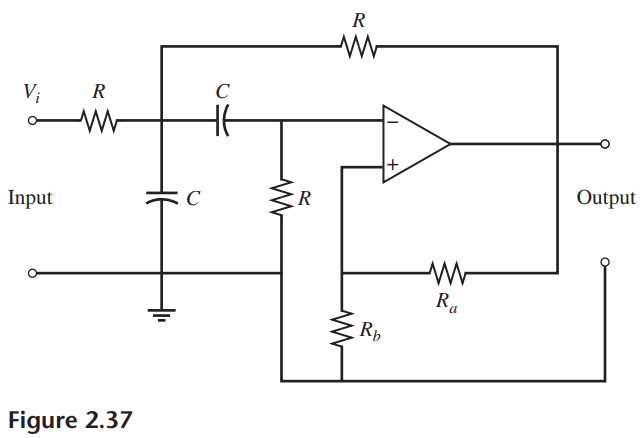
A second-order active band pass filter (BPF), known as a band pass Sallen-Key circuit, is shown in Figure 2.37.(a) Show that the frequency response function of this filter is given by whereω0 = ˆš2(RC) -1Q = ˆš2 / 4 - kK = 1 + Ra / Rb(b) Plot |H (f)|.(c) Show
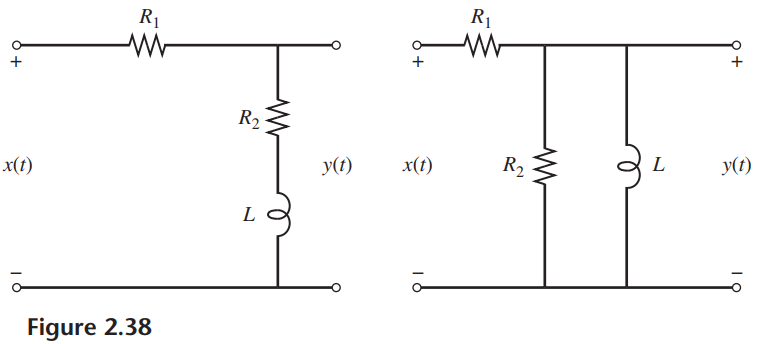
For the two circuits shown in Figure 2.38, determine H(f) and h(f) Sketch accurately the amplitude and phase responses. Plot the amplitude response in decibels. Use a logarithmic frequency axis. R1 R1 R, R2 x(t) У() x(t) У() Figure 2.38
Using the Paley-Wiener criterion, show that|H(f)| = exp (-βf2)is not a suitable amplitude response for a causal, linear time-invariant filter.
Determine whether or not the filters with impulse responses given below are BIBO stable. α and f0 are positive constants.(a) h1 (t) = exp(-α |t|) cos (2πf0t)(b) h2 (t) = cos (2πf0t) u(t)(c) h3 (t) = t-1 u(t - 1)(d) h4 (t) = e-tu (t) – e-(t – 1) u (t - 1)(e) h5 (t) = t-2u (t - 1)(f) h6 (t) =
Given a filter with frequency response functionH (f) = 5 / 4 + j (2πf)and input x(t) = e-3tu(t), obtain and plot accurately the energy spectral densities of the input and output.
A filter with frequency response functionH(f) = 3II (f / 62)has as an input a half-rectified cosine waveform of fundamental frequency 10 Hz. Determine an analytical expression for the output of the filter. Plot the output using MATLAB.
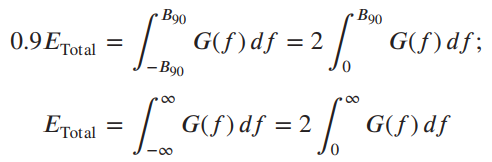
Another definition of bandwidth for a signal is the 90% energy containment bandwidth. For a signal with energy spectral density G(f) = |X(f)|2, it is given by B90in the relation Obtain B90 for the following signals if it is defined. If it is not defined for a particular signal, state why
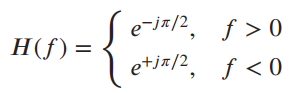
An ideal quadrature phase shifter has frequency response function Find the outputs for the following inputs:(a) x1 (t) = exp (j100Ï€t)(b) x2 (t) = cos (100Ï€t)(c) x3 (t) = sin (100Ï€t)(d) X4 (t) = II (t / 2) e-j#/2, f > 0 etj/2, f < 0 H(f) =
Determine and accurately plot, on the same set of axes, the group delay and the phase delay for the systems with unit impulse responses:(a) h1 (t) = 3e-5t u(t)(b) h2 (t) = 5e-3tu (t) - 2e-5tu (t)(c) h3 (t) = sinc[2B (t - t0)] where B and t0 are positive constants(d) h4 (t) = 5e-3tu (t) -
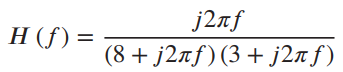
A system has the frequency response functionDetermine and accurately plot the following: (a) The amplitude response(b) The phase response(c) The phase delay(d) The group delay J2лf (8+ ј2лf)(3+ j2лf) |H (f) =
The nonlinear system defined by y(t) = x(t) + 0.1x2 (t) has an input signal with the band pass spectrumSketch the spectrum of the output, labeling all important frequencies and amplitudes. f + 10 + 211 f – 10 X(f)= 21 4
Find the impulse response of an ideal high pass filter with the frequency response function -2л fto Ннp() %3D Но | 1-П 2W
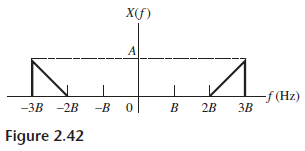
Given the band pass signal spectrum shown in Figure 2.42, sketch spectra for the following sampling rates fsand indicate which ones are suitable.(a) 2B (b) 2.5B (c) 3B (d) 4B (e) 5B (f) 6B X(f) Д -f (Hг) ЗВ -Зв -2B -в о 2B Figure 2.42
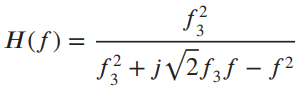
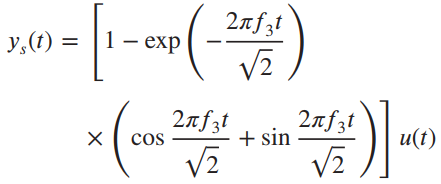
(a) Show that the frequency response function of a second-order Butter worth filter iswhere f3 is the 3-dB frequency in hertz.(b) Find an expression for the group delay of this filter. Plot the group delay as a function of f / f3.(c) Given that the step response for a second-order Butter worth
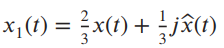
Using appropriate Fourier-transform theorems and pairs, express the spectrum Y(f) of y(t) = x(t) cos (ω0t) + x̂(t) sin (ω0t)in terms of the spectrum X(f) of x(t), where X(f) is low pass with bandwidthB < f0 = ω0 / 2πSketch Y(f) for a typical X(f).
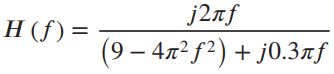
Given a filter with frequency response functionDetermine and accurately plot the following: (a) The amplitude response; (b) The phase response; (c) The phase delay; (d) The group delay. j2лf H (f) = (9 - 4л*/) + ј0.Злf
Given a nonlinear, zero-memory device with transfer characteristic y(t) = x3(t),Find its output due to the inputx(t) = cos (2πt) + cos (6πt)List all frequency components and tell whether they are due to harmonic generation or inter modulation terms.
Verify the pulse width-bandwidth relationship of Equation (2.234) for the following signals. Sketch each signal and its spectrum.(a) x(t) = A exp (-t2 / 2τ2) (Gaussian pulse) (b) x(t) = A exp (-α |t|), (Gaussian pulse) α > 0 (double-sided exponential)
A sinusoidal signal of frequency 1 Hz is to be sampled periodically.(a) Find the maximum allowable time interval between samples.(b) Samples are taken at 1/3-S intervals (i.e., at a rate of fs = 3 sps). Construct a plot of the sampled signal spectrum that illustrates that this is an acceptable
A flat-top sampler can be represented as the block diagram of Figure 2.40.(a) Assuming Ï„ << Ts, sketch the output for a typical x(t).(b) Find the spectrum of the output, Y(f), in terms of the spectrum of the input, X(f). Determine the relationship between Ï„ and Ts
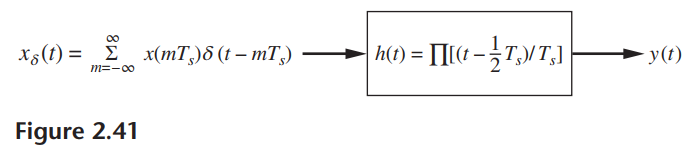
Figure 2.41 illustrates so-called zero-order-hold reconstruction.(a) Sketch y(t) for a typical x(t). Under what conditions is y(t) a good approximation to x(t)?(b) Find the spectrum of y(t) in terms of the spectrum of x(t). Discuss the approximation of y(t) to x(t) in terms of frequency-domain
Determine the range of permissible cutoff frequencies for the ideal low pass filter used to reconstruct the signal x(t) = 10 cos2(600πt) cos(2400πt)Which is sampled at 4500 samples per second. Sketch X(f) and Xδ(f). Find the minimum allowable sampling frequency.
Consider the inputx(t) = II(t/τ) cos [2π(f0 + Δf)t], Δf << f0to a filter with impulse responseh(t) = αe-αt cos (2πf0t) u(t)
Following Example 2.30, considerx(t) = 2 cos (52πt)Find x̂ (t), xp (t), x̃ (t), xR (t), and xI (t) for the following cases: (a) f0 = 25 Hz; (b) f0 = 27 Hz; (c) f0 = 10 Hz; (d) f0 = 15 Hz; (e) f0 = 30 Hz; (f) f0 = 20 Hz.
Assume that the Fourier transform of x(t) is real and has the shape shown in Figure 2.43. Determine and plot the spectrum of each of the following signals:(a) (b)(c) (d) x, (t) = }x(t) + jt) x,(1) = |x(1) +jFC e/2afo!, fo > W x(1) +j&(1) e/2zfot, fo» W х,(() %3D 4
Show that x(t) and x̂ (t) are orthogonal for the following signals: (a) x1(t) = sin (ω0t)(b) x2(t) = 2cos (ω0t) + sin (ω0t) cos (2 ω0t)(c) x3(t) = A exp (jω0t)
A rectangular conducting plate lies in the xy plane, occupying the region 0 < x < a, 0 < y < b. An identical conducting plate is positioned directly above and parallel to the first, at z = d. The region between plates is filled with material having conductivity σ(x) = σ0e−x/a, where
Let V = 10(ρ + 1)z2 cos ϕ V in free space.(a) Let the equipotential surface V = 20 V define a conductor surface. Find the equation of the conductor surface.(b) Find ρ and E at that point on the conductor surface where ϕ = 0.2π and z = 1.5.(c) Find |ρS| at that point.
A coaxial transmission line has inner and outer conductor radii a and b. Between conductors (a < ρ < b) lies a conductive medium whose conductivity is σ(ρ) = σ0/ρ, where σ0 is a constant. The inner conductor is charged to potential V0, and the outer conductor is grounded.(a) Assuming dc
Given the potential field V = 100xz/(x2 + 4) V in free space:(a) Find D at the surface z = 0.(b) Show that the z = 0 surface is an equipotential surface.(c) Assume that the z = 0 surface is a conductor and find the total charge on that portion of the conductor defined by 0 < x < 2,−3 < y
Two parallel circular plates of radius a are located at z = 0 and z = d. The top plate (z = d) is raised to potential V0; the bottom plate is grounded. Between the plates is a conducting material having radial-dependent conductivity, σ(ρ) = σ0ρ, where σ0 is a constant.(a) Find the
Let V = 20x2yz − 10z2 V in free space.(a) Determine the equations of the equipotential surfaces on which V = 0 and 60 V.(b) Assume these are conducting surfaces and find the surface charge density at that point on the V = 60 V surface where x = 2 and z = 1. It is known that 0 ≤ V ≤ 60 V is
Two point charges of −100πμC are located at (2, −1, 0) and (2, 1, 0). The surface x = 0 is a conducting plane.(a) Determine the surface charge density at the origin.(b) Determine ρS at P(0, h, 0).
Let the surface y = 0 be a perfect conductor in free space. Two uniform infinite line charges of 30 nC/m each are located at x = 0, y = 1, and x = 0, y = 2.(a) Let V = 0 at the plane y = 0, and find V at P(1, 2, 0).(b) Find E at P.
A dipole with p = 0.1az μC · m is located at A(1, 0, 0) in free space, and the x = 0 plane is perfectly conducting.(a) Find V at P(2, 0, 1).(b) Find the equation of the 200 V equipotential surface in rectangular coordinates.
At a certain temperature, the electron and hole mobilities in intrinsic germanium are given as 0.43 and 0.21 m2/V · s, respectively. If the electron and hole concentrations are both 2.3 × 10¹⁹ m−3, find the conductivity at this temperature.
Electron and hole concentrations increase with temperature. For pure silicon, suitable expressions are ρh = −ρe = 6200T1.5e−7000/T C/m3. The functional dependence of the mobilities on temperature is given by μh = 2.3 × 10⁵T−2.7 m2/V · s and μe = 2.1 × 10⁵T−2.5 m2/V · s, where the
A semiconductor sample has a rectangular cross section 1.5 by 2.0 mm, and a length of 11.0 mm. The material has electron and hole densities of 1.8 × 10¹⁸ and 3.0 × 10¹⁵ m−3, respectively. If μe = 0.082 m2/V · s and μh = 0.0021 m2/ V· s, find the resistance offered between the end faces of
Two equal but opposite-sign point charges of 3 μC are held x meters apart by a spring that provides a repulsive force given by Fsp = 12(0.5 − x) N. Without any force of attraction, the spring would be fully extended to 0.5 m.(a) Determine the charge separation.(b) What is the dipole moment?
Two perfect dielectrics have relative permittivities ∈r1 = 2 and ∈r2 = 8. The planar interface between them is the surface x − y + 2z = 5. The origin lies in region 1. If E1 = 100ax + 200ay − 50az V/m, find E2.
Region 1 (x ≥ 0) is a dielectric with ∈r1 = 2, while region 2(x < 0) has ∈r2 = 5. Let E1 = 20ax − 10ay + 50az V/m.(a) Find D2.(b) Find the energy density in both regions.
Let the cylindrical surfaces ρ = 4 cm and ρ = 9 cmenclose two wedges of perfect dielectrics, ∈r1 = 2 for 0 < ϕ < π/2 and ∈r2 = 5 for π/2 < ϕ < 2π. If E1 = (2000/ρ)aρ V/m, find(a) E2;(b) The total electrostatic energy stored in a 1 m length of each region.
Given the current density J = −104[sin(2x)e−2yax + cos(2x)e−2yay] kA/m2(a) Find the total current crossing the plane y = 1 in the ay direction in the region 0 < x < 1, 0 < z < 2.(b) Find the total current leaving the region 0 < x, y < 1, 2 < z < 3 by integrating J ·
Given J = −10−4(yax + xay)A/m2, find the current crossing the y = 0 plane in the −ay direction between z = 0 and 1, and x = 0 and 2.
Let J = 400 sin θ/(r2 + 4) ar A/m2.(a) Find the total current flowing through that portion of the spherical surface r = 0.8, bounded by 0.1π < θ < 0.3π, 0 < ϕ < 2π.(b) Find the average value of J over the defined area.
If volume charge density is given as ρv = (cos ωt)/r2 C/m2 in spherical coordinates, find J. It is reasonable to assume that J is not a function of θ or ϕ.
Let J = 25/ρaρ − 20/(ρ2 + 0.01) az A/m2.(a) Find the total current crossing the plane z = 0.2 in the az direction forρ < 0.4.(b) Calculate ∂ρν/∂t.(c) Find the outward current crossing the closed surface defined by ρ = 0.01, ρ = 0.4, z = 0, and z = 0.2.(d) Show that the divergence
In spherical coordinates, a current density J = −k/(r sin θ) aθ A/m2 exists in a conducting medium, where k is a constant. Determine the total current in the az direction that crosses a circular disk of radius R, centered on the z axis and located at(a) z = 0;(b) z = h.
Assuming that there is no transformation of mass to energy or vice versa, it is possible to write a continuity equation for mass.(a) If we use the continuity equation for charge as our model, what quantities correspond to J and ρν?(b) Given a cube 1 cm on a side, experimental data show that the
A truncated cone has a height of 16 cm. The circular faces on the top and bottom have radii of 2 mm and 0.1 mm, respectively. If the material from which this solid cone is constructed has a conductivity of 2 × 10⁶ S/m, use some good approximations to determine the resistance between the two
(a) Using data tabulated in Appendix C, calculate the required diameter for a 2-m-long nichrome wire that will dissipate an average power of 450 W when 120 V rms at 60 Hz is applied to it.(b) Calculate the rms current density in the wire.
A large brass washer has a 2-cm inside diameter, a 5-cm outside diameter, and is 0.5 cm thick. Its conductivity is σ = 1.5 × 10⁷ S/m. The washer is cut in half along a diameter, and a voltage is applied between the two rectangular faces of one part. The resultant electric field in the interior of
Two perfectly conducting cylindrical surfaces of length are located at ρ = 3 and ρ = 5 cm. The total current passing radially outward through the medium between the cylinders is 3 A dc.(a) Find the voltage and resistance between the cylinders, and E in the region between the cylinders, if a
Two identical conducting plates, each having area A, are located at z = 0 and z = d. The region between plates is filled with a material having z-dependent conductivity, σ(z) = σ0e−z/d, where σ0 is a constant. Voltage V0 is applied to the plate at z = d; the plate at z = 0 is at zero
A hollow cylindrical tube with a rectangular cross section has external dimensions of 0.5 in. by 1 in. and a wall thickness of 0.05 in. Assume that the material is brass, for which σ = 1.5 × 10⁷ S/m. A current of 200 A dc is flowing down the tube.(a) What voltage drop is present across a 1 m
A positive point charge of magnitude q1 lies at the origin. Derive an expression for the incremental work done in moving a second point charge q2 through a distance dx from the starting position (x, y, z), in the direction of −ax.
If E = 120aρ V/m, find the incremental amount of work done in moving a 50-μC charge a distance of 2 mm from(a) P(1, 2, 3) toward Q(2, 1, 4);(b) Q(2, 1, 4) toward P(1, 2, 3).
An electric field in free space is given by E = xax + yay + zaz V/m. Find the work done in moving a 1-μC charge through this field(a) From (1, 1, 1) to (0, 0, 0);(b) From (ρ = 2, ϕ = 0) to (ρ = 2, ϕ = 90◦);(c) From (r = 10, θ = θ0) to (r = 10, θ = θ0 + 180◦).
Compute the value of ʃPA G· dL for G = 2yax with A(1,−1, 2) and P(2, 1, 2) using the path(a) Straight-line segments A(1,−1, 2) to B(1, 1, 2) to P(2, 1, 2);(b) Straight-line segments A(1,−1, 2) to C(2,−1, 2) to P(2, 1, 2).
An electric field in free space is given as E = x âx + 4z ây + 4y âz. Given V(1, 1, 1) = 10 V, determine V(3, 3, 3).
Let G = 3xy2ax + 2zay Given an initial point P(2, 1, 1) and a final point Q(4, 3, 1), find ʃG· dL using the path(a) Straight line: y = x − 1, z = 1;(b) Parabola: 6y = x2 + 2, z = 1.
Given E = −xax + yay,(a) Find the work involved in moving a unit positive charge on a circular arc, the circle centered at the origin, from x = a to x = y = a/√2;(b) Verify that the work done in moving the charge around the full circle from x = a is zero.
A uniform surface charge density of 20 nC/m2 is present on the spherical surface r = 0.6 cm in free space.(a) Find the absolute potential at P(r = 1 cm, θ = 25◦, ϕ = 50◦).(b) Find VAB, given points A(r = 2 cm, θ = 30◦, ϕ = 60◦) and B(r = 3 cm, θ = 45◦, ϕ = 90◦).
A sphere of radius a carries a surface charge density of ρs0 C/m2.(a) Find the absolute potential at the sphere surface.(b) A grounded conducting shell of radius b where b > a is now positioned around the charged sphere. What is the potential at the inner sphere surface in this case?
Let a uniform surface charge density of 5 nC/m2 be present at the z = 0 plane, a uniform line charge density of 8 nC/m be located at x = 0, z = 4, and a point charge of 2μC be present at P(2, 0, 0). If V = 0 at M(0, 0, 5), find V at N(1, 2, 3).
In spherical coordinates, E = 2r/(r2 + a2)2ar V/m. Find the potential at any point, using the reference(a) V = 0 at infinity;(b) V = 0 at r = 0;(c) V = 100 V at r = a.
Three identical point charges of 4 pC each are located at the corners of an equilateral triangle 0.5 mm on a side in free space. How much work must be done to move one charge to a point equidistant from the other two and on the line joining them?
Given the electric field E = (y + 1)ax + (x − 1)ay + 2az find the potential difference between the points(a) (2,−2,−1) and (0, 0, 0);(b) (3, 2,−1) and (−2,−3, 4).
Showing 900 - 1000
of 1112
1
2
3
4
5
6
7
8
9
10
11
12
Step by Step Answers

 Get 50% OFF
Claim Now
Get 50% OFF
Claim Now





![[1+cos (2@,t)] To 2t y(t) =](https://dsd5zvtm8ll6.cloudfront.net/si.question.images/images/question_images/1536/6/6/4/3695b97a331182da1536646711237.jpg)






![x(t) X5 (t) h(t) = Y(1) = x,(1) * II(4 - 7)/ 7] Пс-3»я E 8 (t – nT,) 00 n=-00 Figure 2.40](https://dsd5zvtm8ll6.cloudfront.net/si.question.images/images/question_images/1536/7/4/8/2415b98ead12606c1536730587811.jpg)