New Semester
Started
Get
50% OFF
Study Help!
--h --m --s
Claim Now
Question Answers
Textbooks
Find textbooks, questions and answers
Oops, something went wrong!
Change your search query and then try again
S
Books
FREE
Study Help
Expert Questions
Accounting
General Management
Mathematics
Finance
Organizational Behaviour
Law
Physics
Operating System
Management Leadership
Sociology
Programming
Marketing
Database
Computer Network
Economics
Textbooks Solutions
Accounting
Managerial Accounting
Management Leadership
Cost Accounting
Statistics
Business Law
Corporate Finance
Finance
Economics
Auditing
Tutors
Online Tutors
Find a Tutor
Hire a Tutor
Become a Tutor
AI Tutor
AI Study Planner
NEW
Sell Books
Search
Search
Sign In
Register
study help
sciences
chemistry a molecular approach
Chemistry A Molecular Approach 5th Edition Nivaldo Tro - Solutions
What type of energy is chemical energy?(a) Kinetic energy(b) Thermal energy(c) Potential energy
Describe the scientific approach to knowledge. How does it differ from other approaches?
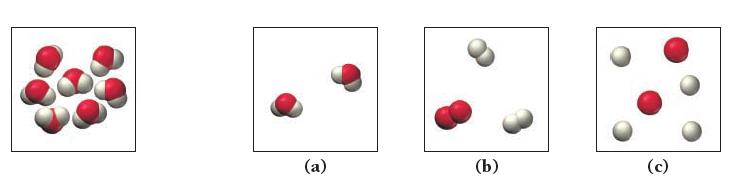
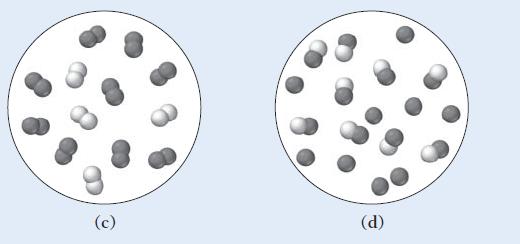
The diagram on the left represents liquid water molecules in a pan. Which of the three diagrams (a, b, or c) best represents the water molecules after they have been vaporized by boiling? (a) (b) (c)
Which change is a physical change?a) Wood burning b) Iron rustingc) Dynamite exploding d) Gasoline evaporating
A man receives a platinum ring from his fiancée. Before the wedding, he notices that the ring feels a little light for its size, and so he decides to determine its density.He places the ring on a balance and finds that it has a mass of 3.15 g. He then finds that the ring displaces 0.233 cm3 of
Explain the main goal of chemistry.
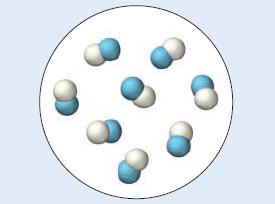
This image represents a particulate view of a sample of matter. Classify the sample according to its composition.a) The sample is a pure element.b) The sample is a homogeneous mixture.c) The sample is a compound.d) The sample is a heterogeneous mixture.
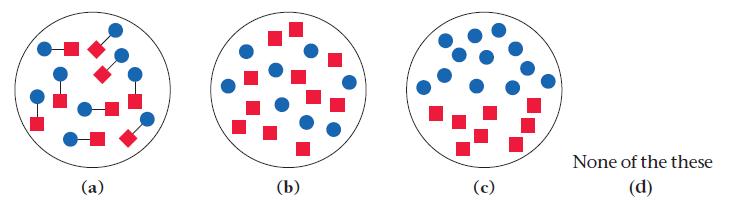
In these images, a blue circle represents an atom of one type of element, and a red square represents an atom of a second type of element. Which image is a pure substance? (a) (b) (c) None of the these (d)
A sick child has a temperature of 40.00 °C. What is the child’s temperature in (a) K and (b) °F?
Explain this statement in your own words and give an example.The properties of the substances around us depend on the atoms and molecules that compose them.
A chemist mixes sodium with water and witnesses a violent reaction between the metal and water. This is best classified as a) An observation. b) A law.c) A hypothesis. d) A theory.
Which statement best explains the difference ANSWER NOW! between a law and a theory?(a) A law is truth; a theory is mere speculation.(b) A law summarizes a series of related observations; a theory gives the underlying reasons for them.(c) A theory describes what nature does; a law describes why
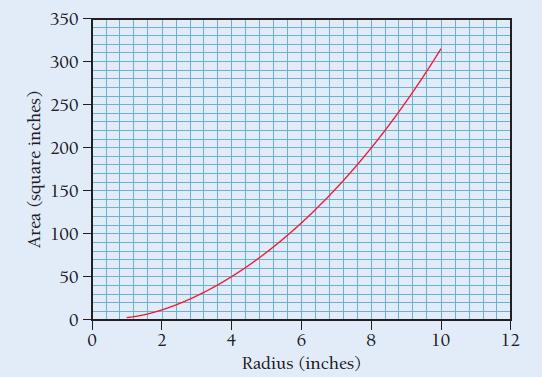
The graph that follows shows the area of a circle as a function of its radius. What is the radius of a circle that has an area of 155 square inches?a) 7.0 inches b) 6.5 inchesc) 6.8 inches d) 6.2 inches Area (square inches) 350 300 250 200 150 100 50 0 0 -2. 4 6 Radius (inches) 8 10 12
Determine whether each change is physical or chemical. What kind of property (chemical or physical) is demonstrated in each case?(a) The evaporation of rubbing alcohol. (b) The burning of lamp oil. (c) The bleaching of hair with hydrogen peroxide. (d) The formation of frost on a cold night.
What is the difference between a physical property and a chemical property?
Explain how distillation is used to separate mixtures.
A wooden block has a volume of 18.5 in3. Express the volume of the cube in cm3.a) 303 cm3 b) 47.0 cm3c) 1.13 cm3 d) 7.28 cm3
What kind of mixtures can be separated by filtration?
The gas mileage of a certain German automobile is 22 km/L.Convert this quantity to miles per gallon.a) 9.4 mi/gal b) 1.3 * 102 mi/galc) 52 mi/gal d) 3.6 mi/gal
Explain the difference between a homogeneous and a heterogeneous mixture.
A solid metal sphere has a radius of 3.53 cm and a mass of 1.796 kg. What is the density of the metal in g/cm3?a) 34.4 g/cm3 b) 0.103 g/cm3c) 121 g/cm3 d) 9.75 g/cm3
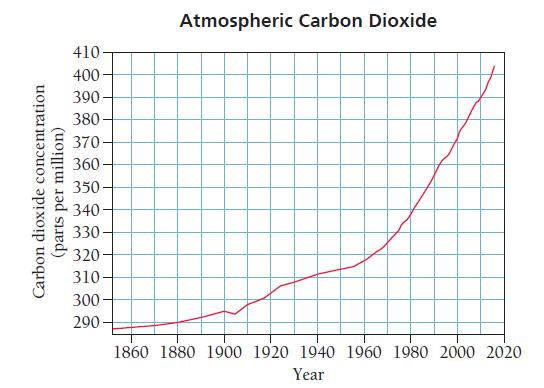
Examine the graph in Figure 1.14 and answer each question.(a) What was the concentration of carbon dioxide in 1960?(b) What was the concentration in 2010?(c) How much did the concentration increase between 1960 and 2010?(d) What is the average rate of increase over this time?(e) If the average rate
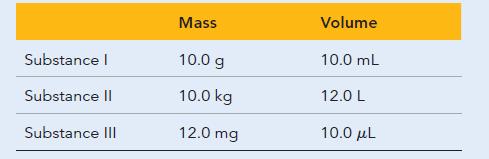
Three samples, each of a different substance, are weighed, and their volume is measured. The results are tabulated. List the substances in order of decreasing density.a) III > II > Ib) I > II > IIIc) III > I > IId) II 7 I 7 III Substance I Substance II Substance III Mass 10.0
Explain the difference between an element and a compound.
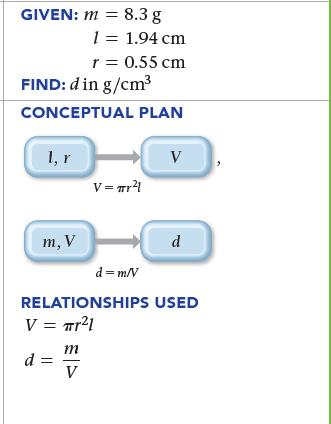
Find the density (in g/cm3) of a metal cylinder with a mass (m) of 8.3 g, a length (l ) of 1.94 cm, and a radius (r) of 0.55 cm. For a cylinder, V = πr2l. GIVEN: m = 8.3 g 1, r FIND: d in g/cm³ CONCEPTUAL PLAN m, V 1 = 1.94 cm r = 0.55 cm m V V = Tr²1 V d d = m/V RELATIONSHIPS USED V = Tr²1 d
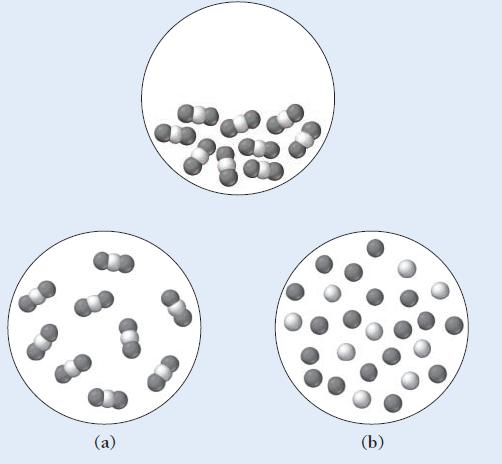
The first diagram depicts a compound in its liquid state.Which of the other diagrams best depicts the compound after it has evaporated into a gas? (a) (b)
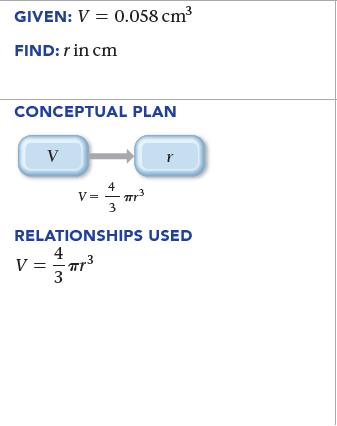
Find the radius (r) in centimeters of a spherical water droplet with a volume (V ) of 0.058 cm3. For a sphere, V = (4>3) πr3. GIVEN: V = 0.058 cm³ FIND: r in cm CONCEPTUAL PLAN V 4 v=mr²³ V= 3 r RELATIONSHIPS USED 4 V = = πr³ 3 .3
Explain the difference between a pure substance and a mixture
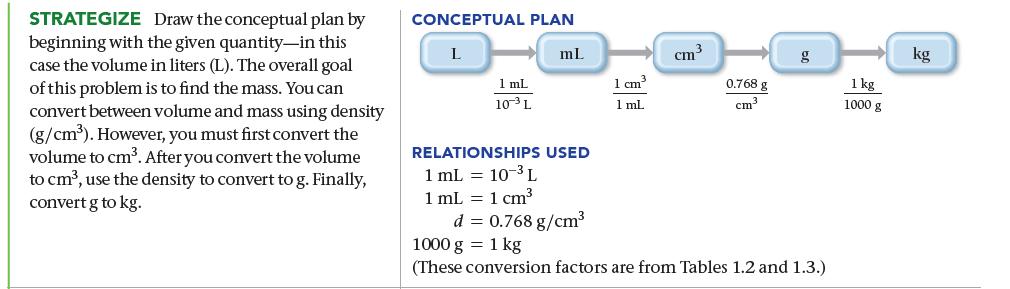
The mass of fuel in a jet must be calculated before each flight to ensure that the jet is not too heavy to fly. A 747 is fueled with 173,231 L of jet fuel. If the density of the fuel is 0.768 g/cm3, what is the mass of the fuel in kilograms? SORT Begin by sorting the information in the problem into
What is the difference between a crystalline solid and an amorphous solid?
Convert 1285 cm2 to m2.a) 1.285 * 107 m2 b) 12.85 m2c) 0.1285 m2 d) 1.285 * 105 m2
How do solids, liquids, and gases differ?
Perform the calculation to the correct number of significant figures.(8.01 - 7.50)/3.002a) 0.1698867 b) 0.17c) 0.170 d) 0.1699
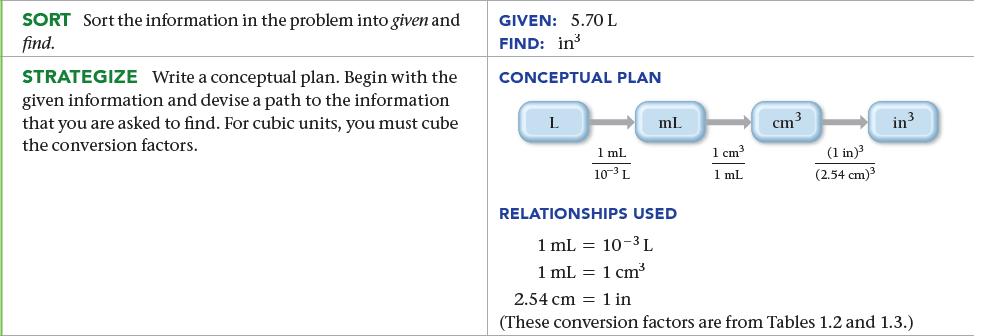
Calculate the displacement (the total volume of the cylinders through which the pistons move) of a 5.70-L automobile engine in cubic inches. SORT Sort the information in the problem into given and find. STRATEGIZE Write a conceptual plan. Begin with the given information and devise a path to the
What are two different ways to classify matter?
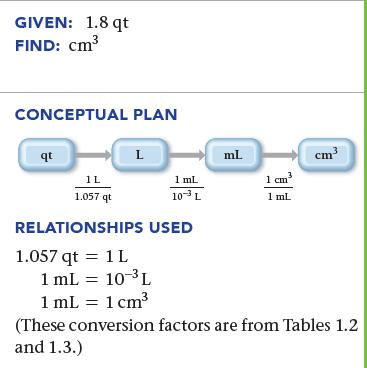
Convert 1.8 quarts to cubic centimeters. GIVEN: 1.8 qt FIND: cm³ CONCEPTUAL PLAN qt 1L 1.057 qt L 1 mL 10-³ L RELATIONSHIPS USED 1.057 qt = 1 L mL 1 mL cm³ 1 mL = 10-³L 1 mL = 1 cm³ (These conversion factors are from Tables 1.2 and 1.3.)
Perform the calculation to the correct number of significant figures. (43.998 * 0.00552)/2.002a) 0.121 b) 0.12c) 0.12131 d) 0.1213
What is wrong with the expression “That is just a theory,” if by theory the speaker is referring to a scientific theory?
What is the mass of a 1.75 L sample of a liquid that has a density of 0.921 g/mL?a) 1.61 * 103 g b) 1.61 * 10-3 gc) 1.90 * 103 g d) 1.90 * 10-3 g
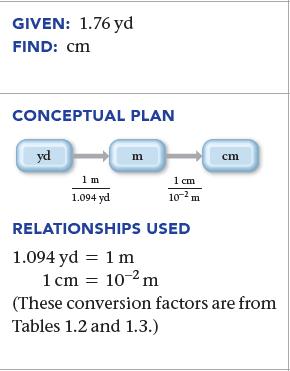
Convert 1.76 yards to centimeters. GIVEN: 1.76 yd FIND: cm CONCEPTUAL PLAN yd 1 m 1.094 yd m 1 cm 102 m RELATIONSHIPS USED 1.094 yd = 1 m 1 cm = 10-²m cm (These conversion factors are from Tables 1.2 and 1.3.)
The density of copper decreases as temperature increases (as does the density of most substances). Which change occurs in a sample of copper when it is warmed from room temperature to 95 °C?(a) The sample becomes lighter.(b) The sample becomes heavier.(c) The sample expands.(d) The sample
What theory did John Dalton formulate?
Express the quantity 33.2 * 10-4 m in mm.a) 33.2 mm b) 3.32 mmc) 0.332 mm d) 3.32 * 10-6 mm
Which prefix multiplier is most appropriate for reporting a measurement of 5.57 * 10-5 m?(a) Mega(b) Milli(c) Micro(d) Kilo
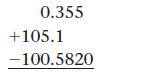
Perform each calculation to the correct number of significant figures.(a) 1.10 * 0.5120 * 4.0015 / 3.4555(b)(c) 4.562 * 3.99870 / (452.6755 - 452.33)(d) (14.84 * 0.55) - 8.02 0.355 +105.1 -100.5820
Showing 4000 - 4100
of 4045
First
27
28
29
30
31
32
33
34
35
36
37
38
39
40
41
Step by Step Answers

 Get 50% OFF
Claim Now
Get 50% OFF
Claim Now