New Semester
Started
Get
50% OFF
Study Help!
--h --m --s
Claim Now
Question Answers
Textbooks
Find textbooks, questions and answers
Oops, something went wrong!
Change your search query and then try again
S
Books
FREE
Study Help
Expert Questions
Accounting
General Management
Mathematics
Finance
Organizational Behaviour
Law
Physics
Operating System
Management Leadership
Sociology
Programming
Marketing
Database
Computer Network
Economics
Textbooks Solutions
Accounting
Managerial Accounting
Management Leadership
Cost Accounting
Statistics
Business Law
Corporate Finance
Finance
Economics
Auditing
Tutors
Online Tutors
Find a Tutor
Hire a Tutor
Become a Tutor
AI Tutor
AI Study Planner
NEW
Sell Books
Search
Search
Sign In
Register
study help
sciences
chemistry a molecular approach
Chemistry A Molecular Approach 5th Edition Nivaldo Tro - Solutions
Which electron in sulfur is most shielded from nuclear charge?a) An electron in the 1s orbitalb) An electron in a 2p orbitalc) An electron in a 3p orbitald) None of the above (All of these electrons are equally shielded from nuclear charge.)
Which periodic property is particularly important to nerve signal transmission? Why?
Write the orbital diagram for sulfur and determine the number of unpaired electrons.
Choose the correct electron configuration for Se. a) 1s²2s²2p 3s²3p¹ c) 1s²2s²2p 3s²3p64s²4p4 b) 1s²2s²2p63s²3p64s²3d¹04p4 d) 1s²2s²2p 3s²3p64s²3d4
What are the four quantum numbers for each of the two electrons in a 4s orbital?(a) n = 4, l = 0, ml = 0, ms = +½; n = 4, l = 0, ml = 0, ms = +½(b) n = 4, l = 0, ml = 0, ms = +½; n = 4, l = 0, mll = 0, ms = -½(c) n = 3, l = 0, ml = 0, ms = +½; n = 3, l = 0, ml = 0, ms = -½(d) n = 4, l = 1, ml
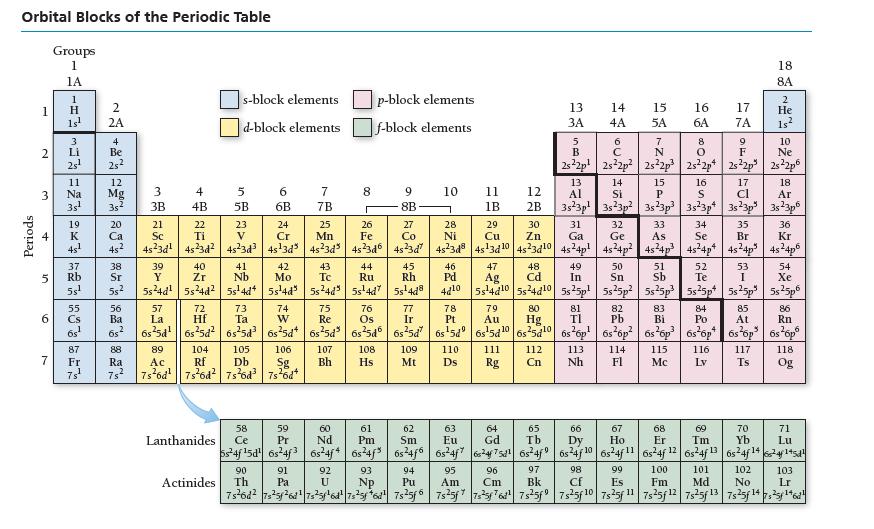
Refer to the periodic table to write the electron configuration for selenium (Se). Orbital Blocks of the Periodic Table Periods 1 2 3 4 6 Groups 1 1A 7 4x523=~=- 2 1s¹ 2A 25² Na 37 5 Rb 5s¹ 12 Mg 3s¹ 35² 20 Ca 4s¹ 45² 55 Cs 6s¹ 4 Be Fr 25²2 ܐܨܐ 38 Sr 55² 56 Ba 68
Explain the contributions of Johann Döbereiner and John Newlands to the organization of elements according to their properties.
Choose the correct orbital diagram for vanadium. a) [Ar] b) [Ar] c) [Ar] d) [Ar] 11 45 45 1 45 11 45 11 3d 1 1 1 1 1 3d 1 1 1 1 3d 111 3d
Without writing an electron configuration, determine the number of valence electrons in nitrogen.(a) 3 (b) 4 (c) 5 (d) 6
Who is credited with arranging the periodic table? How are the elements arranged in the modern periodic table?
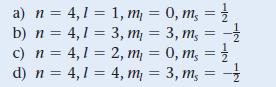
Which set of four quantum numbers corresponds to an electron in a 4p orbital? a) n = 4,1 = 1, m₁ = 0, m, = // b) n = 4,1 = 3, m₁ = 3, m, = -1/ c) n = 4,1 = 2, m₁ = 0, m, = // d) n = 4,1 4, m₁ = 3, m = - =
A main-group element has an outer electron configuration of ns2np4. What charge is likely for an ion of this element?(a) 1- (b) 2- (c) 1+ (d) 2+
Explain the contributions of Meyer and Moseley to the periodic table.
On the basis of periodic trends, choose the larger atom in each pair (if possible). Explain your choices.(a) C or F(b) C or Ge(c) N or Al(d) Al or Ge
Which electrons experience the greatest effective nuclear charge?(a) The valence electrons in Mg (b) The valence electrons in Al (c) The valence electrons in S
Which element has the smallest atomic radius?a) C b) Si c) Be d) F
The periodic table is a result of the periodic law. What observations led to the periodic law? What theory explains the underlying reasons for the periodic law?
We have seen how the number of electrons and the number of protons affect the size of an atom or ion. However, we have not considered how the number of neutrons affects the size of an atom. Would you expect isotopes—for example, C-12 and C-13—to have different atomic radii?(a) C-12 is larger
Which statement is true about electron shielding of nuclear charge?a) Outermost electrons efficiently shield one another from nuclear charge.b) Core electrons efficiently shield one another from nuclear charge.c) Outermost electrons efficiently shield core electrons from nuclear charge.d) Core
What is an electron configuration? Give an example.
A second row element has a large jump between its third and fourth ionization energies. What is the element?(a) Li (b) Be (c) B (d) C
Which is the correct electron configuration for Fe2+? a) [Ar]4s²3d6 c) [Ar]4s03d6 b) [Ar]4s²3d4 d) [Ar]4s²3d8
Based on what you just learned about ionization energies, explain why valence electrons are more important than core electrons in determining the reactivity and bonding in atoms.(a) Since bonding involves the transfer or sharing of electrons, valence electrons are most important because they are
What is shielding? In an atom, which electrons tend to do the most shielding (core electrons or valence electrons)?
On the basis of periodic trends, choose the more metallic element from each pair (if possible).(a) Sn or Te (b) P or Sb (c) Ge or In (d) S or Br
Which species is diamagnetic? a) Cr²+ b) Zn c) Mn d) C
Which statement best explains why sodium commonly forms a 1+ ion and not a 2+ ion?(a) Sodium only has one electron, so it has only one to lose.(b) All metals form 1+ ions, and sodium is a metal.(c) Sodium has only one valence electron that is easily removed; removing a second electron would be more
Arrange these atoms and ions in order of increasing radius:Cs+, Ba2+, I–. a) I< Ba²+ < Cst c) Ba²+ < Cst
What is penetration? How does the penetration of an orbital into the region occupied by core electrons affect the energy of an electron in that orbital?
Arrange these elements in order of increasing first ionization energy: Cl, Sn, Si. a) Cl< Si < Sn c) Si < Cl< Sn b) Sn< Si < Cl d) Sn< Cl< Si
Why are the sublevels within a principal level split into different energies for multielectron atoms but not for the hydrogen atom?
What is an orbital diagram? Provide an example.
What are degenerate orbitals? According to Hund’s rule, how are degenerate orbitals occupied?
List all orbitals from 1s through 5s according to increasing energy for multielectron atoms.
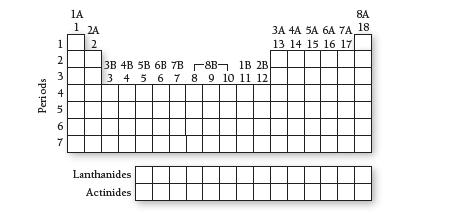
Copy this blank periodic table onto a sheet of paper and label each of the blocks within the table: s block, p block, d block, and f block. Periods 123 + in 69 7 1A 1 24 2 3B 4B 5B 6B 7B 8B 1B 2B 3 4 5 6 7 8 9 10 11 12 Lanthanides Actinides 8A 3A 4A 5A 6A 7A 18 13 14 15 16 17
What are valence electrons? Why are they important?
Explain why the s block in the periodic table has only two columns while the p block has six.
Why do the rows in the periodic table get progressively longer as you move down the table? For example, the first row contains 2 elements, the second and third rows each contain 8 elements, and the fourth and fifth rows each contain 18 elements. Explain.
Describe the relationship between a main-group element’s lettered group number (the number of the element’s column) and its valence electrons.
Describe the relationship between an element’s row number in the periodic table and the highest principal quantum number in the element’s electron configuration. How does this relationship differ for main-group elements, transition elements, and inner transition elements?
Which of the transition elements in the first transition series have anomalous electron configurations?
Describe how to write the electron configuration for an element based on its position in the periodic table.
Describe the relationship between the properties of an element and the number of valence electrons that it contains.
List the number of valence electrons for each family, and explain the relationship between the number of valence electrons and the resulting chemistry of the elements in the family.a. Alkali metals b. Alkaline earth metals c. Halogens d. Oxygen family
Define atomic radius. For main-group elements, describe the observed trends in atomic radius as you move:a. Across a period in the periodic table b. Down a column in the periodic table
What is effective nuclear charge? What is shielding?
Use the concepts of effective nuclear charge, shielding, and n value of the valence orbital to explain the trend in atomic radius as you move across a period in the periodic table.
For transition elements, describe and explain the observed trends in atomic radius as you move:a. Across a period in the periodic tableb. Down a column in the periodic table
How is the electron configuration of an anion different from that of the corresponding neutral atom? How is the electron configuration of a cation different?
The ionization energies of an unknown third-period element are listed here. Identify the element. IE1 = 786 kJ/mol; IE2 = 1580 kJ/mol; IE3 = 3230 kJ/mol; IE4 = 4360 kJ/mol; IE5 = 16,100 kJ/mola) Mg b) Al c) Sid) P
Why is electron spin important when writing electron configurations?Explain in terms of the Pauli exclusion principle.
Which statement is true about trends in metallic character?a) Metallic character increases as you move to the right across a row in the periodic table and increases as you move down a column.b) Metallic character decreases as you move to the right across a row in the periodic table and increases as
Describe how to write an electron configuration for a transition metal cation. Is the order of electron removal upon ionization simply the reverse of electron addition upon filling? Why or why not?
What is ionization energy? What is the difference between first ionization energy and second ionization energy?
What is the general trend in first ionization energy as you move down a column in the periodic table? As you move across a row?
What are the exceptions to the periodic trends in first ionization energy? Why do they occur?
Examination of the first few successive ionization energies for a given element usually reveals a large jump between two ionization energies. For example, the successive ionization energies of magnesium show a large jump between IE2 and IE3. The successive ionization energies of aluminum show a
What is electron affinity? What are the observed periodic trends in electron affinity?
What is metallic character? What are the observed periodic trends in metallic character?
Write the full electron configuration for each element.a. Si b. O c. K d. Ne
Write the full electron configuration for each element.a. C b. P c. Ar d. Na
Write the full orbital diagram for each element.a. N b. F c. Mg d. Al
Write the full orbital diagram for each element.a. S b. Ca c. Ne d. He
Use the periodic table to determine the element corresponding to each electron configuration. a. [Ar] 4s23d¹04p6 C. [Kr] 5s²4d¹05p² b. [Ar] 4s²3d² d. [Kr] 5s²
Use the periodic table to write an electron configuration for each element. Represent core electrons with the symbol of the previous noble gas in brackets.a. P b. Ge c. Zr d. I
Use the periodic table to determine each quantity.a. The number of 2s electrons in Lib. The number of 3d electrons in Cuc. The number of 4p electrons in Brd. The number of 4d electrons in Zr
Use the periodic table to determine each quantity.a. The number of 3s electrons in Mgb. The number of 3d electrons in Crc. The number of 4d electrons in Yd. The number of 6p electrons in Pb
Name an element in the fourth period (row) of the periodic table with the following:a. Five valence electronsb. Four 4p electronsc. Three 3d electronsd. Full s and p sublevels
Name an element in the third period (row) of the periodic table with the following:a. Three valence electronsb. Four 3p electronsc. Six 3p electronsd. Two 3s electrons and no 3p electrons
Determine the number of valence electrons in an atom of each element.a. Ba b. Cs c. Ni d. S
Which outer electron configuration would you expect to belong to a reactive metal? To a reactive nonmetal?a. ns2 b. ns2np6 c. ns2np5 d. ns2np2
Which outer electron configurations would you expect to belong to a noble gas? To a metalloid?a. ns2 b. ns2np6 c. ns2np5 d. ns2np2
According to Coulomb’s law, which pair of charged particles has the lowest potential energy?a. A particle with a 1- charge separated by 150 pm from a particle with a 2+ charge.b. A particle with a 1+ charge separated by 150 pm from a particle with a 1+ charge.c. A particle with a 1- charge
According to Coulomb’s law, rank the interactions between charged particles from lowest potential energy to highest potential energy.a. A 1+ charge and a 1- charge separated by 100 pmb. A 2+ charge and a 1- charge separated by 100 pmc. A 1+ charge and a 1+ charge separated by 100 pmd. A 1+ charge
Which experience a greater effective nuclear charge: the valence electrons in beryllium or the valence electrons in nitrogen? Why?
Arrange the atoms according to decreasing effective nuclear charge experienced by their valence electrons: S, Mg, Al, Si.
If core electrons completely shielded valence electrons from nuclear charge (i.e., if each core electron reduced nuclear charge by 1 unit) and if valence electrons did not shield one another from nuclear charge at all, what would be the effective nuclear charge experienced by the valence electrons
We estimated the effective nuclear charge on beryllium’s valence electrons to be slightly greater than 2+. What would a similar process predict for the effective nuclear charge on boron’s valence electrons? Would you expect the effective nuclear charge to be different for boron’s 2s electrons
Choose the larger atom from each pair.a. Al or In b. Si or Nc. P or Pb d. C or F
Choose the larger atom from each pair, if possible.a. Sn or Si b. Br or Gac. Sn or Bi d. Se or Sn
Arrange these elements in order of increasing atomic radius:Ca, Rb, S, Si, Ge, F.
Arrange these elements in order of decreasing atomic radius:Cs, Sb, S, Pb, Se.
Write the electron configuration for each ion.a. O2- b. Br– c. Sr2+ d. Co3+ e. Cu2+
Write the electron configuration for each ion.a. Cl– b. P3- c. K+ d. Mo3+ e. V3+
Which is the larger species in each pair? a. Sr or Sr²+ c. Ni or Ni²+ b. Nor N³- d. S2- or Ca²+ 2+
Write orbital diagrams for each ion and indicate whether the ion is diamagnetic or paramagnetic.a. V5+ b. Cr3+ c. Ni2+ d. Fe3+
Which is the larger species in each pair?a. Li or Li + b. I - or Cs +c. Cr or Cr3+ d. O or O2-
Arrange this isoelectronic series in order of decreasing radius: F-, O2-, Mg2+, Na+.
Arrange this isoelectronic series in order of increasing atomic radius: Se2-, Sr2+, Rb+, Br–.
Choose the element with the higher first ionization energy from each pair.a. Br or Bi b. Na or Rbc. As or At d. P or Sn
Choose the element with the higher first ionization energy from each pair.a. P or I b. Si or Clc. P or Sb d. Ga or Ge
Arrange these elements in order of increasing first ionization energy:Si, F, In, N.
Arrange these elements in order of decreasing first ionization energy: Cl, S, Sn, Pb.
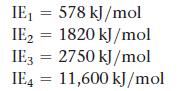
Consider this set of ionization energies.To which third-period element do these ionization values belong? IE₁ = 578 kJ/mol IE2 = 1820 kJ/mol IE3 = 2750 kJ/mol IE4 11,600 kJ/mol =
For each element, predict where the “jump” occurs for successive ionization energies. (For example, does the jump occur between the first and second ionization energies, the second and third, or the third and fourth?)a. Be b. N c. O d. Li
Choose the element with the more negative (more exothermic) electron affinity from each pair.a. Na or Rb b. B or Sc. C or N d. Li or F
Choose the element with the more negative (more exothermic) electron affinity from each pair.a. Mg or S b. K or Cs c. Si or P d. Ga or Br
Choose the more metallic element from each pair.a. Sr or Sb b. As or Bi c. Cl or O d. S or As
Choose the more metallic element from each pair.a. Sb or Pb b. K or Ge c. Ge or Sb d. As or Sn
Arrange these elements in order of increasing metallic character:Fr, Sb, In, S, Ba, Se.
Showing 3200 - 3300
of 4045
First
26
27
28
29
30
31
32
33
34
35
36
37
38
39
40
Last
Step by Step Answers

 Get 50% OFF
Claim Now
Get 50% OFF
Claim Now



![a) [Ar] b) [Ar] c) [Ar] d) [Ar] 11 45 45 1 45 11 45 11 3d 1 1 1 1 1 3d 1 1 1 1 3d 111 3d](https://dsd5zvtm8ll6.cloudfront.net/images/question_images/1700/0/2/5/1996554536f36b791700025197161.jpg)
![a) [Ar]4s3d6 c) [Ar]4s03d6 b) [Ar]4s3d4 d) [Ar]4s3d8](https://dsd5zvtm8ll6.cloudfront.net/images/question_images/1700/0/2/5/262655453ae36ff81700025260123.jpg)



![a. [Ar] 4s23d04p6 C. [Kr] 5s4d05p b. [Ar] 4s3d d. [Kr] 5s](https://dsd5zvtm8ll6.cloudfront.net/images/question_images/1700/0/2/6/88165545a016149a1700026879633.jpg)