New Semester
Started
Get
50% OFF
Study Help!
--h --m --s
Claim Now
Question Answers
Textbooks
Find textbooks, questions and answers
Oops, something went wrong!
Change your search query and then try again
S
Books
FREE
Study Help
Expert Questions
Accounting
General Management
Mathematics
Finance
Organizational Behaviour
Law
Physics
Operating System
Management Leadership
Sociology
Programming
Marketing
Database
Computer Network
Economics
Textbooks Solutions
Accounting
Managerial Accounting
Management Leadership
Cost Accounting
Statistics
Business Law
Corporate Finance
Finance
Economics
Auditing
Tutors
Online Tutors
Find a Tutor
Hire a Tutor
Become a Tutor
AI Tutor
AI Study Planner
NEW
Sell Books
Search
Search
Sign In
Register
study help
sciences
chemistry a molecular approach
Chemistry A Molecular Approach 5th Edition Nivaldo Tro - Solutions
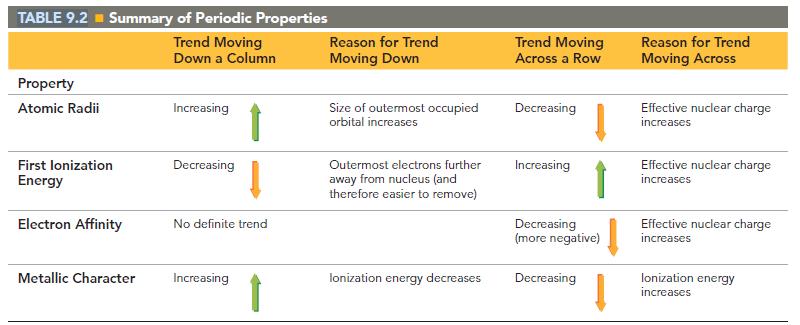
Arrange these elements in order of decreasing metallic character:Sr, N, Si, P, Ga, Al.
Bromine is a highly reactive liquid while krypton is an inert gas.Explain this difference based on their electron configurations.
Potassium is a highly reactive metal while argon is an inert gas.Explain this difference based on their electron configurations.
Both vanadium and its 3+ ion are paramagnetic. Refer to their electron configurations to explain this statement.Electron ConfigurationsQuantum-mechanical theory describes the behavior of electrons in atoms.Since chemical bonding involves the transfer or sharing of electrons, quantum-mechanical
Refer to their electron configurations to explain why copper is paramagnetic while its 1+ ion is not.Electron ConfigurationsQuantum-mechanical theory describes the behavior of electrons in atoms.Since chemical bonding involves the transfer or sharing of electrons, quantum-mechanical theory helps us
Suppose you were trying to find a substitute for K+ in nerve signal transmission. Where would you begin your search? What ions would be most like K+? For each ion you propose, explain the ways in which it would be similar to K+ and the ways it would be different. Refer to periodic trends in your
Suppose you were trying to find a substitute for Na+ in nerve signal transmission. Where would you begin your search? What ions would be most like Na+? For each ion you propose, explain the ways in which it would be similar to Na+ and the ways it would be different. Use periodic trends in your
Life on Earth evolved based on the element carbon. Based on periodic properties, what two or three elements would you expect to be most like carbon?
Which pair of elements would you expect to have the most similar atomic radii, and why?a. Si and Gab. Si and Gec. Si and As
Consider these elements: N, Mg, O, F, Al.a. Write the electron configuration for each element.b. Arrange the elements in order of decreasing atomic radius.c. Arrange the elements in order of increasing ionization energy.d. Use the electron configurations in part a to explain the differences between
Consider these elements: P, Ca, Si, S, Ga.a. Write the electron configuration for each element.b. Arrange the elements in order of decreasing atomic radius.c. Arrange the elements in order of increasing ionization energy.d. Use the electron configurations in part a to explain the differences
Explain why atomic radius decreases as you move to the right across a period for main-group elements but not for transition elements.
Explain why vanadium (radius = 134 pm) and copper (radius = 128 pm) have nearly identical atomic radii, even though the atomic number of copper is about 25% higher than that of vanadium. What would you predict about the relative densities of these two metals? Look up the densities in a reference
The lightest noble gases, such as helium and neon, are completely inert—they do not form any chemical compounds whatsoever. The heavier noble gases, in contrast, do form a limited number of compounds. Explain this difference in terms of trends in fundamental periodic properties.
The lightest halogen is also the most chemically reactive, and reactivity generally decreases as you move down the column of halogens in the periodic table. Explain this trend in terms of periodic properties.
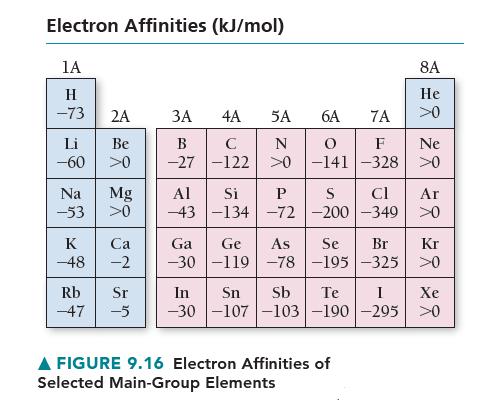
Write general outer electron configurations (nsxnpy) for groups 6A and 7A in the periodic table. The electron affinity of each group 7A element is more negative than that of each corresponding group 6A element. Use the electron configurations to explain why this is so.
The electron affinity of each group 5A element is more positive than that of each corresponding group 4A element. Use the outer electron configurations for these columns to suggest a reason for this observation.
The elements with atomic numbers 35 and 53 have similar chemical properties. Based on their electronic configurations, predict the atomic number of a heavier element that also should share these chemical properties.
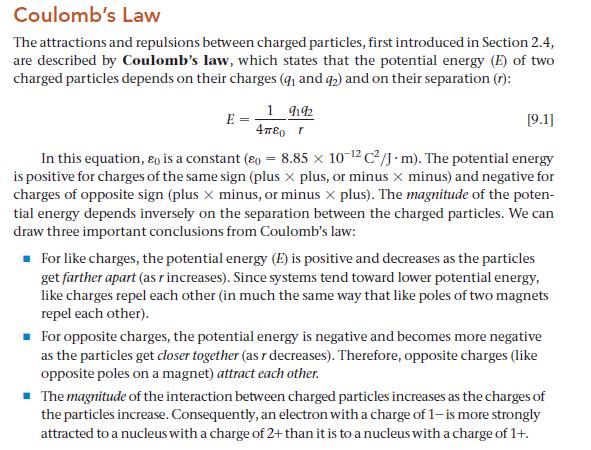
Use Coulomb’s law to calculate the ionization energy in kJ/mol of an atom composed of a proton and an electron separated by 100.00 pm. What wavelength of light has sufficient energy to ionize the atom? Coulomb's Law The attractions and repulsions between charged particles, first introduced in
Write the electron configurations of the six cations that form from sulfur by the loss of one to six electrons. For those cations that have unpaired electrons, write orbital diagrams.
You have cracked a secret code that uses elemental symbols to spell words. The code uses numbers to designate the elemental symbols. Each number is the sum of the atomic number and the highest principal quantum number of the highest occupied orbital of the element whose symbol is to be used. The
The electron affinity of sodium is lower than that of lithium, while the electron affinity of chlorine is higher than that of fluorine. Suggest an explanation for this observation.
The first ionization energy of sodium is 496 kJ/mol. Use Coulomb’s law to estimate the average distance between the sodium nucleus and the 3s electron. How does this distance compare to the atomic radius of sodium? Explain the difference.
Consider the elements: B, C, N, O, F.a. Which element has the highest first ionization energy?b. Which element has the largest atomic radius?c. Which element is most metallic?d. Which element has three unpaired electrons?
As you have seen, the periodic table is a result of empirical observation (i.e., the periodic law), but quantum-mechanical theory explains why the table is so arranged. Suppose that, in another universe, quantum theory was such that there were one s orbital but only two p orbitals (instead of
Consider the metals in the first transition series. Use periodic trends to predict a trend in density as you move to the right across the series.
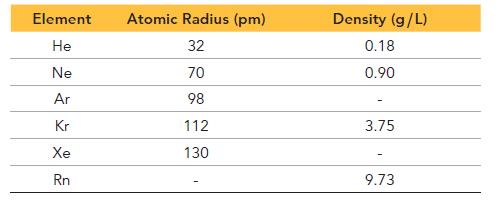
Consider the densities and atomic radii of the noble gases at 25 °C:a. Estimate the densities of argon and xenon by interpolation from the data.b. Estimate the density of the element with atomic number 118 by extrapolation from the data.c. Use the molar mass of neon to estimate the mass of a neon
Consider the elements: Na, Mg, Al, Si, P.a. Which element has the highest second ionization energy?b. Which element has the smallest atomic radius?c. Which element is least metallic?d. Which element is diamagnetic?
Imagine a universe in which the value of ms can be +1/2, 0, and -1/2. Assuming that all the other quantum numbers can take only the values possible in our world and that the Pauli exclusion principle applies, determine:a. The new electronic configuration of neon b. The atomic number of the element
A carbon atom can absorb radiation of various wavelengths with resulting changes in its electron configuration. Write orbital diagrams for the electron configuration of carbon that results from absorption of the three longest wavelengths of radiation it can absorb.
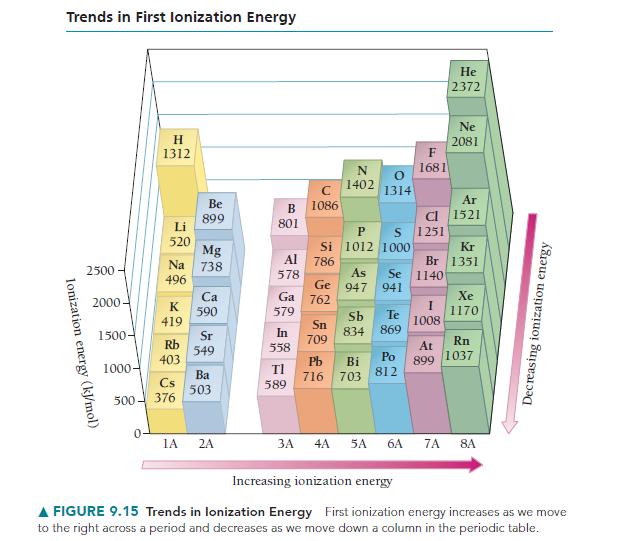
Using the data in Figures 9.15 and 9.16, calculate ΔE for the reaction Na(g)+ Cl(g) → Na+ (g)+ Cl– (g). Trends in First lonization Energy Ionization energy (kJ/mol) 2500 2000. 1500- 1000- H 1312 0 Li 520 Na 496 Rb 403 Cs 500-376 K 419 Be 899 Mg 738 Ca 590 Sr 549 Ba 503 1A
Only trace amounts of the synthetic element darmstadtium, atomic number 110, have been obtained. The element is so highly unstable that no observations of its properties have been possible.Based on its position in the periodic table, propose three different reasonable valence electron
What is the atomic number of the as yet undiscovered element in which the 8s and 8p electron energy levels fill? Predict the chemical behavior of this element.
The trend in second ionization energy for the elements from lithium to fluorine is not a regular one. Predict which of these elements has the highest second ionization energy and which has the lowest and explain. Of the elements N, O, and F, O has the highest and N the lowest second ionization
Unlike the elements in groups 1A and 2A, those in group 3A do not show a regular decrease in first ionization energy as you move down the column. Explain the irregularities.
Even though adding two electrons to O or S forms an ion with a noble gas electron configuration, the second electron affinity of both of these elements is positive. Explain.
We discussed the metalloids, which form a diagonal band separating the metals from the nonmetals. There are other instances in which elements such as lithium and magnesium that are diagonal to each other have comparable metallic character. Suggest an explanation for this observation.
Table 9.2 does not include francium because none of francium’s isotopes are stable. Predict the values of the entries for Fr in Table 9.2. Predict the nature of the products of the reaction of Fr with: (a) Water, (b) Oxygen, and (c) Chlorine. TABLE 9.2 = Summary of Periodic Properties Trend
The heaviest known alkaline earth metal is radium, atomic number 88. Find the atomic numbers of the as yet undiscovered next two members of the series.
Predict the electronic configurations of the first two excited states (next higher-energy states beyond the ground state) of Pd.
From its electronic configuration, predict which of the first 10 elements would be most similar in chemical behavior to the as yet undiscovered element 165.
Imagine that in another universe atoms and elements are identical to ours, except that atoms with six valence electrons have particular stability (in contrast to our universe where atoms with eight valence electrons have particular stability). Give an example of an element in the alternative
The outermost valence electron in atom A experiences an effective nuclear charge of 2+ and is on average 225 pm from the nucleus. The outermost valence electron in atom B experiences an effective nuclear charge of 1+ and is on average 175 pm from the nucleus. Which atom (A or B) has the higher
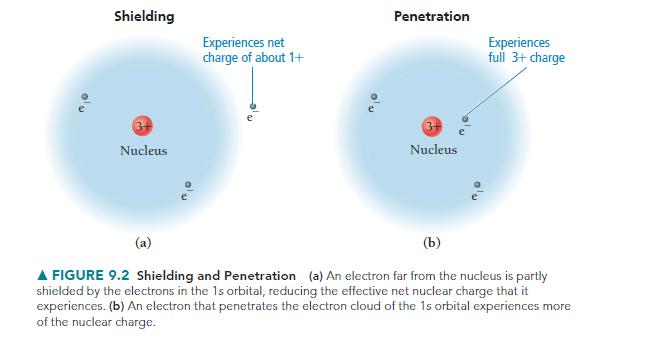
Determine whether each statement regarding penetration and shielding is true or false. (Assume that all lower energy orbitals are fully occupied.)a. An electron in a 3s orbital is more shielded than an electron in a 2s orbital.b. An electron in a 3s orbital penetrates into the region occupied by
Give a combination of four quantum numbers that could be assigned to an electron occupying a 5p orbital. Do the same for an electron occupying a 6d orbital.
Use the trends in ionization energy and electron affinity to explain why calcium fluoride has the formula CaF2 and not Ca2F or CaF.
In a complete sentence describe the relationship between shielding and penetration.
Play a game to memorize the order in which orbitals fill. Have each group member in turn state the name of the next orbital to fill and the maximum number of electrons it can hold (for example, “1s two,” “2s two,” “2p six”). If a member gets stuck, other group members can help,
Sketch a periodic table (without element symbols). Include the correct number of rows and columns in the s, p, d, and f blocks.Shade in the squares for elements that have irregular electron configurations.
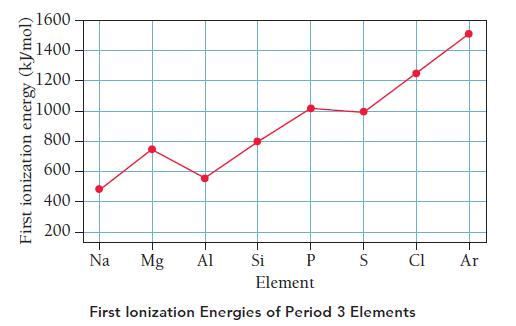
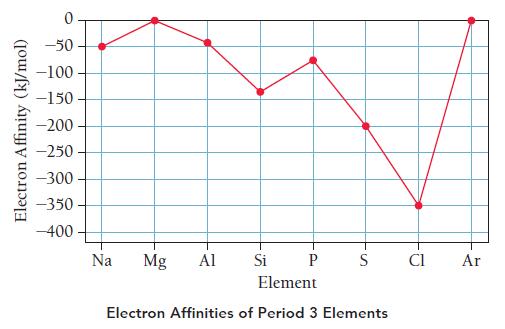
The accompanying graphs show the first ionization energies and electron affinities of the period 3 elements. Refer to the graphs to answer the questions that follow.a. Describe the general trend in period 3 first ionization energies as you move from left to right across the periodic table.Explain
In complete sentences, explain: (a) Why Se2- and Br- are about the same size; (b) Why Br- is slightly smaller than Se2-; and (c) Which singly charged cation you would expect to be approximately the same size as Se2- and Br- and why.
Have each member of your group sketch a periodic table indicating a periodic trend (atomic size, first ionization energy, metallic character, etc.). Have each member present his or her table to the rest of the group and explain the trend based on concepts such as orbital size or effective nuclear
Combustion of 30.42 g of a compound containing only carbon, hydrogen, and oxygen produces 35.21 g CO2 and 14.42 g H2O. What is the empirical formula of the compound?a) C4H8O6b) C2H4O3c) C2H2O3d) C6HO12
What is mass percent composition? Why is it useful?
Silver chloride, often used in silver plating, contains 75.27% Ag by mass. Calculate the mass of silver chloride required to plate 155 mg of pure silver.
The iodide ion is a dietary mineral essential to good nutrition. In countries where potassium iodide is added to salt, iodine deficiency (or goiter) has been almost completely eliminated. The recommended daily allowance (RDA) for iodine is 150 μg/day. How much potassium iodide (76.45% I) should
A 45.2-mg sample of phosphorus reacts with selenium to form 131.6 mg of the selenide. Determine the empirical formula of phosphorus selenide.
A particular coal contains 2.55% sulfur by mass. When the coal is burned, it produces SO2 emissions, which combine with rainwater to produce sulfuric acid. Use the formula of sulfuric acid to calculate the mass percent of S in sulfuric acid. Then determine how much sulfuric acid (in metric tons) is
Lead is found in Earth’s crust as several different lead ores. Suppose a certain rock is 38.0% PbS (galena), 25.0% PbCO3 (cerussite), and 17.4% PbSO4 (anglesite). The remainder of the rock is composed of substances containing no lead. How much of this rock (in kg) must be processed to obtain 5.0
A 2.52-g sample of a compound containing only carbon, hydrogen, nitrogen, oxygen, and sulfur is burned in excess oxygen to yield 4.23 g of CO2 and 1.01 g of H2O. Another sample of the same compound, of mass 4.14 g, yields 2.11 g of SO3. A third sample, of mass 5.66 g, yields 2.27 g of HNO3.
A compound of molar mass 229 g/mol contains only carbon, hydrogen, iodine, and sulfur. Analysis shows that a sample of the compound contains six times as much carbon as hydrogen, by mass. Calculate the molecular formula of the compound.
The elements X and Y form a compound that is 40% X and 60% Y by mass. The atomic mass of X is twice that of Y. What is the empirical formula of the compound?
A compound of X and Y is 1/3 X by mass. The atomic mass of element X is 1/3 the atomic mass of element Y. Find the empirical formula of the compound.
A mixture of carbon and sulfur has a mass of 9.0 g. Complete combustion with excess O2 gives 23.3 g of a mixture of CO2 and SO2. Find the mass of sulfur in the original mixture.
When molecules are represented by molecular models, what does each sphere represent? How big is the nucleus of an atom in comparison to the sphere used to represent an atom in a molecular model?
Without doing any calculations, determine which element in each compound has the highest mass percent composition.a. COb. N2Oc. C6H12O6d. NH3
Explain the problem with the following statement and correct it: “The chemical formula for ammonia (NH3) indicates that ammonia contains three grams of hydrogen for each gram of nitrogen.”
Element A is an atomic element, and element B is a diatomic molecular element. Using circles to represent atoms of A and squares to represent atoms of B, draw molecular-level views of each element.
Without doing any calculations, arrange the elements in H2SO4 in order of decreasing mass percent composition.
With group members playing the roles of nuclei and electrons, demonstrate the formation of an ionic bond between Na and Cl. Demonstrate the formation of the covalent bonds in H2O.
Create a flowchart with a series of simple questions that can be used to determine whether a chemical formula is that of an atomic element, a molecular element, a molecular compound, or an ionic compound. Use your flowchart to identify the correct category for P4, KCl, CH4, Ne, and NH4NO3.
Have each member of your group list one similarity or difference between the naming conventions for ionic and molecular compounds.
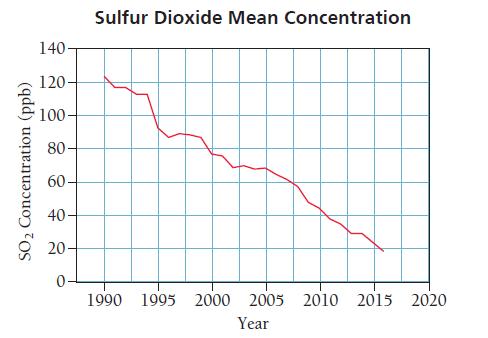
Sulfur dioxide is a pollutant emitted primarily by coal-burning power plants and industrial smelters. Sulfur dioxide in air affects the respiratory system in humans and is the main cause of acid rain. Thanks to the Clean Air Act and its amendments, sulfur dioxide levels in the United States have
A compound isolated from the rind of lemons is found to be 88.14% carbon and 11.86% hydrogen by mass. How many grams of C and H are there in a 100.0-g sample of this substance? How many moles of C and H? What is the empirical formula? The molar mass is determined to be 136.26 g/mol. What is the
Write a balanced equation for the reaction between solid cobalt(III) oxide and solid carbon to produce solid cobalt and carbon dioxide gas. Co₂O3(s) + C(s) - Co(s) + CO₂(8)
How many oxygen atoms are on the right-hand side of the following chemical equation?(a) 4 (b) 5 (c) 6 (d) 14 4 FeCO3(s) + O₂(g) O2(g) 2 Fe₂O3(s) + 4 CO2(g)
What is the coefficient of H2O when the reaction is balanced?a) 1 b) 2c) 3 d) 4 K(s) + H₂O(1)→→KOH(aq) + H₂(g)
Write a balanced equation for the combustion of gaseous butane (C4H10), a fuel used in portable stoves and grills, in which it combines with gaseous oxygen to form gaseous carbon dioxide and gaseous water. C4H10(g) + O₂(8) CO₂(g) + H₂O(g)
Which quantity or quantities must always be the same on both sides of a chemical equation?(a) The number of atoms of each kind (b) The number of molecules of each kind (c) The number of moles of each kind of molecule
Why must chemical equations be balanced?
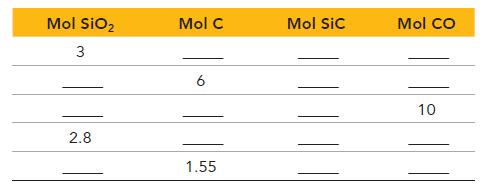
Consider the balanced equation:Complete the table showing the appropriate number of moles of reactants and products. If the number of moles of a reactant is provided, fill in the required amount of the other reactant, as well as the moles of each product that forms. If the number of moles of a
What are the correct coefficients (reading from left to right) when the chemical equation is balanced?a) 1, 3, 1, 3 b) 1, 2, 1, 1c) 1, 3, 2, 1 d) 3, 6, 1, 9 _PC13(1) + H₂O(1) _H3PO3(aq) + _HCl(aq)
Why are scientists concerned about increases in atmospheric carbon dioxide? What is the source of the increase?
Use the balanced equation for the combustion of octane to determine how many moles of H2O are produced by the combustion of 22.0 moles of C8H18.(a) 18 moles H2O (b) 22 moles H2O(c) 176 moles H2O (d) 198 moles H2O 2 C8H18 (1) + 25 O2(g) 16 CO₂(g) + 18 H₂O(g)
Write a balanced equation for the reaction between aqueous strontium chloride and aqueous lithium phosphate to form solid strontium phosphate and aqueous lithium chloride.
For the reaction shown here, 3.5 mol A is mixed with 5.9 mol B and 2.2 mol C. What is the limiting reactant?3 A + 2 B + C → 2 Da) A b) B c) C d) D
During photosynthesis, plants convert carbon dioxide and water into glucose (C6H12O6) according to the reaction:Suppose that a particular plant consumes 37.8 g of CO2 in one week. Assuming that there is more than enough water present to react with all of the CO2, what mass of glucose (in grams) can
Under certain conditions, sodium reacts with oxygen to form sodium oxide according to the reaction:A flask contains the amount of oxygen represented by the diagram shown at far right.Which of the following images best represents the amount of sodium required to completely react with all of the
What is a balanced chemical equation?
Manganese(IV) oxide reacts with aluminum to form elemental manganese and aluminum oxide:What mass of Al is required to completely react with 25.0 g MnO2?a) 7.76 g Al b) 5.82 g Alc) 33.3 g Al d) 10.3 g Al 3 MnO₂ + 4 Al→→→→→→ 3 Mn + 2 Al₂O3
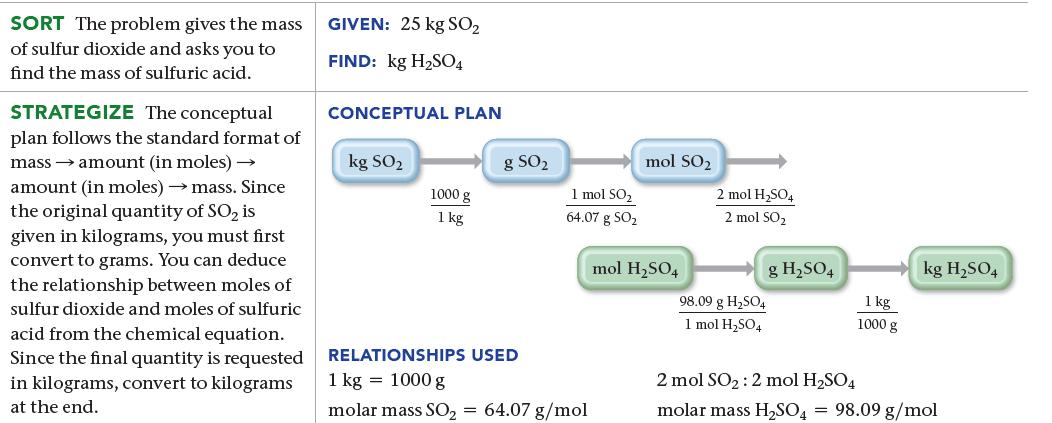
Sulfuric acid (H2SO4) is a component of acid rain that forms when SO2, a pollutant, reacts with oxygen and water according to the simplified reaction:The generation of the electricity used by a medium-sized home produces about 25 kg of SO2 per year. Assuming that there is more than enough O2 and
Identify the reactants and products in this chemical equation.4 NH3(g) + 5 O2( g) → 4 NO(g) + 6 H2O(g)
Consider the generic chemical equation A + 3B → 2C.Let circles represent molecules of A and squares represent molecules of B. The diagram shown at the far right represents the amount of B available for reaction. Which diagram in the answer options accurately represents the amount of A necessary
Sodium and chlorine react to form sodium chloride:What is the theoretical yield of sodium chloride for the reaction of 55.0 g Na with 67.2 g Cl2?a) 1.40 * 102 g NaCl b) 111 g NaClc) 55.4 g NaCl d) 222 g NaCl 2 Na(s) + Cl₂(g) 2 NaCl(s)
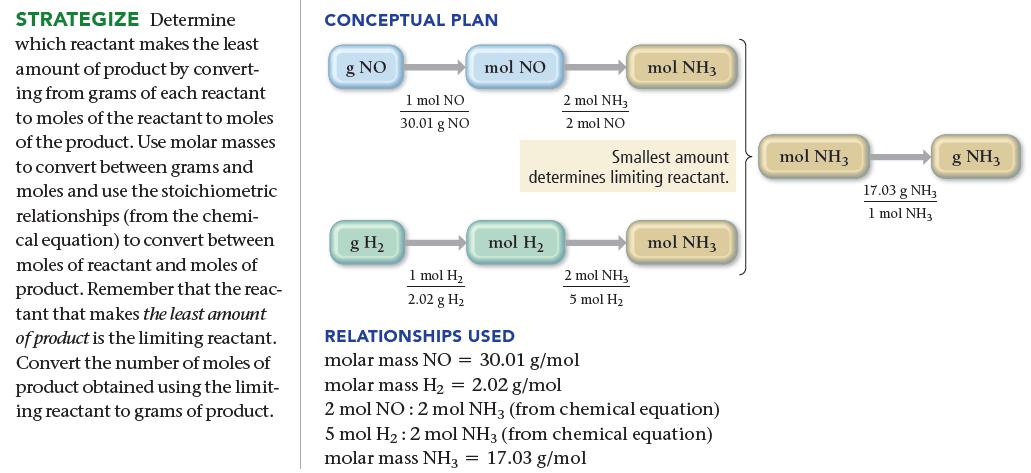
Ammonia, NH3, can be synthesized by the reaction:Starting with 86.3 g NO and 25.6 g H2, find the theoretical yield of ammonia in grams. 2 NO(g) + 5 H₂(g) 2 NH3(g) + 2 H₂O(g)
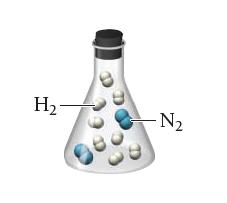
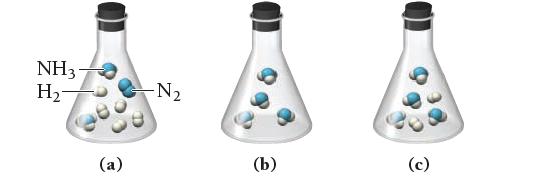
Nitrogen and hydrogen gas react to form ammonia according to the reaction:A flask contains a mixture of reactants represented by the image shown at the left.Which of the following images best represents the mixture in the flask after the reactants have reacted as completely as possible? What is the
What is reaction stoichiometry? What is the significance of the coefficients in a balanced chemical equation?
Sulfur and fluorine react to form sulfur hexafluoride:If 50.0 g S is allowed to react as completely as possible with 105.0 g F2, what mass of the excess reactant is left?a) 20.5 g S b) 45.7 g F2c) 15.0 g S d) 36.3 g F2 S(s) + 3 F₂(g) →→→→→→ SF(g)
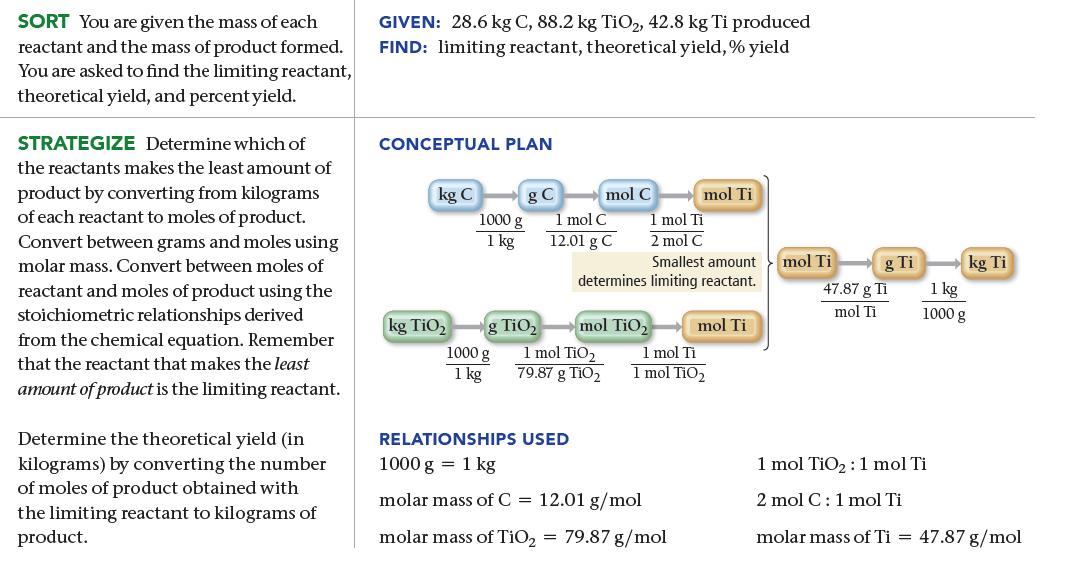
We can obtain titanium metal from its oxide according to the following balanced equation:When 28.6 kg of C reacts with 88.2 kg of TiO2, 42.8 kg of Ti is produced. Find the limiting reactant, theoretical yield (in kg), and percent yield. TiO₂ (s) + 2 C(s) Ti(s) + 2 CO(g)
Nitrogen dioxide reacts with water to form nitric acid and nitrogen monoxide according to the equation:Suppose that 5 mol NO2 and 1 mol H2O combine and react completely. How many moles of the reactant in excess are present after the reaction has completed?(a) 1 mol NO2 (b) 1 mol H2O (c) 2 mol
Showing 3300 - 3400
of 4045
First
27
28
29
30
31
32
33
34
35
36
37
38
39
40
41
Step by Step Answers

 Get 50% OFF
Claim Now
Get 50% OFF
Claim Now