New Semester
Started
Get
50% OFF
Study Help!
--h --m --s
Claim Now
Question Answers
Textbooks
Find textbooks, questions and answers
Oops, something went wrong!
Change your search query and then try again
S
Books
FREE
Study Help
Expert Questions
Accounting
General Management
Mathematics
Finance
Organizational Behaviour
Law
Physics
Operating System
Management Leadership
Sociology
Programming
Marketing
Database
Computer Network
Economics
Textbooks Solutions
Accounting
Managerial Accounting
Management Leadership
Cost Accounting
Statistics
Business Law
Corporate Finance
Finance
Economics
Auditing
Tutors
Online Tutors
Find a Tutor
Hire a Tutor
Become a Tutor
AI Tutor
AI Study Planner
NEW
Sell Books
Search
Search
Sign In
Register
study help
sciences
chemistry a molecular approach
Chemistry A Molecular Approach 5th Edition Nivaldo Tro - Solutions
In a chemical reaction, what is the limiting reactant? What do we mean when we say a reactant is in excess?
A reaction has a theoretical yield of 45.8 g. When the reaction is carried out, 37.2 g of the product is obtained.What is the percent yield?a) 55.1%b) 44.8%c) 123% d) 81.2%
In a chemical reaction, what is the theoretical yield and the percent yield?
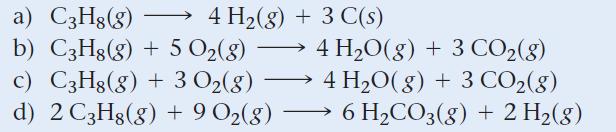
Identify the correct balanced equation for the combustion of propane (C3H8). a) C3H8(g) b) C3H8(g) + 5 0₂(8) c) C3H8(g) + 3 O₂(g) d) 2 C3H8(g) + 9 0₂(8) → 4 H₂(g) + 3 C(s) — - 4 H₂O(g) + 3 CO₂(g) → 4 H₂O(g) + 3 CO₂(g) 6 H₂CO3(g) + 2 H₂(g)
Write a balanced equation for the combustion of liquid methyl alcohol (CH3OH).
We typically calculate the percent yield using the actual yield and theoretical yield in units of mass (grams or kilograms).Would the percent yield be different if the actual yield and theoretical yield were in units of amount (moles)?
Write a balanced chemical equation for each reaction.(a) The reaction between potassium metal and bromine gas(b) The reaction between rubidium metal and liquid water(c) The reaction between gaseous chlorine and solid iodine
Solid potassium chlorate (KClO3) decomposes into potassium chloride and oxygen gas when heated. How many moles of oxygen form when 55.8 g KCIO3 completely decompose?a) 0.455 mol O2b) 0.304 mol O2c) 83.7 mol O2d) 0.683 mol O2
What is a combustion reaction? Why are combustion reactions important? Give an example.
Identify the product of the reaction between hydrogen gas and bromine.a) HBr b) H2Brc) HBr2 d) H2Br3
Write a general equation for the reaction of an alkali metal with:a. A halogen b. Water
Write a general equation for the reaction of a halogen with:a. A metal b. Hydrogenc. Another halogen
Sulfuric acid is a component of acid rain formed when gaseous sulfur dioxide pollutant reacts with gaseous oxygen and liquid water to form aqueous sulfuric acid. Write the balanced chemical equation for this reaction.
Nitric acid is a component of acid rain that forms when gaseous nitrogen dioxide pollutant reacts with gaseous oxygen and liquid water to form aqueous nitric acid. Write the balanced chemical equation for this reaction.
In a popular classroom demonstration, solid sodium is added to liquid water and reacts to produce hydrogen gas and aqueous sodium hydroxide. Write the balanced chemical equation for this reaction.
When iron rusts, solid iron reacts with gaseous oxygen to form solid iron(III) oxide. Write the balanced chemical equation for this reaction.
Write the balanced chemical equation for the fermentation of sucrose (C12H22O11) by yeasts in which the aqueous sugar reacts with water to form aqueous ethanol (C2H5OH) and carbon dioxide gas.
Write the balanced equation for the photosynthesis reaction in which gaseous carbon dioxide and liquid water react in the presence of chlorophyll to produce aqueous glucose (C6H12O6) and oxygen gas.
Write the balanced chemical equation for each reaction.a. Solid lead(II) sulfide reacts with aqueous hydrobromic acid to form solid lead(II) bromide and dihydrogen monosulfide gas.b. Gaseous carbon monoxide reacts with hydrogen gas to form gaseous methane (CH4) and liquid water.c. Aqueous
Write the balanced chemical equation for each reaction.a. Solid copper reacts with solid sulfur to form solid copper(I) sulfide.b. Solid iron(III) oxide reacts with hydrogen gas to form solid iron and liquid water.c. Sulfur dioxide gas reacts with oxygen gas to form sulfur trioxide gas.d. Gaseous
Write the balanced chemical equation for the reaction of aqueous sodium carbonate with aqueous copper(II) chloride to form solid copper(II) carbonate and aqueous sodium chloride.
Balance each chemical equation. SiO₂ (s) + Ca(HCO3)2(aq) Co₂S3(s) + NH4NO3(aq) a. CO₂(g) + CaSiO3(s) + H₂O(1) b. Co(NO3)3(aq) + (NH4)2S(aq) c. Cu₂0(s) + C(s) Cu(s) + CO(g) d. H₂(g) + Cl₂(g) HCI(g)
Write the balanced chemical equation for the reaction of aqueous potassium hydroxide with aqueous iron(III) chloride to form solid iron(III) hydroxide and aqueous potassium chloride.
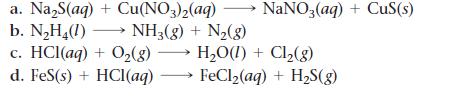
Balance each chemical equation. a. Na₂S(aq) + Cu(NO3)2(aq) b. N₂H₂(1)→→→ NH3(g) + N₂(g) c. HCl(aq) + O₂(g) → H₂O(1) + Cl₂(g) d. FeS(s) + HCl(aq) FeCl₂(aq) + H₂S(g) NaNO3(aq) + CuS(s)
Consider the unbalanced equation for the combustion of hexane:Balance the equation and determine how many moles of O2 are required to react completely with 7.2 moles of C6H14. C6H14(g) + O₂(8) CO₂(g) + H₂O(g)
Consider the unbalanced equation for the neutralization of acetic acid:Balance the equation and determine how many moles of Ba(OH)2 are required to completely neutralize 0.461 mole of HC2H3O2. HC₂H3O₂(aq) + Ba(OH)₂(aq) H₂O(1) + Ba(C₂H3O2)2(aq)
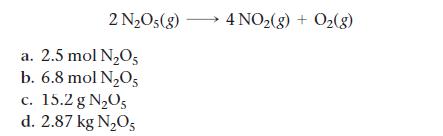
Calculate how many moles of NO2 form when each quantity of reactant completely reacts. 2 N₂O5(g) a. 2.5 mol N₂O5 b. 6.8 mol N₂O5 c. 15.2 g N₂O5 d. 2.87 kg N₂O5 4 NO₂(g) + O₂(g)
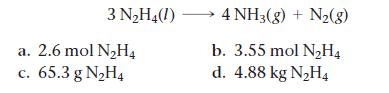
Calculate how many moles of NH3 form when each quantity of reactant completely reacts. 3 N₂H4(1) a. 2.6 mol N₂H4 c. 65.3 g N₂H4 4 NH3(g) + N₂(8) b. 3.55 mol N₂H4 d. 4.88 kg N₂H4
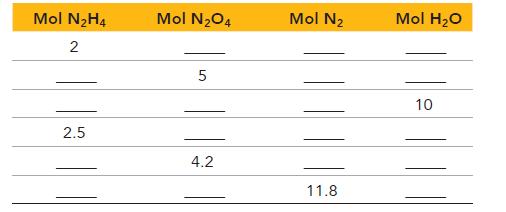
Consider the balanced equation:Complete the table showing the appropriate number of moles of reactants and products. If the number of moles of a reactant is provided, fill in the required amount of the other reactant, as well as the moles of each product that forms. If the number of moles of a
Hydrobromic acid dissolves solid iron according to the reaction:What mass of HBr (in g) do you need to dissolve a 3.2-g pure iron bar on a padlock? What mass of H2 would the complete reaction of the iron bar produce? Fe(s) + 2 HBr(aq) FeBr₂(aq) + H₂(g)
Sulfuric acid dissolves aluminum metal according to the reaction:Suppose you want to dissolve an aluminum block with a mass of 15.2 g. What minimum mass of H2SO4 (in g) do you need?What mass of H2 gas (in g) does the complete reaction of the aluminum block produce? 2 Al(s) + 3 H₂SO4 (aq) →
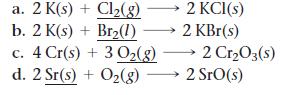
For each of the reactions, calculate the mass (in grams) of the product that forms when 15.39 g of the underlined reactant completely reacts. Assume that there is more than enough of the other reactant. a. 2 K(s) + Cl₂(g) b. 2 K(s) + Br₂(1) 2 KCl(s) 2 KBr(s) c. 4 Cr(s) + 30₂(g) → 2
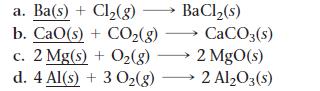
For each of the reactions, calculate the mass (in grams) of the product that forms when 3.67 g of the underlined reactant completely reacts. Assume that there is more than enough of the other reactant. a. Ba(s) + Cl₂(g) b. CaO(s) + COz(g) CaCO3(s) c. 2 Mg(s) + O₂(g) →→→ 2 MgO(s) d. 4
Find the limiting reactant for each initial amount of reactants.a. 2 mol Na, 2 mol Br2b. 1.8 mol Na, 1.4 mol Br2c. 2.5 mol Na, 1 mol Br2d. 12.6 mol Na, 6.9 mol Br2 2 Na(s) + Br₂(g) Br₂(g) 2 NaBr(s)
Find the limiting reactant for each initial amount of reactants.a. 1 mol Al, 1 mol O2b. 4 mol Al, 2.6 mol O2c. 16 mol Al, 13 mol O2d. 7.4 mol Al, 6.5 mol O2 4 Al(s) + 3 O₂(g) →→→ 2 Al2O3(s)
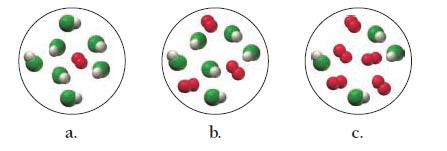
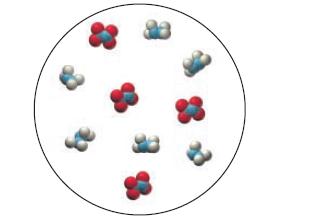
Consider the reaction:Each molecular diagram represents an initial mixture of reactants.Which mixture produces the greatest amount of products? How many molecules of Cl2 form from the reaction mixture that produces the greatest amount of products? 4 HCI(g) + O₂(g) → 2 H₂O(g) + 2 Cl₂(g)
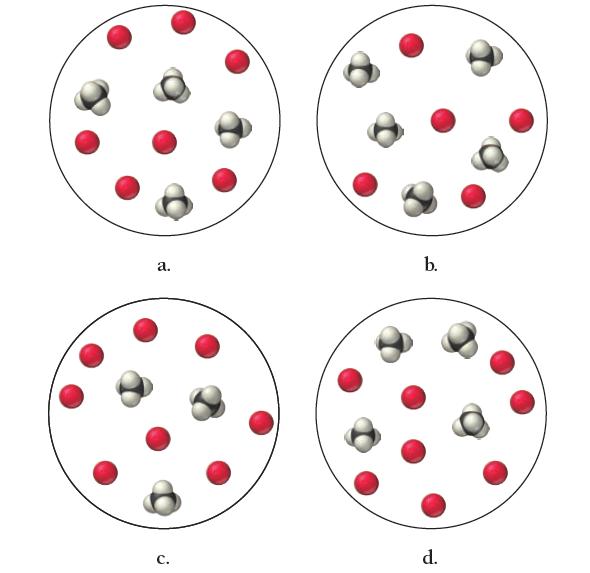
Consider the reaction:Each of the molecular diagrams represents an initial mixture of the reactants. Which reaction mixture produces the greatest amount of products? How many CO2 molecules form from the reaction mixture that produces the greatest amount of products? 2 CH3OH(g) + 3
Calculate the theoretical yield of the product (in moles) for each initial amount of reactants.a. 4 mol Ti, 4 mol Cl2b. 7 mol Ti, 17 mol Cl2c. 12.4 mol Ti, 18.8 mol Cl2 Ti(s) + 2 Cl₂(g) TiCl4 (1)
Calculate the theoretical yield of product (in moles) for each initial amount of reactants.a. 3 mol Mn, 3 mol O2 b. 4 mol Mn, 7 mol O2c. 27.5 mol Mn, 43.8 mol O2 3 Mn(s) + 2O₂(g) →→→→Mn304(s)
Zinc sulfide reacts with oxygen according to the reaction:A reaction mixture initially contains 4.2 mol ZnS and 6.8 mol ∪2. Once the reaction has occurred as completely as possible, what amount (in moles) of the excess reactant remains? 2 ZnS(s) + 3 O₂(g) → 2 ZnO(s) + 2 SO₂(g)
Iron(II) sulfide reacts with hydrochloric acid according to the reaction:A reaction mixture initially contains 0.223 mol FeS and 0.652 mol HCl. Once the reaction has occurred as completely as possible, what amount (in moles) of the excess reactant remains? FeS(s) + 2 HCl(aq) → FeCl₂(s) +
For the reaction shown, calculate the theoretical yield of product (in grams) for each initial amount of reactants.a. 2.0 g Al, 2.0 g Cl2b. 7.5 g Al, 24.8 g Cl2c. 0.235 g Al, 1.15 g Cl2 2 Al(s) + 3 Cl₂(g) 2 AICI;(s)
For the reaction shown, calculate the theoretical yield of the product (in grams) for each initial amount of reactants.a. 5.0 g Ti, 5.0 g F2 b. 2.4 g Ti, 1.6 g F2c. 0.233 g Ti, 0.288 g F2 Ti(s) + 2 F₂(g) →→→→ Tif(s)
Iron(III) oxide reacts with carbon monoxide according to the equation:A reaction mixture initially contains 22.55 g Fe2O3 and 14.78 g CO. Once the reaction has occurred as completely as possible, what mass (in g) of the excess reactant remains? Fe₂O3(s) + 3 CO(g) 2 Fe(s) + 3 CO₂(g)
Lead ions can be precipitated from solution with KCl according to the reaction:When 28.5 g KCl is added to a solution containing 25.7 g Pb2 + , a PbCl2 precipitate forms. The precipitate is filtered and dried and found to have a mass of 29.4 g. Determine the limiting reactant, theoretical yield of
Magnesium oxide can be made by heating magnesium metal in the presence of oxygen. The balanced equation for the reaction is:When 10.1 g of Mg reacts with 10.5 g O2, 11.9 g MgO is collected.Determine the limiting reactant, theoretical yield, and percent yield for the reaction. 2 Mg(s) +
Urea (CH4N2O) is a common fertilizer that is synthesized by the reaction of ammonia (NH3) with carbon dioxide:In an industrial synthesis of urea, a chemist combines 136.4 kg of ammonia with 211.4 kg of carbon dioxide and obtains 168.4 kg of urea. Determine the limiting reactant, theoretical yield
Many computer chips are manufactured from silicon, which occurs in nature as SiO2. When SiO2 is heated to melting, it reacts with solid carbon to form liquid silicon and carbon monoxide gas.In an industrial preparation of silicon, 155.8 kg of SiO2 reacts with 78.3 kg of carbon to produce 66.1 kg of
Elemental phosphorus reacts with chlorine gas according to the equation:A reaction mixture initially contains 45.69 g P4 and 131.3 g Cl2.Once the reaction has occurred as completely as possible, what mass (in g) of the excess reactant remains? P4(s) + 6 Cl₂(g) 4 PC13 (1)
Consider the reaction:A reaction mixture initially contains 5 moles of NO and 10 moles of H2. Without doing any calculations, determine which set of amounts best represents the mixture after the reactants have reacted as completely as possible. Explain your reasoning.a. 1 mol NO, 0 mol H2, 4 mol
What is molarity? How is it useful?
To what volume should you dilute 0.200 L of a 15.0 M NaOH solution to obtain a 3.00 M NaOH solution?
What volume of a 1.50 M HCl solution should you use to prepare 2.00 L of a 0.100 M HCl solution?a) 0.300 L b) 0.133 L c) 30.0 L d) 2.00 L
Complete and balance each combustion reaction equation. a. S(s) + O₂(g) C. Ca(s) + O₂(g) b. C3H6(g) + O₂(g) d. C5H12S(I) + O₂(g)
Complete and balance each combustion reaction equation: a. C4H6(g) + O₂(g) C. CS₂(s) + O₂(g) b. C(s) + O₂(g) d. C3H8O(l) + O₂(g)
Write a balanced chemical equation for the reaction of solid strontium with iodine gas.
Write a balanced chemical equation for the reaction between lithium metal and chlorine gas.
Write a balanced chemical equation for the reaction of solid lithium with liquid water.
Write a balanced chemical equation for the reaction of solid potassium with liquid water.
Write a balanced equation for the reaction of hydrogen gas with bromine gas.
Write a balanced equation for the reaction of chlorine gas with fluorine gas.
The combustion of gasoline produces carbon dioxide and water. Assume gasoline to be pure octane (C8H18) and calculate the mass (in kg) of carbon dioxide that is added to the atmosphere per 1.0 kg of octane burned.
Aspirin can be made in the laboratory by reacting acetic anhydride (C4H6O3) with salicylic acid (C7H6O3) to form aspirin (C9H8O4) and acetic acid (C2H4O2). The balanced equation is:In a laboratory synthesis, a student begins with 3.00 mL of acetic anhydride (density = 1.08 g/mL) and 1.25 g of
Many home barbeques are fueled with propane gas (C3H8). What mass of carbon dioxide (in kg) is produced upon the complete combustion of 18.9 L of propane (approximate contents of one 5-gallon tank)? Assume that the density of the liquid propane in the tank is 0.621 g/mL.
A loud classroom demonstration involves igniting a hydrogenfilled balloon. The hydrogen within the balloon reacts explosively with oxygen in the air to form water. If the balloon is filled with a mixture of hydrogen and oxygen, the explosion is even louder than if the balloon is filled only with
The combustion of liquid ethanol (C2H5OH) produces carbon dioxide and water. After 4.62 mL of ethanol (density = 0.789 g/mL) is allowed to burn in the presence of 15.55 g of oxygen gas, 3.72 mL of water (density = 1.00 g/mL) is collected.Determine the limiting reactant, theoretical yield of H2O,
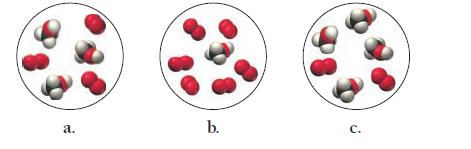
Gaseous methane reacts with oxygen to form carbon dioxide and water vapor. Write a balanced equation for the combustion reaction and determine which mixture has neither reactant in excess. a. C. b. d.
The reaction of NH3 and O2 forms NO and water. The NO can be used to convert P4 to P4O6, forming N2 in the process. The P4O6 can be treated with water to form H3PO3, which forms PH3 and H3PO4 when heated. Find the mass of PH3 that forms from the reaction of 1.00 g of NH3.
An important reaction that takes place in a blast furnace during the production of iron is the formation of iron metal and CO2 from Fe2O3 and CO. Determine the mass of Fe2O3 required to form 910 kg of iron. Determine the amount of CO2 that forms in this process.
Titanium occurs in the magnetic mineral ilmenite (FeTiO3), which is often found mixed with sand. The ilmenite can be separated from the sand with magnets. The titanium can then be extracted from the ilmenite by the following set of reactions:Suppose that an ilmenite–sand mixture contains 22.8%
A liquid fuel mixture contains 30.35% hexane (C6H14), 15.85% heptane (C7H16), and the rest octane (C8H18). What maximum mass of carbon dioxide is produced by the complete combustion of 10.0 kg of this fuel mixture?
A mixture of C3H8 and C2H2 has a mass of 2.0 g. It is burned in excess O2 to form a mixture of water and carbon dioxide that contains 1.5 times as many moles of CO2 as of water. Find the mass of C2H2 in the original mixture.
A mixture of 20.6 g of P and 79.4 g of Cl2 reacts completely to form PCl3 and PCl5 as the only products. Find the mass of PCl3 that forms.
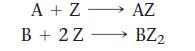
A mixture of A and B contains a total of 5.3 mols. Both A and B react with Z according to the following equations:The reaction of the mixture of A and B with Z consumes 7.8 mol Z.Assuming the reactions go to completion, how many moles of A does the mixture contain? A+Z- B + 2 Z AZ BZ2
A particular kind of emergency breathing apparatus—often placed in mines, caves, or other places where oxygen might become depleted or where the air might become poisoned—works via the following chemical reaction:Notice that the reaction produces O2, which can be breathed, and absorbs CO2, a
Metallic aluminum reacts with MnO2 at elevated temperatures to form manganese metal and aluminum oxide. A mixture of the two reactants is 67.2% mole percent Al. Find the theoretical yield (in grams) of manganese from the reaction of 250 g of this mixture.
Consider the reaction:The molar mass of K is 39.10 g/mol, and that of O2 is 32.00 g/mol. Without doing any calculations, pick the conditions under which potassium is the limiting reactant and explain your reasoning.a. 170 g K, 31 g O2b. 16 g K, 2.5 g O2c. 165 kg K, 28 kg O2d. 1.5 g K, 0.38 g O2 4
Hydrolysis of the compound B5H9 forms boric acid, H3BO3. Fusion of boric acid with sodium oxide forms a borate salt, Na2B4O7. Without writing complete equations, find the mass (in grams) of B5H9 required to form 151 g of the borate salt by this reaction sequence.
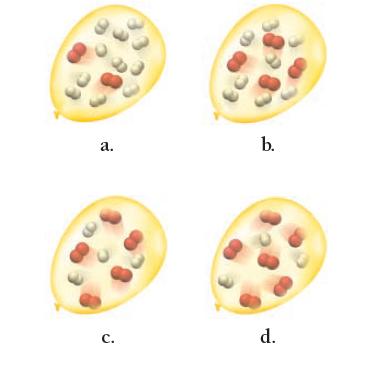
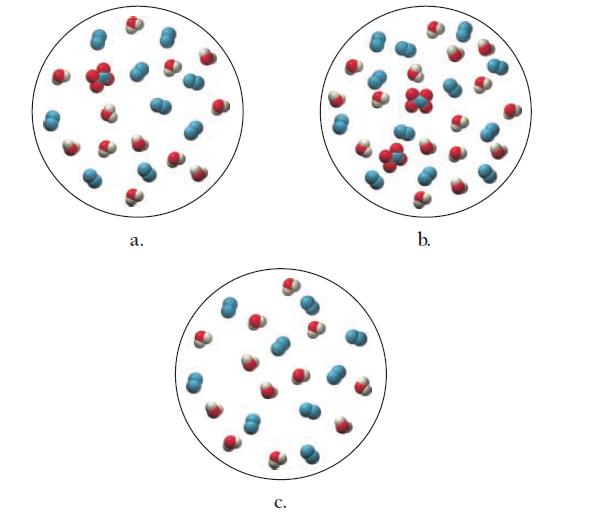
Consider the reaction:Consider also this representation of an initial mixture of N2H4 and N2O4:Which diagram best represents the reaction mixture after the reactants have reacted as completely as possible? 2 N₂H4(8) + N₂O4(8) 3 N₂(g) + 4H₂O(g)
Octane (C8H18), a component of gasoline, reacts with oxygen to form carbon dioxide and water. Write the balanced chemical reaction for this process by passing a single piece of paper around your group and asking each group member to complete the next logical step. As each member completes his or
Imagine you mix 16.05 g of methane (CH4) gas and 96.00 g of oxygen (O2) gas and then ignite the mixture. After a bright flash and a loud bang, some water vapor forms.a. Write the balanced chemical reaction for the combustion of methane.b. Depict the process that occurred using circles to represent
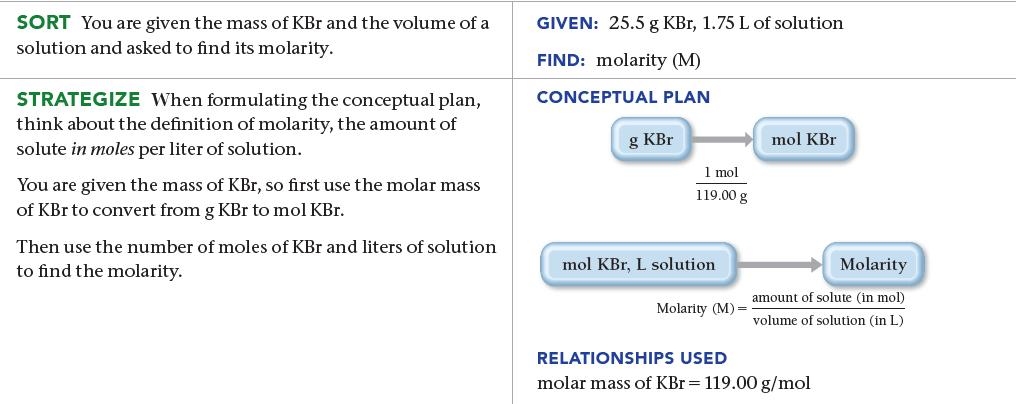
What is the molarity of a solution containing 25.5 g KBr dissolved in enough water to make 1.75 L of solution? SORT You are given the mass of KBr and the volume of a solution and asked to find its molarity. STRATEGIZE When formulating the conceptual plan, think about the definition of molarity, the
Explain the problem with the following statement to your group and correct it. “When a chemical equation is balanced, the number of molecules of each type on both sides of the equation is equal.”
How many moles of solute are required to make 3.0 L of a 2.0 M solution?(a) 2.0 mol solute (b) 3.0 mol solute(c) 4.0 mol solute (d) 6.0 mol solute
What is the molarity of a solution containing 55.8 g of MgCl2 dissolved in 1.00 L of solution?a) 55.8 M b) 1.71 M c) 0.586 M d) 0.558 M
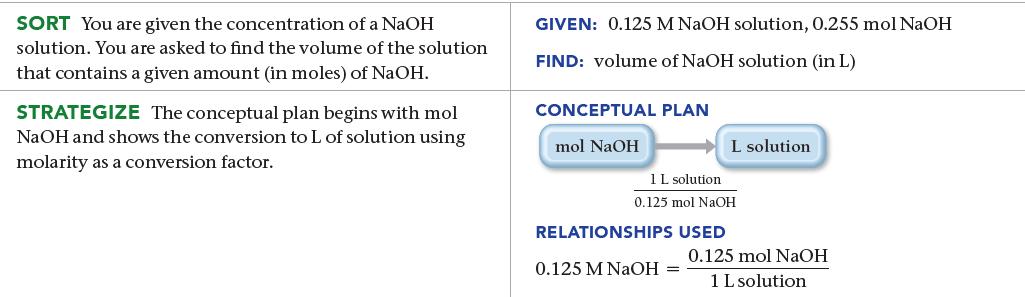
How many liters of a 0.125 M NaOH solution contain 0.255 mol of NaOH? SORT You are given the concentration of a NaOH solution. You are asked to find the volume of the solution that contains a given amount (in moles) of NaOH. STRATEGIZE The conceptual plan begins with mol NaOH and shows the
What is an aqueous solution? What is the difference between the solute and the solvent?
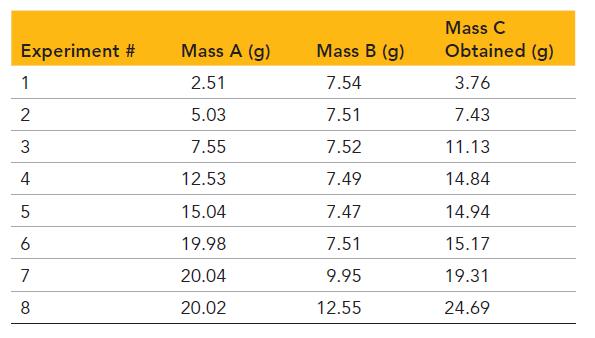
A chemical reaction in which reactants A and B form the product C is studied in the laboratory. The researcher carries out the reaction with differing relative amounts of reactants and measures the amount of product produced. Examine the given tabulated data from the experiment and answer the
If we dissolve 25 g of salt in 251 g of water, what is the mass of the resulting solution?(a) 251 g (b) 276 g (c) 226 g
What mass (in grams) of Mg(NO3)2 is present in 145 mL of a 0.150 M solution of Mg(NO3)2?a) 3.23 g b) 0.022 g c) 1.88 g d) 143 g
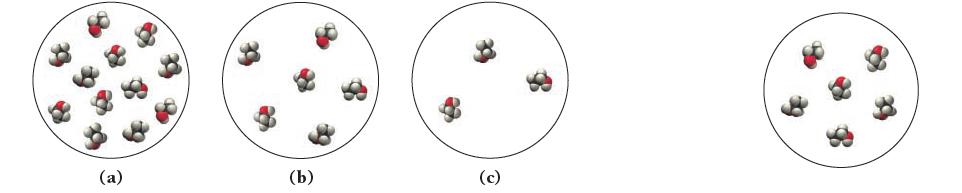
The image shown at the far right represents a small ANSWER NOW! volume within 500 mL of aqueous ethanol (CH3CH2OH) solution. (The water molecules have been omitted for clarity.)Which of the following images best represents the same volume of the solution after we add an additional 500 mL of water?
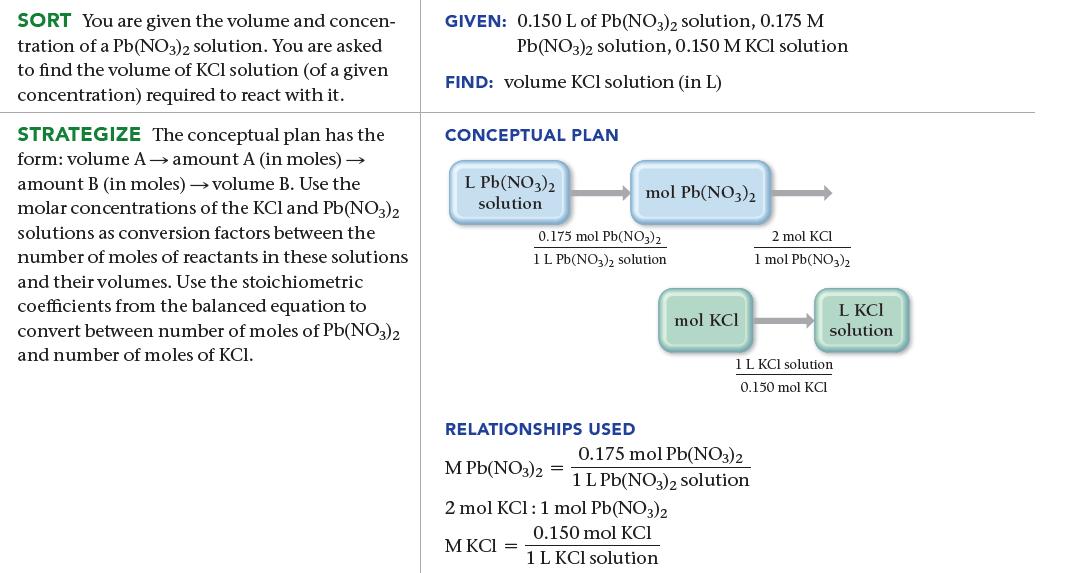
What volume (in L) of a 0.150 M KCl solution will completely react with 0.150 L of a 0.175 M Pb(NO3)2 solution according to the following balanced chemical equation? 2 KCl(aq) + Pb(NO3)2(aq) PbCl₂(s) + 2 KNO3(aq)
Explain how a strong electrolyte, a weak electrolyte, and a nonelectrolyte differ.
Consider the reaction:What is the limiting reactant if you mix equal volumes of a 1 M solution of A and a 1 M solution of B?(a) A (b) B 2 A(aq) + B(aq) C(aq)
Potassium iodide reacts with lead(II) nitrate in the following precipitation reaction:What minimum volume of 0.200 M potassium iodide solution is required to completely precipitate all of the lead in 155.0 mL of a 0.112 M lead(II) nitrate solution?a) 348 mL b) 86.8 mL c) 174 mL d) 43.4 mL 2
Explain the difference between a strong acid and a weak acid.
Predict whether each compound is soluble or insoluble.(a) PbCl2 (b) CuCl2 (c) Ca(NO3)2(d) BaSO4
Which aqueous solution conducts electricity?(a) 1.0 M KBr (b) 1.0 M C6H12O6 (c) 1.0 M CH3OH
Which solution forms a precipitate when mixed with a solution of aqueous Na2CO3?a) KNO3(aq) b) NaBr(aq)c) NH4Cl(aq) d) CuCl2(aq)
What does it mean for a compound to be soluble? Insoluble?
Showing 3400 - 3500
of 4045
First
27
28
29
30
31
32
33
34
35
36
37
38
39
40
41
Step by Step Answers

 Get 50% OFF
Claim Now
Get 50% OFF
Claim Now