New Semester
Started
Get
50% OFF
Study Help!
--h --m --s
Claim Now
Question Answers
Textbooks
Find textbooks, questions and answers
Oops, something went wrong!
Change your search query and then try again
S
Books
FREE
Study Help
Expert Questions
Accounting
General Management
Mathematics
Finance
Organizational Behaviour
Law
Physics
Operating System
Management Leadership
Sociology
Programming
Marketing
Database
Computer Network
Economics
Textbooks Solutions
Accounting
Managerial Accounting
Management Leadership
Cost Accounting
Statistics
Business Law
Corporate Finance
Finance
Economics
Auditing
Tutors
Online Tutors
Find a Tutor
Hire a Tutor
Become a Tutor
AI Tutor
AI Study Planner
NEW
Sell Books
Search
Search
Sign In
Register
study help
sciences
chemistry a molecular approach
Chemistry A Molecular Approach 5th Edition Nivaldo Tro - Solutions
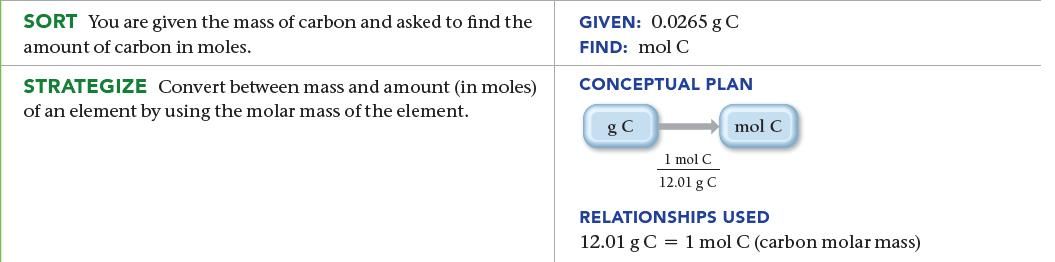
Calculate the amount of carbon (in moles) contained in a 0.0265 g pencil “lead.” (Assume that the pencil lead is made of pure graphite, a form of carbon.) SORT You are given the mass of carbon and asked to find the amount of carbon in moles. STRATEGIZE Convert between mass and amount (in
Determine the number of electrons in the Cr3+ ion.a) 24 electrons b) 27 electronsc) 3 electrons d) 21 electrons
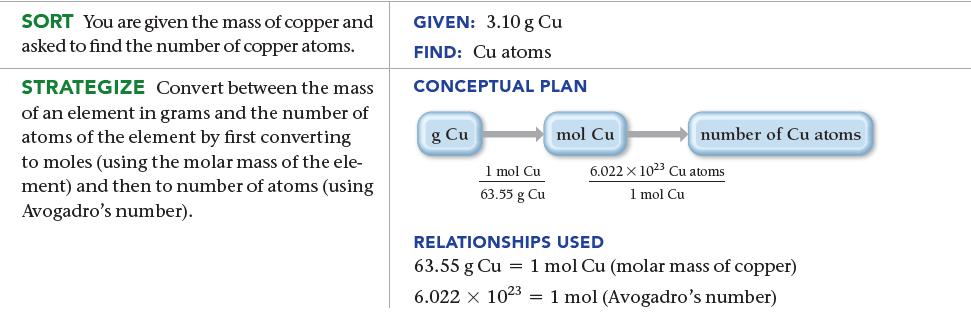
How many copper atoms are in a copper penny with a mass of 3.10 g? (Assume that the penny is composed of pure copper.) SORT You are given the mass of copper and asked to find the number of copper atoms. STRATEGIZE Convert between the mass of an element in grams and the number of atoms of the
How and by whom was the electron discovered? What basic properties of the electron were reported with its discovery?
How many electrons are present in the O2- anion?(a) 6(b) 8(c) 10
In light of the nuclear model for the atom, which statement is true?(a) For a given element, the size of an isotope with more neutrons is larger than one with fewer neutrons.(b) For a given element, the size of an atom is the same for all of the element’s isotopes.
Which element is not a main-group element?a) Se b) Mo c) Sr d) Ba
Describe the plum-pudding model of the atom.
Which terms best apply to lead (Pb)?(a) Transition element; metal (b) Main-group element; nonmetal (c) Halogen; nonmetal (d) Main-group element; metal
What is the charge of the ion most commonly formed by S?a) 2+ b) + c) - d) 2-
Describe Rutherford’s gold foil experiment. How did the experiment prove that the plum-pudding model of the atom was wrong?
Recall from Conceptual Connection 2.7 that carbon has two naturally occurring isotopes: C-12 (natural abundance is 98.93%; mass is 12.0000 amu) and C-13 (natural abundance is 1.07%; mass is 13.0034 amu). Without doing any calculations, determine which mass is closest to the atomic mass of
A naturally occurring sample of an element contains only two isotopes. The first isotope has a mass of 68.9255 amu and a natural abundance of 60.11%. The second isotope has a mass of 70.9247 amu. Find the atomic mass of the element.a) 70.13 amub) 69.72 amuc) 84.06 amud) 69.93 amu
Describe Rutherford’s nuclear model of the atom. What was revolutionary about his model?
Without doing any calculations, determine which sample contains the most atoms.(a) A 1-g sample of copper (b) A 1-g sample of carbon (c) A 10-g sample of uranium
Which sample contains the greatest number of atoms?a) 14 g Cb) 49 g Crc) 102 g Agd) 202 g Pb
If matter is mostly empty space, as suggested by Rutherford, then why does it appear so solid?
Determine the number of atoms in 1.85 mL of mercury.(The density of mercury is 13.5 g/mL.)a) 3.02 * 1027 atomsb) 4.11 * 1020 atomsc) 7.50 * 1022 atomsd) 1.50 * 1025 atoms
List the three subatomic particles that compose atoms and give the basic properties (mass and charge) of each.
A 20.0 g sample of an element contains 4.95 * 1023 atoms.Identify the element.a) Cr b) O c) Mg d) Fe
What defines an element?
Convert each temperature.a. 212 °F to °C (temperature of boiling water at sea level)b. 22 °C to K (approximate room temperature)c. 0.00 K to °F (coldest temperature possible, also known as absolute zero)d. 2.735 K to °C (average temperature of the universe as measured from background black
The coldest ground-level temperature ever measured on Earth is -128.6 °F, recorded on July 21, 1983, in Antarctica. Convert that temperature to °C and K.
The warmest temperature ever measured in the United States is 134 °F, recorded on July 10, 1913, in Death Valley, California.Convert that temperature to °C and K.
Use the prefix multipliers to express each measurement without exponents.a. 1.2 * 10-9 mb. 22 * 10-15 sc. 1.5 * 109 gd. 3.5 * 106 L
Use prefix multipliers to express each measurement without exponents.a. 38.8 * 105 g b. 55.2 * 10-10 s c. 23.4 * 1011 m d. 87.9 * 10-7 L
Use scientific notation to express each quantity with only base units (no prefix multipliers).a. 4.5 nsb. 18 fsc. 128 pmd. 35 μm
Use scientific notation to express each quantity with only base units (no prefix multipliers).a. 35 μLb. 225 Mmc. 133 Tgd. 1.5 cg
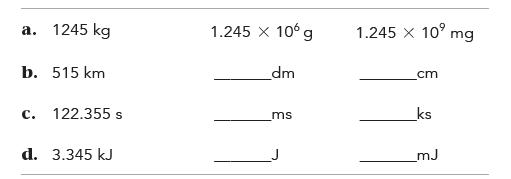
Complete the table. a. 1245 kg b. 515 km C. 122.355 s d. 3.345 kJ 1.245 x 10° g _dm ms 1.245 x 10⁹ mg _cm ks _mJ
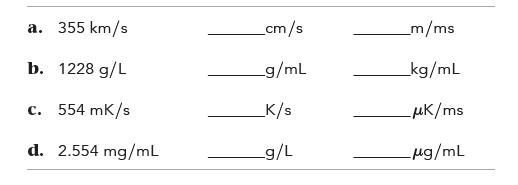
Complete the table. a. 355 km/s b. 1228 g/L c. 554 mK/s d. 2.554 mg/mL _cm/s _g/mL _K/s _g/L _m/ms _kg/mL _μk/ms μg/mL
Express the quantity 254,998 m in each unit.a. kmb. Mmc. mmd. cm
Explain the difference between Z (the atomic number) and A (the mass number).
Where do elements get their names?
What are isotopes? What is percent natural abundance of isotopes?
Describe the two different notations used to specify isotopes and give an example of each.
What is an ion? A cation? An anion?
State the periodic law. How did the periodic law lead to the periodic table?
Describe the characteristic properties of metals, nonmetals, and metalloids.
List the characteristic properties of each group.a. Noble gasesb. Alkali metalsc. Alkaline earth metalsd. Halogens
How do you predict the charges of ions formed by main-group elements?
What is atomic mass? How is it calculated?
Explain how a mass spectrometer works.
What kind of information can be determined from a mass spectrum?
What is a mole? How is the mole concept useful in chemical calculations?
Why is the mass corresponding to a mole of one element different from the mass corresponding to a mole of another element?
A hydrogen-filled balloon is ignited, and 1.50 g of hydrogen reacts with 12.0 g of oxygen. How many grams of water vapor form?
An automobile gasoline tank holds 21 kg of gasoline. When the gasoline burns, 84 kg of oxygen is consumed, and carbon dioxide and water are produced. What is the total combined mass of carbon dioxide and water that is produced?
Two samples of carbon tetrachloride are decomposed into their constituent elements. One sample produces 38.9 g of carbon and 448 g of chlorine, and the other sample produces 14.8 g of carbon and 134 g of chlorine. Are these results consistent with the law of definite proportions? Explain your
Two samples of sodium chloride are decomposed into their constituent elements. One sample produces 6.98 g of sodium and 10.7 g of chlorine, and the other sample produces 11.2 g of sodium and 17.3 g of chlorine. Are these results consistent with the law of definite proportions? Explain your answer.
The mass ratio of sodium to fluorine in sodium fluoride is 1.21:1. A sample of sodium fluoride produces 28.8 g of sodium upon decomposition. How much fluorine (in grams) forms?
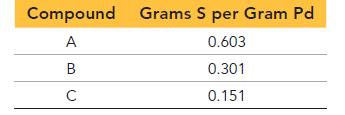
Palladium forms three different compounds with sulfur. The mass of sulfur per gram of palladium in each compound is listed here. Show that these masses are consistent with the law of multiple proportions. Compound Grams S per Gram Pd A 0.603 B 0.301 C 0.151
Upon decomposition, one sample of magnesium fluoride produces 1.65 kg of magnesium and 2.57 kg of fluorine. A second sample produces 1.32 kg of magnesium. How much fluorine (in grams) does the second sample produce?
Two different compounds containing osmium and oxygen have the following masses of oxygen per gram of osmium: 0.168 and 0.3369 g. Show that these amounts are consistent with the law of multiple proportions.
Sulfur and oxygen form both sulfur dioxide and sulfur trioxide.When samples of these are decomposed, the sulfur dioxide produces 3.49 g oxygen and 3.50 g sulfur, while the sulfur trioxide produces 6.75 g oxygen and 4.50 g sulfur. Calculate the mass of oxygen per gram of sulfur for each sample and
Sulfur and fluorine form several different compounds including sulfur hexafluoride and sulfur tetrafluoride. Decomposition of a sample of sulfur hexafluoride produces 4.45 g of fluorine and 1.25 g of sulfur, while decomposition of a sample of sulfur tetrafluoride produces 4.43 g of fluorine and
Which statements are consistent with Dalton’s atomic theory as it was originally stated? Why?a. Sulfur and oxygen atoms have the same mass.b. All cobalt atoms are identical.c. Potassium and chlorine atoms combine in a 1:1 ratio to form potassium chloride.d. Lead atoms can be converted into gold.
Which statements are inconsistent with Dalton’s atomic theory as it was originally stated? Why?a. All carbon atoms are identical.b. An oxygen atom combines with 1.5 hydrogen atoms to form a water molecule.c. Two oxygen atoms combine with a carbon atom to form a carbon dioxide molecule.d. The
Which statements are consistent with Rutherford’s nuclear theory as it was originally stated? Why?a. The volume of an atom is mostly empty space.b. The nucleus of an atom is small compared to the size of the atom.c. Neutral lithium atoms contain more neutrons than protons.d. Neutral lithium atoms
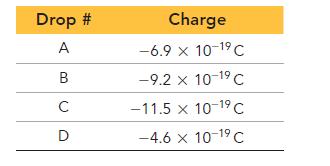
A chemist in an imaginary universe, where electrons have a different charge than they do in our universe, performs the Millikan oil drop experiment to measure the electron’s charge.The charges of several drops are recorded here. What is the charge of the electron in this imaginary universe? Drop
Which statements are inconsistent with Rutherford’s nuclear theory as it was originally stated? Why?a. Since electrons are smaller than protons and since a hydrogen atom contains only one proton and one electron, it must follow that the volume of a hydrogen atom is mostly due to the proton.b. A
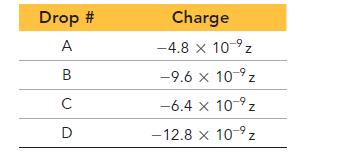
Imagine a unit of charge called the zorg. A chemist performs the oil drop experiment and measures the charge of each drop in zorgs. Based on the results shown here, what is the charge of the electron in zorgs (z)? How many electrons are in each drop? Drop # A B C D Charge -4.8 x 10-z -9.6 x
On a dry day, your body can accumulate static charge from walking across a carpet or from brushing your hair. If your body develops a charge of -15 μC (microcoulombs), how many excess electrons has it acquired? What is their collective mass?
How many electrons are necessary to produce a charge of -1.0 C? What is the mass of this many electrons?
Which statements about subatomic particles are true?a. If an atom has an equal number of protons and electrons, it will be charge-neutral.b. Electrons are attracted to protons.c. Electrons are much lighter than neutrons.d. Protons have twice the mass of neutrons.
Which statements about subatomic particles are false?a. Protons and electrons have charges of the same magnitude but opposite signs.b. Protons have about the same mass as neutrons.c. Some atoms don’t have any protons.d. Protons and neutrons have charges of the same magnitude but opposite signs.
How many electrons does it take to equal the mass of a proton?
A helium nucleus has two protons and two neutrons. How many electrons does it take to equal the mass of a helium nucleus?
Write isotopic symbols in the form X-A (e.g., C-13) for each isotope.a. The silver isotope with 60 neutronsb. The silver isotope with 62 neutronsc. The uranium isotope with 146 neutronsd. The hydrogen isotope with one neutron
Determine the number of protons and the number of neutrons in each isotope. a. ¹4N b. Na C. 222 86 d. 20Pb 82
Write isotopic symbols in the form AZ X for each isotope.a. The copper isotope with 34 neutronsb. The copper isotope with 36 neutronsc. The potassium isotope with 21 neutronsd. The argon isotope with 22 neutrons
Determine the number of protons and the number of neutrons in each isotope. a. 19 K b. Ra 88 C. 99 Tc d. 33P
The amount of carbon-14 in ancient artifacts and fossils is often used to establish their age. Determine the number of protons and the number of neutrons in carbon-14 and write its symbol in the form AZ X.
Uranium-235 is used in nuclear fission. Determine the number of protons and the number of neutrons in uranium-235 and write its symbol in the form AZ X.
Determine the number of protons and the number of electrons in each ion. a. Ni²+ b. S²- c. Br d. Cr³+
Determine the number of protons and the number of electrons in each ion. a. Al³+ b. Se²- c. Ga³+ d. Sr²+
Predict the charge of the ion formed by each element.a. O b. K c. Al d. Rb
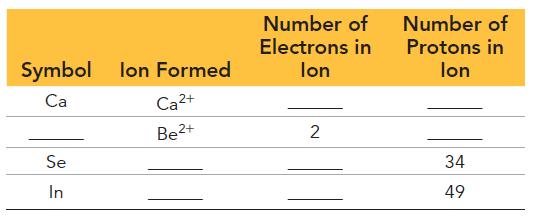
Fill in the blanks to complete the table. Symbol lon Formed Ca Se In Ca²+ Be²+ Number of Electrons in lon 2 Number of Protons in lon 34 49
Predict the charge of the ion formed by each element.a. Mg b. N c. F d. Na
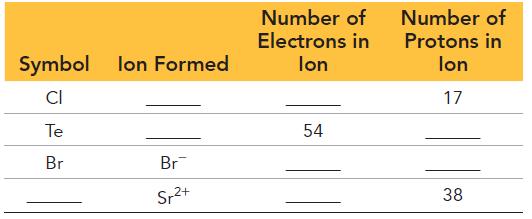
Fill in the blanks to complete the table. Symbol CI Te Br Ion Formed Br Sr²+ Number of Electrons in lon 54 Number of Protons in lon 17 38
Write the name of each element and classify it as a metal, nonmetal, or metalloid.a. K b. Bac. Id. O e. Sb
Determine whether or not each element is a main-group element.a. Telluriumb. Potassiumc. Vanadiumd. Manganese
Determine whether or not each element is a transition element.a. Cr b. Br c. Mo d. Cs
Classify each element as an alkali metal, alkaline earth metal, halogen, or noble gas.a. Sodium b. Iodinec. Calcium d. Bariume. Krypton
Classify each element as an alkali metal, alkaline earth metal, halogen, or noble gas.a. F b. Sr c. K d. Ne e. At
Which pair of elements do you expect to be most similar? Why?a. N and Ni b. Mo and Snc. Na and Mg d. Cl and Fe. Si and P
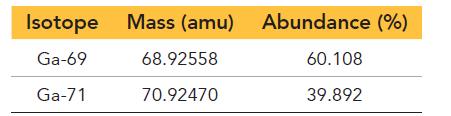
Gallium has two naturally occurring isotopes with the following masses and natural abundances:Sketch the mass spectrum of gallium. Isotope Ga-69 Ga-71 Mass (amu) Abundance (%) 60.108 39.892 68.92558 70.92470
Which pair of elements do you expect to be most similar? Why?a. Nitrogen and oxygenb. Titanium and galliumc. Lithium and sodiumd. Germanium and arsenice. Argon and bromine
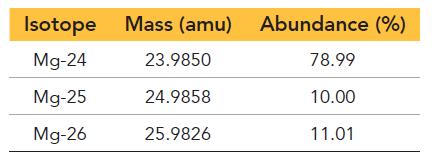
Magnesium has three naturally occurring isotopes with the following masses and natural abundances:Sketch the mass spectrum of magnesium. Isotope Mg-24 Mg-25 Mg-26 Mass (amu) 23.9850 24.9858 25.9826 Abundance (%) 78.99 10.00 11.01
The atomic mass of fluorine is 18.998 amu, and its mass spectrum shows a large peak at this mass. The atomic mass of chlorine is 35.45 amu, yet the mass spectrum of chlorine does not show a peak at this mass. Explain the difference.
Bromine has two naturally occurring isotopes (Br-79 and Br-81) and has an atomic mass of 79.904 amu. The mass of Br-81 is 80.9163 amu, and its natural abundance is 49.31%. Calculate the mass and natural abundance of Br-79.
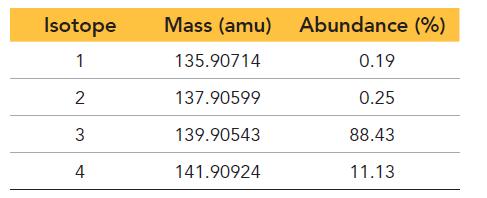
An element has four naturally occurring isotopes with the masses and natural abundances given here. Find the atomic mass of the element and identify it. Isotope 1 2 3 4 Mass (amu) 135.90714 137.90599 139.90543 141.90924 Abundance (%) 0.19 0.25 88.43 11.13
An element has two naturally occurring isotopes. Isotope 1 has a mass of 120.9038 amu and a relative abundance of 57.4%, and isotope 2 has a mass of 122.9042 amu. Find the atomic mass of this element and identify it.
The atomic mass of copper is 63.546 amu. Do any copper isotopes have a mass of 63.546 amu? Explain.
The graduated cylinder shown in the right margin has markings every 0.1 mL.Report the volume (which is read at the bottom of the meniscus) to the correct number of digits.
What observations did Antoine Lavoisier make? What law did he formulate?
Convert 85.0 °F to K.a) 181.1 K b) 358 Kc) 29.4 K d) 302.6 K
Which temperature scale has no negative temperatures?(a) Kelvin (b) Celsius (c) Fahrenheit
How many significant figures are in each number?(a) 0.04450 m (b) 5.0003 km (c) 10 dm = 1 m (d) 1.000 * 105 s (e) 0.00002 mm (f) 10,000 m
Explain the differences between a hypothesis, a law, and a theory.
Which property of rubbing alcohol is a chemical property?a) Density (0.786 g/cm3) b) Flammabilityc) Boiling point (82.5 °C) d) Melting point (-89 °C)
Showing 3900 - 4000
of 4045
First
27
28
29
30
31
32
33
34
35
36
37
38
39
40
41
Step by Step Answers

 Get 50% OFF
Claim Now
Get 50% OFF
Claim Now