New Semester
Started
Get
50% OFF
Study Help!
--h --m --s
Claim Now
Question Answers
Textbooks
Find textbooks, questions and answers
Oops, something went wrong!
Change your search query and then try again
S
Books
FREE
Study Help
Expert Questions
Accounting
General Management
Mathematics
Finance
Organizational Behaviour
Law
Physics
Operating System
Management Leadership
Sociology
Programming
Marketing
Database
Computer Network
Economics
Textbooks Solutions
Accounting
Managerial Accounting
Management Leadership
Cost Accounting
Statistics
Business Law
Corporate Finance
Finance
Economics
Auditing
Tutors
Online Tutors
Find a Tutor
Hire a Tutor
Become a Tutor
AI Tutor
AI Study Planner
NEW
Sell Books
Search
Search
Sign In
Register
study help
sciences
chemistry a molecular approach
Chemistry A Molecular Approach 5th Edition Nivaldo Tro - Solutions
The compound C3H4 has two double bonds. Describe its bonding and geometry, using a valence bond approach.
Draw the structure of a molecule with the formula C4H6Cl2 that has a dipole moment of 0.
Draw the structures of two compounds that have the composition CH3NO2 and have all three H atoms bonded to the C. Predict which compound has the larger ONO bond angle.
Indicate which orbitals overlap to form the s bonds in each molecule. a. BeBr₂ b. HgCl₂ c. ICN
In VSEPR theory, which uses the Lewis model to determine molecular geometry, the trend of decreasing bond angles in CH4, NH3, and H2O is accounted for by the greater repulsion of lone pair electrons compared to bonding pair electrons. How would this trend be accounted for in valence bond theory?
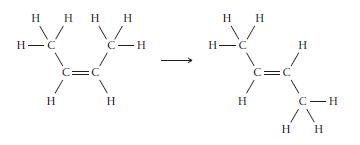
cis-2-Butene isomerizes to trans-2-butene via the reaction shown here.a. If isomerization requires breaking the p bond, what minimum energy is required for isomerization in J/mol? In J/molecule?b. If the energy for isomerization came from light, what minimum frequency of light would be required? In
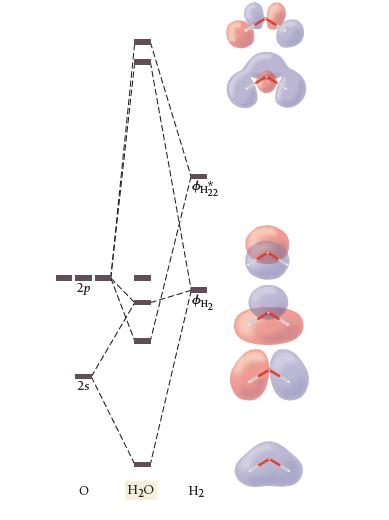
The results of a molecular orbital calculation for H2O are shown here. Examine each of the orbitals and classify them as bonding, antibonding, or nonbonding. Assign the correct number of electrons to the energy diagram. According to this energy diagram, is H2O stable? Explain. I 2p 10H22 $112 O
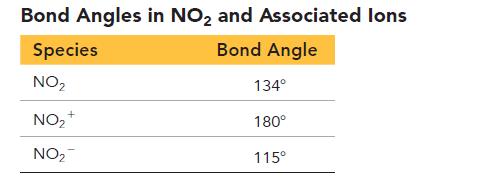
The species NO2, NO2 +, and NO2 - in which N is the central atom have very different bond angles. Predict what these bond angles might be with respect to the ideal angles and justify your prediction.
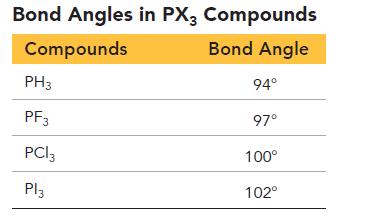
The bond angles increase steadily in the series PF3, PCl3, PBr3, and PI3. After consulting the data on atomic radii, provide an explanation for this observation.
The ion CH5 + can form under very special high-energy conditions in the vapor phase in a mass spectrometer. Propose a hybridization for the carbon atom and predict the geometry.
Use VSEPR theory to predict the geometry (including bond angles) about each interior atom of methyl azide (CH3N3), and make a sketch of the molecule. Would you expect the bond angle between the two interior nitrogen atoms to be the same or different? Would you expect the two nitrogen–nitrogen
Which statement best captures the fundamental idea behind VSEPR theory? Explain what is wrong with each of the other statements.a. The angle between two or more bonds is determined primarily by the repulsions between the electrons within those bonds and other (lone pair) electrons on the central
Suppose that a molecule has four bonding groups and one lone pair on the central atom. Suppose further that the molecule is confined to two dimensions (this is a purely hypothetical assumption for the sake of understanding the principles behind VSEPR theory). Make a sketch of the molecule and
How does each of the three major bonding theories (the Lewis model, valence bond theory, and MO theory) define a single chemical bond? A double bond? A triple bond? How are these definitions similar? How are they different?
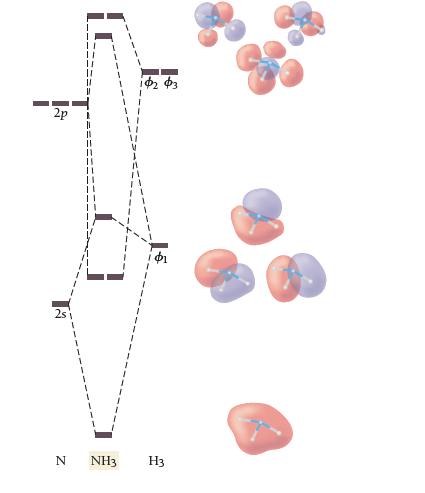
The results of a molecular orbital calculation for NH3 are shown here. Examine each of the orbitals and classify them as bonding, antibonding, or nonbonding. Assign the correct number of electrons to the energy diagram. According to this energy diagram, is NH3 stable? Explain. 2р 2s N NH3 Ф2
How many types of hybrid orbitals do we use to describe each molecule? a. N₂O5 b. C₂H5NO (four C-H bonds and one O-H bond) c. BrCN (no formal charges)
The most stable forms of the nonmetals in groups 4A, 5A, and 6A of the second period are molecules with multiple bonds.Beginning with the third period, the most stable forms of the nonmetals of these groups are molecules without multiple bonds. Propose an explanation for this observation based on
In complete sentences, describe why someone might expect the bond angles in methane (CH4) to be 90° even though the bond angles are actually 109.5°.
At least two different numbers of electron groups can result in a linear molecule. What are they? What are the numbers of bonding groups and lone pairs in each case? Provide an example of a linear molecule in each case.
Have each member of your group select one of the molecules shown below and complete steps a–d. Each member should then present his or her results to the rest of the group, explaining the reasoning used to determine the answers.a. Draw the Lewis dot structure.b. Determine the molecular geometry
How many atomic orbitals form a set of sp3 hybrid orbitals? A set of sp2 hybrid orbitals? A set of sp hybrid orbitals? What is the relationship between these numbers and the number of electron groups around the central atom?
Use MO theory to explain in detail why N2+ and N2 - have similar bond strengths and both are very different from neutral N2.
The VSEPR model is useful in predicting bond angles for many compounds. However, as we have seen, other factors (such as type of bond and atomic radii) may also influence bond angles.Consider that data for bond angles in related species in the tables and answer the questions.a. Draw Lewis
Which molecules have dipole–dipole forces?(a) CO2 (b) CH2Cl2 (c) CH4
Which state of matter is compressible?(a) Solid(b) Liquid(c) Gas
Which state of matter is compressible?a) Gas b) Liquidc) Solid d) None of the above
Explain why water drops are spherical in the absence of gravity.
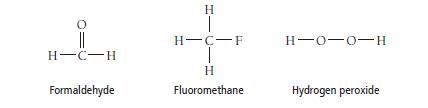
One of these compounds is a liquid at room temperature. Which one and why? H-C-H Formaldehyde H T H-C-F T H Fluoromethane H-0-0-H Hydrogen peroxide
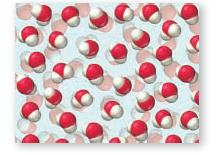
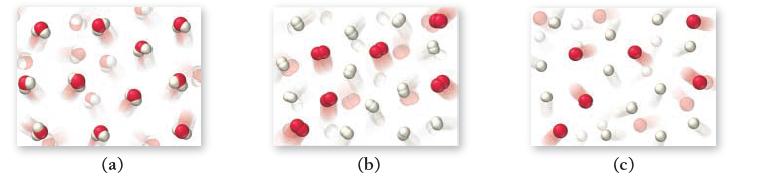
This molecular diagram shows a sample of liquid water:Which of the diagrams below best depicts the vapor emitted from a pot of boiling water?
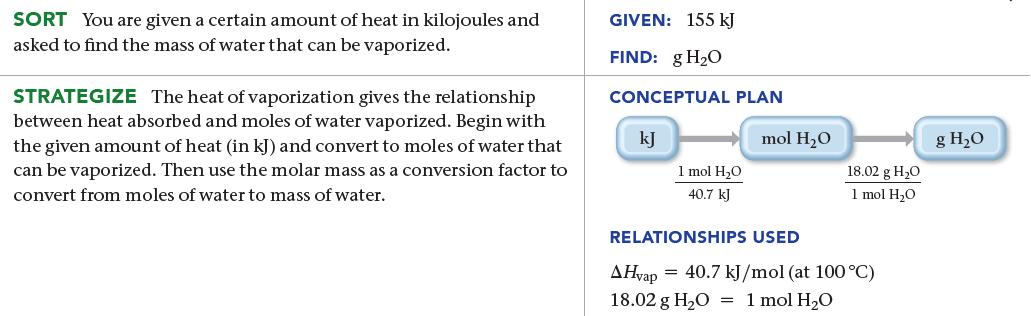
Calculate the mass of water (in g) that can be vaporized at its boiling point with 155 kJ of heat. SORT You are given a certain amount of heat in kilojoules and asked to find the mass of water that can be vaporized. STRATEGIZE The heat of vaporization gives the relationship between heat absorbed
Why are intermolecular forces important?
Which halogen has the highest boiling point?(a) Cl2(b) Br2 (c) I2
Based on the expected intermolecular forces, which halogen has the highest boiling point?a) F2 b) Cl2 c) Br2 d) I2
What are the main properties of liquids (in contrast to gases and solids)?
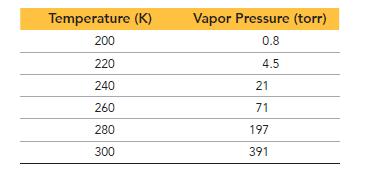
The vapor pressure of dichloromethane is measured as a function of temperature, and the results are tabulated. From the results, determine the heat of vaporization of dichloromethane. Temperature (K) 200 220 240 260 280 300 Vapor Pressure (torr) 0.8 4.5 21 71 197 391
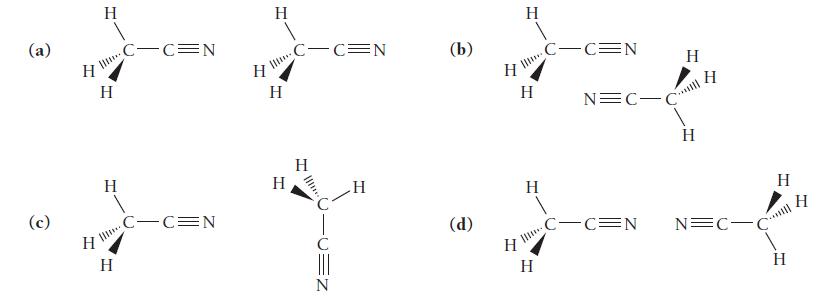
An electrostatic potential map for acetonitrile (CH3CN), which is polar, is shown here: From this map, determine the geometry for how two acetonitrile molecules would interact with each other. Which of the orientations shown here is most likely?
Which substance experiences dipole–dipole forces?a) CCl4 b) NF3 c) CS2 d) SO3
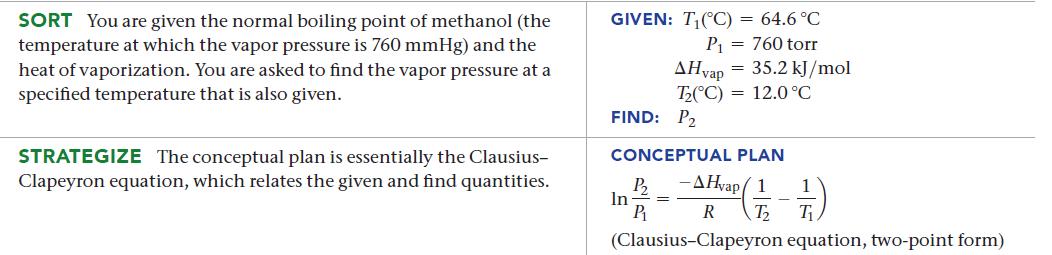
Methanol has a normal boiling point of 64.6 °C and a heat of vaporization (ΔHvap) of 35.2 kJ/mol. What is the vapor pressure of methanol at 12.0 °C? SORT You are given the normal boiling point of methanol (the temperature at which the vapor pressure is 760 mmHg) and the heat of vaporization. You
What are the main properties of solids (in contrast to liquids and gases)?
Which substance has the highest boiling point?(a) CH3OH (b) CO (c) N2
One of these substances is a liquid at room temperature.Which one?a) CH3OH b) CF4 c) SiH4 d) CO2
Which sample of water has the greatest rate of vaporization?(a) A 100 mL sample of water at 25 °C in 100-mL beaker with a 5 cm diameter.(b) A 100 mL sample of water at 55 °C in 100-mL beaker with a 5 cm diameter.(c) A 100 mL sample of water at 25 °C in 250-mL beaker with a 7 cm diameter.(d) A
Which property of a liquid increases with increasing temperature?a) Surface tensionb) Viscosityc) Vapor pressured) None of the above
What factors cause transitions between the solid and liquid state? The liquid and gas state?
What happens to the vapor pressure of a substance when its surface area is increased at constant temperature?(a) The vapor pressure increases.(b) The vapor pressure remains the same.(c) The vapor pressure decreases.
Determine the amount of heat (in kJ) required to vaporize 1.55 kg of water at its boiling point. For water, ΔHvap = 40.7 kJ/mol (at 100 °C).a) 3.50 * 103 kJ b) 1.14 * 106 kJc) 2.11 kJ d) 686 kJ
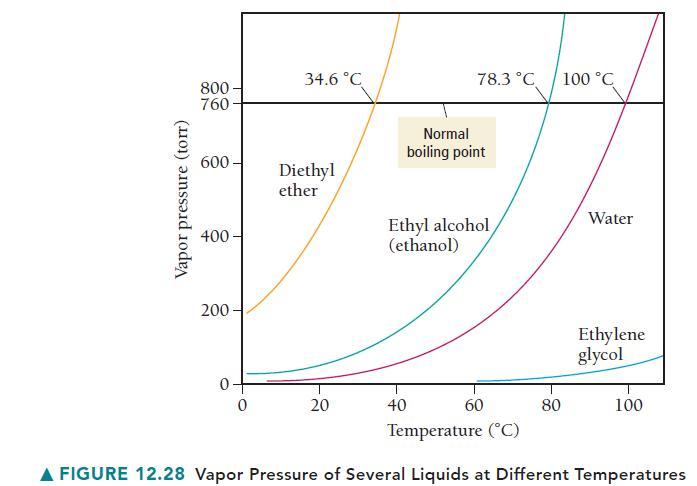
Use Figure 12.28 to estimate the boiling point of water at an external pressure of 200 torr.(a) 66 °C (b) 84 °C (c) 100 °C (d) 0 °C Vapor pressure (torr) 800- 760 600- 400- 200 0- 0 34.6 °C Diethyl ether 20 78.3 °C 40 Normal boiling point Ethyl alcohol (ethanol) 60 80 100
Describe the relationship between the state of a substance, its temperature, and the strength of its intermolecular forces.
The vapor pressure of a substance is measured over a range of temperatures. A plot of the natural log of the vapor pressure versus the inverse of the temperature (in kelvin) produces a straight line with a slope of-3.46 * 103 K. Find the enthalpy of vaporization of the substance.a) 2.40 * 10-3
From what kinds of interactions do intermolecular forces originate?
You just saw that the heat capacity of ice is Cs, ice = 2.09 J/g · °C and that the heat of fusion of ice is 6.02 kJ/mol. When a small ice cube at -10 °C is put into a cup of water at room temperature, which of the following plays a greater role in cooling the liquid water: the warming of the ice
Why are intermolecular forces generally much weaker than bonding forces?
A substance has a triple point at -24.5 °C and 225 mmHg. What is most likely to happen to a solid sample of the substance as it is warmed from -35 °C to 0 °C at a pressure of 220 mmHg?(a) The solid melts into a liquid.(b) The solid sublimes into a gas.(c) Nothing (the solid remains solid).
What is the dispersion force? What does the magnitude of the dispersion force depend on? How can you predict the magnitude of the dispersion force for closely related elements or compounds?
What is the dipole–dipole force? How can you predict the presence of dipole–dipole forces in a compound?
How is the polarity of a liquid generally related to its miscibility with water?
What is hydrogen bonding? How can you predict the presence of hydrogen bonding in a compound?
What is the ion–dipole force? Why is it important?
What is surface tension? How does surface tension result from intermolecular forces? How is it related to the strength of intermolecular forces?
What is viscosity? How does viscosity depend on intermolecular forces? What other factors affect viscosity?
What is capillary action? How does it depend on the relative strengths of adhesive and cohesive forces?
Explain what happens in the processes of vaporization and condensation.Why does the rate of vaporization increase with increasing temperature and surface area?
Why is vaporization endothermic? Why is condensation exothermic?
How is the volatility of a substance related to the intermolecular forces present within the substance?
What is the heat of vaporization for a liquid, and why is it useful?
Explain the process of dynamic equilibrium. How is dynamic equilibrium related to vapor pressure?
What happens to a system in dynamic equilibrium when it is disturbed in some way?
How is vapor pressure related to temperature? What happens to the vapor pressure of a substance when the temperature is increased? Decreased?
What is the Clausius–Clapeyron equation, and why is it important?
Define the terms boiling point and normal boiling point.
Explain what happens to a substance when it is heated in a closed container to its critical temperature.
What is sublimation? Give a common example of sublimation.
What is fusion? Is fusion exothermic or endothermic? Why?
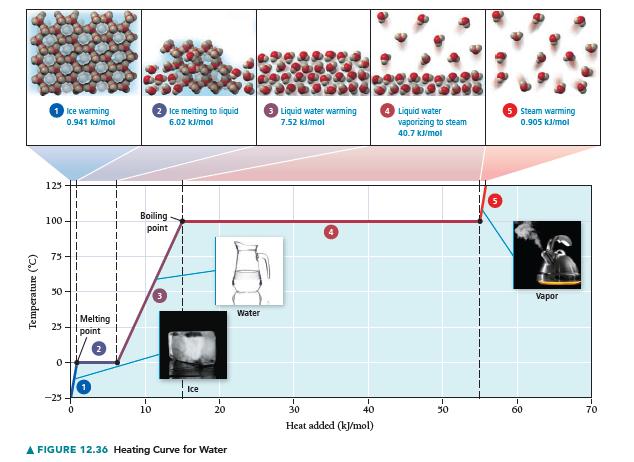
Examine the heating curve for water in Section 12.7 (Figure 12.36). Explain why the curve has two segments in which heat is added to the water but the temperature does not rise. Temperature (°C) 125 100 75 50 25 0 -25 Ice warming 0.941 kJ/mol | | Melting point Ice melting to liquid 6.02
What is the heat of fusion, and why is it important?
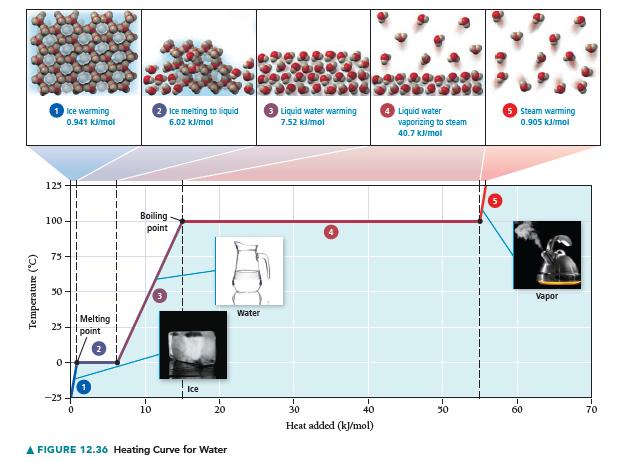
Examine the heating curve for water in Section 12.7 (Figure 12.36). Explain the significance of the slopes of each of the three rising segments. Why are the slopes different? Temperature (°C) 125 100 75 50 25 0 -25 Ice warming 0.941 kJ/mol | | Melting point Ice melting to liquid 6.02
What is a phase diagram? Draw a generic phase diagram and label its important features. What is the significance of crossing a line in a phase diagram?
How do the properties of water differ from those of most other substances?
Determine the kinds of intermolecular forces that are present in each element or compound.a. N2 b. NH3 c. COd. CCl4
Determine the kinds of intermolecular forces that are present in each element or compound.a. Kr b. NCl3 c. SiH4 d. HF
Determine the kinds of intermolecular forces that are present in each element or compound.a. HCl b. H2O c. Br2 d. He
Determine the kinds of intermolecular forces that are present in each element or compound.a. PH3 b. HBr c. CH3OH d. I2
Arrange these compounds in order of increasing boiling point.Explain your reasoning.a. H2S b. H2Se c. H2O
Arrange these compounds in order of increasing boiling point.Explain your reasoning.a. CH4 b. CH3CH3 c. CH3CH2Cl d. CH3CH2OH
In each pair of compounds, pick the one with the higher boiling point. Explain your reasoning.a. CH3OH or CH3SH b. CH3OCH3 or CH3CH2OHc. CH4 or CH3CH3
In each pair of compounds, pick the one with the higher boiling point. Explain your reasoning.a. NH3 or CH4b. CS2 or CO2 c. CO2 or NO2
In each pair of compounds, pick the one with the higher vapor pressure at a given temperature. Explain your reasoning.a. Br2 or I2 b. H2S or H2O c. NH3 or PH3
In each pair of compounds, pick the one with the higher vapor pressure at a given temperature. Explain your reasoning.a. CH4 or CH3Cl b. CH3CH2CH2OH or CH3OH c. CH3OH or H2CO
Determine whether each pair of compounds forms a homogeneous solution when combined. For those that form homogeneous solutions, indicate the type of forces that are involved.a. CCl4 and H2Ob. KCl and H2Oc. Br2 and CCl4d. CH3CH2OH and H2O
Determine whether each pair of compounds forms a homogeneous solution when combined. For those that form homogeneous solutions, indicate the type of forces that are involved.a. CH3CH2CH2CH2CH3 and CH3CH2CH2CH2CH2CH3 b. CBr4 and H2Oc. LiNO3 and H2O d. CH3OH and CH3CH2CH2CH2CH3
Which compound would you expect to have greater surface tension:acetone [(CH3)2CO] or water (H2O)? Explain.
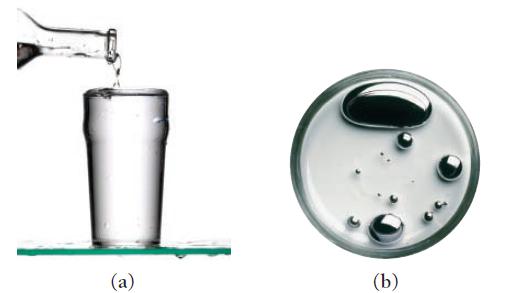
Water (a) “wets” some surfaces and beads up on others. Mercury (b), in contrast, beads up on almost all surfaces. Explain this difference. 1 (a) (b)
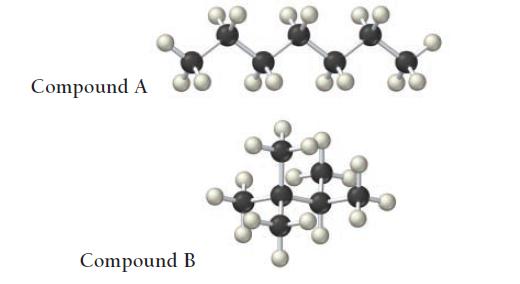
The structures of two isomers of heptane are shown. Which of these two compounds would you expect to have the greater viscosity? Compound A Compound B
Explain why the viscosity of multigrade motor oils is less temperature-dependent than that of single-grade motor oils.
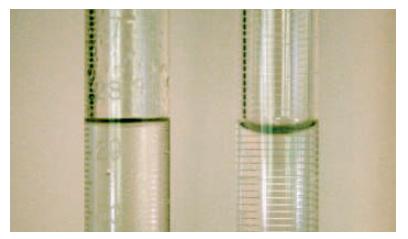
Water in a glass tube that contains grease or oil residue displays a flat meniscus (left), whereas water in a clean glass tube displays a concave meniscus (right). Explain this observation.
When a thin glass tube is put into water, the water rises 1.4 cm.When the same tube is put into hexane, the hexane rises only 0.4 cm. Explain.
Which evaporates more quickly: 55 mL of water in a beaker with a diameter of 4.5 cm or 55 mL of water in a dish with a diameter of 12 cm? Is the vapor pressure of the water different in the two containers? Explain.
Which evaporates more quickly: 55 mL of water (H2O) in a beaker or 55 mL of acetone [(CH3)2CO] in an identical beaker under identical conditions? Is the vapor pressure of the two substances different? Explain.
Spilling room-temperature water over your skin on a hot day cools you down. Spilling room-temperature vegetable oil over your skin on a hot day does not. Explain the difference.
Why is the heat of vaporization of water greater at room temperature than it is at its boiling point?
Showing 2700 - 2800
of 4045
First
21
22
23
24
25
26
27
28
29
30
31
32
33
34
35
Last
Step by Step Answers

 Get 50% OFF
Claim Now
Get 50% OFF
Claim Now