New Semester
Started
Get
50% OFF
Study Help!
--h --m --s
Claim Now
Question Answers
Textbooks
Find textbooks, questions and answers
Oops, something went wrong!
Change your search query and then try again
S
Books
FREE
Study Help
Expert Questions
Accounting
General Management
Mathematics
Finance
Organizational Behaviour
Law
Physics
Operating System
Management Leadership
Sociology
Programming
Marketing
Database
Computer Network
Economics
Textbooks Solutions
Accounting
Managerial Accounting
Management Leadership
Cost Accounting
Statistics
Business Law
Corporate Finance
Finance
Economics
Auditing
Tutors
Online Tutors
Find a Tutor
Hire a Tutor
Become a Tutor
AI Tutor
AI Study Planner
NEW
Sell Books
Search
Search
Sign In
Register
study help
sciences
chemistry principles and practice
Chemistry Principles And Practice 3rd Edition Daniel L. Reger, Scott R. Goode, David W. Ball - Solutions
Predict the effect of adding nitric acid to(a) The solubility of calcium fluoride.(b) The solubility of silver chloride.StrategyWrite the expression for the reaction that occurs as the solid dissolves, and determine whether any of the species might react with nitric acid.
Calculate the amount of La(OH)3(s) needed to neutralize 50.0 mL of 0.25 M HNO3.
Calculate the pH in the titration of 20.00 mL of 0.125 M HCl with 0.250 M NaOH after adding 9.60, 10.40, and 12.00 mL of NaOH.
Estimate the pH that results when 100 mL of 0.2 M HCl is mixed with 150 mL of 0.2 M NaOH.
Calculate the pH of a solution that is 0.50 M hydrofluoric acid and 0.10 M sodium fluoride; Ka for HF is 6.3 × 10⁻⁴.
How many moles of sodium benzoate must be added to 1 L of a 0.022 M solution of benzoic acid (pKa = 4.19) to prepare a pH 4.50 buffer?
Calculate the change in pH observed when we add 5.0 mL of 0.050 M NaOH to 100.0 mL of the pH 4.74 acetate buffer that is 0.120 M acetic acid and 0.120 M sodium acetate.
Calculate the pH values after the addition of 0, 10.00, 20.00, and 30.00 mL of 0.500 M NaOH to 20.00 mL of 0.500 M nitrous acid (Ka = 5.6 × 10⁻⁴).
Choose an indicator for the titration of ammonia (colorless solution in the flask) with standard HCl (colorless solution in the burette). Justify your choice.
Calculate the pH of 0.033 M carbonic acid. (This concentration corresponds to a solution that is saturated with CO2 at 1 atm.)
Calculate the equilibrium constants for a solution that is 0.10 M sodium hydrogen ascorbate, and determine whether the solution is acidic or basic.
Predict the effect of adding hydrochloric acid on(a) The solubility of calcium nitrate.(b) The solubility of calcium hydroxide.
Define titration, analyte, and titrant.
A high-school student needs to standardize some hydrochloric acid for a project. The concentration is about 0.2 M. The student has several hundred milliliters of standard base (0.100 M), a 50-mL burette, and some phenolphthalein. Write a set of instructions that the student can use to standardize
Sketch a titration curve for the titration of potassium hydroxide with HCl, both 0.100 M. Identify three regions in which a particular chemical species or system dominates the acid-base equilibria.
Describe the shape of a titration curve. Sketch, without calculation, a titration curve for 0.1 M weak acid with strong base. Label the points or regions at which the equilibrium is a strong acid or base, a weak acid or base, and a buffer.
Examine each of the following solutions and decide whether it is a buffer system. Justify your answer.(a) 0.100 M ammonia and 0.100 M ammonium nitrate(b) 0.100 M ammonia and 0.100 M acetic acid(c) 0.100 M acetic acid and 0.100 M ammonium nitrate
Explain why the Henderson–Hasselbalch equation fails to predict the pH of dilute buffer solutions.
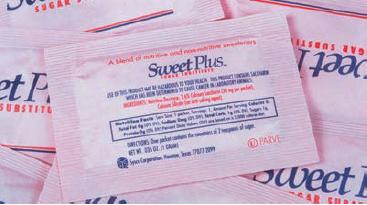
You work for a company that purchases buffers in dry form, in small envelopes similar to those in which sugar is packaged. Laboratory technicians make buffers by adding one package to 500 mL distilled water. You are asked to design an experimental plan to test the effectiveness of these buffers.
Sketch a titration curve for the titration of acetic acid (CH3COOH) with sodium hydroxide (NaOH), both 0.100 M. Identify four regions in which a particular chemical system dominates the acid-base equilibria.
Preparing solutions of most acid-base indicators is more complicated than just dissolving some of the powder in water. Typical instructions may be to dissolve about 0.1 g of indicator in 50 mL alcohol; then add distilled water so that the total volume is about 100 mL. (More specific instructions
Several years ago, a chemistry student decided to check the color chart that came with bromthymol blue, the indicator pictured in Section 16.6, to make sure that it was accurate enough for measuring the pH in an expensive aquarium. The student put the sensor of a pH meter, known to be accurate, in
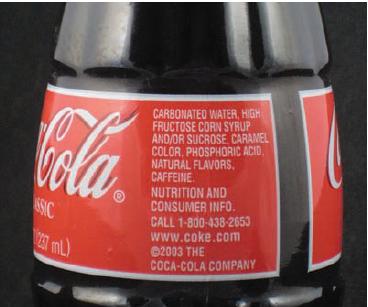
The polyprotic phosphoric acid is found in many soft drinks. Is the polyprotic nature of the acid important in this application? Why do you think manufacturers have chosen phosphoric acid in preference to other acids?
List five insoluble compounds that are more soluble in acidic solution than in neutral solution. List five compounds that are not influenced by the acidity of the solution.
Calculate how much 0.100 M HCl is needed to react completely(a) 10.0 mL of 0.150 M KOH.(b) 250.0 mL of 0.00520 M Ba(OH)2.(c) 100.0 mL of 0.100 M ammonia.
Calculate how much 0.100 M NaOH is needed to react completely(a) 45.00 mL of 0.0500 M HCl.(b) 5.00 mL of 0.350 M H2SO4 (forming Na2SO4).(c) 10.00 mL of 0.100 M acetic acid.
How many millimoles of KOH are needed to neutralize completely 35.1 mL of 0.101 M nitric acid?
How many millimoles of HCl are needed to neutralize completely 50.0 mL of 0.0233 M sodium hydroxide?
Write the chemical equation for the reaction of H2SO4 with lithium hydroxide, forming Li2SO4. Calculate the number of millimoles of H2SO4 needed to react completely with 25.0 mL of 0.244 M LiOH, forming Li2SO4.
Write the chemical equation for the neutralization of H2SO4 with La(OH)3, forming La2(SO4)3. Calculate the number of millimoles of H2SO4 needed to neutralize 0.8457 g La(OH)3(s), forming La2(SO4)3.
Calculate the pH during the titration of 100.0 mL of 0.200 M HCl with 0.400 M NaOH after 0, 25.00, 50.00, and 75.00 mL NaOH have been added. Sketch the titration curve.
Calculate the pH during the titration of 50.00 mL of 0.250 M HNO3 with 0.500 M KOH after 0, 12.50, 25.00, and 40.00 mL KOH have been added. Sketch the titration curve.
Calculate the pH during the titration of 1.00 mL of 0.240 M LiOH with 0.200 M HNO3 after 0, 0.25, 0.50, 1.20, and 1.50 mL nitric acid have been added. Sketch the titration curve.
Calculate the pH during the titration of 50.00 mL of 0.100 M NaOH with 0.100 M HNO3 after 0, 25.00, 50.00, and 75.00 mL nitric acid have been added. Sketch the titration curve.
Calculate the pH during the titration of 1.00 mL of 0.240 M Ba(OH)2 with 0.200 M HNO3 after 0, 0.50, 1.00, 2.40, and 3.00 mL nitric acid have been added. Graph the titration curve and compare with the curve obtained in Exercise 16.21.Exercise 16.21Calculate the pH during the titration of 1.00 mL of
Calculate the pH during the titration of 50.00 mL of 0.100 M Sr(OH)2 with 0.100 M HNO3 after 0, 50.00, 100.00, and 150.00 mL nitric acid have been added. Graph the titration curve and compare with the titration curve obtained in Exercise 16.22.Exercise 16.22Calculate the pH during the titration of
Estimate the pH that results when the following two solutions are mixed.(a) 50 mL of 0.1 M HCl and 50 mL of 0.2 M NaOH(b) 100 mL of 0.1 M HCl and 50 mL of 0.2 M NaOH(c) 150 mL of 0.1 M HCl and 50 mL of 0.2 M Ba(OH)2(d) 200 mL of 0.1 M HCl and 50 mL of 0.2 M Ba(OH)2
Estimate the pH that results when the following two solutions are mixed.(a) 50 mL of 0.2 M HNO3 and 50 mL of 0.1 M KOH(b) 100 mL of 0.2 M HNO3 and 150 mL of 0.2 M KOH(c) 150 mL of 0.2 M HNO3 and 150 mL of 0.2 M KOH(d) 200 mL of 0.2 M HNO3 and 200 mL of 0.2 M Sr(OH)2
Estimate the pH that results when the following two solutions are mixed.(a) 50 mL of 0.3 M HClO4 and 50 mL of 0.4 M KOH(b) 100 mL of 0.3 M HClO4 and 50 mL of 0.4 M NaOH(c) 150 mL of 0.3 M HClO4 and 100 mL of 0.3 M Ba(OH)2(d) 200 mL of 0.3 M HClO4 and 100 mL of 0.3 M Ba(OH)2
Estimate the pH that results when the following two solutions are mixed.(a) 50 mL of 0.4 M HBr and 50 mL 0.2 M NaOH(b) 100 mL of 0.4 M HBr and 50 mL 0.2 M NaOH(c) 150 mL of 0.4 M HBr and 100 mL 0.4 M Ba(OH)2(d) 200 mL of 0.4 M HBr and 100 mL 0.4 M Ba(OH)2
Calculate the pH of solutions that are(a) 0.25 M formic acid and 0.40 M sodium formate.(b) 0.50 M benzoic acid and 0.15 M sodium benzoate.
Calculate the pH of solutions that are(a) 0.20 M acetic acid and 0.50 M sodium acetate.(b) 0.25 M hydrofluoric acid and 0.10 M potassium fluoride.(c) 0.0250 mol sodium nitrite, NaNO2, in 250.0 mL of 0.0410 M nitrous acid, HNO2.
Calculate the pH that results when the following solutions are mixed.(a) 25.0 mL of 0.250 M HF and 20.0 mL of 0.360 M NaF(b) 20.0 mL of 0.144 M NH3 and 10.0 mL of 0.152 M NH4Cl
Calculate the pH that results when the following solutions are mixed.(a) 10.00 mL of 0.500 M sodium acetate and 20.00 mL of 0.350 M acetic acid(b) 350.0 mL of 0.150 M pyridinium chloride and 650.0 mL of 0.450 M pyridine
A buffer is made by dissolving 0.0500 mol potassium acetate and 0.0500 mol acetic acid in some water and adding water until the volume is a little less than a liter. The pH is adjusted to 5.00 by adding small amounts of concentrated acid (HCl) and base (NaOH) as needed, and the solution is then
Saccharin is an artificial sweetener that is also a weak acid. It has the formula C7H5NSO3, and its pKa is 11.68. A 12-oz (350-mL) can of diet cola contains 3.0 mg saccharin and has a pH of 4.50. What are the equilibrium molar concentrations of saccharin and the saccharide ion?
Calculate the pH of a solution made by(a) Adding 10.0 g sodium benzoate to 3.00 g benzoic acid and dissolving in water to make 1.00 L of solution.(b) Adding 25.0 g sodium acetate to 9.0 g acetic acid and dissolving in water to make 500 mL of solution.
Calculate the pH of a solution made by(a) Adding 12.5 g sodium nitrite to 6.0 g nitrous acid and adding water until the fi nal volume is 1.00 L.(b) Adding 45.0 g formic acid to 20.0 g sodium formate and adding enough water to make 1.00 L of buffer.(c) Adding 15.00 g sodium acetate and 12.50 g
Calculate the pH of a solution made by(a) Adding 15.45 g potassium fl uoride to 100.0 mL of 0.850 M HF.(b) Adding 45.00 g ammonium chloride to 250.0 mL of 0.455 M ammonia.
Calculate the pH of a solution made by(a) Adding 30.0 g sodium formate to 300 mL of 0.30 M formic acid.(b) Adding 30.0 g sodium acetate to 300 mL of 0.30 M acetic acid.
Calculate the pH that results when the following solutions are mixed.(a) 100.0 mL of 0.800 M formic acid and 200.0 mL of 0.100 M sodium formate(b) 300.0 mL of 0.350 M ammonia and 200.0 mL of 0.150 M ammonium chloride
How many grams of sodium acetate must be added to 400.0 mL of 0.500 M acetic acid to prepare a pH 4.35 buffer?
What volume of 0.500 M HF must be added to 750 mL of 0.200 M sodium fluoride to prepare a buffer of pH 3.95?
How many grams of ammonium chloride must be added to 500 mL of 0.137 M ammonia to prepare a pH 9.80 buffer?
A buffer solution that is 0.100 M acetate ion and 0.100 M acetic acid is prepared.(a) Calculate the initial pH, fi nal pH, and change in pH when 1.00 mL of 1.00 M NaOH is added to 100.0 mL of the buff er.(b) Calculate the initial pH, final pH, and change in pH when 1.00 mL of 1.00 M NaOH is added
A buffer solution that is 0.100 M acetate and 0.200 M acetic acid is prepared.(a) Calculate the initial pH, final pH, and change in pH when 1.00 mL of 0.100 M HCl is added to 100.0 mL of the buffer.(b) Calculate the initial pH, final pH, and change in pH when 1.00 mL of 0.100 M HCl is added to
Calculate the minimum concentrations of formic acid and sodium formate that are needed to prepare 500.0 mL of a pH 3.80 buffer whose pH will not change by more than 0.10 unit if 1.00 mL of 0.100 M strong acid or strong base is added.
Calculate the minimum concentrations of acetic acid and sodium acetate that are needed to prepare 100 mL of a pH 4.50 buffer whose pH will not change by more than 0.05 unit if 1.00 mL of 0.100 M strong acid or strong base is added.
Estimate the pH that results when the following two solutions are mixed.(a) 50 mL of 0.2 M HCOOH and 50 mL of 0.1 M KOH(b) 100 mL of 0.2 M HCOOH and 150 mL of 0.2 M KOH(c) 150 mL of 0.2 M HCOOH and 150 mL of 0.2 M KOH(d) 200 mL of 0.2 M HCOOH and 200 mL of 0.2 M Sr(OH)2
Estimate the pH that results when the following two solutions are mixed.(a) 50 mL of 0.1 M HF and 50 mL of 0.2 M NaOH(b) 100 mL of 0.1 M HF and 50 mL of 0.2 M NaOH(c) 150 mL of 0.1 M HF and 50 mL of 0.2 M Ba(OH)2(d) 200 mL of 0.1 M HF and 50 mL of 0.2 M Ba(OH)2
Estimate the pH that results when the following two solutions are mixed.(a) 50 mL of 0.3 M CH3COOH and 50 mL of 0.4 M KOH(b) 100 mL of 0.3 M CH3COOH and 50 mL of 0.4 M NaOH(c) 150 mL of 0.3 M CH3COOH and 100 mL of 0.3 M Ba(OH)2(d) 200 mL of 0.3 M CH3COOH and 100 mL of 0.3 M Ba(OH)2
Estimate the pH that results when the following two solutions are mixed.(a) 50 mL of 0.4 M HCl and 100 mL 0.2 M NH3(b) 100 mL of 0.4 M HCl and 100 mL 0.2 M NH3(c) 150 mL of 0.4 M HCl and 200 mL 0.2 M NH3(d) 200 mL of 0.4 M HCl and 100 mL 0.4 M NH3
Calculate the pH during the titration of 25.00 mL of 0.400 M acetic acid with 0.500 M NaOH after 0, 10.00, 20.00, and 25.00 mL of base have been added. Sketch the titration curve, and label the four regions of importance.
Calculate the pH during the titration of 30.00 mL of 0.150 M benzoic acid with 0.150 M NaOH after 0, 10.00, 30.00, and 40.00 mL of base have been added. Sketch the titration curve, and label the four regions of importance.
Sketch the curve for the titration of 100 mL of a 0.10 M weak acid (Ka = 1.0 × 10⁻⁴) with a 0.20 M strong base. On the same axes, sketch the titration curve for the same volume and concentration of HCl.
Calculate the pH during the titration of 10.00 mL of 0.400 M hypochlorous acid with 0.500 M KOH after the addition of 0%, 50%, 95%, 100%, and 105% of the base needed to reach the equivalence point. Graph the titration curve (pH vs. volume KOH), and label the four regions of importance.
Calculate the pH during the titration of 30.00 mL of 0.200 M pyridine with 0.200 M HCl after 0, 15.00, 30.00, and 40.00 mL acid have been added. Sketch the titration curve, and label the four regions of importance.
Calculate the pH in the titration of 50.00 mL of 0.100 M ammonia with 0.100 M HCl after 0, 25.00, 50.00, and 75.00 mL acid have been added. Sketch the titration curve, and label the four regions of importance.
Sketch a titration curve for the reaction of 50 mL of a 0.10 M weak base (Kb = 1.0 × 10⁻⁵) with 0.20 M strong acid. On the same axes, sketch the titration curve for the same volume and concentration of NaOH.
Calculate the pH during the titration of 100.0 mL of 0.230 M hydrofl uoric acid with 0.500 M NaOH after the addition of 0%, 50%, 95%, 100%, and 105% of the base needed to reach the equivalence point. Graph the titration curve (pH vs. volume of NaOH), and label the four regions of importance.
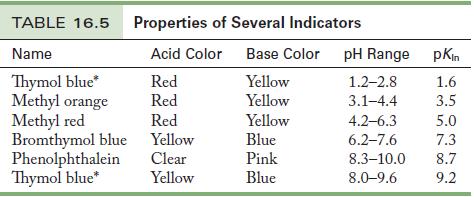
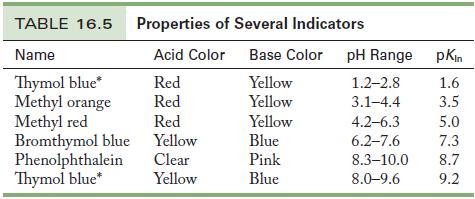
Choose an appropriate compound from Table 16.5 to serve as an indicator for the titration of a particular weak acid (in the flask) with base (in the buret), given that the pH at the equivalence point is(a) 7.5(b) 9.0(c) 10.5Table 16.5
Consider all acid-base indicators discussed in this chapter. Which of these indicators would be suitable for the titration of each of these?(a) NaOH with HClO4(b) Acetic acid with KOH(c) NH3 solution with HBr(d) KOH with HNO3 Explain your choices.
A chemist is developing a titration analysis for lactic acid. Lactic acid is a monoprotic acid with Ka = 8.4 × 10⁻⁴. Calculate the pH at the equivalence point of a titration of 100 mL of 0.100 M lactic acid with 0.500 M NaOH. Suggest an indicator from Table 16.4, and explain why you chose it.Table
Chloropropionic acid, ClCH2CH2COOH, is a weak monoprotic acid with Ka = 7.94 × 10⁻⁵. Calculate the pH at the equivalence point in a titration of 10.00 mL of 0.100 M chloropropionic acid with 0.100 M KOH. Choose an indicator from Table 16.4 for the titration.Explain your choice.Table 16.4
A 25.0-mL sample of 1.44 M NH3 is titrated with 1.50 M HCl. Calculate the pH at the equivalence point.Choose an indicator from Table 16.4, and justify your choice.Table 16.4
Exactly 50 mL of a 0.0500 M solution of ethylamine, a base with Kb = 1.1 × 10⁻⁶, is titrated with 0.100 M HNO3. What is the pH at the equivalence point? Suggest a good indicator from Table 16.4 for this titration, and justify your selection.Table 16.4
Write the chemical equilibria and expressions for the equilibrium constants for the ionizations of the following polyprotic acids.(a) Oxalic acid(b) Sulfurous acid
Write the chemical equilibrium and expression for the equilibrium constants for the ionization of(a) Tartaric acid.(b) Malic acid.
Calculate the pH of 0.010 M ascorbic acid.
Calculate the pH of 0.050 M phosphoric acid.
State whether each of the following solutions is acidic, basic, or neutral.(a) Sodium hydrogen oxalate(b) Potassium hydrogen malonate
State whether each of the following solutions is acidic, basic, or neutral.(a) Disodium hydrogen citrate(b) Potassium dihydrogen citrate
State whether each of the following solutions is acidic, basic, or neutral.(a) Potassium dihydrogen phosphate(b) Potassium hydrogen carbonate
State whether each of the following solutions is acidic, basic, or neutral.(a) Disodium hydrogen phosphate(b) Potassium hydrogen tartrate
Does adding the second compound increase, decrease, or have no effect on the solubility of the first compound?(a) Ca(CH3COO)2 and HCl(b) MgF2 and HCl
Does adding the second compound increase, decrease, or have no effect on the solubility of the first compound?(a) AgCl and NH3(b) PbCl2 and Pb(NO3)2
Does adding the second compound increase, decrease, or have no effect on the solubility of the first compound?(a) Aluminum hydroxide and NaOH(b) Magnesium phosphate and HNO3
A pipet was used to measure 10.00 mL of a sulfuric acid solution into a titration flask. It took 31.77 mL of 0.102 M NaOH to neutralize the sulfuric acid completely. Calculate the concentration of the sulfuric acid solution. Assume that the reaction is
You have a pH buffer made from 0.010 M acetic acid and 0.020 M sodium acetate. To buffer a biological reaction, you add 5.0 mL of this buffer to 1.0 L of a solution that contains the system of interest.(a) Calculate the pH of the buffered biological system.(b) You find that the concentration of
Calculate the pH of each of the following solutions.(a) 1.00 mL of 0.150 M formic acid plus 2.00 mL of 0.100 M sodium hydroxide(b) 25.00 mL of 0.250 M ammonia plus 5.00 mL of 0.100 M hydroiodic acid(c) 5.00 mL of 0.200 M barium hydroxide plus 50.00 mL of 0.400 M hydrobromic acid
Calculate the pH of each of the following solutions.(a) 10.0 mL of 0.300 M hydrofluoric acid plus 30.0 mL of 0.100 M sodium hydroxide(b) 100.0 mL of 0.250 M ammonia plus 50.0 mL of 0.100 M hydrochloric acid(c) 25.0 mL of 0.200 M sulfuric acid plus 50.0 mL of 0.400 M sodium hydroxide
Write the chemical equation and the expression for the equilibrium constant, and calculate Kb for the reaction of each of the following ions as a base.(a) Sulfate ion(b) Citrate ion
Calculate the concentration of hydroxide ion in the titration of 20.0 mL of 0.102 M NaOH with 0.207 M HCl after 0, 5, 10, 15, and 20 mL HCl are added. Graph the molar concentration of hydroxide ion (not pH or pOH) as a function of volume.
Write the chemical equation and the expression for the equilibrium constant, and calculate Kb for the reaction of each of the following ions as a base.(a) Malonate ion(b) Carbonate ion
Phenolphthalein is a commonly used indicator that is colorless in the acidic form (pH = 8.3) and pink in the base form (pH = 10.0). It is a weak acid with a pKa of 8.7. What fraction is in the acid form when the acid color is apparent? What fraction is in the base form when the base color is
The indicator methyl red is a weak acid with a pKIn of 5.00. Calculate the pH values at which the indicator will be 1%, 5%, 95%, and 99% in the acid form.
Use Table 16.5 as a source of data about methyl red. What fraction of the indicator is in the acid form when the acid color is observed? What fraction is in the base form when the base color is observed?Table 16.5
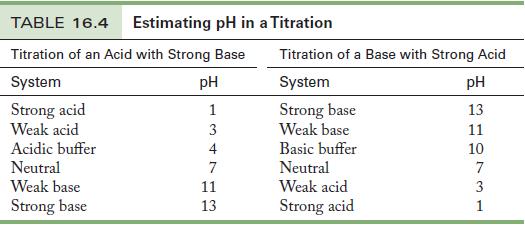
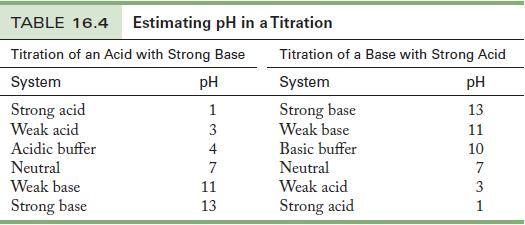
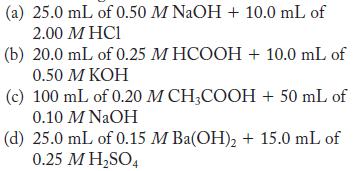
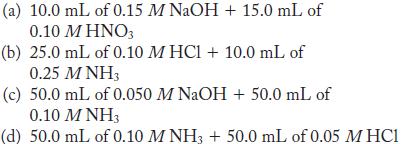
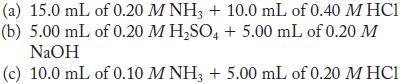
Determine the dominant acid-base equilibrium that results when each of the following pairs of solutions is mixed. Indicate the equilibrium by writing 1 for a strong acid, 3 for a weak acid, 4 for an acidic buffer, 7 for a neutral solution, 9 for a basic buffer, 10 for a weak base, and 13 for a
Determine the dominant acid-base equilibrium that results when each of the following pairs of solutions is mixed. Indicate the equilibrium by writing 1 for a strong acid, 3 for a weak acid, 4 for an acidic buffer, 7 for a neutral solution, 10 for a basic buffer, 11 for a weak base, and 13 for a
Determine the dominant acid-base equilibrium that results when each of the following pairs of solutions is mixed. Indicate the equilibrium by writing 1 for a strong acid, 3 for a weak acid, 4 for an acidic buffer, 7 for a neutral solution, 9 for a basic buffer, 10 for a weak base, and 13 for a
Showing 500 - 600
of 2906
1
2
3
4
5
6
7
8
9
10
11
12
13
14
15
Last
Step by Step Answers

 Get 50% OFF
Claim Now
Get 50% OFF
Claim Now