New Semester
Started
Get
50% OFF
Study Help!
--h --m --s
Claim Now
Question Answers
Textbooks
Find textbooks, questions and answers
Oops, something went wrong!
Change your search query and then try again
S
Books
FREE
Study Help
Expert Questions
Accounting
General Management
Mathematics
Finance
Organizational Behaviour
Law
Physics
Operating System
Management Leadership
Sociology
Programming
Marketing
Database
Computer Network
Economics
Textbooks Solutions
Accounting
Managerial Accounting
Management Leadership
Cost Accounting
Statistics
Business Law
Corporate Finance
Finance
Economics
Auditing
Tutors
Online Tutors
Find a Tutor
Hire a Tutor
Become a Tutor
AI Tutor
AI Study Planner
NEW
Sell Books
Search
Search
Sign In
Register
study help
sciences
chemistry principles and practice
Chemistry Principles And Practice 3rd Edition Daniel L. Reger, Scott R. Goode, David W. Ball - Solutions
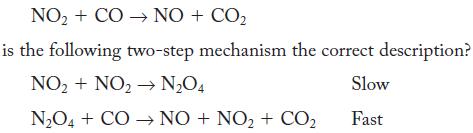
For the same reaction, NO + CO NO + CO is the following two-step mechanism the correct description? NO + NO NO4 Slow NO4 + CO NO + NO + CO Fast
Nitrogen dioxide reacts with carbon monoxide to form carbon dioxide and nitrogen monoxide. The overall stoichiometry isEvaluate the following mechanism to determine whether it is consistent with experiment.StrategyThe rate of reaction will be limited by the rate of the slow step. NO + CO NO + CO
What is meant by the mechanism of a reaction? How does the mechanism relate to the order of the reaction?
Explain the influence of temperature on the rate of an uncatalyzed endothermic reaction and a catalyzed (lower-Ea) endothermic reaction.
Explain how temperature influences the rate of an uncatalyzed exothermic reaction and a catalyzed (lower-Ea) exothermic reaction.
Draw energy-level diagrams for catalyzed and uncatalyzed one-step endothermic reactions. Label the activation energy for each path.
Draw energy-level diagrams for catalyzed and uncatalyzed one-step exothermic reactions. Label the activation energy for each path.
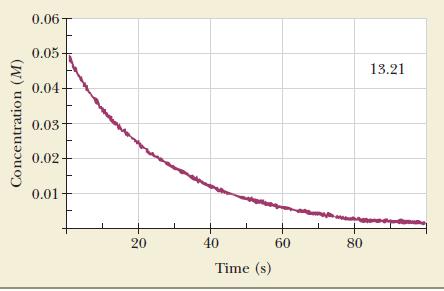
Oxalic acid can decompose to formic acid and carbon dioxide:A graph of the concentration of oxalic acid as a function of time follows.(a) Write an expression for the rate of reaction in terms of a changing concentration.(b) Calculate the average rate of reaction between 10 and 30
Define an elementary step and explain why equations for elementary reactions can be used to predict the rate law, but the overall reaction stoichiometry cannot.
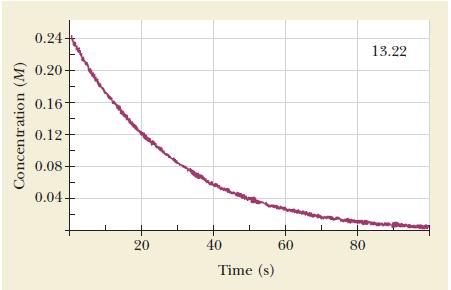
Cyclobutane can decompose to form ethylene:The cyclobutane concentration can be measured as a function of time by mass spectrometry (a graph follows).(a) Write an expression for the rate of reaction in terms of a changing concentration.(b) Calculate the average rate of reaction between 10 and 30
Explain why enzymatic reactions are zero order in the substrate.
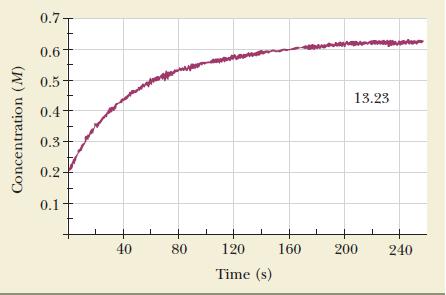
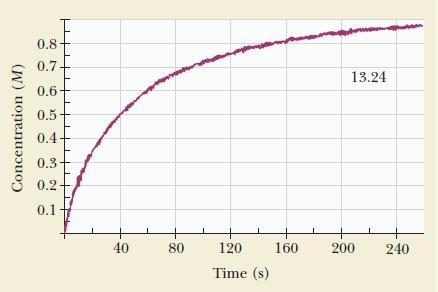
Nitrogen monoxide reacts with chlorine to form nitrosyl chloride.The figure shows the increase in nitrosyl chloride concentration under appropriate experimental conditions. The concentration of nitrosyl chloride actually starts at zero, although this fact may be difficult to see in the figure.(a)
Hydrogen iodide forms from hydrogen and iodine:The following figure shows the increase in hydrogen iodide concentration under appropriate experimental conditions.(a) Write an expression for the rate of reaction in terms of a changing concentration.(b) Calculate the average rate of reaction between
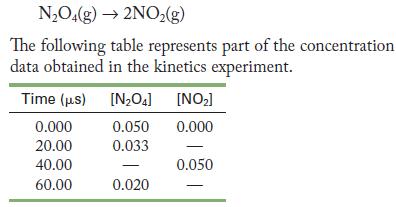
Dinitrogen tetroxide decomposes to nitrogen dioxide under laboratory conditions.(a) Fill in the missing concentrations.(b) Calculate the rate of reaction at 30 microseconds. NO4(g) 2NO(g) The following table represents part of the concentration data obtained in the kinetics experiment. Time (us)
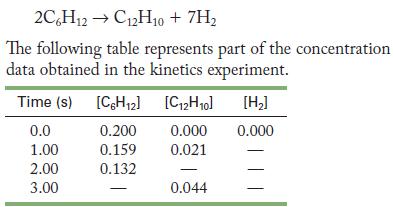
Under certain conditions, biphenyl, C12H10, can be produced by the decomposition of cyclohexane, C6H12:(a) Fill in the missing concentrations.(b) Calculate the rate of reaction at 1.5 seconds. 2C6H12C12H10 + 7H The following table represents part of the concentration data obtained in the kinetics
For the reaction,the dinitrogen pentoxide appears at a rate of 0.0055 M/s. Calculate the rate at which the NO2 disappears and the rate of the reaction. (0+)0N (8) + (8)ONZ
Consider the combustion of ethane:If the ethane is burning at the rate of 0.20 M/s, at what rates are CO2 and H2O being produced? 2CH6(g) + 70(g) 4CO(g) + 6HO(g)
For the reaction,the NOCl concentration increases at a rate of 0.030 M/s under a particular set of conditions. Calculate the rate of disappearance of chlorine at this time and the rate of the reaction. 2NO(g) + Cl(g) 2NOCI(g)
For the reaction,water is produced at the rate of 0.10 M/s. Calculate the rates of production of the other species and the rate of the reaction. 3NO(g) + CH(g) 3N(g) + 2CO(g) + HO(g)
The chromium(III) species reacts with hydrogen peroxide in aqueous solution to form the chromate ion.Under particular experimental conditions, the chromate ion, CrO2-4, is produced at an instantaneous rate of 0.0050 M/s. Calculate the instantaneous rates at which the other species change
In aqueous solution, the permanganate ion reacts with nitrous acid to form Mn2+ and nitrate ions.Under a particular set of conditions, the permanganate ion concentration is decreasing at an instantaneous rate of 0.012 M/s. Calculate the instantaneous rates at which the other concentrations change
Write a rate law forif the reaction is known to be first order in ammonia and second order in hydrogen chloride. NH3(g) + HCl(g) NHCl(g)
Write a rate law forif measurements show the reaction is first order in nitrogen trioxide and second order in oxygen. NO3(g) + O(g) NO(g) + O3(g)
What is the order in each reactant and the overall order for a reaction that has the following rate law? (a) rate = k[NO][NO] (b) rate = k[0]/2[C1] (c) rate = k[HCIO][OH-]
Use the experimental initial rate data to determine the rate law and rate constant for the gas-phase reaction of nitrogen monoxide with hydrogen. 2NO(g) + 2H(g) N(g) + 2HO(g) Experiment 1 2345 Initial Concentration (M) [NO] 0.10 0.10 0.10 0.20 0.30 [H] 0.10 0.20 0.30 0.10 0.10 Initial Rate of
What is the order in each reactant and the overall order for a reaction that has the following rate law? k[O3][NO] (a) rate = (b) rate= [NO]/ [C1] (c) rate = k[CH3Br][OH-]
Use the following experimental initial rate data to determine the rate law and rate constant for the gas-phase reaction of dinitrogen monoxide and water. NO(g) + HO(g) 2NO(g) + H(g) Experiment 1 23 Initial Concentration (M) [NO] [HO] 0.12 0.10 0.12 0.20 0.25 0.30 Initial Rate of Reaction
Use the following experimental initial rate data to determine the rate law and rate constant for the reaction of hydrogen iodide with ethyl iodide. HI(g) + CH;I(g) CH.(g) + L(g) Experiment 1 123 Initial Concentration (M) [HI] 0.053 0.106 0.106 [CH5l] 0.23 0.23 0.46 Initial Rate of Reaction
In a study of the gas-phase reaction of nitrogen dioxide with ozone, the initial rate method is used to evaluate the reaction at 15 °C. Determine the rate law and the rate constant from the data. NO(g) + O3(g) NO3(g) + O(g) Experiment 1 2 3 4 Initial Concentration (M) [NO] 2.0 x 10⁻⁶ 3.0 x 10⁻⁶
A chemist studies the kinetics of the gas-phase reaction of phosphine with diborane at 0 °C. Determine the rate law and the rate constant (use torr as the concentration unit) from the data. PH3(g) + BH.(g) PH3BH3(g) + BH3(g) Experiment 1 7234 Initial Concentration (torr) [BH6] 1.2 1.2 1.2 3.0
Determine the rate constant and order from the concentration-time dependence.Assume that the chemical reaction is reactants → products Time (s) [Reactant] (M) 0.250 0 1 0.216 2 0.182 0.148 0.114 0.080 3 4 5
Determine the rate constant and order from the concentration-time dependence.Assume that the chemical reaction is reactants → products Time (s) 0 2 15 [Reactant] (M) 0.0451 0.0421 0.0376 0.0316 0.0226
Determine the rate constant and order from the concentration-time dependence.Assume that the chemical reaction is reactants → products Time (s) 0.001 0.002 0.003 0.004 0.005 [Reactant] (M) 0.220 0.140 0.080 0.050 0.030
Determine the rate constant and order from the concentration-time dependence.Assume that the chemical reaction is reactants → products Time (s) 0 10 20 50 70 [Reactant] (M) 0.0350 0.0223 0.0142 0.0037 0.0015
Nitrosyl chloride decomposes to nitrogen monoxide and chlorine at increased temperatures. Determine the rate constant and order from the concentration-time dependence. NOCI(g) NO(g) + Cl(g) Time (s) 0 30 60 100 200 300 400 [NOCI] (M) 0.100 0.064 0.047 0.035 0.021 0.015 0.012
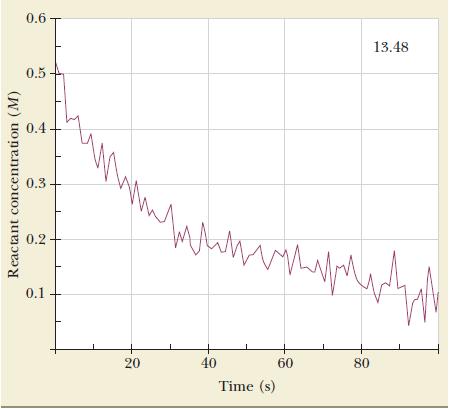
Determine the rate constant and order by analyzing the concentration-time dependence. Reactant concentration (M) 0.6 0.5 0.4 0.3 0.2 0.1 ww 20 win www 40 Time (s) 60 80 13.48
When formic acid is heated, it decomposes to hydrogen and carbon dioxide in a first-order decay.At 550 °C, the half-life of formic acid is 24.5 minutes.(a) What is the rate constant, and what are its units?(b) How many seconds are needed for formic acid, initially 0.15 M, to decrease to 0.015 M?
The initial concentration of the reactant in a first-order reaction A → products is 0.64 M and the half-life is 30 seconds.(a) Calculate the concentration of the reactant 60 seconds after initiation of the reaction.(b) How long would it take for the concentration of the reactant to decrease to
The half-life of tritium, 3H, is 12.26 years. Tritium is the radioactive isotope of hydrogen.(a) What is the rate constant for the radioactive decay of tritium, in y-1 and s-1?(b) What percentage of the original tritium is left after 61.3 years?
The half-life of uranium-235, the major radioactive component of naturally occurring uranium, is 7.04 × 10⁸ years.(a) What is the rate constant for the radioactive decay of uranium-235, in y-1 and s-1?(b) What percentage of original uranium-235 is left after 4.5 × 10⁹ years?
Calculate the half-life of a first-order reaction if the concentration of the reactant decreases from 0.012 to 0.0082 M in 66.2 seconds.
The hypothetical compound A decomposes in a first order reaction that has a half-life of 2.3 × 10² seconds at 450 °C. If the initial concentration of A is 4.32 × 10⁻² M, how long will it take for the concentration of A to decline to 3.75 × 10⁻³ M?
Calculate the half-life of a first-order reaction if the concentration of the reactant decreases from 1.02 × 10⁻³ M to 7.4 × 10⁻⁴ M in 116.7 seconds. How long does it take for the reactant concentration to decrease from 7.4 × 10⁻⁴ M to 2.0 × 10⁻⁴ M ?
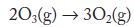
The decomposition of ozone is a second-order reaction with a rate constant of 30.6 atm-1 s-1 at 95 °C.If ozone is originally present at a partial pressure of 21 torr, calculate the length of time needed for the ozone pressure to decrease to 1.0 torr. 203(g) 30(g)
Consider the second-order decomposition of nitrosyl chloride.At 450 K, the rate constant is 15.4 atm-1 s-1.(a) How much time is needed for NOCl originally at a partial pressure of 44 torr to decay to 22 torr?(b) How much time is needed for NOCl originally at a concentration of 0.0044 M to decay to
Calculate the half-life of a first-order reaction if the concentration of the reactant is 0.0451 M at 30.5 seconds after the reaction starts and is 0.0321 M at 45.0 seconds after the reaction starts. How many seconds after the start of the reaction does it take for the reactant concentration to
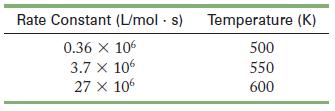
The following data were obtained by studying the change in rate constant as a function of temperature.Calculate the activation energy and the pre-exponential term. You may use a graphic method if you have a spreadsheet or graphing calculator, or an algebraic method if you do not. Rate Constant
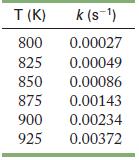
The decomposition of formic acid is measured at several temperatures. The temperature dependence of the first-order rate constant is:Calculate the activation energy, in kilojoules, and the preexponential term. You may use a graphic method if you have a spreadsheet or graphing calculator, or an
A reaction rate doubles when the temperature increases from 25 °C to 40 °C. What is the activation energy?
What is the activation energy for a reaction if its rate constant is found to triple when the temperature is increased from 600 to 610 K?
The activation energy for the isomerization of cyclopropane to propene is 274 kJ/mol. By what factor does the rate of reaction increase as the temperature increases from 500 °C to 550 °C?
Consider the results of an experiment in which nitrogen dioxide reacts with ozone at two different temperatures, 13 °C and 29 °C.If the activation energy is 29 kJ/mol, by what factor does the rate constant increase with this temperature change? NO(g) + O3(g) NO3(g) + O(g)
The activation energy for the isomerization of cyclopropane to propene is 274 kJ/mol. By what factor does the rate of this reaction increase as the temperature increases from 250 °C to 280 °C?
The activation energy for the decomposition of cyclobutane (C4H8) to ethylene (C2H4) is 261 kJ/mol. If the system produces ethylene at the rate of 0.043 g/s at 500 °C, what is the rate if the temperature increases to 600 °C?
A catalyst decreases the activation energy of a particular exothermic reaction by 15 kJ/mol, from 40 to 25 kJ/mol.Assuming that the reaction is exothermic, that the mechanism has only one step, and that the products differ from the reactants by 40 kJ, sketch approximate energy-level diagrams for
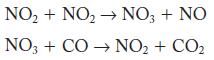
Sum the following elementary steps to determine the overall stoichiometry of the gas-phase reaction. NO + NO NO3 + NO NO3 + CO NO + CO
A catalyst decreases the activation energy of a particular endothermic reaction by 50 kJ/mol, from 140 to 90 kJ/mol.Assuming that the reaction is endothermic, that the mechanism has only one step, and that the products differ from the reactants by 20 kJ, sketch approximate energy-level diagrams for
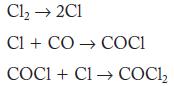
Sum the following elementary steps to determine the overall stoichiometry of the reaction. Cl 2C1 Cl + CO COCI COCI+ CI COC1
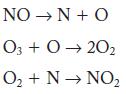
Sum the following elementary steps to determine the overall stoichiometry of this hypothetical reaction. NO N + O 03 + 0 202 O + N NO
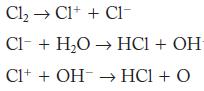
Sum the following elementary steps to determine the overall stoichiometry of the hypothetical reaction. Cl C1+ + C1- Cl + HO HC1 + OH C1+ + OH HC1 + O
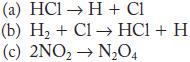
Write the rate law and the molecularity for each of the following elementary reactions. (a) HCl H + Cl (b) H + Cl HC1 + H (c) 2NO N04
Define the rate of reaction in terms of changing concentrations for aA + bB cC + dD
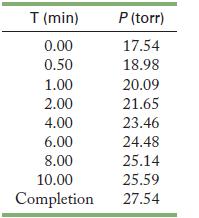
Nitramide decomposes to water and dinitrogen monoxide.This reaction was studied by J. N. Brønsted in 1924 as part of research into the fundamental nature of acids and bases. If 1.00 L of 0.440 M nitramide is placed in a reactor at 20 °C, the following results are expected. (The experiment was
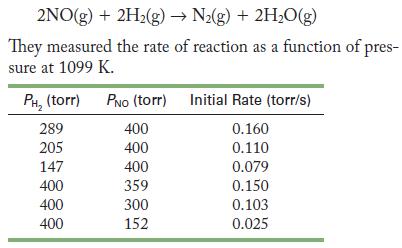
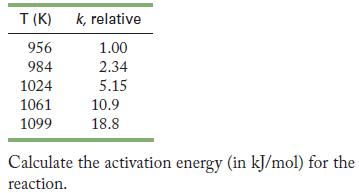
In 1926, Hinshelwood and Green studied the reaction of nitrogen monoxide and hydrogen.(a) What is the rate law for the reaction?(b) Use the data from the first experiment to calculate the rate constant at 1099 K, using torr as the concentration unit.(c) The relative rate of the reaction changed
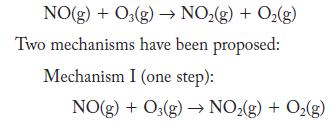
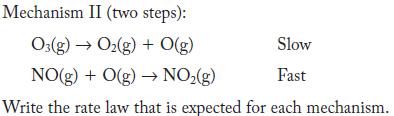
Nitrogen monoxide reacts with ozone. NO(g) + O3(g) NO(g) + O(g) Two mechanisms have been proposed: Mechanism I (one step): NO(g) + O3(g) NO(g) + O(g)
The gas-phase reaction of nitrogen monoxide with chlorine proceeds to form nitrosyl chloride. 2NO(g) + Cl(g) 2NOC1(g) rate = k[NO][C1] Evaluate the following proposed mechanism to determine whether it is consistent with the experimental results, and identify intermediates, if any. k NO 2NO Fast,
Nitrogen dioxide can react with ozone to form dinitrogen pentoxide and oxygen.A two-step mechanism has been proposed. Identify the rate-limiting step. 2NO(g) + O3(g) NO5(g) + O(g) rate = /[NO][03]
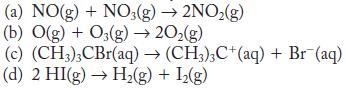
Assuming that each reaction is elementary, predict the rate law and molecularity. (a) NO(g) + NO3(g) 2NO(g) (b) O(g) + O3(g) 20(g) (c) (CH3)3CBr(aq) (CH3)3C+ (aq) + Br (aq) (d) 2 HI(g) H(g) + 1(g)
Evaluate each of the following proposed mechanisms to determine whether it is consistent with the experimentally determined stochiometry and rate law, and identify intermediates, if any. 2NO2+O3 NO5 + O rate = k[NO][03] k (a) 2NO NO4 k NO4 + 03 NO5 + O (b) NO+ O3 NO3 + O NO3 + NO NO5 Fast,
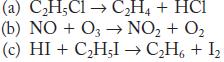
Write the rate law and the molecularity for each of the following elementary reactions. (a) CH5C1 CH4 + HC1 (b) NO + O3 NO + O (c) HI + CHI CH6 + 1
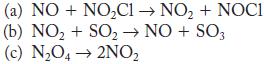
Write the rate law and the molecularity for each of the following elementary reactions. (a) NO+NOCl NO + NOCI (b) NO + SO NO + SO3 (c) NO4 2NO
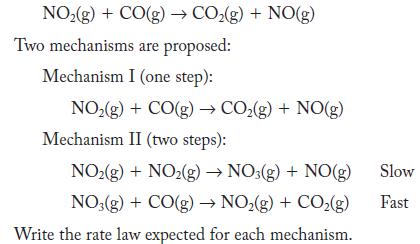
Nitrogen dioxide reacts with carbon monoxide to form carbon dioxide and nitrogen monoxide. NO(g) + CO(g) CO(g) + NO(g) Two mechanisms are proposed: Mechanism I (one step): NO(g) + CO(g) CO(g) + NO(g) Mechanism II (two steps): NO(g) + NO2(g) NO3(g) + NO(g) NO3(g) + CO(g) NO(g) + CO(g) Write the
The decomposition of hydrogen peroxide is catalyzed by horseradish peroxidase, an enzyme isolated from the vegetable.The hydrogen peroxide concentration is measured as a function of time to produce the following data for the catalyzed reaction.(a) What is the order?(b) What is the rate law for the
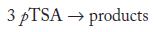
Kice and Bowers studied the decomposition of p-toluene sulfinic acid (pTSA) (J Am Chem Soc 84:605, 1962). Th ey found the stoichiometry to beThe scientists removed a portion of the reaction mixture and performed a titration at periodic intervals to determine the concentration of pTSA. Their results
The enzyme catalase reduces the activation energy for the decomposition of hydrogen peroxide from 72 to 28 kJ/mol. Calculate the factor by which the rate of reaction increases at 298 K, assuming that everything else is unchanged. HO(aq) H0(e) + 10(g)
A catalyst reduces the activation energy of a reaction from 215 to 206 kJ. By what factor would you expect the reaction-rate constant to increase at 25 °C? Assume that the pre-exponential term (A) is the same for both reactions. Use the formula ln k = ln A - Ea/RT.)
Use the following experimental data to determine the rate law and rate constant for formation of phosgene. CO + Cl COC1 Experiment 123 Initial Concentration (M) [CO] 0.053 0.106 0.106 [C] 0.23 0.23 0.46 Initial Rate of Reaction (M/s) 3.7 x 10⁻⁵ 7.4 x 10⁻⁵ 10.4 X 10⁻⁵
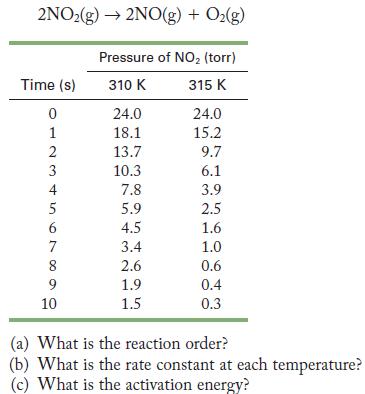
The following data were obtained for the decomposition of nitrogen dioxide. 2NO2(g) 2NO(g) + O(g) Time (s) 0 1 23456 4 7 8 9 10 Pressure of NO (torr) 310 K 315 K 24.0 18.1 13.7 10.3 7.8 5.9 4.5 3.4 2.6 1.9 1.5 24.0 15.2 9.7 6.1 3.9 2.5 1.6 1.0 0.6 0.4 0.3 (a) What is the reaction order? (b) What
The reactant in a first-order reaction decreases in concentration from 0.451 to 0.235 M in 131 seconds. How long does it take to decrease from 0.235 to 0.100 M?
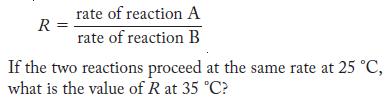
Reaction A has an activation energy of 30 kJ/mol;Reaction B has an activation energy of 40 kJ/mol. The ratio of their rates is called R. rate of reaction A R = rate of reaction B If the two reactions proceed at the same rate at 25 C, what is the value of R at 35 C?
Determine the order and rate constant by analyzing the concentration-time graph. You may want to use a pencil to draw a smooth line through the data.
Two reactions have activation energies of 45 and 40 kJ/mol, respectively. Which reaction shows the greater increase in rate with an increase in temperature?
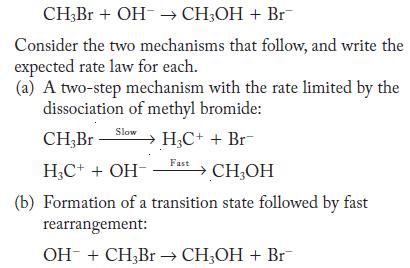
When methyl bromide reacts with hydroxide ion, methyl alcohol and bromide ion form. CH3Br + OH CH3OH + Br Consider the two mechanisms that follow, and write the expected rate law for each. (a) A two-step mechanism with the rate limited by the dissociation of methyl bromide: Slow CH,Br HC++ Br HC+
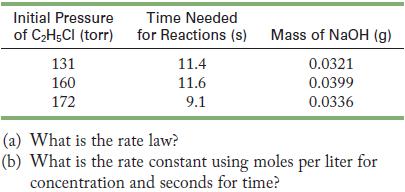
Ethyl chloride decomposes to form ethylene and hydrogen chloride at 437 K.The reaction takes place in a 4.0-L container and is monitored by measuring the time needed for the hydrogen chloride to react with a known amount of base. CHCl(g) CH4(g) + HCl(g) -
The following experimental data were obtained in a study of the kinetics of the gas-phase formation of nitrosyl bromide at 791 K. Determine the rate law and the rate constant from the data.
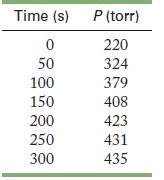
When formic acid is heated, it decomposes to hydrogen and carbon dioxide in a first-order decay.The rate of reaction is monitored by measuring the total pressure in the reaction container.Calculate the rate constant and half-life, in seconds, for the reaction. At the start of the reaction (time =
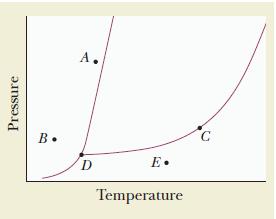
Answer the following questions by using the phase diagram in Exercise 11.43.(a) Sketch the heating curve that is expected when heat is added to the sample at constant pressure, starting at point B.(b) Describe what happens if the pressure is lowered at constant temperature, starting at point A.(c)
What mass of acetic acid (CH3COOH, molar mass = 60.05 g/mol) must be dissolved in 250 g water to produce a 0.150-m solution ?StrategyThis problem is similar to conversions performed in Chapter 4, except that the desired molality is used as a conversion factor. The following diagram outlines the
Select the liquid in each part that has the greater expected enthalpy of vaporization.(a) C2H4 or CH4(b) Cl2 or ClF(c) H2S or H2Te(d) NH3 or PH3(e) CHI3 or CH3I(f) BBr2I or BBrI2
Identify the types of all the intermolecular forces that cause each of the following gases to condense to a liquid when cooled.(a) F2(b) BF3(c) HF(d) NO2
Identify the kinds of intermolecular forces (London dispersion, dipole-dipole, hydrogen bonding) that are the most important in each of the following substances.(a) Methane (CH4)(b) Methanol (CH3OH)(c) Chloroform (CHCl3)(d) Benzene (C6H6)(e) Ammonia (NH3)(f) Sulfur dioxide (SO2)
Arrange the following substances in order of increasing strength of crystal forces: CO2, KCl, H2O, N2, CaO.
In each part, select the substance that has the greater boiling point, based on the relative strengths of the intermolecular attractions.(a) C3H8 or CH4(b) I2 or ICl(c) H2S or H2Te(d) H2Se or H2O(e) CH2Cl2 or CH3Cl(f) NOF or NOCl
Describe how the equilibrium system responds to the change described in each of the following parts.(a) Heat is added to a sample of solid in equilibrium with its vapor at constant pressure.(b) The pressure on an equilibrium mixture of water and ice is increased abruptly.(c) The pressure on an
Determine the mass percentage concentration of a solution prepared by dissolving 5.00 g NaCl in 200 g water.StrategyDetermine the total mass of the solution and substitute the appropriate quantities into the definition of mass percentage concentration.
What is the molality of a solution that contains 2.00 g glucose (molar mass = 180 g/mol) in 25.0 g of solvent?
We analyzed the enthalpy change that accompanies the formation of a solution from the pure solute and solvent by considering three changes that must occur:(1) Separate the solvent molecules;(2) Separate the solute molecules;(3) Bring the solute particles and solvent particles together. If the
Find the molarity of a 7.85% aqueous ammonia solution that has a density of 0.965 g/mL.
Determine the molarity of an aqueous solution that is 37.2% in HCl. The density of this solution is 1.034 g/mL.StrategyWrite the concentrations as fractions.The units in the numerator of percentage composition can be easily converted to moles, and we can use the density of the solution to convert
Predict the solvent in which the given compound is more soluble, and justify your prediction.StrategyConsider the types of intermolecular interactions in the solute and the solvents. Solubility will be greater in a solvent that has the more similar type of interaction. (a) Carbon tetrachloride
Showing 1100 - 1200
of 2906
First
5
6
7
8
9
10
11
12
13
14
15
16
17
18
19
Last
Step by Step Answers

 Get 50% OFF
Claim Now
Get 50% OFF
Claim Now


![NO + CO NO + CO The rate law, found by experiment, is second order: rate = k[NO]](https://dsd5zvtm8ll6.cloudfront.net/images/question_images/1704/3/4/4/95265963d78871df1704344952027.jpg)













![(a) rate = k[NO][NO] (b) rate = k[O]/2[C1] (c) rate k[HCIO][OH-] =](https://dsd5zvtm8ll6.cloudfront.net/images/question_images/1704/3/5/3/64165965f69d628c1704353641585.jpg)
![2NO(g) + 2H(g) N(g) + 2HO(g) Experiment 1 2345 Initial Concentration (M) [NO] 0.10 0.10 0.10 0.20 0.30 [H]](https://dsd5zvtm8ll6.cloudfront.net/images/question_images/1704/3/5/3/70365965fa70a8711704353702734.jpg)
![k[O3][NO] (a) rate = (b) rate= [NO]/ [C1] (c) rate = k[CH3Br][OH-]](https://dsd5zvtm8ll6.cloudfront.net/images/question_images/1704/3/5/3/65565965f772eefc1704353654897.jpg)
![NO(g) + HO(g) 2NO(g) + H(g) Experiment 1 23 Initial Concentration (M) [NO] [HO] 0.12 0.10 0.12 0.20 0.25](https://dsd5zvtm8ll6.cloudfront.net/images/question_images/1704/3/5/3/74465965fd0eb79d1704353744583.jpg)
![HI(g) + CH;I(g) CH.(g) + L(g) Experiment 1 123 Initial Concentration (M) [HI] 0.053 0.106 0.106 [CH5l] 0.23](https://dsd5zvtm8ll6.cloudfront.net/images/question_images/1704/3/5/3/76165965fe13e4701704353760938.jpg)
![NO(g) + O3(g) NO3(g) + O(g) Experiment 1 2 3 4 Initial Concentration (M) [NO] 2.0 x 10⁻⁶ 3.0 x 10⁻⁶ 4.0 x](https://dsd5zvtm8ll6.cloudfront.net/images/question_images/1704/3/5/3/77765965ff16e9aa1704353777138.jpg)
![PH3(g) + BH.(g) PH3BH3(g) + BH3(g) Experiment 1 7234 Initial Concentration (torr) [BH6] 1.2 1.2 1.2 3.0](https://dsd5zvtm8ll6.cloudfront.net/images/question_images/1704/3/5/3/8946596606606bc41704353893552.jpg)
![Time (s) [Reactant] (M) 0.250 0 1 0.216 2 0.182 0.148 0.114 0.080 3 4 5](https://dsd5zvtm8ll6.cloudfront.net/images/question_images/1704/3/5/4/018659660e2f164f1704354018702.jpg)
![Time (s) 0 2 15 [Reactant] (M) 0.0451 0.0421 0.0376 0.0316 0.0226](https://dsd5zvtm8ll6.cloudfront.net/images/question_images/1704/3/5/4/041659660f9ad7751704354040910.jpg)
![Time (s) 0.001 0.002 0.003 0.004 0.005 [Reactant] (M) 0.220 0.140 0.080 0.050 0.030](https://dsd5zvtm8ll6.cloudfront.net/images/question_images/1704/3/5/4/1066596613a2b0b41704354105848.jpg)
![Time (s) 0 10 20 50 70 [Reactant] (M) 0.0350 0.0223 0.0142 0.0037 0.0015](https://dsd5zvtm8ll6.cloudfront.net/images/question_images/1704/3/5/4/133659661557b7371704354133147.jpg)
![NOCI(g) NO(g) +- Ch(g) Time (s) 0 30 60 100 200 300 400 [NOCI] (M) 0.100 0.064 0.047 0.035 0.021 0.015 0.012](https://dsd5zvtm8ll6.cloudfront.net/images/question_images/1704/3/5/4/1516596616749a601704354150888.jpg)





![2NO(g) + Cl(g) 2NOC1(g) rate = k[NO][C1] Evaluate the following proposed mechanism to determine whether it](https://dsd5zvtm8ll6.cloudfront.net/images/question_images/1704/3/5/5/143659665475f29b1704355142932.jpg)
![2NO(g) + O3(g) NO5(g) + O(g) rate = /[NO][03]](https://dsd5zvtm8ll6.cloudfront.net/images/question_images/1704/3/5/5/041659664e176f1c1704355041072.jpg)
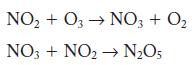
![2NO2+O3 NO5 + O rate = k[NO][03] k (a) 2NO NO4 k NO4 + 03 NO5 + O (b) NO + 03 NO3 + O NO3 + NO NO5 Fast,](https://dsd5zvtm8ll6.cloudfront.net/images/question_images/1704/3/5/5/17165966563b233b1704355171135.jpg)

![Time (s)[H2O2] (M) 0 10 20 30 40 50 60 0.0334 0.0300 0.0283 0.0249 0.0198 0.0164 0.0130](https://dsd5zvtm8ll6.cloudfront.net/images/question_images/1704/3/5/5/44865966678b27851704355448171.jpg)
![Time (s) 0 900 1800 2700 3600 7200 10800 18000 [pTSA], M 0.100 0.0863 0.0752 0.064 0.0568 0.0387 0.0297 0.0196](https://dsd5zvtm8ll6.cloudfront.net/images/question_images/1704/3/5/5/414659666561eb001704355413691.jpg)

![CO + Cl COC1 Experiment 123 Initial Concentration (M) [CO] 0.053 0.106 0.106 [C] 0.23 0.23 0.46 Initial Rate](https://dsd5zvtm8ll6.cloudfront.net/images/question_images/1704/3/5/5/475659666933ac681704355474758.jpg)




![(a) Carbon tetrachloride [CC14()] in liquid water or hexane [C6H4(e)] (b) Urea [CO(NH)2(s)] in water or](https://dsd5zvtm8ll6.cloudfront.net/images/question_images/1704/2/6/4/668659503dcc39b71704264668454.jpg)


