New Semester
Started
Get
50% OFF
Study Help!
--h --m --s
Claim Now
Question Answers
Textbooks
Find textbooks, questions and answers
Oops, something went wrong!
Change your search query and then try again
S
Books
FREE
Study Help
Expert Questions
Accounting
General Management
Mathematics
Finance
Organizational Behaviour
Law
Physics
Operating System
Management Leadership
Sociology
Programming
Marketing
Database
Computer Network
Economics
Textbooks Solutions
Accounting
Managerial Accounting
Management Leadership
Cost Accounting
Statistics
Business Law
Corporate Finance
Finance
Economics
Auditing
Tutors
Online Tutors
Find a Tutor
Hire a Tutor
Become a Tutor
AI Tutor
AI Study Planner
NEW
Sell Books
Search
Search
Sign In
Register
study help
sciences
chemistry principles and practice
Chemistry Principles And Practice 3rd Edition Daniel L. Reger, Scott R. Goode, David W. Ball - Solutions
Calculate the pH of the following solutions.(a) 0.10 M sodium nitrate(b) 0.050 M KFStrategyLook at the ions formed when the salt dissolves. If both are spectator ions, the pH will be set by the autoionization of water. If one is a weak acid or base, then treat the problem accordingly.
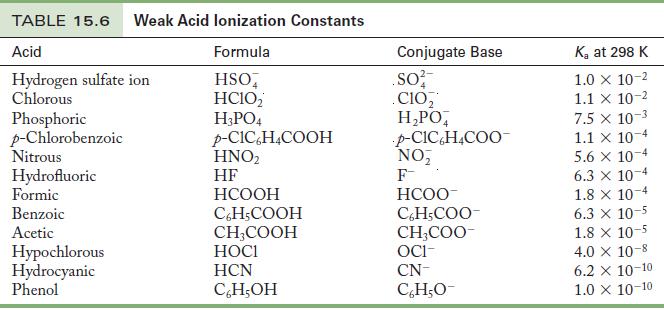
Rank the following bases in order of relative strength, from weakest to strongest: formate ion, cyanide ion, and acetate ion.StrategyThis problem can be solved without calculations, because Table 15.6 lists values of Ka for each acid. The acids can be ranked in order of Ka, and the conjugate bases
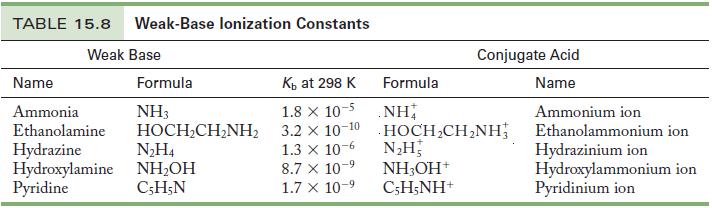
Use the information in Tables 15.6 and 15.8 to calculate Kb for the formate ion at 25 °C.StrategyBecause formate ion is the conjugate base of formic acid, use Table 15.6 to find Ka for formic acid; then calculate Kb for the formate ion from the relationship between Ka and Kb.Table 15.6Table 15.8
Calculate the pH of household ammonia, which is a 1.44 M aqueous solution of NH3. The numerical value of Kb is 1.8 × 10⁻⁵ at 25 °C.StrategyWrite the chemical equation, the iCe table, and the algebraic expression for Kb; substitute equilibrium concentrations from the equilibrium (e) line of the
Calculate the pH and the fraction ionized (in %) in a 0.100 M solution of the weak acid naphthol, for which Ka is 1.7 × 10⁻¹⁰.StrategyWrite the chemical equation, iCe table, algebraic expression for Ka, numerical expression for Ka, and solve.
Laboratory measurements show that a 0.100 M solution of chlorobenzoic acid has a pH of 2.50. Calculate Ka.StrategyUse the five-step approach and the iCe table. Start by converting the pH to the concentration of hydrogen ion, writing the chemical equation, and filling in the known quantities in the
Picric acid, a weak acid, is dissolved in water to prepare a 0.100 M solution. Conductivity measurements at a particular temperature indicate that the picric acid is 82% ionized. Calculate Ka and pKa.StrategyUse the fraction ionized to calculate the concentrations of the species in solution.
Calculate the hydroxide ion concentration, the pOH, and the pH of the solution made when 1.00 g barium hydroxide dissolves in enough water to produce 500.0 mL of solution.StrategyFirst, calculate the amount of barium hydroxide from the mass and molar mass. Next, calculate the amount of hydroxide
Calculate the hydrogen ion concentration and pH of the following:(a) 0.010 M HNO3(b) A solution prepared by diluting 10.0 mL of 0.50 M HClO4 to 50.0 mL(c) A solution prepared by adding 9.66 g HCl(g) to some water and then diluting the solution to 500.0 mL Strategy Remember that the ionization of a
Calculate the hydrogen ion concentration in a solution that has(a) pH = 3.50 .(b) pH = 12.56 .StrategyConverting from pH to [H3O+] involves raising 10 to the -pH power.
An acid is added to water so that the hydrogen ion concentration is 0.25 M. Calculate the hydroxide ion concentration.StrategyThe product of the concentrations of the hydrogen and hydroxide ions is equal to Kw. Substitute the known values of Kw and the concentration of hydrogen ion to calculate
Identify the conjugate pairs.StrategyIdentify the species that differ by a proton—these are the conjugate pairs. The acid form has the proton; the base form lacks the proton.
Kc at 137 °C is 4.42 for
Consider a 10.0-L vessel that contains 0.15 mol phosphorus trichloride, 0.20 mol chlorine, and 0.25 mol phosphorus pentachloride at 332 °C. Kp is 2.5 forCalculate the equilibrium pressures of all species. PC13(g) + Cl PC1;(g)
Exactly 4 mol sulfur trioxide is sealed in a 5.0-L container at 1529 K. Kp is 1150 forCalculate the concentrations of all species at equilibrium. 2SO3(g)2SO(g) + O(g)
Consider the formation of hydrogen fluoride (HF):If a 2.0-L nickel reaction container (glass cannot be used because it reacts with HF) filled with 0.010 M H2 is connected to a 5.0-L container of 0.020 M F2, and Kp is 7.8 × 10¹⁴, calculate the concentrations of all species at equilibrium. H(g) +
Write the expression for the equilibrium constant and calculate the partial pressure of CO2(g), given that Kp is 0.12 (at 1000 K) for CaCO3(s) CaO(s) + CO(g)
Write the expression for the equilibrium constant and calculate the partial pressure of CO2(g), given that Kp is 0.25 (at 427 °C) for NaHCO3(s) NaOH(s) + CO(g)
Write the expression for the equilibrium constant and calculate the partial pressure of SO3(g), given Kp is 0.74 (at 2100 K) for CaSO4(s) CaO(s) + SO3(g)
Write the expression for the equilibrium constant and calculate the partial pressure of CO2(g), given Kp is 1.25 (at 1500 K) for NaCO3(s) NaO(s) + CO(g)
Write the expression for the solubility product for the dissolution of(a) Magnesium fluoride.(b) Calcium phosphate.(c) Aluminum carbonate.(d) Lanthanum fluoride.
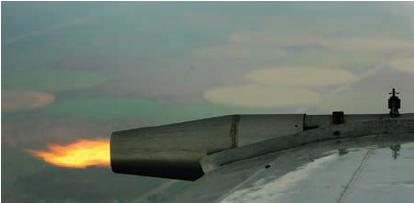
Silver iodide is sprayed from airplanes by modern “rainmakers” in an attempt to coax rain from promising cloud formations. The silver iodide crystals provide “seeds,” that is, sites for condensation of water. Silver iodide satisfies two requirements needed to form water drops. First, the
Write the expression for the solubility product for the dissolution of(a) Barium sulfate.(b) Silver acetate.(c) Copper(I) Carbonate.(d) Gold(III) Chloride.
The solubility of silver iodate, AgIO3, is 1.8 × 10⁻⁴ M. Calculate the solubility product constant.
Given the following data, calculate the solubility product constant.(a) The solubility of barium chromate, BaCrO4, is 1.1 × 10⁻⁵ M.(b) The solubility of cesium permanganate is 0.22 g/100 mL.(c) The solubility of silver phosphate, Ag3PO4, is 4.4 × 10⁻⁵ M.
Given the following data, calculate the solubility product constant.(a) The solubility of silver sulfate, Ag2SO4, is 1.0 × 10⁻² M.(b) The solubility of potassium iodate, KIO3, is 43 g/L.(c) The solubility of cadmium fluoride is 0.12 M.
The solubility product constant for silver tungstate, Ag2WO4, is 5.5 × 10⁻¹². Calculate the solubility of this compound in water.
The solubility product constant for copper(II) iodate, Cu(IO3)2, is 7.4 × 10⁻⁸. Calculate the solubility of this compound in water.
Lead poisoning has been a hazard for centuries. Some scholars believe that the decline of the Roman Empire can be traced, in part, to high levels of lead in water from containers and pipes, and from wine that was stored in leadglazed containers. If we presume that the typical Roman water supply was
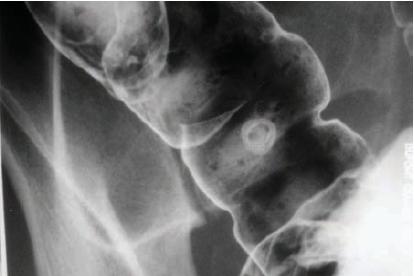
Even though barium is toxic, a suspension of barium sulfate is administered to patients who need x rays of the gastrointestinal tract. The barium “milkshake” is safe to drink because the solubility of barium sulfate is so low. Calculate the solubility of barium sulfate in grams per liter using
Calculate the solubility of barium sulfate (Ksp × 1.1 × 10⁻¹⁰) in(a) Water.(b) A 0.10 M barium chloride solution.
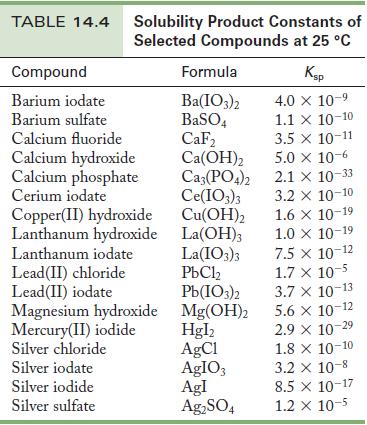
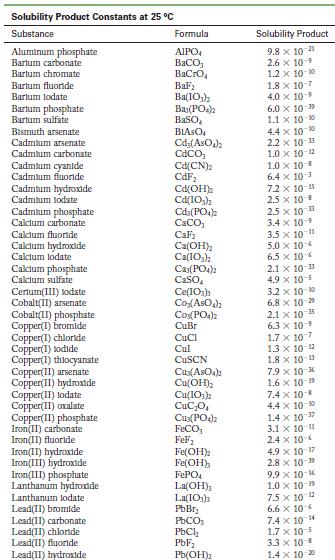
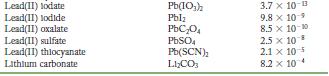
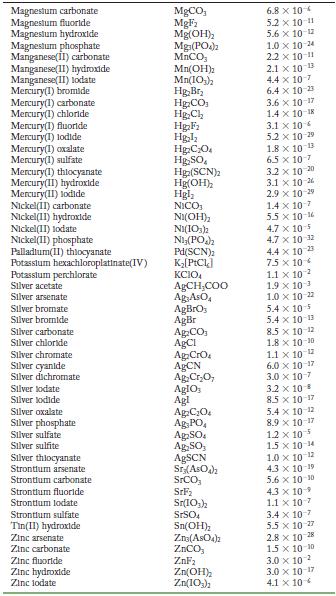
Use the solubility product constant from Appendix F to determine whether a precipitate will form if 20.0 mL of 1.0 × 10⁻⁶ M magnesium chloride is added to 80.0 mL of 1.0 × 10⁻⁶ M potassium fluoride.Appendix F Solubility Product Constants at 25 C Substance Aluminum phosphate Bartum carbonate
Use the solubility product constant from Appendix F to determine whether a precipitate will form if 10 mL 0.0010 M AgNO3 is added to 10 mL 0.0010 M Na2SO4.Appendix F Solubility Product Constants at 25 C Substance Aluminum phosphate Bartum carbonate Bartum chromate Barlum fluoride Barlum lodate
Use the solubility product constant from Appendix F to determine whether a precipitate will form if 10.0 mL of 1.0 × 10⁻⁶ M iron(II) chloride is added to 20.0 mL of 3.0 × 10⁻⁴ M barium hydroxide.Appendix F Solubility Product Constants at 25 C Substance Aluminum phosphate Bartum carbonate Bartum
Use the solubility product constant from Appendix F to determine whether a precipitate will form if 25.0 mL of 0.010 M NaOH is added to 75.0 mL of a 0.10 M solution of magnesium chloride?Appendix F Solubility Product Constants at 25 C Substance Aluminum phosphate Bartum carbonate Bartum chromate
Calculate the solubility of copper(II) iodate, Cu(IO3)2 (Ksp = 7.4 × 10⁻⁸), in(a) Water.(b) A 0.10 M copper(II) nitrate solution.
Calculate the solubility of lead fluoride, PbF2 (Ksp = 3.3 × 10⁻⁸), in(a) Water.(b) A 0.050 M potassium fluoride solution.
Calculate the solubility of zinc carbonate, ZnCO3 (Ksp = 1.5 × 10⁻¹⁰), in(a) Water.(b) 0.050 M Zn(NO3)2.(c) 0.050 M K2CO3.
Some barium chloride is added to a solution that contains both K2SO4 (0.050 M) and Na3PO4 (0.020 M).(a) Which begins to precipitate first: the barium sulfate or the barium phosphate?(b) The concentration of the first anion species to precipitate, either the sulfate or phosphate, decreases as the
A scientist seals some PCl5 in a 20.0-L flask. After equilibrium is attained, chemical analysis shows that the flask contains 0.10 mol PCl5(g) and 0.20 mol each of PCl3(g) and Cl2(g). Calculate the equilibrium constant at the reaction temperature for PC15(g) PC13(g) + Cl(g)
Some trisodium phosphate, Na3PO4, is added to a solution that contains 0.0020 M aluminum nitrate and 0.0040 M calcium chloride.(a) Which begins to precipitate first: the aluminum phosphate or the calcium phosphate?(b) The concentration of the first ion to precipitate, either Al3+ or Ca2+,
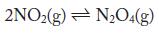
To evaluate the equilibrium constant fora scientist seals 0.200 mol nitrogen dioxide in a 2.5-L container. At equilibrium, the reaction vessel is found to contain 0.15 mol nitrogen dioxide and 0.025 mol dinitrogen tetroxide. Calculate the equilibrium constant for the reaction at this particular
A total of 0.010 mol sulfur trioxide is sealed in a 2.0-L container. The temperature is increased to 832 °C, and some SO3 decomposes, forming sulfur dioxide and oxygen:Chemical analysis of the equilibrium mixture at 832 °C finds 0.0040 mol oxygen.(a) Calculate the concentrations of all
Exactly 0.030 mol phosphorus pentachloride is sealed in a 500-mL container at 538 °C. Phosphorus trichloride and chlorine are formed:After equilibrium is established, chemical analysis shows that 0.0100 mol phosphorus pentachloride is present, the rest having reacted.(a) Calculate the
Exactly 0.010 mol hydrogen iodide is sealed in a 5.0-L container. The temperature is increased to 3000 K. At this temperature, Kp is 0.050 forCalculate the equilibrium concentrations of all species. 2HI(g) H(g) + 1(g)
Find the concentration of silver necessary to begin precipitation of AgCl from a solution in which the Cl- concentration is 7.4 × 10⁻⁴ M.
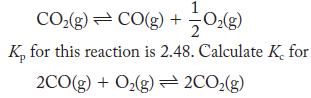
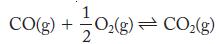
At 3000 K, carbon dioxide dissociates 1 CO(g) CO(g) + -O(g) K, for this reaction is 2.48. Calculate K, for 2CO(g) + O(g)2CO(g)
Exactly 10.0 mL of a 0.0502 M KCl solution is added to 20.0 mL of 0.0259 M AgNO3.(a) Write the net ionic equation for the reaction.(b) Calculate the mass of the insoluble product formed.(c) Calculate the concentrations of the anions in the equilibrium solution.
5.0 mmol SO2(g) and 5.0 mmol O2(g) are sealed in a 1.0-L container. The mixture is heated for several hours and sulfur trioxide forms.Chemical analysis of the reaction mixture shows that 2.0 mmol SO3(g) forms. Th e experiment is repeated, except with twice as much (10.0 mmol) SO2(g) and
Sulfur dioxide reacts with chlorine at 227 °C:Kp for this reaction is 5.1 × 10⁻². Initially, 1.00 g each of SO2 and Cl2 are placed in a 1.00-L reaction vessel. After 15 minutes, the concentration of SO2Cl2 is 45.5 μg/mL.(a) Has the system reached equilibrium?(b) If the system is not at
Nitrogen, hydrogen, and ammonia are in equilibrium in a 1000-L reactor at 550 K. The concentration of N2 is 0.00485 M, H2 is 0.022 M, and NH3 is 0.0016 M. Th e volume of the container is halved, to 500 L.(a) Calculate the equilibrium constant.(b) Define y as the change in the concentration of
The concentration of barium in a saturated solution of barium sulfate at a particular temperature is 1.2 μg/mL. Calculate Ksp at this temperature.
According to the Resource Conservation and Recovery Act (RCRA), waste material is classified as toxic and must be handled as hazardous if the lead concentration exceeds 5 mg/L. By adding chloride ion, the lead ion will precipitate as PbCl2, which can be separated from the liquid portion. Once the
Will a precipitate form if 20.0 mL of 10 μg/mL solution of barium ion is mixed with 25.0 mL of 0.050 M potassium sulfate, K2SO4?(a) Write the net ionic equation for the reaction.(b) Calculate the mass of precipitate formed, if any.(c) Calculate the concentrations of all species in solution.
You are in the silver recovery business. You receive 55-gal drums of waste silver solution from photography laboratories, metal plating operations, and other industrial companies. Currently, you have a drum of waste from a silver-plating factory with the silver concentration at 1 oz/gal. (Precious
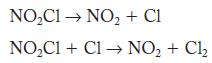
Nitryl chloride, NO2Cl, decomposes to NO2 and Cl2 with first-order kinetics. The following mechanism has been proposed. Identify the rate-limiting step. NOCl NO + Cl NOCl + C1 NO + Cl
How can you determine whether a system has reached equilibrium?
Describe a nonchemical system that is in equilibrium, and explain how the principles of equilibrium apply to the system.
Describe a nonchemical system that is not in equilibrium, and explain why equilibrium has not been achieved.
Sunlight strikes the upper atmosphere, creating ozone, which eventually decomposes to O2. Is the sunlight-ozone system in equilibrium? Explain your answer.
Does a 1.5-V battery represent a system that is at equilibrium? If not, describe the equilibrium status of a battery.
Describe a chemical system in which Kp is equal to Kc. Generalize to define the conditions for which Kp and Kc are always unequal.
Compare Q with Keq. Are they always different in value?
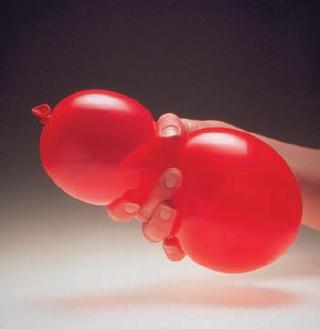
Does Le Chatelier’s principle apply to nonchemical equilibrium systems? Describe the changes from equilibrium that are observed as a person squeezes a partially filled balloon.
Under what circumstances do changes in the volume of a gaseous system not change the equilibrium constant?
Compare how changes in temperature influence Keq and Q.
Explain why terms for pure liquids and solids do not appear in the expression for the equilibrium constant.
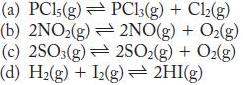
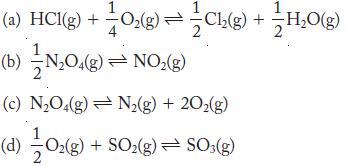
Write the expression for the equilibrium constant (Kc) for the following: (a) PC15(g) (b) 2NO2(g) (c) 2SO3(g) (d) H(g) + 12(g) 2HI(g) PC13(g) + Cl(g) 2NO(g) + O(g) 2SO(g) + O(g)
Temperature influences solubility. Does temperature have the same effect on all substances? Justify your answer.
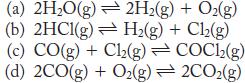
Write the expression for the equilibrium constant (Kc) for the following: (a) 2HO(g) 2H(g) + O(g) (b) 2HCl(g) H(g) + Cl(g) (c) CO(g) + Cl(g) = COC1(g) (d) 2CO(g) + O2(g) 2CO(g)
Write the expression for the equilibrium constant (Kp) for the following: (3)OS = (3)OS + (3)0 (P) (c) NO4(g) = N(g) + 20(g) (*)ON (8)0N (9) 30H + (9407 = 90 + (91H ()
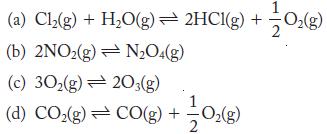
Write the expression for the equilibrium constant (Kp) for the following: (a) Cl(g) + HO(g) 2HCl(g) + 0(g) = (b) 2NO(g) NO4(g) (c) 302(g) 203(g) (d) CO(g) CO(g) +0(g) 2
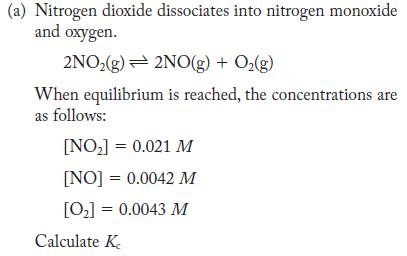
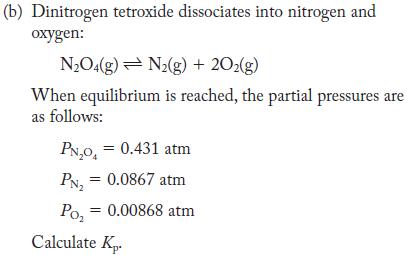
Calculate the equilibrium constant from experimental measurements. (a) Nitrogen dioxide dissociates into nitrogen monoxide and oxygen. 2NO(g) 2NO(g) + O(g) When equilibrium is reached, the concentrations are as follows: [NO] = 0.021 M [NO] = 0.0042 M [0] = 0.0043 M Calculate K
An equilibrium mixture contains 3.00 mol CO, 2.00 mol Cl2, and 9.00 mol COCl2 in a 50-L reaction flask at 800 K. Calculate the value of the equilibrium constant Kc for the reactionat this temperature. CO(g) + Cl(g) COC1(g)
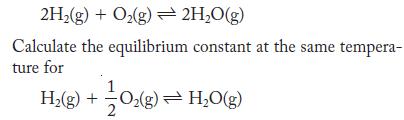
At 2000 K, experiments show that the equilibrium constant for the formation of water is 1.6 × 10¹⁰. 2H(g) + O(g) 2HO(g) Calculate the equilibrium constant at the same tempera- ture for H(g) + O(g) = HO(g)
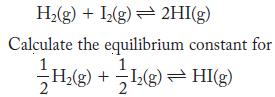
At 500 K, the equilibrium constant is 155 for H(g) + 1(g) 2HI(g) Calculate the equilibrium constant for HI(g) H(g) + (g) +1(g) =
If 200 mL of 0.010 M CaCl2(aq) is mixed with 300 mL of 0.150 M NaOH(aq), will Ca(OH)2 precipitate?
Kc at 1400 K is 3.6 × 10⁻⁶ forCalculate Kc at 1400 K for N(g) + O(g) 2NO(g)
At 77 °C, Kp is 1.7 × 10⁴ for the formation of phosphorus pentachloride from phosphorus trichloride and chlorine.
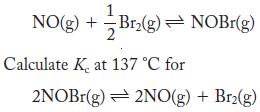
Nitrosyl bromide is formed from nitrogen monoxide and bromine:Kp for this reaction is 116 at 25 °C. Calculate Kc at this temperature. 1 NO(g) + - Br(g) NOBr(g) 2
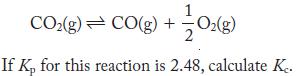
At 3000 K, carbon dioxide dissociates: CO(g) CO(g) + + 1/1/0(g) If Kp for this reaction is 2.48, calculate Ke.
Sulfur dioxide reacts with chlorine when sealed in a reactor at increased temperature. At 227 °C, Kc = 20.9. Calculate Kp at this same temperature. SO(g) + Cl(g) SOCl(g)
The value of Kc for the reaction N(g) + 3H(g) 2NH3(g) is 2.00 at 400 C. Find the value of K, for this reaction at this temperature.
In an experiment, 4.95 mol CO2, 0.050 mol CO, and 0.050 mol O2 are placed in a 5.0-L reaction vessel at 1400 K. Calculate the reaction quotient, Q, for the following reaction:If Kc for this reaction is 1.05 × 10⁻⁵, will the mixture form more CO or more CO2, or is the system at equilibrium? Draw a
The sulfur dioxide–oxygen–sulfur trioxide equilibrium is of interest to scientists who study acid rain.The concentrations at the beginning of an experiment are [SO2] = 0.015 M; [O2] = 0.012 M; [SO3] = 1.45 M; Kc = 5.0 = 106 at 700 K. Calculate the reaction quotient, Q, and draw a number line
A 20.0-L flask contains 1.0 mol PCl5(g) and 2.0 mol each of PCl3(g) and Cl2(g). Kc at 425 °C is 4.0 forCalculate the reaction quotient, Q, and draw a number line with Q and Kc in the appropriate places. In which direction will the reaction proceed? PC1; (g) PC13(g) + Cl(g)
Consider the equilibrium at 25 °C.Suppose that 0.15 mol SO3(g), 0.015 mol SO2(g), and 0.0075 mol O2(g) are placed into a 10.0-L flask at 25 °C.(a) Is the system at equilibrium?(b) If the system is not at equilibrium, in which direction must the reaction proceed to reach equilibrium? Explain your
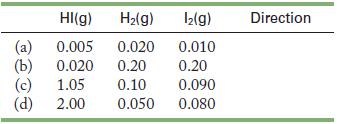
The equilibrium constant for the decomposition of hydrogen iodide is 0.010 at 307 °C.Determine the direction of the reaction if the following amounts (in millimoles, where 1 mmol = 1.0 × 10⁻³ mol) of each compound are placed in a 1.0-L container. 2HI(g) H(g) + 1(g)
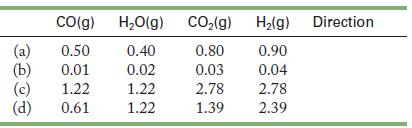
The equilibrium constant for the water-gas shift reaction is 5.0 at 400 °C.Determine the direction of the reaction if the following amounts (in moles) of each compound are placed in a 1.0-L container. CO(g) + HO(g) CO(g) + H(g)
Some sulfur trioxide is sealed in a container and allowed to equilibrate at a particular temperature. The reaction is endothermic.In which direction will the reaction proceed(a) If more sulfur trioxide is added to the system?(b) If oxygen is removed from the system?(c) If the volume of the
Consider the system(a) How will the concentration of ammonia at equilibrium be affected by(1) Removing O2(g)?(2) Adding N2(g)?(3) Adding water?(4) Expanding the container?(5) Increasing the temperature?(b) Which of the above factors will increase the value of K? Which will decrease it? 4NH3(g) +
Write the iCe table for the reaction and initial concentrations given in(a) Exercise 14.29.(b) Exercise 14.30.Exercise 14.29In an experiment, 4.95 mol CO2, 0.050 mol CO, and 0.050 mol O2 are placed in a 5.0-L reaction vessel at 1400 K. Calculate the reaction quotient, Q, for the following
Write the iCe table for the reaction and initial concentrations given in(a) Exercise 14.31.(b) Exercise 14.32.Exercise 14.31A 20.0-L flask contains 1.0 mol PCl5(g) and 2.0 mol each of PCl3(g) and Cl2(g). Kc at 425 °C is 4.0 forCalculate the reaction quotient, Q, and draw a number line with Q and
Consider 1.0 mol each of hydrogen and iodine sealed in a 2.0-L flask at 1200 K.The equilibrium constant, Kc, for this reaction is 4.6.(a) Complete the iCe table, using y to represent the equilibrium concentration of HI.(b) Write the expression for the equilibrium constant, Kc. H(g) + 12(g) 2HI(g)
If 1.0 mol each of SO2 and NO2 are sealed in a 1.0-L flask at 1500 K, they react to form SO3 and NO:The equilibrium constant, Kc, for this reaction is 1.98.(a) Complete the iCe table, using y to represent the equilibrium concentration of SO3.(b) Write the algebraic expression for the equilibrium
Exactly 0.500 mol each of sulfur trioxide and nitrogen monoxide are sealed in a 20.0-L flask.Kc is 0.50 at 1500 K.(a) Complete the iCe table.(b) Write the algebraic expression for the equilibrium constant, Kc.(c) Write the numerical expression for the equilibrium constant, Kc. (8) ON + (8)OS (8)ON
Exactly 2.0 mol each of carbon monoxide and water are sealed in a 4.0-L flask at 1100 K.The equilibrium constant, Kc, is 0.55 for this reaction.(a) Complete the iCe table.(b) Write the expression for the equilibrium constant, Kc.(c) Write the polynomial form of the expression for the equilibrium
When ammonia is placed in a reactor and the temperature is increased to 745 °C, some of the ammonia decomposes to nitrogen and hydrogen. The initial concentration of ammonia was 0.0240 M. After equilibrium is attained, the concentration of ammonia is 0.0040 M. Calculate Kc at 745 °C for 2NH3(g)
Chemists have conducted studies of the high temperature reaction of sulfur dioxide with oxygen in which the reactor initially contained 0.0076 M SO2, 0.00360 M O2, and no SO3. After equilibrium was achieved, the SO2 concentration decreased to 0.00320 M. Calculate Kc at this temperature for 2SO(g)
A scientist seals 1.00 mol sulfur trioxide in a 1.00-L container, and the temperature is increased to 950 °C. Some SO3 decomposes, forming sulfur dioxide and oxygen:At equilibrium, experiments show that 0.50 mol sulfur trioxide is left.(a) Calculate the concentrations of all species.(b) Calculate
Showing 900 - 1000
of 2906
First
3
4
5
6
7
8
9
10
11
12
13
14
15
16
17
Last
Step by Step Answers

 Get 50% OFF
Claim Now
Get 50% OFF
Claim Now